
Your shoulder has been barking since you lifted groceries out of the trunk. Your back tightens halfway through the drive home. Your teenager rolled an ankle at practice and wants to “wait it out,” but you can already tell that isn't a real plan. Around Milton, those problems show up in ordinary places. On the commute toward Boston, walking the neighborhood, chasing kids through the park, or trying to stay active on the Blue Hills trails.
When pain starts changing how you move, sleep, work, or exercise, you often want the same thing. Clear answers. A plan that fits real life. And a clinic close enough that getting help doesn't feel like another burden.
Table of Contents
- Your Partner in Health Right Here in Milton
- Specialized Physical Therapy Services We Offer
- What to Expect on Your Path to Recovery
- Meet Your Expert Milton Physical Therapy Team
- Real Results from Your Milton Neighbors
- Schedule Your Visit and Frequently Asked Questions
Your Partner in Health Right Here in Milton

If you're searching for physical therapy in Milton, MA, you're not short on options. Milton sits inside a dense regional healthcare market, with Healthgrades listing over 2,500 physical therapy specialists nearby. That gives patients a lot of choice, but it also creates a practical problem. A long list of providers doesn't tell you who will listen, identify what's driving the problem, and build a plan that makes sense for your day-to-day life.
That's where local care matters.
A community-focused clinic understands the difference between treating a diagnosis and treating a person. Back pain isn't just “back pain” when it flares up during your train commute or after a long day on your feet. Knee pain isn't just a sore joint when it keeps you from walking the neighborhood, getting through work comfortably, or keeping up with your usual routine. Good PT starts by connecting symptoms to the way you live.
Why local matters more than a big directory
Milton residents move through a busy corridor of work, school, sports, and family responsibilities. The right PT plan has to fit that reality.
- Convenient care: A nearby clinic makes it easier to stay consistent with visits.
- Personalized treatment: Local therapists can tailor goals to your routines, not just to a chart.
- Real accountability: You're more likely to follow through when your care team knows your progress, setbacks, and priorities.
Practical rule: The best physical therapy plan is the one you can actually stick with. Convenience and trust both matter.
What patients usually need first
Individuals don't need a lecture. They need help answering a few straightforward questions:
| What you're wondering | What good PT should provide |
|---|---|
| Why does this keep coming back? | A movement-based assessment that looks for the root cause |
| Should I push through it or back off? | Specific guidance on what to modify and what to keep doing |
| How long will this take? | A realistic plan with milestones, not vague reassurance |
That's the value of a neighborhood clinic. You're not looking for generic care in a crowded metro area. You're looking for a team in Milton that can meet you where you are, explain what's going on in plain English, and help you move with more confidence.
Specialized Physical Therapy Services We Offer
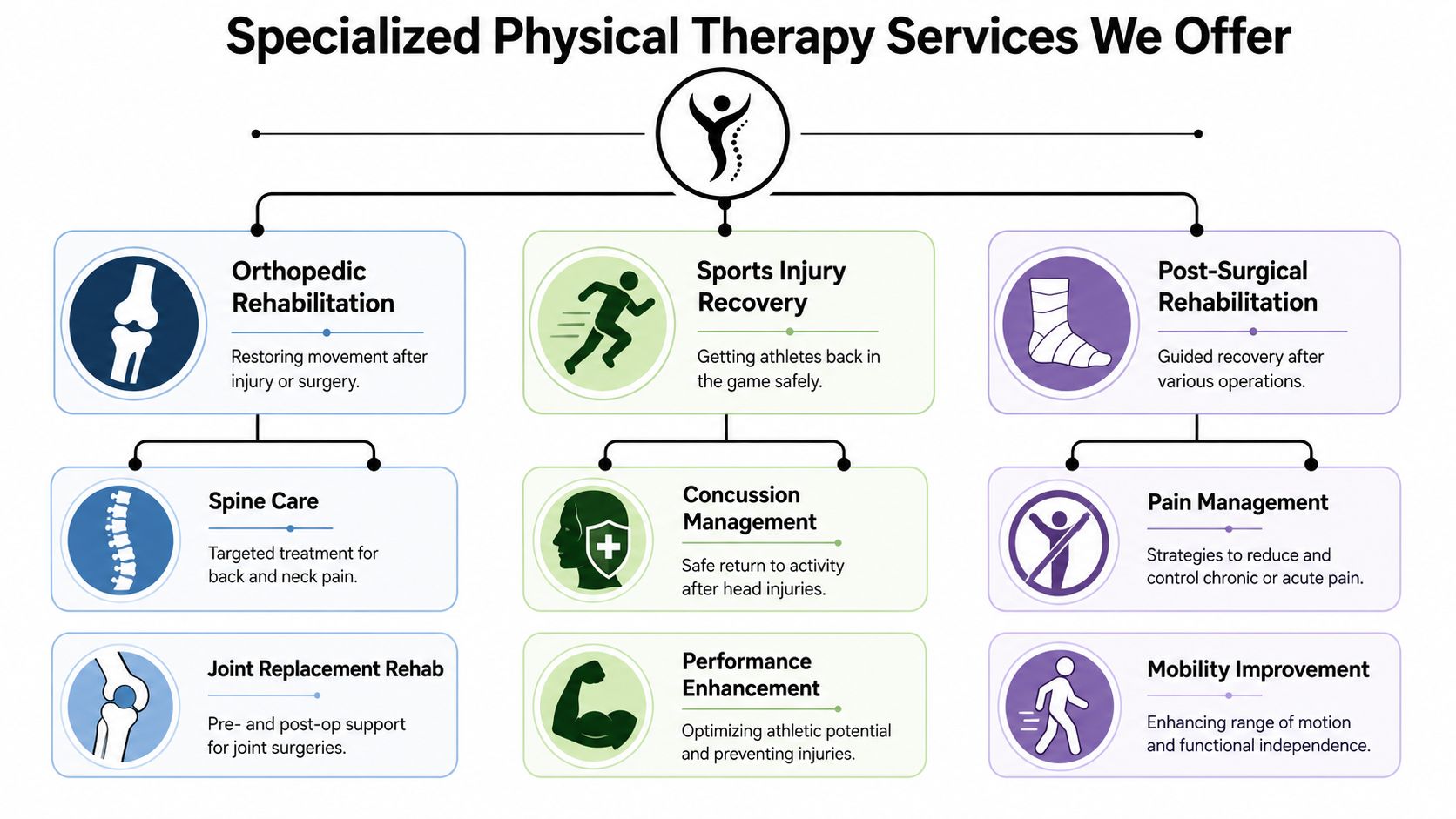
People in Milton come in with different complaints, but the core question is usually the same. What do you need your body to do again? Walk the Blue Hills trails without flare-ups, sit through a full workday, get back on the ice or field, carry groceries without guarding, or feel steady on the stairs at home.
That answer shapes the treatment.
Care for pain, stiffness, and everyday movement problems
Orthopedic physical therapy is often the right fit for back pain, sciatica, neck pain, shoulder irritation, hip stiffness, and knee pain. Treatment starts with the movement problem behind the symptoms, not just the name of the diagnosis. In practice, that may mean improving joint motion, building strength where support is lacking, and changing a few daily habits that keep the area irritated.
I often tell patients that pain relief alone is not enough if the same pattern shows up every time they bend, lift, sit, or train. If you are trying to alleviate lower back pain, a better desk setup can help, but it usually works best alongside targeted exercise, walking tolerance, and a plan for returning to normal activity.
Some cases improve quickly with hands-on care and a focused home program. Others take more patience because the body has been compensating for months. Both can improve, but the timeline and the approach are different.
Post-surgical rehab and return to activity
After surgery, rehab has to match tissue healing, current strength, swelling levels, and your actual day-to-day demands. A knee replacement, rotator cuff repair, ACL reconstruction, and ankle surgery all require different progressions. Pushing too hard can stir things up. Waiting too long to restore motion and strength can slow recovery just as much.
Early progress usually looks practical. Walking with better mechanics. Getting up from a chair with less effort. Reaching a little farther. Sleeping more comfortably. Those wins matter because they build the base for harder work later.
For Milton residents, the goal is not merely finishing a rehab protocol on paper. The goal is getting back to school drop-offs, commuting, yard work, exercise, and the routines that make life feel normal again.
Sports rehab, balance work, and specialty services
Sports rehab should match the athlete in front of you. A high school soccer player returning after an ankle injury needs different testing and loading than an adult runner dealing with recurring knee pain or a tennis player with shoulder irritation. Good rehab looks at force, control, endurance, and confidence before return to play, not just whether pain has settled down.
We also treat plenty of people who would never call themselves athletes.
- Balance and gait training: Helpful for adults who feel unsteady, shorten their steps, avoid uneven ground, or have had close calls at home or in the community.
- Vestibular rehab: Used for dizziness, vertigo, motion sensitivity, and balance problems that make shopping, turning, walking, or getting out of bed uncomfortable.
- Pelvic health: Useful during pregnancy, after delivery, and for pelvic pain or bladder symptoms that interfere with exercise and daily life.
- Pediatric physical therapy: Support for children and teens who need help with coordination, strength, movement skills, or injury recovery.
Balance work deserves its own attention. Peak Physical Therapy and Sports Performance notes that fall prevention and confidence with walking are common concerns for older adults in Milton. Good treatment goes beyond telling someone to be careful. It trains stepping reactions, lower-body strength, head and eye movement tolerance, and the ability to move through daily life with more control.
What to Expect on Your Path to Recovery
The first visit is usually a relief. Most patients walk in worried they'll be rushed, handed a generic sheet of exercises, or told to stop doing everything they enjoy. A good evaluation feels different from that almost immediately.
Your first appointment
It starts with your story. When did the problem begin? What makes it worse? What have you already tried? Just as important, what are you trying to get back to? Sleeping comfortably, lifting your child, climbing stairs normally, finishing a workday without pain, or returning to training all lead to different treatment decisions.
Then comes the movement exam. Your therapist looks at how you move, where you compensate, what motions are limited, and which positions reproduce symptoms. Sometimes the painful area is the source. Sometimes it's where the body is finally protesting after compensating somewhere else.
A useful evaluation should leave you understanding your problem better than when you walked in.
Building a plan that actually fits real life
Once the exam is done, the next step is a plan you can follow. That plan usually blends a few pieces together:
- Hands-on treatment when it helps reduce pain, improve motion, or calm irritation.
- Targeted exercise to rebuild strength, control, endurance, and confidence.
- Activity guidance so you know what to keep doing, what to modify, and what to stop for now.
- Home program support that gives you enough to make progress without turning recovery into a second job.
What doesn't work well is relying on one thing alone. Passive treatment without exercise rarely holds up. Random online exercises without an exam often miss the actual issue. Resting forever can make people weaker and more hesitant to move.
How progress usually feels
Recovery is rarely perfectly linear. One week may feel smooth, and the next may feel a little stiff or sore because your body is being asked to do more. That doesn't automatically mean something is wrong. It usually means your therapist needs to adjust the dose, timing, or exercise selection.
The process should still feel organized. You should know what you're working toward and why each phase matters. That's what helps patients stay engaged from the first appointment through the final visit.
Meet Your Expert Milton Physical Therapy Team
A good PT team becomes clear in the first visit. You should leave knowing who is guiding your care, what they noticed, and how their plan fits your actual week in Milton, whether that means commuting, coaching youth sports, getting through a school day, or staying active on the weekends.
Training matters, but patient experience matters just as much. The American Physical Therapy Association reports that the United States had approximately 72 physical therapists per 100,000 people in 2021, up from 65 per 100,000 in 2017, a 13.63% increase over four years while population growth was 2.17% in the same period, and 225,350 physical therapists were counted by the U.S. Bureau of Labor Statistics in 2021 (APTA demographics report). In practice, that means patients now have more access to clinicians with focused experience in orthopedics, sports rehab, balance work, and return-to-activity planning.
What separates a strong local team is judgment. A therapist can have solid credentials and still miss the mark if treatment feels generic, rushed, or disconnected from your goals. The better fit is a clinician who listens closely, explains the problem in plain language, and adjusts the plan when your body does not respond on schedule.
Here is what I would want any Milton resident to look for in a therapist:
- Clear explanations: You understand what is being treated and why each part of the plan matters.
- Good clinical pacing: The therapist knows when to challenge strength and mobility, and when to reduce load so irritated tissue can settle down.
- Functional relevance: Sessions connect to real tasks like stairs, lifting, running, yard work, childcare, or getting through a workday without a flare.
- Follow-through outside the clinic: Home exercises are realistic enough to complete between visits.
If you are still comparing options, this guide on how to choose a physical therapist can help you ask better questions before you book.
Some readers also want to understand the profession itself, especially if a student or career changer in the family is exploring healthcare work. You can discover PT jobs with WeekdayDoc for a general view of physical therapist opportunities in Massachusetts.
For patients, the practical question is simpler. You want a local team that pays attention, uses one-on-one care well, and builds a plan around your life instead of handing you a standard sheet of exercises. Peak Physical Therapy and Sports Performance is one Milton option for that kind of care.
Real Results from Your Milton Neighbors
Individuals often decide to start PT only after they've already spent weeks or months trying to manage around the problem. They've changed how they sleep, stopped certain workouts, avoided long walks, or started bracing before simple tasks. What changes the decision is usually not hearing a technical explanation. It's realizing that other local patients have been in the same spot and gotten back to normal life.
The outcomes people care about most
A parent wants to get through pickup, dinner, and bedtime without back pain flaring.
A runner wants to stop testing the knee every few steps.
An older adult wants to feel steady turning, walking, and getting up at night.
Those are the moments that make physical therapy feel worthwhile. Not because recovery is dramatic, but because ordinary life gets easier again.
“Good rehab should feel practical. You should notice the difference in the places your pain used to interrupt your day.”
What successful rehab often has in common
Patients who do well usually aren't the ones chasing quick fixes. They're the ones who commit to a plan, communicate when something feels off, and keep showing up even when progress is gradual.
Common patterns include:
- They get a specific diagnosis of the movement problem, not just the pain location.
- They follow a home program that's manageable.
- They judge progress by function, not just by soreness on one particular day.
If you'd like to read direct patient feedback, Peak shares experiences from people across the practice on its patient testimonials page.
That kind of social proof matters because starting PT can feel vulnerable. It helps to know that neighbors have come in frustrated, uncertain, or discouraged, and left moving better, feeling stronger, and trusting their bodies again.
Schedule Your Visit and Frequently Asked Questions

If pain is changing how you move, now is a good time to act. The hardest part is often booking the first visit. After that, most patients feel better from having a plan.
You can schedule an appointment online with the Milton clinic and choose a time that fits your week.
Questions people ask before the first visit
Do I need a doctor's referral?
That depends on your insurance plan and your situation. The fastest way to avoid surprises is to contact the clinic before your first appointment and ask what's required for your specific coverage.
What should I wear?
Wear comfortable clothes you can move in. If your knee, hip, or ankle is the issue, shorts are often helpful. If your shoulder or neck is the problem, a loose top makes the exam easier.
How long will my appointment take?
Your first visit is usually longer than a routine follow-up because it includes discussion, movement testing, and plan development. Follow-up visits focus more on treatment progression.
How to make the first visit more useful
Bring a short list of the activities that bother you most. That gives your therapist better starting targets than a broad statement like “everything hurts.”
A few examples:
- Work tasks: Sitting, commuting, lifting, standing, or stairs
- Home routines: Carrying laundry, sleeping, yard work, childcare
- Exercise goals: Running, strength training, walking, cycling, tennis, or returning to a school sport
The more specific your goal, the easier it is to build a treatment plan around it.
What about insurance and payment questions?
Ask before the visit. Verifying benefits in advance is one of the simplest ways to reduce stress and avoid delays.
Will I get exercises to do at home?
Usually yes, but they should be targeted and manageable. A strong home plan supports the clinic work. It shouldn't bury you in busywork.
What if I'm nervous because this has been going on for a while?
That's common. Many people arrive worried that they've waited too long or that movement will make things worse. A careful exam helps sort out what's safe, what needs to change, and what can improve with the right progression.
If you live in Milton and want practical, local help, taking the first step is straightforward. Book the evaluation, bring your questions, and start with a plan built around your actual routine.
If you're ready to move with less pain and more confidence, book a visit with Peak Physical Therapy and Sports Performance. The Milton team can help you take the next step, whether you're dealing with a new injury, a lingering problem, or recovery after surgery.