


Preventing a fall isn’t about just one thing. It's a combination of improving your balance and strength, making your home safer, and getting expert guidance on your specific risks. We understand that the fear of falling can be overwhelming, but this guide is here to show you that taking proactive steps can help you build physical resilience and live your life with confidence.
Understanding the High Stakes of Fall Prevention
For many older adults across Massachusetts, the thought of a fall brings up deep-seated fears—losing cherished independence, having to miss family gatherings, or facing a serious injury that could change life forever. It’s the worry of not being able to walk the dog at a local spot like Borderland State Park or feeling unsteady while grabbing groceries.
This guide is centered on a simple but powerful truth: falls are not an inevitable part of aging. While the risk certainly increases as we get older, knowing that falls are preventable is the first step toward taking back control. This isn't about living in fear; it's about taking proactive, informed steps to stay steady on your feet and active in your community.
The Real Impact of Falls
The statistics around falls are more than just data; they paint a picture of a major public health challenge. Consider this: in 2021 alone, falls led to a staggering 38,000 deaths among Americans aged 65 and older. On top of that, emergency departments managed 3 million visits for fall-related injuries in the same group. These aren't just numbers—they're a wake-up call. You can read more about the national impact of falls on NCOA.org to see the full scope of the issue.
The good news is that targeted prevention can turn this trend around. Physical therapy is a cornerstone of this proactive approach, offering evidence-based strategies to improve your stability and reduce your risk.
We understand how a fear of falling can hold you back from doing what you love. Our licensed physical therapists are here to give you the confidence and strength to navigate your life safely, from your home to your Massachusetts community.
Your Path to Stability and Confidence
A complete fall prevention plan means looking at a few key areas of your life and making small, meaningful adjustments. Here’s what a comprehensive strategy includes:
- Building Your Physical Foundation: Targeted exercises to improve balance, strength, and flexibility are crucial. Strong legs make it easier to stand up from a chair, while good balance helps you recover if you trip unexpectedly.
- Creating a Safe Home: Simple modifications in your living space can dramatically reduce hazards. This could mean removing throw rugs, improving lighting, and installing grab bars where you need them most.
- Seeking an Expert Assessment: A licensed physical therapist can perform a comprehensive evaluation to pinpoint your unique risk factors, whether it's an unsteady gait, muscle weakness, or issues with dizziness.
This guide will walk you through actionable strategies for each of these areas. We’ll cover targeted exercises, provide a home safety checklist, and explain how professional guidance from our team at Peak Therapy can help you feel steady on your feet again. Our clinics across Massachusetts—from Braintree and Quincy to Weymouth and beyond—are here to help you build the strength and confidence needed to live fully and safely.
How to Assess Your Personal Fall Risk
The first step in preventing a fall is getting real about your personal risk. This goes way beyond just feeling a bit "unsteady" now and then. It’s about taking an honest look at how your health, your home, and even your daily routines might be setting the stage for a fall.
Most people immediately think of physical issues like weak legs or poor balance, and they're definitely part of the picture. But true fall risk is almost always a mix of things happening inside your body and hazards in the world around you.
What’s Increasing Your Risk?
We can break down risk factors into two main camps: things related to your health (internal) and things in your environment (external).
To make it easier to see where you stand, use this simple checklist. It can help you pinpoint specific areas that might be affecting your stability.
Your Personal Fall Risk Self-Checklist
Use this self-assessment tool to identify potential fall risk factors across different categories and understand their impact on your stability.
| Risk Category | Check If This Applies to You | How It Can Affect Your Stability |
|---|---|---|
| Previous Falls | Have you fallen in the past year? | A previous fall is the single biggest predictor of a future fall. |
| Fear of Falling | Do you worry about falling or limit your activities because of this fear? | This fear can lead to inactivity, making your muscles weaker and balance worse, which ironically increases your fall risk. |
| Balance Issues | Do you ever feel dizzy, unsteady, or like the room is spinning? | Dizziness or vertigo can throw you off balance suddenly. You can read more on how winter affects dizziness and vertigo in our guide. |
| Muscle Weakness | Do you struggle to get up from a chair or climb stairs? | Weak leg and core muscles make it hard to catch yourself if you stumble or to maintain your balance during everyday movements. |
| Chronic Conditions | Do you have arthritis, diabetes, heart disease, or a neurological condition? | These conditions can cause pain, numbness in your feet, weakness, or fatigue, all of which compromise your stability. |
| Multiple Medications | Do you take four or more prescription or over-the-counter medications daily? | Polypharmacy can cause side effects like dizziness, drowsiness, or drops in blood pressure that directly lead to falls. |
| Vision Problems | Has it been over a year since your last eye exam? | Poor vision makes it easy to miss a trip hazard like a small step, a cord, or a change in flooring. |
| Home Hazards | Do you have loose rugs, poor lighting, clutter, or no grab bars in the bathroom? | These are classic trip-and-fall scenarios waiting to happen. Most falls in older adults happen right at home. |
This checklist isn't meant to be a formal diagnosis, but if you checked off even one or two boxes, it’s a clear sign that it’s time to take action.
This flowchart can also help guide your next steps.
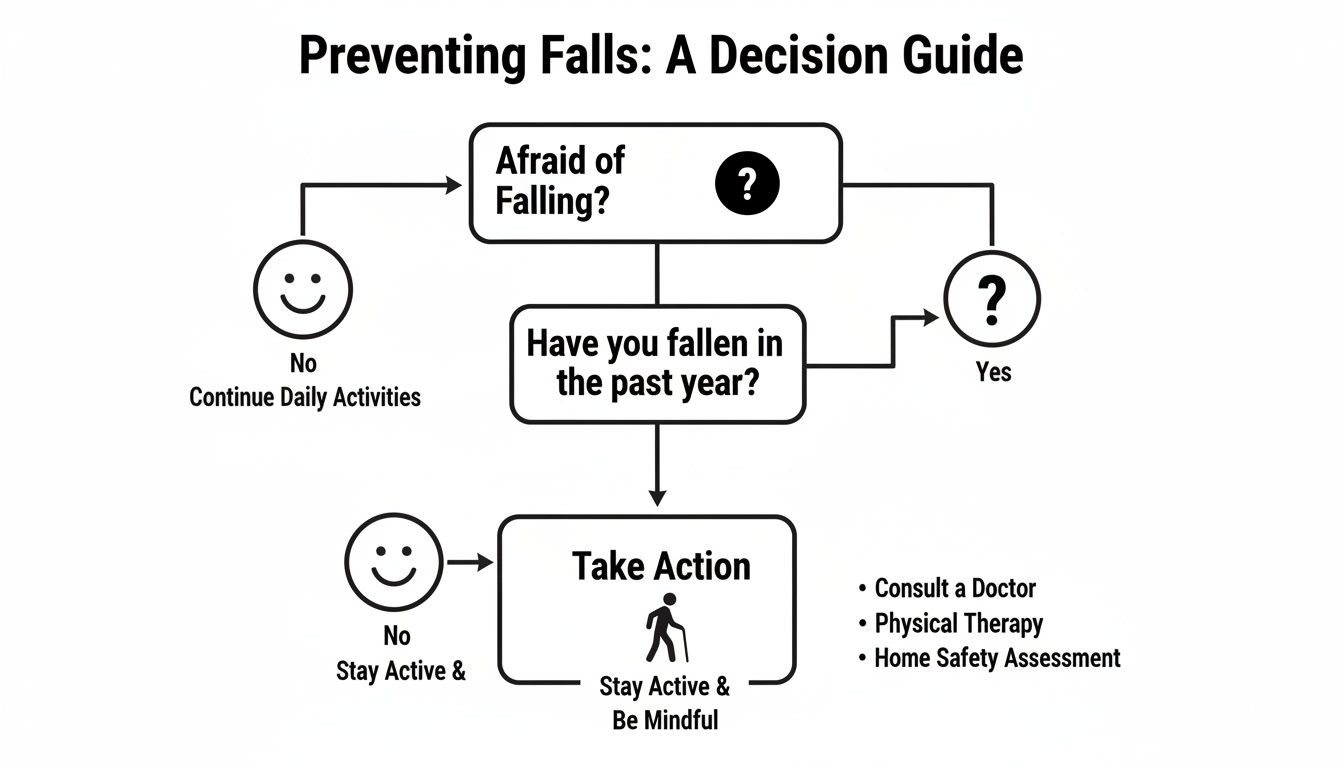
As you can see, whether you've already had a fall or are just afraid of having one, the recommendation is the same: it's time to actively work on reducing your risk.
A fear of falling often becomes a self-fulfilling prophecy. When you’re scared of falling, you naturally become less active. This leads to muscle weakness and a loss of balance, which in turn makes you more likely to fall.
It's a vicious cycle we see all the time in our Massachusetts clinics, but it's one that physical therapy is perfectly designed to break. The statistics show just how critical this is. Globally, falls among older adults surged to 45.7 million new incidents in 2021 alone—a staggering 182% increase since 1990—and resulted in 555,000 deaths. These aren't just numbers; they represent real people and families, underscoring why prevention is absolutely essential.
What a Physical Therapist Looks For
When you come to a Peak Therapy clinic for a balance assessment, our licensed physical therapists perform a comprehensive evaluation to determine the root cause of your instability. We don’t just watch you walk across the room.
Our therapists use a series of standardized, evidence-based tests to get objective measurements of your balance, strength, and gait. We’ll also have an in-depth conversation with you about your medical history, any falls you've had, what medications you’re taking, and what your home environment is like.
This complete picture allows us to build a truly personalized treatment plan to keep you safe, active, and confident on your feet.
Building Foundational Strength and Balance at Home
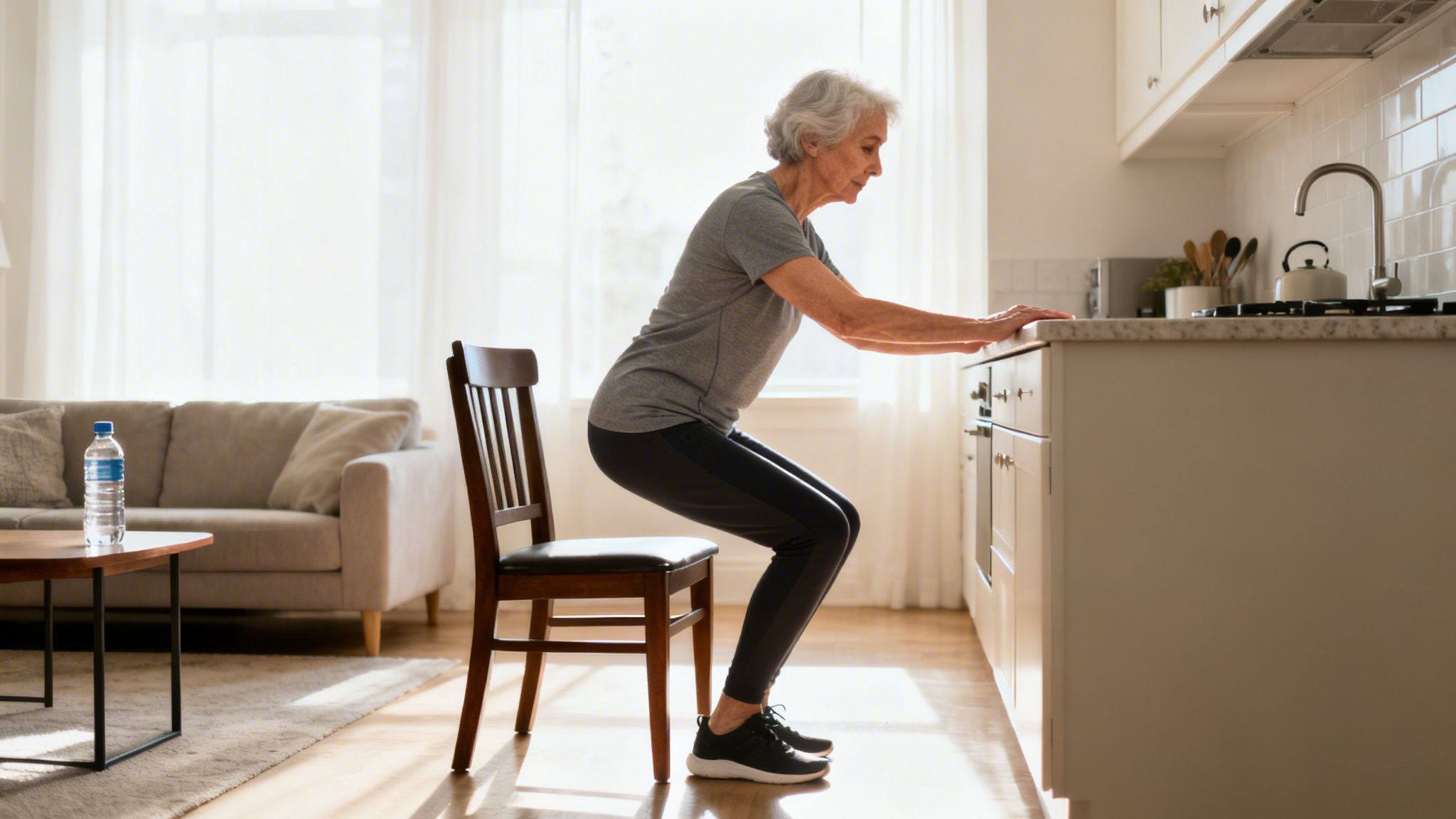
One of the most powerful things you can do to prevent falls is to consistently work on your strength and balance right from the comfort of your home. This isn't about heavy lifting. It's about building functional strength—the kind of strength you rely on every day to get out of a chair, carry groceries, or simply step off a curb with confidence.
With every practice session, you're doing more than just building muscle. You're also sharpening the communication between your brain, nerves, and muscles, which is what governs your balance. Think of it as fine-tuning your body’s internal reflexes. The more you practice, the quicker and more automatic your reactions become when you unexpectedly lose your footing.
Let’s walk through a few simple but effective exercises to help you feel more stable and in control.
Getting Started Safely
Before jumping into any new routine, safety is paramount. Always position yourself next to a sturdy, stable surface you can hold onto for support. A kitchen counter, the back of a heavy sofa, or a securely installed railing are all great choices.
It’s crucial to have a clear, clutter-free space around you. Never try to perform balance exercises in an open room where a fall could lead to injury.
Safety First Tip: Always hold onto a fixed, sturdy object like a kitchen counter. Avoid using anything that could move or tip, such as a lightweight chair or a walker.
Essential Exercises for Stability and Strength
Here are a few foundational exercises that specifically target the muscles and systems responsible for keeping you steady on your feet. Think of these as your starting point for building a more stable base.
Sit-to-Stand
This might be the single most important exercise for maintaining your independence. It strengthens the major muscles in your legs and glutes, which power you up from a chair, the toilet, or out of a car.
- Start by sitting on the edge of a sturdy, armless chair with your feet flat on the floor and about hip-width apart.
- Lean your chest forward slightly, tighten your core, and push through your heels to stand up completely. Try your best not to use your hands.
- Slowly and with full control, reverse the motion to sit back down. Aim to complete 8-12 repetitions.
Beginner Tip: If you need a little help at first, that’s perfectly fine! Use the chair's arms for a slight push-off, and over time, work on relying on them less and less.
Chair Leg Raises (Knee Extensions)
This simple movement zeros in on your quadriceps, the big muscles on the front of your thighs. Strong quads are absolutely essential for walking, climbing stairs, and preventing your knee from giving way.
- Sit up tall in a sturdy chair with your back well-supported.
- Slowly extend one leg straight out until your knee is straight but not locked. Squeeze that thigh muscle and hold for 2-3 seconds.
- Gently lower your foot back down. Try for 10-15 repetitions on one side before switching to the other leg.
Single Leg Stance
Here’s a true balance-builder. This exercise directly retrains your brain-to-body connection and improves proprioception—your body's built-in sense of where it is in space. This is critical for making those split-second adjustments that stop a fall before it happens.
- Stand behind a solid support like a kitchen counter, holding on with both hands.
- Shift your weight onto one leg and slowly lift your other foot just an inch or two off the floor.
- Hold this steady position for 10-20 seconds, then lower your foot and switch legs.
Ready for a challenge? As you feel more stable, try holding on with just one hand, then only your fingertips. Eventually, you can try letting go for a few seconds at a time, keeping your hands hovering just above the support for safety.
Heel-to-Toe Walk
This exercise challenges your balance while you’re in motion, which is what we call dynamic balance. It’s great practice for navigating uneven ground or narrow spaces.
- Stand alongside a wall or a long countertop, keeping a light hand on it for support.
- Take a step forward by placing the heel of your front foot directly against the toes of your back foot, like you’re walking on a tightrope.
- Look straight ahead, not down at your feet, and take 10-15 slow, deliberate steps.
These exercises are a fantastic way to begin building your confidence and stability. While a home program is an excellent start, it’s not a replacement for a professional assessment. A licensed physical therapist can identify your specific areas of weakness and design a personalized program tailored exactly to your needs, which is the safest and most effective way to reduce fall risk.
Creating a Fall-Proof Home Environment
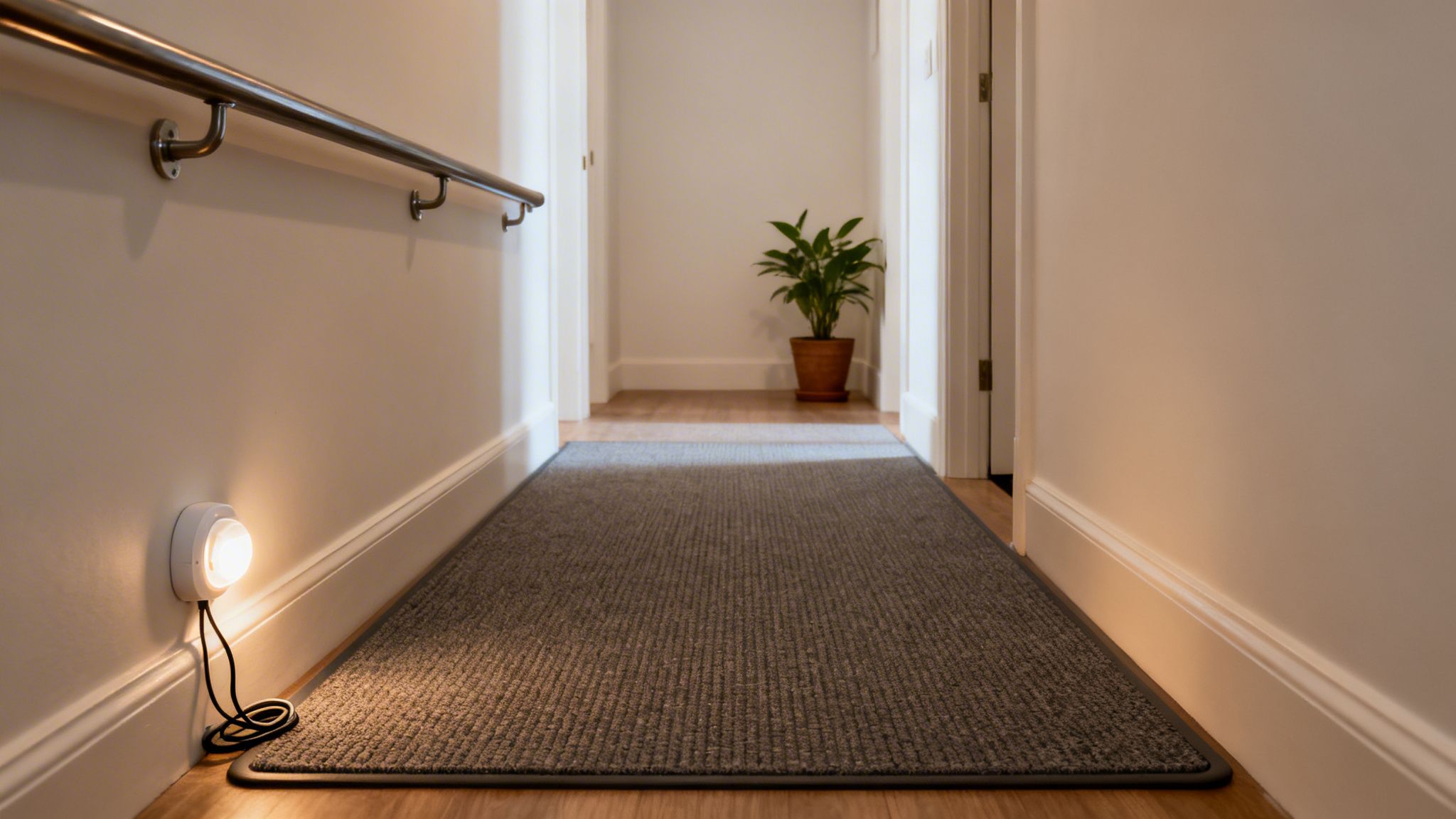
While building up your balance and strength is a huge piece of the puzzle, the other half is making sure your home is set up for safety. Your home should be your sanctuary, but for many, it’s filled with hidden fall risks. The truth is, it’s often the small, everyday things in our living spaces that pose the biggest threats.
The majority of falls among older adults actually happen right inside the house. The good news? You can dramatically reduce these risks with a few simple, thoughtful adjustments. This isn't about expensive renovations; it’s about taking a clear-eyed look at your home, room by room, and making it a safer place to be.
Start with High-Traffic Areas
Let's begin with the spaces you use the most—hallways, stairs, and the living room. Keeping these main pathways clear and well-lit should be your top priority.
Secure All Rugs: We all have that one favorite throw rug, but it’s a classic tripping hazard. If you want to keep it, use double-sided rug tape or a quality non-slip backing to anchor it firmly to the floor. Any small, loose mats should probably go.
Eliminate Clutter: Your walking paths need to be wide and completely clear. Take a moment to move those stacks of mail, decorative baskets, or stray pieces of furniture out of the way. Imagine your path from the bed to the bathroom at night—is it a straight shot, or an obstacle course?
Tame Electrical Cords: Cords should never be stretched across a walkway. Reroute them along the baseboards or use purpose-built cord covers to tack them down and keep them out of your path.
Improve Lighting Everywhere
Poor lighting can easily hide a trip hazard, especially at night or on an overcast day. As our vision changes, it becomes harder to adjust to dim conditions, so brightening your home is one of the most powerful things you can do to prevent falls.
Plug-in, motion-activated nightlights are a fantastic and inexpensive fix for hallways, bedrooms, and bathrooms. They give you instant, hands-free light the moment you get up, so you're never left fumbling for a switch in the dark.
Here's a simple rule of thumb: If you have to squint to see clearly, it’s not bright enough. Make sure every room has an easy-to-reach light switch at the entrance, and think about swapping out dim, low-wattage bulbs for brighter, more efficient LEDs.
Focus on Kitchen and Bathroom Safety
The kitchen and bathroom come with their own unique risks, mainly because of wet surfaces and the need to constantly reach, bend, and stoop.
Bathroom Modifications
The bathroom is a notorious hotspot for falls. Installing a few pieces of adaptive equipment isn’t a sign of weakness—it's a smart move that helps you stay safe and independent.
- Install Grab Bars: These are non-negotiable. Place them both inside and outside the shower and right next to the toilet to give you a sturdy handhold when you need it most.
- Use Non-Slip Mats: A good non-slip mat or adhesive strips inside the tub or shower stall provides crucial traction on wet, slippery surfaces.
- Add a Shower Chair: A simple shower chair allows you to sit while you bathe, which reduces fatigue and significantly lowers the risk of losing your balance.
- Consider a Raised Toilet Seat: This simple device makes sitting down and, more importantly, standing back up from the toilet much safer and easier.
Kitchen Organization
In the kitchen, the main goal is to keep things you use every day within easy reach. This prevents you from over-stretching or balancing precariously on an unstable step stool.
Try moving your everyday plates, glasses, and your favorite coffee mug to a lower, more accessible shelf. Keep heavier pots and pans on the countertop or in low cabinets. The less you have to reach high or bend low, the safer you'll be.
Secure Your Stairs
Stairs demand special attention because a fall here can be especially dangerous. First, make sure you have sturdy handrails on both sides of the staircase for maximum support.
For areas like balconies and stairs, understanding proper balustrade height regulations is crucial, as these guidelines are specifically designed for preventing falls and keeping people safe. Finally, check that each step has good traction and is clearly visible. If not, adding non-slip tread strips or even a strip of contrasting paint on the edge of each step can make a world of difference.
When to Seek Professional Physical Therapy
Home exercises and safety checklists are a great start, but sometimes they just don't get to the heart of the problem. If you’ve already had a fall, find yourself avoiding activities you once enjoyed because you’re scared of falling, or just feel a growing sense of unsteadiness on your feet, those are clear signs it’s time to bring in an expert.
A physical therapist moves beyond generic exercises to create a targeted, evidence-based program that addresses the specific reasons for your instability. We’re here to help you rebuild your confidence, get to the root cause of your balance issues, and secure your independence for the long haul.
What to Expect from a Fall Prevention Program
We know that taking the first step can feel intimidating, especially when you’re already dealing with the frustration and fear that comes with feeling unsteady. Our first goal is always to listen. At our clinics in Hanover, Cohasset, and across Massachusetts, your journey starts with a compassionate, one-on-one evaluation to understand your unique situation.
Here’s what your first visit will look like:
- We’ll have a real conversation. We want to hear about your health history, any falls you've experienced, your medications, and your personal goals. Are you hoping to confidently walk your dog in Duxbury, or do you just want to feel safer getting out of bed in the morning?
- We’ll run a comprehensive assessment. Your licensed physical therapist will perform a comprehensive evaluation using a series of evidence-based tests to get an objective look at your balance, how you walk (your gait), your strength, and your overall mobility.
- We’ll find the root cause. We don’t just treat symptoms. We dig deep to figure out why you’re feeling unstable. Is it muscle weakness? An inner ear issue? A problem with your gait?
This thorough evaluation allows us to create a personalized treatment plan that meets you exactly where you are—one that’s both achievable and challenging enough to make a real, lasting difference.
A licensed physical therapist is a certified falls risk expert. Our role is to identify the early warning signs—like muscle weakness or subtle gait changes—and intervene with a specific plan before a life-altering fall can happen.
Your Personalized Treatment Plan
Once we have a clear picture of your needs, we’ll build your personalized treatment plan. Because no two people are the same, no two fall prevention plans are exactly alike.
Depending on what we find, your physical therapist might incorporate:
- Advanced Balance Training: This is much more than just standing on one leg. We use specialized equipment and dynamic exercises to challenge your body’s stability systems in a safe, controlled setting.
- Gait Analysis and Training: We’ll carefully analyze your walking pattern to spot any abnormalities that might put you at risk for a trip or fall. From there, we’ll provide specific cues and exercises to help you walk more safely and efficiently.
- Vestibular Rehabilitation: If dizziness or vertigo is a key factor, we use targeted head and eye movements to help retrain your brain and inner ear, which can dramatically reduce that spinning sensation.
- Aquatic Therapy: For anyone dealing with painful joints from conditions like arthritis, our warm water pools offer the perfect environment. You can build strength and improve mobility without putting stress on your body.
The need for this kind of specialized care is growing. Over a 30-year period, global fall-related deaths climbed by 29%, and North America saw a particularly sharp 53% spike in its age-standardized rates. You can explore the full analysis of these trends from Oxford Academic to understand the urgency behind prevention.
This is exactly why our physical therapy programs at locations from Scituate to Duxbury focus on directly addressing fall triggers like chronic pain, vertigo, and arthritis. Seeking physical therapy for fall prevention is one of the most proactive investments you can make in your future—it’s a choice to stay strong, active, and in control of your life.
Frequently Asked Questions About Fall Prevention
As you start focusing on fall prevention, it's only natural to have some questions. We hear many of the same concerns from our patients across our Massachusetts clinics, so we’ve put together some practical answers to help you feel more confident.
What Should I Do Immediately After I Fall?
A fall, even a minor one, can be scary. The most important first step is to stay as calm as possible and take a moment before you even think about getting up.
Take a quick mental inventory. Check yourself for any obvious pain, bleeding, or anything that feels out of place. If you feel any sharp pain or think you might be seriously hurt, do not try to get up. If you have a personal emergency response system, use it. Otherwise, call 911 or shout for help.
If you feel you can get up safely, do it slowly and carefully. Roll over onto your hands and knees and crawl toward a sturdy piece of furniture, like a heavy chair or couch. Place both hands firmly on the seat, bring one foot forward, and plant it on the floor. From that kneeling lunge, use your arms and legs to push yourself up to a standing position.
No matter what, always tell your doctor or physical therapist you had a fall, even if you weren't injured. A single fall is the number one predictor of having another one—it’s a clear signal that it’s time to have an expert take a closer look.
Do I Really Need a Cane or Walker?
Many people push back against the idea of using a cane or walker. They worry it’s a sign of weakness or giving up their independence. We see it differently. In our experience, using an assistive device correctly can be the very thing that preserves your independence by keeping you safe and active.
Think of it as a tool, not a crutch. A cane or walker gives you a wider, more stable base of support, which takes a lot of pressure off weak or painful joints. It provides the confidence you need to navigate uneven ground, whether it’s a cobblestone street in Boston or a gravel path at a local park.
A cane or walker isn't a sign of defeat; it's a tool that helps you keep participating in your life fully and safely. A physical therapist can make sure you have the right device, fit it to you properly, and teach you how to use it for the greatest benefit.
What Kind of Shoes Are Best for Fall Prevention?
Your choice of footwear is a simple but incredibly important part of your safety plan. Your shoes should give you a stable foundation, not create another risk.
Look for a shoe with these key features:
- A sturdy, non-slip sole: Good traction is a must, especially on slick surfaces like wet pavement or smooth tile.
- A low, wide heel: High heels and even narrow wedge styles can throw off your center of gravity and compromise your stability.
- A secure, closed-back design: Avoid wearing slippers, flip-flops, or any shoe your foot can slide out of.
- A proper fit: Shoes that are too loose let your foot slide around, while shoes that are too tight can cause pain and affect your gait.
Walking barefoot or just in socks around the house is a major risk factor for falls. Hardwood and tile floors offer zero traction. We always recommend investing in a good pair of supportive, non-slip house shoes or slippers to wear indoors.
Are you ready to take control of your balance and build the confidence to live life without fear of falling? The expert team at Peak Therapy is here to create a personalized fall prevention plan just for you. Our licensed physical therapists will perform a comprehensive evaluation to uncover the root cause of your instability and guide you through a program to build strength, improve balance, and help you feel steady on your feet again. Schedule your evaluation today at one of our convenient Massachusetts locations by visiting peaktherapy.com.