
A lot of people start searching for physical therapy in Cohasset, MA at the same moment they realize the problem isn't going away on its own. It might be the shoulder that flared up after a weekend on the water, the knee that's making youth sports sidelines and bleachers feel longer than they used to, or the back pain that turns a simple walk near Wheelwright Park into something you plan around.
That moment matters because patients don't want a lecture. They want a nearby clinic, a clear plan, and some confidence that the person treating them understands how they live on the South Shore. If you're trying to get back to sailing, running, lifting, gardening, commuting, or keeping up with your family without thinking about pain all day, the right local fit makes a difference.
Table of Contents
- Your Local Partner in Health and Recovery in Cohasset
- Why Cohasset Chooses Peak for Physical Therapy
- Services and Conditions We Treat in Cohasset
- Your Patient Journey with Our Cohasset Team
- Finding Our Cohasset Clinic Directions and Parking
- Insurance Verification and Booking Your Appointment
- Frequently Asked Questions About PT in Cohasset
Your Local Partner in Health and Recovery in Cohasset
Living in Cohasset often means staying active in ways that don't always feel like “exercise.” You carry gear to the beach. You twist awkwardly unloading the car. You spend long stretches on your feet at work, then head to a practice, game, or walk along the South Shore because life doesn't slow down just because your back or knee started complaining.
The tricky part is that pain usually doesn't arrive in a dramatic way. More often, it builds. A little stiffness getting out of bed becomes a hesitation on the stairs. A sore shoulder becomes trouble reaching overhead. Dizziness that seemed minor starts making quick turns or crowded errands feel less comfortable than they should.
That's when local physical therapy becomes useful, not as a last resort, but as a practical next step.
Care that fits real South Shore routines
Patients in Cohasset usually aren't looking for generic advice. They want to know whether treatment can help them get back to boating, tennis, strength training, work, weekend yard projects, or moving around town with less pain and more confidence. Good therapy starts there, with your actual routine, not a template.
A strong plan also respects the fact that rehab has to fit into a normal week. If exercises are too complicated, too time-consuming, or don't match the problem, people stop doing them. If a treatment plan ignores the activity you want to return to, progress stalls.
Practical rule: The best rehab plan is one you can actually follow between visits and trust when you return to daily life.
What patients usually need first
Individuals don't need a complicated explanation on day one. They need a few basics:
- A clear starting point so they understand what's driving the pain or limitation.
- A realistic plan that fits work, family, and commute demands.
- Treatment that changes function so walking, lifting, turning, sleeping, or exercising feels easier.
- A path back to activity that doesn't push too hard or hold back too long.
That's what people are usually looking for when they search for Physical Therapy Cohasset MA. They want help close to home, and they want it to feel personal.
Why Cohasset Chooses Peak for Physical Therapy
Cohasset gives patients options. Healthgrades lists 266 specialists practicing Physical Therapy in Cohasset, with an overall average rating of 4.6 stars. That tells you two things right away. First, this is an active and competitive market. Second, people here expect a high standard of care and pay attention to the treatment experience, not just the appointment slot.
What matters in a crowded local market
When patients have many clinics to choose from, the difference usually isn't a long service list. It's whether the care feels focused, organized, and specific to the person in front of the therapist.
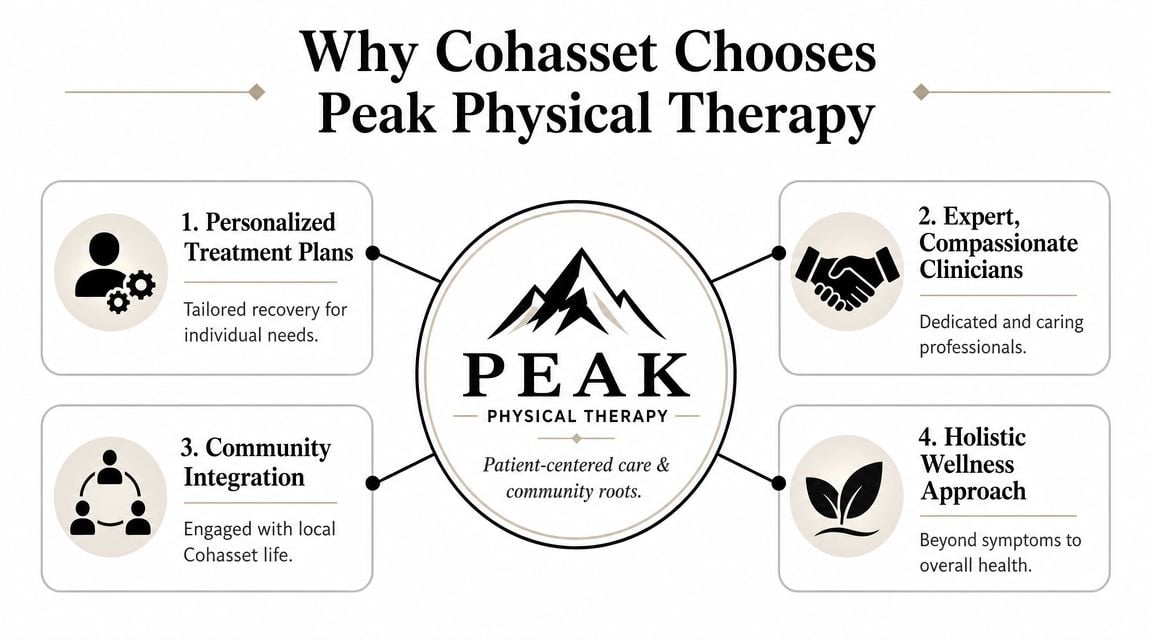
That's where a patient-centered approach matters. It shows up in simple ways:
- Listening first instead of jumping straight into a routine.
- Adjusting the plan when pain, schedule, or goals change.
- Explaining trade-offs clearly so you know when to rest, when to move, and when to push.
- Keeping treatment goal-based rather than visit-based.
For someone in Cohasset, that might mean helping a runner build back mileage without provoking the same issue every week. It might mean getting a parent through the school drop-off, workday, and evening activities with less pain before worrying about higher-level fitness goals. It might mean balancing return-to-sport goals with the reality of a packed family calendar.
What a better patient experience looks like
Patients usually notice quality care in the details. They feel it when the therapist remembers what aggravated the pain last week. They hear it when the home program is explained in plain English. They trust it when progress is measured by meaningful changes, such as sleeping better, walking farther, getting through a shift more comfortably, or returning to a favorite activity.
At the local clinic level, values matter only if they change what the patient experiences. Attentive care means patients don't feel rushed. Grow forward means the plan should evolve as function improves. Lead the way means clear guidance when symptoms are frustrating or inconsistent. Create joy means rehab doesn't have to feel cold or clinical every single visit.
If you're weighing options, a useful starting point is this guide on how to choose a physical therapist. The right choice usually comes down to communication, convenience, and whether the clinic treats your goals as seriously as your symptoms.
The clinic experience matters most when recovery takes time. You're not choosing one appointment. You're choosing a partner for the full course of rehab.
Services and Conditions We Treat in Cohasset
People searching for physical therapy in Cohasset, MA often want to know one thing first. Do you treat my issue, or not? In practical terms, most patients come in because something is limiting daily movement, exercise, work, or confidence.
The Cohasset clinic treats a broad mix of outpatient needs, including back pain and sciatica, vertigo and dizziness, work-related injuries, balance and gait disorders, and post-surgical rehabilitation. That range matters because local patients don't show up with one neat diagnosis. They show up with pain when bending, weakness after surgery, recurring flare-ups from sport, or unsteadiness that makes them less sure on their feet.
What people commonly come in for
Here's a simple view of the types of problems often addressed in clinic:
| Service Category | Commonly Used For |
|---|---|
| Orthopedic rehabilitation | Back pain, neck pain, shoulder pain, hip, knee, foot, and ankle issues |
| Post-surgical rehabilitation | Recovery after orthopedic procedures and rebuilding strength and mobility |
| Sports rehabilitation | Return to running, field sports, gym training, golf, and other active routines |
| Vestibular and balance care | Vertigo, dizziness, gait issues, and fall-prevention support |
| Work injury care | Pain or strain related to job tasks, lifting, repetition, or awkward movement |
| Pelvic health and specialty care | Pregnancy, postpartum, and other function-focused concerns |
| Hands-on and movement-based therapy | Mobility restrictions, muscle tension, weakness, and movement retraining |
A practical view of treatment options
Good PT should match the problem. A stiff, guarded back needs a different strategy than a post-operative knee or a swimmer's shoulder. That's why treatment often combines several tools rather than relying on one method.
Patients may benefit from:
- Manual therapy when joints or soft tissue need help moving more comfortably.
- Therapeutic exercise to rebuild strength, control, and endurance where the body has lost it.
- Mobility work for stiffness that keeps showing up during daily tasks.
- Balance and gait training when steadiness feels off or walking confidence has dropped.
- Return-to-sport progressions for athletes who need a structured path back, not a guess.
Some issues also need activity-specific guidance. Golfers are a good example. Rotational back pain often improves when treatment includes both body mechanics and swing demands, which is why resources like these golf back pain solutions can be useful alongside in-clinic rehab.
For deeper educational content on anatomy, recovery timelines, and condition-specific explanations, visit Highbar Health. That's the better place to go when you want a broader clinical deep dive beyond the local care experience.
Your Patient Journey with Our Cohasset Team
Starting PT feels easier when you know what the process looks like. Most patients are relieved to find out it isn't an intimidating handoff into a gym full of random exercises. It's a guided process that begins with understanding what's wrong, what matters to you, and what a realistic recovery path looks like.
At the local clinic, the tone should feel personal from the start. You're meeting clinicians whose job is to connect symptoms to movement, habits, history, and goals. Some patients come in after surgery with a clear protocol. Others come in with pain they've been trying to manage on their own for weeks or months. Either way, the first priority is clarity.
What the first visit usually feels like
The first visit usually starts with questions that matter more than people expect. Where do you feel the problem? What makes it worse? What have you stopped doing because of it? When does it feel easiest? What are you trying to get back to?
Then comes the movement assessment. That may include walking, reaching, bending, balance, strength, joint motion, or task-specific testing depending on the issue. A good evaluation doesn't just name the painful area. It looks for the movement pattern, weakness, stiffness, or irritation that's keeping the issue active.
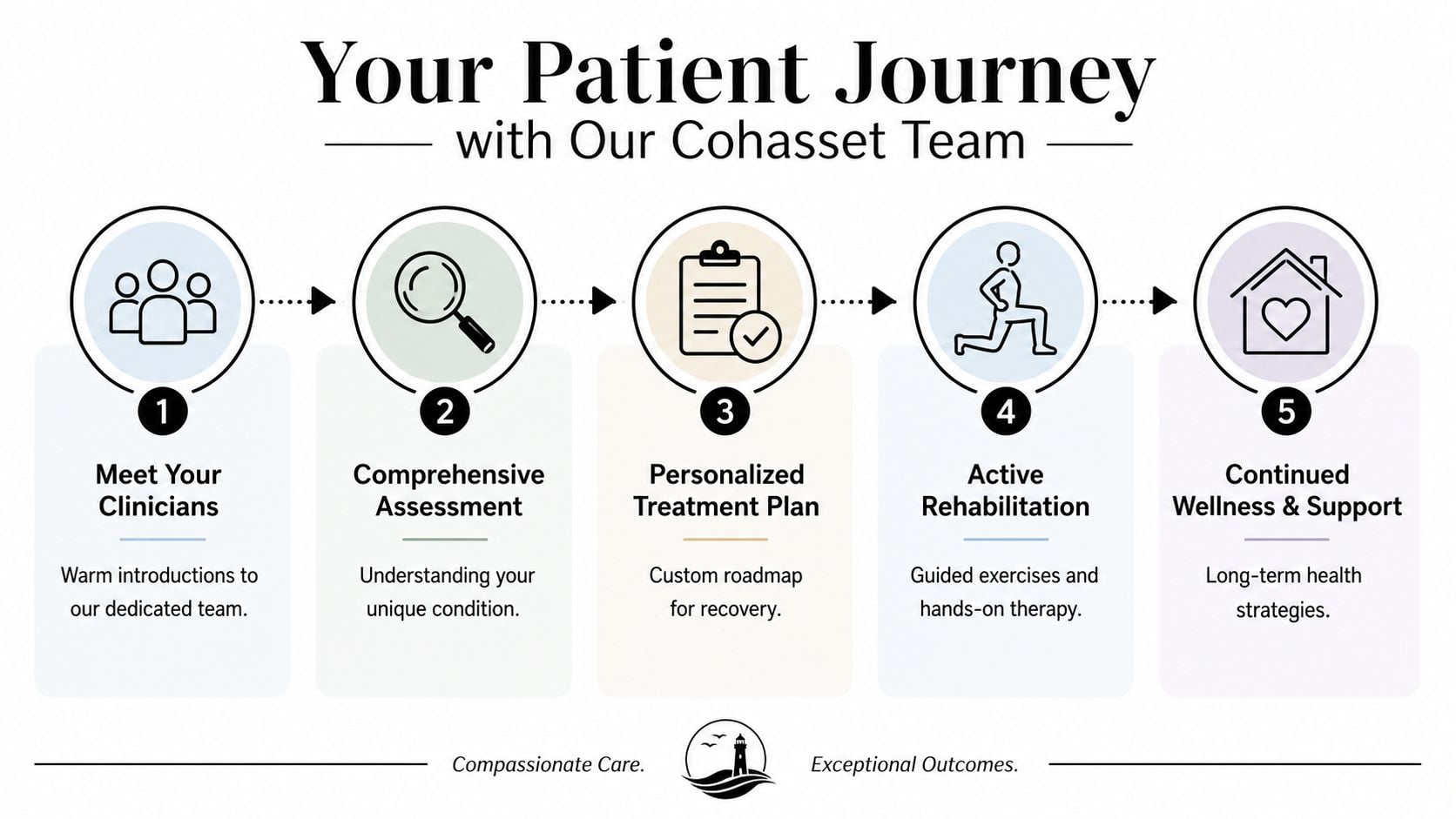
After that, the plan should feel straightforward. You should leave knowing what the focus is, what to work on at home, and what progress is likely to look like over the next phase of care.
How progress happens visit by visit
Most successful rehab follows a simple pattern, even though the details differ by condition:
- Calm things down. Reduce irritation, improve comfort, and restore confidence in movement.
- Build capacity. Add strength, control, endurance, and better movement quality.
- Return to real activity. Practice the demands that matter to your life, sport, or job.
That middle phase is where many people either move forward or get stuck. If exercises are too easy, nothing changes. If they're too aggressive, symptoms flare and confidence drops. The therapist's job is to find the working range where the body adapts without getting overwhelmed.
Recovery usually isn't perfectly linear. What matters is whether function is improving and whether the plan changes when your body gives new information.
By the time patients are ready to finish formal care, the goal isn't dependence on the clinic. It's independence. You should know what your body responds well to, what warning signs to respect, and how to keep moving with more confidence than when you started.
Finding Our Cohasset Clinic Directions and Parking
You wake up with a stiff back, your appointment is between school drop-off and work, and the last thing you need is to circle a crowded lot wondering if you are even in the right building. Getting to PT should feel straightforward, especially when you are already dealing with pain, post-surgical soreness, or a brace on your leg.
Our Cohasset office is at 231 Chief Justice Cushing Hwy (Route 3A), Suite #203, in the Cohasset Medical Building. If you know the area, it is just past the Stop & Shop plaza and next to Wheelwright Park. For South Shore patients coming from Cohasset, Hingham, or Scituate, Route 3A usually makes the drive simple and familiar.
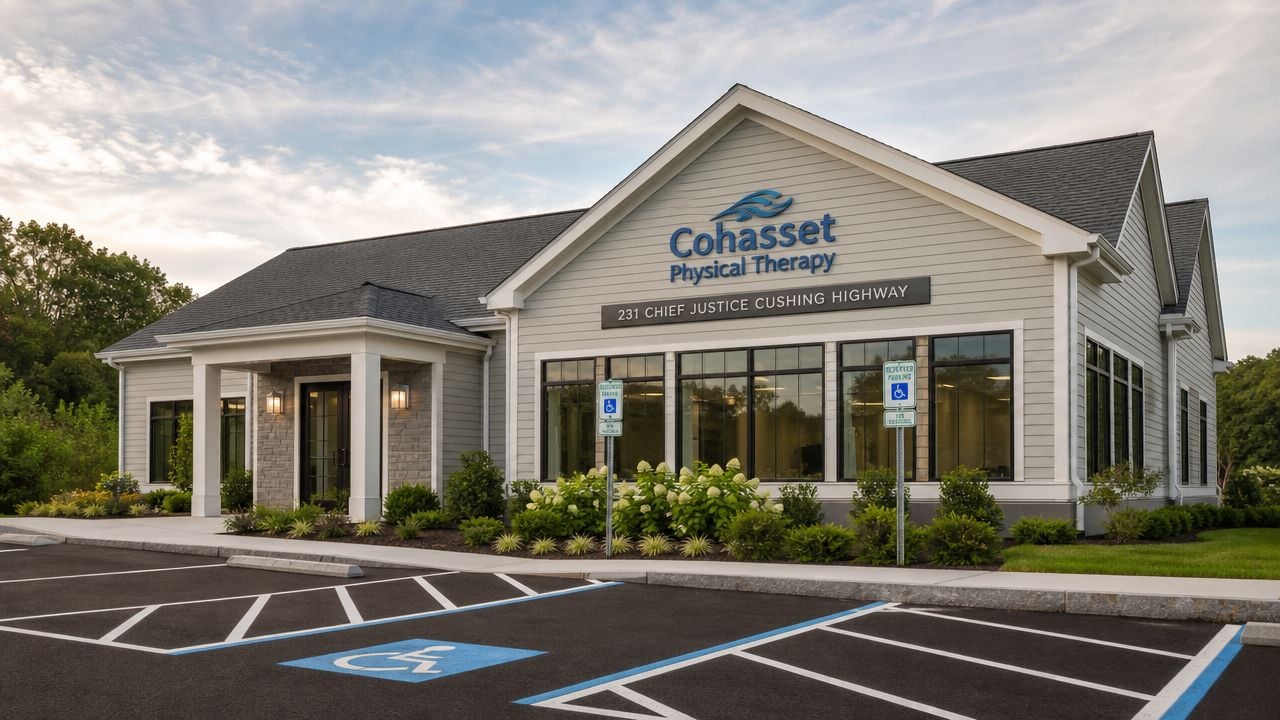
Parking matters more than people expect.
If walking across a large lot aggravates your knee, if you are recovering from surgery, or if you are bringing in a middle school athlete before practice, easy access changes the whole feel of the visit. Patients tend to stick with care when the logistics are manageable. That is a real part of treatment, not a small detail.
A few practical points help on the first visit:
- Route 3A access keeps the drive direct for many South Shore families.
- The medical building setting makes the location easier to spot than a tucked-away office.
- Parking on site helps if longer walks are uncomfortable or tiring.
- Nearby landmarks like Stop & Shop and Wheelwright Park make it easier to know you are close.
For local residents, that convenience fits real life. You may be heading in after a morning walk near the harbor, before heading back to Hingham for work, or squeezing in a visit between school pickup and hockey practice. A clinic can provide excellent care, but if getting there feels like a project every time, attendance usually suffers.
The goal is simple. Your visit should start with treatment, not with frustration in the parking lot.
Insurance Verification and Booking Your Appointment
A lot of Cohasset patients call us with the same concern. They are ready to start, but they do not want to get stuck sorting out referrals, insurance rules, and scheduling details while their shoulder, back, or knee keeps bothering them.
The good news is that Massachusetts is a direct-access state, so you can often begin physical therapy without waiting for a physician referral. Insurance rules can still differ by plan, though, and that is usually the part worth confirming before the first visit. If you have a new sports injury, a nagging flare-up after yard work, or pain that is making the work commute or school drop-off harder, getting that answer early can save time.
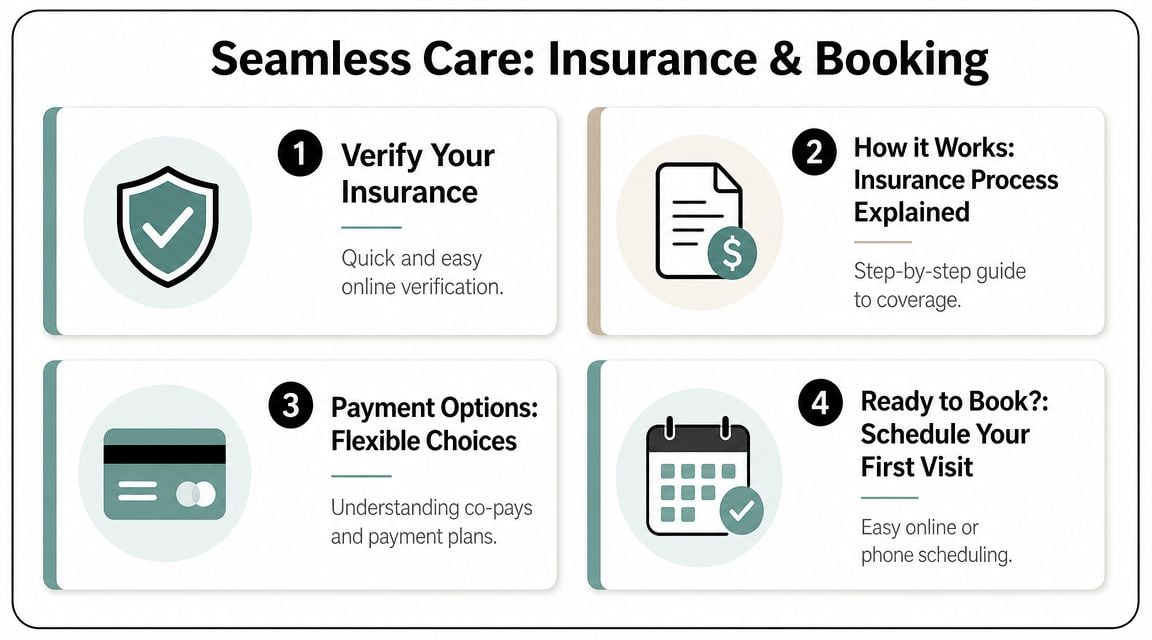
A simple first move is to check the clinic's insurance information and verification page. It gives you a clear place to confirm coverage, understand what your plan may require, and start the booking process without guessing.
A few details make the front-end process easier:
- Keep your insurance card nearby when you call or fill out forms.
- Ask whether your plan needs a referral or authorization before the first visit.
- Have your schedule in mind so you can choose appointment times that fit real life, whether that means before work, after school pickup, or between South Shore activities.
- Bring post-op instructions or recent imaging reports if you have them, especially after surgery or a specialist visit.
Patients usually appreciate knowing there is a trade-off here. Booking quickly helps you get evaluated sooner, but checking your benefits first helps avoid surprise paperwork or billing confusion. Both matter. The smoothest start is usually to verify coverage, then reserve your appointment as soon as you know your options.
If you want a better sense of the insurance side behind the scenes, this overview of insurance credentialing for therapists explains how therapy practices work with payer networks.
Peak Physical Therapy and Sports Performance offers online scheduling and insurance verification tools, which makes it easier to start care without a long back-and-forth.
Frequently Asked Questions About PT in Cohasset
New patients usually have practical questions, not theoretical ones. That's normal. When you're dealing with pain or recovering from surgery, you want the visit to feel simple.
Before your first visit
What should I wear to my first appointment?
Wear comfortable clothes you can move in easily. If the issue is your knee, hip, or ankle, choose something that lets the therapist see that area without a struggle. If it's your shoulder or neck, avoid stiff layers that limit movement.
Should I bring anything with me?
Bring your insurance information, any referral paperwork if your plan requires it, and any relevant post-op instructions if you've had surgery. A short list of your main symptoms and questions can also help.
Will I get exercises to do at home?
Usually, yes. The best home program is specific, manageable, and easy to repeat correctly. It shouldn't feel like a second job.
During your plan of care
How long is a typical PT session?
Session length can vary based on your needs and treatment plan. What matters more is that each visit has a purpose, whether that's improving mobility, progressing strength, working on balance, or preparing you to return to a specific activity.
What if I'm sore after treatment?
Some mild soreness can happen, especially when you begin moving differently or rebuilding strength. Sharp, escalating, or lingering pain is different and should be discussed so the plan can be adjusted.
How often will I need to come in?
That depends on your condition, goals, schedule, and how independently you can work between visits. Some people need closer guidance early. Others do well with more time between appointments once they understand the program.
What if I need to reschedule?
Call as early as you can. Rehab works best with consistency, but life happens. Rescheduling quickly helps keep momentum going.
Can PT help if I've had the pain for a long time?
Often, yes. Chronic issues usually need a more patient, structured approach. The key is identifying what keeps the problem going and building a plan around function, not frustration.
If pain, dizziness, stiffness, or post-surgical limitations are getting in the way of daily life on the South Shore, take the next step with Peak Physical Therapy and Sports Performance. Book your appointment, verify your insurance, and get a local plan that helps you move with more confidence in Cohasset.