
You wake up, swing your feet out of bed, and realize the pain is still there. Maybe your shoulder protests when you reach for a coffee mug. Maybe your knee tightens up on the stairs. Maybe a walk near Duxbury Beach, a workout, yard work, or even a long drive has become something you plan around instead of enjoy.
That's usually the moment people start searching for physical therapy in Duxbury, MA. They're not looking for a lecture. They want a straight answer to a few practical questions. Who can help me? What happens when I call? And how do I get started without making this more complicated than it needs to be?
Table of Contents
- Finding Relief and Getting Back to Your Duxbury Life
- Meet Your Neighborhood Experts in Movement
- Comprehensive PT Services for the Duxbury Community
- Your First Visit and Path to Recovery
- Success Stories from Your Duxbury Neighbors
- Scheduling and Insurance Made Simple
- Frequently Asked Questions
Finding Relief and Getting Back to Your Duxbury Life
Pain has a way of shrinking the day. A shoulder problem can turn kayaking, lifting groceries, or sleeping comfortably into a chore. A stiff knee can make neighborhood walks or time outdoors feel like work instead of a break. Individuals are typically already motivated to seek help. They need a clinic that makes the next step clear.
That can be harder than it should be. Duxbury has a lot of options. Healthgrades lists 139 physical therapy specialists within 10 miles of Duxbury, which tells you two things at once. First, access to care is strong. Second, choosing the right fit can feel overwhelming when every listing starts to look the same.
The right clinic isn't just close by. It should match how you want to recover, how closely you want to be guided, and what you want to get back to doing.
The biggest difference isn't a fancy promise. It's whether your care feels personal from day one. If your treatment gets reduced to a generic handout and a quick check-in, progress often stalls. If your therapist listens carefully, looks at how you move, and adjusts the plan as your body responds, recovery tends to feel more direct and less confusing.
In a town like Duxbury, that matters. People here want to stay active, independent, and able to enjoy daily life without overthinking every movement. Good physical therapy should help you return to the things that make this community feel like home, whether that's walking the beach, coaching youth sports, gardening, commuting without pain, or keeping up with kids and grandkids.
Meet Your Neighborhood Experts in Movement
Duxbury patients usually want care that feels both skilled and approachable. They want a therapist who can handle a tricky shoulder, post-surgical stiffness, dizziness, or recurring back pain, but who also explains things in plain language and gives them a clear plan.

The clinic at 1528 Tremont St. #2 follows that kind of model. The Duxbury location describes one-on-one physical therapy and care for orthopedics, back pain and sciatica, balance and gait disorders, concussion management, vertigo and dizziness, and post-surgical rehabilitation. That matters because a broad outpatient skill set is useful in a town where one household may need sports rehab, another may need fall-prevention work, and someone else may be trying to avoid surgery or recover well after it.
Why one on one care matters
One-on-one care sounds simple, but in practice it changes the whole experience.
- You get a full conversation: Your therapist can hear how the problem started, what makes it worse, and what you need to return to.
- Movement gets watched closely: Small compensations often explain why pain keeps hanging around.
- The plan can change quickly: If an exercise irritates your symptoms, it should be adjusted right away, not after a few unproductive visits.
That kind of attention helps patients feel less like a number and more like a person with a real goal.
Practical rule: If you leave your first few PT visits unsure why you're doing the exercises, ask for more clarity. Good rehab should make sense to you.
A clinic that feels local and practical
A neighborhood clinic should feel grounded in the community it serves. That means understanding the routines patients are trying to get back to, not just the diagnosis written on a form. Some people want to lift overhead without shoulder pain. Others want to get through a workday, return to the golf course, walk farther, or feel steadier on their feet.
If you want to learn more about the clinicians behind that care model, you can review the Peak team page. For people who like to understand movement in more detail between visits, Peak Performance's movement podcast is also a useful listen on how movement patterns affect pain and performance.
Comprehensive PT Services for the Duxbury Community
A good local PT clinic shouldn't only treat one type of patient. Duxbury families need a place that can handle the common problems that show up across different ages and stages of life. That includes sports injuries, post-operative rehab, recurring neck and back pain, balance issues, dizziness, pelvic health concerns, and pediatric needs.
The key is matching the service to the specific problem in front of you. Pain in the same body part can come from very different movement limitations. That's why treatment works better when it's built around function, not just a body region label.
Conditions We Treat at Peak PT Duxbury
| If You're Experiencing… | Our Specialized Services Include… |
|---|---|
| Back pain that makes sitting, lifting, or getting out of the car difficult | Orthopedic physical therapy, movement retraining, manual therapy, and progressive strength work |
| Sciatica symptoms that travel into the hip or leg | Targeted physical therapy for mobility, nerve-related symptom management, and graded return to normal activity |
| Shoulder pain with reaching, lifting, or sleeping | One-on-one orthopedic rehab focused on motion, strength, and mechanics |
| Balance problems or feeling unsteady while walking | Balance and gait training, fall-prevention work, and confidence-building functional exercises |
| Dizziness or positional vertigo | Vestibular-focused care to reduce symptoms and improve stability |
| Recovery after knee, hip, or shoulder surgery | Post-surgical rehabilitation with staged progression based on healing and function |
| Sports injuries in active adults or student athletes | Return-to-sport rehab, strength rebuilding, and movement-based progression |
| Pregnancy or postpartum concerns | Pelvic health physical therapy and guided return to exercise and daily activity |
| Pediatric movement concerns | Age-appropriate physical therapy that supports strength, coordination, and confidence |
For a broader overview of available care approaches, the clinic's physical therapy treatment information gives a useful starting point.
Care that fits real life in Duxbury
The best rehab plans connect directly to what your week looks like.
- For active adults: Treatment often centers on walking tolerance, stairs, lifting, reaching, golf, running, or getting back to the gym without flare-ups.
- For athletes: Rehab should build toward cutting, jumping, sprinting, landing, and practice demands, not just symptom reduction.
- For older adults: The focus may be steadiness, confidence, getting up from chairs more easily, and reducing fear around movement.
- For new and expecting parents: Pelvic health work can address issues that people often delay talking about, even though help is available.
A lot of patients also appreciate trustworthy reading between visits. For postpartum concerns, this post-pregnancy recovery guide offers a helpful general resource alongside individualized pelvic health care.
The main thing that doesn't work is trying to force everyone through the same program. A student athlete, a retiree working on balance, and someone recovering from joint surgery may all be in PT, but their treatment should not look the same.
Your First Visit and Path to Recovery
The first appointment usually feels easier once you know what to expect. Patients often arrive wondering whether they need imaging, whether movement will make things worse, and whether this is going to be a long, frustrating process. A good evaluation answers those questions early.
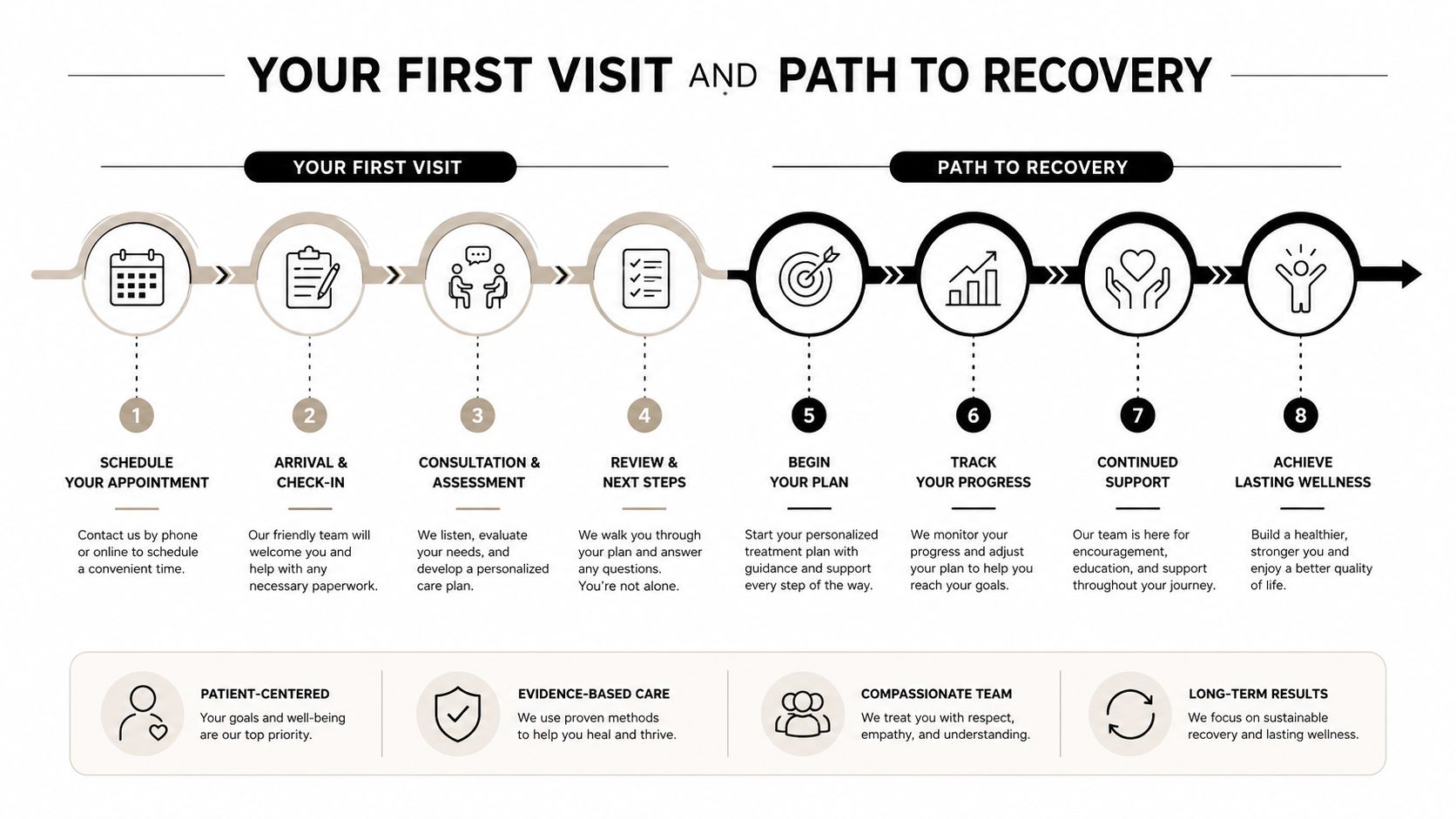
What happens at the first appointment
Your therapist starts by listening. That sounds basic, but it matters. The story of how pain started, what you've already tried, what time of day feels worst, and what you need to get back to often shapes the whole plan.
Then comes the movement assessment. That may include range of motion, strength, balance, walking, posture, task-specific testing, or checking which movements reproduce symptoms and which reduce them.
A useful first visit usually includes:
- A clear conversation about the problem so the treatment matches your actual goals.
- Hands-on assessment and movement testing to identify what's limited.
- A starting plan with exercises, activity advice, and realistic next steps.
Some people expect PT to be all exercise or all hands-on treatment. In reality, the best plan usually combines education, guided movement, and progression over time.
How progress is measured
Pain matters, but it can't be the only thing guiding treatment. Physical therapy literature supports using measurable, function-based outcomes alongside symptom reports so clinicians can track whether treatment is actually improving function, not just pain. That's especially important when someone feels a little better but still has major strength, balance, or control deficits that could lead to the problem coming back.
In practice, that means your therapist may recheck things like:
- Range of motion
- Strength symmetry
- Balance or gait quality
- Task performance, such as squatting, reaching, stair use, or sport-specific movement
If those measures improve, treatment progresses. If they don't, the plan changes.
What works: reassessing at regular intervals and adjusting load, complexity, and activity demands.
What doesn't: repeating the same exercises for weeks just because they're familiar.
That's how rehab becomes personal in a meaningful way. Not because every session is different for the sake of variety, but because every session should move you closer to a clear functional goal.
Success Stories from Your Duxbury Neighbors
Patients typically don't come to physical therapy because they want perfect posture or a more interesting exercise program. They come because something in daily life stopped feeling normal. The stories below reflect the kinds of goals many Duxbury patients bring into the clinic.

The gardener with back pain
One patient came in after weeks of low back pain that flared every time she bent forward, carried bags of mulch, or spent time in the yard. Rest helped a little, but every active weekend brought the pain right back.
Her turning point wasn't a single stretch. It was learning which movements were overloading her back, rebuilding strength gradually, and practicing better strategies for lifting and repeated bending. Her goal wasn't abstract. She wanted to garden without paying for it the next day.
The runner with stubborn foot pain
Another patient had cut back mileage, changed shoes, and taken time off, but foot pain kept returning when runs got longer. He didn't need a random collection of exercises. He needed someone to look at calf strength, ankle mobility, loading tolerance, and running-related demands.
As symptoms settled, rehab shifted toward controlled strengthening, then return-to-run progression. That's often how good rehab works. It starts with calming things down, then builds enough capacity that normal activity stops feeling like a threat.
The parent recovering after surgery
Post-operative patients often tell the same story. Surgery addressed one part of the problem, but stiffness, weakness, and uncertainty still made daily tasks hard. A parent recovering from an orthopedic procedure may not be focused on athletics at all. They may just want to climb stairs, carry laundry, sleep better, and feel steady caring for the family again.
Those are meaningful wins. Physical therapy is often most powerful when it restores ordinary life.
Recovery feels more manageable when the goal is specific. Not “get better,” but “walk the beach comfortably,” “lift my grandchild,” or “get through the workday without limping.”
Scheduling and Insurance Made Simple
Starting care shouldn't feel like another obstacle. Patients typically want a short path from “I think I need help” to “I have an appointment on the calendar.” That means clear scheduling options, straightforward intake, and help understanding insurance before the first visit.
If you're comparing options for physical therapy Duxbury MA, ask practical questions first. Can you book easily? Will someone help verify benefits? Will the front desk explain what to bring and what to expect? Those details matter more than people think because they shape how quickly you can get moving.
For insurance and billing questions, the clinic's insurance information page is a helpful place to start. If you want deeper educational content about conditions, anatomy, and rehab science, visit highbarhealth.com, where that broader clinical library lives.
Bring your ID, insurance card, any referral if your plan requires one, and wear clothes that let you move comfortably. After that, the process should feel simple.
Frequently Asked Questions
Do I need a referral to start physical therapy in Duxbury
Often, no. Massachusetts is a direct access state, which means patients can often see a physical therapist without a physician referral, though insurance rules can still vary by plan. If you're unsure, call before booking and ask whether your specific coverage requires a referral for payment.
What should I wear to my first appointment
Wear comfortable clothes that let the therapist see and assess the area involved. For knee, hip, or ankle issues, shorts are helpful. For shoulder or neck issues, a loose T-shirt or tank-style top usually works well.
How long will recovery take
That depends on the problem, how long it's been going on, your goals, and how consistently the plan is followed. Some people improve quickly. Others need a longer progression, especially after surgery or repeated flare-ups.
What if I'm not sure PT is the right first step
That's common. If your pain is limiting normal life but doesn't clearly require emergency care, a PT evaluation can often help you decide the next move. Good clinics will tell you when PT is appropriate and when you should be seen elsewhere first.
If pain is keeping you from enjoying life in Duxbury, it's worth getting a clear plan instead of waiting and hoping it settles down. Peak Physical Therapy and Sports Performance offers local outpatient care that helps patients move better, recover with purpose, and get back to the routines that matter most. Book an appointment and take the first step toward feeling like yourself again.