
Pain has a way of shrinking your world fast. One week you're walking the Hanover Branch Rail Trail, coaching from the sidelines, commuting, lifting groceries, or getting through a workday without thinking much about your body. Then your back tightens, your knee starts barking on stairs, or your shoulder won't let you reach overhead without a reminder that something's off.
That's usually the moment people start searching for physical therapy in Hanover, MA. Not because they want a lecture. Because they want a clear next step close to home, and they want to know if they can get back to normal life on the South Shore.
Table of Contents
- Your Partner in Hanover for Pain Relief and Recovery
- More Than Treatment It Is Personalized Care
- Expert Care for A Wide Range of Conditions
- What to Expect on Your First Visit
- Your Guide to Visiting Our Hanover Clinic
- Your Questions Answered
Your Partner in Hanover for Pain Relief and Recovery
You feel it on an ordinary day first. The back tightens getting out of the car at Market Basket. The knee complains halfway through a walk near home. The shoulder starts talking every time you reach into the back seat or try to sleep on one side.

That is usually when Hanover patients decide it is time to stop waiting and get answers. The goal is rarely vague. You want to get through your commute on Route 53 with less pain, get back to youth sports, recover steadily after surgery, or feel confident walking the South Shore without guarding every step.
Peak is part of the Highbar Health network, but what matters here is the Hanover experience. Care should feel local, practical, and easy to fit into real life. That means clear guidance, follow-up that makes sense, and a plan built around your schedule, your insurance questions, and what Massachusetts direct access rules allow when you want to start promptly.
Practical rule: The best rehab plan is one you can follow at home, at work, and between visits.
Good physical therapy looks past the painful area and asks why it keeps getting irritated. A sore shoulder may involve stiffness through the upper back, weakness around the shoulder blade, or a loading pattern that breaks down late in the day. Dizziness, concussion symptoms, and balance problems can also need broader rehab support, and some patients benefit from learning about related services such as cognitive assessment and therapy when focus, memory, or daily function have been affected.
Patients also want to know how to choose the right fit before booking. That decision usually comes down to access, communication, and whether the clinic treats your actual goals instead of handing you a generic program. This guide on how to choose a physical therapist in Hanover can help you ask better questions before your first visit.
Hanover has plenty of outpatient rehab options along Washington Street and nearby roads, which is useful because convenience matters when visits happen week after week. A clinic can have a good reputation and still be the wrong fit if getting there adds stress, the schedule is too tight, or the plan does not match the life you are trying to return to. The right choice is the place where you can get in, be heard, and make steady progress toward the activities that matter on the South Shore.
More Than Treatment It Is Personalized Care
Technique matters. So does attention.
You can tell within one visit whether you're being listened to or moved through a schedule. Personalized care isn't a slogan. It shows up in the questions your therapist asks, how carefully movement is assessed, and whether the plan reflects your actual priorities instead of a canned progression.
The difference patients feel
Hands-on, one-on-one care tends to work better for a simple reason. The therapist can adjust in real time. If an exercise flares your symptoms, form can be corrected. If your pain behaves differently at work than it does in the clinic, the program can be changed to match reality.
That's especially important in a place like Hanover, where patients are coming in with very different needs:
- Working adults who need a plan that fits a commute and desk time
- Athletes and active adults who care about a confident return to running, lifting, or field sports
- Older adults who want safer walking, steadier balance, and less fear with everyday movement
- Post-surgical patients who need structure, pacing, and close monitoring from week to week
Good rehab isn't about doing more exercises. It's about doing the right work at the right time.
Care should continue between visits
A thoughtful PT plan also extends beyond the treatment table. Patients do better when they know what to do on their own, what to avoid for now, and what signs mean progress is happening even before pain is fully gone. For some people, that same mindset is why healthcare teams are increasingly interested in tools like remote patient monitoring, which helps explain how ongoing follow-up can support care between appointments.
If you're comparing clinics, don't just ask what services they offer. Ask how they evaluate, how they progress care, and how they communicate when something isn't working. That's usually what separates a good experience from a frustrating one. If you want a practical checklist, this guide on how to choose a physical therapist is a useful place to start.
Expert Care for A Wide Range of Conditions
Pain and movement problems rarely show up the same way twice. In Hanover, one person is trying to get through a workday without back pain, another wants to get back to golf or pickleball, and someone else is trying to feel steady again walking through the grocery store or up the stairs at home.
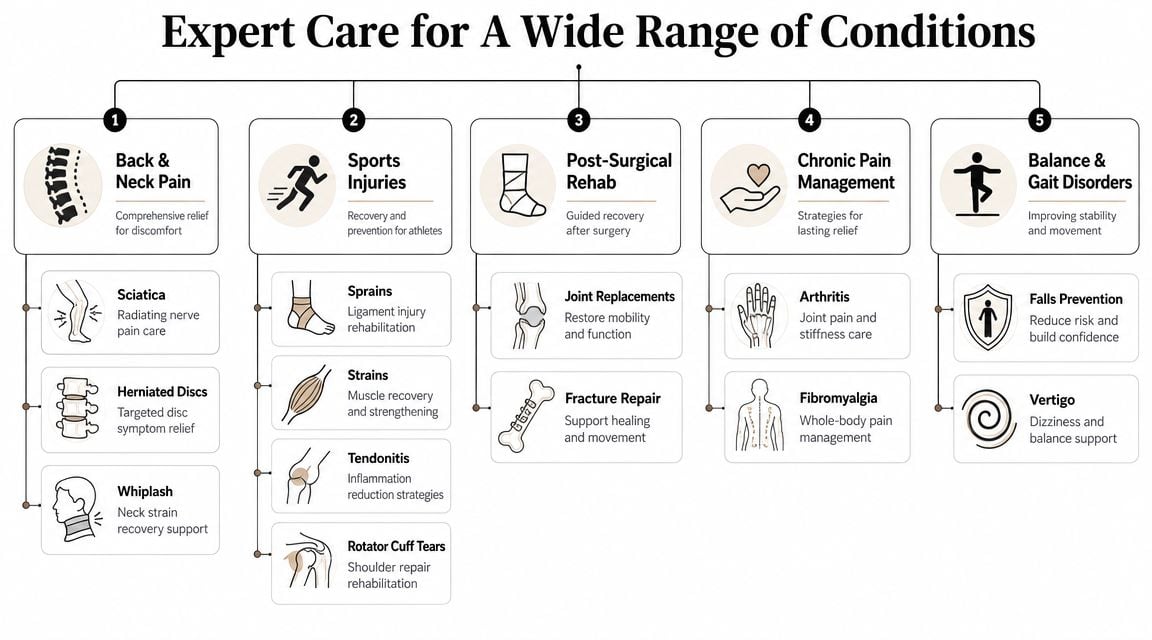
The diagnosis matters, but function matters just as much. A sore shoulder means something different if you cannot reach overhead at work, lift a child into the car, or sleep on that side. Good physical therapy connects the irritated tissue to the actual task you want back.
What we commonly treat
Physical therapy often helps with:
- Back and neck pain, especially when sitting, driving, sleeping, or lifting has become harder
- Shoulder, hip, and knee pain that shows up with stairs, exercise, reaching, squatting, or longer walks
- Sports injuries that need a safe return to running, jumping, cutting, lifting, or practice
- Post-surgical rehab after procedures where mobility, swelling, strength, gait, and pacing all need attention
- Chronic or recurring pain that has not improved with rest alone and needs a clearer plan
- Balance and dizziness concerns that affect confidence, walking, or quick head and body movements
The trade-off is usually straightforward. Rest may calm symptoms for a few days, but too little movement often leads to more stiffness, weakness, and hesitation. Pushing too hard too soon can flare things up. The goal is to find the middle ground where your body is challenged enough to improve without paying for it later.
Some conditions improve quickly. Others take patience and regular progression. If symptoms have been around for months, if you have had surgery, or if you are dealing with dizziness or repeated flare-ups, the plan usually needs more structure. You can review the range of problems we treat on our physical therapy conditions page.
Balance and dizziness deserve real attention
People often wait too long to bring up balance problems because they assume it is just part of getting older. I would not brush that off. If walking feels less automatic, if you grab railings more than you used to, or if rolling in bed makes the room spin, that is worth evaluating.
A few common signs to pay attention to:
- Unsteadiness while walking, even without a recent fall
- Dizziness with position changes, such as looking up, bending over, or turning in bed
- Fear of falling that makes you avoid errands, exercise, or going out alone
- A recent fall or near-fall followed by slower, more guarded movement
These issues are treatable in many cases. The right exam looks at gait, strength, reaction time, positional dizziness, and how your balance holds up during everyday tasks. For Hanover patients, that often means focusing on safe walking in the community, getting up and down stairs with more confidence, and returning to normal routines without feeling tentative every step of the way.
What to Expect on Your First Visit
Starting PT shouldn't feel intimidating. A good first visit feels organized, clear, and useful from the minute you walk in.

You'll check in, handle any needed paperwork, and then spend time with your therapist one on one. That first conversation matters because symptoms don't exist in isolation. Where it hurts is only part of the story. Your therapist also needs to know how long it has been going on, what makes it worse, what has helped, what your routine looks like, and what you want to get back to doing.
Your first conversation matters
The evaluation usually includes movement testing, strength checks, mobility assessment, and a look at how your body handles the tasks that bother you most. If stairs hurt, stairs matter. If turning your head while driving is the problem, that movement matters. The exam should connect directly to your daily life.
Patients often worry they'll be pushed too hard on day one. That's not the point of the first visit. The point is to identify the likely driver of the problem and choose a smart place to begin.
A strong first session usually includes:
- A clear discussion of your main complaint
- A practical physical assessment
- Early treatment to start calming symptoms or improving movement
- Home guidance you can realistically follow
- A roadmap for the next few visits
You leave with a plan
By the end of the visit, you should know what the therapist is seeing, what the initial goals are, and what success will look like. You should also know what to do if symptoms change between appointments.
The first visit should reduce uncertainty, not add to it.
That clarity is one reason PT helps people move forward. Even when pain has been lingering for a while, it's a relief to leave with an explanation, a starting strategy, and a next appointment already in place.
Your Guide to Visiting Our Hanover Clinic
You leave work in Hanover, realize your back is still barking, and the last thing you want is a long, confusing trip to an appointment. Convenience matters more than people expect. If getting to PT feels like another chore, it is harder to stay consistent long enough to feel the benefit.
Finding us on Route 53
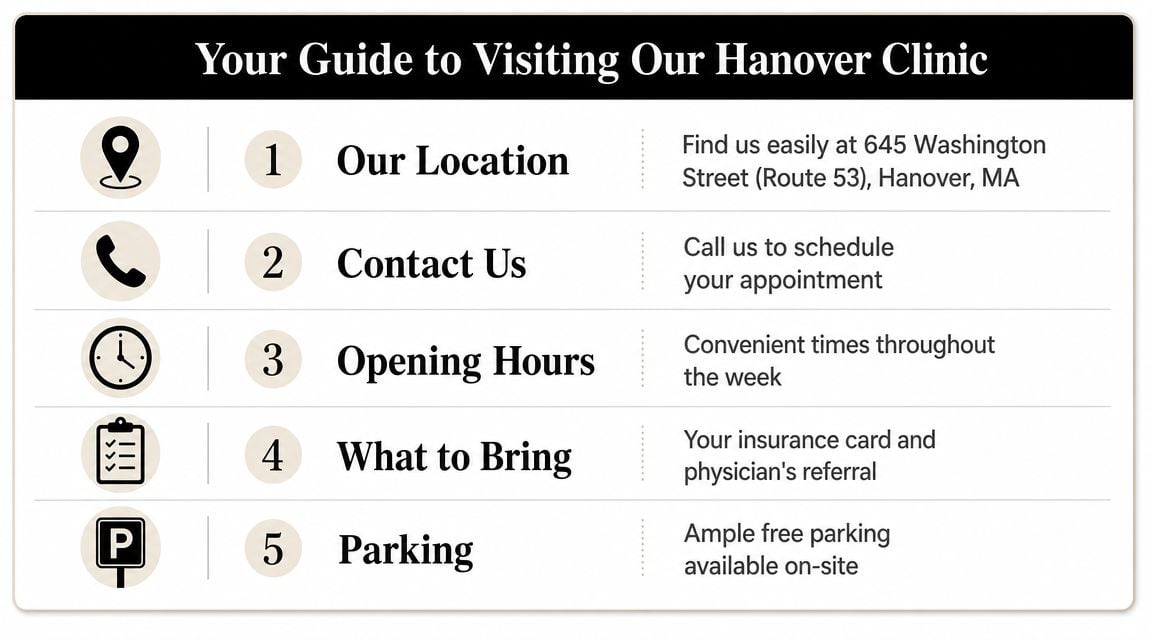
Our clinic is at 645 Washington Street (Route 53), a spot that makes sense for Hanover patients because it is easy to reach from the center of town and from nearby South Shore communities. For many people, that means less time figuring out the drive and more confidence that they can fit visits into a normal week.
Parking and access matter, too. If you are already dealing with knee pain, a sore shoulder, or dizziness, you should not have to solve a complicated arrival process before treatment even starts. For clinic-specific details like directions, contact information, and booking options, visit the Hanover Peak clinic page.
What to bring and what to ask
A little prep makes the first visit easier.
- Your insurance card so coverage can be checked
- A referral, if you already have one
- A short medication list or notes about recent procedures if they relate to the problem you are coming in for
- Questions about scheduling if you need visits before work, after school pickup, or around a changing weekly routine
Insurance is one place where small details can affect the whole plan. Massachusetts direct access rules often let patients start PT without a referral, but insurance plans do not always handle that the same way. Ask the front desk to verify benefits before your first appointment so you know what is covered, what paperwork is needed, and whether there are visit limits.
That kind of clarity helps. Hanover patients are usually trying to get back to something specific, walking the neighborhood without hip pain, driving Route 3 without neck stiffness, getting through a workday, or returning to youth sports sidelines without limping by halftime. A clinic visit should feel practical from the moment you book it.
Your Questions Answered
Do I need a referral to start physical therapy
Often, no. Massachusetts direct access rules usually let you see a physical therapist without getting a physician referral first.
The practical catch is insurance. Some plans still want a referral or have visit rules that affect coverage, even if state law allows you to begin care right away. If you are trying to get in quickly because back pain is making work harder, your shoulder hurts every time you lift groceries, or dizziness is making stairs feel less safe, it helps to verify those details before the first appointment.
What should I wear
Wear clothing that lets you move and gives easy access to the area being treated. For knee, hip, or ankle problems, shorts work well. For shoulder or neck issues, a T-shirt or tank top usually makes the exam easier.
Good therapy depends on seeing how you move. If we need to check your squat, gait, balance, or shoulder reach, clothing can make that simpler for you and more accurate for us.
How long does a visit take
Your first visit is usually the longest because it includes your history, a hands-on exam, movement testing, and a treatment plan. Follow-up visits are shorter and more focused on treatment, exercise progressions, and adjusting the plan based on how you felt after the last session.
That schedule matters for Hanover patients trying to fit PT around commutes, school pickup, or a full workday on the South Shore.
What if I'm not sure physical therapy is right for my issue
That is a fair question.
Physical therapy is not only for athletes or patients after surgery. It can also help with joint pain, arthritis stiffness, balance problems, vertigo, recovery after a fall, and day-to-day movement problems that have slowly started limiting what you do. The first visit helps sort out whether PT fits your issue, whether you need a referral to another provider, or whether a different plan makes more sense.
How do I book
Call the clinic or book online. If you want help sorting out insurance, referral questions, or appointment times that fit your week, ask before you schedule so you know what to expect.
If you are looking for a practical, local option for physical therapy in Hanover, MA, Peak Physical Therapy and Sports Performance provides outpatient care on Washington Street for pain, injury recovery, post-surgical rehab, dizziness, balance concerns, and return-to-activity goals. That includes the everyday goals Hanover patients talk about most. Walking comfortably, getting through a workday, returning to youth sports sidelines, or feeling steady again out in the community.