


If you're dealing with knee pain here in Massachusetts, you understand how much it can disrupt your life. We get it. The frustration of not being able to enjoy a walk, play with your kids, or even just get through the day without a nagging ache is real. The good news is that targeted knee pain strengthening exercises are a clinically proven way to find lasting relief and get you back to doing what you love. It’s all about building a strong, stable foundation around your knee joint by focusing on the entire support system—your quads, hamstrings, hips, and glutes.
Your Guide to Overcoming Knee Pain with Strengthening

That nagging ache after a walk around Lake Quannapowitt in Wakefield or the sharp twinge stopping you from hiking the Blue Hills is more than just a nuisance. It's a barrier keeping you from living the active Massachusetts life you enjoy. We understand how exhausting and discouraging persistent knee pain can be. It’s natural to feel frustrated, worried about the pain worsening, or even scared that exercise might do more harm than good.
But here’s what our licensed physical therapists want you to know: the right kind of exercise isn’t just safe—it’s one of the most powerful, evidence-based tools for reducing pain and restoring your function for good. This guide is your starting point. It’s not about pushing through painful workouts, but about taking a smarter, more strategic approach to building strength and reclaiming your mobility.
Building Your Knee's Support System
Think of your knee joint as the hub of a complex support network. When the surrounding muscles are weak or imbalanced, the joint itself is forced to absorb excessive stress. This is often the root cause behind common issues like runner's knee, IT band syndrome, and arthritis flare-ups.
Our clinical approach focuses on creating a natural "brace" for your knee by strengthening the muscles that are meant to handle the load, taking the pressure off the joint itself.
The muscles around your knee are designed to absorb shock from every step and control movement, but they must be strong and balanced to do their job effectively. When they aren't, the knee joint pays the price.
Key Muscle Groups for Knee Support
| Muscle Group | Primary Role in Knee Health | Common Weakness Symptom |
|---|---|---|
| Quadriceps | Absorb impact and control knee extension (straightening). | Pain when walking downstairs or downhill. |
| Hamstrings | Stabilize the joint and control knee flexion (bending). | A feeling of instability or giving out. |
| Glutes | Control the alignment of the entire leg from the hip down. | Knee collapsing inward during squats or stairs. |
| Hip Abductors | Prevent the knee from caving inward during single-leg activities. | Pain on the outside of the knee or hip. |
By targeting these key areas, you build a foundation of support that takes the pressure off the knee joint itself, allowing it to heal and function without pain.
Why Your Hips Are So Critical for Knee Health
It surprises many of our patients in Massachusetts to learn just how directly their hip strength is connected to their knee pain. When your hips are weak—especially the abductor muscles on the outside—your thigh bone can rotate inward and cause your knee to collapse toward the midline every time you walk, run, or climb stairs. This poor alignment puts a tremendous amount of strain on your kneecap and the surrounding tissues.
In fact, clinical research consistently shows that programs combining hip and knee exercises are far more effective for treating common problems like patellofemoral pain syndrome (PFPS) than just focusing on the knee alone. One major systematic review found that this combined approach led to significantly greater pain reduction and a major improvement in activity levels.
A comprehensive approach to overcoming knee pain often starts with a clear understanding of your condition and a personalized plan, much like the process outlined in these practical treatment plan examples. At Peak Therapy, our licensed physical therapists perform a comprehensive evaluation to determine the root cause of your pain and develop this exact type of personalized roadmap for your recovery.
Foundational Exercises to Gently Build Knee Strength
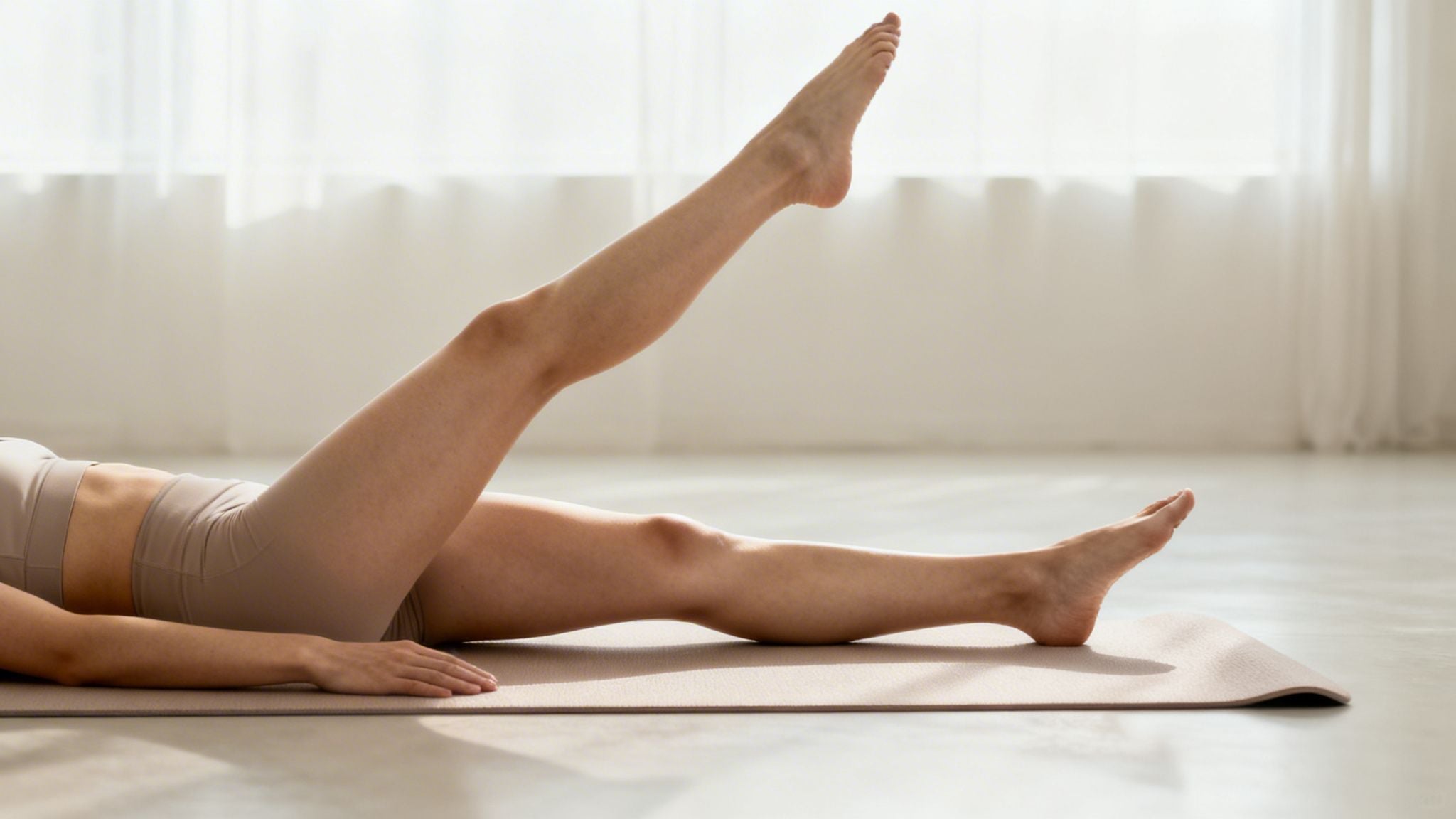
When your knee is already hurting, the idea of exercise can feel intimidating. That's why our physical therapists always begin with foundational, low-impact movements. These exercises gently activate the key muscles supporting your knee without putting extra stress on the joint itself.
Think of this phase as re-establishing a clear line of communication between your brain and your muscles. The goal isn’t to push through pain but to reawaken muscles that may have become inhibited due to injury or discomfort. Focusing on high-quality, precise movements is far more important than the number of repetitions. This approach builds a solid, pain-free base for more challenging exercises later on.
The Pain-Free Rule
Before starting any knee pain strengthening exercises, there's one critical rule: You should feel your muscles working, not a sharp pain in your joint. If an exercise causes a stabbing, sharp, or worsening pain, stop immediately. That's your body's signal that the movement is irritating the joint.
At Peak Therapy, we often use a "stoplight" analogy. Green means you're good to go—no joint pain. Yellow signals mild muscle fatigue, which is a normal and productive feeling. Red means you've hit sharp joint pain—stop and let's reassess.
Quad Sets (Isometric Quadriceps Contractions)
This is one of the safest and most effective starting points for activating your quadriceps, the large muscle group on the front of your thigh. Because it's an isometric exercise, you create muscle tension without bending the knee, making it ideal for the early stages of recovery when the joint is sensitive.
- How to do it: Lie on your back with your legs straight. You can place a small, rolled-up towel under the knee of the leg you're working.
- The movement: Gently tighten your thigh muscle (your quad), trying to press the back of your knee down into the towel.
- Key cue: You should see your kneecap pull slightly upward toward your hip. Hold that contraction for 5-10 seconds, then relax the muscle completely.
- Starting point: Begin with 2 sets of 10 repetitions.
Straight Leg Raises
Once you can perform quad sets comfortably, the straight leg raise is the next logical progression. It builds on that initial muscle activation by adding movement from the hip, which challenges your quad to work harder to keep the leg stable and straight. This is a staple for rebuilding strength after an injury or surgery.
To maintain proper form, brace your core and keep your lower back in a neutral, comfortable position on the floor. This prevents your back from arching, a common compensation that can cause strain.
- How to do it: Lie on your back with one leg straight and the other bent with your foot flat on the floor for support.
- The movement: Tighten the quad on your straight leg first, then slowly lift that leg about 12-18 inches off the floor. The leg should remain perfectly straight the entire time.
- Key cue: The magic is in the control. Don't just let your leg drop; lower it back down slowly and deliberately.
- Starting point: Aim for 2 sets of 10-15 repetitions on each leg.
Hamstring Curls (Standing or Lying)
The hamstrings, which run down the back of your thigh, are just as important as the quads for knee stability. If they're weak, your quads can become overworked, creating a muscular imbalance that often contributes to knee pain.
When you're just starting, a standing version is a great, safe option. Just hold onto a sturdy chair or countertop for balance support.
- How to do it: Stand tall while holding onto a chair for support.
- The movement: Slowly bend one knee, bringing your heel up toward your buttock.
- Key cue: Focus on a slow, smooth motion. Squeeze your hamstring muscle at the top of the movement before slowly lowering your foot back down.
- Starting point: Perform 2 sets of 10-12 repetitions on each side.
These exercises are a crucial first step, but they are just the beginning of building a resilient knee. For more tips on building long-term strength, our guide on preventing knee injuries with physical therapy offers deeper insights.
Building Robust Knee Stability with Intermediate Exercises
The foundational exercises are starting to feel manageable, and your everyday pain is beginning to ease. That's fantastic progress. Now it's time to build on that foundation with intermediate exercises that challenge your muscles in ways that better mimic real-world activities.
This is how we build the kind of functional strength that gives you confidence, whether you're navigating the uneven sidewalks in historic Scituate or taking on a weekend hike at World's End in Hingham. These movements are more dynamic, demanding better control and coordination from the muscles supporting your knee.
Introducing Progressive Overload
To continue getting stronger, your muscles need a gradually increasing challenge. This principle is called progressive overload. This isn’t about jumping into painful, high-intensity workouts; it's a strategic, gradual process.
You can safely progress your knee strengthening exercises by:
- Increasing Repetitions: If you started with 10 reps, work your way up to 12 or 15.
- Adding Sets: Instead of doing 2 sets of an exercise, try doing 3.
- Adding Light Resistance: A light resistance band can make a familiar movement more challenging.
- Improving Range of Motion: As your knee allows, try to go a little deeper into a squat or lunge.
The most important rule is to change only one variable at a time and pay close attention to how your body responds. If adding a resistance band causes joint pain, go back to bodyweight and try adding more reps instead. A physical therapist is an expert at guiding you through this process safely and effectively.
Intermediate Knee Strengthening Exercises
These next exercises add more complexity and load to the muscles you've already been working. Here, proper form is everything. A sloppy lunge can easily irritate your knee, but a well-controlled one can be one of the best things for it.
1. Mini-Squats
The squat is one of the most fundamental movements we do every day. A mini-squat is the perfect way to start teaching your quads, glutes, and hamstrings how to work together to keep your knee stable under load.
- How to do it: Stand with your feet about shoulder-width apart, toes pointing mostly forward. Feel free to hold onto a sturdy countertop for balance.
- The movement: Slowly push your hips back and bend your knees, as if you're about to sit in a chair. Only go down a few inches to start—think "mini" squat, not a deep one.
- Critical form tip: Watch your knees as you move. Make sure they are tracking straight over your second toe. It's crucial that you do not let your knees collapse inward.
- Starting point: Begin with 2 sets of 10-12 repetitions.
2. Controlled Lunges
Lunges are incredible for building single-leg strength and stability—skills you use every time you walk, run, or climb stairs. The key is to start with a very small, controlled motion.
- How to do it: Stand up tall, then take a small, comfortable step forward with one leg.
- The movement: Slowly lower your hips until both knees are bent at an angle that feels comfortable and pain-free. Your front knee should stay aligned over your ankle, not drift past your toes. Push off that front foot to return to standing.
- Key cue: Keep your torso upright and your core engaged. Your stability should come from your hips and legs, not from leaning your body forward.
- Starting point: Aim for 2 sets of 8-10 repetitions on each leg.
3. Step-Ups
This exercise directly translates to climbing stairs, a common challenge for many of us in our multi-level New England homes. Start with a low, sturdy step or just the bottom step of a staircase.
- How to do it: Stand facing a low step. Place your entire right foot firmly on the surface.
- The movement: Press through your right heel to lift your body up until your right leg is straight. Try to avoid pushing off with your back leg; let the front leg do the work.
- Key cue: The "down" phase of the movement is just as important. Slowly lower your left foot back to the floor with control. Don't just let it drop.
- Starting point: Perform 2 sets of 10 repetitions on each leg.
Modifying Exercises for Common Knee Conditions
Your knee pain is unique to you. That's why a one-size-fits-all approach to knee pain strengthening exercises so often fails. What brings relief for someone with knee arthritis might be the wrong approach for a person recovering from meniscus surgery.
Knowing how to adapt your routine for your specific situation is the key to strengthening your knees safely and successfully. While this guidance will empower you with knowledge, it’s not a substitute for a professional diagnosis. A licensed physical therapist is the only person who can truly get to the root cause of your pain and create a personalized plan. At Peak Therapy, this is our expertise.
Adjusting for Knee Osteoarthritis (OA)
With knee osteoarthritis, the cartilage in the joint gradually wears down, which can make weight-bearing movements painful. The goal of exercise is to strengthen the muscles that support the knee without adding compressive stress to the joint itself.
For people with OA, strengthening is incredibly effective. Research shows that a consistent program can dramatically reduce pain and improve daily function. A 2023 meta-analysis even found that patients who followed a progressive resistance training plan for 8-12 weeks saw significant pain reduction and a major boost in their ability to perform daily activities. You can read the full research about these strengthening findings to learn more. This evidence is exactly why we build our physical therapy plans around this principle.
Here are some helpful modifications for OA:
- Focus on Non-Weight-Bearing Exercises: Moves like straight leg raises, hamstring curls, and quad sets are fantastic because they build strength without loading the sore joint.
- Try Aquatic Therapy: Exercising in a pool can be a game-changer for arthritis. The water’s buoyancy supports your body weight, allowing you to move and strengthen your legs with minimal impact.
- Adjust Your Range of Motion: During exercises like mini-squats, only go as deep as you can without pain. A smaller, pain-free movement is far more beneficial than pushing into a painful range.
This flowchart shows key decision points as you build strength and get ready to progress from foundational to more intermediate exercises.
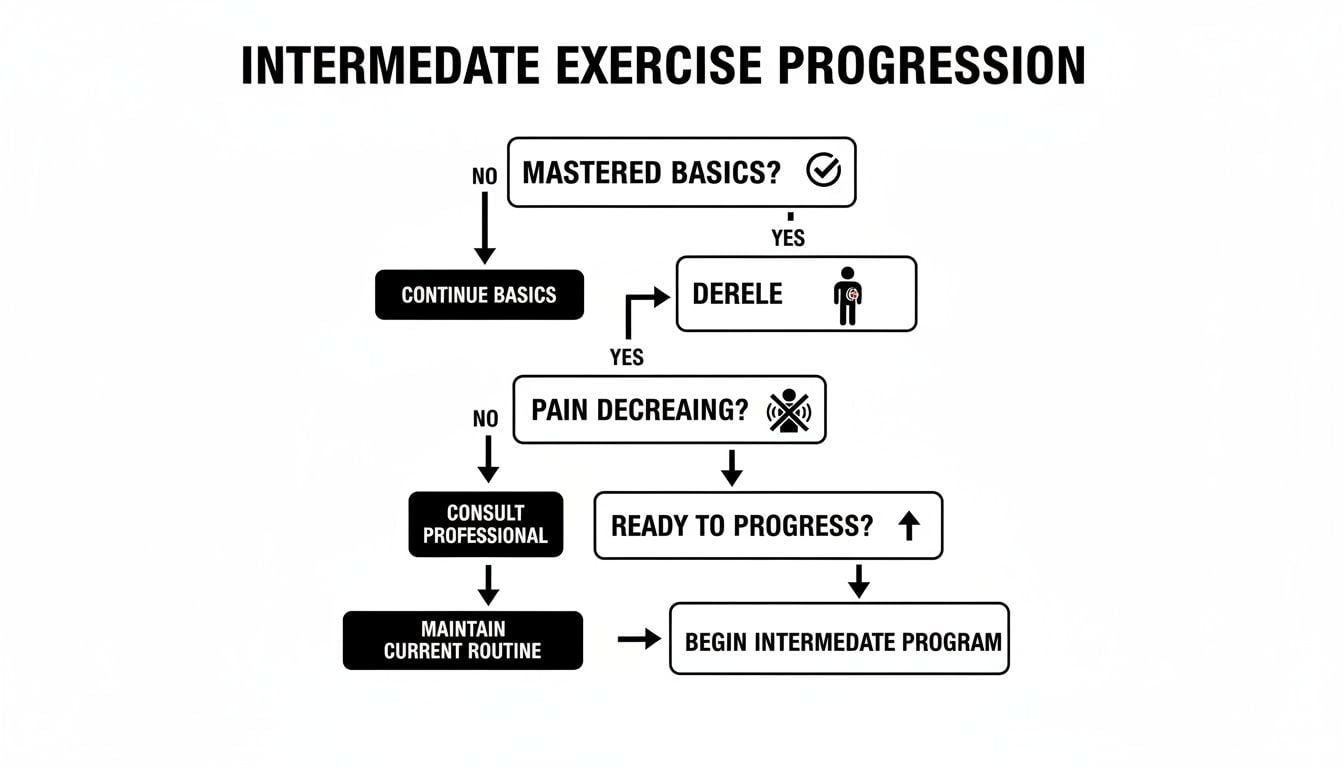
As you can see, moving forward depends not just on mastering the basics but also on making sure your pain is consistently decreasing.
Adapting for Patellofemoral Pain Syndrome (PFPS)
Often called "runner's knee," PFPS involves pain around or behind the kneecap. It’s frequently caused by poor tracking of the patella (kneecap), which is often a direct result of weakness in the hips and glutes.
For PFPS, thinking "above the knee" is crucial. Your glutes control your femur (thigh bone), and if they're weak, your knee can twist and collapse inward, creating stress on the kneecap.
For this condition, the focus should be:
- Prioritizing Hip and Glute Strength: Exercises like clamshells, glute bridges, and side-lying leg raises are your best friends. These directly target the muscles that stabilize your pelvis and prevent that inward knee collapse.
- Modifying Squats and Lunges: Pay strict attention to your form. Your knee should always track over your second toe—not dive inward. Using a mirror for feedback is incredibly helpful here.
Recovering After Knee Surgery
Post-surgical rehabilitation is a highly structured process that must be guided by your physical therapist. We phase the approach carefully to protect healing tissues while gradually restoring your strength and mobility. Rushing this can lead to major setbacks.
For example, after a meniscectomy (meniscus trimming), our initial focus is on gentle muscle activation and controlling swelling. Jumping back into squats or lunges too soon could easily compromise the surgical site. Our physical therapists guide you through each stage, starting with exercises like quad sets and gentle heel slides, and only progressing you when your knee is physiologically ready. You can learn more about recovering from a meniscus injury in our article.
This table offers a quick-reference guide on how to approach exercises based on your specific condition.
Exercise Modification Guide for Knee Conditions
| Condition | Recommended Focus | Exercises to Modify or Avoid Initially |
|---|---|---|
| Knee Osteoarthritis | Non-weight-bearing strength; pain-free range of motion. | Deep squats, lunges, high-impact activities (running, jumping). |
| Patellofemoral Pain | Hip and glute strength; correcting movement patterns. | Deep knee bends; any exercise where the knee collapses inward. |
| Post-Knee Surgery | Gentle activation and mobility, following PT protocol. | Any exercise not cleared by your therapist; avoid overloading the joint. |
Remember, these are general guidelines. A personalized plan from a physical therapist will always provide the safest and most effective path to recovery.
Why Expert Guidance Makes All the Difference
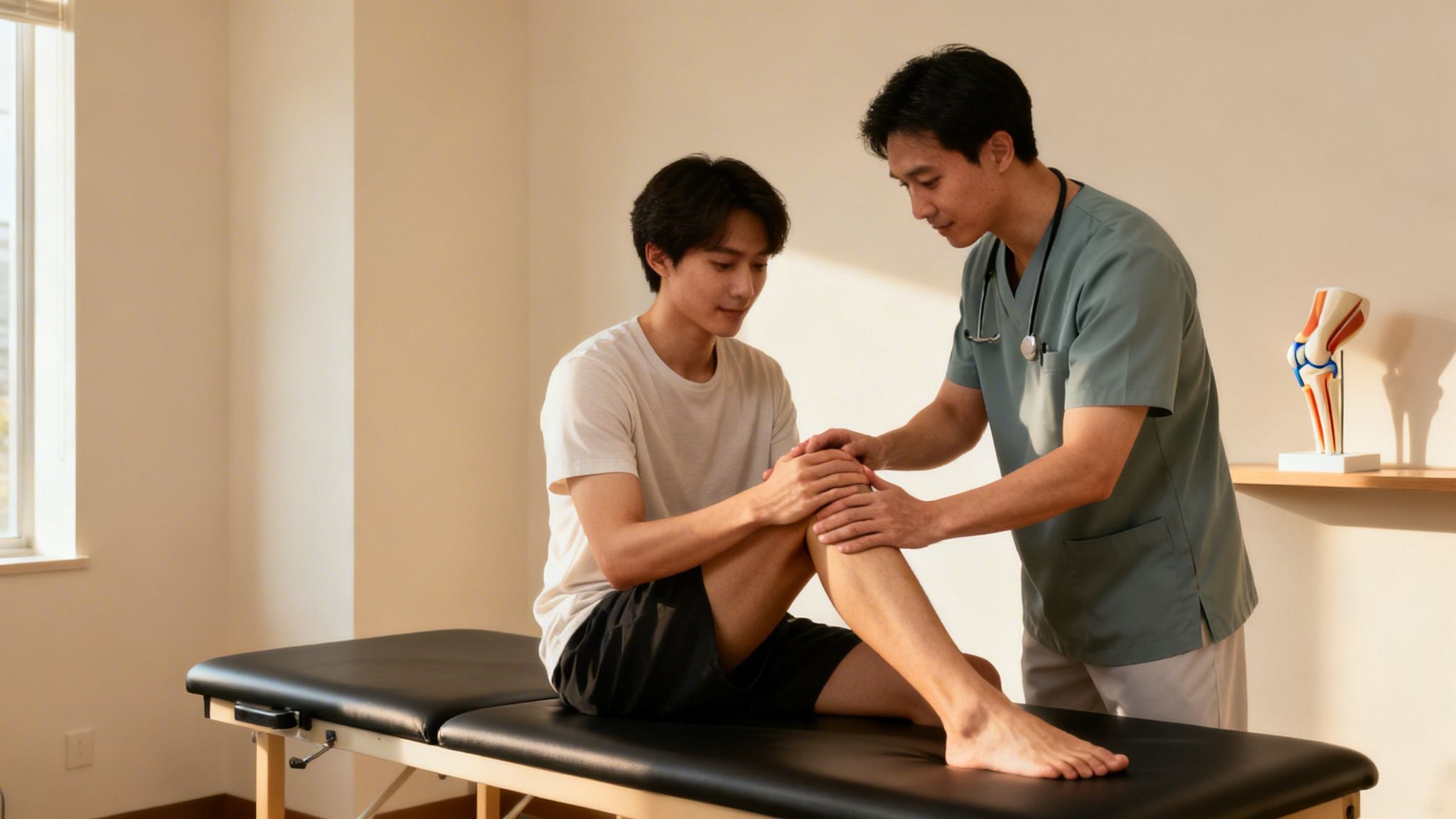
Starting a program of knee pain strengthening exercises on your own is a great first step. It shows you're ready to take control of your recovery. But here's the reality: following a generic plan often leads to frustration, stalled progress, or even new injuries. It’s the difference between guessing what might work and knowing exactly what your knee needs.
The most common pitfall we see at our Massachusetts clinics is incorrect exercise form. You might think you're strengthening your quads, but a slight, unintentional shift in your hips could be putting more strain on the very tissues you're trying to heal.
This isn't just a minor detail; it's a well-documented issue. Home exercise programs frequently fail because form breaks down quickly without professional feedback. In one study, after just one week, not a single participant could accurately replicate the movements they were taught. The errors were significant—one exercise showed 232% more unwanted hip rotation than intended, completely undermining its purpose.
From Guesswork to a Clear Diagnosis
This is where a licensed physical therapist at Peak Therapy changes everything. We move you from a world of guesswork to one of diagnostic certainty. Your journey with us doesn’t start with a list of exercises; it starts with a conversation and a comprehensive evaluation.
A physical therapist is a movement expert trained to identify the true source of your pain. Oftentimes, it’s not where you actually feel the ache. Your knee pain could easily stem from:
- Muscle Imbalances: A classic example is having overactive quads and weak glutes, which pulls your kneecap out of alignment.
- Poor Biomechanics: The way you walk, run, or climb stairs could be putting uneven stress on your knee joint without you even realizing it.
- Hip or Ankle Issues: Weakness or stiffness in the joints above and below the knee can have a powerful domino effect.
- An Underlying Condition: We can identify signs of issues like IT band syndrome or patellofemoral pain that require a very specific approach.
You shouldn't have to wonder if your efforts are helping or hurting. At Peak, our licensed physical therapists perform a comprehensive evaluation to determine the root cause of your knee pain and develop a personalized treatment plan, giving you the confidence that every exercise is building you up, not breaking you down.
More Than Just Exercises
A personalized exercise plan is just one piece of the puzzle. When you come into one of our clinics—from Quincy to Hanover—you gain access to a full spectrum of care designed to accelerate your recovery. This includes hands-on techniques that you simply can't do at home.
Manual therapy is a cornerstone of our approach. This is where our therapists use skilled, hands-on techniques to mobilize joints, release tight muscles, and reduce pain. These targeted interventions can make an immediate difference in your comfort and mobility, which makes it much easier to perform your strengthening exercises correctly and without pain.
We also integrate advanced modalities when appropriate to support your body's natural healing process. This combination of expert evaluation, personalized exercise, and hands-on care is how we help patients achieve real, lasting results. This integrated approach is especially vital during post-surgical rehab, which you can read more about in our guide on how physical therapy supports post-surgery knee recovery.
Your Questions About Knee Strengthening Answered
Starting a new exercise program for knee pain naturally brings up questions. It's completely normal to feel a mix of hope and uncertainty. We hear these questions every day in our Peak Therapy clinics across Massachusetts, and our goal is to give you clear, reassuring answers based on clinical experience. Feeling confident and informed is a huge part of a successful recovery.
How Long Until My Knee Feels Better with These Exercises?
This is often the first thing people ask, and for good reason. While everyone’s recovery timeline is different, most of our patients report feeling a noticeable improvement in pain and stability within 4 to 8 weeks of starting a consistent, personalized exercise program.
These initial gains are largely neuromuscular—your brain is simply getting better and more efficient at activating the right muscles around your knee at the right time. This improved coordination provides immediate stability and can reduce pain surprisingly quickly.
True gains in muscle strength and size (hypertrophy) take a bit longer, typically becoming significant after about 8 to 12 weeks of dedicated work. A physical therapist at Peak Therapy can help set realistic expectations based on your specific condition, age, and activity level, ensuring your program is designed for the fastest, safest results.
Is It Normal to Feel Some Pain During Knee Exercises?
It's crucial to distinguish between "good pain" (muscle fatigue) and "bad pain" (joint irritation). Feeling a burn or a dull ache in the muscles you're targeting—like your quads or glutes—is a positive sign. That means you're challenging the muscles and they're getting stronger.
However, you should never feel sharp, stabbing, or increasing pain within the knee joint itself during an exercise.
We use a simple "stoplight system" with our patients to help them make safe decisions:
- Green Light: No pain at all. You're good to go.
- Yellow Light: Mild, achy discomfort in the muscle (not the joint) that doesn't get worse. This is generally okay.
- Red Light: Any sharp, shooting, or increasing pain inside the knee joint. This is your signal to stop the exercise immediately.
If you hit a red light, don’t try to push through it. A physical therapist can teach you how to modify exercises to stay in that safe, effective zone.
Can I Accidentally Make My Knee Pain Worse by Exercising?
Yes, unfortunately, it is possible to aggravate knee pain by exercising incorrectly. This is exactly why getting professional guidance is so important. The most common mistakes are using poor form, progressing too quickly, or simply choosing the wrong exercises for your specific condition.
For example, if your pain is from patellofemoral issues caused by weak hips, doing hundreds of leg extensions without also strengthening your glutes might only make the underlying imbalance worse.
At Peak Therapy, our first step is always a thorough evaluation. We don't guess; we get to the root cause of the problem. This ensures the personalized treatment plan we create for you is designed to heal your knee, not harm it. We will start you at a safe, foundational level and only progress you when your knee is ready for the next challenge.
When Is It Time to See a Physical Therapist for Knee Pain?
While it’s tempting to wait and see if the pain just goes away, getting help early often prevents a minor issue from turning into a chronic problem. You shouldn't have to stop doing what you love because of knee pain. We recommend scheduling an appointment with a physical therapist if your knee pain:
- Lasts for more than a week or two without improving.
- Interferes with your daily life, like walking, climbing stairs, or sleeping.
- Was caused by a specific injury or came on with noticeable swelling.
- Makes your knee feel unstable, like it might "give way" or buckle.
You don't need to be in agony to benefit from physical therapy. Even a nagging ache that keeps you from your weekend hobbies is a good reason to get it checked out. At our clinics across the South Shore, from Braintree to Plymouth, we can provide a clear diagnosis and a personalized plan to get you on the road to recovery right away.
Don't let knee pain dictate your life. The expert team at Peak Physical Therapy and Sports Performance is here to provide the personalized care and expert guidance you need to move better, feel stronger, and live fully. Schedule your evaluation today by visiting us at https://peaktherapy.com.