


If you’re facing knee replacement surgery, we understand that the unknown can feel daunting. Having a clear knee replacement recovery timeline helps turn that uncertainty into a reassuring, step-by-step plan. While full recovery is a journey that takes anywhere from three months to a year, you’ll hit major milestones, like walking with less help and handling daily life, within the first 3 to 6 weeks.
Your Recovery Roadmap: What to Expect and When
It helps to think of your recovery as a roadmap, guiding you from the operating room right back to the life you want to live. The journey starts the moment surgery is over, with each week building on the progress you’ve already made. It’s a process of healing and rebuilding, where your small, consistent efforts add up to big wins in mobility and freedom from pain.
We get it—you’re probably feeling a mix of hope and nervousness. You’re ready to get back to walking your dog around your Massachusetts neighborhood, playing with your grandkids, or just getting around your own home without that frustrating, constant pain. The great news is that knee replacement has come a long way, and our focus is on getting you moving safely and quickly.
To give you a clearer picture, here’s a quick overview of what the journey typically looks like. This table breaks down the key phases, what our licensed physical therapists will help you work on, and what you can generally expect to be doing at each stage.
Knee Replacement Recovery At-A-Glance
| Recovery Phase | Typical Timeframe | Key Milestones and Goals |
|---|---|---|
| Immediate Post-Op | Days 0–2 | Managing pain and swelling. Standing and walking with a walker. Starting gentle range-of-motion exercises prescribed by your therapist. |
| Early Recovery | Weeks 1–6 | Increasing knee bend (flexion) and straightening (extension). Transitioning from a walker to a cane. Walking for short distances. |
| Mid-Recovery | Weeks 6–12 | Returning to most daily activities and light-duty work. Walking without assistance. Driving (once off pain meds). Focus on building strength. |
| Long-Term Rehab | 3–12+ Months | Regaining full strength and endurance. Returning to recreational activities and sports. Fine-tuning balance and coordination for long-term joint health. |
This timeline is a great guide, but remember, your Peak Therapy physical therapist will develop a personalized treatment plan specifically for your progress and goals.
Early Progress Milestones
Most patients are up and walking with a walker or crutches either the same day as their surgery or within 24 hours. Getting you moving right away is key to preventing stiffness, reducing the risk of complications, and promoting healing.
During that first week, your main goals are to manage pain and get your knee to bend to about 70 degrees. By week two, we’re aiming for a 90-degree bend, which is enough to allow for short walks with a cane. Come week three, you'll start walking for longer distances as your range of motion continues to improve.
This visual shows how you’ll likely progress from needing a walker to walking on your own in just a few short weeks.
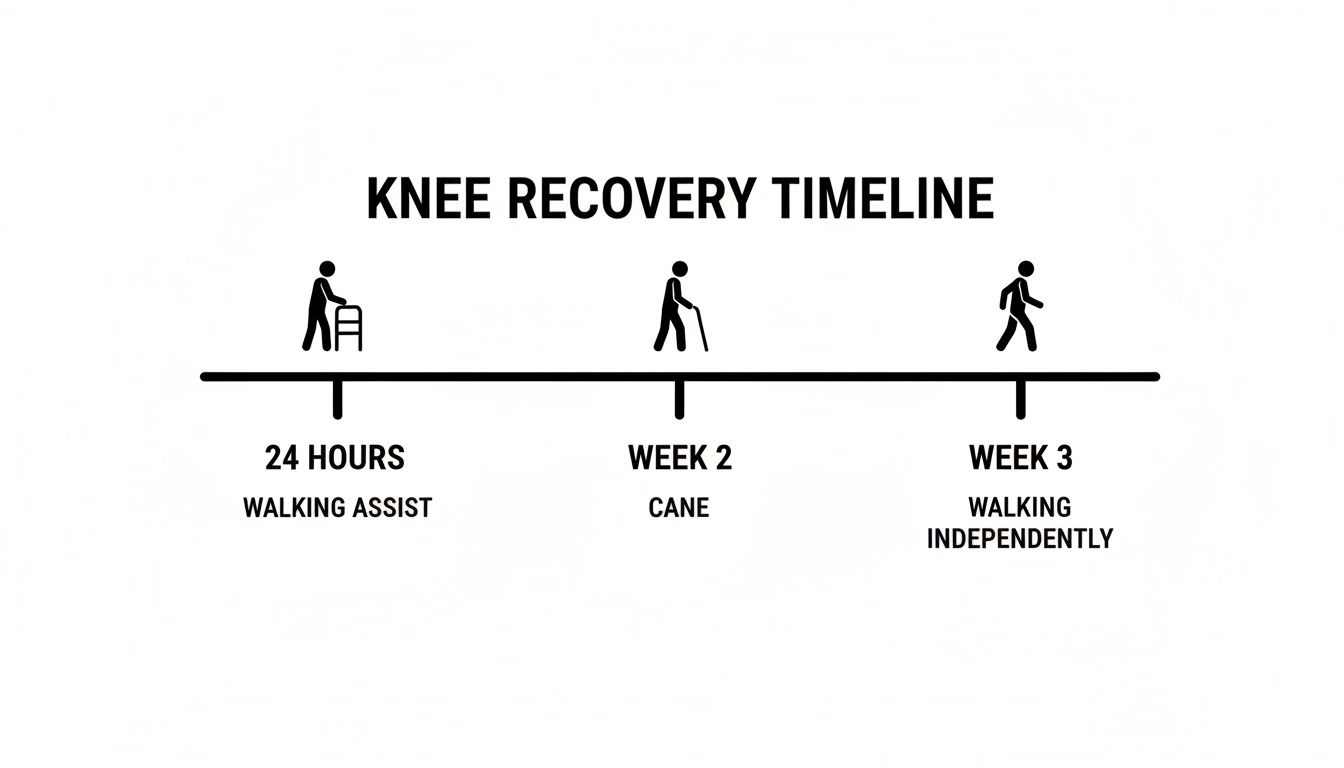
Seeing this progression helps highlight just how quickly you can expect to regain your independence—a huge milestone in your early recovery.
The Role of Guided Physical Therapy
Your commitment to physical therapy is the single most important part of your recovery. A structured, guided plan from an expert is the key to safely rebuilding your strength and getting your full range of motion back.
At Peak Therapy, our licensed physical therapists don’t use "one-size-fits-all" protocols. We perform a comprehensive evaluation to develop a personalized treatment plan that’s all about you. We’ll partner with you to set goals that matter and make sure your new knee works beautifully for years to come.
Your therapist will be your guide through every phase, from those first careful steps to the strengthening exercises that get you back to doing what you love. To learn more about this crucial partnership, you might find it helpful to read our guide on how post-operative rehabilitation restores mobility after joint surgery. Working together is what keeps your recovery on track and gives you the confidence to move forward.
The First Six Weeks: Your Foundation for Healing
The first six weeks of your knee replacement recovery are the most important. This is where you and your physical therapist will lay the groundwork for your long-term success, starting with your very first steps in the hospital and ending with you regaining confidence in your day-to-day life. It’s an intensive period, but with the right guidance, you’ll be amazed at the progress you can make.

This phase is all about tackling the early challenges while celebrating small, crucial wins. We’ll be focused on controlling your pain and swelling, hitting key range-of-motion goals, and safely getting you back on your feet.
The First 48 Hours Post-Surgery
Your recovery starts the moment you leave the operating room. Thanks to modern surgical protocols, you’ll likely be out of bed and standing with a physical therapist’s help within 24 hours. We know that might sound daunting, but getting moving early is one of the best things you can do to prevent stiffness, lower the risk of blood clots, and jumpstart the healing process.
Before you’re discharged from a Massachusetts hospital like South Shore Hospital or BID-Plymouth, your care team will make sure you can:
- Stand up and walk a short distance using a walker or crutches.
- Safely get in and out of a bed and a chair.
- Manage your pain with the prescribed medication plan.
- Perform basic exercises, like ankle pumps and quad sets.
Taking those first steps is an empowering moment that sets a positive tone for the weeks to come.
Weeks 1-3: Building Your Base
Once you're home, your outpatient physical therapy begins in earnest. This is where our team at Peak Therapy steps in to become your dedicated partner. Whether you’re seeing us at our Quincy, Braintree, or Weymouth clinics, we’ll guide you through this critical phase with a personalized treatment plan.
During these first three weeks, your recovery will revolve around three main goals:
- Managing Swelling: Swelling is the body’s normal response to surgery, but getting it under control is essential for regaining motion and reducing pain. Your therapist will show you the right way to ice and elevate your leg. For a deeper look, check out our guide on managing post-operative swelling through effective rehabilitation.
- Achieving Full Extension: Getting your knee completely straight—to 0 degrees of extension—is a top priority. This is vital for a normal walking pattern, and it’s something we start working on from day one.
- Increasing Bending (Flexion): We’ll work with you to gradually and safely bend your knee. The goal is to reach 90 degrees of flexion in the first couple of weeks. Hitting this milestone is what allows you to sit comfortably in a chair and get in and out of a car.
As your strength and confidence build, you’ll likely graduate from a walker to a single crutch or a cane. Simple daily tasks will start to feel easier, but it's crucial to listen to your body and avoid overdoing it. Showering safely can also be a challenge at first; an accessible walk-in shower can make a huge difference in reducing fall risk and making daily hygiene easier.
Weeks 4-6: Gaining Independence
This is where all your hard work really starts to pay off. You’ll notice a big drop in pain and a major improvement in how well you can move. Your physical therapy sessions will become more advanced as we add exercises to build strength in the muscles that support your new knee.
This phase is incredibly rewarding. It's when our patients start to feel like themselves again. You're not just healing—you're actively rebuilding the strength that will let you walk the beach in Scituate or browse the shops in Hingham without a second thought.
By the end of week six, many of our patients can:
- Walk without a cane or walker, at least for shorter distances.
- Go up and down stairs with more confidence and strength.
- Stand for longer periods to do light household chores.
- Achieve 110-120 degrees of flexion, allowing for much more fluid movement.
Even though you’ll feel a lot better, having some stiffness or swelling after activity is still completely normal. This six-week mark is a massive turning point in your knee replacement recovery, and it sets a strong foundation for the next stage of your comeback.
Weeks Six To Twelve: Building Strength And Independence
The first six weeks are behind you, and this is where things start to get exciting. This period, from weeks six to twelve, marks a huge shift in your knee replacement recovery. The intense, early healing is done, and now our focus turns from just getting you moving to building real, functional strength so you can get your independence back.
This is when you finally start to feel less like a patient and more like yourself again.

During these weeks, your sessions with a Peak Therapy specialist will start to look and feel different. We'll advance your program to include more challenging exercises that rebuild the muscles supporting your new joint. This work is what ensures the long-term success of your knee replacement.
Graduating To Advanced Exercises
While we’ll still keep an eye on your range of motion, the main goal now is building power and endurance in your new knee. Think of it as graduating from learning to walk again to learning how to walk with confidence and strength for the long haul.
As you move beyond the initial healing, adding targeted exercises is crucial. Incorporating dedicated knee strengthening exercises will rebuild stability and help you regain full independence.
Your personalized physical therapy plan will now include:
- Stationary Cycling: This is an incredible low-impact way to improve your knee’s flexibility and get your heart rate up, all without putting stress on the new joint.
- Targeted Strengthening: We'll introduce resistance bands or light weights to fire up your quadriceps, hamstrings, and glutes. These are the muscles that act as your knee’s own personal support system.
- Balance Training: You’ll perform exercises that challenge your stability. This is absolutely critical for preventing falls and helping your new knee feel less like an implant and more like a natural part of you.
This progression is always managed carefully by your licensed physical therapist, ensuring you’re challenged safely. From our South Shore clinics in Hanover to Pembroke, our team helps patients build this crucial muscle stability, protecting the new joint for years of activity.
Reaching Major Life Milestones
This phase is so rewarding because you start to reclaim the little—and big—parts of your life. The frustration of needing help fades as you begin hitting exciting milestones, and your world starts to feel a whole lot bigger.
This is the stage where our patients' confidence soars. They start walking into our clinics without a cane, sharing stories about driving to the grocery store or sleeping through the night without pain for the first time in months. It’s a powerful reminder of why they went through surgery in the first place.
Between weeks six and twelve, you can usually look forward to these key milestones:
- Walking Without Assistance: Most patients are able to confidently walk without a cane or walker, both around the house and for longer distances outside.
- Returning to Driving: Once you’re off narcotic pain medication and have the strength and reaction time needed, your surgeon will likely give you the green light to drive again. This is a huge step toward independence!
- Managing Daily Life with Ease: Things like carrying groceries, doing chores, and tackling stairs become much less of a production.
- Sleeping Better: As pain and stiffness continue to decrease, you can often find a comfortable sleeping position without being woken up by your knee.
Even though you'll feel a world better, it's perfectly normal to still have some mild swelling or warmth, especially after a busy day or a tough PT session. This is just part of the long-term healing process. For a deeper look at how physical therapy supports you, explore our guide on how physical therapy supports post-surgery knee recovery.
By the three-month mark, you’ll have built a solid foundation for the final stretch of your recovery.
Three Months to One Year: The Journey to Full Function
You’ve made it through the toughest part of your knee replacement recovery. This next phase, from three months up to a year, is where you transition from actively healing to truly living with your new knee. It's less about intensive recovery and more about rediscovering your freedom from the pain that held you back.
The focus now shifts to fine-tuning your strength, building up your endurance, and getting back to the activities you love. Your new joint is solid, but the real work is in strengthening the muscles around it. That’s what gives you the confidence to trust your knee again.
Defining Your New Normal
By the three-month mark, most people notice a huge difference. Pain has dropped off significantly, and you're moving much more freely. Many patients feel they are about 80% recovered at this stage, but that feeling of being "fully recovered" really settles in over the next several months.
So, what does that feel like?
- Minimal Pain: Daily activities are no longer a chore, and you aren't reaching for pain medication.
- Excellent Mobility: You can walk, take the stairs, and stand up from a chair without that old stiffness or limitation.
- Renewed Confidence: You simply stop thinking about your knee with every step. You just trust it to be there for you.
This is the point where you might start planning that round of golf at one of the courses near Duxbury, feel up for a long walk through Wompatuck State Park, or get down on the floor to play with your grandkids without a second thought. Our therapists at Peak Therapy help you build the specific strength needed for these goals, making sure your return is both safe and successful.
Continuing Your Progress With Maintenance
Even though your formal physical therapy sessions might become less frequent after three months, the work isn't quite over. Think of it as ongoing maintenance for a high-performance engine; you have to keep it tuned up. Continuing with a home exercise program is what guarantees long-term success.
Your physical therapist will set you up with a routine designed to maintain your strength and flexibility for years to come.
"Full recovery isn’t a finish line you cross at 12 weeks. It’s the point where you have the strength and confidence to do what you love again, without pain holding you back. This long-term phase is about making that freedom last a lifetime."
It's perfectly normal to feel some occasional stiffness or a minor ache, especially after you try a new or more strenuous activity. The key is to listen to your body and stick with the good habits you learned in PT. Your knee will continue to improve for up to a full year as the last bits of swelling resolve and your muscles hit their peak strength.
Long-Term Durability and Success
A question we hear all the time is, "How long will my new knee last?" The great news is that modern knee replacements are incredibly durable. An extensive review of data shows that today’s implants are built for the long haul, allowing you to plan for decades of active living. You can read more on the topic from Healthline to understand the expected lifespan.
By the one-year mark, most patients have forgotten the limitations that led them to surgery in the first place. The pain that once dictated their lives is gone, replaced by the freedom of movement. It’s a journey that takes patience and effort, but the payoff—a vibrant, active life—is more than worth it.
When Can I Get Back to My Life? Driving, Work, and Hobbies
Of all the questions we hear at our Massachusetts clinics, "When can I get back to my normal life?" is easily the most common. It’s a question loaded with hope—the hope of returning to a job you love, driving to see friends, or just enjoying your favorite hobbies without a second thought.
There’s no single date we can circle on the calendar for you. Instead, your return to daily life is a personal journey, one that depends on your specific surgery, the demands of your job, and how your body heals. Still, having a general framework helps you set realistic goals with your physical therapist.
Getting Back Behind the Wheel
Regaining the freedom to drive is a huge milestone. For most people, this happens around four to six weeks after surgery, but it’s not a hard-and-fast rule.
Before you get back in the driver’s seat, you need to be absolutely sure it’s safe. That means two things:
- You must be completely off all narcotic pain medications. These drugs significantly slow your reaction time.
- You need to have enough strength and control in your surgical leg to hit the brake hard and fast in an emergency.
Your Peak physical therapist will work with you on specific exercises to sharpen your reaction time and build that crucial leg strength, giving you the confidence to get back on the road safely.
Returning to Your Job
How quickly you can return to work depends almost entirely on what you do for a living. This is where a personalized recovery plan really shines.
- Sedentary or Desk Jobs: If your work is mostly office-based, you might be back within four to six weeks. For a commuter taking the train from Weymouth into a Boston desk job, the focus might be on improving sitting tolerance and safely navigating public transit.
- Physically Demanding Jobs: If you're a tradesperson in Norwell or have a job that requires a lot of standing, walking, lifting, or climbing, your timeline will be longer. A return to work is more likely in three to six months to ensure your knee is strong enough to handle the daily strain without risk of re-injury.
While everyone is different, research shows patients average about 7.7 weeks away from work for total knee replacements and just 5.9 weeks for partial ones. Most people—around 70-80%—are back on the job within three to six months. Things like a strong desire to return, good pre-op mental health, and an accessible workplace can definitely speed things up. You can explore the full findings on return-to-work timelines and influencing factors to see more of the data.
The goal isn't just to return to work—it's to return with the strength and confidence to do your job without pain or fear of re-injury. A personalized physical therapy plan from one of our licensed therapists is the bridge that gets you there.
Resuming Hobbies and Low-Impact Sports
Getting back to the activities that bring you joy is the ultimate reward for all your hard work. Your physical therapist will be your guide, helping you reintroduce them safely and gradually.
After a knee replacement, low-impact sports are your best friend. They help build strength and endurance without putting too much stress on your new joint.
- Swimming and Water Aerobics: Once your incision has completely healed (usually around 6 to 8 weeks), you can get in the pool. The buoyancy of water creates a perfect, gentle environment for exercise.
- Stationary Cycling: This is often one of the first exercises we introduce in physical therapy. It’s fantastic for regaining your range of motion and building strength.
- Golf, Doubles Tennis, and Bowling: These activities can often be resumed around the three-month mark, once your strength, balance, and mobility are up to the task.
Your path back to an active lifestyle is a step-by-step process. By working closely with your Peak physical therapist, you’ll have a clear and hopeful roadmap to reclaiming the life you love.
Taking the Next Step with Peak Physical Therapy
Knowing the knee replacement recovery timeline is one thing, but having an expert physical therapy team in your corner makes all the difference. A new knee joint is an incredible tool, but the freedom it promises is earned through dedicated, guided rehabilitation. At Peak Physical Therapy, our entire focus is on helping you navigate each phase of recovery with a plan designed to get you back to the life you love.

We understand that facing major surgery and a long recovery can be frustrating and uncertain. That’s why our approach is built on one-on-one care, deep clinical expertise, and genuine encouragement every step of the way.
A Personalized Plan for Each Phase
You’ll see the difference a tailored strategy makes from your very first appointment. We don’t believe in generic protocols. Instead, your licensed physical therapist will conduct a thorough evaluation to create a plan that matches your specific goals and your body’s unique pace of healing.
- Early Recovery (Weeks 1-6): Our first priority is managing pain and swelling. We use gentle, hands-on manual therapy and proven techniques to help you hit those critical early range-of-motion milestones, like getting your knee fully straight and achieving that crucial 90-degree bend.
- Mid-Recovery (Weeks 6-12): As you start feeling more like yourself, we’ll advance your exercises to build the functional strength and stability you need. This is where we prepare you to get back behind the wheel, return to work, and simply move with renewed confidence.
- Long-Term Function (3-12 Months): Here, we shift our focus to your higher-level goals. Whether that means returning to the golf courses on the South Shore or just walking the beach in Scituate without a second thought, we help you build the strength and endurance to make your results last.
The timeline is your map, but your physical therapist is your guide. We are committed to helping you navigate every part of the journey, ensuring you not only heal but come back stronger than before.
Convenient, Expert Care Across Massachusetts
With 13 convenient locations across the South Shore—from Quincy and Braintree to Plymouth and Duxbury—expert post-surgical care is always close by. We make it easy to get started and even offer specialized programs like aquatic therapy, which can help speed up healing in a comfortable, low-impact environment.
Your goal is to move freely and live fully. Our mission is to help you get there. Don't leave your recovery to chance. Contact Peak Physical Therapy today to schedule your initial evaluation and take the most important step in your knee replacement recovery.
Your Knee Replacement Recovery Questions, Answered
It's completely normal to have questions as you begin your recovery journey. We understand that knowing what to expect can ease your mind and help you focus on what’s important: healing. Here are a few of the questions we hear most often from our patients at our Massachusetts clinics.
How Much Pain and Swelling Should I Expect?
Pain and swelling are a normal part of the healing process. You'll feel it most in the first one to two weeks after your operation, but it will steadily improve from there. Your surgeon will manage your pain with medication, while your physical therapist will teach you how to control swelling using ice, elevation, and gentle movements.
While most of your discomfort should fade by week six, it's common to have some mild, lingering swelling for three to six months, especially after a busy day on your feet. Keep in mind, if you ever have a sudden, sharp increase in pain or swelling that seems out of place, it’s important to call your doctor’s office right away.
What Range of Motion Goals Do I Need to Hit?
Getting your knee moving again is one of the most important parts of your recovery. Our licensed physical therapists focus on two key milestones to get you back to your life:
- Full Extension (0 degrees): This just means getting your knee completely straight. We start working on this from day one because it’s the key to walking with a normal, smooth gait.
- Flexion (Bending): We aim for 90 degrees of bend within the first couple of weeks. Hitting this goal is a big deal—it means you can sit down in a normal chair and get in and out of a car without a struggle. By six weeks, we’ll be pushing for 110-120 degrees to unlock even more function.
Your Peak Physical Therapist will track your progress every step of the way. We use proven hands-on manual therapy and targeted exercises to help you reach these goals safely, without ever pushing you too hard or too fast.
Is There Anything I Can Do to Speed Up My Recovery?
Absolutely. The single biggest factor in your recovery speed is your dedication to your physical therapy program. Patients who consistently do their home exercises and follow their therapist's advice almost always recover faster and have better long-term results.
Beyond that, simple things can make a huge difference. Focusing on good nutrition, getting enough rest, and trying to maintain a positive mindset all help your body heal. Your fitness level before surgery matters, too—building strength beforehand can give you a real head start.
When Will My New Knee Feel “Normal”?
This is a great question, and the answer is all about patience. We understand how eager you are to feel like yourself again. While you’ll be walking and doing most of your daily tasks within a few weeks, it can take anywhere from six months to a full year for the knee to feel like it's truly yours.
In the beginning, you might notice some clicking sounds or a feeling of warmth, which is perfectly normal. As your muscles get stronger and the last of the stiffness fades, that new joint will feel more and more natural. By the one-year mark, most of our patients have stopped thinking about their knee entirely—they’re too busy enjoying their new, pain-free life.
Your recovery is a partnership, and having an expert guide can shape your success for years to come. At Peak Physical Therapy, our dedicated team is ready to create a personalized plan to help you move freely and live fully. Don't wait to get the support you need. Schedule your evaluation at one of our convenient Massachusetts locations by visiting us at https://peaktherapy.com.