


Maybe you’ve noticed leaking when you laugh, a heavy feeling after a walk, pain with intimacy, or a nagging sense that your body doesn’t feel the way it used to. You might be postpartum. You might be years past pregnancy. You might not have had children at all. What many people share is the same quiet thought: “Is this normal, and do I just have to live with it?”
You don’t.
Pelvic floor symptoms are common, but common doesn’t mean you should ignore them. In the U.S., pelvic floor disorders affect one in three women annually, which means roughly 40 million women could benefit from pelvic floor physical therapy, yet many conditions go unreported because of stigma, according to this overview of pelvic organ prolapse and pelvic floor disorders. Many men and children can benefit too, depending on the issue.
If you’re searching for pelvic floor therapy what to expect, you’re probably not looking for a vague overview. You want to know what will happen. Will it be awkward? Will it hurt? Do you have to do internal work on day one? How many visits will it take? What should you wear? What about insurance?
Those are reasonable questions. This guide walks through the process the way I’d explain it to a new patient in the clinic: calmly, clearly, and step by step.
Your First Step Toward Pelvic Health
A lot of patients tell me they waited months, or even years, before making the call.
Some were embarrassed by urine leakage during workouts. Others assumed pelvic pressure after childbirth was just part of getting older. Some had pain but couldn’t describe it well, so they kept putting off care. By the time they arrive, many are frustrated and a little nervous.

You are not overreacting
Pelvic floor problems can affect basic daily life.
That might mean planning errands around bathrooms, avoiding exercise, bracing before a sneeze, or feeling anxious about intimacy. These symptoms can be physically uncomfortable, but they can also chip away at confidence.
Many people wait because the symptoms feel private. In reality, pelvic floor concerns are some of the most treatable issues we see.
Why therapy is often the right starting point
Pelvic floor physical therapy is a non-invasive, individualized approach that focuses on how your muscles work, how they coordinate with breathing and movement, and what’s driving your symptoms.
That matters because pelvic floor problems aren’t always caused by weakness alone. Sometimes the muscles are tight, guarded, and not letting go well. Sometimes they’re uncoordinated. Sometimes the issue involves posture, abdominal pressure, scar tissue, bowel habits, or how your body manages exercise.
If movement tends to flare your symptoms, it can also help to review practical self-management ideas like these strategies to relieve pelvic pain after exercise. That kind of day-to-day guidance often works best alongside a full evaluation so you know which strategies fit your body.
Understanding Your Pelvic Floor Muscles
Your pelvic floor muscles sit at the bottom of your pelvis and form a supportive layer for the bladder, bowel, and reproductive organs. They are small, but they do a lot of work that people rarely notice until something feels off.
A simple way to understand them is to picture a group of muscles that must respond at the right time and with the right amount of effort. They help close when you need control. They help let go when you need to urinate, have a bowel movement, or tolerate intimacy comfortably. They also work together with your breathing, abdominals, hips, and low back during lifting, exercise, and everyday movement.
That balance matters more than many patients expect.
These muscles need strength and release
Pelvic floor problems are often described as a weakness issue, but that explanation is incomplete. Some patients do have muscles that are underactive and do not generate enough support or endurance. Others have muscles that stay guarded, tense, or poorly coordinated, which can create a very different set of symptoms.
A helpful comparison is a hand that never fully unclenches. Even if it feels strong, it cannot do fine tasks well because it cannot relax on cue. Pelvic floor muscles work in a similar way. Good function depends on timing, control, and the ability to both contract and release.
Here are two patterns a therapist may be sorting through:
| Pattern | What it means | Common experiences |
|---|---|---|
| Hypotonic | The muscles have low tone or reduced strength and endurance | Leakage, reduced support, feelings of heaviness |
| Hypertonic | The muscles stay too tense or do not relax well | Pelvic pain, constipation, painful intercourse, difficulty letting go |
Some patients fit neatly into one pattern. Many do not. A muscle can be tense, fatigued, and weak at the same time, which is one reason online advice and generic Kegels can miss the mark.
Why the difference matters
Treatment depends on what the muscles are doing, not what the symptoms seem to suggest at first glance. If the pelvic floor is overworking and not relaxing, more strengthening may increase pressure and irritation. If the muscles are not generating enough support, targeted strengthening and coordination work may help a great deal.
Practical rule: the right exercise matches your current muscle pattern, your symptoms, and your goals.
This is also why pelvic floor therapy rarely focuses on one small body part in isolation. At Peak Physical Therapy and Sports Performance, we often explain it as a team effort. Your diaphragm manages pressure from above. Your abdominal wall and back help stabilize the trunk. Your hips and posture influence how force travels through the pelvis. If one part of that system is off, the pelvic floor often tries to compensate.
Understanding that bigger picture can make the therapy process feel much less mysterious. It also helps explain why your treatment plan may include breathing work, movement retraining, bowel or bladder habit coaching, and home exercises, not just pelvic floor contractions.
Your First Appointment The Initial Evaluation
The first visit is usually the one people worry about most. Once they’ve done it, most say the anticipation was harder than the appointment itself.

It starts with a conversation
Your evaluation is often 45 to 60 minutes long in pelvic floor care, and the first part is talking through your story. A good evaluation isn’t rushed.
You may be asked about:
- Your symptoms like leakage, urgency, constipation, pressure, pelvic pain, or pain with sex
- Your history including pregnancies, surgeries, injuries, back pain, exercise habits, and bowel or bladder changes
- Your goals such as returning to running, lifting without pain, getting through a workday more comfortably, or feeling less anxious about leakage
This part matters because symptoms that seem unrelated often connect. A patient may come in for urinary urgency and mention tailbone pain. Another may come in for pelvic heaviness and also have trouble with breath holding during lifting.
Then comes an outside movement assessment
Before any internal exam is discussed, your therapist may assess how your body moves from the outside.
That can include posture, breathing pattern, abdominal control, hip mobility, back movement, and how you squat, sit, or bear down. This helps identify pressure patterns and movement habits that may be contributing to symptoms.
There’s also a meaningful connection between the pelvic floor and low back symptoms. Johns Hopkins notes that initial assessment may include biofeedback to measure muscle function during rest, contraction, and relaxation, and cites evidence that 95.3% of women with low back pain had pelvic floor dysfunction in one study in that overview of pelvic floor therapy assessment and treatment methods.
Internal assessment is optional
Many patients feel the most uncertainty when considering an internal pelvic floor assessment. This assessment can provide valuable information about muscle tone, tenderness, coordination, and strength, but it is always your choice.
You can ask questions first. You can say no. You can defer it to a later visit. You can stop at any time.
When it is appropriate and you consent, the assessment is gentle and focused on muscle function, not a gynecologic exam. The purpose is to understand whether the muscles are underactive, overactive, poorly coordinated, or sensitive.
Biofeedback can help make things clearer
Some evaluations use biofeedback as part of the baseline assessment. This technology records muscle activity during rest, squeeze, and relaxation.
That can help show whether the muscles can:
- Activate well
- Hold a contraction
- Return to resting baseline after effort
For some patients, seeing that information on a screen makes the problem feel less vague and more understandable. It also helps shape a plan that fits what your body needs.
Core Pelvic Floor Therapy Treatments and Techniques
Pelvic floor treatment usually works like a toolbox, not a single exercise prescription. Your therapist chooses the tools that match your symptoms, exam findings, daily activities, and comfort level.
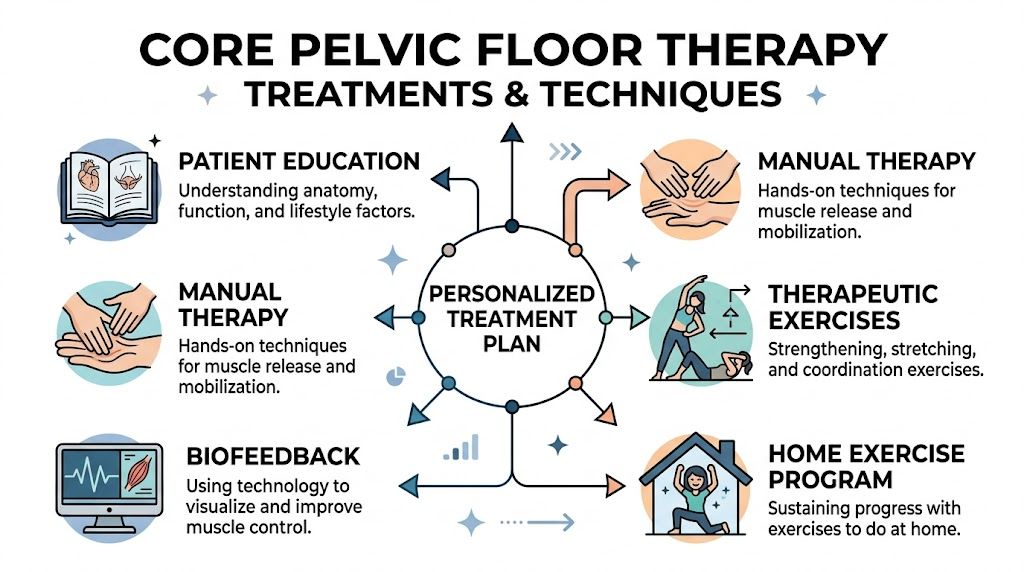
Manual therapy
Some pelvic floor muscles are weak. Some are tight, guarded, irritated, or poorly coordinated. When tension and restriction are part of the problem, manual therapy can help calm the area down and restore more normal movement.
This may involve external treatment to the abdomen, hips, glutes, inner thighs, tailbone region, or low back. In some cases, it may also include internal soft tissue treatment if that matches your symptoms and you give consent.
The goal is comfort and function. Your therapist is not trying to force tissue to change through pain. They are helping muscles release protective holding patterns, improving mobility, and reducing the sensitivity that can keep the whole system on high alert.
If muscle guarding sounds familiar, this overview of pelvic floor muscle spasm treatments explains why relief often requires more than strengthening alone.
Retraining and exercise
Pelvic floor rehab includes learning the right skill at the right time.
For one patient, that means improving strength and endurance. For another, it means learning how to relax after years of clenching. A third patient may need both, because the pelvic floor has to contract when support is needed and let go when it is time to urinate, have a bowel movement, or tolerate penetration comfortably.
Your plan may include:
- Breathing drills to improve pressure control and muscle coordination
- Mobility work for the hips, spine, rib cage, or pelvis
- Strengthening for the pelvic floor, abdominals, hips, and glutes
- Functional retraining for coughing, lifting, running, jumping, or gym activities
A useful comparison is learning to use brakes and gas pedals smoothly. Muscles that only squeeze and never relax are not functioning well. Muscles that relax but cannot support you are not functioning well either. Therapy builds control in both directions.
Biofeedback as a training tool
Biofeedback can also be part of treatment, not just assessment. It gives you visual or auditory feedback about what the muscles are doing while you practice contracting, relaxing, or coordinating with breath.
That helps clear up a common point of confusion. Many patients discover they are bearing down instead of lifting. Others are working hard to squeeze but not returning to a resting state afterward. The connection between seemingly unrelated symptoms is often significant, especially when urgency, pain, pressure, constipation, and low back or hip tension show up together.
Seeing the muscle response in real time often makes home practice feel more concrete and less like guesswork.
Education that changes daily habits
Education is part of the treatment itself because symptoms are often shaped by everyday habits. Small changes in how you breathe, brace, sit, lift, empty your bladder, or respond to urgency can reduce strain on the pelvic floor throughout the day.
A pelvic floor plan often includes guidance on:
- Bladder habits, including whether frequent "just in case" trips are training the bladder to signal too early
- Bowel mechanics, such as positioning and breathing strategies that reduce straining
- Pressure management during lifting, exercise, and core work
- Home practice, so progress continues between visits
At Peak Physical Therapy and Sports Performance, pelvic health treatment may also include related orthopedic factors such as hip mobility, back mechanics, abdominal coordination, and return-to-sport demands. That broader view can be helpful because the pelvic floor does not work in isolation. It works as part of a pressure and movement system that involves the trunk, diaphragm, hips, and nervous system.
What a Typical Therapy Session Looks Like
A follow-up visit usually feels less like a formal exam and more like guided problem-solving.
You arrive, settle in, and start with a short check-in. Maybe your urgency was better this week but bowel movements were still difficult. Maybe you tried your breathing work during workouts and noticed less pressure. Maybe symptoms flared after a long commute or a weekend soccer tournament with your kids.
The first few minutes
Your therapist wants to know what changed since the last visit.
Not just whether pain is up or down, but what activities were easier, what felt confusing, and whether the home program felt realistic. This is how the plan stays personalized instead of becoming a generic set of exercises.
The treatment portion
One session might focus on downtraining and relaxation because your muscles still aren’t letting go well. Another might include progressive strengthening because control is improving and you’re ready for more challenge.
A typical session can include:
- Hands-on treatment for muscle tension or mobility restrictions
- Guided movement such as breathing, pelvic coordination, hip work, or core control
- Biofeedback practice if visual feedback helps your learning
- Functional practice for coughing, lifting, squatting, walking, or exercise-specific goals
Some days the work is quiet and subtle. Other days it feels more like orthopedic rehab or movement coaching.
Before you leave
You’ll usually finish by reviewing what to practice at home.
That home plan should feel doable. If a program is too long, too confusing, or increases symptoms, it needs adjustment. Good pelvic floor therapy builds independence over time, so each visit should leave you with more clarity, not more guesswork.
The best home program is the one you can actually follow consistently.
Navigating the Logistics of Your Care Plan
The importance of logistics is often underestimated. A good plan has to fit your schedule, your comfort level, and your budget.
How often you’ll come
Many pelvic floor programs follow a 6 to 12 week course with 1 to 2 sessions weekly, depending on your symptoms, goals, and how long the issue has been present. Some people need a shorter course. Others benefit from more time, especially when symptoms are longstanding or layered with orthopedic issues.
If you’re postpartum or recovering from surgery, timing may also matter. In some cases, starting 4 to 6 weeks after delivery or surgery is appropriate.
What to wear and what to bring
Keep it simple.
- Wear comfortable clothes that let you move easily
- Bring your questions so you don’t have to remember everything in the moment
- Bring relevant records if you’ve had surgery, imaging, or specialist visits
- Track your symptoms for a few days if patterns are hard to describe
Loose athletic clothing usually works well. You don’t need to prepare in any special way unless your therapist gives specific instructions.
Insurance and cost questions
This is one of the biggest stress points for patients, and many online guides skip it. Temple Health specifically notes that patient-facing resources often fail to answer practical financial questions like insurance coverage and out-of-pocket costs, even though those unknowns can lead people to stop before finishing a 6 to 12 session plan, as discussed in its article on pelvic floor therapy and patient concerns about cost.
That’s especially important in Massachusetts, where many families are already juggling high healthcare expenses, childcare, commuting, and work schedules.
Ask these questions before you start:
- Do I need a referral
- Is pelvic floor physical therapy covered under my plan
- What will my copay or coinsurance be
- How many visits are authorized
If bladder irritation or urgency is part of your concern, nutrition questions often come up too. This article on foods to avoid with pelvic floor dysfunction can help you think through symptom triggers between visits.
Realistic Outcomes and Life After Therapy
Success in pelvic floor rehab usually doesn’t feel dramatic. It feels relieving.
You cough and don’t leak. You go for a walk and don’t feel heavy pressure afterward. You can sit through a meeting without constantly thinking about your bladder. You return to exercise with less fear. You feel more in control of your body.

What the evidence supports
Supervised pelvic floor muscle training has strong support for urinary symptoms and quality of life. A systematic review and meta-analysis covering 10 studies and 1,648 women found meaningful quality-of-life improvement, and the summary data report that 58.8% of stress urinary incontinence patients had significant improvement after 12 months. Other programs reported 53% less pelvic pain and participants being 11% less likely to have moderate-to-severe depression after 12 weeks, according to this review of pelvic floor muscle training outcomes.
Those numbers are encouraging, but they also point to something important. Improvement often builds through consistent practice, follow-through, and the right program for your specific pattern.
Progress is personal
A postpartum patient may want to lift a car seat, return to running, or feel normal during intimacy again. An athlete may want better pressure control during jumping or sprinting. Someone with chronic pelvic pain may measure progress by fewer flares, better bowel function, and less guarding.
For patients managing leakage day to day while working on recovery, practical products can help bridge the gap. This guide to Understanding Urinary Incontinence Pads is useful if you want to compare options while symptoms are improving.
What happens after formal therapy
Pelvic floor PT is not a lifelong commitment. The goal is to leave with tools.
That may include a maintenance exercise routine, strategies for flare-ups, breathing techniques for lifting, and a better understanding of what your symptoms respond to. If pain has been part of your story, this resource on breaking through chronic pelvic pain can help you think about long-term self-management after discharge.
Recovery doesn’t require perfection. It requires a plan that fits your body and enough consistency to let that plan work.
Frequently Asked Questions About Pelvic Floor Therapy
Questions usually get more specific near the end of care. That is normal. Once the process feels less mysterious, people often want clear answers about comfort, timing, and whether pelvic floor therapy is meant for them.
Is pelvic floor therapy painful
Pelvic floor therapy should feel respectful and manageable, not overwhelming.
Some techniques can bring up tenderness, especially if muscles are tight, irritated, or guarding. A good therapist explains each step before it happens, checks in during treatment, and changes the plan if your body says a movement, position, or technique is too much. You are allowed to ask questions, pause, or say no at any point.
A helpful way to think about it is this. Sensitive muscles often react like a sore shoulder. Gentle, well-timed treatment can help. Pushing too hard usually does not.
Can men benefit from pelvic floor therapy
Yes. Men come to pelvic floor therapy for bladder leakage, urinary urgency, constipation, pelvic pain, tailbone pain, pain after surgery, and some sexual health concerns.
The pelvic floor is part of the same pressure and support system in every body. Your therapist looks at how those muscles work with breathing, the abdominals, the hips, and posture. The goal is not just to find a painful spot. The goal is to understand the pattern that is keeping symptoms going.
How soon after giving birth can I start
Many postpartum patients start after their follow-up with their medical provider, often around 4 to 6 weeks, if healing is on track. Some people need care sooner for education, breathing, body mechanics, or support with symptoms, while others are more comfortable waiting a bit longer.
Your timing depends on your delivery, your symptoms, your energy, and how healing is progressing. If you are unsure, ask. That first conversation can help you figure out whether it makes sense to book now, verify insurance benefits, or choose a later start date that feels more realistic.
Peak Physical Therapy and Sports Performance provides pelvic health physical therapy across Massachusetts’ South Shore, including clinics in Braintree, Quincy, Weymouth, Cohasset, Duxbury, East Bridgewater, Hanover, Kingston, Milton, Norwell, Pembroke, Plymouth, and Scituate. If you have been hesitating because the logistics feel unclear, a simple first call can answer practical questions about scheduling, location, and what to bring, so the process feels easier before you ever walk into the clinic.