


You wake up, roll onto your side, and feel that familiar catch in your shoulder. By the time you’ve poured coffee, your neck is stiff enough that backing out of the driveway feels awkward. Later, maybe it shows up again while trimming shrubs in Hanover, lifting a grandchild in Braintree, or trying to enjoy a walk along Duxbury Beach without that ache creeping from the base of your neck into the top of your shoulder.
A lot of South Shore residents brush this off as “just getting older.” Sometimes it is age-related wear. But that doesn’t mean you have to accept pain, stiffness, and shrinking movement as your new normal. Arthritis of the shoulder and neck is common, often manageable, and in many cases responds well to the right physical therapy plan.
Shoulder osteoarthritis affects nearly 1 in 3 people over age 60, with radiographic prevalence up to 32.8% in that group, according to the Arthritis Foundation’s overview of osteoarthritis of the shoulder. The big takeaway isn’t just that it’s common. It’s that many people wait too long before getting help.
Table of Contents
- That Morning Stiffness Isnt Just Age It Might Be Arthritis
- Understanding Shoulder and Neck Arthritis in Simple Terms
- Is It Arthritis Common Symptoms and When to Get Help
- Your First Visit What to Expect at Our South Shore Clinics
- A Closer Look at Physical Therapy for Shoulder and Neck Arthritis
- Staying Active and Managing Arthritis Pain at Home
- Take the First Step to Relief at a Peak Clinic Near You
That Morning Stiffness Isnt Just Age It Might Be Arthritis
The pattern is usually pretty recognizable once you know what to look for. You feel more limited first thing in the morning. Reaching overhead gets harder. Turning your head while driving takes more effort. Rest helps a little, but not enough. Then everyday tasks start shrinking around the pain.
For some people, the shoulder is the main problem. For others, the neck is driving the whole picture and the shoulder gets blamed. Often, both are involved. That’s one reason this gets so frustrating. The pain doesn’t always stay in one neat spot.
What it often looks like on the South Shore
A retired homeowner in Norwell may notice it while raking leaves or carrying bags from the garden center. Someone in Quincy may feel it after a long commute or a day at the computer. A boater in Cohasset may find docking, pulling lines, or lifting gear overhead suddenly feels much less simple than it used to.
Those are the moments when people usually start changing how they move without realizing it. They shrug more. They turn their whole body instead of their neck. They avoid one arm. That compensation can keep you functioning for a while, but it usually adds more strain.
Practical rule: If stiffness and pain keep returning in the same shoulder or neck, or you’re quietly avoiding movements you used to do without thinking, it’s time to get it checked.
Why waiting tends to backfire
Arthritic joints usually don’t like two extremes. They don’t like being overloaded, and they don’t like being ignored. Too much force can flare symptoms. Too little movement can make stiffness worse.
That’s where guided treatment helps. A physical therapist can sort out what’s irritated, what’s weak, what’s stiff, and what movements are still safe to train. If you want a quick read on early warning signs before booking, Peak has a helpful article on recognizing early arthritis symptoms and the benefits of physical therapy.
A lot of people come in worried they’ve waited too long. Usually, they haven’t. The earlier you deal with the loss of motion and the movement habits around it, the better your odds of getting back to gardening, golf, lifting, driving, and sleeping with less aggravation.
Understanding Shoulder and Neck Arthritis in Simple Terms
A healthy joint moves with very little friction. With arthritis, the joint surfaces get rougher, the area becomes irritated, and the muscles around it often tighten up to protect it. That combination can make everyday movement feel stiff, pinchy, weak, or unpredictable.
In the shoulder, people often notice it first when they reach into a cabinet, carry groceries, or try to sleep on that side. In the neck, it may show up more as turning stiffness, soreness after a long drive, or pain that spreads toward the shoulder blade. On the South Shore, I hear the same question all the time. "Is this my neck or my shoulder?" Often, it is both.

That overlap matters. If your shoulder hurts every time you pull weeds in Duxbury, the problem may still involve a stiff neck or upper back. If your neck feels jammed after a ride home to Marshfield, your shoulder blade and rotator cuff may be part of why it keeps flaring up. Treating only the sore spot often leads to short-term relief and a quick return of the same symptoms.
Two broad patterns patients should know
Wear-and-tear arthritis is the type many people mean when they say arthritis. Over time, the joint does not handle load as well, and motion can become stiffer, rougher, and more limited.
Inflammatory arthritis is different. It is driven more by the immune system and may affect several joints at once. If symptoms seem widespread, unusually irritable, or paired with swelling and fatigue, your medical provider may recommend lab work. In some cases, people may need to get an arthritis blood test from Lola as part of that bigger picture.
Here is the plain-English version:
| Area | What people usually feel | What often happens next |
|---|---|---|
| Shoulder arthritis | Pain reaching overhead, lifting, or sleeping on that side | People use the arm less, then lose motion and strength |
| Neck arthritis | Pain turning the head, stiffness after sitting, pain into the upper shoulder | People guard the area and build extra tension |
| Both together | Hard to tell which area started it | Daily tasks get slower, more awkward, and more tiring |
Why the neck and shoulder get tangled together
The shoulder depends on the shoulder blade, upper back, and neck to move well. If the neck is stiff, shoulder mechanics usually change. If the shoulder is painful, the neck muscles often tighten to compensate.
That is why someone comes into Peak PT saying their shoulder is the whole problem, but testing shows limited neck motion and poor shoulder blade control. The reverse happens too. A person may blame the neck, but the shoulder has lost range and strength from months of avoiding it.
Good treatment looks at the full chain. For South Shore patients who want to get back to gardening, golf, the gym, or getting out on the boat in Cohasset without paying for it later, that full-body view usually makes the difference.
Is It Arthritis Common Symptoms and When to Get Help
Sometimes arthritis announces itself clearly. More often, it creeps in. You stop reaching for the top shelf in your Weymouth kitchen with one arm. Your golf swing in Pembroke feels shorter and less comfortable. After the drive home to Scituate, your neck feels jammed and your shoulder blade is burning.
That slow build is why people second-guess themselves. They wonder if they slept wrong, overdid yard work, or just need a few days off. Sometimes that’s true. But if the same pattern keeps circling back, arthritis moves higher on the list.
Shoulder signs people notice first
Shoulder arthritis often feels mechanical. Certain motions are the problem, especially reaching overhead, reaching behind your back, putting on a coat, fastening a seatbelt, or lifting something away from your body.
Common signs include:
- Morning stiffness: The shoulder feels stuck when the day starts, then gradually loosens.
- Pain with overhead reach: Putting dishes away, washing your hair, or working in the garage becomes irritating.
- Pain lying on that side: Sleep gets interrupted because the joint doesn’t tolerate pressure well.
- A catching or grinding feeling: Some people notice rough movement, especially after inactivity.
- Loss of confidence in the arm: You start using the other hand for simple jobs.
Neck signs that can fool you
Neck arthritis isn’t always just neck pain. It can look like upper shoulder tension, headaches starting at the base of the skull, or discomfort when checking blind spots while driving.
You might notice:
- Turning is harder than tilting: Looking over your shoulder is more limited than looking down.
- Pain after static posture: Long desk work, reading, or phone use stiffens everything up.
- Symptoms that spread: Pain may travel into the upper trap, shoulder blade area, or arm.
- Headaches tied to stiffness: These often build as the neck tightens.
- A need to move your whole body: Instead of rotating your neck, you pivot from the trunk.
If symptoms seem widespread or you’re trying to sort out whether inflammation may be part of the picture, some patients also use outside medical resources to understand testing options, such as this article on how to get an arthritis blood test from Lola. That doesn’t replace an in-person exam, but it can help you ask better questions.
The key question isn’t “Do I have pain?” It’s “Has this pain started changing how I live?”
When not to wait
Most shoulder and neck arthritis symptoms can be assessed in a regular physical therapy setting. A few situations call for quicker medical attention.
Seek prompt evaluation if you have:
- Rapidly worsening weakness: Especially if the arm suddenly won’t lift or grip feels clearly reduced.
- Numbness that’s persistent or spreading: Especially if it’s paired with loss of coordination.
- Pain after a fall or direct injury: Arthritis and injury can overlap.
- Severe unrelenting pain at rest: Not just soreness with movement.
- Fever or unexplained illness with joint pain: That needs medical review.
For everyone else, the best time to get help is usually earlier than you think. If it hurts every morning, limits driving, interrupts sleep, or keeps you from the activities that make South Shore life feel like yours, it’s worth being assessed.
Your First Visit What to Expect at Our South Shore Clinics
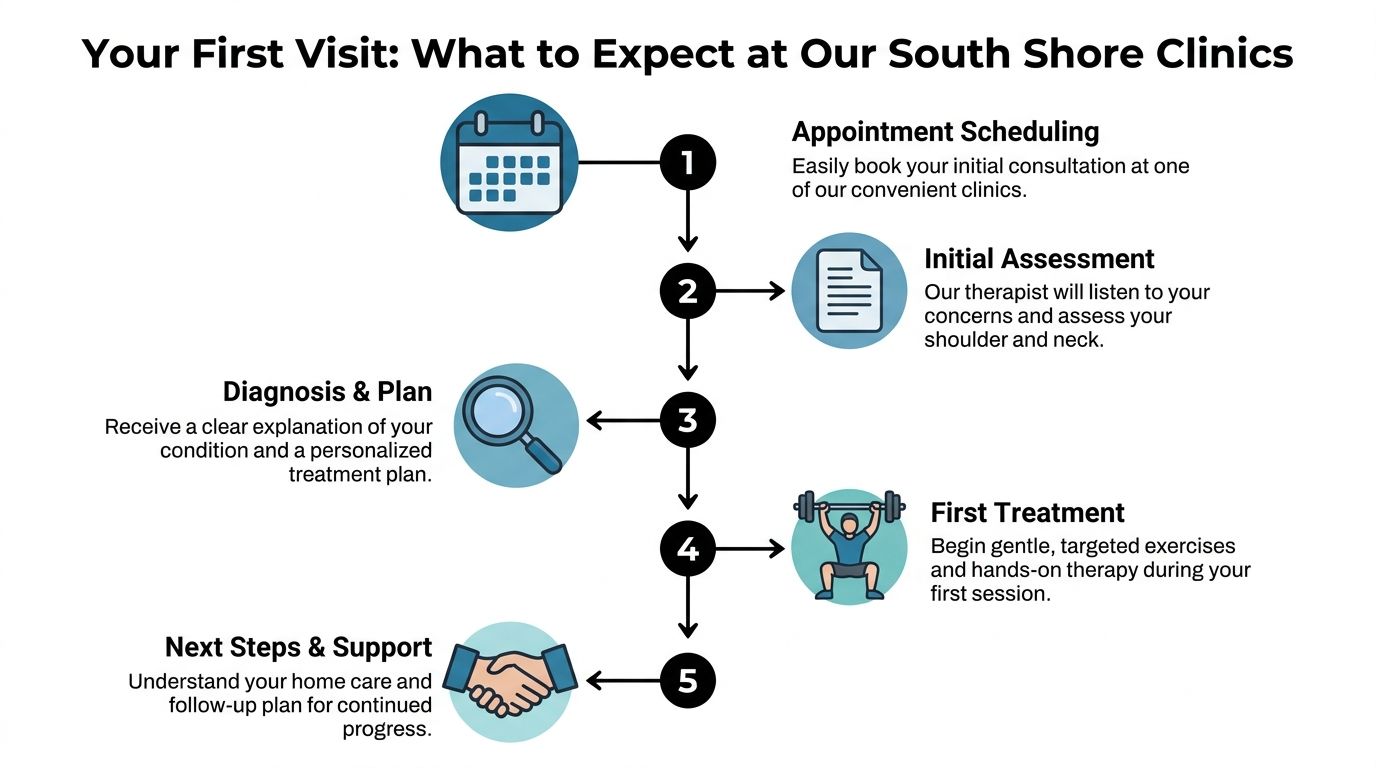
Starting physical therapy shouldn’t feel complicated. Patients often show up with a pretty practical goal. Sleep better. Reach the top cabinet. Get through work without a stiff neck. Get back on the boat in Cohasset. Lift mulch in the yard without paying for it the next day.
The first visit is built around those goals, not just around the diagnosis written on a referral.
Physical therapy is considered a first-line treatment for dysfunction, and reported outcomes include 15-25° flexion gains in elderly cohorts and delayed surgery in 40-50% of early-stage glenohumeral osteoarthritis cases, according to Orthobullets’ summary of glenohumeral arthritis treatment. That doesn’t mean every person gets the same result. It does mean a good conservative plan is worth taking seriously.
The evaluation is about your life not just your pain
A first appointment usually starts with a conversation that matters more than people expect. When did symptoms start? What motions trigger them? What have you stopped doing? What time of day is worst? What does “better” mean for you?
Then comes the movement exam. Your therapist looks at how your neck turns, how your shoulder lifts, how your shoulder blade moves, what strength you still have, and which positions reproduce symptoms. We also look at nearby areas that may be feeding the problem, especially the upper back and shoulder blade mechanics.
A useful first visit often answers questions like these:
- Is the shoulder the main source, or is the neck feeding it
- Is the problem mostly stiffness, mostly weakness, or a mix of both
- Are you avoiding movements that are safe to retrain
- Do you need medical follow-up alongside therapy
Most people feel better once they understand why a movement hurts. Uncertainty creates tension. Clarity usually lowers it.
Personalized exercise progressions
Treatment becomes specific. If your joint is irritable, we don’t start by loading it aggressively. If your motion is blocked, we don’t skip straight to strengthening. If your neck is driving your shoulder symptoms, we don’t pretend band exercises alone will solve it.
Early exercises are often simple and targeted. They may focus on supported range of motion, light isometrics, shoulder blade control, or gentle neck mobility. As your tolerance improves, the plan progresses toward real-life demands like lifting, carrying, pushing, pulling, and sustained posture.
Some people need a very gradual climb. Others are ready for a stronger program right away. Good therapy adjusts load, not just exercise selection.
Hands-on manual therapy
Manual therapy is often helpful when stiffness and guarding are major parts of the picture. That can include joint mobilization, soft tissue work, guided stretching, or techniques that improve how the neck, upper back, shoulder, and shoulder blade move together.
This doesn’t “cure” arthritis. It does something more practical. It often creates a window where movement is easier, pain is lower, and exercise becomes more productive.
For arthritis of the shoulder and neck, hands-on care is often most useful when:
- The joint feels blocked: You can’t get into motion comfortably on your own.
- Muscles are overworking: The neck and upper trap stay tense all day.
- Pain has changed your movement pattern: You’re hiking the shoulder or holding yourself rigid.
- Exercise alone flares you up: You need symptoms calmed before loading more.
Advanced modalities
Some patients benefit from adjunct services when the joint is irritated or land-based movement is limited. Options may include dry needling, aquatic therapy, or other pain-modulating strategies chosen by the therapist based on the presentation.
That’s one place where Peak Physical Therapy and Sports Performance may fit for South Shore patients who want orthopedic rehab close to home, especially when shoulder and neck symptoms need a mix of manual care, guided exercise, and activity-specific progression.
The trade-off is simple. Modalities can reduce pain and improve tolerance, but they’re not the whole plan. If a treatment feels good for a day but doesn’t improve how you move and function, it’s incomplete.
Post-surgical rehab
Some readers are already past the “Is this arthritis?” stage. They may be recovering from an injection, a shoulder procedure, or discussing replacement after years of symptoms. Therapy is still central there.
Post-surgical rehab has a different rhythm. Protection comes first. Then motion. Then strength. Then return to the things that matter to you, whether that’s paddling, gardening, housework, or getting through a workday without fear of reinjury.
A strong rehab process should leave you knowing:
| Stage | What the focus usually is |
|---|---|
| Early | Protect healing tissues and reduce guarding |
| Middle | Restore motion and rebuild control |
| Later | Add strength, endurance, and practical function |
| Return to activity | Match rehab to your real life, not just clinic exercises |
The first visit isn’t about being told to “rest and see.” It’s about getting a useful map. Once people understand what’s driving their pain and what the plan is, they usually stop feeling stuck.
A Closer Look at Physical Therapy for Shoulder and Neck Arthritis
People often know they should “do PT,” but they’re not sure what that means beyond a few stretches. Good treatment is more specific than that. Each part of the program has a job.
For moderate cases such as rotator cuff tear arthropathy, physical therapy can improve function and has shown 20-30% range-of-motion improvement without surgery in some cases, as described in the AAOS overview of shoulder arthritis. The reason it works is not magic. It’s because the program targets the limits that matter most.

Why mobility work comes first
A stiff arthritic joint usually doesn’t tolerate force well. If the shoulder can’t move, the body borrows motion from somewhere else. Usually that means the shoulder blade, upper trap, or low back. If the neck is stiff, people twist through the trunk or hold themselves rigid.
That’s why early treatment often includes controlled mobility work such as pendulums, assisted reaching, wall slides, or gentle cervical movement. The goal is not to force the joint. The goal is to restore enough motion that everyday movement becomes cleaner and less threatening.
Why strength matters more than most people think
Once motion improves, the next job is support. Arthritic joints often feel unstable, not because they’re dislocating, but because the muscles around them aren’t doing enough work at the right time.
For the shoulder, that usually means rotator cuff and shoulder blade training. For the neck, it often includes postural muscles and deep stabilizers. Stronger support can reduce how much stress lands on irritated tissues during simple tasks like carrying groceries or washing windows.
A well-built program usually includes:
- Range before resistance: Load a motion the body can control.
- Small movements done well: Better mechanics beat bigger, sloppier reps.
- Gradual exposure: Start with tolerable resistance, then build.
- Task carryover: Make sure gains show up in driving, lifting, housework, and hobbies.
Why manual care can calm things down
When people hear “manual therapy,” they sometimes think of it as passive treatment. Used well, it’s more like a bridge. It can reduce guarding, improve soft tissue mobility, and make the next exercise set more effective.
That’s especially useful in arthritis of the shoulder and neck because these patients often arrive with both joint restriction and muscle overprotection. If the upper trap is doing all the work, or the shoulder blade is locked down, hands-on treatment can help reset the pattern enough for exercise to stick.
A treatment is only useful if it changes what you can do afterward.
If you want a broader look at how PT strategies vary by condition, Peak’s article on understanding physical therapy treatment for different types of arthritis is a good next read.
When lower impact options make more sense
Sometimes land-based exercise is too provocative at first. That doesn’t mean you stop moving. It means you change the environment.
Aquatic therapy can be a smart choice when body weight, guarding, or pain make regular exercise tough to tolerate. The water supports movement and can make range-of-motion work feel safer and smoother. That can be a very practical option for older adults, people with more advanced stiffness, or anyone who flares quickly.
The common thread in all of this is progression. The plan should change as your body changes. If therapy never moves beyond symptom relief, it stalls. If it loads too aggressively too soon, it flares. The sweet spot is specific, patient, and adjusted often.
Staying Active and Managing Arthritis Pain at Home
What you do between visits matters. In many cases, the home routine is what keeps a decent week from turning into another flare. The good news is that it usually doesn’t need to be long or fancy.
Consistent range-of-motion work and stretching for 2-3 minutes daily can help maintain mobility, and early, steady stretching may delay progression by 20-30% compared with medication alone, according to Johns Hopkins Medicine’s shoulder arthritis guidance.

A simple home routine that works
Short, repeatable work often yields better results than an ambitious program abandoned after three days. For arthritis of the shoulder and neck, a brief daily routine usually beats occasional marathon stretching.
A practical home plan often includes:
- Gentle morning motion: A few easy shoulder and neck movements to reduce that first-hour stiffness.
- One mobility exercise for consistent practice: Pendulums, assisted reach, or a supported neck drill.
- One strength drill: Something light and controlled for the rotator cuff, shoulder blade, or postural muscles.
- A reset during the day: Especially if you sit, drive, or look down often.
Daily modifications that protect irritated joints
Home care also means changing how you do things, not just adding exercises.
If you’re gardening in Duxbury, bring the work closer to you instead of repeatedly reaching out with a straight arm. If you’re working from home in Milton, raise screens and reading material so your neck isn’t dropped forward all day. If you’re carrying groceries in from the car, split the load and use both arms instead of asking one irritated shoulder to do all of it.
These choices sound small. They’re not. Small mechanical changes repeated every day often decide whether symptoms settle down or stay irritated.
Protecting a joint doesn’t mean avoiding movement. It means choosing cleaner movement.
Heat ice and sleep position
Heat is often useful before movement when stiffness is the main complaint. Ice can be more helpful after activity if the joint feels hot, achy, or reactive. Neither one fixes the underlying issue, but both can make it easier to stay consistent.
Sleep is another big factor. If shoulder pain wakes you, pillow setup matters. Some patients find it helpful to explore a broader concierge guide to shoulder comfort for sleep-position ideas, then match those ideas to what their therapist recommends.
For added home support around neck mobility and posture, Peak also has a helpful resource on stretches for sore back and neck.
The goal at home isn’t perfection. It’s consistency. A few minutes done well, plus smarter movement through the day, usually outperforms long stretches of doing nothing followed by overdoing it on weekends.
Take the First Step to Relief at a Peak Clinic Near You
A lot of people wait too long.
They put up with the stiff shoulder that makes it hard to reach a cabinet in the morning, or the neck pain that flares up on Route 3, then slowly start cutting things out. Less yard work. Fewer rounds of golf. No more long afternoons gardening in Duxbury or getting back on the boat in Cohasset because it just does not feel worth the aftermath. Arthritis can shrink your routine that way. The right plan can start giving parts of it back.
At Peak, treatment is built around what you need to do each week. For one person, that means turning the head more comfortably while driving. For another, it means reaching overhead without pain, sleeping better, or building enough strength and motion to handle housework, exercise, and weekends outside without paying for it the next day.
Peak has clinics across the South Shore in:
- Braintree
- Quincy
- Weymouth
- Cohasset
- Duxbury
- East Bridgewater
- Hanover
- Kingston
- Milton
- Norwell
- Pembroke
- Plymouth
- Scituate
If shoulder or neck arthritis is starting to run your schedule, Peak Physical Therapy and Sports Performance can help you reduce pain, improve motion, and get back to the activities that matter to you. Book an evaluation at the clinic that works best for you, and get a clear, practical plan for feeling better.