


If you're searching for physical therapy braintree ma, there's a good chance something simple has started feeling harder than it should. Your back tightens on the drive home. Your knee talks back on the stairs. Dizziness makes a quick turn in the kitchen feel less routine than it used to. Maybe you're trying to get back to the gym, back to youth sports sidelines, back to work, or just back to walking around Braintree without thinking about every step.
That’s where the right clinic experience matters. Good physical therapy isn’t just a list of services. It’s the full journey. The first phone call, the first evaluation, the plan that suits your life, and the steady progress that gets you back to doing what matters. On the South Shore, people want care that feels personal, practical, and close to home.
Table of Contents
- Your Partner in Health on the South Shore
- Meet Your Braintree Physical Therapy Team
- Expert Care for Conditions Affecting Braintree Residents
- Our Specialized Physical Therapy Services
- Your Recovery Journey What to Expect at Peak Braintree
- Navigating Insurance and Scheduling Your First Visit
- Directions Parking and Frequently Asked Questions
Your Partner in Health on the South Shore
You feel it in the middle of an ordinary week. Your neck tightens after the commute, your back starts barking by Thursday, or your knee cuts a walk short when you were planning to keep going. At that point, you do not need generic stretches from a search result. You need a plan that fits your body, your schedule, and the life you are trying to get back to.
That is why local care matters.
On the South Shore, people are balancing work, family, sports, long drives, train time, and the usual wear that comes with staying active. Rehab has to match that reality. A parent who needs to pick up a toddler safely has a different goal than a runner training for a return to miles, and both need more than a one-size-fits-all exercise sheet.
At Peak Braintree, the experience should feel personal from the first contact. You call with a question, get scheduled with people who know the area and understand how busy life here can be, and start care with a clear reason for every visit. That patient journey matters. Good physical therapy is not just the treatment table or the exercise corner. It is the whole process of being heard, examined carefully, coached directly, and progressed at the right pace.
We also know there are trade-offs. Some patients want more hands-on work because it helps calm pain early. Others need a plan built around independence because they cannot be in the clinic multiple times each week. Strong care accounts for both. The goal is to help you make steady progress without wasting time, overcomplicating the plan, or asking for visits you cannot realistically maintain.
If you want to see the broader South Shore physical therapy clinic network, that overview can help you get oriented.
Patients in Braintree usually want the same core things:
- A clear starting point so they understand what is hurting and why
- Treatment that matches the problem whether that means manual therapy, guided exercise, movement retraining, or a mix
- Progress they can feel in daily life at work, at the gym, on the field, or at home
- A schedule they can stick with because consistency is what turns a good plan into a real recovery
That is what being a partner in your health looks like here. We help you reduce pain, rebuild confidence in movement, and return to the parts of life that matter to you.
Meet Your Braintree Physical Therapy Team
The feeling of a clinic is often underestimated in its importance. You can usually tell within a few minutes whether a place is organized, attentive, and invested in your progress. In a strong outpatient setting, the front desk knows how to make scheduling easier, the therapist listens before jumping to conclusions, and the whole visit feels focused rather than rushed.
In Braintree, the market for physical therapists is competitive. The average salary is about $54.94 per hour, which is above the national average, according to Indeed’s Braintree physical therapist salary data. For patients, that matters because strong local compensation helps clinics attract and keep skilled clinicians who want to build long-term careers here.
What a strong team looks like in practice
Patients usually notice three things first:
- They’re heard well. Your therapist asks where it hurts, but also when it hurts, what makes it worse, what you’ve stopped doing, and what you’re trying to get back to.
- The environment stays upbeat. Rehab is work, but it shouldn’t feel dreary. A positive clinic keeps people engaged, especially when recovery takes time.
- Care feels personal. You don’t want to explain your whole story from scratch every visit.
That’s especially important in orthopedics and sports rehab, where progress often depends on small adjustments from session to session. The plan may need to shift based on swelling, pain irritability, work demands, sleep, confidence, or how your body responds to loading.
Why one-on-one attention changes outcomes
A common frustration in PT is feeling like you’re passed around. What tends to work better is continuity. One therapist tracks how your squat changes, how your shoulder tolerates overhead motion, or how your balance improves when the room is quiet versus busy. Those details are easy to miss when care gets too generic.
What works: a therapist who can connect your symptoms, movement patterns, and daily routine into one plan.
If you want to get familiar with the clinicians and the larger network behind local care, you can review the Peak team directory. Patients often feel more comfortable booking once they can put faces and specialties to the clinic.
The human side of rehab
The best PT teams combine clinical judgment with calm communication. They know when to push and when to hold back. They know that post-op patients may be nervous, athletes may want to move too fast, and people with chronic pain often need both validation and structure.
That mix is hard to fake. You feel it when you walk in.
Expert Care for Conditions Affecting Braintree Residents
You feel it in ordinary moments first. Your back tightens getting out of the car in the South Shore Plaza lot. Your shoulder catches when you reach into a cabinet. Your ankle still feels off weeks after you rolled it, and now your knee is starting to complain too. By the time many people call Peak Braintree, the problem has already started to change how they move through the day.
The patterns we treat here usually reflect daily life in Braintree. Long commutes, desk work, weekend sports, yard work, gym routines, and the stop-and-go demands of family life all show up in the body.
Problems we treat every week
A large share of visits involve orthopedic pain that has begun to interfere with work, exercise, sleep, or basic mobility. Common concerns include:
- Back pain and sciatica that make sitting, driving, or bending more irritating
- Neck pain and headaches tied to posture, tension, or repetitive screen time
- Shoulder pain with lifting, reaching, throwing, or pressing overhead
- Hip and knee pain that affect stairs, walking tolerance, squatting, or workouts
- Foot and ankle pain that alter your gait and gradually create trouble up the chain
Foot and ankle issues are a good example of how one problem can spread. We often see patients who tried to push through plantar heel pain, a stiff big toe, or an old ankle sprain, then developed knee or hip symptoms because they changed the way they walked. If that sounds familiar, our foot pain physical therapy article is a useful place to start.
Sports and activity-related injuries
Braintree stays active, and the rehab plan has to match the sport and the person. A runner returning to mileage needs load management and stride tolerance. A hockey player may need edge control, rotation, and power. A high school athlete coming back after injury usually needs more guidance with pacing than an adult lifter who knows how to train but keeps hitting the same pain trigger.
This stage matters. Pain may be lower, but confidence, timing, and movement quality often lag behind. That is where good rehab can keep someone from returning too soon, then ending up right back in the clinic.
Some patients also like extra structure between visits. For older adults working on consistency with walking, balance, and healthy routines, an AI coach for senior wellness can be a practical add-on.
Dizziness and balance issues
We also treat people whose main concern is not pain. It is the feeling that the room shifts when they roll in bed, turn quickly, or move through a busy store. Others describe general unsteadiness, hesitation on stairs, or a growing fear of falling.
These cases need careful screening because dizziness is not one single diagnosis. Positional vertigo, balance deficits, and other vestibular problems each call for a different approach. The first job is to identify the pattern. Then we choose the right exercises, balance work, or repositioning treatment.
The good news is that many balance and vestibular problems respond well when they are identified early and treated accurately.
If dizziness is changing how safely you move, it is time to get it checked instead of guessing.
When patients tend to progress faster
Earlier care usually means a simpler problem to solve. Waiting often gives the body time to build workarounds that are harder to unwind later. A sore foot changes your stride. The altered stride irritates the knee. Then activity drops, stiffness builds, and getting back to normal feels farther away than it should.
At Peak Braintree, we look at that whole picture. The goal is not just to calm down one painful spot. It is to help you move well again, trust your body again, and get back to the parts of life that matter to you.
Our Specialized Physical Therapy Services
The right service depends on where you are in recovery. A runner with Achilles pain, a parent six weeks after surgery, and someone getting dizzy in the grocery store do not need the same plan, even if all three are hurting or avoiding movement. At Peak Physical Therapy and Sports Performance in Braintree, we choose treatment tools based on what your body can handle today and what you need to get back to next.
Manual therapy when it helps you move better
Hands-on treatment has a clear role, but only when it serves the larger plan. If a joint is stiff, muscles are guarding, or pain is making normal movement hard, manual therapy can calm things down enough for you to walk, squat, reach, or train with better form. That matters because symptom relief alone is not the finish line.
We use manual therapy to create a window for progress. Then we build on it right away with the exercise, retraining, or loading that helps the change last.
Practical rule: Hands-on care should lead to better movement the same day.
What specialized care often looks like in Braintree
Patients here usually need more than one lane of treatment. The service list matters less than the fit.
- Post-surgical rehabilitation for the knee, shoulder, hip, ankle, and spine
- Sports rehab and return-to-play progression for athletes who need a staged plan
- Balance and gait training for adults who feel less steady or have changed how they walk
- Vestibular rehabilitation for positional vertigo and other dizziness-related problems
- Pelvic health support during pregnancy, postpartum, and for other pelvic floor concerns
- Dry needling and mobility-focused treatment when pain and restriction are slowing progress
Some people need symptom relief first. Others are ready to load strength right away. Many do best with both.
| Approach | What helps | What usually falls short |
|---|---|---|
| Passive-only care | Can reduce pain for a short period | Doesn’t build strength, control, or confidence |
| Exercise-only from day one | Works well when irritability is low | Can flare symptoms if the body is too guarded |
| Blended rehab | Matches treatment to your stage and goals | Requires regular adjustment and follow-through |
A plan you can follow outside the clinic
A good program has to fit real life in Braintree. If your home routine takes 45 minutes and needs perfect conditions, it usually will not get done. We keep home exercise focused, progress it as you improve, and make sure you understand why each piece is there.
For patients who respond well to low-impact control work, Pilates-based movement can support posture, trunk control, and body awareness alongside PT. This Pilates for rehabilitation guide gives a useful overview of that style of training.
The goal is simple. Use the right service at the right time, with a plan you can stick with long enough to get back to your normal routine, your sport, or your job with confidence.
Your Recovery Journey What to Expect at Peak Braintree
You call because your back has been barking for three weeks, your runner’s knee is changing the way you train, or your shoulder still does not feel right after lifting. What usually makes that first call stressful is not the work itself. It is not knowing what will happen once you walk through the door.
At Peak Braintree, we try to remove that uncertainty early. You should know who you are seeing, what the first visit is for, and how the plan will connect to your real goal, whether that is getting through a workday comfortably, chasing your kids, or returning to the gym without second-guessing every movement.
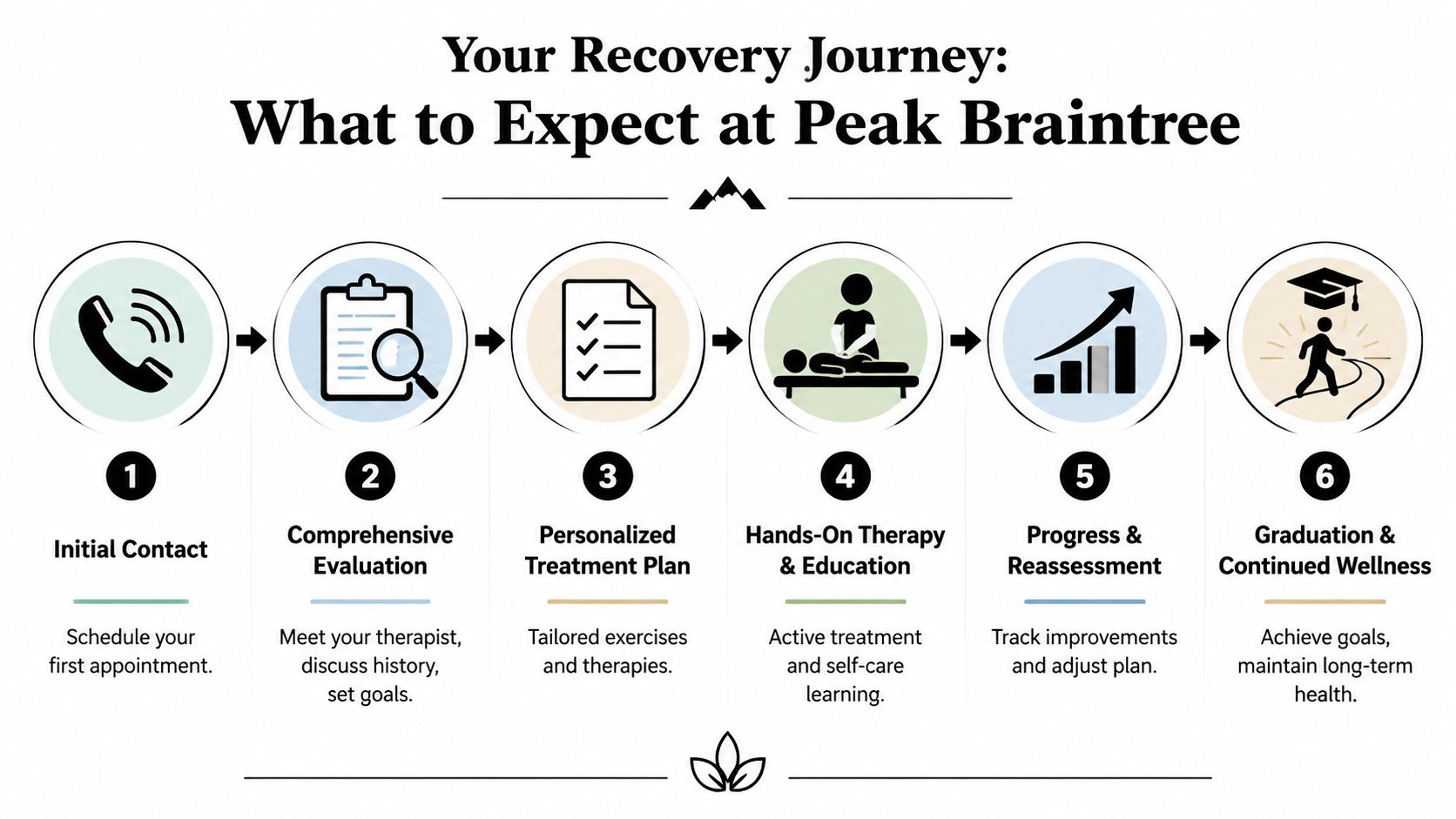
Step by step through the clinic experience
Initial contact
The process starts with a real conversation. We gather the basics, answer practical questions, and help you choose a visit time that fits your week. If you are hurting, even that first interaction should lower the stress level a bit.Detailed evaluation
Your first appointment is where we listen, test movement, and look for patterns. We want to know what brought the pain on, what keeps it going, what you have already tried, and what you need to get back to. A good evaluation is not just about the painful spot. It is about the full picture.Personalized treatment plan
After the exam, we map out the next few steps. Some people need to calm symptoms down first. Others are ready for strength work right away. Many need both. The right plan depends on irritability, injury history, schedule, and goals, not a preset routine.Hands-on care, exercise, and coaching
Treatment often includes guided exercise, movement retraining, and manual treatment when it fits the problem. We also explain what you should do between visits, what to modify at home or work, and what level of soreness is acceptable versus a sign to adjust.Progress checks and plan changes
Recovery is rarely a straight line. If you are improving, we build on it. If a certain drill keeps flaring things up, we change it. That is one of the biggest differences between a generic program and care that is customized for you.Graduation from care
Discharge should make sense. By the end, you should feel stronger, understand how to manage minor setbacks, and know what keeps you moving well after formal PT ends.
What tends to help people do well
The patients who make steady progress usually do a few simple things consistently. They give honest feedback. They follow through on the home plan. They tell us when real life gets in the way so we can adjust the program instead of pretending the schedule is unlimited.
A few habits matter:
- Keep track of patterns such as pain with stairs, sleep, long drives, workouts, or standing at work
- Do the home program regularly even if it looks basic on paper
- Speak up early about flares so we can change the load, volume, or exercise choice
- Ask questions when you are unsure why an exercise is there
That last point matters more than people think. If you understand the purpose of the plan, you are more likely to stick with it.
What graduation should actually feel like
Finishing care at Peak Braintree should not feel abrupt. It should feel like you earned your way out of the clinic. You should leave knowing what your maintenance routine is, what warning signs to watch for, and what level of activity you can handle with confidence.
For active adults and athletes, recovery also depends on sleep, nutrition, and training choices outside the clinic. If you are sorting through options after hard practices or lifting sessions, this overview of supplements for athletic recovery is a useful general read alongside your rehab plan.
The goal is straightforward. Help you move from that first uncertain phone call to a point where you can handle your sport, work, or daily routine with less pain and a clear plan to stay there.
Navigating Insurance and Scheduling Your First Visit
You finally decide to call because the shoulder has been waking you up, or the knee keeps barking every time you take the stairs at work. Then a different worry shows up. Do I need a referral? What will this cost? Can I even find an appointment that fits my week?
We hear those questions every day at Peak Braintree, and they are reasonable. Starting physical therapy should feel clear from the first phone call. If the scheduling or insurance process is confusing, people often wait longer than they should, and that usually means more stiffness, more compensation, and a slower start once care begins.
Before your first visit, you should be able to get direct answers on a few practical points:
- Insurance verification based on the information on your card
- Expected copay or coinsurance if your plan provides that detail
- Referral requirements if your insurance or physician requires one
- Appointment options that work with your job, commute, school, or family schedule
- A clear checklist for visit one so you know what to bring and how to prepare
That last part matters more than people expect.
A good front desk team does more than fill a slot on the calendar. They help remove the small obstacles that keep people from getting started. At our Braintree clinic, that usually means talking through availability clearly, explaining what we can confirm before the visit, and telling you where there may still be some uncertainty. Insurance benefits are not always simple. Some plans have visit limits, some apply deductibles first, and some require authorizations. It is better to say that plainly than to give a vague answer.
If you are scheduling your first appointment, have your insurance card, a few time windows that could work, and any referral or prescription you were given. That makes the process faster and helps us match you with the right therapist and visit length.
The goal is simple. Your first interaction with Peak Braintree should feel organized, helpful, and local. You should know what the next step is, what questions still need answers, and when you are coming in.
Directions Parking and Frequently Asked Questions
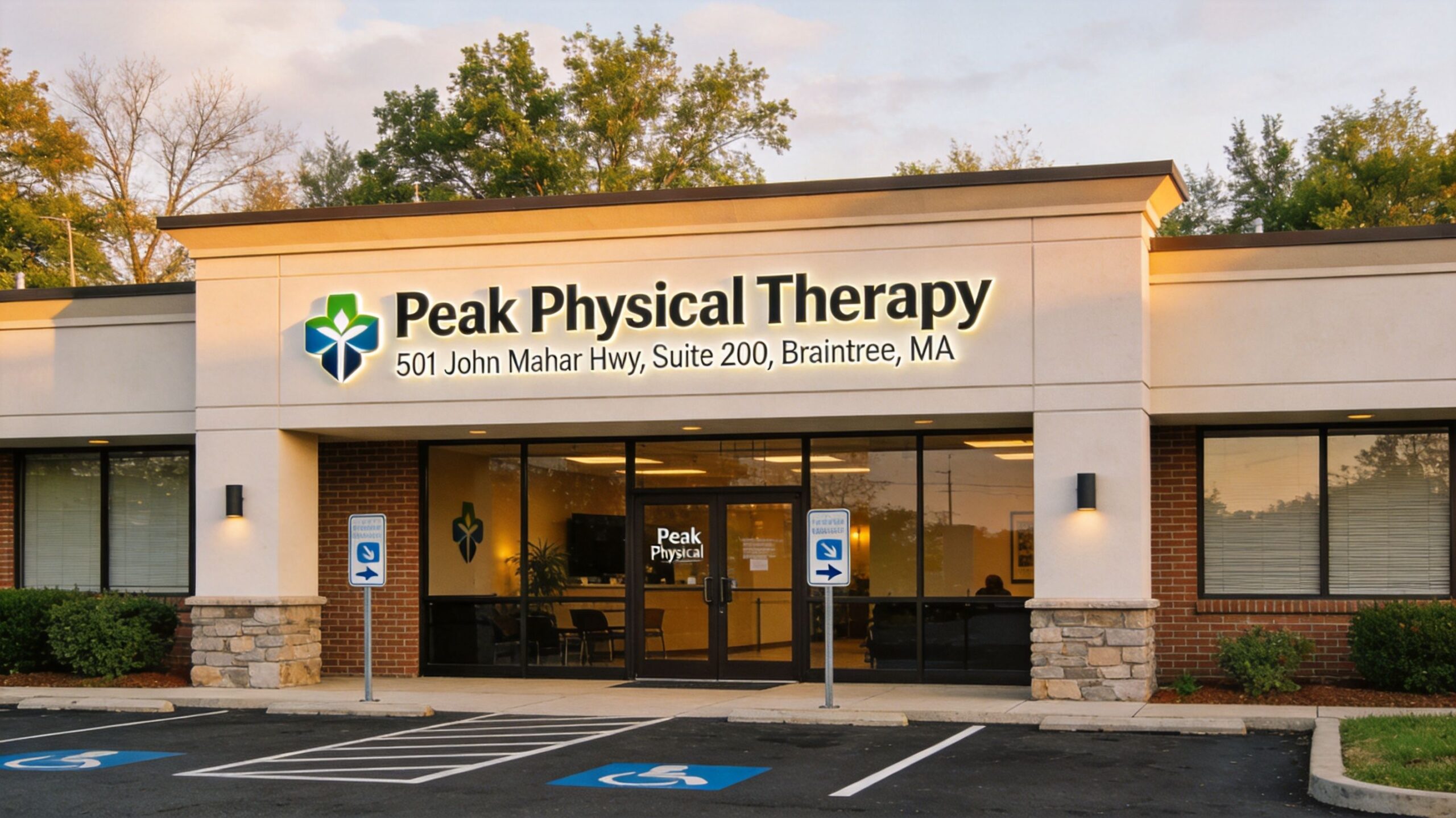
The Braintree clinic is located at 501 John Mahar Hwy Suite 200, Braintree, MA. If you’re coming from the South Shore Plaza area, you’re not far. If you’re coming off Route 3, the office park access is straightforward, and once you’ve been there once, repeat visits are easy to fit into the week.
Getting here
- From Route 3 head toward John Mahar Highway and follow signs into the office park area.
- From South Shore Plaza the clinic is a short local drive.
- Parking is available at the Braintree Hill Office Park, which makes arrivals easier for patients coming before work, during lunch, or after school pickup.
Frequently asked questions
Do I need a doctor’s referral?
Some patients come in with a referral, and some start by contacting the clinic directly. If you’re unsure what your plan requires, call first and ask. The front desk can help you sort it out.
What should I wear?
Wear comfortable clothes you can move in. If we’re looking at a knee, shorts help. If it’s a shoulder or neck problem, a loose top is usually easiest.
How long is the first appointment?
Your first visit is typically longer than a follow-up because it includes your history, movement assessment, and plan development.
How often will I come in?
That depends on your condition, irritability, and goals. Some patients need a more concentrated start. Others do well with a lighter schedule plus a solid home program.
If you’re ready to stop guessing and start moving better, schedule an appointment with Peak Physical Therapy and Sports Performance. We’ll help you take the next step with clear guidance, local care, and a plan built around getting you back to your life on the South Shore.