


A lot of people start searching for physical therapy Norwell MA when something ordinary stops feeling easy. It might be low back pain after an afternoon working in the yard, a shoulder that won't settle down after tennis or lifting, or a knee that starts talking back every time you take the stairs, walk the dog, or try to keep up with kids on the South Shore.
That moment matters. Pain tends to shrink your routine first. You skip the walk, cut the workout short, sit out the game, or avoid the drive because getting in and out of the car is a hassle. Good physical therapy should do the opposite. It should help you understand what's going on, give you a clear plan, and get you back to the life you want to live in Norwell and the surrounding South Shore towns.
Table of Contents
- Your Local Guide to Physical Therapy in Norwell
- Meet Your Neighborhood PT Clinic in Norwell
- Pain and Conditions We Treat for Norwell Residents
- Our Specialized PT Services for an Active South Shore Life
- Your First Visit What to Expect
- Navigating Insurance and Simple Scheduling
- Common Questions About PT in Norwell
Your Local Guide to Physical Therapy in Norwell
A common South Shore story goes like this. Someone spends a Saturday gardening, cleaning up the yard, or carrying things in and out of the house. By evening, their back tightens up. The next morning, bending to tie shoes or load groceries feels sharp and guarded instead of automatic.

That's often when people realize rest alone isn't fixing it. The same thing happens with runners who feel a nagging calf or knee problem, parents who can't lift comfortably, and active adults who notice dizziness, weakness, or stiffness getting in the way of daily life. In Norwell, those problems don't just affect exercise. They affect errands, work, youth sports drop-offs, weekend plans, and the basic rhythm of home life.
When pain starts changing your routine
The biggest mistake many people make is waiting until a manageable issue becomes a stubborn one. Not every ache needs formal care, but pain that keeps returning, limits movement, or changes how you walk, lift, sleep, or exercise deserves attention.
Practical rule: If you've started avoiding normal movement because you expect pain, it's time to get assessed.
Physical therapy works best when it's built around your real goals. That might mean walking without limping, getting through your workday without neck tension, returning to the gym, or feeling steady again when you turn your head or get out of bed. A good plan shouldn't feel generic. It should fit your body, your schedule, and the way you live on the South Shore.
Care that feels local and useful
The Norwell clinic serves people across the area who want practical help, not vague advice. That includes students, working adults, new parents, older adults, and athletes at different stages of recovery. Some come in after surgery. Some want to avoid surgery. Some just want to stop thinking about pain every time they move.
Physical therapy Norwell MA should feel personal, convenient, and clear. When people know where to go, what to expect, and how treatment connects to their goals, taking the first step gets a lot easier.
Meet Your Neighborhood PT Clinic in Norwell
The Norwell clinic is easy to reach for people coming from town or from nearby South Shore communities. Peak Physical Therapy's Norwell clinic is a full-service center at 99 Longwater Circle, Suite #201, featuring a dedicated private pelvic health center and specializing in conditions from pediatrics to geriatrics, conveniently located just off Route 3 at Exit 36, as noted on the Norwell clinic location page.
That location matters more than people think. When appointments fit into a normal week, it's easier to stay consistent. For many patients, being near Assinippi Park and familiar stops like the Derby Street area makes treatment feel less like a disruption and more like part of the routine.
Easy access matters more than people expect
Physical therapy only works if you can reach it. South Shore schedules are packed. School pickups, commutes, hybrid work, practices, and family responsibilities all compete for time. A clinic that's simple to find and easy to park at removes friction right away.
The Norwell setting also supports a broad range of care needs. Someone recovering from surgery may need a very different environment than a patient coming in for pelvic health, balance issues, or pediatric support. Having that range under one roof helps people stay local rather than piecing care together across multiple stops.
A clinic should feel professional without feeling cold
People often walk into PT unsure whether they'll be pushed too hard, talked over, or handed a sheet of exercises with little explanation. The better experience is more grounded. You should feel listened to, examined carefully, and given a plan that makes sense.
Good physical therapy isn't just about equipment or square footage. It's about whether the team can connect treatment to the life you want to get back to.
If you're comparing locations within the South Shore, it helps to look at the broader Peak physical therapy center network to see what's close to home, work, or school. For Norwell patients, that local access can make follow-through much easier, especially when recovery takes more than a couple of visits.
Pain and Conditions We Treat for Norwell Residents
Few individuals walk in saying, “I need a movement assessment.” Instead, they come in saying, “My shoulder hurts when I reach overhead,” “My back locks up after sitting,” or “My knee won't let me get back to what I was doing before.” That's the right place to start.
In Norwell, the most common issues tend to be the ones that interrupt normal South Shore life. Back pain after yard work. Hip or knee pain that makes walking less comfortable. Sports injuries from youth, high school, or adult activity. Neck tension that builds from desk work and driving. Balance problems that make people feel less steady than they used to.
The problems that bring people in most often
Some conditions are straightforward. Others overlap. A patient may come in for knee pain but really be moving around a stiff ankle or weak hip. Someone with headaches may have a neck and posture problem. That's why treatment starts with the pattern, not just the pain site.
Common reasons Norwell patients seek care include:
- Back pain and sciatica: Trouble sitting, standing, lifting, or getting comfortable at night.
- Sports injuries: Sprains, strains, overuse pain, and return-to-play concerns for athletes and active adults.
- Post-surgical recovery: Rebuilding strength, mobility, and confidence after orthopedic procedures.
- Neck pain and headaches: Stiffness, referred pain, and movement restrictions that build over time.
- Shoulder, hip, and knee pain: Joint problems that affect stairs, sleep, workouts, and daily chores.
- Foot and ankle issues: Pain that changes walking mechanics and makes activity less enjoyable.
- Pregnancy and postpartum concerns: Back, pelvic, and movement challenges during and after pregnancy.
For pregnancy-related back discomfort, many people also appreciate simple home strategies like posture changes, support choices, and activity modifications. This practical guide to pregnancy back pain from Hiccapop is a useful companion to in-person care.
For local treatment of lower-body pain, patients can also review hip, knee, foot, and ankle pain relief options to see how these issues are commonly addressed in clinic.
Your Path to Recovery at Peak Norwell
| Condition / Goal | Peak Norwell Service |
|---|---|
| Back pain or sciatica | Individual evaluation, hands-on treatment, movement retraining, home exercise plan |
| Sports injury recovery | Rehab progression, strength work, return-to-activity planning |
| Neck pain and headaches | Mobility work, posture-based treatment, targeted exercise |
| Shoulder, knee, or hip pain | Joint-specific rehab, strength and control training |
| Post-surgical recovery | Structured rehab plan based on procedure and healing stage |
| Balance, dizziness, or unsteadiness | Vestibular-focused treatment and fall-related movement work |
| Pregnancy or postpartum symptoms | Pelvic health-informed care and movement support |
If you want a deeper educational breakdown of diagnoses, anatomy, and recovery concepts, that's where highbarhealth.com is helpful. The local clinic visit should stay focused on your symptoms, your movement, and your next steps in Norwell.
Our Specialized PT Services for an Active South Shore Life
You feel pretty good walking the path at Norris Reservation, then the room spins when you look up. Or your knee surgery is behind you, but stairs at home in Norwell still feel shaky. Those are the moments when general advice stops being enough. You need care that matches the problem, your stage of healing, and the life you want to get back to on the South Shore.
At Peak Physical Therapy and Sports Performance in Norwell, specialized care is built around that full experience. Patients want skilled treatment, but they also want convenience, privacy, and a team that understands local routines, from youth sports schedules to commuting on Route 53 and weekends at the beach. That shapes how treatment is planned here.
Post-surgical rehab that respects healing time
Post-op rehab works best when progression matches healing. Push too hard and the joint gets angry. Wait too long and strength, motion, and confidence are harder to rebuild.
For ACL reconstruction and rotator cuff repair, rehab usually follows phased milestones over months, not weeks, as outlined by the American Academy of Orthopaedic Surgeons on ACL rehabilitation and the American Academy of Orthopaedic Surgeons on rotator cuff and shoulder conditioning. The exact timeline depends on the procedure, tissue quality, pain response, and your goals. A recreational runner returning to local road races and a parent who just wants to carry groceries without pain do not need the same progression.
A strong post-surgical plan usually includes:
- Phase-based treatment: early motion and swelling control, then muscle activation, then strength, balance, and return to higher-demand activity
- Clear goals for each visit: restoring extension, improving quad control, rebuilding overhead strength, or correcting gait
- Close attention to compensation: limping, guarding, trunk shift, or shoulder hiking can slow recovery if they are ignored
- Home work that fits real life: short, specific exercises people can do between appointments without guessing
Good rehab restores function in the right order.
Vestibular and concussion care
Dizziness can shrink a person's world fast. Grocery store aisles feel busy. Rolling in bed feels unsettling. Driving through local traffic feels less comfortable than it should.
Vestibular physical therapy helps address problems such as BPPV, gaze instability, motion sensitivity, and balance loss. The National Institute on Deafness and Other Communication Disorders explains that balance problems become more common with age and can raise fall risk, especially when dizziness leads people to move less or avoid activity altogether. The NIDCD overview of balance disorders is a useful reference for that bigger picture.
In the clinic, treatment depends on the cause. Some patients need canal repositioning. Others do better with eye and head coordination drills, balance work, or gradual exposure to movements that bring on symptoms. Concussion care follows the same principle. The goal is not to provoke symptoms for the sake of it. The goal is to calm the system, rebuild tolerance, and help people return to school, work, exercise, and daily errands with more confidence.
Pelvic health and pediatric support
Some concerns are easier to address in a quieter setting. Pelvic pain, pregnancy-related discomfort, postpartum recovery, bladder symptoms, and deep core weakness often require privacy and trust from the first visit. Norwell's clinic includes a dedicated private pelvic health space, which helps patients speak openly and practice treatment strategies without feeling rushed or exposed.
The clinic also works with children and teens. Around here, that often means helping a young athlete after an ankle sprain, assessing coordination concerns, or building strength during a growth spurt when movement suddenly feels awkward. For parents who want simple ideas at home, the Playz guide on improving kids' motor skills shares practical ways to support fine motor development between visits.
Specialty care should still feel local and personal. It should be easy to reach, clear to follow, and specific to the way you live in Norwell and the rest of the South Shore.
Your First Visit What to Expect
Starting PT feels easier when you know what the first day will look like. Patients generally do not need more medical jargon. They need a clear sense of what to bring, what will happen, and whether the appointment will be useful.
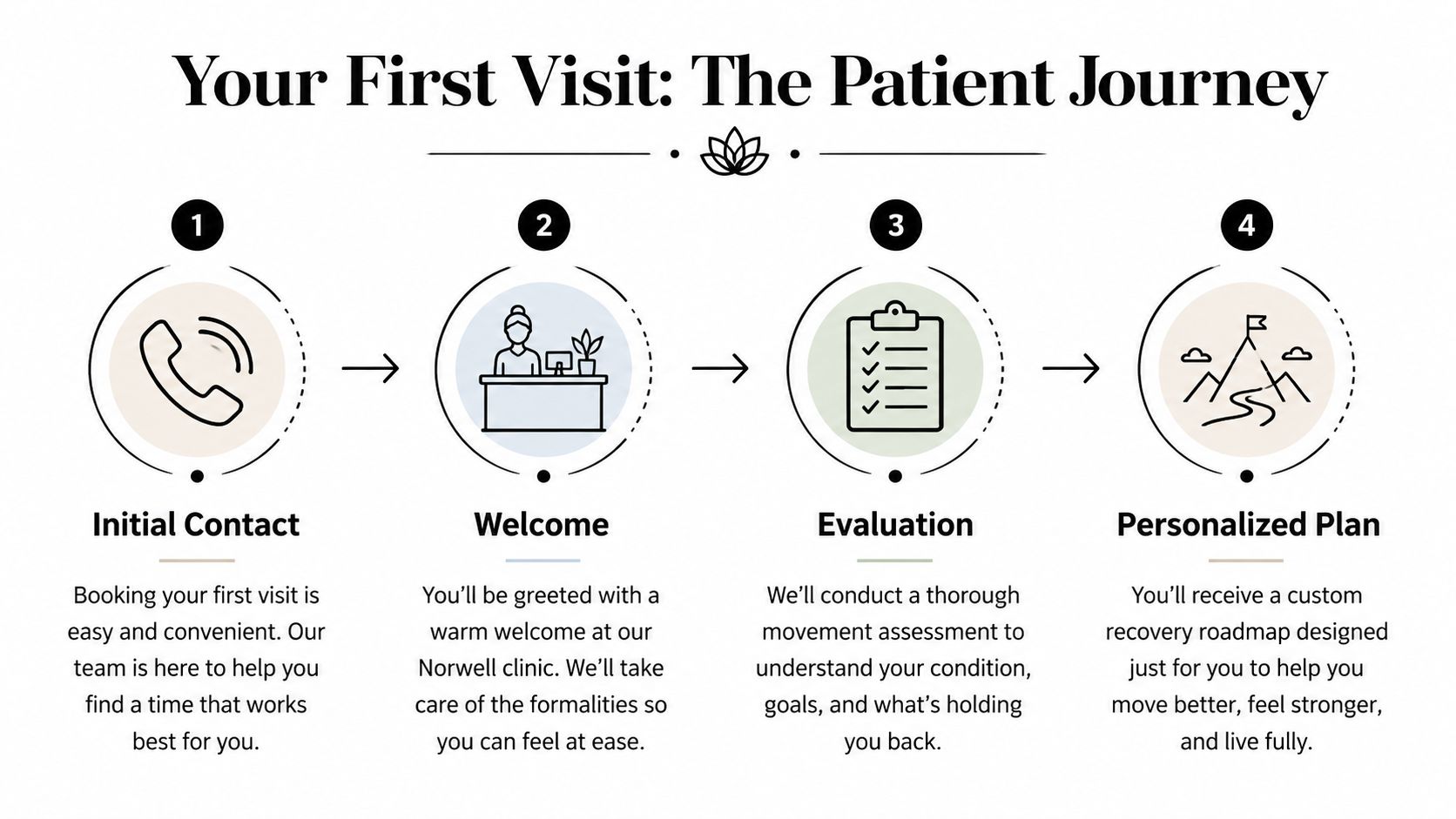
How the first appointment usually unfolds
The first visit starts with your story. When did the problem begin? What makes it worse? What have you stopped doing because of it? That information matters because two people can have the same diagnosis and need very different treatment plans.
From there, the therapist looks at how you move. That may include walking, bending, reaching, balance, strength, joint mobility, or symptom-provoking motions. The point isn't to put you through a test for the sake of testing. The point is to find the drivers of the problem.
A first visit often includes:
- Conversation about symptoms and goals: What's bothering you, and what do you want to get back to?
- Movement assessment: How your body is loading, compensating, and responding.
- Hands-on treatment or guided exercise: Depending on what's appropriate that day.
- A plan for next steps: Frequency, priorities, and what to start doing at home.
What helps people get more from visit one
Wear clothing you can move in comfortably. If you're coming for a knee, shoulder, back, or hip problem, choose something that gives the therapist a practical view of that area. Bring any relevant surgical information if you have it, and think in advance about the activities you most want to return to.
Recovery plans work better when the goal is specific. “I want to walk the dog without limping” is more useful than “I just want to feel better.”
Many patients leave the first visit relieved because they finally have a framework. Not a vague “wait and see,” but a reasoned explanation of what to work on and what progress should look like.
Navigating Insurance and Simple Scheduling
You finally decide to get your knee, back, or shoulder checked. Then the practical questions hit. Does my plan cover this? Do I need a referral? Can I find appointments that work around school pickup, the commuter rail, or an early shift?
For many Norwell patients, those details are what delay care. The clinical side matters, but the process matters too. If insurance feels confusing or scheduling feels hard, people wait longer than they should.
Peak Physical Therapy and Sports Performance puts those details up front. The team helps verify coverage before the first visit so patients have a clearer picture of co-pays, deductibles, and referral requirements instead of guessing at the desk.
Clarity before care starts
That early clarity changes decisions. If you know what your visits are likely to cost and what paperwork is needed, it becomes much easier to commit to a plan and keep momentum.
Patients who want to review the details ahead of time can read Peak's insurance information and coverage details before calling. From there, the front desk can help sort out the remaining questions based on your plan and your schedule.
Scheduling that fits real life
The best appointment time is not always the earliest one available. It is the time you can keep consistently. Around Norwell, that often means working around commuting, family routines, youth sports, or the simple reality that recovery still has to fit into daily life.
A few practical points matter most:
- Referral requirements: Some plans allow direct access, while others still require a physician referral. It is smart to confirm before visit one.
- Timing matters: If you need before-work, after-school, or midday visits, booking early usually gives you better options.
- Consistency beats convenience once: One perfectly timed visit helps less than a schedule you can follow for several weeks.
Good physical therapy should feel personal and doable from the first phone call. At a neighborhood clinic, that means clear answers, local convenience, and a scheduling plan that fits the life you are trying to get back to.
Common Questions About PT in Norwell
By the time someone is ready to book, the remaining questions are usually practical. That's a good sign. It means they've moved from “Should I do this?” to “How do I get started?”
Quick answers patients ask all the time
Do I need a doctor's referral to start physical therapy?
Sometimes yes, sometimes no. It depends on your insurance plan and your situation. If you're unsure, ask when you schedule so you know exactly what's needed before the first appointment.
What should I wear?
Wear comfortable clothing you can move in. If your issue involves your knee, hip, shoulder, or back, choose something that lets you move easily and gives the therapist access to assess the area.
How long does each session last?
Session length can vary based on the evaluation, your plan of care, and what's being worked on that day. The clinic can give you visit-specific details when you book.
Do you offer virtual or telehealth appointments?
For some patients, yes. The availability of virtual or hybrid physical therapy is a critical access point for patients, and Peak can discuss telehealth options for specific conditions, providing care for those who struggle with travel or have busy schedules, according to this virtual and hybrid PT reference. That can be helpful for busy professionals, caregivers, or patients who need a flexible option.
What happens if I'm nervous to start? That's normal. Many individuals haven't been to PT recently, and some have never gone at all. A good first visit should leave you feeling heard, informed, and clear on what comes next.
If pain, stiffness, dizziness, post-surgical limitations, or pelvic health concerns are getting in the way of your day, local help is close by.
If you're ready to take the next step, book an appointment with Peak Physical Therapy and Sports Performance. The Norwell clinic can help you get clear on what's causing the problem, what treatment should look like, and how to get back to daily life on the South Shore with more confidence.