
You're walking through South Shore Plaza, stepping off a curb near Quincy Avenue, or chasing a loose ball with your kids at Watson Park. Your foot lands a little off. The ankle rolls. You feel that sharp jolt, then the swelling starts, and the rest of the day changes fast.
Individuals in Braintree don't need a long anatomy lecture in that moment. They need a practical plan. Can you put weight on it? Should you get it checked first? When does physical therapy help, and what does recovery truly look like if you want to get back to commuting, workouts, youth sports sidelines, long walks, or weekend activity on the South Shore?
This guide is built for that exact situation. It's a local, real-world look at ankle sprain physical therapy in Braintree MA, with a focus on what happens in the first days, what progress should feel like, and how to avoid the common mistake of letting a “simple sprain” linger longer than it should.
Table of Contents
- That Awkward Step and What Comes Next
- Your First Visit for an Ankle Sprain in Braintree
- The Peak Physical Therapy Recovery Roadmap
- Key Ankle Rehab Exercises You Can Expect
- When to See a Doctor Before Physical Therapy
- Why You Should Not Just Walk It Off
- Your Next Step to Ankle Recovery in Braintree
That Awkward Step and What Comes Next
An ankle sprain usually doesn't happen during some dramatic moment. More often, it happens during ordinary life. A missed step in a parking lot. A quick pivot at the gym. A rushed turn while carrying groceries into the house after work.
In Braintree, that matters because life doesn't slow down much after the injury. You may still need to drive, commute, get kids where they need to go, walk the dog, or stay on your feet for work. Even a mild sprain can make all of that feel unstable.
The first few hours matter
The earliest decisions often shape the next few weeks. Some people do too much too soon and keep re-irritating the joint. Others immobilize completely for too long and get stiff, weak, and hesitant to move.
Practical rule: If the ankle is painful and swollen after a twist, don't assume time alone will sort it out cleanly.
A better first step is to slow things down and pay attention to what the ankle is telling you. Can you bear weight at all? Is the swelling climbing quickly? Does the joint feel sore but manageable, or does it feel like something more serious happened?
What local patients usually want
Patients aren't asking for perfect textbook recovery. They want to know when they can walk normally again, when stairs will feel less awkward, and when they can trust the ankle on uneven ground.
That's where a local rehab plan helps. For ankle sprain physical therapy in Braintree MA, the primary goal isn't just reducing pain. It's helping you move through a structured recovery so the ankle feels steady again during everyday South Shore life, not just on the treatment table.
Your First Visit for an Ankle Sprain in Braintree
The first appointment should feel clear, not confusing. If your ankle is swollen, sore, and making you nervous on every step, you shouldn't leave with a generic sheet of exercises and a vague idea of what might help.

What we ask first
The conversation matters. How you hurt it tells us a lot. Rolling the ankle during a jog is different from coming down on someone's foot in a game, and both are different from a fall with immediate inability to stand on it.
We also ask what you need to get back to. That answer shapes the plan. A parent trying to manage stairs and errands has different demands than a high school athlete, a warehouse worker, or someone who wants to feel stable during long walks at Pond Meadow Park.
A strong first visit usually covers:
- How the injury happened: The direction of the twist, whether you heard or felt anything unusual, and how quickly swelling showed up.
- What symptoms changed since day one: Better, worse, or about the same. Morning stiffness, end-of-day swelling, and pain with turns all matter.
- What you need the ankle to do: Walk comfortably, return to a sport, work on your feet, or handle uneven ground without fear.
What we check in the exam
The physical exam is where the plan becomes specific. We look at swelling, tenderness, range of motion, walking pattern, and how much load the ankle can tolerate. We also compare sides, because the injured ankle often loses motion and control in ways patients don't notice until we test it.
That exam usually includes a mix of hands-on assessment and movement testing.
| What we assess | Why it matters |
|---|---|
| Range of motion | Stiffness can change gait and keep pain going |
| Strength | Weak muscles leave the joint feeling loose or unreliable |
| Balance | Sprains often disrupt your sense of position and stability |
| Walking pattern | Limping can protect the ankle short term but create other problems |
The best evaluation doesn't rush to the exercise sheet. It identifies what's limiting you right now.
From there, the treatment plan gets built around your actual presentation. Peak Physical Therapy and Sports Performance has a Braintree clinic that treats foot and ankle problems with one-on-one care, which is the kind of setting where those details can shape day-one treatment rather than getting lost in a standard protocol.
The Peak Physical Therapy Recovery Roadmap
Ankle sprain recovery works best when it follows a sequence. People get into trouble when they skip ahead. They try strength work before motion is back, jogging before balance is ready, or daily activity before swelling is under control.
A phase-based model keeps the rehab honest. It also gives patients a more realistic sense of progress.
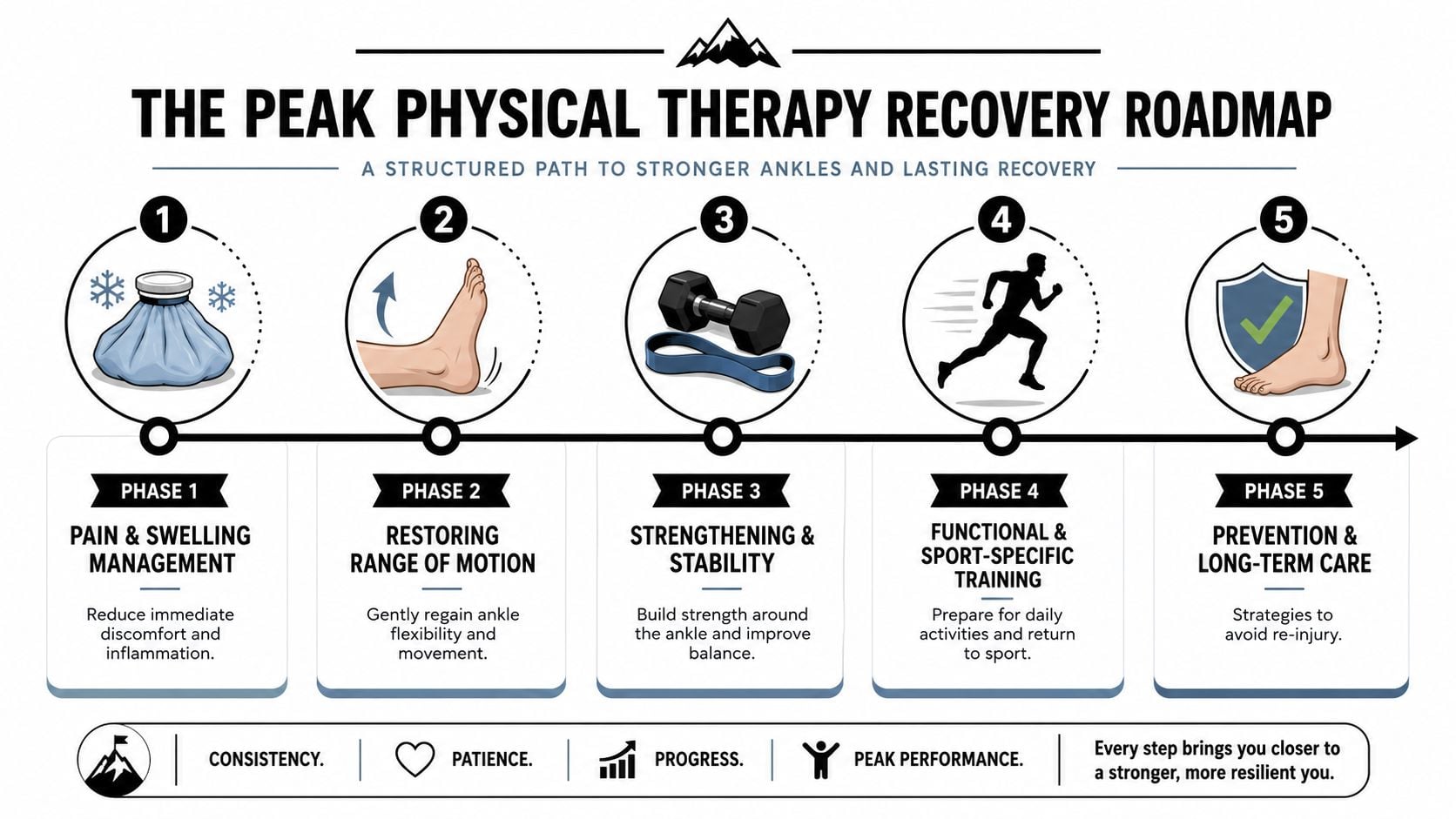
Evidence-based ankle sprain rehab is typically organized in phases. The acute phase often begins in the first 7 to 10 days, focused on controlling pain and inflammation. The next phase usually continues over the following 3 to 4 weeks, restoring strength, gait, and balance through progressive exercise, according to this ankle sprain rehabilitation timeline.
Phase one protects the ankle
Early on, the ankle needs calm, not punishment. In this initial stage, P.R.I.C.E. principles often fit well: protection, rest, ice, compression, and elevation. The point isn't to do nothing. The point is to reduce irritation enough that recovery can begin.
In this stage, we usually focus on:
- Swelling control: Less swelling usually means better motion and easier weight-bearing.
- Pain management: Pain that stays high tends to shut movement down.
- Safe mobility: Sometimes that means modifying walking, using support, or limiting aggravating activity for a short stretch.
What doesn't work here is the all-or-nothing mindset. Complete bed rest usually leaves the ankle stiff. Pushing through sharp pain usually keeps it angry.
Phase two restores motion and control
Once the ankle settles, we start getting movement back. Many patients then realize the problem isn't just soreness. The joint may feel blocked, tight, or hesitant to bend over the foot during walking.
This middle stretch often includes range-of-motion work, calf stretching, early strengthening, and gait retraining. If your walking pattern got altered in the first few days, we clean that up during this period before it becomes a habit.
Your ankle doesn't just need to heal. It needs to relearn how to move normally under load.
A few practical trade-offs show up here:
- Too cautious: You avoid motion because it feels vulnerable, and stiffness lingers.
- Too aggressive: You jump into harder exercise and the ankle swells again that night.
- Right pace: Symptoms may show up mildly during rehab, but they settle and don't keep escalating.
Phase three rebuilds strength and balance
This stage matters more than many people realize. A lot of ankles feel “mostly fine” before they're ready. Walking may be better, but cutting, stepping off a curb, changing direction, or standing on one leg can still feel shaky.
That's why strengthening and balance work become central. We use controlled loading to restore calf strength, ankle control, and the body's awareness of where the foot is in space.
Common priorities in this phase include:
- Strength around the ankle and foot: So the joint has active support, not just hope.
- Static and dynamic balance work: So you can trust the ankle when the ground or task changes.
- Gait and stair mechanics: So normal life stops feeling like a test.
Phase four returns you to real life
Return to activity is not one single event. It's a progression. Someone returning to neighborhood walks doesn't need the same prep as someone going back to basketball, tennis, or field sports. But both need the ankle to tolerate real-world unpredictability.
That means rehab has to move beyond isolated exercises. We start layering in direction changes, faster loading, uneven-surface demands, and task-specific drills based on what your week looks like.
A useful way to think about this stage is by matching the rehab to the goal:
| Goal | What rehab has to prove |
|---|---|
| Normal daily walking | Minimal limp, good push-off, stable turns |
| Work on your feet | Tolerance for standing, walking, and repeated loading |
| Recreational exercise | Comfortable strength, balance, and confidence under speed |
| Sport return | Control during hopping, cutting, landing, and reaction |
For many Braintree patients, this is the part that makes rehab feel worth it. You stop thinking only about the sprain and start noticing what you can do again.
Key Ankle Rehab Exercises You Can Expect
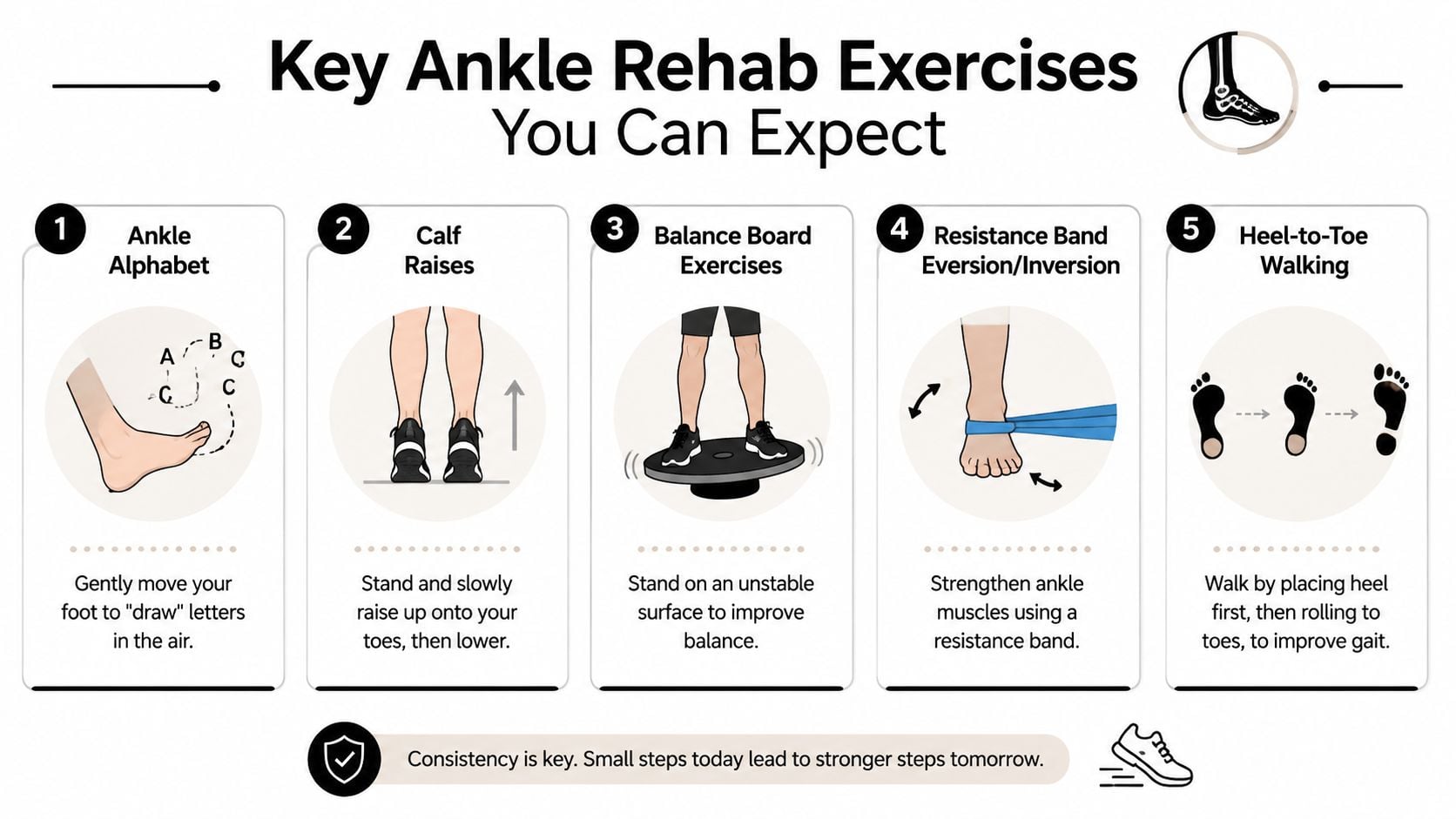
Many wonder what ankle rehab looks like once it starts. The answer is less glamorous than people expect, but that's part of why it works. Good ankle rehab is built on simple movements done at the right time, in the right order, with the right coaching.
Early movements that calm things down
At the beginning, exercises are usually small and controlled. An example is the ankle alphabet, where you move your foot to trace letters in the air. It looks simple because it is simple, but that's the point. It restores gentle motion without forcing the joint.
Another common early drill is a calf stretch or assisted ankle movement to help restore the ability to bring the shin forward over the foot. That matters for walking, stairs, and getting out of a chair without compensating.
Patients are often surprised by how much these basics change the way the ankle feels over the next day or two.
Later drills that rebuild trust in the ankle
As the ankle tolerates more load, the exercise menu changes. Towel scrunches can help wake up the foot muscles. Resistance band work can build control in the directions that often feel weakest after a sprain. Calf raises help restore push-off strength that many people lose without realizing it.
Then balance training starts to matter in a bigger way. Single-leg standing, heel-to-toe walking, or work on an unstable surface helps retrain the body's ability to react.
A few examples of what that progression can look like:
- Ankle alphabet: Useful early when the ankle needs motion without too much force.
- Resistance band inversion and eversion: Helps rebuild directional strength.
- Calf raises: Important for walking speed, stairs, and return to activity.
- Single-leg balance drills: Rebuild confidence and proprioception.
- Heel-to-toe walking: Helps clean up gait and foot placement.
If you want a broader home-focused look at progression ideas, this guide on how to strengthen ankles after a sprain is a helpful companion.
The right exercise should challenge the ankle enough to create progress, not enough to restart the injury cycle.
The mistake isn't usually that patients aren't trying hard enough. It's that they're doing the wrong thing for the stage they're in. That's why guided progression matters so much.
When to See a Doctor Before Physical Therapy
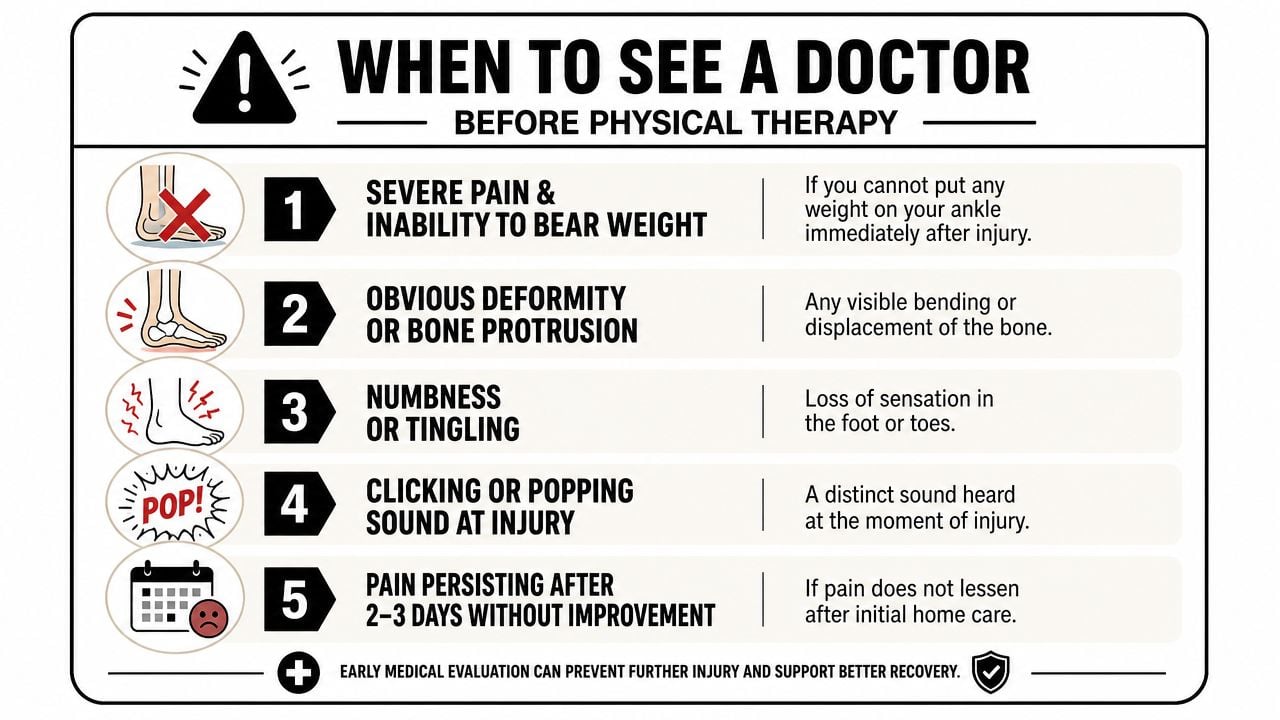
Not every rolled ankle should go straight into rehab. Some need medical evaluation first. That distinction protects you from treating a fracture, a more severe ligament injury, or another problem like it's a routine sprain.
Signs that need medical clearance first
Public guidance highlighted in this ankle sprain safety overview emphasizes that inability to bear weight, severe swelling, or suspected fracture should be evaluated by a physician before rehabilitation begins.
That doesn't mean every painful ankle is an emergency. It means some symptoms raise the stakes enough that imaging or a medical exam should come first.
Watch for signs like these:
- Inability to bear weight: If you can't take steps on it, don't guess.
- Severe swelling: Fast, marked swelling can signal a more significant injury.
- Obvious deformity: The joint looks wrong, not just swollen.
- Persistent numbness or tingling: That needs medical attention.
- Pain that feels sharply bony rather than just ligament soreness: Better to get it checked.
Why this step matters
Rehab works best when the diagnosis is right. If a fracture or major structural injury is being missed, exercise alone won't solve the actual problem.
For patients wondering whether their symptoms fit a routine sprain or something that needs a doctor first, this article on ankle pain when walking can help frame what different walking-related symptoms may mean.
If the ankle looks dramatically swollen, won't accept weight, or feels structurally wrong, medical clearance comes before exercise.
That's not a setback. It's the safest way to start.
Why You Should Not Just Walk It Off
“Walk it off” is common advice because some ankle sprains do improve with time. The problem is that time alone doesn't reliably restore motion, balance, strength, or confidence. It mainly tests your willingness to put up with the issue.
That's why untreated or under-treated sprains often turn into a longer annoyance than people expected. The ankle may stop hurting at rest but still feel unreliable during turns, stairs, workouts, or uneven ground.
What walking it off misses
Pain is only one part of the problem. After a sprain, people often lose joint motion, calf strength, and balance control. Those deficits can stick around subtly even after daily discomfort fades.
The result is familiar. You think you're fine. Then one quick pivot or awkward landing reminds you the ankle isn't really ready.
A “walk it off” approach also tends to create two opposite patterns:
- The pusher: Keeps moving through it, never lets swelling settle, and stays irritated.
- The avoider: Stops using the ankle normally, gets stiff and weak, and loses confidence.
Neither pattern restores full function well.
Why patients often need to advocate for rehab
Physical therapy is not automatically built into ankle sprain care. In a study of ankle sprain visits in U.S. care settings, only 16.8% received a physical therapy referral, while 34.5% had medication administered, supplied, or ordered, according to this study of U.S. ankle sprain visit patterns.
That gap matters. It means many people with ankle sprains are managed early in general medical settings and may never get guided rehab unless they ask about it.
For ankle sprain physical therapy in Braintree MA, that makes patient awareness important. If the ankle still feels unstable, swollen, stiff, or not quite right, that's often the signal to stop waiting and get it assessed.
Your Next Step to Ankle Recovery in Braintree
A sprained ankle can look minor on paper and still disrupt everything that matters in a normal week. If you're adjusting your walking, avoiding stairs, skipping workouts, or feeling unsure every time you step on uneven ground, it's already affecting more than your ankle.
The next step is getting a plan that fits your actual life in Braintree. Not just the diagnosis, but the reality of work schedules, school pickups, local sports, errands, and the daily pace of the South Shore.
Why local follow-through matters
Recovery usually goes better when care is close enough to make consistency realistic. That matters more than people think. The best rehab plan in theory doesn't help much if your schedule, commute, or family obligations make it hard to follow through.
If you're also comparing broader local care options, this page on physical therapy in Braintree MA gives a useful overview of what to expect from treatment close to home.
For people who want more detailed educational content on joint mechanics, ligament injuries, and rehab principles beyond this local guide, Highbar Health has deeper resources at Highbar Health.
Book care that fits real life
The practical next move is simple. Get the ankle evaluated, find out what stage you're in, and start the right level of rehab instead of guessing. That may mean a few focused visits and a home program. It may mean a longer progression if balance, sport demands, or repeated sprains are part of the picture.
What matters most is that the plan is specific. It should match your symptoms, your goals, and the demands waiting for you outside the clinic.
If your ankle still isn't letting you walk, move, or train the way you want, don't settle for “it's probably fine.”
If you're ready to start a practical recovery plan, book an appointment with Peak Physical Therapy and Sports Performance. A local evaluation can help you figure out whether your ankle needs protection, mobility work, balance retraining, or a full return-to-activity progression so you can get back to life in Braintree with more confidence.