
You feel shoulder pain in the moments that should be simple. Reaching into a cabinet for a coffee mug. Lifting a bag of groceries out of the trunk. Pulling on a winter coat after a windy day near Wollaston Beach. Maybe it started as a nagging ache after a long workday at the computer. Maybe it hit hard after shoveling snow, swinging a golf club at Granite Links, or throwing with your kid at the park.
Those experiencing shoulder pain in Quincy don't need a lecture when their shoulder hurts. They need a clear path forward. They want to know what's causing the pain, what usually helps, and whether they can get back to normal life without overcomplicating it.
That's what shoulder pain physical therapy in Quincy, MA should feel like. Local, practical, and grounded in what works.
Table of Contents
- Living with Shoulder Pain in Quincy
- Common Causes of Shoulder Pain on the South Shore
- How Physical Therapy Heals Shoulder Injuries
- What to Expect at Your First PT Visit in Quincy
- Your Personalized Shoulder Recovery Plan
- Simple Home Exercises to Support Your Recovery
- Start Your Journey to a Pain-Free Shoulder Today
Living with Shoulder Pain in Quincy
Shoulder pain has a way of shrinking your day. At first, you work around it. You use the other arm. You stop reaching overhead. You sleep on one side only. Then the small adjustments pile up, and suddenly ordinary things feel annoying or exhausting.
In Quincy, that might mean struggling to carry bags up the steps, feeling a sharp catch when you unload the car, or noticing that a walk along the beach doesn't feel relaxing because your upper arm and shoulder keep throbbing. Parents feel it when they pick up a child. Office workers feel it after hours at a laptop. Active adults feel it after yard work, rec league sports, or a weekend that asked a little too much from a stiff shoulder.

When everyday movement becomes a problem
A sore shoulder rarely stays limited to one motion. It can affect:
- Morning routines like getting dressed, washing your hair, or reaching for dishes
- Work tasks such as typing, driving, lifting, stocking, or repeated overhead use
- Home responsibilities including cooking, cleaning, snow shoveling, and carrying laundry
- Free time like golfing, workouts, pickup games, or just sleeping comfortably
What bothers people most isn't only the pain. It's the uncertainty. They don't know if they should rest, stretch, push through it, or stop moving altogether.
Shoulder pain often improves faster when the plan matches the irritation level of the joint and the demands of your real life.
That's the good news for Quincy residents. Help is close by, and the process is usually more straightforward than people expect. A shoulder doesn't need guesswork. It needs the right progression, the right amount of load, and a plan built around what you need your arm to do.
Common Causes of Shoulder Pain on the South Shore
A lot of shoulder pain starts with one ordinary moment. You finish shoveling after a nor'easter, reach up to put a box on a shelf, or take a full swing at Granite Links and feel a sharp pull that was not there the day before. Other times it builds slowly, then suddenly starts affecting sleep, work, and simple reaching.
On the South Shore, the cause is usually one of a few familiar patterns. Some shoulders are irritated by a single event, such as a fall, an awkward lift, or a forceful reach. Others become painful over time from repeated loading, limited mobility, or strength loss that makes the joint work harder than it should.
The local patterns behind the pain
Common shoulder problems include arthritis, bursitis or tendinitis, dislocation, fracture, frozen shoulder, rotator cuff injury, and muscle strains, and standard physical therapy care often includes joint mobilization, strengthening, stretching, manual therapy, and patient education according to shoulder pain treatment guidance from Peak Physical Therapy and Sports Performance.
Around Quincy, a few triggers show up again and again:
- Seasonal cleanup and snow shoveling. Repeated lifting and pushing can flare up tendons, stiff joints, and old rotator cuff issues.
- Golf, rec sports, and gym workouts. A shoulder that lacks control often gets irritated during swings, presses, throwing, or overhead lifting.
- Home and yard projects. Painting, cleaning gutters, carrying bins, and assembling furniture ask for more endurance than many people realize.
- Work routines. Nurses, tradespeople, drivers, teachers, hairstylists, and desk workers all stress the shoulder in different ways. The pattern matters more than the job title.
- Winter stiffness and age-related wear. Arthritic or already-sensitive shoulders often feel more limited in cold weather, especially first thing in the morning.
Different causes need different starting points
A frozen shoulder usually needs a different early plan than a rotator cuff strain. Arthritis behaves differently than instability after a fall. That is the trade-off people often miss. Rest may calm one shoulder down for a few days, but too much rest can make a stiff shoulder harder to recover. Pushing through can help some sore muscles, but it can also keep an irritated tendon angry.
The job is to identify which tissue is involved, how reactive it is, and what your shoulder has to do every day in Quincy life. Once that is clear, the rehab plan gets much simpler.
If shoulder pain is changing how you sleep, reach, drive, work, or carry groceries, it is worth getting assessed.
How Physical Therapy Heals Shoulder Injuries
You feel it when you reach into the back seat after a trip down Hancock Street, or halfway through the second nine at Granite Links. The shoulder is not just sore. It has stopped doing its job well.
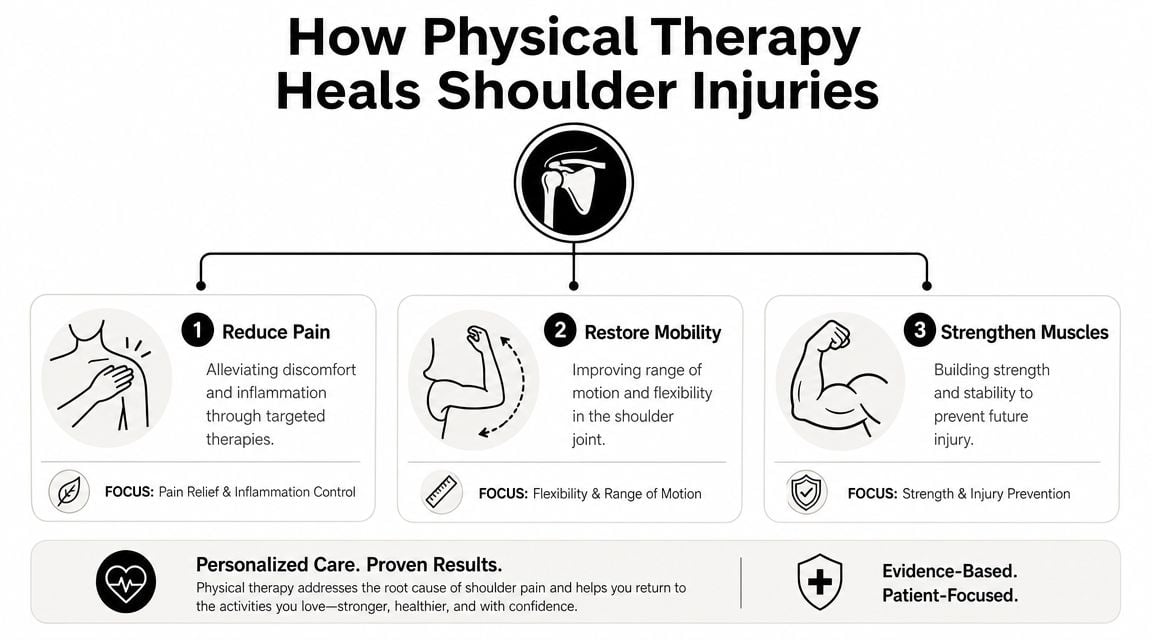
That is where physical therapy helps. The goal is to reduce irritation, restore motion, rebuild strength, and get the shoulder handling everyday Quincy life again without constant flare-ups.
Pain reduction comes first, but it isn't the finish line
Early rehab usually starts by calming the shoulder enough that you can move it without provoking a bigger setback. That may include gentle range-of-motion work, light muscle activation, changes to sleeping or lifting position, and short-term hands-on treatment if stiffness or guarding is getting in the way.
Manual therapy can be useful here, especially for a stiff joint or protective muscle tension. It helps create a window where exercise is more tolerable. Exercise still drives the recovery.
That trade-off matters. Rest can settle an angry shoulder for a day or two, but too much rest often leads to more stiffness, weaker support muscles, and less confidence using the arm.
Motion and strength have to come back in the right order
A shoulder usually improves when treatment matches the stage of healing. If pain is high and the joint is reactive, heavy strengthening too early tends to backfire. If the shoulder has calmed down but strength and control have not returned, stretching alone will not solve the problem.
In practice, rehab often follows a progression like this:
- Settle the irritation with symptom-guided movement and activity changes
- Restore mobility if the joint capsule, upper back, or surrounding muscles are limiting motion
- Build strength in the rotator cuff and shoulder blade muscles with a dose the tissue can tolerate
- Return to real tasks such as reaching overhead, carrying groceries, serving a tennis ball, swimming, lifting at work, or shoveling after a nor'easter
The sequence matters more than people expect.
A lot of online shoulder routines fail for one simple reason. They give the right exercise to the wrong shoulder at the wrong time.
Good rehab also retrains how the shoulder works
The painful spot is only part of the picture. Shoulder rehab often includes the rotator cuff, shoulder blade muscles, upper back, and sometimes the neck or rib cage, because those areas all affect how the arm moves under load.
For someone on the South Shore, that might mean building enough control to place dishes in a high cabinet, enough endurance to get through a work shift, or enough power to swing a club without that familiar pinch on the follow-through. Progress is measured by function, not just by whether a single test hurts less in the clinic.
Practical rule: If an exercise causes a sharp spike in pain and the shoulder is still more irritated the next day, the load was too high or the timing was off.
I like care plans that follow clear clinical reasoning rather than random exercise selection. If you want the thinking behind that approach, this overview of EBP for rehabilitation practitioners is a helpful read.
What to Expect at Your First PT Visit in Quincy
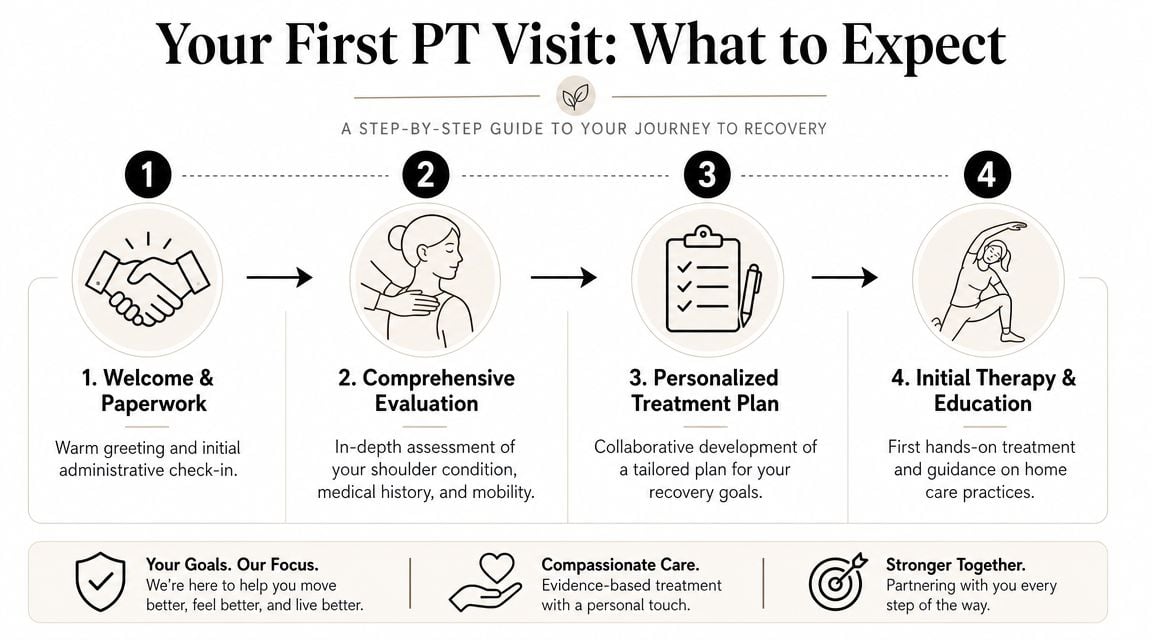
The first visit should answer two questions quickly. What's bothering the shoulder, and why is it happening?
Individuals often arrive worried that the evaluation will be complicated or painful. In reality, a good first appointment feels more like problem-solving. You talk through what you've been noticing, what movements trigger symptoms, how long it's been going on, and what you need to get back to. That could be sleeping through the night, reaching overhead at work, getting back to the gym, or putting on a jacket without thinking about it.
The evaluation is about patterns, not just pain
A shoulder assessment usually looks at more than the spot that hurts. A therapist wants to see:
- Range of motion when you lift, rotate, and reach
- Strength in the rotator cuff and nearby support muscles
- Movement quality during overhead tasks and daily motions
- Irritability or how easily symptoms flare during and after activity
- Functional limits that matter in your life, job, or sport
That last point matters. Someone who works at a desk needs a different plan than someone stocking shelves, lifting tools, or returning to tennis.
Progress should be measurable
Modern shoulder rehab should track more than “it feels a little better.” Plans are often benchmarked against measurable outcomes such as pain-free active range of motion, external-rotation strength symmetry, and function scores like QuickDASH or SPADI, as described in this shoulder rehab resource focused on measurable progress.
That gives you a baseline. It also helps your therapist adjust the plan week by week based on pain levels, work demands, and activity goals instead of relying on guesswork alone.
Here's what many first visits include:
| Part of visit | What happens | Why it matters |
|---|---|---|
| Conversation | You explain symptoms, daily demands, and goals | Treatment should match your real life |
| Movement testing | The shoulder is checked through motion and control tasks | Pain location alone doesn't explain the problem |
| Strength checks | Key muscle groups are assessed | Weakness changes how the joint handles load |
| First treatment | You usually leave with a starting plan | Early clarity reduces fear and overthinking |
If you want a broader local overview of care options and what physical therapy looks like in the area, read more at physical therapy in Quincy, MA.
A strong first visit should leave you with a clear starting point, a reason for the symptoms, and a plan you can actually follow.
Your Personalized Shoulder Recovery Plan
Two Quincy neighbors can walk in with the same complaint and need very different plans. One strained a shoulder clearing heavy snow after a nor'easter and now winces reaching for a coffee mug. Another feels pain only after nine holes at Granite Links or a long shift of overhead work. The label may sound similar. The plan should not.
A useful recovery plan is built around three things. What movement is limited, what load the shoulder can handle today, and what you need it to do in real life by the end of rehab. A parent lifting a child, a carpenter working above shoulder height, and an older adult dealing with gradual stiffness each start in a different place and progress at a different speed.
What your plan may include
Treatment often combines a few pieces, adjusted as symptoms calm down and function improves:
- Targeted mobility work if stiffness in the joint, upper back, or surrounding tissue is blocking comfortable motion
- Early muscle loading with gentle holds or short-range work if the shoulder is too sensitive for heavier exercise
- Strength progressions for the rotator cuff, shoulder blade muscles, and arm as tolerance improves
- Movement practice for reaching, lifting, pushing, pulling, or overhead tasks that currently trigger symptoms
- Pacing and activity changes so you can keep living your life without setting the shoulder off every few days
The order matters. The dose matters too.
If a shoulder is easily irritated, starting too aggressively usually backfires. If a shoulder has become weak and deconditioned, protecting it for too long also slows recovery. Good rehab lives in the middle. It asks the shoulder to do enough work to improve, without asking for so much that you lose the next two days to soreness.
That is why the plan changes over time. Early on, treatment may focus on calming pain, restoring motion, and building trust in simple movements. Later, the work gets more specific. Carrying groceries up porch steps in Quincy Center, lifting bins at work, serving a tennis ball, or getting through a full round of golf all place different demands on the shoulder.
What steady progress usually looks like
Recovery is rarely dramatic. It usually looks like this:
- Pain eases faster after activity
- Reaching overhead feels less guarded
- Strength improves side to side
- Sleep becomes less interrupted
- Daily tasks stop feeling like a test
At Peak Physical Therapy and Sports Performance, we build plans around those real changes, not just a diagnosis on paper. If your case is more complex and you want deeper clinical background on shoulder conditions and rehab options, the Highbar Health hub is the right place to explore that in more detail.
The goal is simple. Get your shoulder working well enough that normal Quincy life feels normal again.
Simple Home Exercises to Support Your Recovery
A home program works best when it gives your shoulder a small, repeatable win between visits. For a lot of Quincy patients, that means a few minutes of controlled movement before work, after a shift, or later in the evening when the shoulder usually starts to tighten up. The goal is not to see how much the shoulder can tolerate. The goal is to keep it moving and help it settle.
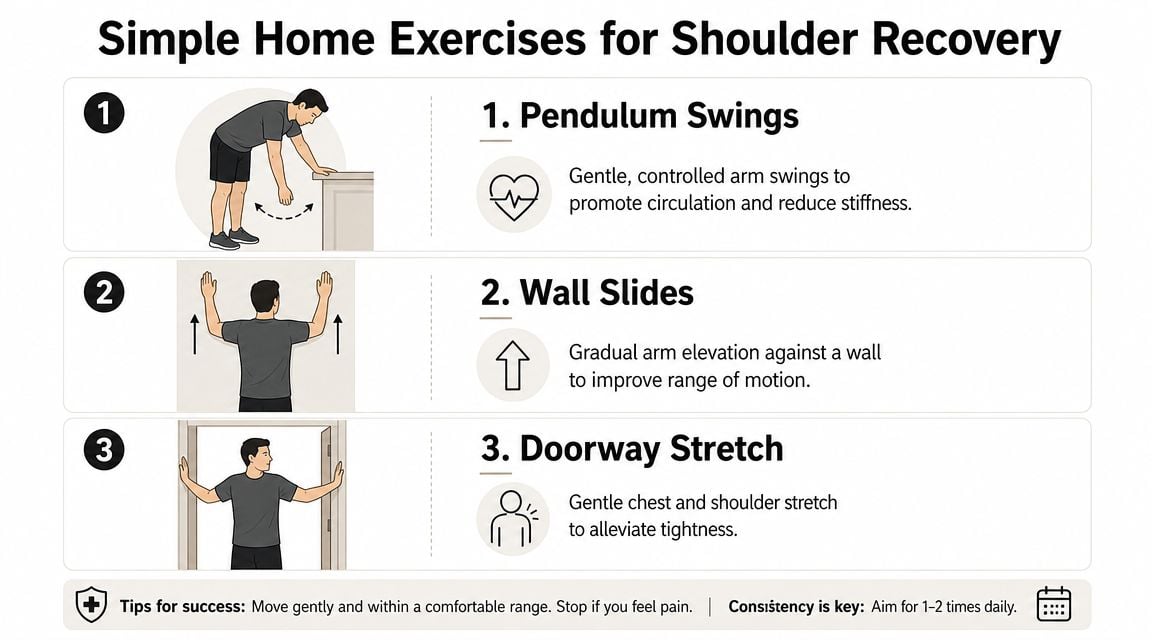
These are three common starting exercises I often use with patients who need a gentle place to begin. They are simple, but the details matter.
Pendulum swings
Lean forward and support yourself with the uninvolved hand on a counter or table. Let the sore arm hang relaxed. Make small circles or gentle forward and back motions. If you are tightening your neck or bracing the shoulder, make the movement smaller.Wall slides
Stand facing a wall with your hands or forearms supported. Slide upward only as far as you can without a hard shrug or a pinch at the top. This is a good way to practice overhead motion with less strain than reaching into a cabinet or lifting something off a shelf.Doorway stretch
Place your forearm lightly on the side of a doorway and step through until you feel a mild stretch in the front of the chest and shoulder. Keep the ribs down and avoid forcing the position. A light stretch is enough.
A few guardrails help these stay useful.
- Keep pain in the mild range. A little effort or stiffness during the exercise can be fine. Sharp pain, catching, or soreness that lingers well into the next day usually means the dose was too high.
- Use slow, even reps. Quick, jerky movements tend to irritate sensitive shoulders.
- Stop if the pattern feels wrong. Numbness, clear weakness, or pain that keeps ramping up deserves a closer look.
If you want a few more examples, our guide to home therapy exercises for shoulder pain is a helpful place to start. Still, home exercises are only one part of recovery. If your shoulder keeps flaring after simple drills, the program likely needs to be adjusted for your specific problem, whether that is stiffness, cuff irritation, poor loading tolerance, or movement compensation.
Start Your Journey to a Pain-Free Shoulder Today
Shoulder pain is common in Quincy. It's also treatable, and in most cases the next step doesn't need to be complicated. If your shoulder hurts when you reach, lift, sleep, work, exercise, or get through basic daily tasks, it's worth getting a clear answer and a plan that fits your life.
The biggest mistake is usually waiting too long and hoping the shoulder will sort itself out. Some do. Many don't.
If you're looking for shoulder pain physical therapy in Quincy, MA, book an evaluation and get a straightforward starting point. The sooner you know what's driving the pain, the sooner you can start building back motion, strength, and confidence.
If your shoulder is limiting work, sleep, exercise, or everyday movement, Peak Physical Therapy and Sports Performance makes it easy to take the next step. Schedule an appointment online through the website and connect with a local clinic team that can evaluate your shoulder, map out a personalized recovery plan, and help you get back to moving comfortably on the South Shore.