You wake up with that same pressure behind your eyes. You push through your Quincy commute, sit through another workday in Braintree or Boston, and hope coffee, water, or a dark room will take the edge off. By the time the weekend comes, the idea of walking Nantasket, getting to Duxbury Beach, or just watching your kid's game without your head pounding feels like too much.
That cycle wears people down. Many South Shore adults have already tried the obvious things before they look into physical therapy. They've adjusted screens, taken medication, stretched a little, maybe even bought a new pillow. Sometimes that helps. Sometimes it only masks the problem for a few hours.
That's where targeted headache physical therapy on the South Shore can make a real difference. For many headache sufferers, physical therapy offers significant hope. Migraine patients treated with physical therapy have shown an 18% improvement in migraine frequency according to this clinical overview of how physical therapy can help headaches. The reason is simple. Some headaches have a strong mechanical driver in the neck, upper back, jaw, posture, or muscle tension pattern.
If that sounds familiar, the right next step isn't guessing harder. It's getting assessed by someone who can tell whether your headaches are coming from a musculoskeletal source and whether a hands-on, exercise-based plan can help.
Table of Contents
- Tired of Headaches Ruling Your Life on the South Shore
- Understanding the Headaches Physical Therapy Can Treat
- Our Evidence-Based Approach to Headache Relief
- Is Headache Physical Therapy Right for You
- Your First Visit at a Peak South Shore Clinic
- Charting Your Progress and Building Self-Care Habits
- Find Headache Relief Near You on the South Shore
Tired of Headaches Ruling Your Life on the South Shore
A lot of headache stories on the South Shore sound similar. A parent in Hanover spends the afternoon at practice fields, then gets home with neck tightness that turns into a headache by dinner. A commuter from Weymouth grips the wheel through traffic, shoulders up around the ears, then feels pain climb from the base of the skull into the temples. A Plymouth resident works at a laptop all week, then loses half the weekend recovering.
The frustrating part is that recurring headaches rarely stay contained to your head. They change how you work, drive, exercise, sleep, and show up for family. People start planning around the next flare-up instead of around what they want to do.
Headaches that keep coming back after desk work, driving, reading, lifting, or poor sleep often deserve a closer look at the neck and upper back, not just the head pain itself.
That's why physical therapy can be such a practical option. It doesn't ask you to only endure symptoms better. It looks for the movement restriction, muscle overload, postural habit, or trigger-point pattern that keeps restarting the cycle.
On the South Shore, that local context matters. Long car time, screen-heavy jobs, youth sports schedules, stress, and weekend activity spikes all show up in the body. The right care plan needs to match real life. It should help you sit longer without building tension, turn your head without reproducing symptoms, and get through the day without feeling like your headache is always one bad posture away.
Understanding the Headaches Physical Therapy Can Treat
Physical therapy isn't for every headache. That's the first thing to say clearly. But for the right headache pattern, it can be one of the most useful conservative treatments available.
When the source is in the neck
The easiest way to think about it is this. Sometimes the headache is the lightbulb. The problem is the wiring behind the wall.
If the source is a stiff upper cervical joint, weak deep neck stabilizers, overloaded upper trapezius muscles, or sustained forward-head posture, treating only the pain misses the driver. A good physical therapy exam looks for whether the headache is linked to neck movement, posture, muscle tension, or joint restriction.
A helpful outside read on that connection is this guide to understanding neck pain and related headaches. For readers dealing with symptoms after a head injury, there's also a separate pathway worth reviewing in this post on concussion physical therapy on the South Shore.
Common headache types treated with physical therapy
| Headache Type | Common Symptoms | Typical Triggers |
|---|---|---|
| Cervicogenic headache | Pain that often starts in the neck or base of the skull, reduced neck motion, pain with turning the head | Driving, desk posture, sleeping awkwardly, prior neck injury |
| Tension-type headache | Band-like tightness, pressure, neck and shoulder tension, muscle tenderness | Stress, long computer work, jaw clenching, sustained posture |
| Migraine with a neck component | Head pain with neck stiffness or neck tension that seems to build before or during episodes | Postural strain, muscle tightness, sensory overload, poor sleep |
These categories matter because the treatment response differs. Cervicogenic and tension-type headaches often respond well when therapy addresses joint mobility, muscle tension, stretching, strengthening, and self-management. Some migraine patients also improve when there's a clear mechanical contributor in the neck and upper back.
When another condition needs a different path
Not every severe or frequent headache belongs in a PT clinic first. Some people need medical evaluation, medication management, imaging, or a neurology workup before rehab makes sense.
Practical rule: If your symptoms don't behave like a movement-related problem, or they're paired with unusual neurological or systemic signs, physical therapy shouldn't be the starting point.
That distinction is part of good care. The right clinician should help you sort out whether you're dealing with a musculoskeletal headache pattern, a migraine-dominant presentation, post-concussion symptoms, or something that needs a physician's input first.
For deeper educational content on anatomy, headache mechanisms, and related neck conditions, visit Highbar Health's resource hub at highbarhealth.com.
Our Evidence-Based Approach to Headache Relief
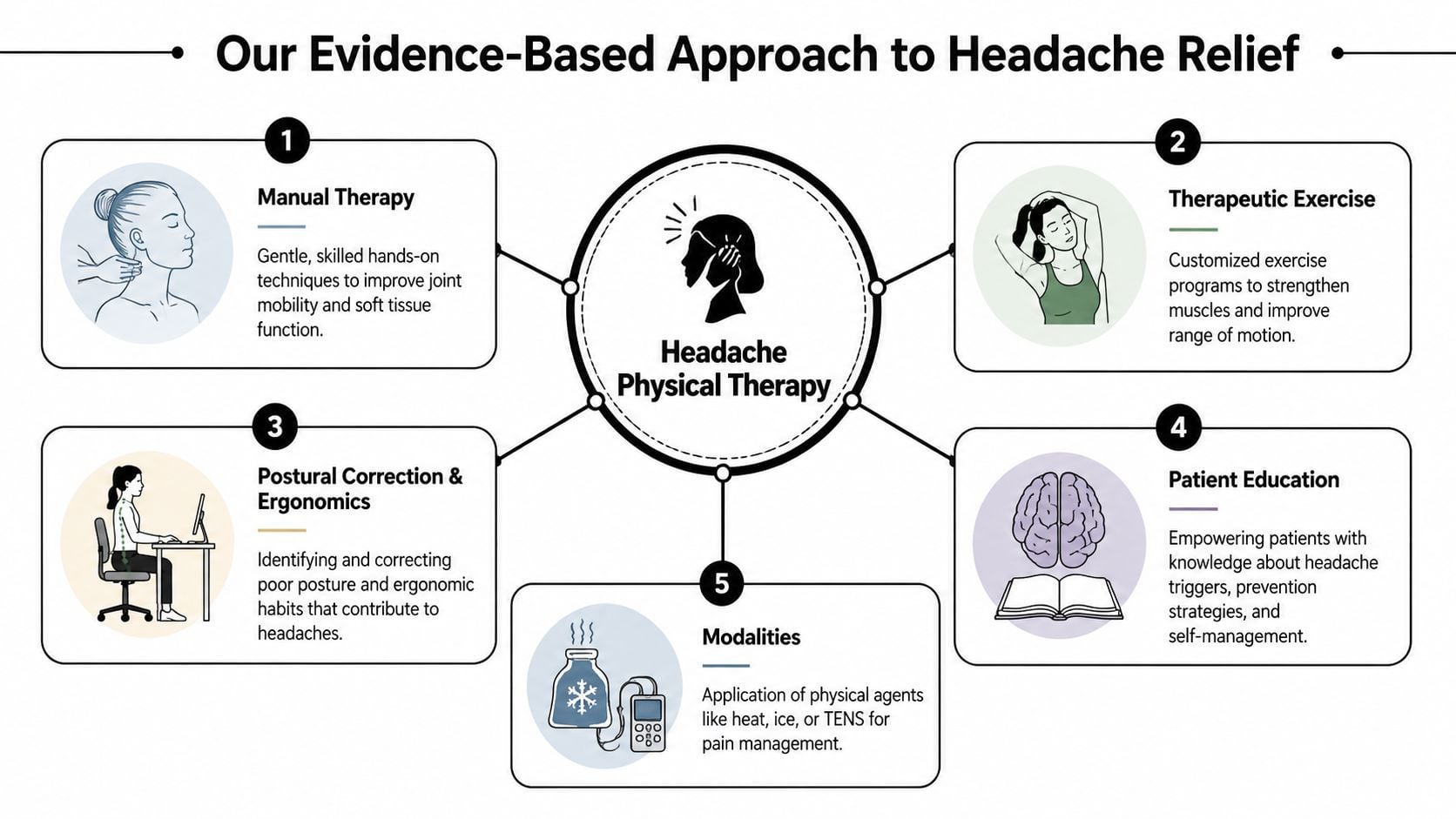
Headache PT works best when it's specific. Random massage, generic stretching, and passive treatment alone usually don't hold for long if no one addresses the reason your tissues keep getting irritated.
A major 2023 systematic review identified 28 reports and included 23 in the quantitative synthesis. It found that manipulation plus dry needling ranked highest for reducing short-term headache intensity, with a mean difference of -4.87, and also improved headache frequency by -3.09 versus control. The authors also emphasized that the results were based on low-certainty evidence, so the right takeaway is promising benefit, not overblown certainty. You can review that analysis in the 2023 systematic review on physical therapist interventions for headache.
That lines up with what good outpatient care already does. It combines hands-on treatment, active rehab, and patient education instead of leaning on one tool.
Manual therapy for stiff joints and irritated tissues
Manual therapy is useful when the neck or upper thoracic spine isn't moving well, or when muscle guarding is feeding the headache pattern. This can include joint mobilization, soft-tissue work, and targeted hands-on techniques to calm irritated areas.
What it does well:
- Improves motion: Restoring movement in stiff cervical or upper-back segments can reduce strain during turning, lifting, and prolonged sitting.
- Decreases local irritation: Soft-tissue techniques can reduce tenderness in overloaded muscles at the base of the skull, upper trapezius, and surrounding areas.
- Creates a better window for exercise: People often move more normally after the right hands-on treatment, which makes strengthening and motor control work more effective.
What it doesn't do well on its own:
- It doesn't build lasting capacity: If posture, strength, endurance, and work setup never change, symptoms often return.
- It can become passive care: If every visit is only table treatment, progress often plateaus.
Dry needling for stubborn trigger points
Dry needling can help when there are persistent trigger points that refer pain into the head, jaw, or temple region. For the right patient, it's not a gimmick. It's one option inside a broader plan.
It tends to make the most sense when a muscle knot is easy to reproduce, keeps returning, and limits how well the patient responds to manual therapy and exercise alone. It tends to make less sense when the headache pattern has no clear muscular driver.
Relief that lasts usually comes from pairing symptom reduction with movement retraining, strength, and better day-to-day habits.
If your symptoms look more migraine-dominant than cervicogenic, this article on physical therapy and migraines is a useful next read.
Therapeutic exercise that changes the pattern
Exercise is where short-term relief becomes usable progress. The most effective programs usually target:
- Deep neck flexor control
- Upper-back and scapular strength
- Mobility where you're stiff
- Load tolerance for work, driving, reading, and exercise
- Postural awareness you can maintain
This is also where therapists need to be honest. More exercise isn't always better. The right exercise is the one that improves control without flaring symptoms, matches your day, and can be repeated consistently.
For South Shore residents, that might mean building tolerance for long commutes, desk work, yard work, lifting beach gear, or getting through a youth sports weekend without your headache ramping up by midday.
Is Headache Physical Therapy Right for You
A common South Shore pattern looks like this. You get through a Route 3 commute, a day at the laptop, or an afternoon carrying coolers and chairs to the beach, and the headache starts building from your neck into your head. If that sounds familiar, physical therapy may be a good fit.
The people who respond best usually have headaches with a mechanical pattern. Symptoms change with posture, neck position, muscle tension, or repeated daily activities. That does not make the pain any less disruptive. It means there is something specific to examine and treat.
Signs you may be a strong fit
Several findings tend to point toward headache PT:
- Your headache begins with neck or shoulder tension: Pain starts at the base of the skull, neck, or upper traps and then travels upward.
- Certain positions bring it on: Driving, desk work, reading in bed, scrolling on your phone, or looking down for long stretches reliably make symptoms worse.
- Neck movement feels stiff or triggers pain: Turning to check traffic, backing out of the driveway, or looking over your shoulder brings on the headache or increases it.
- You have a history of neck strain or impact: Old sports injuries, a past car accident, or a “minor” strain can leave behind stiffness and poor motor control.
- You get short-term relief, but it never sticks: Massage, heat, or cracking your neck helps for a few hours or a day, then the same pattern returns.
I also look for one more thing. Your symptoms should be reproducible. If a posture, movement, or muscle test reliably brings on your familiar pain, that gives us a practical target.
When PT may not be the right first step
Headaches are not all the same, and forcing every case into a musculoskeletal explanation is poor care. Some patients need a medical workup first, especially when the pattern is new, severe, or unrelated to movement.
Seek medical evaluation promptly if you have:
- A sudden, severe headache unlike your usual pattern
- Fever, unexplained illness, or neck stiffness with whole-body symptoms
- New vision changes, fainting, confusion, or other neurological symptoms
- A headache after significant trauma
- A pattern that is quickly getting worse without a clear trigger
There is a real trade-off here. Starting PT early can help the right patient avoid months of chasing symptoms. Starting PT before ruling out a medical cause can delay the care you need.
Good headache care starts with choosing the right lane. If your symptoms consistently track with neck tension, posture, jaw clenching, or daily activity on the South Shore, a focused PT evaluation is a reasonable next step.
Your First Visit at a Peak South Shore Clinic
A first appointment for headache physical therapy should feel more like problem-solving than a test. There's often a worry that generic stretches will be prescribed or that nothing useful will turn up. A good evaluation is much more specific than that.
It starts with your story
The first part is conversation. You describe where the pain starts, how it spreads, what time of day it tends to show up, what makes it worse, and what gives even temporary relief.
That history matters because patterns tell you a lot. A headache that ramps up after a long Route 3 commute is different from one that appears randomly at rest. A headache tied to jaw clenching, laptop posture, or looking down at schoolwork suggests a different driver than one with no movement link at all.
The physical exam is practical, not intimidating
A strong treatment plan starts with a mechanistic exam, meaning the clinician looks for the physical factors that keep the problem going. That includes whether the headache is aggravated by neck movement or sustained posture, a pattern that strongly predicts a musculoskeletal driver according to this overview of mechanistic headache treatment in physical therapy.
The exam often includes:
- Posture assessment: How your head, neck, shoulders, and upper back are positioned at rest
- Neck range of motion: Whether turning, bending, or extending the neck reproduces symptoms
- Palpation of muscles and joints: Gentle pressure to see whether specific tissues trigger your familiar headache
- Strength and control testing: Especially the neck and shoulder muscles that support sustained posture
- Functional questions: What happens during work, driving, sleep, lifting, exercise, or stress
The exam isn't about proving how much pain you have. It's about finding what reliably changes it.
By the end of that visit, the useful questions are usually clearer. Is this coming from the neck? Which movements matter most? What should be treated first? What can you start doing at home right away?
Charting Your Progress and Building Self-Care Habits
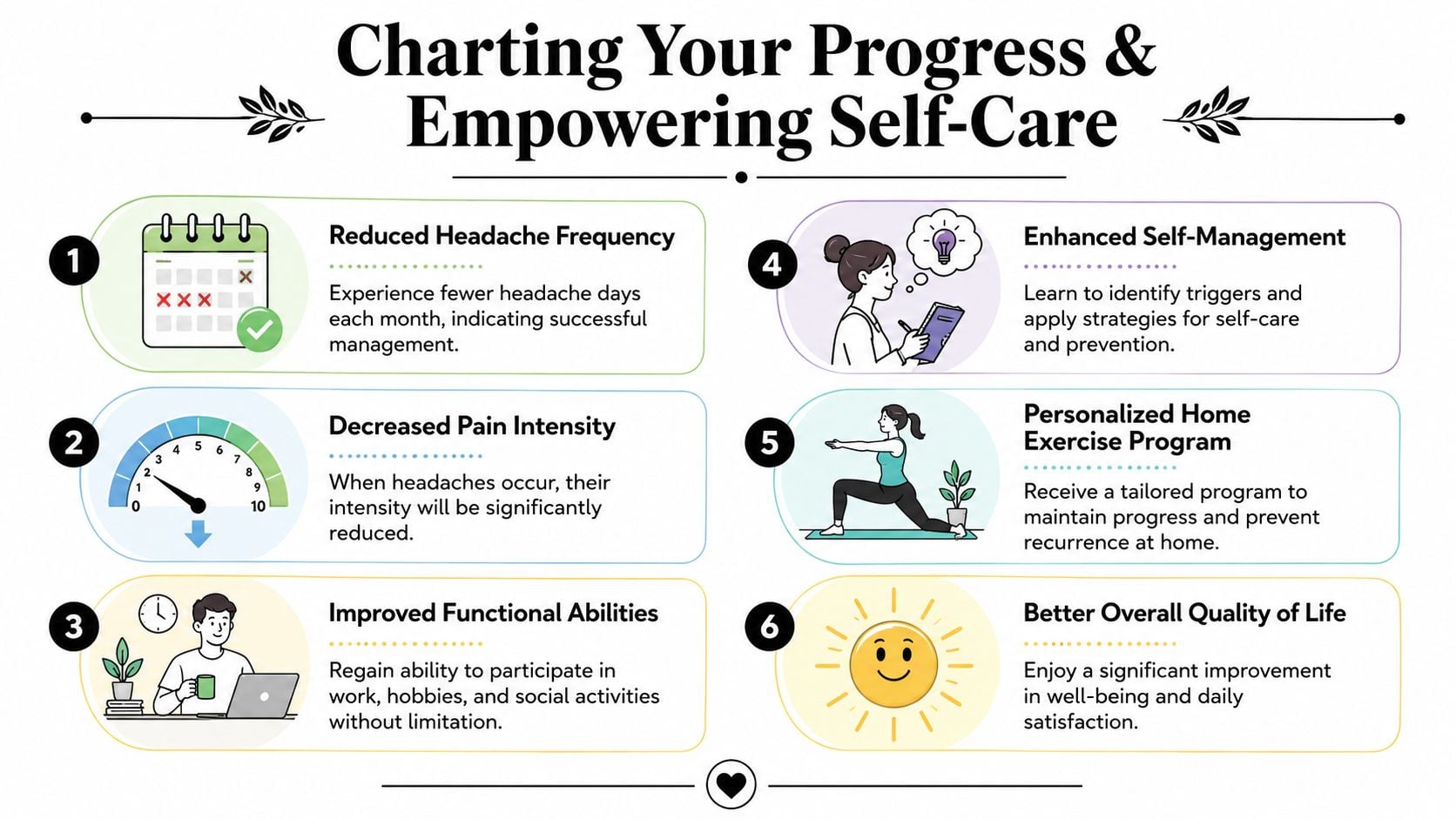
Progress should be easy to recognize in real life. The goal is not just a better score on paper. It is getting through a Quincy commute, a desk-heavy workday, or a night of sleep without the same headache pattern taking over.
A strong plan tracks changes that matter day to day. That usually means fewer headache days, lower intensity when symptoms do show up, better neck movement, and more tolerance for reading, driving, screen time, or exercise. In the clinic, I also look for whether flare-ups settle faster and whether patients feel more confident catching the early signs before a full headache builds.
What progress actually looks like
Early progress is often subtle, but it is still meaningful.
- Fewer flare-ups: The headache shows up less often over the course of a week.
- Lower intensity: Symptoms may still appear, but they are less disruptive and easier to settle.
- Better activity tolerance: You can work at the computer, drive Route 3, read, or look down at tasks longer before symptoms start.
- Less neck guarding: Turning your head feels easier, and you are not bracing for pain with every movement.
- Shorter recovery time: A bad day does not automatically turn into a bad week.
Progress is rarely perfectly linear. Some people feel better quickly, then hit a plateau while building strength and control. Others improve more steadily but need time to change the daily habits that keep feeding the problem. Both patterns can be normal.
Simple self-care strategies to start now
These ideas are often reasonable starting points for headaches that seem tied to posture, neck tension, or long periods in one position. They are not a substitute for an evaluation, especially if your symptoms are new, changing, or do not behave like a movement-related headache.
Gentle chin tuck
Sit tall and draw your chin straight back. Keep your eyes level and avoid tipping your head up or down. Hold briefly, then relax.Upper trapezius stretch
Sit on one hand and gently tilt your opposite ear toward your shoulder. Keep the stretch light. Stretching should not feel like you are chasing pain.Micro-break reset
During desk work, traffic, or long study sessions, pause for a quick reset. Roll your shoulders back, unclench your jaw, and bring your head back over your trunk instead of letting it drift forward.Screen and reading check
Raise the phone, tablet, or book closer to eye level when possible. Small setup changes often reduce the repeated neck strain that keeps symptoms going.
Small changes repeated every day usually work better than one big effort you cannot keep up.
If headaches are interfering with work, commuting, workouts, or weekends on the South Shore, getting care close to home makes follow-through easier. This guide to finding physical therapy near you on the South Shore can help you choose a clinic location that fits your routine.
Find Headache Relief Near You on the South Shore
If you're looking for headache physical therapy on the South Shore, convenience matters. It's easier to follow through when expert care is close to home, close to work, or on your usual route.
South Shore residents can access care in Braintree, Quincy, Weymouth, Cohasset, Duxbury, East Bridgewater, Hanover, Kingston, Milton, Norwell, Pembroke, Plymouth, and Scituate. If you're comparing options by location, this guide to physical therapy near me on the South Shore can help you narrow down the best clinic fit.
Booking is straightforward, and staff can help you understand scheduling and insurance steps before you start.
If headaches are interfering with your commute, workday, sleep, workouts, or weekends, it makes sense to get them assessed instead of waiting for the next flare to pass on its own. The right plan can tell you whether your headaches are a good fit for PT, what's driving them, and what to do next.
If you're ready to stop planning your life around headaches, book an evaluation with Peak Physical Therapy and Sports Performance. With clinics across the South Shore and a team focused on personalized, evidence-based care, it's a practical next step toward lasting relief.