


A lot of athletes on the South Shore know this feeling.
You tweak an ankle in a pickup game in Quincy. Your hamstring grabs halfway through a tempo run while you’re building toward a spring race. Your teenager comes home from practice in Norwell or Duxbury saying, “It’s probably nothing,” but they’re limping to the kitchen. The next few days get frustrating fast. You miss workouts. You start changing the way you move. You wonder whether resting will be enough, or whether the same thing is going to happen again the minute you get back out there.
That frustration is real. So is the fear behind it. Athletes don’t just hate pain. They hate losing momentum, losing confidence, and losing access to the routines that keep them grounded through busy workweeks, cold Massachusetts winters, and the long stretch of training between goals.
The good news is that many sports injuries are not random bad luck. Research from leading health organizations, including the CDC, indicates that 50-60% of sports injuries are preventable through evidence-based strategies like proper warm-up routines, technique training, and workload management (bullcitypt.com on preventable sports injuries).
That doesn’t mean you can control everything. Sports are chaotic. Weather changes. Fields get slick. Opponents collide with you. Bodies get tired. But it does mean you can stack the odds in your favor.
Preventing injury usually comes down to a few essential habits done consistently. Warm up with purpose. Build strength where your sport demands it. Progress your training instead of making emotional jumps. Respect recovery. Pay attention when your body starts whispering, not just when it starts yelling.
Don't Let an Injury Sideline You Again
A sprained ankle rarely feels like a big-picture problem in the moment. It feels personal and immediate. You were moving well, then one bad landing changes the whole week.

For many athletes, the toughest part isn’t the first injury. It’s the cycle after it. You rest just enough to feel better, return at the same intensity, then something else starts to hurt. The calf tightens. The knee gets sore. The shoulder feels unstable. That pattern is common because people often treat the pain, but not the reason it showed up.
Most injuries have a setup
In clinic, the setup usually looks familiar. A runner adds mileage too quickly when Boston Marathon season picks up. A high school athlete goes from little off-season work to full practices. An adult league basketball player skips warm-ups because the game starts at 7 and everyone is short on time.
The injury seems sudden, but the groundwork was laid earlier.
Common setup factors include:
- Poor preparation when muscles and joints go from desk mode to game speed too quickly
- Unmanaged training load when the body gets a spike in running, cutting, throwing, or jumping
- Movement deficits such as limited hip mobility, poor landing control, or weak trunk stability
- Rushed return after soreness or a prior injury before strength and confidence are fully back
Practical rule: If the same area keeps flaring up, stop calling it bad luck. Assume your body is giving you useful information.
Prevention is more practical than people think
When people search for how to prevent sports injuries, they often expect complicated programs or expensive technology. Most of the time, the basics matter more.
The athletes who stay available tend to do simple things well:
- They warm up before they compete.
- They build strength even when they’re not hurt.
- They progress training gradually.
- They sleep, hydrate, and recover like those things count.
- They respond early when pain changes the way they move.
That approach matters whether you’re a high school soccer player in Braintree, a hockey player in Plymouth, or an adult trying to stay active through winter by lifting, running, skating, or playing indoor basketball.
The goal isn’t to be cautious all the time
The goal is to be durable.
Durable athletes can train hard, recover well, and repeat that cycle without breaking down every few weeks. That doesn’t come from one magic drill. It comes from a system.
The rest of this guide focuses on that system. Not generic advice. The habits that hold up when life gets busy, weather gets ugly, and your sport still demands speed, force, and repetition.
Building Your Injury-Proof Foundation
Most athletes think they warm up. A lot of them are really just starting slowly.
That’s not the same thing. A warm-up should prepare your joints, muscles, and nervous system for the exact demands you’re about to place on them. It should raise temperature, improve movement quality, and get you ready to accelerate, cut, jump, rotate, or absorb contact.

Warm-up first, stretch later
One of the most common mistakes I see is athletes doing long static stretches before explosive activity. That’s usually the wrong tool at the wrong time.
Use this simple split:
| When | Best focus | What it should feel like |
|---|---|---|
| Before activity | Dynamic movement | Controlled, active, progressively faster |
| After activity | Cool-down and static stretching | Easy, relaxed, never painful |
The Cleveland Clinic guidance also notes that stretching is best held for up to 20 seconds without pain, and cooldowns should last twice as long as warm-ups. The same source includes the youth age-to-hours ratio guideline, meaning weekly sport hours should not exceed a child’s age, such as a 10-year-old staying at 10 hours max per week (Cleveland Clinic sports injury prevention guidance).
That youth guideline matters in towns like Hanover, Norwell, and Duxbury where kids often stack club sports, school teams, skills sessions, and private lessons. More activity isn’t always better. Better-managed activity is better.
A simple dynamic warm-up that works
You don’t need a complicated routine. You need one you’ll do.
Try this pre-sport sequence before running, field sports, basketball, tennis, or gym training:
Brisk walk or easy jog
Start moving and gradually raise body temperature.Leg swings
Front to back first, then side to side. Hold onto a wall or fence if needed.High knees
Keep posture tall and move with rhythm, not speed.Butt kicks
Stay light on your feet.Walking lunges with rotation
Open the hips and add trunk rotation over the front leg.Lateral shuffles
Wake up the hips for side-to-side control.Torso twists
Rotate through the upper body without forcing range.Skipping or short build-up runs
Finish with a movement that feels closer to your sport.
Don’t judge a warm-up by whether it feels hard. Judge it by whether your first hard effort feels smoother and more controlled.
Mobility is different from warming up
Mobility isn’t the same as a pregame routine. Warm-ups prepare you for the session in front of you. Mobility helps maintain the joint motion and tissue quality that support better mechanics over time.
If your hips are stiff, your lower back often picks up extra work. If your ankle motion is limited, your knee may absorb force poorly. If your thoracic spine is locked up, your shoulder may lose clean overhead motion.
A useful daily mobility habit can be brief:
- Ankles with knee-over-toe calf mobility
- Hips with openers and controlled rotations
- Thoracic spine with rotation drills
- Shoulders with wall slides or controlled reach patterns
Equipment and environment still matter
Winter in Massachusetts changes the equation. Cold tissue feels stiffer. Turf gets harder. Roads get slick. Shoes that felt fine in October may not match the surface in January.
Before every session, check:
- Footwear for the sport and surface
- Layering so you start warm rather than trying to “run into” warmth
- Protective gear that fits and is worn correctly
- Field or court conditions when snow, ice, or wet surfaces change traction
Parents should also keep one eye on schedule quality. If a young athlete is practicing tired, sore, and overloaded, that isn’t toughness training. That’s usually a setup for overuse.
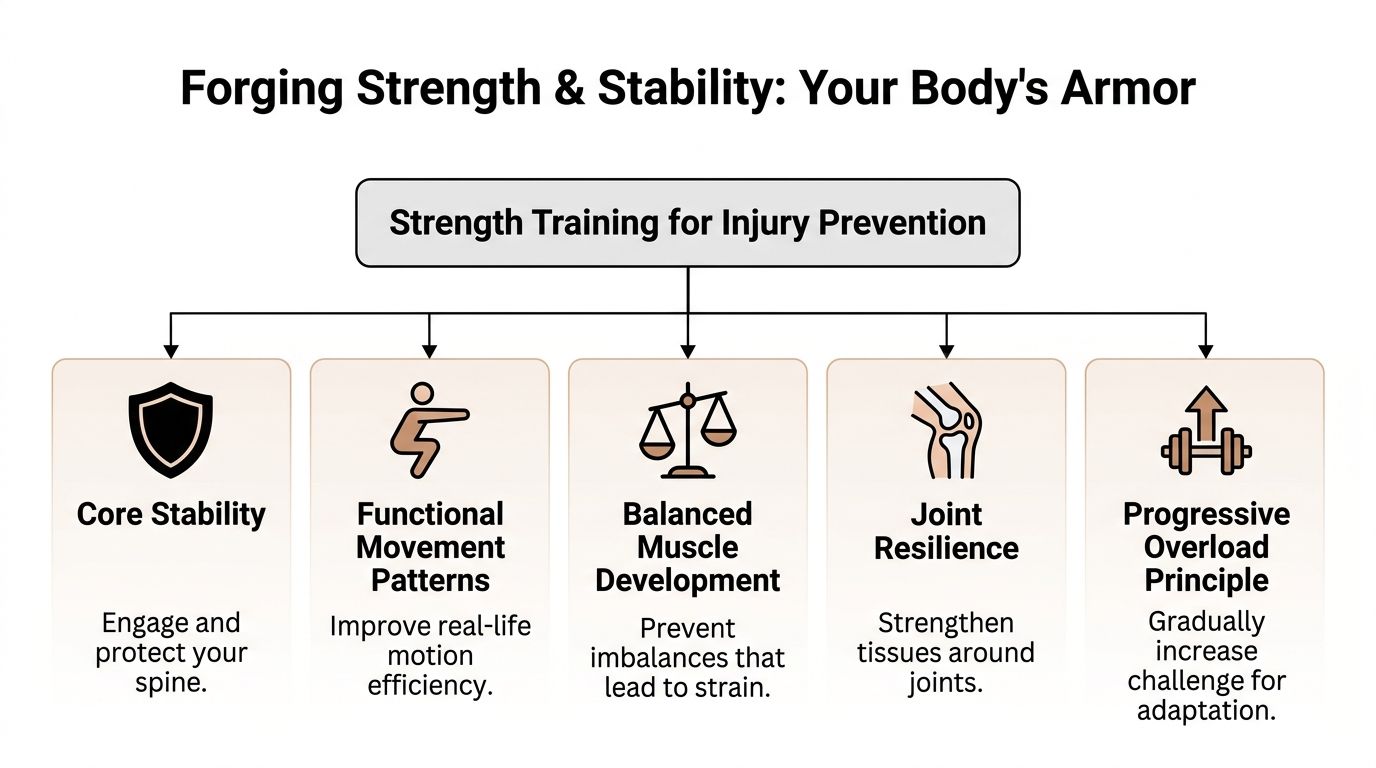
Forging Strength and Stability Your Body's Armor
Warm-ups prepare you for today. Strength training prepares you for the whole season.
That’s the difference athletes often miss. If you only think about injury prevention right before practice, you’re already late. Your real protection comes from what your body can tolerate week after week. Strength is what raises that ceiling.
Strength is not just about muscle size
For injury prevention, strength training is less about aesthetics and more about force control.
Can you decelerate well? Can you absorb impact? Can you keep your knee from collapsing inward when you land? Can your trunk stay stable when your legs and arms are moving fast? Can your hamstring control the leg as it swings forward at speed?
That last point matters more than most runners and field athletes realize. Research on neuromuscular training programs that include the Nordic hamstring exercise found a 50% reduction in hamstring strain injuries across multiple sports (PMC review on neuromuscular training and Nordic hamstring exercise).
That’s why injury prevention programs shouldn’t be random collections of band exercises. They should target the way your sport creates force and the way injuries usually happen.
The body areas that earn their keep
If you only have time for a focused prevention routine, prioritize the regions that protect the rest of you.
Hips and glutes
Strong hips help control femur position, pelvis stability, and knee mechanics. They matter for runners, skaters, field athletes, and anyone cutting or landing.
Useful choices include:
- Split squats for single-leg control
- Lateral band walks for glute medius activation
- Step-downs for hip and knee alignment under load
Core and trunk
The core doesn’t just “tighten your abs.” It transfers force and keeps your spine from leaking energy.
Build it with movements such as:
- Front plank variations
- Side planks
- Dead bugs
- Pallof press holds
Posterior chain
Your hamstrings and glutes help you sprint, hinge, decelerate, and protect the knee.
A strong posterior chain routine can include:
- Romanian deadlifts
- Bridges or hip thrusts
- Nordic hamstring curls
- Single-leg deadlifts
Shoulder stabilizers
Throwers, swimmers, tennis players, and lifters need shoulder control, not just pressing strength.
Focus on:
- Rows
- External rotation work
- Scapular retraction drills
- Bottom-up carries or other control-based carries
Five exercises worth keeping in rotation
Here’s a simple short list I’d trust for many athletes.
Split squat
Start tall. Lower under control. Keep the front knee tracking over the foot. Drive back up without collapsing inward.Single-leg Romanian deadlift
Hinge at the hip, keep the back flat, and reach the free leg behind you. This builds balance, hip stability, and posterior chain strength.Side plank
Keep the body in one straight line. Don’t let the hips roll back. This is basic but powerful for trunk control.Nordic hamstring curl
Kneel with your ankles anchored. Lower your body forward slowly while resisting the fall as long as you can. Use your hands to catch yourself, then reset.Lateral step-down
Stand on a step, lower one heel toward the floor, and keep the standing knee aligned. This exposes weak hip control quickly.
A prevention program should look boring on paper and feel effective in your sport. Flashy isn’t the goal. Transfer is.
What works better than generic routines
Generic leg day isn’t enough if your sport asks for sprinting, cutting, overhead motion, or repeated rotation. Your program should match your demands and your injury history.
That’s especially true for athletes with knee risk factors. If you want a practical outside resource on movement mechanics and prevention principles, SoccerWares has a useful guide on how to prevent ACL injuries. For a more focused look at female athletes and knee protection, Peak has also covered exercises to prevent ACL injuries in female athletes.
The trade-off athletes need to accept
Strength work can feel like it steals time from your sport. In the short term, maybe it does. In the long term, it keeps you on the field, road, court, or ice.
The athletes who skip it often say they’re too busy training. Then they lose weeks to an injury that strength work might have helped prevent.
That’s the trade-off. A small amount of targeted prehab now, or a forced break later.
The Art of Smart Training Managing Your Workload
A lot of injuries don’t happen because the program is bad. They happen because the jump was too big.
That’s the classic Massachusetts spring mistake. Someone trains inconsistently all winter, gets one warm week, then suddenly runs hard outside four days in a row. Or a high school athlete comes back from an off-season lull and tries to match in-season volume immediately. The body usually tolerates a little ambition. It doesn’t tolerate spikes well.

Too much too soon is still the big trap
Most athletes don’t need a perfect training plan. They need a plan that doesn’t lurch.
If you’ve ever felt great for one or two sessions and then suddenly heavy, sore, flat, or unusually stiff, that’s often a workload problem. The issue isn’t just total effort. It’s the mismatch between what you did recently and what your body was prepared to handle.
A simple self-coaching model helps here.
Use Sense Think Act
A high-performance injury prevention model called Sense-Think-Act has been used in complex athletic settings. In one real-world example, Cirque du Soleil used this approach and saw a 15% overall injury reduction and a 27% decline in overuse injuries over four years (PMC article on the Sense-Think-Act model).
You can apply the same logic without turning yourself into a data scientist.
Sense
Pay attention to what your body is telling you before, during, and after training.
Useful signals include:
- Morning stiffness that’s unusual for you
- Heaviness or dead legs that don’t improve during warm-up
- Pain that changes your mechanics
- Lingering soreness that keeps accumulating instead of fading
- Mood and motivation changes when fatigue is building
Think
Interpret the pattern, not just the single workout.
Ask:
- Did I increase volume, speed, hills, lifting load, or game time quickly?
- Am I stacking hard days without enough recovery?
- Am I carrying a minor issue that’s changing how I move?
- Did weather, sleep, work stress, or travel lower my recovery capacity?
Act
Make a smart adjustment early.
That may mean:
- Replacing a speed session with easy aerobic work
- Cutting volume for a few days
- Swapping impact work for bike, pool, or mobility
- Returning to drills before full scrimmage intensity
- Addressing a weak link before it becomes the next injury
The body is usually willing to negotiate early. It gets less cooperative when you ignore the first few warning signs.
Rest is part of training
Athletes often treat rest as lost time. It isn’t. Recovery is when adaptation catches up.
That matters for basketball players managing jumping volume, runners building toward races like Falmouth, and youth athletes juggling school sport with club commitments. If the schedule includes hard practices, lifting, games, and weekend tournaments, you need at least some low-stress slots built in on purpose.
A good week usually has rhythm. Hard days. Easy days. A progression that makes sense.
Smart adjustments beat stubborn consistency
The right move isn’t always to shut everything down. It’s often to modify with intention.
If ankle stability is limiting your return to court sport, a focused progression matters more than “testing it” in full games. Peak has a practical look at techniques for preventing ankle injuries in basketball that fits well with this idea of controlled progression.
When people ask how to prevent sports injuries, this is one of the least glamorous but most important answers. Build gradually. Watch for spikes. Don’t let one good-feeling day trick you into borrowing from the next two weeks.
Fueling Your Resilience Nutrition Sleep and Sport-Specific Advice
A strong training plan falls apart if recovery inputs are weak.
You can warm up correctly, lift consistently, and still keep getting nicked up if you under-hydrate, under-fuel, or sleep poorly. Recovery isn’t passive. It’s part of performance.
Eat and drink like recovery matters
Hydration is basic, but athletes skip it constantly, especially in winter when thirst cues feel lower. Hockey players, indoor court athletes, and runners training in cold air often finish sessions more dehydrated than they realize.
A few practical rules help:
- Start hydrated instead of trying to catch up afterward
- Drink during longer or more intense sessions when access allows
- Replace fluids after training, especially if the session was sweaty even in cold weather
- Use consistent meals rather than huge swings between under-eating and overeating
Protein supports tissue repair. Carbohydrates help refill the tank for the next session. Fats support overall health and hormone function. You don’t need to make sports nutrition complicated to make it useful.
If you want a practical food list, this guide on foods that aid muscle recovery is a reasonable starting point for planning post-workout meals and snacks.
Sleep is not optional
Sleep is where a lot of physical and mental recovery happens. Athletes know this, but many still treat bedtime as flexible and training time as sacred.
That trade-off usually backfires.
Poor sleep tends to show up as:
- Slower reaction time
- More irritability and lower focus
- Stiffer warm-ups
- Harder efforts feeling harder than they should
- Minor aches hanging around longer
For high school athletes, sleep is often the hidden issue. Early school schedules, homework, screens, and late practices can turn a manageable training week into one the body can’t absorb well.
Sport-specific advice for Massachusetts athletes
Local context changes prevention. The body doesn’t train in a vacuum.
For runners
Boston-area runners deal with hills, wind, slushy shoulders, and winter traction problems.
Keep these in mind:
- Rotate your routes when road camber is severe
- Don’t force pace on icy or uneven footing
- Add calf and foot strength if you’re running in heavier winter shoes
- Be careful when reintroducing hills after a flat treadmill block
For hockey players
Hockey demands repeated hip flexion, powerful skating, and trunk control.
Priorities include:
- Hip mobility so you’re not forcing motion from the low back
- Adductor strength to handle skating demands
- Single-leg stability for transitions and contact
- Recovery after tournament weekends when volume stacks quickly
For field and court athletes
Spring and summer fields on the South Shore can be uneven. Indoor courts in winter mean more repetitive jumping on hard surfaces.
Focus on:
- Landing mechanics
- Ankle and calf capacity
- Hip control when cutting
- A real cooldown instead of ending the session abruptly and heading to the car
For boaters and paddlers
South Shore athletes aren’t only runners and team sport players. Time on the water asks for trunk endurance, balance, shoulder control, and comfort with rotation.
If you boat, paddle, sail, or spend long periods balancing on unstable surfaces, train your:
- Core anti-rotation control
- Shoulder blade stability
- Hip mobility
- Balance under changing surface demands
Recovery habits look boring until you compare them with the frustration of losing another month to something preventable.
When Pain Is More Than Just Soreness Recognizing the Signs
Not every ache means you need an appointment. Training creates soreness. New exercises create soreness. Hard weekends create soreness.
The key question is whether the discomfort behaves like normal adaptation or like a problem that’s starting to take over your movement.
Normal soreness versus a warning sign
Normal soreness usually improves as you warm up, settles within a reasonable window, and doesn’t change your mechanics much.
Pain deserves more attention when it does any of the following:
- Changes the way you run, squat, throw, cut, or land
- Feels sharp, catching, or unstable
- Comes with swelling
- Keeps returning in the same spot
- Doesn’t settle after a few days of smart modification
- Worsens as activity goes on instead of easing into it
A simple test is this: if you’re making excuses for why your movement looks different, the issue probably deserves a real evaluation.
Early care usually means fewer detours
Waiting is understandable. People don’t want to overreact. They don’t want to stop training. They hope it will disappear.
Sometimes it does. Often it lingers just enough to alter mechanics and create a second problem.
That’s why early assessment matters. Peak has written about the importance of early treatment for sports injuries, and the logic is straightforward. The sooner you identify the driver, the easier it is to correct the pattern before it becomes a longer interruption.
What a PT evaluation should do
A useful physical therapy visit should go beyond “where does it hurt?”
It should look at:
- Irritability of the tissue
- Range of motion
- Strength and asymmetry
- Movement quality
- Sport demands and schedule
- Your recent training history
- Your return-to-play goals
At a clinic visit in Weymouth, Kingston, Quincy, or another South Shore location, the goal isn’t just symptom relief. It’s understanding why your body is getting overloaded in that specific area and what needs to change so you can return with more confidence.
Pain that alters movement is performance information. Treat it that way.
Your Weekly Injury Prevention Checklist
Injury prevention works best when it’s built into the week instead of left to motivation. You shouldn’t have to reinvent the plan every Monday.
Use this checklist as a simple template and adjust it to your sport, age, schedule, and current training phase.
Daily habits
- Move a little every day with a short mobility routine for ankles, hips, thoracic spine, or shoulders based on your needs
- Check in with your body before training and notice stiffness, unusual fatigue, or pain that changes movement
- Hydrate consistently across the day, not just around workouts
- Protect sleep like it belongs in the training plan, because it does
Before and after activity
- Warm up dynamically before every practice, game, lift, or run
- Match the session by including movements that resemble the speed and direction demands of your sport
- Cool down on purpose after harder efforts with easy movement and gentle static stretching
- Look at equipment and surface before you start, especially during winter or on uneven fields
Two to three times each week
- Do strength work for hips, glutes, trunk, posterior chain, and sport-specific weak links
- Use single-leg training so side-to-side deficits don’t hide
- Include eccentric control such as slow lowering work that teaches tissues to absorb force
- Keep at least one exercise that challenges balance or landing control
Once each week
- Review your workload and ask whether training rose gradually or jumped
- Plan recovery slots before the week gets crowded
- Modify early if something is building in the wrong direction
- For youth athletes, audit total hours so enthusiasm doesn’t turn into overload
If pain shows up
- Don’t push through altered mechanics
- Scale the load first, then reassess
- Watch the pattern, not just the pain score
- Get evaluated if the issue is sharp, recurrent, swollen, unstable, or not improving
The athletes who stay active longest usually aren’t the ones doing the most. They’re the ones doing the right things often enough that setbacks don’t keep stealing their season.
If you’re dealing with recurring soreness, coming back from an injury, or trying to build a smarter plan for the season ahead, Peak Physical Therapy and Sports Performance can help you turn these principles into an individualized program based on your sport, movement patterns, and goals at any of our South Shore clinics.