


After hip replacement surgery, the journey to reclaiming your life begins almost immediately. We understand you might be feeling a mix of hope and anxiety. Your active role in a guided rehabilitation program is the single most important factor in a successful outcome, and it all starts with those crucial first few days.
Navigating The First Days After Hip Replacement Surgery
The time right after your surgery can feel a little foggy, filled with questions about what you can and can’t do. At Peak Therapy, we find that replacing that uncertainty with a clear, confident plan is the best way to start your healing journey. This initial hospital stay is all about keeping you safe, managing your post-op discomfort, and taking those first few gentle steps toward a new, more mobile life.
Think of this period as laying the groundwork for everything that comes next. Your hospital team, including nurses and an in-hospital physical therapist, will get you up and moving within 24 hours. This might sound fast, but it’s critical for preventing complications like blood clots and keeping stiffness from settling in.
Understanding Your Immediate Post-Op Priorities
Your first few days aren't about pushing your limits; they're about learning to move safely with your new joint. We know pain and swelling are a major concern, and your team will focus on helping you manage them with medication, ice, and proper leg elevation. In fact, learning how to manage post-operative swelling through effective rehabilitation is a skill that will pay dividends throughout your recovery.
The most important rule in this phase is to strictly follow your surgeon's hip precautions. These are the do's and don'ts that protect your new hip while the surrounding tissues heal.
Key Takeaway: The first 48-72 hours are less about aggressive exercise and more about protection. Following your surgeon's specific precautions isn't just a suggestion—it’s the most effective way to prevent a dislocation and ensure your new hip heals correctly.
What to Expect in the Hospital
Your in-hospital physical therapist will be your guide for your very first movements. This isn't about hitting the gym; it's about re-learning fundamental tasks with your new body mechanics.
Our licensed physical therapists perform a comprehensive evaluation to determine the best approach for you. You'll practice things like:
- Getting in and out of bed safely: Your therapist will show you a specific technique to avoid bending your hip past 90 degrees or twisting your leg.
- Simple bedside exercises: Expect to do a lot of ankle pumps to keep your circulation moving, along with gentle muscle-firing exercises like glute squeezes.
- Walking with an assistive device: You'll get comfortable using a walker or crutches, putting only the amount of weight on your leg that your surgeon has cleared.
- Navigating the bathroom: This usually involves using a raised toilet seat to avoid breaking that crucial 90-degree hip flexion rule.
This initial timeline shows just how quickly your recovery gets moving, focusing on bed mobility, learning to use your walker, and sticking to those all-important precautions.
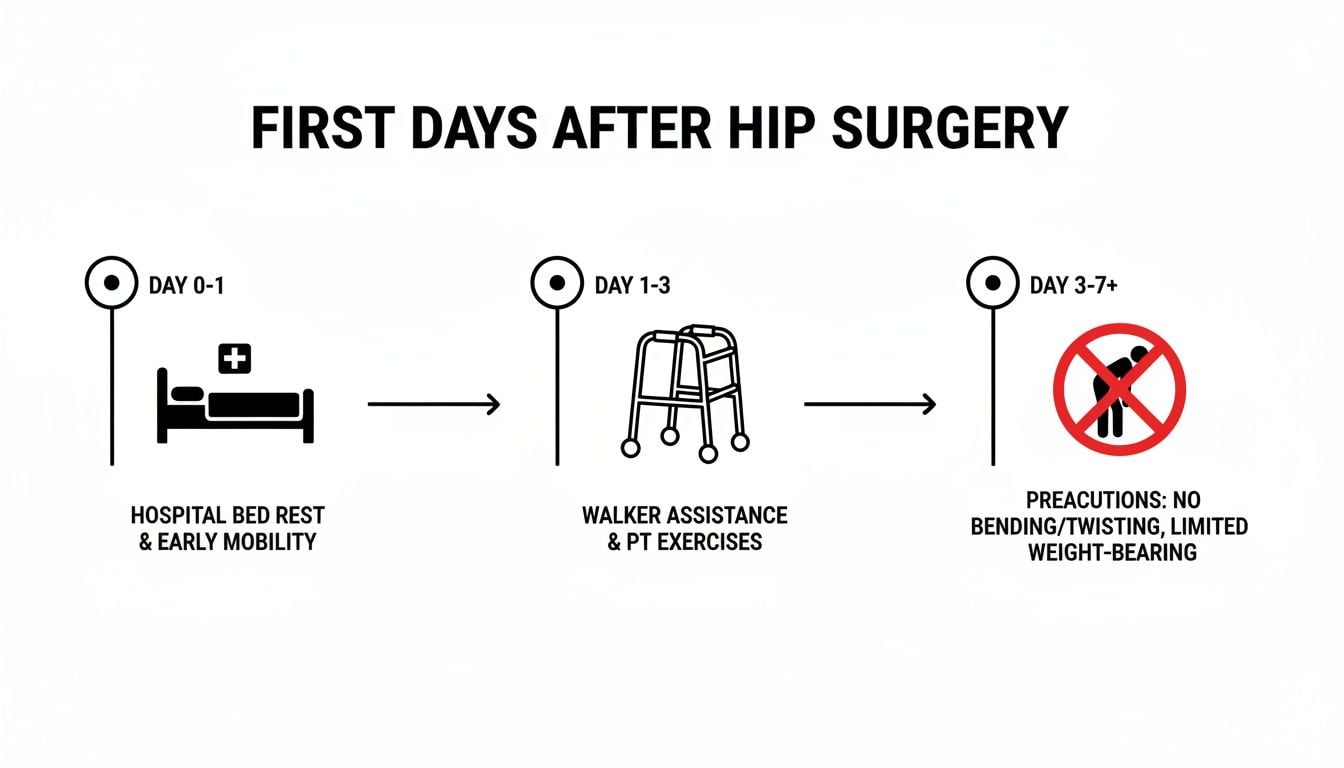
As you can see, the focus quickly shifts from rest to active, guided movement. Starting physical therapy early with a trusted partner ensures you have a professional, personalized plan from day one. Our expert therapists at Peak Therapy’s clinics across Massachusetts, from Quincy to Plymouth, are ready to guide you safely from that hospital bed right back to the life you love.
Your Recovery Timeline: What To Expect Week By Week

We understand how frustrating it can feel to have your life on hold. Knowing what’s ahead can make your recovery journey feel much more manageable. The path back to an active life is built on small, consistent wins. Each week builds on the last, and understanding what’s coming next helps reduce anxiety and empowers you to play an active role in your own healing.
With your Peak Therapy team, we break down your recovery into clear, achievable phases. This isn't a generic schedule; it's a personalized roadmap we create with you, based on your surgery, your fitness level, and your personal goals.
Whether you want to walk the beaches of Duxbury without pain or just carry groceries up the stairs in Quincy, we map out the journey together.
Weeks 1-4: The Foundation Phase
The first month after hip replacement is all about protection and healing. Your body has just been through a major procedure, so our primary focus is on managing pain and swelling, mastering your hip precautions, and getting you moving safely.
During these critical first few weeks, your licensed physical therapist will work closely with you to:
- Control Pain and Swelling: We’ll use ice, proper elevation, and gentle movements to reduce inflammation. This is key for your comfort and for promoting tissue healing.
- Activate Key Muscles: You’ll learn simple but vital exercises like ankle pumps, quad sets, and glute squeezes. These maintain muscle tone and boost circulation right from the start.
- Master Safe Mobility: You’ll become an expert with your walker or crutches, practicing how to get in and out of chairs and navigate your home without putting your new joint at risk.
This phase demands patience. We know it can be hard, but the small, careful movements you do now are laying the groundwork for bigger gains down the road. Every short walk down the hall is a huge victory.
Weeks 5-8: Building Strength and Independence
As you move into your second month, you’ll start to feel a real shift. The initial surgical pain is fading, and your confidence is growing. The focus of physical therapy after hip replacement now pivots from protection to actively rebuilding strength and beginning the transition away from walkers or crutches.
This is when you start to feel less like a patient and more like yourself again. Your Peak Therapy plan will adapt, introducing more challenging—but still safe—exercises. Understanding this process is key; for a similar perspective on post-op mobility, you can learn more about how to walk after joint replacement surgery.
Key Milestone: During this phase, many patients progress from a walker to a single cane. Your therapist will guide this transition carefully, as it marks a major return to independence and requires better balance and hip control—a core focus of your sessions now.
Goals for this period often include:
- Improving Your Gait: Weaning off the walker and focusing on a more natural walking rhythm and stride.
- Building Hip Strength: Introducing new exercises, sometimes with light resistance bands, to strengthen the muscles that support your new hip.
- Restoring Range of Motion: Continuing with gentle stretches to improve your flexibility, allowing you to bend and move more freely for daily tasks.
Weeks 9-12+: Reclaiming Your Lifestyle
By the third month, your recovery enters an exciting new stage. You’re moving with more confidence, your strength has improved dramatically, and your endurance is building. The goal now is to bridge the gap from basic function to returning to the full, active life you love. You shouldn't have to miss out on what matters most.
Your physical therapy sessions will become more dynamic and tailored to your hobbies. If you're a golfer, we can start incorporating rotational movements. If you love hiking the trails at Wompatuck State Park near Hingham, we’ll focus on building your endurance for uneven ground.
This advanced phase concentrates on:
- Advanced Strengthening: Progressing to more complex exercises that mimic real-world activities.
- Refining Your Balance: Performing exercises that challenge your stability, which is essential for preventing falls and moving confidently.
- Gradual Return to Activity: Your therapist will work with you and your surgeon to create a safe timeline for reintroducing sports, hobbies, and more demanding tasks.
Everyone’s timeline is unique. While these phases offer a general guide, your progress is personal. Our licensed physical therapists at our 13+ clinics, from Norwell to Pembroke, are experts at adjusting your program based on how you’re feeling to ensure your recovery is both safe and successful.
Your recovery is a phased journey with clear milestones along the way. The table below outlines what you can generally expect at each stage, from the first few weeks of healing to the final months of regaining your full strength and function.
Milestones In Your Hip Replacement Recovery Journey
| Recovery Phase | Primary Goals | Typical Activities & Exercises | PT Focus |
|---|---|---|---|
| Weeks 1-4 (Foundation) | Manage pain & swelling; protect the joint; establish safe, basic mobility. | Ankle pumps, quad sets, glute squeezes; walking short distances with a walker; safe transfers. | Pain management, muscle activation, gait training with assistive devices, patient education. |
| Weeks 5-8 (Strength Building) | Wean off assistive devices; increase strength; improve range of motion. | Stationary biking; walking with a cane; gentle hip strengthening with bands; standing balance exercises. | Gait refinement, progressive strengthening, restoring hip flexibility, balance training. |
| Weeks 9-12+ (Functional Return) | Return to recreational activities; build endurance; refine balance and complex movements. | Bodyweight squats and lunges; stair climbing; navigating uneven surfaces; activity-specific drills. | Advanced strengthening, dynamic balance, endurance building, sport/hobby-specific training. |
Remember, this chart is a guide. Your personal journey will be tailored by your physical therapist to match your specific needs and ensure you reach your goals safely and efficiently.
Essential Exercises To Rebuild Hip Strength And Stability

A personalized exercise plan is the engine that drives your recovery after hip replacement. While surgery gives you a new joint, it’s the consistent, guided work you do afterward that truly rebuilds strength, restores your mobility, and gets you back to living your life. These exercises aren't random movements; each one is selected by a licensed physical therapist to wake up specific muscles, protect your new hip, and slowly prepare you for more.
At Peak Therapy, our therapists do more than just hand you a sheet of exercises. We make sure you understand why each movement is so important. This knowledge is empowering and helps you stay motivated with your home exercise program—a piece of the puzzle that is absolutely critical for a great outcome.
Crucial Early-Stage Activation Exercises
Right after surgery, your body is in healing mode. The goal of exercise isn't about building massive strength just yet. Instead, we focus on gently reawakening the muscles around your new hip, promoting healthy blood flow, and stopping stiffness from setting in.
These initial movements are very low-impact and are usually done lying down to keep your new joint safe and sound. Think of it as sending a "wake-up call" to muscles that have been quiet because of pre-surgery pain or the operation itself.
Common Foundational Exercises:
- Ankle Pumps: Simply pointing and flexing your feet. This small motion is a powerhouse for preventing blood clots by keeping circulation moving, which is a top priority right after surgery.
- Gluteal Sets: Squeezing your buttock muscles and holding for a few seconds. This directly targets your glutes—major stabilizers for your hip—without needing to move the joint at all.
- Heel Slides: While on your back, you’ll gently slide your heel toward your bottom, bending your knee and hip only as far as is comfortable. This is one of the first ways we begin to restore your hip's range of motion.
Your therapist will be watching your form closely, making small tweaks that make a huge difference in hitting the right muscles and avoiding any strain.
Progressing To Functional Strength
As you start to heal and the initial soreness fades, your physical therapist will begin advancing your personalized treatment plan. This is where we start the real work of rebuilding the functional strength you need for everyday life. The goal is to fortify the key muscles supporting your hip—the glutes, quads, and hamstrings—so you can walk, stand, and climb stairs with stability and confidence.
This progression is always gradual and is based entirely on how you’re doing. We’ll never push you past what your body is ready for. Instead, we add challenges systematically, building on what you’ve already achieved.
For instance, a simple heel slide might evolve into a more active movement. An exercise you did lying down might transition to a standing version where you support more of your body weight. For some, this is also a great time to try low-impact options like aquatic therapy. Many find the water’s buoyancy allows them to move with less discomfort—you can learn more in our guide to the best aquatic therapy exercises.
The Concept of Progression: As you get stronger, your therapist will safely increase the challenge. This might mean adding a light resistance band, increasing your reps, or moving from a seated to a standing exercise. This ensures you’re always working at a level that is both safe and effective for building real strength.
Sample Exercise Instructions
To give you a better idea, here’s how we might teach a common exercise at our clinics in Quincy, Hanover, and across Massachusetts.
Example Exercise: Standing Hip Abduction
First, you’ll stand next to a sturdy countertop or the back of a chair for support. Stand up tall with your feet about hip-width apart and gently engage your core.
Keeping your standing leg just slightly bent, slowly lift your surgical leg straight out to your side. The key here is to keep your torso perfectly upright—try not to lean your body to the side to get the leg higher. It’s all about the hip doing the work.
You’ll feel the muscles on the outside of your hip tighten. Hold that for just a moment at the top. Then, slowly and with complete control, lower your leg back down. That controlled lowering motion is just as important as the lift itself.
This single exercise is fantastic for strengthening the hip abductor muscles, which are crucial for keeping your pelvis stable when you walk. Weakness in these muscles can often lead to a limp or feeling unsteady. Your Peak Therapy therapist will provide expert cues to make sure you get the most out of every single rep.
Reclaiming Your Life And Everyday Mobility

All those exercises in the clinic are just the beginning. The real sign of a successful recovery is when you can confidently apply that new strength to your everyday life. At Peak Therapy, we understand that the ultimate goal of physical therapy after hip replacement is getting you back to your routine without pain or hesitation.
Our focus is squarely on rebuilding your independence. A huge piece of that puzzle is mastering your gait—your unique pattern of walking. We'll work closely with you to transition smoothly from a walker or crutches to a confident, natural stride you can rely on.
Learning To Walk Naturally Again
Walking smoothly without a limp is a top priority for most of our patients. As movement experts, our licensed physical therapists have a trained eye for the subtle compensations your body might have developed from living with pain. We’ll use targeted exercises and real-time feedback to help you correct these patterns before they become ingrained habits.
Gait training is about more than just putting one foot in front of the other. We'll focus on restoring symmetrical movement, making sure both legs have a similar stride length and timing. It’s also about rebuilding your confidence to put full, steady weight on your new hip and strengthening the key stabilizer muscles that keep your pelvis level with each step.
It’s a process that requires patience, but with expert coaching, you’ll go from hesitant steps to a comfortable stroll. We love seeing our patients get back to enjoying a walk at Borderland State Park near Easton or along the Quincy waterfront. To truly improve hip mobility and move freely, regaining your full range of motion is essential for reducing discomfort and restoring your natural movement.
Safely Tackling Everyday Challenges
Life isn’t lived on a flat, even surface. True independence means being able to handle the real-world obstacles you encounter every day. Your physical therapy sessions will always include practical training for these common scenarios.
Navigating Stairs
This can be one of the most intimidating tasks after surgery. We’ll teach you the right technique—leading with your stronger, non-operative leg going up ("up with the good") and leading with your new, operative leg coming down ("down with the bad"). We’ll practice with you until it feels like second nature.
Getting In and Out of a Car
We'll show you exactly how to get into a car seat without breaking that crucial 90-degree hip precaution. The trick is to back up to the seat, sit down first, and then carefully swing your legs into the car one at a time.
Bending and Reaching
Simple tasks like putting on your socks or picking something up from the floor suddenly require new strategies. Your therapist will teach you safe hip-hinge techniques and can recommend adaptive equipment to help you manage these tasks while protecting your new hip.
Key Insight: Building confidence in these everyday movements is just as important as building muscle strength. Our therapists provide the hands-on coaching and reassurance needed to overcome the fear and hesitation that can hold back your recovery.
We know it’s the little things that feel like the biggest wins—like getting your own coffee without asking for help or navigating a busy grocery store. For more great tips on staying steady on your feet, check out our guide on the best balance exercises for seniors. Our goal is to give you the skills and confidence to get back to the Massachusetts lifestyle you love.
Why Expert Physical Therapy Is Your Key To Long-Term Success
The surgery itself is a huge accomplishment—it gives you a new, pain-free joint. But the real, long-term success of your hip replacement isn’t just about the implant; it’s about how well you learn to use it. This is where expert physical therapy after a hip replacement becomes the most important part of your recovery.
Many patients think recovery is just a matter of following a handout of generic exercises. This approach completely misses the most critical piece of healing: a personalized plan. A one-size-fits-all sheet of paper can't see how you move, identify your unique muscle imbalances, or adjust your program based on your pain and progress. It's like having a map without a guide.
From A Handout To Hands-On Care
At Peak Therapy, our approach is built around you. Your journey with us starts with a comprehensive, one-on-one evaluation with a licensed physical therapist. We don't just look at your new hip; we perform a comprehensive evaluation to assess your entire body's movement patterns, from head to toe.
This initial assessment allows us to determine the root cause of any lingering issues and build a personalized treatment plan that is truly yours. We can pinpoint which muscles have grown weak from years of compensating for a painful hip and which ones have become overly tight. From there, we create a program designed specifically to:
- Correct Muscle Imbalances: We’ll work on strengthening weak muscles (often the glutes) and releasing tight ones (like your hip flexors) to get your body mechanics back on track.
- Restore Normal Movement: We help you unlearn the limp or shuffle you may have developed over the years. Our goal is to retrain your body to walk with a smooth, natural, and efficient gait.
- Provide Hands-On Manual Therapy: Our therapists use skilled, hands-on techniques to reduce swelling, ease muscle tension, and improve joint mobility much faster than exercises alone can.
This personalized, hands-on care is your best defense against common complications. By getting to the root causes of your movement issues, we help ensure you meet the strength and mobility goals needed to safely get back to work, your hobbies, and the Massachusetts lifestyle you love.
An Investment In Your Best Possible Outcome
Choosing professional physical therapy is about much more than just checking a box on your post-op list. Think of it as an active partnership dedicated to helping you achieve the best possible outcome from your surgery. Your surgeon did the amazing work of replacing the joint; your physical therapist teaches you how to make it a seamless part of a full, active life.
Your surgery set the stage, but your dedicated work with a physical therapist writes the rest of the story. Whether your goal is playing with your grandkids on the floor, walking the beaches of the South Shore, or simply moving around your home in Braintree or Milton with total confidence, our team is here to guide you. We'll make sure your recovery isn't just complete, but truly exceptional.
Your Hip Replacement Rehab Questions Answered
It’s completely normal to have a head full of questions as you get ready for your recovery. That uncertainty can be frustrating, but getting clear answers from an expert brings back a sense of control and peace of mind. Our physical therapists across our Massachusetts clinics, from Quincy to Plymouth, hear these same concerns every single day.
We’ve put together answers to the most common questions we get from patients who are starting physical therapy after a hip replacement. Think of this as the straightforward, reassuring information you need to feel confident and ready for the road ahead.
How Soon After Surgery Should I Start Physical Therapy?
Most people are surprised to learn that physical therapy starts almost immediately—often within 24 hours of your surgery, right there in the hospital. A therapist will help you with those first crucial movements, like getting out of bed safely and taking your first steps with a walker or crutches.
Once you’re home, starting outpatient physical therapy at a dedicated clinic like Peak Therapy is a top priority. We always recommend scheduling your first appointment within just a few days of being discharged. Getting a jump-start on therapy is so important.
Starting right away helps you manage pain and swelling much more effectively. It also reduces the risk of complications like blood clots and keeps your new joint from getting too stiff. Most importantly, it helps you build safe movement habits from day one, setting a positive pace for a smoother, more successful recovery.
What Are The Signs I’m Pushing Myself Too Hard?
Finding the balance between challenging your body and overdoing it is one of the trickiest parts of recovery. Learning to listen to your body is the most important skill you'll develop. A little muscle soreness after your therapy session or home exercises is a good thing—it means your muscles are getting stronger.
Sharp, intense, or escalating pain, however, is a warning sign. The main red flags that tell you it’s time to pull back include:
- A sharp, significant increase in pain that doesn’t get better with rest and ice.
- A noticeable spike in swelling around your hip, thigh, or even down your lower leg.
- Any new or sudden feeling of instability in your new hip, like it might "give way."
If you experience these symptoms, don't just stop everything. The key is to communicate. Ease up on what you're doing and call your physical therapist right away. They'll help you adjust your personalized treatment plan to find that “just right” level of activity for safe and steady progress.
When Can I Get Back To Driving, Work, Or Sports?
This is probably the number one question we hear, and the honest answer is: it’s different for everyone. Your personal timeline depends on how you’re healing, the exact type of surgery you had, and the physical demands of the activity you want to return to.
Still, we can offer some general guidelines we see with most of our patients.
Driving: Most people are cleared to get back behind the wheel around 4 to 6 weeks after surgery. The golden rule is that you must be completely off all narcotic pain medication and have enough muscle control and reaction time to brake suddenly if you need to.
Work: Returning to a desk job often happens on a similar 4-to-6-week timeline. If your job is more physically demanding and involves lifting, a lot of standing, or walking, you'll need more time—often 3 months or more. This requires careful planning with your therapist to ensure you're ready.
Sports and Activities:
- We usually introduce low-impact activities like swimming or using a stationary bike around the 2 to 3-month mark.
- Getting back to higher-impact sports like running, tennis, or skiing takes longer and requires a green light from both your surgeon and your physical therapist. This is typically closer to 6 months or more, and only after you’ve hit specific strength and stability goals.
How Do I Choose The Right Physical Therapist In Massachusetts?
Picking the right partner for your recovery is one of the most important decisions you'll make. Not all physical therapy is created equal, and you deserve a team that truly understands the ins and outs of post-surgical rehab.
When searching for a clinic, look for one with deep experience in post-operative care. At Peak Therapy, our licensed physical therapists across the South Shore specialize in this. Whether you're near our Braintree, Weymouth, or Hanover clinics, finding a conveniently located clinic is key to staying consistent with your appointments.
Your therapist should be committed to one-on-one care, not handing you off to an aide with a generic sheet of exercises. A great therapist listens to your personal goals, performs a thorough evaluation, and builds a plan that is truly just for you. Finally, check out patient reviews and make sure the clinic you choose is a trusted partner in the community.
The right guidance makes all the difference in your recovery. At Peak Therapy, our dedicated and licensed physical therapists are ready to build a personalized plan to help you recover your strength, confidence, and mobility. Schedule your appointment today and take the next step toward getting back to the life you love.