

When it comes to managing shoulder pain and preventing it from coming back, a targeted rotator cuff exercise program is one of the most effective tools we have. These exercises strengthen the small but mighty muscles that stabilize your shoulder, helping you get back to your life without needing more aggressive treatments.
Understanding Your Shoulder Pain and The Role of Exercise
If you're struggling with a nagging ache or sharp, stabbing pain in your shoulder, you are not alone. At Peak Therapy, we understand the frustration that comes with being unable to sleep through the night, the fear of reaching into a high cabinet, or the disappointment of missing a round of golf at a local Massachusetts course. It’s a heavy burden, and many people we see in our clinics worry this pain means surgery is just around the corner.
But we're here to tell you that for many, there's a clear, effective, and non-invasive path forward. Our licensed physical therapists perform a comprehensive evaluation to determine the root cause of your pain and develop a personalized treatment plan. The first step on that path is understanding the 'why' behind your pain.
What Is the Rotator Cuff?
The rotator cuff isn't just one thing; it's a team of four small muscles and their tendons wrapping around your shoulder joint. Think of them as the crucial support crew for your arm, especially important for the active lifestyles we live here in Massachusetts.
They work together to:
- Stabilize the joint: They keep the head of your upper arm bone (humerus) perfectly centered in its shallow socket.
- Control movement: They allow you to lift and rotate your arm, whether you're throwing a baseball with your kids, shoveling snow after a Nor'easter, or just carrying groceries.
Because the shoulder has more range of motion than any other joint in your body, it depends heavily on this muscular team for stability. Unfortunately, this incredible mobility also makes it more prone to injury.
Why Does It Hurt So Much?
Rotator cuff pain usually comes from inflammation (tendinitis) or a tear in one of the tendons. This can happen from overuse, a sudden injury like a slip on winter ice, or simply from age-related changes over time. It's a problem that affects people from all walks of life, from high school athletes in our local communities to remote workers with poor desk setups.
The pain might be a constant, dull ache or a sharp twinge with certain movements, and it almost always feels worse at night. The emotional toll is just as real as the physical one, disrupting your daily routine and causing a lot of anxiety. Often, this leads to other issues. You can learn more about how this pain can travel in our article on the connection between wrist and shoulder pain.
A personalized rotator cuff exercise program isn't just about strengthening muscles. It’s about restoring proper movement patterns and getting to the root cause of your pain—that's the real key to lasting relief and preventing future problems.
A licensed physical therapist is an expert at figuring out the specific source of your pain. Here at Peak Therapy, our approach starts with a thorough evaluation to understand your unique situation. We don't just hand you a generic sheet of exercises. We design a personalized plan to rebuild your strength, restore your mobility, and put you back in control so you can return to life without limitations.
When to Start Exercising and When to See a Professional
When your shoulder starts hurting, the first impulse is usually to do something to fix it. While jumping into a rotator cuff exercise program can be a great step, it’s vital to know when you can safely start on your own and when you absolutely need a professional to take a look first.
Pushing through the wrong kind of pain can easily make a minor issue much worse. It's all about learning to tell the difference between normal muscle fatigue and a true warning sign. A little soreness during a gentle movement might just be your muscles waking up, but sharp, shooting, or worsening pain is your body’s signal to stop.
A Quick Self-Check
Before you even think about starting an exercise, take a moment to see where you’re at. Can you get through your day without major pain?
Try these simple movements:
- Reach Across: Can you reach your arm across your chest to touch your opposite shoulder?
- Lift to the Side: Are you able to lift your arm out to the side until it's parallel with the floor?
- Rotate Behind: Can you place the back of your hand on your lower back?
If you can do these with only mild, manageable discomfort, you can likely begin some very gentle mobility work. However, if they cause a sharp pain or feel impossible to complete, it's time to pause and get an expert opinion.
This flowchart can help you decide on the best next step for your shoulder pain.
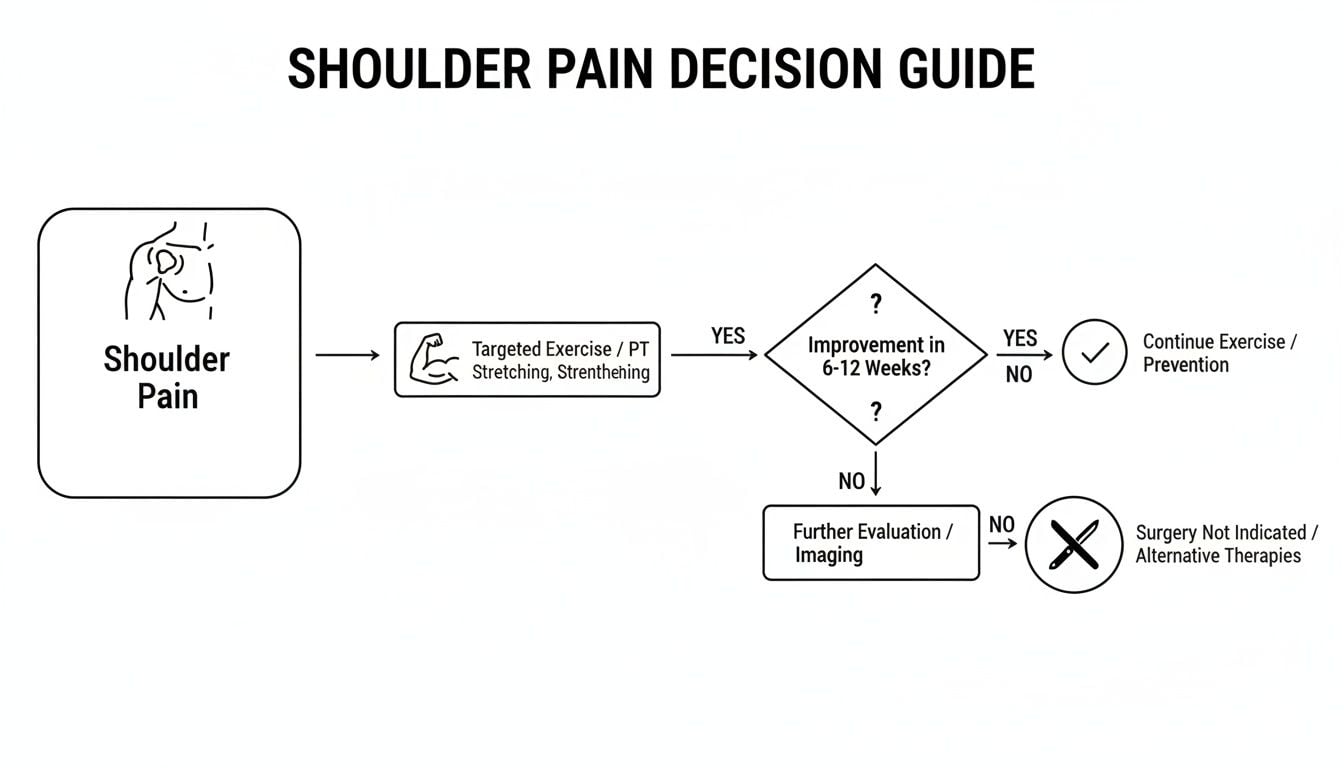
As you can see, targeted exercise is a core part of recovery for many, but certain symptoms are clear signs you need a professional diagnosis to rule out a more serious injury.
Red Flags: When to Call a Physical Therapist Immediately
Some symptoms are non-negotiable. If you experience any of the following, don't try to self-diagnose or exercise through it. Your first call should be to a licensed physical therapist for a full evaluation.
- Sudden, intense pain after a specific incident, like a fall or lifting something heavy.
- Inability to lift your arm up over your head or out to your side.
- Obvious and significant weakness in the shoulder that wasn’t there before.
- A visible deformity, such as a bump or an unusual shape around the shoulder joint.
- Pain that is constant and severe, especially if it wakes you up at night.
- A popping or snapping sound at the moment of injury, followed by immediate, intense pain.
Deciding to see a professional at a Peak Therapy clinic in Quincy or Hanover isn't giving up. It's the smartest, safest move you can make to get a correct diagnosis and a recovery plan that actually works for you, helping you get back to your life on the South Shore.
We see firsthand the frustration and uncertainty that come with a shoulder injury. Our job is to take the guesswork out of your recovery. A physical therapist will pinpoint the exact cause of your pain—whether it's tendinitis, a small tear, impingement, or something else entirely.
That diagnosis is everything. Trying a generic rotator cuff routine without knowing what you’re dealing with can easily lead to a longer recovery or even re-injury. Getting expert guidance from day one ensures you’re on the right path, helping you feel better, move with confidence, and get back to your life here in Massachusetts.
Your Foundational Rotator Cuff Exercise Program
When your shoulder is hurting, the thought of exercise can be intimidating. We understand that fear. But getting started is less about heavy lifting and more about re-establishing the connection between your brain and the deep stabilizing muscles in your shoulder.
This initial phase is all about control, gentle mobility, and activating the right muscles without flaring things up. The focus here is quality over quantity, laying a solid groundwork for getting stronger down the road.

Think of this program as your starting blueprint for recovery, guided by the same principles we use with our patients every day. We’ll begin with movements designed to calm the joint down, then gradually "wake up" the rotator cuff muscles.
Gentle Mobility With Pendulum Swings
Often, the very first goal is to simply create some space in the shoulder joint and dial down the pain. Pendulum swings are perfect for this. They use gravity to gently pull the head of the arm bone (humerus) away from the socket, which can provide immediate relief from that pinching or "impingement" feeling.
It’s like gently rocking a fussy joint to sleep. We understand how exhausting constant pain can be, and this movement offers a moment of relief. The key is that this is a passive motion—your injured shoulder muscles should be completely relaxed.
How to Do It:
- Find a sturdy table or the back of a chair for support. Lean over, placing your good hand on the surface.
- Let your injured arm hang straight down toward the floor like a rope. Keep it totally relaxed.
- Now, use your body to create the motion, not your arm. Gently shift your weight forward and back, allowing your arm to swing naturally.
- Next, shift your weight side to side, letting the arm follow. Finally, move your body in a small circle to create circles with your arm.
- Perform for 30-60 seconds in each direction (front-to-back, side-to-side, and both clockwise and counterclockwise circles). Aim for 1-2 sets daily.
Physical Therapist's Tip: The secret to this exercise is relaxation. If you feel your shoulder muscles firing up, you’re trying too hard. Let your body create the momentum and imagine your arm is just dead weight.
Waking Up the Muscles: Isometric Activation
Once you’ve calmed the joint down, it's time to gently activate the rotator cuff muscles without actually moving the shoulder. We call this an isometric contraction. It’s the safest way to begin strengthening because it puts almost no stress on the tendons themselves.
This kind of focused movement is critical. In fact, research shows that motor control exercises are especially effective for rotator cuff pain, leading to significant short-term improvements compared to just doing generic movements. You can read more about these findings on the importance of targeted movements to see why control really is more important than brute force early on.
Isometric External Rotation (Turning Outward)
This move targets the infraspinatus and teres minor—two crucial muscles on the back of your shoulder blade that help rotate your arm out.
- Stand with your elbow bent to 90 degrees, keeping it tucked firmly against your side. A small rolled-up towel between your elbow and body can help.
- Place the palm of your other hand on the back of your exercising wrist.
- Gently try to rotate your forearm outward, but use your other hand to block the movement completely.
- Hold this gentle push for 5-10 seconds. You should feel a mild muscle engagement in the back of your shoulder, never sharp pain.
- Relax, then repeat for 10-15 repetitions.
Isometric Internal Rotation (Turning Inward)
Now we’ll target the subscapularis, the rotator cuff muscle located on the front of your shoulder blade.
- Start in the same position: elbow bent at 90 degrees and tucked into your side.
- This time, place your other hand on the inside of your exercising wrist.
- Gently try to rotate your forearm inward toward your belly, while your other hand provides a block.
- Hold that quiet contraction for 5-10 seconds, feeling for the muscle working in the front of your shoulder and armpit area.
- Relax, and repeat for 10-15 repetitions.
Building Your Support System: Scapular Squeezes
Here’s something many people miss: your rotator cuff doesn't work alone. It relies on a strong foundation from the muscles around your shoulder blade (scapula). If these "scapular stabilizers" are weak, your rotator cuff is forced to work overtime, setting it up for strain and injury.
Scapular squeezes (or retractions) are a non-negotiable exercise for strengthening this critical support system.
How to Do It:
- Sit or stand with good, tall posture, letting your arms rest at your sides.
- Imagine you’re trying to pinch a pencil between your shoulder blades. Gently squeeze them together and slightly down.
- Hold that squeeze for 3-5 seconds. Make sure you aren't shrugging your shoulders up toward your ears—the movement is back and down.
- Slowly release the squeeze to return to the start.
- Perform 2-3 sets of 10-15 repetitions.
This program is a fantastic starting point. It’s also important to pair these strengthening exercises with safe mobility work. For more on that, check out our guide on rotator cuff stretches to relieve nagging shoulder pain.
Remember, in these early stages, consistency is far more important than intensity. Nailing these foundational exercises will build the stability you need to progress safely, getting you one step closer to your life, whether that’s working in your Norwell garden or playing with your grandkids in Plymouth.
Progressing to a Stronger, More Resilient Shoulder
Once you’ve nailed down the basics of mobility and muscle activation, it's time to build some real, usable strength in that shoulder. This is where resistance training enters the picture. We’re going to carefully add a bit of weight or tension to your exercises, encouraging those rotator cuff muscles to work harder, adapt, and get stronger.
This is the phase that truly bridges the gap from early recovery back to real life. We understand you don't just want to be out of pain—you want to get back to your life without fear. This is what helps you load groceries in a busy Quincy lot, swing a golf club out in Duxbury, or simply reach for that top shelf without a moment’s hesitation.
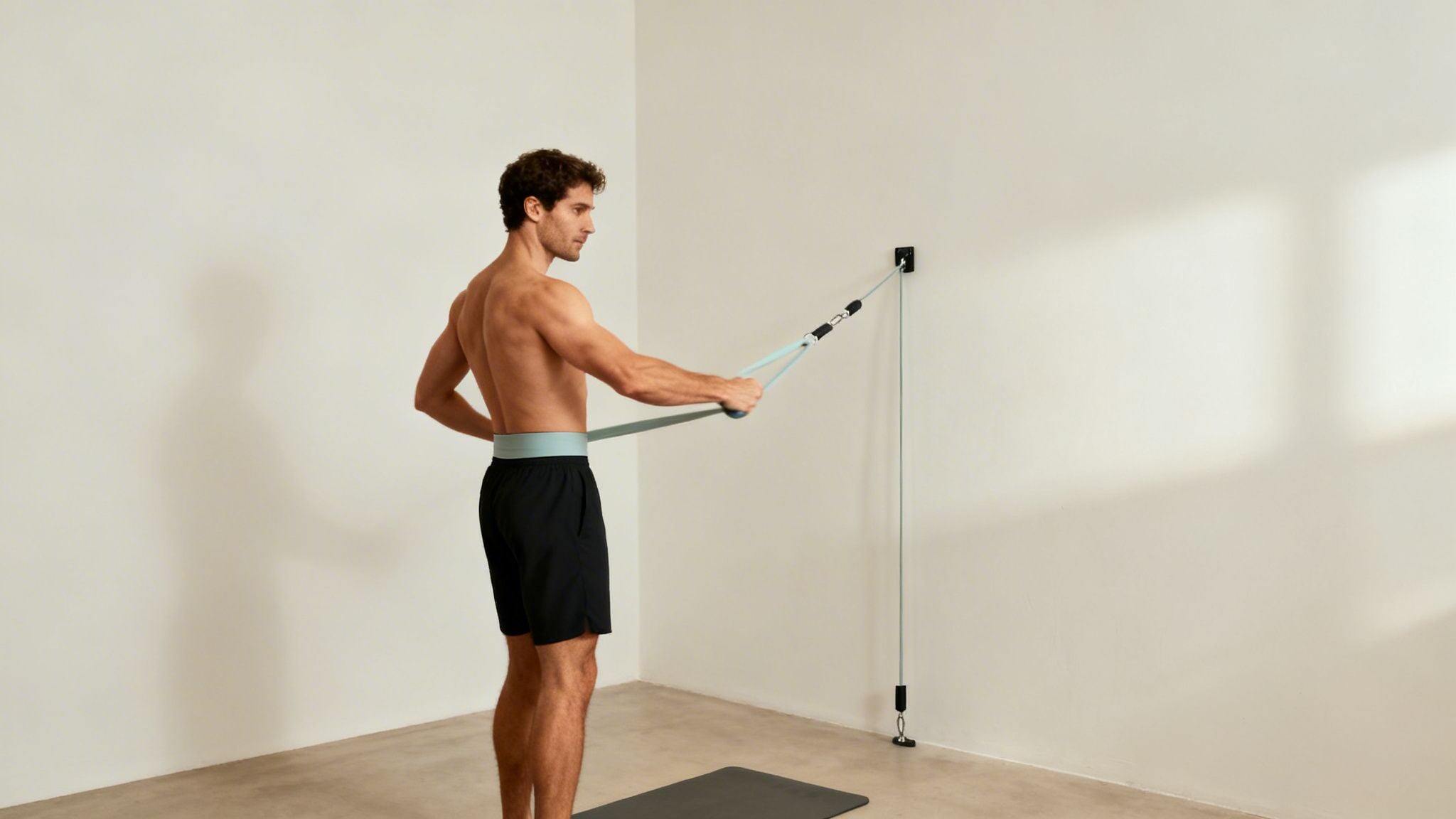
The whole process is guided by a key physical therapy concept: progressive overload. It’s a simple idea. To get stronger, you have to gradually ask more of your muscles. As soon as an exercise feels too easy, it’s a signal that your body is ready for a slightly tougher challenge.
Choosing Your Tools for Resistance
You don't need a fancy, expensive gym membership to do this right. Some of the most effective tools are simple and can be used right in your living room.
- Resistance Bands: We love these in the clinic. They’re the gold standard for rotator cuff work because they provide smooth, consistent tension and are incredibly versatile. The different colors aren't just for show—they correspond to different resistance levels (yellow is often light, red is medium, green is heavy).
- Light Dumbbells: For specific movements like scaption or rows, dumbbells are fantastic for building strength in a controlled way. And we mean light. Starting with just 1-3 lbs can feel surprisingly demanding when your form is spot-on.
- Cable Machines: If you do have gym access, a cable machine is the best of both worlds. You get the constant tension of a band paired with the precise, incremental weight selection of dumbbells. This lets you make very small, controlled jumps in resistance.
The goal is to find a weight or band that lets you complete 10-15 repetitions with perfect form. The last two or three reps should feel challenging, but never painful. If you're breezing through 15 reps without breaking a sweat, that’s your cue to grab the next color band or a slightly heavier dumbbell.
Key Resistance Exercises for a Stronger Rotator Cuff
Now we’re going to layer some resistance onto the foundational movements you’ve already been practicing. Remember, quality over quantity, always. Moving a lighter weight with perfect form is a thousand times better than struggling with a heavier one.
Resisted External Rotation
This is the next step up from the isometric hold you started with. It's absolutely crucial for strengthening the infraspinatus and teres minor—the muscles that control outward rotation and, just as importantly, slow your arm down after you throw or reach.
- Setup: Anchor a resistance band to a doorknob or a sturdy pole at about elbow height. Stand sideways to it, grabbing the band with your hand that's further away.
- Action: Bend your elbow to a 90-degree angle and tuck it right into your side. Placing a small, rolled-up towel between your elbow and your ribs is a great trick to keep it there. Now, keeping that elbow pinned, slowly pull the band by rotating your forearm outward, away from your body.
- Control: Only go as far as you can without your elbow floating away or your shoulder shrugging up. Then, slowly and with control, return to the start.
Resisted Internal Rotation
This one targets the subscapularis, a powerful muscle on the front of your shoulder blade that’s a key player in shoulder stability and inward rotation.
- Setup: Stand in the same spot, but turn around to face the other direction. This time, you'll hold the band with the hand closest to the anchor point.
- Action: With your elbow still bent to 90 degrees and locked at your side, slowly pull the band inward across your stomach.
- Control: Make sure the movement is coming from your shoulder. Try not to let your wrist or arm do all the work. Pause for a second at the end of the motion, then slowly release back.
Physical Therapist's Tip: For both of these rotation exercises, I tell my patients to imagine their elbow is a hinge on a gate. The gate (your forearm) swings open and closed, but that hinge never moves from its spot on the fence post (your torso).
Scaption (The "Empty Can" Refined)
Scaption is a fantastic, functional exercise that strengthens the supraspinatus and deltoid muscles in the shoulder's natural plane of movement. We use a "thumbs-up" variation to keep the joint happy and avoid any pinching.
- Setup: Stand with your feet shoulder-width apart. Hold a very light dumbbell (1-3 lbs) or even just your own arm weight to start.
- Action: With your arm straight and your thumb pointing toward the ceiling, lift your arm up at a 30-degree angle from the front of your body. It's not straight forward and it's not straight out to the side—it's that sweet spot right in between.
- Control: Raise your arm only to shoulder height, no higher. Focus on a slow, controlled lift, making sure you aren't shrugging your shoulder up toward your ear. Slowly lower back down.
Adding this kind of smart resistance isn't just a hunch; it's backed by solid evidence. A major review of studies covering over 550 patients found that a consistent rotator cuff program with resistance training resulted in a 35-45% reduction in shoulder pain and a 20-30% boost in daily function in just 6-12 weeks.
To help visualize how this all fits together, here is a sample plan showing how you might progress over time.
Sample Rotator Cuff Exercise Progression Plan
This table provides a general roadmap for moving from early-stage recovery to advanced strengthening. Remember, this is just a sample; your personal timeline will depend on your specific injury, starting fitness level, and how your body responds.
| Phase | Goal | Sample Exercises | Frequency & Duration |
|---|---|---|---|
| Phase 1: Foundation | Reduce pain, improve mobility & activate muscles. | Pendulum swings, wall push-ups, isometric rotations. | 3-5x/week, 2-4 weeks |
| Phase 2: Early Strengthening | Introduce light resistance & build endurance. | Banded rotations, scaption (no weight), wall slides. | 3-4x/week, 3-6 weeks |
| Phase 3: Advanced Strengthening | Increase load & build functional strength. | Dumbbell scaption, rows, resisted push-up progressions. | 2-3x/week, 4-8 weeks |
| Phase 4: Return to Activity | Sport/activity-specific drills & power development. | Plyometric push-ups, medicine ball throws, sport drills. | 2-3x/week, ongoing |
Progressing through these phases with care is what builds a shoulder that’s not just pain-free, but truly resilient.
You can read more about how we apply these principles to athletes in our guide on how physical therapy helps shoulder injuries in athletes. And for a broader look at how this fits into a total-body approach, these fundamental strength training exercises are a great resource for building a strong foundation. Building a tough, resilient shoulder is all about this kind of thoughtful, gradual progression, ensuring you get back to your active Massachusetts lifestyle safely and for the long haul.
Why a Physical Therapist Is Your Best Guide to Recovery
While following a general exercise guide for your rotator cuff is a decent starting point, it can only get you so far. Nothing replaces the personalized diagnosis and hands-on care of a licensed physical therapist who truly understands the demands of your life here in Massachusetts.
We see it all the time—people hesitate to seek help for persistent shoulder pain, hoping it will just get better on its own. They feel stuck, frustrated, and worried about their pain getting worse. The problem is, guessing at the root cause can lead to frustrating setbacks or even make the injury worse. A physical therapist takes the guesswork out of recovery.
The Power of a Professional Diagnosis
When you visit a Peak Therapy clinic, whether in Scituate or Duxbury, we don’t just look at the symptom. We dig deeper to find the source of the problem.
Your therapist will start with a thorough evaluation that a blog post or video simply can't offer. We will:
- Assess your movement patterns to see not just what hurts, but why it hurts. Is it how you lift, reach, or throw?
- Test your strength and range of motion to pinpoint specific weaknesses in the rotator cuff and the muscles that support it.
- Talk with you about how this pain is impacting your life, from carrying groceries to enjoying a day at the beach. We want to understand what you're missing out on and what your goals are.
This detailed assessment allows us to create a plan that’s 100% customized to you. We'll make sure you’re doing the right rotator cuff exercises for your specific condition, not just a generic routine.
A physical therapist doesn't just hand you a list of exercises. We teach you how to perform them with perfect form, provide corrections, and skillfully adjust your program as you get stronger. That expert guidance is the fastest and safest way back to an active life.
Beyond Basic Exercises: Advanced Treatment Options
Your recovery at Peak Therapy often involves much more than just strengthening exercises. Our therapists are trained in advanced techniques that can significantly speed up healing and reduce pain, helping you feel better, faster.
Depending on what we find during your evaluation, your plan may also include:
- Manual Therapy: Hands-on techniques used to improve joint mobility and release tight, painful tissues around the shoulder.
- Dry Needling: A specialized method our therapists use to target trigger points and release deep muscle tension.
- Aquatic Therapy: Performing exercises in our therapy pools, where the water’s buoyancy reduces stress on your shoulder while its natural resistance helps build strength.
This combined approach is incredibly effective. Research consistently shows that a structured exercise program is a powerful tool against shoulder pain, often matching surgical outcomes for both pain relief and functional improvement. In fact, a major review found that workers who completed an exercise therapy program had significantly fewer shoulder-related work absences—a 23% decrease after two and a half years compared to other groups. You can explore the full research findings on exercise versus other interventions to see the data for yourself.
A customized plan from a physical therapist isn’t just about fixing the immediate problem. It’s about building a more resilient shoulder for the future, so you can live confidently without fear of re-injury.
Common Questions We Hear About Rotator Cuff Exercises
As you start your rotator cuff program, it's completely normal to have questions. In our Massachusetts clinics, we find that understanding the why behind your recovery is just as important as doing the exercises. Let’s go over some of the most common questions we hear from patients just like you.
How Long Does It Take for Rotator Cuff Exercises to Work?
This is probably the number one question we get, and the honest answer is: it depends on your specific situation. Many people start feeling some relief from pain within a few weeks of starting a consistent, gentle program.
However, building real, lasting strength is a longer game. Based on our clinical experience, it typically takes 6 to 12 weeks of a progressive exercise plan to see significant improvements in both strength and your ability to perform daily tasks. Your personal timeline will depend on things like the severity of your injury, how consistent you are, and your overall health.
Should I Do Rotator Cuff Exercises if They Cause Pain?
This is such a critical question. The simple rule we tell our patients is this: never push through sharp, stabbing, or worsening pain. A bit of mild muscle fatigue or a dull ache in the muscle you're working is usually okay, but "bad" pain is your body's way of telling you to stop.
Pain is your body's feedback system. Listening to it is one of the most important parts of a safe recovery. Pushing through the wrong kind of pain can turn a minor issue into a major setback.
If an exercise consistently hurts, something isn't right. You might be using incorrect form, the exercise could be too advanced, or it might just be the wrong move for your specific injury. This is where working with a physical therapist is invaluable—we can tweak your program to keep you moving forward without triggering a flare-up.
Can I Make My Rotator Cuff Injury Worse with Exercise?
Unfortunately, yes. It is possible to make a rotator cuff injury worse if you take the wrong approach, which is why a proper diagnosis from a professional is so important from the start.
We often see people make a few common mistakes that can set them back:
- Doing too much, too soon: Jumping into heavy weights or resistance before your muscles and tendons are ready is a recipe for reinjury.
- Using poor form: This puts stress on all the wrong places and can easily aggravate an already sensitive tendon.
- Performing the wrong exercises: The right exercises for tendinitis are very different from those for a significant tear. Guessing can be risky.
Starting with the low-load, foundational exercises we covered earlier is a safe way to begin. But for a program that is truly safe and effective, getting professional guidance is always your best bet.
How Often Should I Perform Rotator Cuff Exercises?
The ideal frequency really depends on the type of exercise and where you are in your recovery. For strengthening exercises with resistance bands or light weights, we generally recommend 2-3 times per week on non-consecutive days. This schedule gives your muscles the downtime they need to recover and get stronger.
On the other hand, gentle mobility drills like pendulum swings or motor control exercises like scapular squeezes are less demanding. These can often be done daily to improve movement patterns and reduce stiffness. When you work with a therapist at Peak Physical Therapy, we’ll build a precise schedule based on your evaluation and how your body is responding.
Shoulder pain shouldn't keep you from living your life. The dedicated physical therapists at Peak Physical Therapy and Sports Performance are here to provide a clear diagnosis and a personalized plan to get you back to feeling strong and confident. Don't guess at your recovery—let our experts guide you.