


For any runner in Massachusetts, whether you're logging a few miles around Quincy on the weekend or training for the Boston Marathon, nothing is more frustrating than an injury that stops you in your tracks. We understand the feeling of being sidelined. Running physical therapy is a specialized form of care designed not just to treat injuries like shin splints or runner’s knee, but to dig deeper and fix the root cause. It’s a proactive partnership to build a stronger, more efficient, and more resilient runner.
Why Runners Need More Than Just Rest
If you’re a runner on the South Shore, you’ve probably been given the same old advice for that nagging pain: “just rest it.” So you take a week off, the pain fades, and you excitedly lace up your shoes again—only for the same ache to flare up a few miles in.
This cycle is beyond frustrating. It can make you feel like you're losing all your progress and might never get back to running consistently. The truth is, for most running injuries, rest isn’t a solution. It’s just a pause button on the pain.

A Specialized Approach For Your Body
Running puts unique, repetitive stress on your body. Think of specialized running physical therapy less like a general auto repair shop and more like a high-performance tuning center for your most important piece of equipment: you. Instead of just treating the symptom (like your knee pain), our licensed physical therapists at Peak act like biomechanics detectives.
Our experts perform a comprehensive evaluation to determine the root cause of your pain. Often, the culprit isn’t where you feel the ache. We uncover and treat the underlying issues that lead to injuries in the first place, such as:
- Muscle imbalances where some muscles overwork to compensate for weaker ones.
- Hidden weaknesses in your hips or core that throw off your stability with every step.
- Mobility restrictions in your ankles or hips that force unhealthy changes in your stride.
- Inefficiencies in your running form that create repetitive, damaging stress, mile after mile.
This in-depth approach provides a clear, accurate diagnosis of what’s truly going on. Below is a quick look at how this specialized care addresses some of the most common aches and pains we see in Massachusetts runners.
Common Running Pains and How Specialized PT Solves Them
| Common Running Pain | What It Feels Like | The Running PT Solution |
|---|---|---|
| Runner's Knee | A dull ache around or behind your kneecap, often worse going up or down stairs. | Our evaluation often reveals this is caused by weak hips or quad imbalances. Our physical therapists create a personalized plan to strengthen those support muscles and analyze your running form to reduce stress on the knee. |
| Shin Splints | A nagging, sharp pain along the inner edge of your shinbone. | This frequently stems from overstriding or poor foot mechanics. We use gait analysis to correct your form and implement specific exercises to strengthen your lower leg and foot muscles. |
| IT Band Syndrome | A sharp, stabbing pain on the outside of your knee, especially when running downhill. | We understand this is almost never an "IT band" problem—it’s a "weak hip" problem. We focus on strengthening your gluteus medius to improve stability and control, addressing the true source of the pain. |
| Plantar Fasciitis | A stabbing pain in the bottom of your heel, usually worst with your first steps in the morning. | Our therapists address calf tightness and ankle mobility restrictions while prescribing exercises to strengthen the small muscles in your feet, providing better support for your arch. |
By targeting the source, we don't just relieve your immediate pain—we help you build a more durable body that's less likely to break down in the future.
The Growing Need for Expert Running Care
This need for specialized care is clear when you look at the numbers. The physical therapy industry, valued at USD 27.94 billion in 2026, is expected to soar to USD 49.18 billion by 2034. North America currently makes up 40% of the market, a trend driven by high injury rates from activities like marathons, trail running, and everyday jogging—all incredibly popular right here in Massachusetts.
At Peak Therapy, we don't just want you to recover from your current injury. Our goal is to partner with you to rebuild your body, giving you the tools and strength to prevent future setbacks and return to running with more confidence than ever before.
This focus on enhancing performance is crucial, as many running injuries stem from movement patterns that can be corrected. Knowing how to strengthen key supporting muscles is a game-changer for runners. You might find our guide on exercises to prevent ACL injuries in female athletes helpful, as it highlights similar principles of building a strong foundation to prevent injury.
What Makes Running Physical Therapy Different
If you're a runner dealing with a stubborn injury, it's easy to think any physical therapist can get you back on track. While general PT is incredibly effective for a wide range of problems, running physical therapy provides a specialized focus that’s often the key to not just healing, but preventing the injury from coming back.
Think of it this way. You could take your daily driver to any good mechanic. But if you own a high-performance machine built for the racetrack, you’d only trust a specialist who understands its unique demands. As a runner, your body is that high-performance machine.
A generalist PT can absolutely help a sore muscle heal. But a running specialist understands the incredible stress, unique biomechanics, and specific movement patterns that led to the injury in the first place. That clinical context changes everything.
A Focus on the Entire System
The biggest difference is our perspective. General PT often zeroes in on the site of pain to help you get through daily activities. Running physical therapy treats your pain as a clue—a symptom of an imbalance somewhere in your running mechanics. The objective isn't just to quiet the pain; it's to rebuild the entire system so you can run more efficiently and with greater resilience.
This means our licensed physical therapists look far beyond your aching shin or sore knee. We dig deeper to investigate:
- Your Stride: We'll analyze your running form to find hidden inefficiencies, like overstriding or a low cadence, that send punishing impact forces through your joints with every step.
- Your Strength: We test the crucial muscles that power your run, particularly in your hips and core. Uncovering subtle weaknesses here often reveals why other parts of your body are breaking down from overcompensating.
- Your Mobility: We assess how well your ankles, hips, and even your upper back are moving. A stiff joint in one area can set off a chain reaction of problems down the line.
By looking at how all these pieces work together while you run, we can identify the true root cause of the breakdown.
A Partnership for Long-Term Success
At Peak Physical Therapy, we see this as a partnership. We don’t just hand you a list of exercises and send you on your way. We take the time to teach you why you got hurt and empower you with the tools to manage your training and fine-tune your mechanics for the long haul.
It's a shift from a reactive mindset of "fixing what's broken" to a proactive one of "building a better runner." We aim to make sure that when you return to the roads and trails of Massachusetts, you're not just pain-free—you're stronger, more knowledgeable, and more confident than you were before the injury.
This comprehensive, whole-body approach is what truly sets it apart. We understand that for many of our patients, running isn’t just exercise; it's a fundamental part of who they are. Our job is to protect that, helping you log countless more miles without the fear of another setback. This is the expert-level care every dedicated Massachusetts runner deserves.
Your Comprehensive Running Evaluation
The first step in any effective running physical therapy isn't treatment; it’s a comprehensive evaluation. When you come to Peak for your first appointment, we put on our detective hats to uncover the real reason for your pain. We look past the obvious question of “where does it hurt?” to discover why it hurts, giving us the blueprint for your personalized treatment plan.
This process is all about demystifying your injury. We want to replace the frustration and uncertainty you've been feeling with a clear diagnosis and a confident path forward. Think of it as a thorough, multi-part investigation into how your body moves.
The Initial Conversation: A Deep Dive Into Your Story
Before we even look at how you run, we listen. Your story as a runner provides the most critical clues we need to get started. This initial chat goes way beyond your immediate symptoms, helping us build a complete picture of you as an individual.
We'll cover key parts of your running life, including:
- Your Training History: We'll talk about your typical weekly mileage, your training schedule (long runs, speed work, easy days), and any recent changes. A sudden jump in mileage or intensity is a classic trigger for overuse injuries.
- Your Pain Patterns: When does the pain show up? Is it a sharp pain that stops you mid-run or a dull ache that builds over time? Does it flare up going up the hills of Milton or on the flats along the Scituate coastline?
- Your Goals and Motivation: Are you training for the Boston Marathon, trying to keep up with your local running club, or just hoping to jog around your neighborhood without pain? Knowing what drives you helps us build a plan that gets you back to what you love.
- Your Injury History: Is this a new problem or a recurring one? Past injuries can leave behind subtle weaknesses or mobility issues that contribute to what you're feeling now.
This conversation helps us form our initial clinical theories, which then guide the hands-on part of our assessment.
The Hands-On Physical Assessment
Next, we move to a hands-on physical assessment to test the structures that support you when you run. This is where we pinpoint specific limitations that might be forcing your body into less-than-ideal—and often painful—movement patterns. It's a systematic check of your body's "running equipment."
Our licensed physical therapists will evaluate:
- Mobility and Flexibility: We’ll check the range of motion in key joints like your ankles, hips, and even your upper back. For instance, a stiff ankle can easily cause your knee or hip to take on extra stress, leading to pain in those areas.
- Strength and Stability: We perform specific tests to find weak links in the chain, especially in crucial running muscles like your glutes, core, and lower legs. A weak gluteus medius, for example, is a common culprit behind IT band syndrome and runner's knee.
- Palpation: We’ll gently press on the area of pain and surrounding tissues to identify the exact location of tenderness. This helps us differentiate between a bone, tendon, or muscle injury, which is critical for an accurate diagnosis.
A key finding from our clinical experience is that the site of your pain is rarely the source of the problem. A comprehensive physical assessment allows our therapists to connect the dots between something like a mobility restriction in your hip and the shin pain you're experiencing.
The Video Gait Analysis
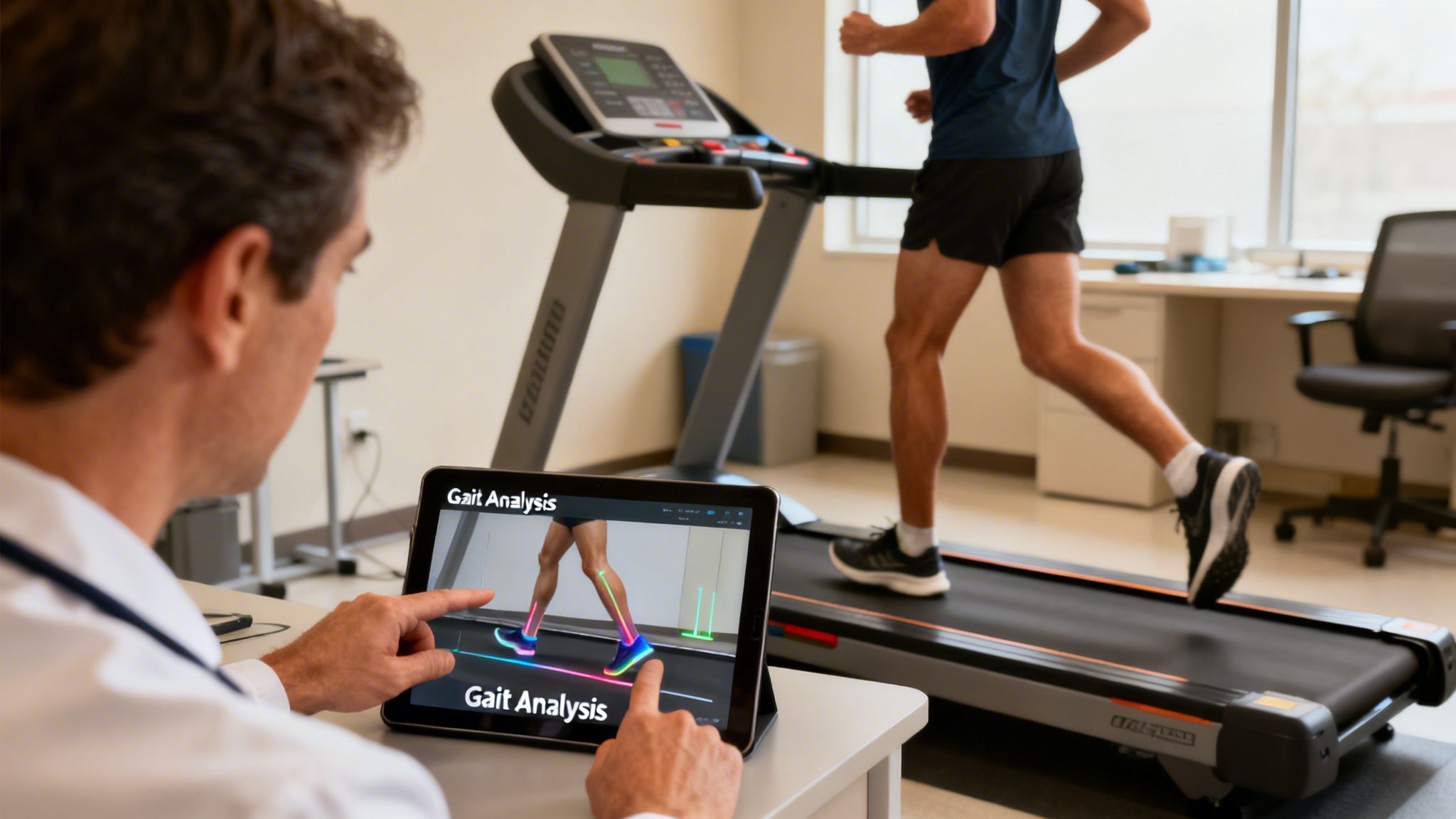
The highlight of our running evaluation is the video gait analysis. This is where we get to see your body in action. We'll have you run on a treadmill for a few minutes while we record you from different angles using advanced technology.
Then, we play it back in slow motion. This powerful tool allows both you and your therapist to see the subtle details that are impossible to catch in real time. We analyze every phase of your running stride—from foot strike to push-off—looking for biomechanical patterns that contribute to repetitive stress. This includes checking key metrics like your cadence (step rate), foot strike, overstriding, pelvic drop, and upper body rotation.
For most runners, seeing their own run broken down frame-by-frame is a true eye-opener. It provides undeniable visual evidence of the movement habits causing your pain and becomes the foundation for your treatment. This detailed evaluation ensures your running physical therapy is targeted, efficient, and designed for lasting results.
Building Your Personalized Treatment Plan
Once your evaluation is complete, our licensed physical therapists move from diagnosis to strategic action. The detailed information from your physical assessment and video gait analysis allows us to build a personalized treatment plan that’s truly yours. This isn't a one-size-fits-all handout; it's a dynamic roadmap designed to correct imbalances, build functional strength, and get you back to running without pain.
Think of your treatment plan as a toolkit. Every tool inside is chosen specifically to address the root causes of your injury. Our therapists blend hands-on techniques with highly targeted exercises, creating a plan that adapts as you get stronger and more mobile. The goal isn’t just to heal you—it’s to rebuild you into a more efficient and resilient runner.
Key Components of Your Running PT Program
Your recovery journey will be built on a foundation of proven, evidence-based treatments. And while every plan is unique, most runners at Peak will experience a combination of these core elements, all tailored to their specific needs and goals.
- Manual Therapy: This involves skilled, hands-on techniques performed by your physical therapist. We use methods like soft tissue mobilization to release tight, overworked muscles and joint mobilization to restore movement in stiff areas like your ankles and hips. Manual therapy is excellent for providing rapid pain relief and improving your range of motion, creating a window of opportunity for you to build strength using better movement patterns.
- Therapeutic Exercise: This is where we work on correcting the weaknesses and imbalances we uncovered during your evaluation. These aren’t random gym exercises. They are highly specific drills designed to activate and strengthen underperforming muscles, especially your glutes and core. For example, if your gait analysis showed a "hip drop," your exercises will focus on strengthening the gluteus medius to give you better pelvic stability on the run.
- Neuromuscular Re-education: It might sound complicated, but the idea is simple: we’re retraining the communication between your brain and your muscles to create better movement habits. Through specific drills, balance work, and targeted cues, we help you unlearn inefficient patterns that led to injury and lock in safer, more powerful ones. This is where we directly apply the findings from your gait analysis to help you become a technically sounder runner.
Advanced Services to Accelerate Healing
In addition to our core treatments, Peak Therapy offers advanced services that can accelerate your recovery. Your therapist may recommend these based on your specific injury and recovery goals.
One of the most effective tools in modern running physical therapy is Dry Needling. This technique involves inserting a thin, sterile needle into a trigger point, or "knot," in a tight muscle. This can release muscle tension, reduce pain, and improve function almost immediately, helping you get more out of your strengthening exercises. Another powerful option is Aquatic Therapy, which allows you to run or perform exercises in a low-impact pool environment. This helps you maintain cardiovascular fitness and leg strength without stressing your healing tissues.
The most effective treatment plans are multi-faceted. Combining hands-on care to restore mobility with targeted exercises to build strength and stability addresses every angle of your recovery, ensuring no stone is left unturned.
Understanding how to manage all the different factors of recovery is crucial. Runners often find that chronic pain can linger if not properly addressed, which is why a well-rounded plan is so important. For more on this, you can explore our guide on managing chronic pain after sports injuries with physical therapy.
A holistic approach for runners often goes beyond just the therapy clinic. Proper fueling is critical for tissue repair and energy levels, and you may find value in resources like A Runner's Guide to Performance Nutrition. It's another key piece of the puzzle to becoming a healthier, more durable runner.
Finally, the data shows just how effective this approach is. Up to 70% of runners face a lower-body injury each year, but that doesn't have to bench you for long. Physical therapy has been shown to reduce the recurrence of running injuries by 50-60%. At Peak, our evidence-based programs mirror this success—we get 90% of our patients with knee injuries back to running pain-free within 8-12 weeks.
Your Safe Return To Running Program
Feeling pain-free in the clinic is a huge milestone, but it’s not the finish line. We know that for any runner in recovery, the biggest fear is jumping back in too soon and ending up right back where you started. That's why a structured Return to Run program is the most important part of your recovery—it’s the bridge that gets you from being pain-free at rest to running confidently on the road again.
This isn’t about guesswork or simply “listening to your body.” It's an evidence-based protocol that methodically reintroduces load to your healing tissues. Your Peak physical therapist will design a gradual program that moves you from walk-run intervals to continuous running, giving your body the time it needs to adapt and get stronger.
This visual shows the key components we use to build the foundation for a successful return-to-run plan.
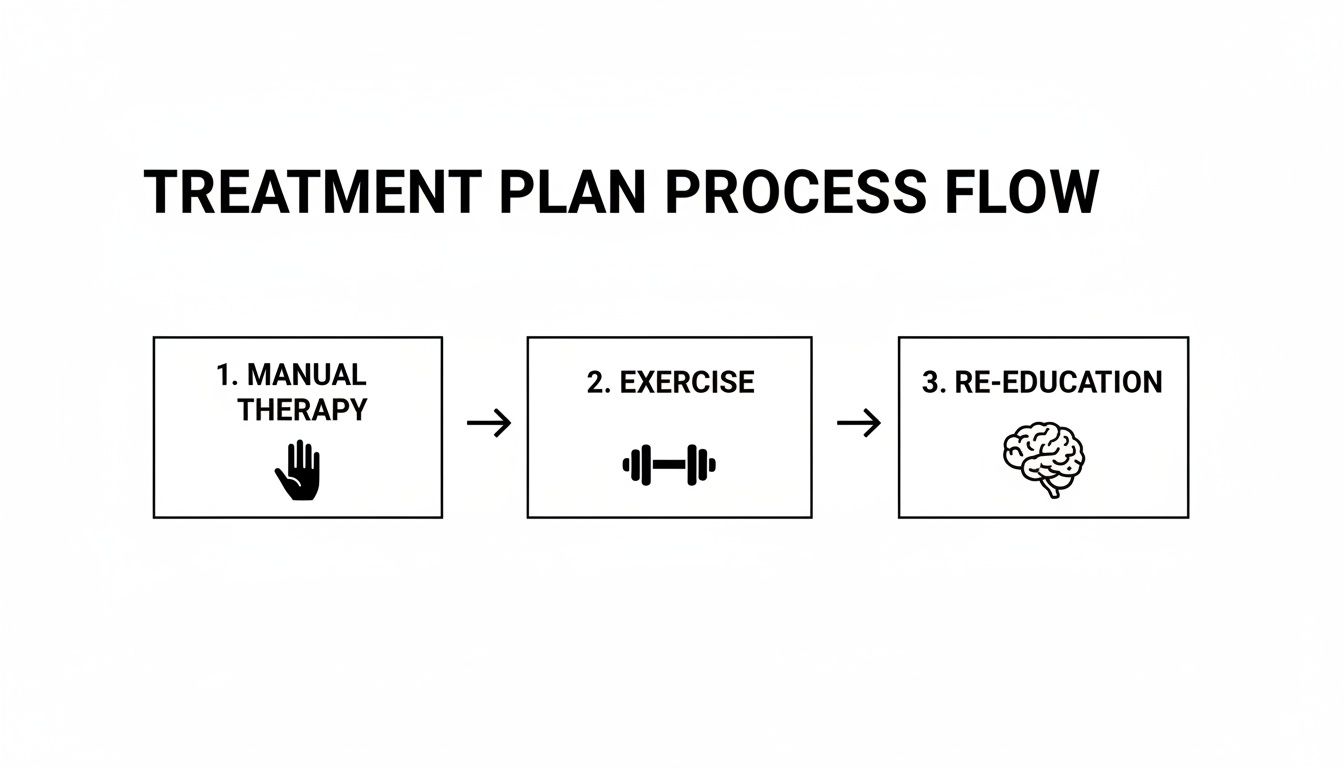
This flow illustrates how hands-on therapy, targeted exercise, and movement re-education all work together to prepare your body for the unique demands of running.
Progression Based On Clear Criteria
Moving forward in your return-to-run plan isn’t based on the calendar; it’s based on how your body responds. At each stage, we use specific, objective criteria to decide if you’re ready for the next step.
Your therapist will assess:
- Symptom Response: You must remain completely pain-free during and after each running session. If your original pain returns, it’s a sign we need to adjust the load.
- Functional Strength: We’ll re-test key strength markers to make sure your muscles are strong enough for the increased impact forces of running.
- Gait Mechanics: We keep a close eye on your running form, especially as you get tired, to ensure you don't slip back into old, harmful habits.
This controlled process takes the anxiety out of returning to running. It gives you a clear, reassuring roadmap, showing our commitment to your long-term health over a quick fix. You’ll know exactly what you need to do to progress, empowering you to take ownership of this final stage of recovery. Recovering from a meniscus injury, for example, requires this same careful, criteria-based approach, which you can read more about in our article on recovering from a meniscus injury with physical therapy.
A successful return isn't just about avoiding re-injury. It's about rebuilding your confidence, one pain-free step at a time. Our structured programs ensure you return to running not just healed, but stronger and more resilient than before.
Beyond our clinic walls, learning modern training approaches can also help prevent future setbacks. For instance, many runners benefit from learning how to avoid running injuries and burnout by using sports wearables and smarter training techniques. This knowledge complements your physical recovery and helps you train more intelligently down the road.
Getting this final step right is absolutely crucial. With an estimated 8.6 million running injuries occurring each year in the U.S., a smart recovery plan is non-negotiable. At our local clinics across Massachusetts, including our locations in Cohasset and Duxbury, our core value to 'Care Deeply' is reflected in these personalized return-to-run plans, which consistently earn five-star reviews and contribute to our 90% patient satisfaction rate.
Your Questions About Running Physical Therapy, Answered
Dealing with a running injury can be frustrating and filled with uncertainty. We get it. To help, we’ve gathered some of the most common questions we hear from runners across Massachusetts who are considering running physical therapy. Our goal is to provide clear, reassuring answers so you can feel confident in your next steps toward getting back on the road.
How Soon Should I See A Physical Therapist For A Running Injury?
The simple answer? As soon as you notice an ache or pain that doesn’t go away after a day or two of rest. Acting quickly is one of the best things you can do for your recovery.
Early intervention allows our licensed physical therapists to determine the root cause of the problem before your body starts compensating—like changing your stride to avoid pain—which can easily lead to new injuries down the line.
At Peak, we can typically get you in for your first appointment within a few days. Getting an expert evaluation early can stop a nagging issue from becoming a chronic one that sidelines you for months. Don't wait for the pain to get worse; the sooner we see you, the faster you'll likely recover.
Do I Need A Doctor's Referral To Start Running Physical Therapy In Massachusetts?
No, you don't. Massachusetts is a "Direct Access" state for physical therapy. This means you can schedule an evaluation directly with us at any of our clinics, without needing a referral from a physician first.
This is a huge advantage for injured runners. It saves you the time and cost of an extra doctor's visit and lets you start the recovery process that much faster. We will always communicate with your doctor and keep them informed to ensure you’re receiving the best, most coordinated care possible.
What Should I Bring To My First Running PT Appointment?
To make your first visit as productive as possible, we recommend you come prepared. This gives your physical therapist a complete picture of what's going on and helps them start building the right plan for you from day one.
Here’s a quick checklist of what to bring for your initial evaluation:
- Your running shoes (the pair you run in most often).
- Comfortable athletic clothing, like shorts and a t-shirt, so we can easily see how you move.
- Your insurance card and a photo ID.
- Any relevant medical records or imaging reports (like X-ray or MRI results) you might have.
If you happen to keep a training log with your mileage and workout details, that information is always incredibly helpful for your therapist, too.
Will My Health Insurance Cover Running Physical Therapy?
For most people, the answer is yes. The majority of health insurance plans in Massachusetts cover physical therapy services when they're medically necessary to treat an injury or condition that impacts your function.
The team at Peak understands that insurance can be confusing. That’s why we’re always happy to verify your benefits before your first appointment. This way, you’ll have a clear, upfront understanding of your coverage with no surprises. You can easily check your insurance on our website or give one of our local clinics a call.
You shouldn’t have to stop doing what you love because of running pain. The expert team at Peak Physical Therapy and Sports Performance is ready to perform a comprehensive evaluation to find the root cause of your injury, build a personalized treatment plan, and get you back to doing what you love. Schedule your appointment online and start your journey back to a pain-free run.