
You're walking the seawall in Scituate, pushing a cart through the grocery store in Hanover, or just getting out of bed in Quincy. Then the room lurches. Your stomach flips. You grab the nearest counter, railing, or wall and wait for the spin to stop.
That kind of episode rattles people fast. It should. Dizziness and vertigo can turn normal South Shore routines into something you start avoiding. Beach walks feel risky. Driving feels off. Even rolling over in bed becomes a problem.
If that's where you are right now, don't guess your way through it. Inner ear balance problems are common, treatable, and worth taking seriously. This guide is for South Shore residents who want a practical local path forward, not a vague internet answer.
Table of Contents
- That Sudden Spin When Life on the South Shore Tilts
- Is It Your Inner Ear Common Balance Problem Causes
- Recognizing the Telltale Signs of a Balance Problem
- Getting a Clear Diagnosis at Peak Physical Therapy
- How We Treat Inner Ear Balance Problems on the South Shore
- Home Management and Fall Prevention Strategies
- When to See a Physical Therapist and Your Next Steps
- FAQs About Balance and Vestibular Therapy
That Sudden Spin When Life on the South Shore Tilts
One of the most common stories we hear sounds almost boring at first. Someone turns over in bed, looks up to grab a mug from a cabinet, or bends down to tie a shoe. Then everything starts spinning. Not “I feel a little off” spinning. Real spinning. The kind that makes you freeze and wait it out.
On the South Shore, that quickly changes behavior. A walk at Nantasket feels less enjoyable when you're worried the horizon will sway. Parents stop rushing through errands in Braintree because busy aisles make them feel strange. Older adults in Weymouth or Duxbury start holding furniture as they move through the house.

The biggest mistake is waiting too long because you hope it will just pass. Sometimes it does. Plenty of times it doesn't. Worse, people start shrinking their world around the symptom. They stop driving at night, avoid exercise, and skip social plans because they don't trust their balance.
Practical rule: If dizziness is changing how you move through your day, it deserves an actual evaluation.
If you want a simple local starting point, Peak has a helpful overview on what causes dizziness and vertigo. But the short version is this. Spinning, rocking, unsteadiness, and motion sensitivity usually have a reason. You don't need to settle for “I'm just getting older” or “maybe I stood up too fast.”
Is It Your Inner Ear Common Balance Problem Causes
When people say “I think it's my inner ear,” they're often pointing in the right direction. But they usually don't know what that means. That's fair. The vestibular system is hidden, small, and easy to blame without understanding.
Your balance system works like a three-way conversation
The inner ear's vestibular system helps maintain balance by converting head motion into neural signals from fluid-filled labyrinth structures. When that signaling gets disrupted, people can develop vertigo, unsteadiness, and visually driven instability, especially during head turns or walking, because the brain is getting incorrect information about head position and motion, as explained by the National Institute on Deafness and Other Communication Disorders.
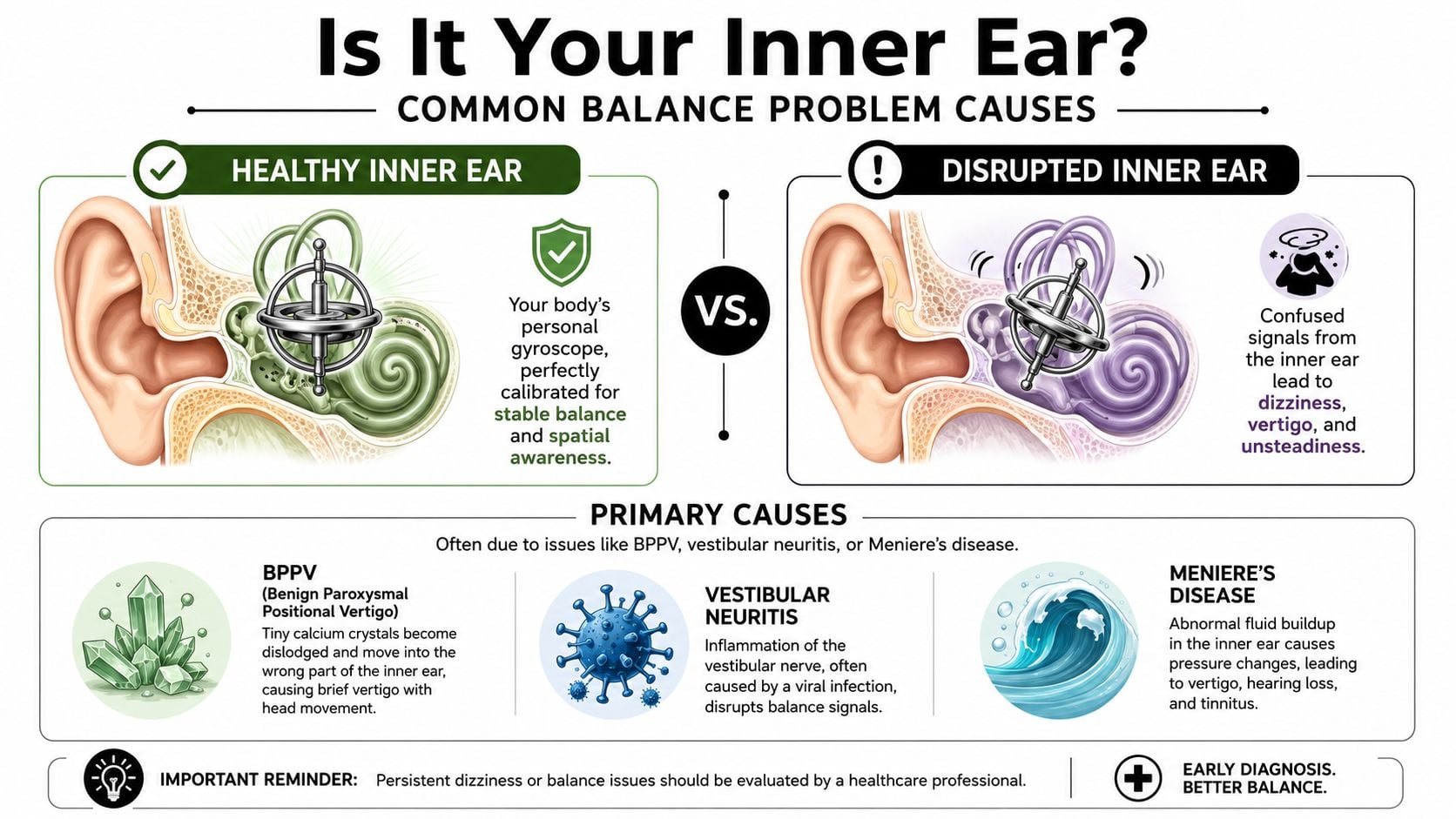
Here are the inner ear problems people most often hear about:
- BPPV: This is the classic “I turn my head and the room spins” problem. It often shows up with rolling in bed, looking up, or bending over. People sometimes call it loose crystal vertigo.
- Vestibular neuritis or labyrinthitis: These problems often hit harder and can leave you feeling knocked sideways for a while. People may describe a sudden severe dizzy spell followed by lingering imbalance.
- Meniere's disease: This tends to be associated with inner ear fluid changes and may come with episodes that feel more complex than simple position-related spinning.
- Vestibular migraine: Not everyone with this has a classic pounding headache during the dizzy spell. Some people mainly notice motion sensitivity, visual overload, or episodes of imbalance.
If your symptoms line up with one of those, that's useful. It still isn't a diagnosis.
For local treatment options, Peak also has a page on vertigo and dizziness care.
Common inner ear conditions at a glance
| Condition | Key Symptom | Typical Duration | Common Trigger |
|---|---|---|---|
| BPPV | Brief spinning with position changes | Usually brief episodes | Rolling in bed, looking up, bending over |
| Vestibular neuritis | Strong dizziness with lingering imbalance | Can feel more prolonged | Often starts suddenly |
| Labyrinthitis | Dizziness that may come with other ear-related symptoms | Can persist beyond the first episode | Often starts abruptly |
| Meniere's disease | Recurrent episodes that may feel more involved than simple positional vertigo | Varies by episode | Often not tied to one simple movement |
| Vestibular migraine | Motion sensitivity, dizziness, visual overload | Varies | Visual environments, motion, migraine patterns |
A useful rule of thumb is simple. If one exact head movement sets it off, BPPV moves higher on the list. If you feel off in crowded visual spaces or after a major dizzy event, something else may be going on.
Recognizing the Telltale Signs of a Balance Problem
People use the word dizziness to describe a lot of different sensations. That creates confusion fast. Clear descriptions matter because the feeling itself often points toward the cause.
Vertigo is not the same as general dizziness
Vertigo means you feel movement that isn't happening. It is described as spinning, tilting, swaying, or being pulled to one side. Dizziness is broader. It can mean lightheadedness, fogginess, floating, imbalance, or a vague “something isn't right” feeling.
Those differences matter. A quick spin when you roll in bed sounds different from the unsteady, visually overwhelmed feeling someone gets walking through a bright store in Hanover. Nausea, difficulty concentrating, and a sense that your eyes can't keep up with your head can all point toward a vestibular issue.
A major reason not to brush these symptoms off is scale. A landmark U.S. study found that 35.4% of adults age 40 and older had objective vestibular dysfunction, an estimated 69 million Americans, with prevalence increasing significantly with age and among people with diabetes, according to this JAMA Internal Medicine study.
How symptoms show up in daily South Shore life
You don't need textbook language to recognize a real problem. Start with what your day feels like now.
- In busy environments: Aisles, checkout lines, and large open stores can make you feel visually overloaded.
- On uneven ground: Sand, grass, and cracked sidewalks can expose balance trouble fast.
- During quick head turns: Backing out of the driveway, checking traffic, or looking side to side while walking can trigger symptoms.
- When you're tired: Vestibular problems often feel worse when you're run down, stressed, or moving too fast.
If you've started changing your habits to avoid symptoms, your body is already telling you this needs attention.
Another clue is recovery time. Some people bounce back in seconds. Others feel “off” for hours after a trigger. That pattern helps a trained clinician separate a brief positional issue from a more persistent balance problem.
Getting a Clear Diagnosis at Peak Physical Therapy
A real diagnosis doesn't come from guessing which online list matches your symptoms. It comes from a careful exam. That matters because balance problems don't come from one body part alone.

What happens at your first visit
The first step is your story. When did this start. What movements trigger it. Do you feel spinning, lightheadedness, or both. Is walking in a straight line harder. Do busy visual settings make things worse. Those details are not small talk. They shape the whole exam.
Then your therapist checks how your eyes move, how your balance responds, and how you walk. If BPPV is suspected, position-change testing may be used to see whether certain movements bring on vertigo and specific eye movement patterns. The test is brief, controlled, and done for a reason.
You may also be asked to track a target with your eyes, turn your head while focusing, stand in different positions, or walk while moving your head. None of that is random. Each piece helps identify whether the problem looks vestibular, movement-related, or something else.
Why a careful exam matters
Balance depends on input from the eyes, ears, body, and brain. Conditions like arthritis, neuropathy, low blood pressure, and vision problems can mimic vestibular disease, which is why a thorough clinical evaluation is critical to distinguish the root cause and select the right treatment, as noted by the Cleveland Clinic overview of balance problems.
That point gets missed all the time. People assume any dizzy spell must be “the ear.” Sometimes it is. Sometimes the picture is mixed. A stiff neck, nerve changes in the feet, vision trouble, medication effects, or a blood pressure issue can all muddy the waters.
Good vestibular care starts with ruling things in and ruling things out. That's how you avoid wasting weeks on the wrong treatment.
For South Shore residents in Norwell, Pembroke, Quincy, Plymouth, and nearby towns, the value of a neighborhood clinic is simple. You can get assessed close to home and start a plan that fits your daily routine instead of trying to piece this together alone.
How We Treat Inner Ear Balance Problems on the South Shore
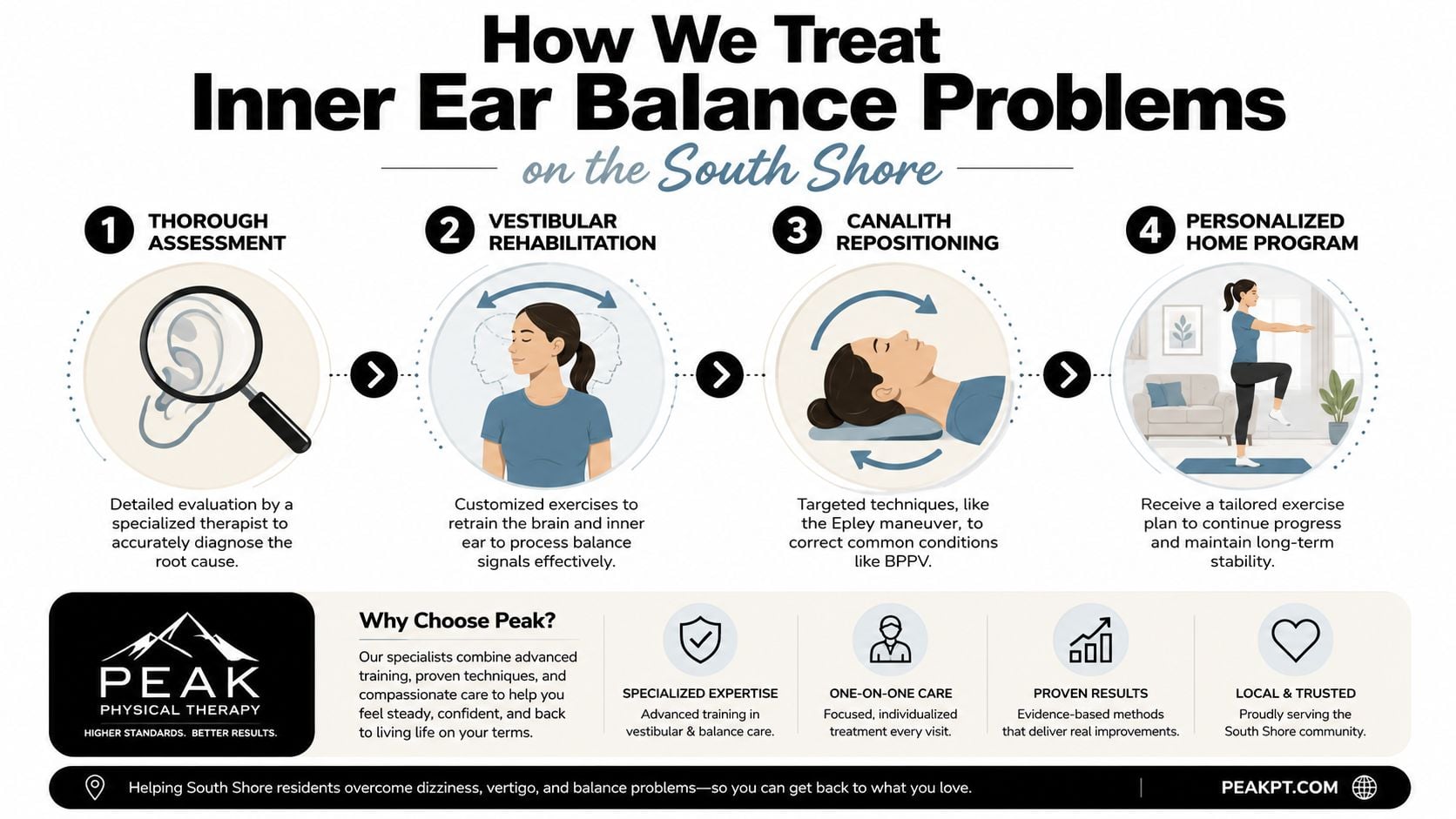
The right treatment depends on what is driving your dizziness. A spinning spell from BPPV needs one approach. Lingering motion sensitivity, blurry vision with head turns, or a wobbly feeling when you walk needs another.
Treatment depends on the cause
For BPPV, treatment is often straightforward. A therapist uses canalith repositioning maneuvers to move the misplaced crystals out of the part of the inner ear that is triggering the vertigo. When the diagnosis is right, people often feel a clear change quickly.
If the problem is not BPPV, internet repositioning videos are a bad bet. They waste time, stir up symptoms, and send people down the wrong path.
For ongoing dizziness after an inner ear issue, the usual answer is vestibular rehabilitation therapy. That means targeted exercises chosen for your exact pattern of symptoms, not a generic handout. The goal is to help your brain sort out movement and balance signals again so normal activities feel normal.
What treatment usually includes
A vestibular plan may include:
- Gaze stabilization: training your eyes to stay locked on a target while your head moves
- Habituation: practicing specific movements that trigger symptoms so your system becomes less reactive over time
- Balance retraining: standing and walking drills that challenge balance safely
- Functional practice: real tasks like rolling in bed, looking up, bending down, turning in the kitchen, or walking through a busy grocery store
A lot of South Shore residents need more than inner ear treatment alone. If you have started moving less, gripping railings on every staircase, or avoiding errands in Quincy, Hingham, or Braintree because you feel off balance, your program should also address leg strength, confidence, and fall risk.
That part matters. People do not just lose balance. They also lose trust in their body.
A smart plan builds both back at the same time. That may include coaching on safer movement at home, reaction and stepping drills, and guidance similar to these fall prevention strategies for staying safer at home. If you are also helping an older parent or spouse, broader advice on caring for the elderly can be useful alongside vestibular treatment.
Good treatment should feel specific to your day. It should match the movements that trigger symptoms and the places your balance breaks down, whether that is getting out of bed in Marshfield, walking the aisles in Hanover, or turning on the stairs at home.
Rest has a small role early on. Too much rest slows recovery. The nervous system improves when you practice the right movements in the right dose, then build from there. That is how people get back to walking confidently, driving locally, shopping without that floaty feeling, and living on the South Shore without planning every day around dizziness.
Home Management and Fall Prevention Strategies
A bad dizzy spell at home is where small hazards turn into real problems fast. The throw rug by the bed, the dark hallway to the bathroom, the quick head turn in the kitchen. Those are the moments that catch South Shore residents off guard.
Start by making your home easier to move through today. Do not wait for a formal diagnosis to fix obvious risks.
- Secure loose rugs: If it slides, remove it or anchor it.
- Improve lighting: Put bright bulbs in hallways, stairways, bathrooms, and entryways. Night lights help if you are getting up after dark.
- Clear walking paths: Pick up cords, shoes, bags, laundry, and pet toys.
- Use the railings and counters you already have: Keep a hand close during transfers, stairs, and tight turns.
If you are helping an older parent or spouse in Weymouth, Scituate, or Plymouth, broader guidance on caring for the elderly can help you think through safety without stripping away independence.
Be selective about what you do on your own. Random vertigo exercises from social media are a bad bet. Inner ear problems do not all respond to the same movements, and the wrong routine can stir symptoms up for no good reason.
Use these rules until you have been assessed:
- Get up in stages: Sit first, pause, then stand.
- Turn slowly: Move your eyes first, then your head and body together if fast motion sets you off.
- Slow down bending and reaching: Looking up, leaning forward, and picking things up from the floor are common triggers.
- Keep needed items at waist or counter height: Reduce repeated bending while symptoms are active.
- Wear stable shoes indoors: Slippers with poor grip make a shaky day worse.
For more practical home safety ideas, read these fall prevention strategies for staying safer at home.
One more clear recommendation. Do not stop moving completely. Short, controlled movement is usually better than spending the day planted on the couch. In clinics across the South Shore, we see the same pattern. People feel dizzy, start doing less, then get weaker and less steady. Keep activity light, predictable, and safe until you get the right plan.
When to See a Physical Therapist and Your Next Steps
If dizziness is affecting your routine, book the appointment. That's the advice. Don't wait for it to become a bigger problem.
Signs it is time to book
You should get checked if any of these sound familiar:
- You've fallen or nearly fallen: One close call is enough.
- You're avoiding normal activities: Driving, shopping, exercise, or social outings feel limited by dizziness.
- Symptoms are new or getting worse: New patterns deserve a fresh look.
- A child or teen is dealing with repeated dizziness: This is not just an older adult issue.
Balance problems can show up much earlier than people think. A national analysis found that more than 1 in 20 U.S. children ages 3 to 17, nearly 3.3 million children, had a dizziness or balance problem, with prevalence rising to 7.5% in teens ages 15 to 17, according to this Vestibular Disorders Association summary.
That matters for families across the South Shore. If your teenager feels off during sports, in school hallways, or during rapid head movement, it's worth evaluating instead of dismissing.
Braintree, Scituate, East Bridgewater, Quincy, Hanover, and the rest of the South Shore all have people doing the same thing right now. Waiting, limiting activity, and hoping this resolves on its own. Some of them improve. Many just adapt badly. Get clarity instead.
FAQs About Balance and Vestibular Therapy
Do I need a referral
In many cases, you can start with a physical therapy evaluation without waiting around for a long referral process. If your situation needs a physician involved, a good clinic will tell you plainly and help point you in the right direction. The main point is this. Don't assume paperwork has to delay getting answers.
How long does it take to feel better
That depends on the cause. BPPV often improves quickly once it's identified and treated correctly. Other vestibular problems are more gradual because the brain needs time and repetition to adapt. If someone promises a one-size-fits-all timeline, ignore that promise.
What matters more is whether the plan is specific and whether your symptoms are being measured by function. Are you rolling in bed more comfortably. Can you walk the grocery store without grabbing the cart. Are head turns easier. That's the kind of progress that counts.
What if it is not an inner ear problem
That's not a failed visit. That's a useful answer. A skilled vestibular evaluation can help show when symptoms don't fit a clean inner ear pattern. If something else looks more likely, you can be directed toward the right next step instead of spending weeks chasing the wrong fix.
The goal isn't to force every dizziness problem into an inner ear bucket. The goal is to figure out what's actually driving your symptoms.
Can kids and active adults benefit from vestibular therapy too
Yes. Dizziness can affect older adults, runners, parents, student athletes, and kids. If symptoms are interfering with school, sports, exercise, work, or everyday movement, treatment is worth considering.
What should I do before my appointment
Write down your triggers. Note whether you feel spinning, swaying, lightheadedness, or fogginess. Pay attention to what movements bring symptoms on and how long they last. That information helps your therapist move faster toward the right diagnosis.
If dizziness, vertigo, or unsteadiness is disrupting life on the South Shore, take the next step with Peak Physical Therapy and Sports Performance. Book an appointment at the clinic most convenient for you in Braintree, Quincy, Weymouth, Cohasset, Duxbury, East Bridgewater, Hanover, Kingston, Milton, Norwell, Pembroke, Plymouth, or Scituate, and get a clear plan to help you feel steady again.