
You're at the playground, the beach, or a weekend soccer game somewhere on the South Shore, and you notice something small but persistent. Your child avoids one leg when climbing. They trip more than other kids their age. Their head still tilts to one side in photos. Or maybe your baby just doesn't seem as comfortable with rolling, crawling, or standing as you expected.
That kind of worry is quiet at first. Most parents don't jump straight to panic. They watch, compare, second-guess themselves, and wonder if they should wait or make a call.
In many cases, the most helpful next step isn't to wait for the problem to get obvious. It's to get a skilled set of eyes on how your child moves. Around the South Shore, families are often looking for care that feels practical, local, and built for real life, not just a list of exercises on a handout. That's where pediatric physical therapy can make a real difference.
Table of Contents
- A Parent's Guide to Helping Your Child Thrive on the South Shore
- What Is Pediatric Physical Therapy Really
- Common Signs Your Child Might Benefit from a PT
- Your Child's First Visit and Therapy Journey at Peak
- Find a Pediatric PT Near You on the South Shore
- Partnering with Your Family for Success Beyond the Clinic
- Frequently Asked Questions from South Shore Parents
- Do I need a doctor's referral for pediatric physical therapy in Massachusetts?
- What should my child wear to their appointment?
- How long is a typical therapy session?
- How do therapists measure progress?
- What if my child is shy, anxious, or doesn't cooperate right away?
- How long will my child need therapy?
- When should I stop waiting and schedule?
A Parent's Guide to Helping Your Child Thrive on the South Shore
A lot of families looking for pediatric physical therapy in South Shore MA start in the same place. Not with a diagnosis. Not with a specialist referral. Just with a parent noticing that something seems off during ordinary life.
Maybe it's a toddler at the beach in Duxbury who doesn't want to squat to play in the sand. Maybe it's a preschooler in Milton who still walks on their toes around the house. Maybe it's a school-aged child in Weymouth who keeps stumbling on stairs, or a young athlete in Pembroke who says their knee hurts after practice but insists they're fine.

The hard part is that many movement issues don't look dramatic. They show up as hesitation, fatigue, awkward patterns, frustration, or avoiding activities other kids seem to enjoy. Parents often tell themselves they don't want to overreact. That instinct comes from a good place, but it can also delay useful support.
Practical rule: If a movement pattern keeps catching your attention for weeks, it's worth having it checked.
Good pediatric PT is not about labeling kids or making families feel alarmed. It's about understanding how a child moves, what may be getting in the way, and how to build confidence step by step. On the South Shore, that matters because family life is active. Kids want to run on the beach, climb at the park, keep up at recess, return to gymnastics, and join friends on the field without feeling behind.
What works best is a plan that fits into real family routines. What doesn't work is hoping a clear pattern will disappear on its own without anyone assessing why it's happening.
Parents usually feel better once they stop guessing and start getting answers. Even when the concern turns out to be manageable, that clarity helps. You know what to watch, what to practice at home, and what progress should look like.
What Is Pediatric Physical Therapy Really
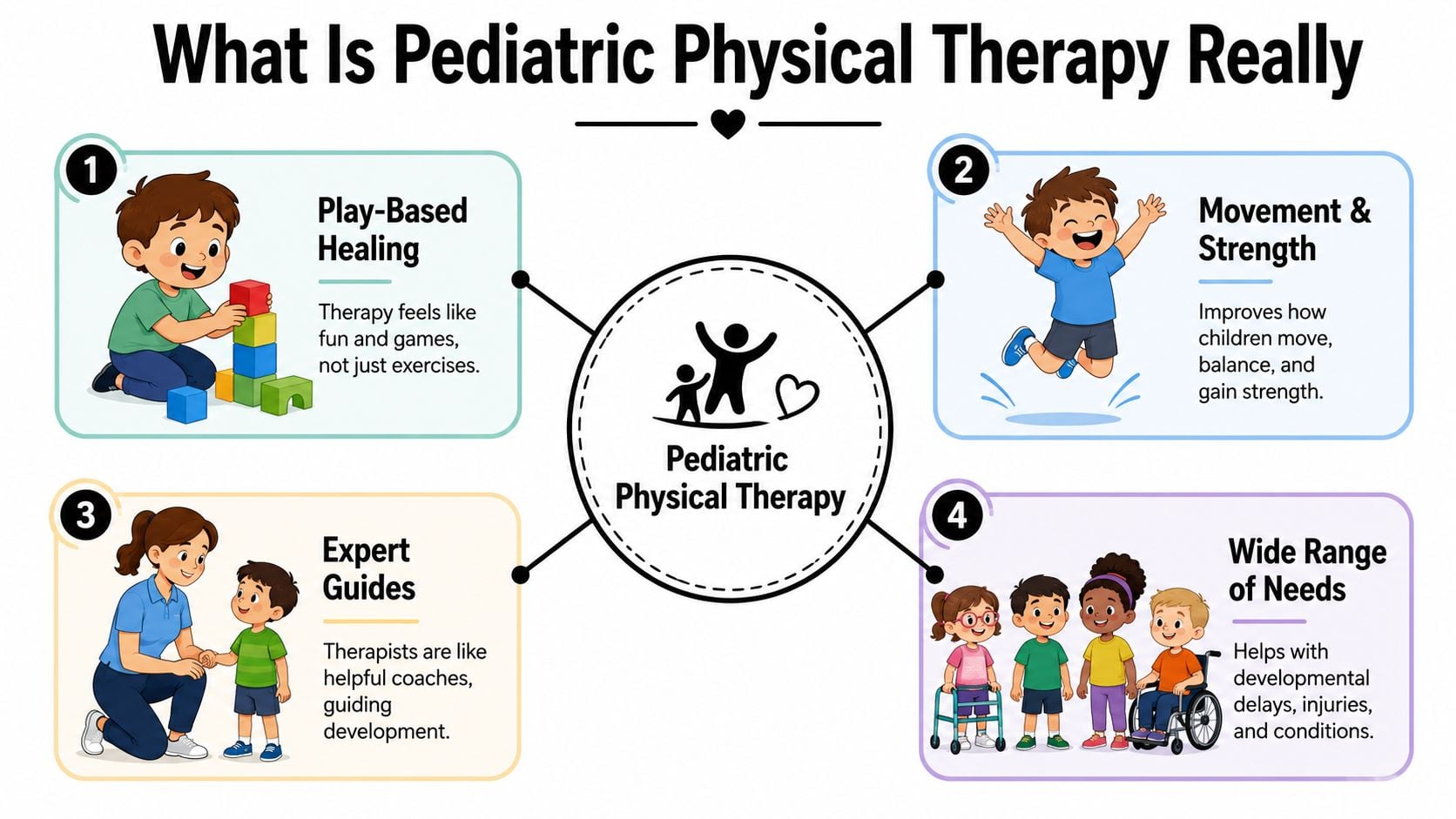
Pediatric physical therapy helps children move with more comfort, control, and confidence in daily life. For one child, that may mean learning to crawl, stand, and keep balance on uneven ground. For another, it means returning to soccer, dance, playground time, or gym class without pain or hesitation.
For parents, the biggest shift is usually this. PT is not just a set of exercises handed over on paper. It is a close look at how your child moves, where they are getting stuck, and what will help them participate more fully at home, at school, and out in the community.
For most kids, therapy works best when it feels purposeful and engaging. A therapist might use toys, obstacle courses, stepping games, balance challenges, crawling activities, or sport-specific drills to work on the movement skills your child needs. The child experiences a game or challenge. The therapist is tracking posture, coordination, symmetry, balance, strength, endurance, and whether those gains carry over into real life.
It should feel purposeful, not forced
A good pediatric PT session meets a child at their developmental level.
That means a toddler is not asked to grind through repetitive drills that mean nothing to them. The work is built into play that encourages kneeling, reaching, climbing, cruising, squatting, and recovering balance. An older child with a sports injury needs something different. Their plan may focus on landing mechanics, strength, coordination, pacing, and safe return to activity.
On the South Shore, that practical approach matters. Families are trying to fit care into school schedules, commutes, practices, and busy afternoons. Children also test their skills in real places here, at the beach, on playgrounds, on fields, and on uneven sidewalks and grass. Therapy has to prepare them for those settings, not just for a treatment room.
Some children also need support that overlaps with sensory processing, communication, feeding, or daily routines. In those cases, coordinated care helps parents make sense of the full picture instead of chasing separate answers. If sensory processing is part of what you are noticing, this overview of what is sensory integration for kids is a useful parent-friendly companion.
How pediatric PT differs from adult PT
Adult PT often starts with a clear injury or a clear pain complaint.
Pediatric PT often starts with a parent saying, “Something seems off, but I can't tell if it's serious.” A baby may always turn one way. A preschooler may avoid jumping. A grade-school child may fall more than expected or tire out faster than peers. A young athlete may have pain that keeps coming back.
That changes the whole treatment approach.
- The goal is daily function. We look at how your child moves during play, transitions, stairs, sports, and school routines.
- Parents are part of the plan. Home strategies matter because children improve faster when practice fits into normal life.
- The session has to hold the child's attention. If an activity is not age-appropriate, it usually will not produce useful repetition or good movement quality.
- Progress has to mean something to your family. Better balance at the park, easier mornings, fewer falls, smoother stair climbing, and returning to team activities all count.
At Peak, that often starts with a simple question from a parent, followed by an evaluation that turns vague worry into a clear plan. The pediatric physical therapy services at Peak Physical Therapy give a clear overview of the kinds of movement concerns we treat and how care is customized to a child's age and goals.
The best sessions usually look simple from the outside. A child climbs, reaches, runs, kicks, or balances a little better than they did last week. To a parent, that can feel like a small win. In practice, it is often the moment confidence starts to come back.
Common Signs Your Child Might Benefit from a PT
Most parents don't need a diagnosis to schedule an evaluation. They just need a reason that makes sense.
If you're wondering whether what you're seeing is enough to justify a visit, focus on patterns. One off day usually isn't the issue. A repeated movement difficulty, persistent asymmetry, ongoing pain, or a skill that doesn't seem to be coming together is more worth attention.
For your baby and toddler
With babies and toddlers, concerns often show up as differences in movement quality, comfort, or early motor development.
| Condition / Concern | What You Might Notice |
|---|---|
| Head preference or tilt | Your baby looks to one side more often, or their head seems tilted in photos |
| Delayed floor mobility | Rolling, crawling, or transitioning between positions seems harder than expected |
| Stiffness or asymmetry | One side of the body seems easier to use than the other |
| Trouble with standing or cruising | Your child avoids pulling up, standing, or taking supported steps |
| Frequent falls beyond what seems typical | Walking looks unusually unstable or awkward over time |
A few examples parents notice at home:
- During floor play: Your baby reaches more with one arm or resists tummy time in a consistent way.
- When changing positions: Moving from sitting to crawling or kneeling seems effortful.
- On uneven ground: Grass, sand, and playground surfaces expose balance challenges quickly.
For your school-aged child
By this age, movement issues are often easier to spot because school, recess, sports, and stairs demand more.
Common reasons parents book an evaluation include:
- Frequent tripping: Not just occasional clumsiness, but repeated stumbles during running or walking.
- Toe walking: A child continues walking on their toes or does it often enough that it stands out.
- Difficulty with stairs or jumping: They use extra support, move cautiously, or avoid playground activities.
- Poor coordination: Catching, kicking, hopping, or balancing seems harder than expected.
- Low endurance: They fatigue early compared with peers during outings or sports.
If you want a broader parent checklist, this article on developmental milestones for children can help you frame what you're noticing without turning every difference into a problem.
For a more PT-specific look at concerning movement patterns, Peak's article on pediatric movement abnormality signs and symptoms is a useful next read.
If your child avoids a movement, that matters as much as whether they can technically do it.
For your young athlete
This group often gets missed because active kids push through discomfort. Parents hear “it only hurts after practice” and assume rest will solve it.
Sometimes it does. Sometimes it doesn't.
Watch for these patterns:
- Pain after sports: Knee, ankle, heel, hip, or back pain that keeps returning.
- A change in mechanics: Running looks uneven, throwing changes, or landing seems stiff or guarded.
- Loss of confidence: Your child suddenly hesitates with cutting, jumping, sprinting, or contact.
- Trouble returning after an injury: They're cleared to play but don't look like themselves yet.
- Recurring complaints: The same area keeps flaring up during the season.
What usually helps is early assessment, clear guidance, and a plan tied to sport and daily function. What usually doesn't help is bouncing between total rest and full activity with no in-between plan.
Your Child's First Visit and Therapy Journey at Peak
The first call is usually the moment a parent shifts from worry to action. Once that happens, most families want to know one thing. What will this look like for my child?
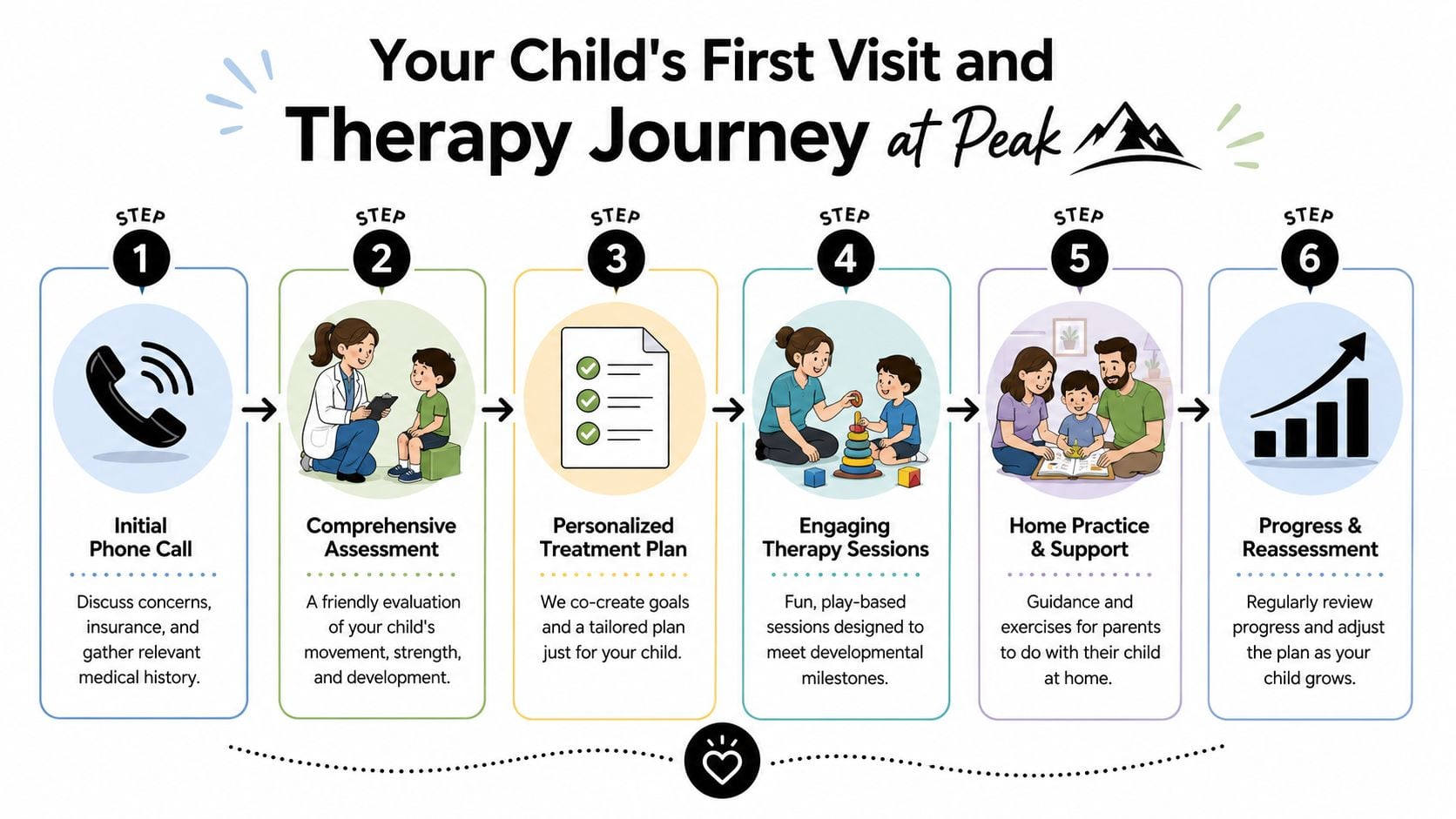
The answer is simpler than many parents expect. You'll talk through your concerns, share any helpful history, and schedule an evaluation focused on how your child moves in real life, not just what a form says.
What to have ready before the first call
You don't need to prepare a perfect summary. A few basics help:
- Your main concern: What have you noticed, and when did it start?
- Any diagnosis or referral: If you have one, bring it. If you don't, that's often still okay to discuss.
- Medical and developmental history: Birth history, prior injuries, surgeries, or other therapies can be relevant.
- Your goals: Better walking, less pain, improved balance, easier stairs, return to sport, or more confidence on the playground.
If your child is old enough, it helps to include what they care about too. Kids often give the most useful goals in simple language. “I want to keep up at recess” is a strong therapy goal.
What the first visit usually feels like
A pediatric evaluation should not feel like a test your child can fail.
The therapist will spend time observing how your child sits, stands, transitions, walks, balances, plays, and responds to movement challenges. Depending on age, that may look like toys on the floor, stepping activities, reaching games, hopping, running, or sport-specific movement. The point is to see how the body organizes movement, where it compensates, and what seems to limit function.
Parents are part of this process. You'll be asked what you're seeing at home, what concerns you most, and what daily routines feel hard right now.
Bring your real questions to the first visit. Parents often apologize for “overthinking,” but those details usually help.
What happens after the evaluation
After the assessment, the therapist builds a plan around clear goals. Not abstract goals. Useful ones.
That may include:
- Clinic sessions focused on strength, mobility, balance, coordination, gait, or sport-specific movement.
- Home activities that fit normal routines, so therapy doesn't become a second full-time job.
- Progress checks based on function. Is your child moving more easily, participating more fully, and needing less compensation?
If you're looking for one local option, Peak Physical Therapy and Sports Performance provides pediatric care through its South Shore network, including a Braintree pediatric clinic, with a focus on movement concerns, developmental issues, injuries, and return to activity.
What works well is consistency and a realistic home plan. What usually fails is a routine that's too complicated for family life. If parents leave with ten exercises and no idea when to do them, follow-through drops fast. If they leave with two or three specific activities linked to real moments in the day, progress tends to stick.
Find a Pediatric PT Near You on the South Shore
A lot of families reach this point after a few hard weeks. Your child is struggling with stairs, avoiding playground equipment, limping after practice, or falling behind peers in ways you cannot quite explain. You are ready to get help, but now the practical question shows up fast. Where can you go that fits real South Shore life?
Location matters because pediatric PT only works when families can keep showing up. A clinic may look like a good fit on paper, but if the drive cuts through heavy traffic, overlaps with school pickup, or turns every appointment into a rushed evening, consistency gets harder than it should be.
Peak Physical Therapy and Sports Performance has clinics across the South Shore, including a dedicated pediatric site in Braintree. That gives families a local option without turning each visit into a long cross-county trip. If your child would benefit from a pediatric-focused setting, the Braintree pediatric physical therapy clinic is a clear place to start.
That setup can be especially helpful for families in Quincy, Braintree, Milton, Weymouth, Norwell, Hanover, Pembroke, Kingston, Plymouth, Duxbury, Scituate, Cohasset, and nearby towns. On the South Shore, a twenty-minute difference in drive time can decide whether therapy feels manageable or starts slipping off the calendar.
How parents usually choose the right clinic
The best choice is usually the clinic you can return to without a weekly argument, scramble, or missed meal.
Parents often ask whether they should choose the closest office or the one that feels more suited to their child. Usually, the answer is a mix of both. A pediatric-focused location can be a strong fit for a younger child or a child with developmental concerns. A closer site may make more sense for an older child who needs steady follow-up after an injury and has to fit visits around school and sports.
A few questions help narrow it down:
- How long is the drive at the actual time of day you would go?
- Can your child handle that car ride well, especially after school or practice?
- Are appointment times realistic with work, pickups, and sibling schedules?
- Does your child do better in a setting built for pediatric care?
- Can your family keep that routine going for several weeks?
Those trade-offs matter. A good plan that your family can repeat usually beats a perfect plan that is too hard to maintain.
Some parents also like ideas for what to do at home while they are getting started. If your child is working on coordination, play skills, or hand use along with gross motor progress, these engaging fine motor activities for kids can give you a few simple ideas to use during everyday play.
Partnering with Your Family for Success Beyond the Clinic
The families who do best in pediatric PT usually don't have more free time. They have a plan they can use.
A child may spend a short window in the clinic, but effective carryover happens at home, in the yard, on walks, before school, after bath time, or while waiting for practice to start. Parents don't need to become therapists. They just need clear guidance on how to make useful movement part of normal life.
What helps at home
Home programs work when they're simple, repeatable, and tied to routines your family already has.
- Use existing moments: Practice balance while waiting for the school bus, stepping over cracks in the sidewalk, or climbing onto the couch with control.
- Make it playful: Young kids respond better to games than commands. Animal walks, obstacle paths, and reaching games usually go further than “do your exercises.”
- Keep sessions short: A few focused minutes done consistently often work better than one long session everyone dreads.
- Build around your South Shore routine: After a family walk, on a playground visit, or before heading to the beach are natural places to add movement work.
If your child is also working on hand skills or classroom readiness, this guide to engaging fine motor activities for kids can give parents more ideas for play that supports development.
Home practice should feel doable on your busiest weekday, not just on your most organized weekend.
What usually does not help
Some common mistakes slow progress even when parents mean well.
- Doing too much at once: Kids tune out when every evening becomes therapy time.
- Correcting constantly: Frequent reminders about posture or walking can create frustration.
- Changing the plan on your own: Adding random online exercises often muddies what the therapist is trying to target.
- Waiting for motivation: Young children usually need routine and repetition more than inspiration.
The strongest home programs are clear, targeted, and adjusted as your child improves. Parents should leave sessions knowing exactly what to do, how often to do it, and what success should look like.
Frequently Asked Questions from South Shore Parents
Do I need a doctor's referral for pediatric physical therapy in Massachusetts?
That can depend on your child's insurance plan and the details of the situation. Some families come in with a referral, and some start by contacting a clinic directly to ask what's needed. The fastest path is usually to call and verify the requirements before the first visit.
What should my child wear to their appointment?
Comfortable clothes that allow easy movement are best. Think leggings, shorts, T-shirts, or athletic clothes. Shoes should be easy to walk and play in unless you've been asked to bring something specific.
How long is a typical therapy session?
That varies by clinic, child, and treatment plan. The first evaluation is usually different from a follow-up visit because it includes more discussion, observation, and planning. When you schedule, ask what the evaluation and standard treatment visits typically look like so you can plan your day.
How do therapists measure progress?
Progress is usually measured by function, not just by how an exercise looks in the clinic. Therapists watch for better balance, easier transitions, improved walking or running, less pain, more confidence, and smoother participation in everyday activities like stairs, play, recess, or sports.
What if my child is shy, anxious, or doesn't cooperate right away?
That's common. A skilled pediatric therapist expects a warm-up period and knows how to build rapport through play, pacing, and choice. The first visit doesn't require perfect participation to be useful.
How long will my child need therapy?
There isn't one answer. Some children need a short burst of care and a home plan. Others need a longer stretch with periodic reassessment as they grow, return to sport, or work on more complex movement goals. The plan should be specific to your child, not generic.
When should I stop waiting and schedule?
If a movement concern keeps showing up, affects daily life, or is limiting play, school activity, or sports, it's reasonable to book an evaluation. Parents rarely regret getting clarity early.
If you're ready to stop guessing and start with a clear local plan, Peak Physical Therapy and Sports Performance is a straightforward place to book an appointment, check locations, and take the next step for your child's care on the South Shore.