If you're an athlete on the South Shore, you probably didn't start searching for physical therapy because life slowed down on its own. It was the sharp ankle roll during a soccer match in Pembroke, the shoulder that kept barking after tennis in Milton, the knee that never settled down after running along the coast, or the concussion symptoms that made school, work, and practice feel harder than they should.
Around here, athletes don't just mean varsity players. It means the high school hockey player in Quincy, the adult league runner in Plymouth, the sailor in Cohasset, the weekend basketball player in Braintree, and the parent trying to stay active enough to keep up with everyone else. When one injury starts changing how you train, compete, sleep, or move through your day, you need a plan that makes sense locally and clinically.
Table of Contents
- Your Partner in Performance on the South Shore
- What Is Sports Physical Therapy at Peak
- Common Injuries We Treat in South Shore Athletes
- Your Journey Back to the Game The Peak Approach
- Beyond Recovery Proactive Injury Prevention and Performance
- Find Your Peak Clinic Locations and Specialties on the South Shore
- FAQs for South Shore Athletes
Your Partner in Performance on the South Shore
A lot of athletes here try to push through longer than they should. A Pembroke soccer player tapes the ankle tighter and hopes for the best. A Scituate runner shortens the stride and keeps logging miles. A Braintree football player says the shoulder is "fine" because the season matters. That usually works for a week or two. Then the compensation starts, the confidence drops, and the problem gets bigger.

The South Shore has been treating athletes with a more complete rehab mindset for a long time. Dedicated sports and orthopedic rehabilitation services have operated in the area since 1986, and those early models already included sports-specific training, functional training, and performance testing for return to activity and sport, as described by South Shore Sports and Muscular Therapy. That matters because local athletes have never needed cookie-cutter rehab. They need care that matches the demands of cutting, sprinting, throwing, lifting, landing, balancing, and getting back out there safely.
What local athletes usually need
Most sports injuries aren't just about pain. They're about what the pain is stopping you from doing.
- A student athlete needs clarity: Can I practice this week, or am I making it worse?
- A parent needs a roadmap: Is this a growth-related issue, an overuse problem, or something that needs more protection?
- An active adult needs realism: Can I keep training while this calms down, or do I need to back off and rebuild?
Practical rule: The earlier you address a sports injury, the easier it is to correct the movement changes that follow it.
That is what makes physical therapy for athletes on the South Shore different from generic exercise advice. You need someone who understands your sport, your schedule, and the very normal urge to return too soon. The right plan doesn't just settle symptoms. It rebuilds trust in the injured area and gives you a clear path back to your team, your training group, or your regular routine.
What Is Sports Physical Therapy at Peak
Sports physical therapy isn't just general PT done around athletic people. It is rehab built around performance demands. That means the question isn't only, "Does it hurt less?" The better question is, "Can you cut, accelerate, decelerate, rotate, absorb force, and repeat those actions the way your sport requires?"
We treat the athlete, not just the diagnosis
A runner with knee pain, a volleyball player with shoulder pain, and a hockey player with hip tightness might all need strength and mobility work. But they don't need the same program. The runner needs efficient loading and stride tolerance. The volleyball player needs overhead control and repeated hitting tolerance. The hockey player needs edge control, rotation, and power transfer.
That is a key difference in sports rehab. We look at:
- The injury itself
- The movement pattern behind it
- The exact demands of the sport
- The timeline and pressure around return to play
If you only treat pain and never train the movement that caused trouble, the athlete often feels better in the clinic and worse back on the field.
What works and what usually falls short
What works is a program that changes as you improve. Early on, that may mean calming symptoms, restoring motion, and cleaning up protective movement patterns. Later, it should look more like strength work, balance challenges, directional change, landing control, and sport-specific progression.
What doesn't work well is guessing your way through recovery with random online drills or resting until the pain fades and then jumping straight back into full participation. Athletes often feel almost ready before they are fully prepared for the speed and unpredictability of sport.
Good sports PT should feel progressive. If rehab never moves beyond a table, a band, and a few basic exercises, it usually isn't enough for return to sport.
Posture and movement quality can also shape how force moves through the body, especially in repetitive sports and gym training. If you're curious how alignment and positioning affect performance and strain, this overview of how posture impacts health is a useful primer.
For deeper education on anatomy, surgical recovery, and condition-specific rehab, head to highbarhealth.com. That is the better place for full clinical explainers. Here, the focus is simpler. If you're looking for physical therapy for athletes South Shore MA families can use close to home, you want local access, a sport-specific plan, and a return-to-play process that matches real life.
Common Injuries We Treat in South Shore Athletes
On the South Shore, the injury list tends to match the sports calendar. In the fall, we see field and turf injuries. In the winter, hockey, basketball, and indoor training aches rise. Spring brings throwing issues, track problems, and the usual rush of athletes trying to ramp up too fast. Summer adds beach running, recreational leagues, and overuse issues from doing more after doing less.
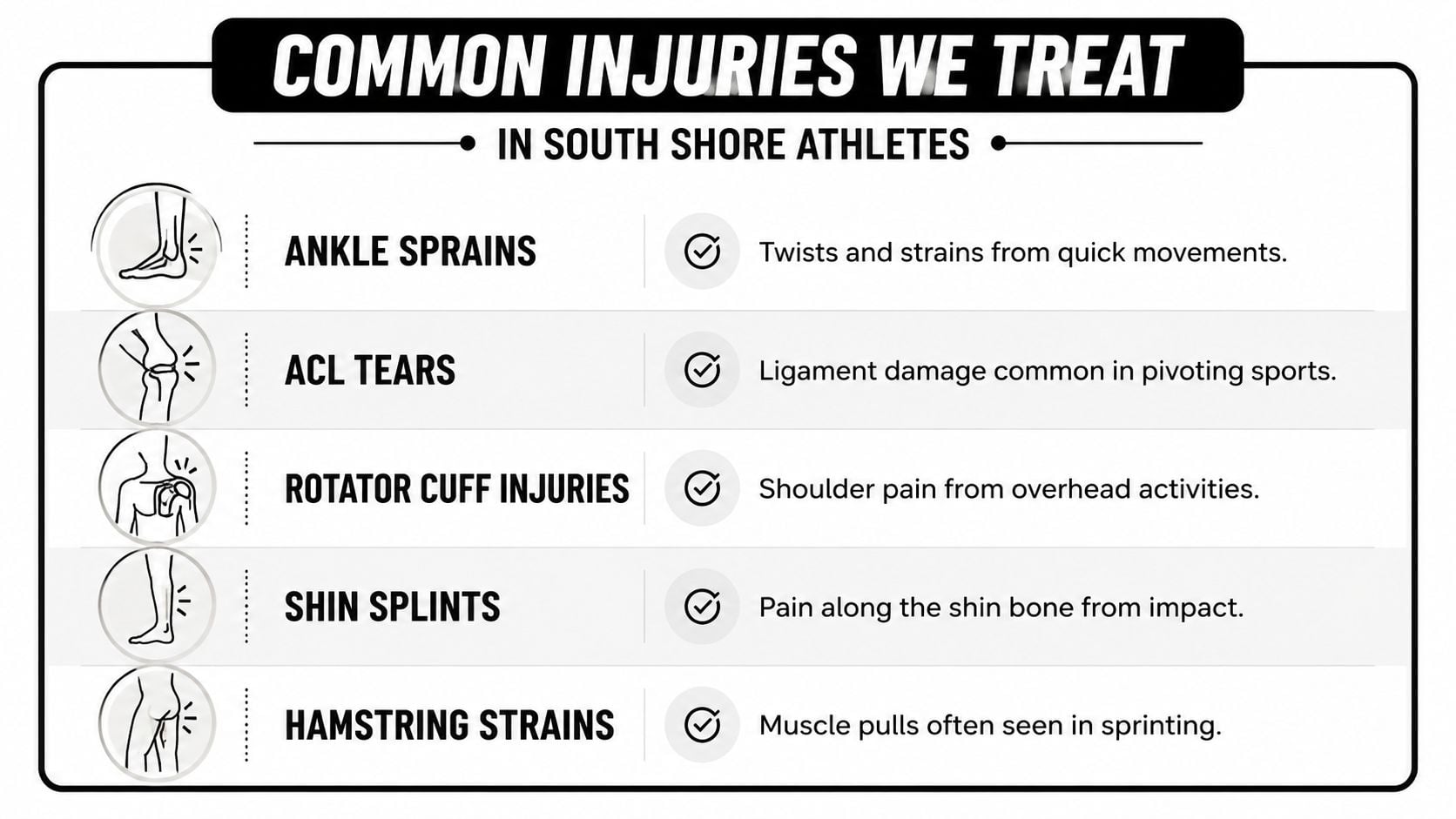
The broader regional care system is equipped for a wide range of athletic problems, including sports injuries, orthopedic injuries, back and neck pain, concussions, and vestibular balance disorders, according to South Shore Health physical therapy services. For athletes, that matters because recovery is rarely one-dimensional. A knee injury can affect balance. A concussion can change tolerance for school, exercise, and head movement. A shoulder issue can involve mobility, strength, and mechanics all at once.
The injuries we see most often
Some patterns show up again and again in local athletes:
- Ankle sprains: Common in basketball, soccer, lacrosse, and trail or uneven-surface running. The pain may calm down quickly, but balance loss and lingering instability often stick around if they aren't trained.
- ACL and other knee injuries: Usually tied to cutting, landing, or awkward deceleration. Soccer, basketball, football, and lacrosse athletes are especially familiar with this category.
- Rotator cuff and shoulder overload: Seen in tennis, swimming, baseball, softball, and athletes who do a lot of overhead lifting.
- Shin splints and lower leg overuse pain: Frequent in runners, field athletes, and anyone who increased training volume too fast.
- Hamstring strains: Common in sprinters, soccer players, and athletes returning to speed work before they're ready.
What the sport often tells us
The sport usually gives useful clues before the exam even starts.
A Quincy hockey player with groin or hip pain may be dealing with repeated skating demands and poor load tolerance in rotation. A Braintree soccer player with swelling after a noncontact pivot raises different concerns than a Duxbury runner with knee pain that builds gradually over weeks. A sailor in Cohasset with shoulder irritation may have enough strength in the gym but poor control in awkward, repetitive positions.
That is why local sports rehab has to be specific. The same body part can mean very different things depending on the sport.
If you're dealing with a knee injury and want a more focused local guide, Peak's article on ACL recovery physical therapy in Braintree MA is a good next read.
The athlete's story matters. How the symptoms started, what movements trigger them, and what the sport demands usually tell us more than the pain location alone.
Your Journey Back to the Game The Peak Approach
When athletes are frustrated, they usually want two things right away. They want to know what is going on, and they want to know how long it will take to get back. The honest answer is that every recovery moves a little differently, but the process should still feel organized and clear.
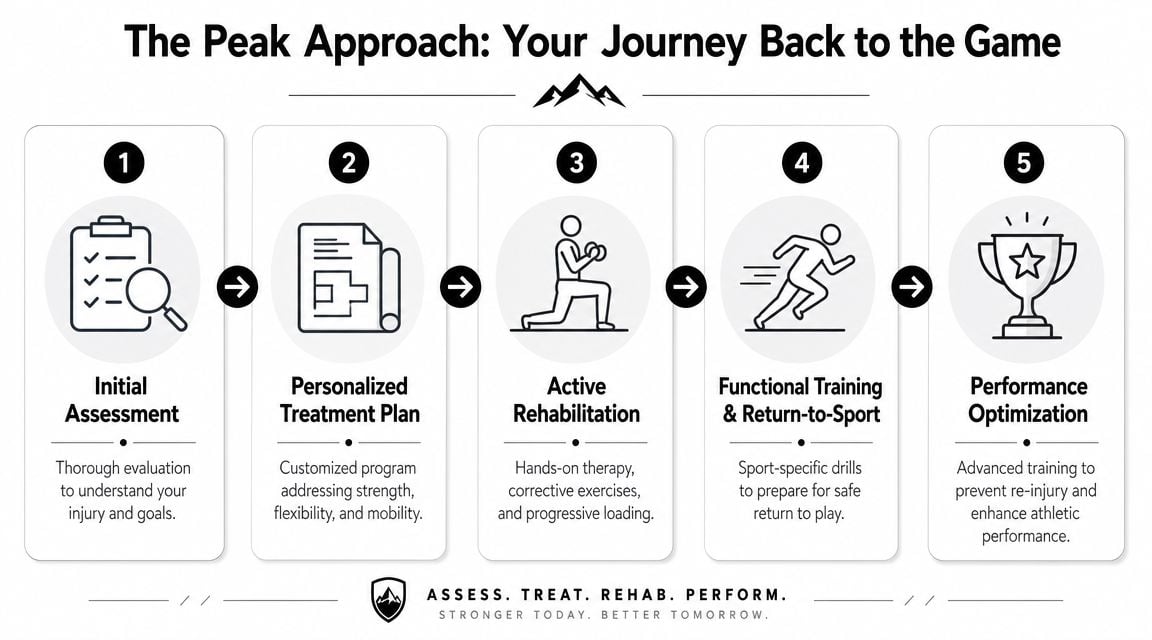
Step one starts with a real athletic assessment
The first visit should go beyond "Where does it hurt?" We look at how the injury happened, what your sport asks of you, what you've already tried, and which movements currently break down. For a parent bringing in a teen athlete, this also means hearing what the season looks like and what pressures are in the background.
Early treatment usually focuses on reducing irritation and restoring basic motion. That might include hands-on care, targeted exercise, activity modification, and very specific guidance on what to keep doing versus what to pause.
The middle phase is where many athletes either build momentum or stall
Once symptoms settle, rehab has to become active. This is the phase where strength, balance, coordination, and loading tolerance matter more and more.
A useful recovery plan usually includes:
- Progressive loading: Enough challenge to rebuild tissue capacity without flaring everything up.
- Movement retraining: Better control with squats, lunges, landing, reaching, rotating, or changing direction.
- Sport-specific preparation: Drills that start to look more like the actual demands of practice and competition.
What stalls athletes is staying too cautious for too long or, just as often, doing too much too soon. If a runner jumps from easy rehab work back to full speed repeats, the body usually lets them know. If a basketball player never practices deceleration and lateral control in rehab, the first live game can expose that gap fast.
Return to sport should be earned, not guessed
Near the end of rehab, the goal changes again. You're no longer just trying to feel better. You're trying to prove readiness. That means looking at confidence, control, repeated effort, and how the body handles sport-like tasks.
Recovery is not complete when daily life feels okay. For athletes, recovery is complete when the injured area can handle the actual demands of sport.
This is also where communication matters. Athletes do better when expectations are clear. Parents want to know what signs mean "ready" versus "not yet." Coaches need practical guardrails. The return should feel deliberate, not hopeful.
Peak Physical Therapy and Sports Performance offers this kind of structured sports rehab and return-to-play support across South Shore clinics, which is useful when you want care close to home and training that lines up with athletic goals.
Beyond Recovery Proactive Injury Prevention and Performance
A lot of South Shore athletes first come in after something hurts. A better window is earlier. The middle school pitcher in Braintree whose shoulder feels heavy in June, the Cohasset sailor who keeps fighting hip stiffness after long days on the water, or the Duxbury runner who always seems to lose two weeks every season to a calf strain usually has warning signs before a true setback.
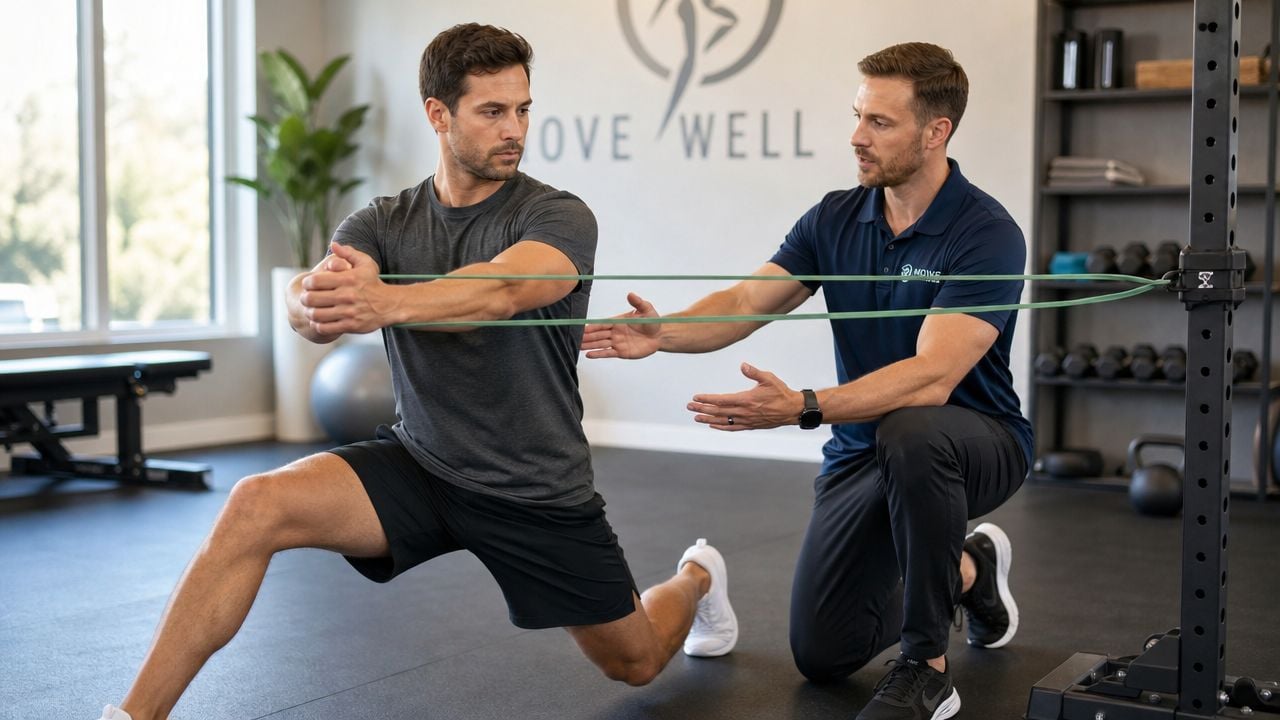
Prevention usually looks simple until it keeps you on the field
In clinic, prevention rarely starts with flashy drills. It starts with finding the problem that keeps showing up under load. Sometimes that is an ankle that never regained full control after a "minor" sprain. Sometimes it is poor trunk control that shows up late in a game, or a shoulder that can produce force but cannot repeat it cleanly through a full week of practice.
That matters because performance gains do not hold up well on top of bad mechanics or poor capacity.
The preventive work that pays off most often includes a few consistent pieces:
- Movement screening: Checking control, symmetry, stiffness, and compensation before pain forces a break from training.
- Preseason build-up: Progressing volume and intensity with a plan instead of cramming work into the two weeks before tryouts.
- Recovery habits: Sleep, fueling, mobility, and weekly training balance all shape how well an athlete handles practice and games.
For high school and college athletes, this is often the difference between feeling good for one workout and staying available for a full season.
Performance work has to match the athlete in front of us
A freshman soccer player coming back from a knee injury does not need the same plan as an adult runner training for a half marathon, even if both want to "get stronger." Tissue healing, irritability, training age, schedule, and sport all change the right starting point. Good sports PT accounts for that instead of forcing everyone through the same progression.
One tool we may use is Blood Flow Restriction Therapy. This approach can stimulate strength and hypertrophy with low-load exercise by partially restricting venous return while maintaining arterial inflow, creating a strong training stimulus without the same mechanical stress as traditional heavy loading. That can help an athlete rebuild strength while protecting a healing joint or tissue.
Used correctly, it supports the bigger plan. It does not replace it.
The bigger plan is still straightforward. Build mobility where it is missing. Build control where it is shaky. Add force production. Then layer in speed, jumping, cutting, throwing, or sport endurance at the right time. Athletes who want a clearer picture of that progression can read Peak's overview of a sports performance training program.
Some athletes are not held back by effort. They are held back by poor timing, poor control, or a body that cannot handle repeated load yet.
Small habits around training can help too. Sleep quality, breathing comfort, and recovery routines are not the whole answer, but they can support harder training blocks. For athletes curious about breathing support at night or during recovery, this article on athletic performance and recovery with nasal strips gives a practical overview.
If you are dealing with recurring pain, a drop in performance, or a body part that never feels fully trustworthy, get it checked before it turns into missed games or a lost season. Peak clinics across the South Shore help athletes clean up those weak links early, then build back toward stronger, more reliable performance.
Find Your Peak Clinic Locations and Specialties on the South Shore
A good rehab plan has to fit real life on the South Shore. A Hingham hockey player may need before-school visits. A Braintree football parent may need a clinic close to work. A runner training along the Duxbury coast usually does better when the clinic is easy to reach and the plan matches the mileage they are trying to hold.
That is why location matters. So does finding a clinic that sees your sport clearly.
If you want to compare towns and start with what is closest to home, school, or practice, the Peak physical therapy center directory is the simplest place to begin.
Peak Physical Therapy South Shore Locations and Specialties
| Clinic Location | Address/Area | Key Programs & Focus Areas |
|---|---|---|
| Braintree | Braintree area | Sports injury rehab, return-to-play support, orthopedic recovery |
| Quincy | Quincy area | Sports rehab, shoulder and knee care, concussion-related PT needs |
| Weymouth | Weymouth area | Orthopedic rehab, neck and back care, active adult recovery |
| Cohasset | Cohasset area | Sports and orthopedic PT, coastal community activity support |
| Duxbury | Duxbury area | Running-related rehab, orthopedic care, active lifestyle PT |
| East Bridgewater | East Bridgewater area | General orthopedic PT, post-injury progression, strength rebuilding |
| Hanover | Hanover area | Youth and adult sports rehab, mobility and performance support |
| Kingston | Kingston area | Orthopedic recovery, lower-extremity rehab, return to activity |
| Milton | Milton area | Shoulder, neck, and sports-related overuse care |
| Norwell | Norwell area | Knee, hip, and sports movement rehab |
| Pembroke | Pembroke area | Youth athlete PT, field sport injuries, return-to-play progressions |
| Plymouth | Plymouth area | Sports rehab, running and active adult care, post-surgical support |
| Scituate | Scituate area | Sports and balance-focused rehab for active coastal lifestyles |
How to choose the right location
Start with the clinic you can get to consistently. That sounds simple, but it matters more than athletes expect. Missed visits slow down progress, especially for a teen in season or an adult trying to rehab around work and family schedules.
Then look at fit. A soccer player with repeated ankle sprains, a Norwell baseball pitcher with shoulder pain, and a Plymouth runner building for a fall race all need different exercise progressions and different testing before they trust the body again. Convenience gets you in the door. The right clinical focus keeps you moving.
A few practical filters help:
- Choose for attendance: The best plan only works if you can show up.
- Choose for your sport: Field sports, overhead sports, running, and post-op rehab each bring different demands.
- Choose for the next phase too: Early pain relief is only part of the job. You also need strength, loading, and return-to-sport progression that makes sense for your schedule.
For runners, fueling can become part of the conversation too. If training load is rising and recovery feels off, this guide on calorie tracking for runners offers a useful look at how athletes can organize nutrition around training.
The right clinic should feel local, practical, and specific to your sport. If you are trying to get back to football in Braintree, lacrosse in Hingham, soccer in Pembroke, or sailing in Cohasset, Peak gives you a nearby place to start and a clear path back to full participation.
FAQs for South Shore Athletes
Do I need a doctor's referral to start physical therapy
Many athletes and parents ask this first because they don't want to waste time. The fastest path is usually to call and ask based on your insurance plan and situation. The front desk can help you sort out what is needed before the first visit so you can focus on getting started instead of guessing.
If you're unsure, don't wait for pain to become a bigger problem. Reach out and confirm the steps.
What happens at the first appointment
Expect a conversation, a movement assessment, and a starting plan that makes sense for your sport and your current symptoms. Wear comfortable clothing you can move in. If the problem involves the knee, shoulder, hip, ankle, or back, clothing that allows easy access to that area helps.
Bring any imaging reports, surgical paperwork, or physician notes you already have. If you don't have those, that shouldn't stop you from asking questions and booking.
How long does sports rehab usually take
That depends on the injury, the sport, and how the body responds to loading. Mild issues may improve quickly with the right plan. More involved injuries, especially post-surgical cases or injuries that affect cutting, jumping, or repeated overhead effort, usually take longer and need a more layered progression.
What matters most is not chasing an arbitrary date. It is making steady progress in the right order.
Athletes get into trouble when they use pain alone as the benchmark. A quiet joint or muscle still has to prove it can handle force, speed, and repetition.
Can I keep training while I'm in PT
Often, yes. But it usually needs modification. The answer is rarely all or nothing. Some athletes can keep lifting with adjustments. Some can run at reduced volume. Some need a short pullback from specific movements while they rebuild capacity elsewhere.
That is one of the most practical benefits of sports PT. Instead of hearing "just rest," you get clearer guidance on what to keep, what to change, and what to avoid for now.
Does Peak work with my insurance
Insurance questions are common, and they're worth asking early. Coverage depends on your plan. The simplest move is to contact the clinic directly so the team can help verify benefits and explain the next steps before your first session.
What if my child is nervous about starting
That is normal. Teen athletes often worry they'll be told they can't play, and younger athletes may not know what to expect. A good first visit should lower stress, not raise it. The process should feel understandable, age-appropriate, and tied to the athlete's real goals.
If you're a parent, booking early usually makes the whole situation easier. Small problems are often simpler to manage than entrenched ones.
If you're looking for Peak Physical Therapy and Sports Performance on the South Shore, the next step is simple. Book an appointment at the clinic that fits your town, your schedule, and your sport. Whether you're trying to get a student athlete back on the field, return to running without setbacks, or finally deal with the shoulder, knee, ankle, or concussion symptoms you've been pushing through, a local Peak clinic can help you start with a clear plan.