


As we age, maintaining good balance becomes crucial for safety, confidence, and independence. A simple stumble, once a minor inconvenience, can become a serious fall, potentially leading to injury, a loss of mobility, and a fear of participating in the activities you love. This is a common concern for many older adults across Massachusetts, whether navigating icy sidewalks in the winter or enjoying a walk along a local park trail.
This guide is designed to be a medically-grounded plan, not just another list. We will explore the best balance exercises for seniors, curated by the expert physical therapists at Peak Therapy. You’ll learn not just what to do, but how to perform each movement safely and effectively. Our licensed physical therapists will provide step-by-step instructions, common mistakes to avoid, and simple ways to make the exercises easier or more challenging as your stability improves.
We understand how frustrating and isolating it can feel to be unsteady on your feet. Our goal is to empower you with a personalized plan to regain control, significantly reduce your fall risk, and stay active and engaged in your community. Beyond physical training, assessing your living environment with a thoughtful home safety checklist can further reduce the risk of falls and help seniors maintain their independence.
This article will detail specific exercises like the Single-Leg Stance, Tandem Walking, and Sit-to-Stands, providing a clear path to better balance. Let’s take the first step toward a more stable and confident future together.
1. Single-Leg Stance (Unilateral Standing)
The single-leg stance, also known as unilateral standing, is a foundational exercise and a cornerstone of any effective senior balance program. Its power lies in its simplicity. By standing on one leg, you directly challenge your body’s ability to maintain its center of gravity over a small base of support. This simple action forces the intricate network of nerves, muscles, and sensory systems responsible for balance to work harder and adapt.
This exercise is one of the best balance exercises for seniors because it strengthens the small, stabilizing muscles in your standing leg, ankle, and hip. It also requires constant, subtle adjustments, which improves your proprioception, or your body’s awareness of its position in space. A strong core is crucial for maintaining stability during this exercise; for more ideas on building core strength, explore these core strengthening exercises for your back.
At Peak Physical Therapy clinics across Massachusetts, our licensed physical therapists frequently use the single-leg stance as both a diagnostic tool to assess baseline stability and a core component of personalized fall prevention plans. It’s an exercise that can be done almost anywhere, making it a practical addition to your daily routine.
How to Perform the Single-Leg Stance
- Setup: Stand behind a sturdy chair or next to a kitchen counter, placing your fingertips on it for light support. Ensure you are on a flat, non-slip surface.
- Execution: Shift your weight onto one leg. Slowly lift the other foot a few inches off the floor. Keep your standing knee slightly bent, not locked.
- Focus: Maintain a tall posture with your shoulders back and your core muscles gently engaged. Keep your gaze fixed on a spot in front of you to help maintain balance.
- Hold: Aim to hold the position for 10 seconds, gradually working your way up to 30 seconds as you feel more stable.
- Repeat: Lower your foot back to the ground. Perform 2-3 repetitions on one leg before switching to the other.
Progressions and Safety
To safely advance this exercise, first try reducing your reliance on hand support, from fingertips to just one finger, and eventually to no hands at all. Once you can comfortably hold the stance for 30 seconds without support, a physical therapist can introduce more dynamic challenges. This might include closing your eyes for a few seconds or practicing on a slightly unstable surface, like a thick rug or a foam pad, to further test your stability.
2. Tandem Stance (Semi-Tandem Stand)
The tandem stance is an excellent intermediate balance exercise that directly prepares your body for the dynamic challenges of walking and navigating uneven ground. By placing one foot directly in front of the other, you create a very narrow base of support, forcing your body to make constant, fine-tuned adjustments to stay upright. This heel-to-toe position mimics the moments during a normal gait cycle when your stability is most tested.
This movement is one of the best balance exercises for seniors because it significantly improves proprioception, your body’s internal sense of its position. It strengthens the muscles in your feet, ankles, and hips that are critical for maintaining lateral (side-to-side) stability. At Peak Physical Therapy, our licensed therapists often introduce the tandem stance as a progression after a patient masters basic static balance, using it to build confidence and readiness for more complex movements as part of our comprehensive fall prevention programs.
Because it bridges the gap between standing with feet apart and balancing on a single leg, the tandem stance is a key part of balance rehabilitation. It’s a safe, controlled way to challenge the systems responsible for stability without introducing the high risk of single-leg movements, making it ideal for seniors looking to steadily improve their balance at home.
How to Perform the Tandem Stance
- Setup: Stand next to a sturdy kitchen counter or behind a firm chair, placing your fingertips on the surface for initial support. Make sure you’re on a flat, non-slip floor.
- Execution: Step one foot so its heel is touching or is very close to the toes of the other foot, as if you were standing on a tightrope. It’s okay if your feet aren’t perfectly aligned at first; just get them as close as is comfortable.
- Focus: Keep your posture tall, with your shoulders relaxed and your core muscles gently tightened to support your spine. Fix your gaze on a stationary spot directly in front of you to help stabilize your body.
- Hold: Aim to hold this position for 10 seconds. As you get more comfortable and stable, gradually work your way up to a 30-second hold.
- Repeat: Step back to a normal stance, then switch so the opposite foot is in front. Perform 2-3 repetitions on each side.
Progressions and Safety
To safely advance this exercise, begin by reducing your hand support from fingertips to a single finger, and then to hovering your hand just above the support surface. Once you can hold the stance for 30 seconds without any hand contact, you can add dynamic challenges. Your physical therapist may guide you to try closing your eyes for a few seconds or performing slow head turns from side to side. For an advanced progression, they may have you practice the stance on a slightly less stable surface, like a thick carpet or a balance pad.
3. Sit-to-Stand (Chair Squats)
The sit-to-stand, often called a chair squat, is one of the most powerful functional movements a senior can practice. It directly translates to real-world independence, strengthening the exact muscles and balance reactions needed to get up from a couch, a dining chair, or a toilet seat. We understand how frustrating it is to feel “stuck” in a chair, and this movement is key to preserving personal freedom.
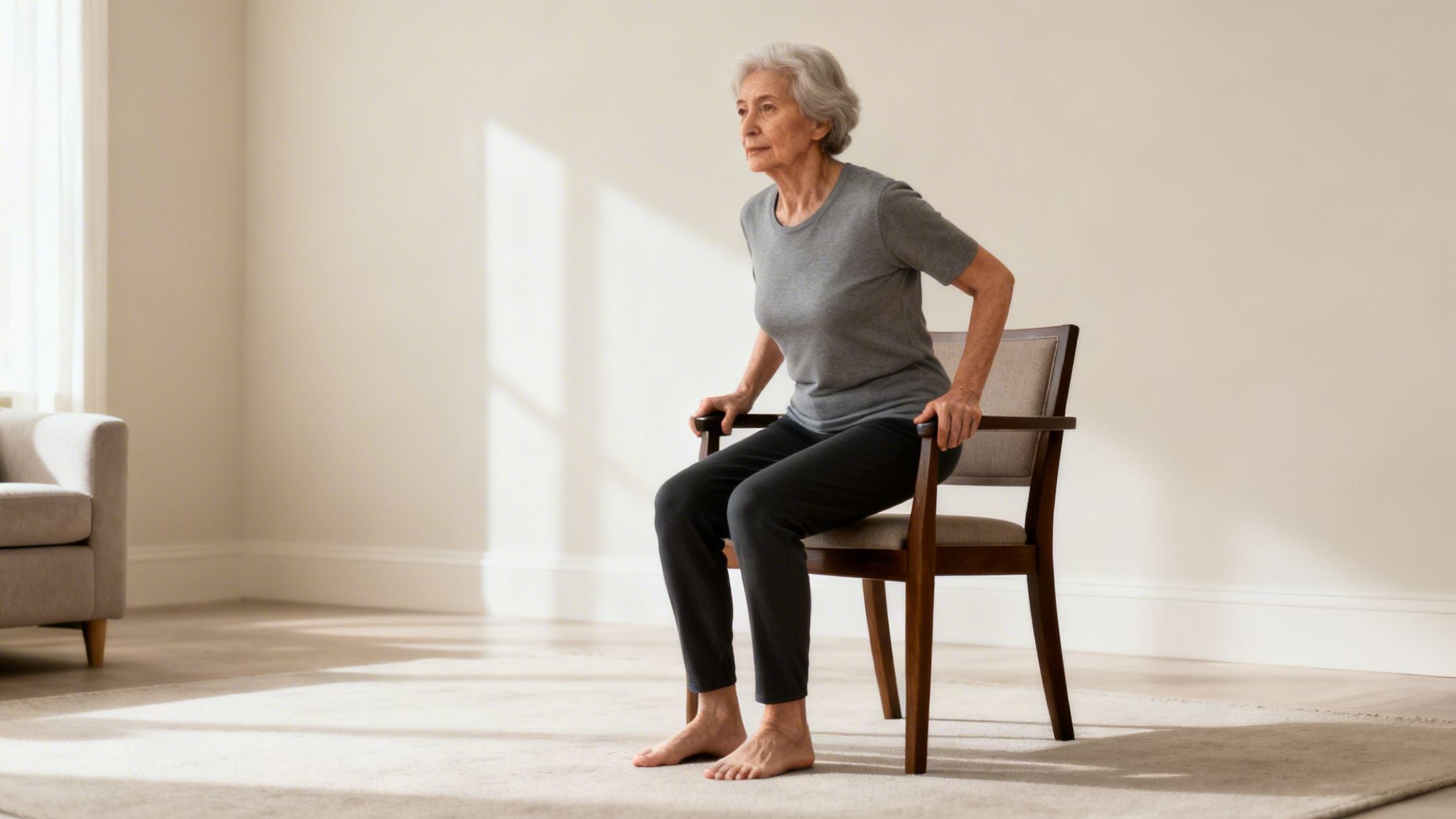
This movement is recognized as one of the best balance exercises for seniors because it combines leg strength, core stability, and dynamic balance control in a single, fluid motion. The ability to control the descent back into the chair is just as important as the strength to stand up, as it requires coordination and eccentric muscle control. A weak sit-to-stand pattern is often a key indicator of increased fall risk and functional decline.
At Peak Physical Therapy, we see firsthand how challenges with this simple action can impact a person’s life. We frequently incorporate the sit-to-stand movement as part of our rehabilitation programs for Massachusetts residents recovering from leg injuries or surgery. It’s a vital part of rebuilding the strength and confidence needed to return to normal activities safely.
How to Perform the Sit-to-Stand
- Setup: Choose a sturdy, non-wheeled chair, preferably with armrests. Sit on the front half of the seat with your feet flat on the floor, about shoulder-width apart.
- Execution: Keeping your chest up, lean forward slightly at your hips. Push through your heels to stand up straight. To sit back down, reverse the motion slowly and with control, aiming your hips back toward the chair.
- Focus: Use the power of your legs, not your arms, to lift your body. Your upper body should move forward as a counterbalance to initiate the movement.
- Hold: The movement should be continuous but controlled. Aim for a 2-3 second count on the way up and a 2-3 second count on the way down.
- Repeat: Perform 8-12 repetitions. Rest and then complete 2-3 sets in total.
Progressions and Safety
Start by using a chair with armrests, lightly pushing off with your hands for assistance if needed. As you build strength, reduce your reliance on your arms until you can perform the movement hands-free. To progress further, you can cross your arms over your chest to eliminate their use completely. For an advanced challenge, your physical therapist can guide you in using a slightly lower chair, which increases the range of motion and the demand on your leg muscles.
4. Standing Marching in Place
Standing marching is a dynamic balance exercise that introduces movement into a stability challenge, closely mimicking the coordination required for walking. By lifting your knees alternately in a controlled marching motion, you engage a complex system of muscles and nerves to maintain your balance while shifting your weight from one leg to the other. This movement is a key step up from static holds, preparing your body for real-world scenarios.
This exercise is one of the best balance exercises for seniors because it improves balance, coordination, and hip flexor strength simultaneously. The rhythmic, alternating leg movement directly supports gait mechanics, helping to improve the quality and safety of your walking pattern. It is a functional exercise that bridges the gap between stationary balance training and confident movement, making it a valuable part of any fall prevention strategy.
At Peak Physical Therapy, our therapists often use standing marching to help seniors regain confidence in their movement. We see firsthand how this simple, low-impact activity can improve neuromuscular coordination and build the foundational strength necessary for a more active life. From group classes to one-on-one sessions, it is a safe and effective way to challenge stability.
How to Perform Standing Marching in Place
- Setup: Stand tall behind a sturdy chair, countertop, or next to a wall, placing your hands on it for support if needed. Plant your feet hip-width apart on a firm, non-slip surface.
- Execution: Shift your weight onto one leg and slowly lift the opposite knee toward your chest, as if you are marching in slow motion. Aim to lift your knee to a comfortable height without losing your posture.
- Focus: Lower your foot back to the floor with control and immediately begin lifting the other knee. Keep your core muscles gently tightened and your back straight throughout the movement.
- Hold: Continue this alternating marching motion for 30 to 60 seconds. The goal is smooth, continuous movement, not speed.
- Repeat: Rest for 30 seconds after completing one set. Perform a total of 2-3 sets.
Progressions and Safety
Always begin with slow, deliberate movements while using a chair or wall for support. As your balance improves, you can gradually reduce your hand support until you can march confidently without holding on. To increase the challenge, try increasing your speed slightly or lifting your knees higher. For a more advanced variation, a physical therapist may have you incorporate coordinated arm swings (opposite arm to opposite leg) or try marching while performing a simple cognitive task, such as counting backward from 20.
5. Tandem Walking (Heel-to-Toe Walking)
Tandem walking, commonly known as heel-to-toe walking, is a dynamic exercise that improves balance while you are in motion. By walking in a straight line and placing the heel of your front foot directly against the toes of your back foot, you simulate walking on a tightrope. This movement narrows your base of support, forcing your body to make constant adjustments to maintain stability, which directly translates to safer, more confident walking in everyday life.
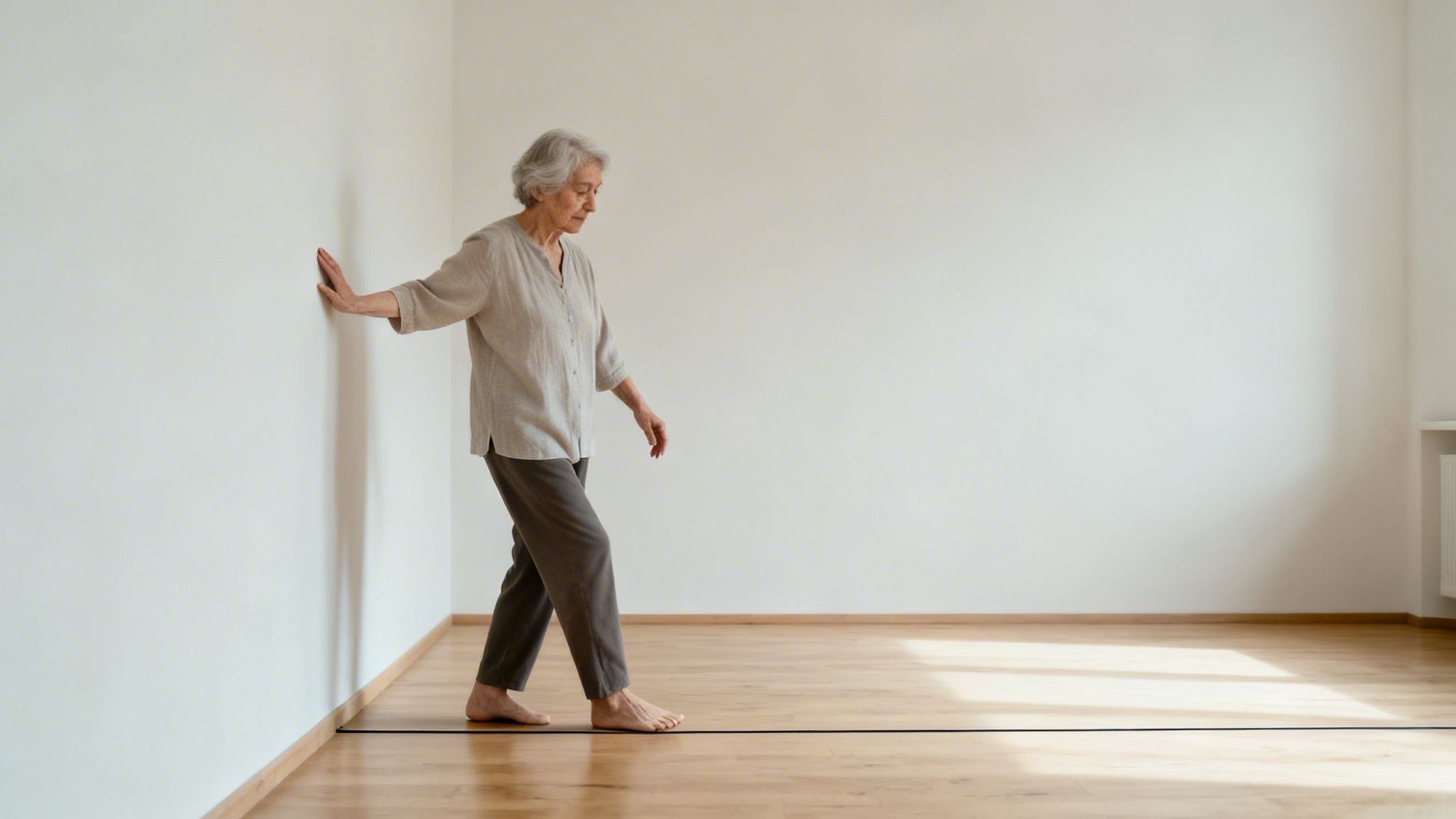
This exercise is one of the best balance exercises for seniors because it sharpens coordination and proprioception—your body’s sense of where it is in space. It strengthens the muscles in your legs and core that are essential for a steady gait. Conditions like vertigo or inner-ear issues can significantly impact this sense, and targeted exercises are key; you can find essential information for vertigo sufferers to better understand these challenges.
At Peak Physical Therapy, our therapists use tandem walking as a standard part of gait training and our fall prevention programs. It is a functional test that helps us assess dynamic balance and create personalized plans to help Massachusetts seniors move safely and effectively. It’s an easy exercise to practice in a hallway at home, making it a practical tool for improving mobility.
How to Perform Tandem Walking
- Setup: Find a clear, straight path, like a hallway. Stand near a wall or a long countertop so you can place your hands on it for light support if needed.
- Execution: Step forward with one foot, placing its heel directly in front of the toes of the other foot. Your feet should form a straight line.
- Focus: Look forward at a fixed spot on the wall, not down at your feet. Keep your posture upright and your core muscles gently engaged to prevent swaying.
- Hold: Walk slowly and deliberately for 10-20 steps. Each step should be a careful, controlled heel-to-toe placement.
- Repeat: Rest after your set of steps, then turn around and repeat the process 2-3 times.
Progressions and Safety
Start by using a wall for full support. As you feel more confident, reduce your support to just your fingertips, then one finger, until you can perform the walk without any assistance. For a greater challenge under professional guidance, your physical therapist might have you try walking without arm support or with your arms crossed over your chest. More advanced progressions include performing the walk with your eyes closed for a few steps at a time or practicing on different surfaces, such as carpet.
6. Heel Raises and Toe Raises (Calf and Shin Raises)
Strengthening the lower legs is fundamental to improving stability, and the combination of heel raises and toe raises is one of the most direct ways to achieve this. These complementary movements target the muscles in your calves (gastrocnemius and soleus) and shins (anterior tibialis). Strong ankle and foot muscles are your first line of defense against a stumble, allowing you to make rapid, small adjustments to maintain your center of gravity and prevent a fall.
This pair of movements is one of the best balance exercises for seniors because it directly impacts walking mechanics and reactive balance. Every step you take requires a push-off from your toes (using calf muscles) and lifting your foot to clear the ground (using shin muscles). Weakness in these areas can lead to a shuffling gait and an increased risk of tripping. For more details on strengthening your lower legs, you can explore specific Calf Raises and their benefits.
In our Peak Physical Therapy fall prevention programs, our therapists frequently prescribe these exercises. We’ve seen firsthand how building targeted strength in the ankles and lower legs gives our patients in Massachusetts more confidence and control, whether they are walking on uneven ground or simply standing up from a chair. Strong lower legs also support joint health, which can be particularly beneficial if you’re managing joint discomfort; physical therapy can offer strategies for easing arthritis pain and improving mobility.
How to Perform Heel and Toe Raises
- Setup: Stand tall facing a sturdy kitchen counter, a wall, or the back of a solid chair. Place your hands on the support surface for balance. Your feet should be about hip-width apart and flat on the floor.
- Execution (Heel Raise): Slowly press through the balls of your feet to raise your heels as high as you comfortably can. Feel the engagement in your calf muscles.
- Hold (Heel Raise): Hold the top position for 1-2 seconds before slowly and deliberately lowering your heels back to the floor.
- Execution (Toe Raise): Keeping your heels on the ground, rock your weight back slightly and lift the toes and front part of your feet toward the ceiling. You should feel the muscles on the front of your shins working.
- Repeat: Perform 10-15 repetitions of heel raises, followed by 10-15 repetitions of toe raises. This completes one set. Aim for 2-3 sets of each movement.
Progressions and Safety
Your initial focus should be on slow, controlled movements. To make the exercise more challenging, begin by reducing your hand support, moving from a full grasp to just your fingertips. As your strength and stability improve, try performing the raises without any hand support at all. For an advanced variation, your physical therapist can guide you in performing heel raises on a single leg, which significantly increases the balance demand. Always ensure your support surface is within easy reach.
7. Standing Hip Abduction and Adduction
Standing hip abduction and adduction are exercises that target the muscles on the outside and inside of your hips. By moving your leg away from and across your body in a controlled manner, you strengthen the stabilizing muscles that help prevent side-to-side swaying.
These movements are some of the best balance exercises for seniors because they address a common source of instability: weak hips. Strong hip abductors (on the outside of the hip) and adductors (on the inside) provide a sturdy foundation for your pelvis, which is central to maintaining balance. At Peak Physical Therapy, our licensed therapists regularly prescribe these exercises to our older adult patients in Massachusetts to improve gait, build functional strength, and reduce the risk of debilitating falls. They are a core component of many post-hip surgery and fall prevention programs.
The slow, deliberate nature of side leg lifts also enhances your body’s awareness of its position, improving the connection between your brain and muscles. It’s an accessible exercise that requires no special equipment and can be easily incorporated into your daily activities at home.
How to Perform Standing Hip Abduction and Adduction
- Setup: Stand facing a sturdy chair, countertop, or wall, placing your hands on it for support. Position your feet hip-width apart on a flat, non-slip surface.
- Execution (Abduction): Shift your weight onto one leg, keeping a slight bend in that knee. Without leaning your torso, slowly lift your other leg straight out to the side about 12 to 18 inches. Keep your toes pointing forward, not up toward the ceiling.
- Execution (Adduction): From the starting position, slowly lift one leg and cross it in front of your standing leg in a controlled motion. Focus on using your inner thigh muscles.
- Focus: Maintain an upright posture with your core muscles gently engaged to keep your torso stable. The movement should come from your hip, not from tilting your body.
- Repeat: Perform 10-15 repetitions of abduction on one leg, then switch to the other. Follow the same pattern for adduction. Aim for 2-3 sets per leg.
Progressions and Safety
Your initial focus should be on proper form and controlled movement. As you get stronger, you can progress by reducing your hand support, moving from two hands to your fingertips, and eventually performing the exercise without holding on. Once this can be done safely, your physical therapist might add a light resistance band around your ankles for an extra challenge. For an advanced balance test, they may have you try the movements with your eyes closed for a few seconds, but only if you feel very stable and have support nearby.
8. Reaching and Weight Shifting Exercises
Daily life is not static; it involves constant movement, reaching, and shifting. Reaching and weight shifting exercises prepare your body for these real-world scenarios. By performing controlled reaching movements in different directions, you challenge your ability to maintain balance while your center of gravity moves. This dynamic stability is essential for functional activities like retrieving an item from a high shelf, turning to look behind you, or even reacting during a potential fall.

This exercise is one of the best balance exercises for seniors because it directly mimics the movements that can often lead to unsteadiness. It trains your body to anticipate and manage shifts in weight, strengthening the connection between your brain and muscles. It improves your ability to control your body’s momentum, which is a key skill in preventing falls.
In our Peak Physical Therapy fall prevention programs, we frequently include reaching exercises because they address the practical demands of daily living. We find them particularly effective in post-stroke rehabilitation for regaining functional movement and in general balance training to build confidence. Mastering these movements can make a significant difference in feeling secure and independent at home.
How to Perform Reaching and Weight Shifting
- Setup: Stand facing a sturdy chair, countertop, or wall, with your hands ready for support if needed. Stand with your feet about shoulder-width apart on a non-slip surface.
- Execution: Slowly reach one arm forward as if trying to touch something just beyond your grasp. Allow your weight to shift forward onto your toes, but keep your heels on the ground.
- Focus: Keep your hips relatively stationary and your core engaged. Move slowly and deliberately, focusing on controlling the motion from start to finish. Reach only as far as you can while maintaining perfect balance.
- Hold: Hold the extended reach for 1-2 seconds before slowly returning to the starting position.
- Repeat: Perform 8-10 reaches forward. Then, repeat the same number of reaches to each side and then diagonally. Complete 2-3 sets for each direction.
Progressions and Safety
Start with forward reaches, as they are the most stable. Once comfortable, progress to side reaches and then diagonal reaches. To advance the exercise, try reaching progressively further or reducing your hand support. For an added challenge, your physical therapist may have you perform the reaches while standing on one leg or on a slightly unstable surface like a thick mat. You can also make it more functional by reaching for light objects, like a can of soup or a water bottle.
Top 8 Senior Balance Exercises Comparison
| Exercise | Implementation complexity | Resource requirements | Expected outcomes | Ideal use cases | Key advantages |
|---|---|---|---|---|---|
| Single-Leg Stance (Unilateral Standing) | Low to moderate — static balance, easy to progress | Minimal — stable surface, optional wall/counter or foam pad for progression | Improved static balance, ankle and core stabilizer strength, reduced fall risk | Baseline balance assessment, home fall-prevention routine, early rehab | Scalable difficulty, no equipment, directly trains proprioception |
| Tandem Walking (Heel-to-Toe Walking) | Moderate — dynamic gait task requiring coordination | Small clear walkway (10–15 ft), optional hand support | Improved dynamic balance, gait coordination, proprioception | Gait training, recovery from gait disorders, fall-prevention programs | Mimics real walking mechanics, reveals gait asymmetries, adds cardio |
| Sit-to-Stand (Chair Squats) | Low to moderate — functional strength and balance | Stable chair (appropriate height), optional arm support | Increased lower-body strength, functional independence, measurable progress | Functional capacity testing, post-surgical rehab, daily mobility training | Highly functional, easily quantified, suitable with many modifications |
| Standing Marching in Place | Low — rhythmic dynamic balance and coordination | Minimal — small space, optional chair or wall for support | Improved coordination, hip flexor strength, standing endurance | Warm-ups, transitional exercises, limited-space programs | Simple to learn, safe for many, combines aerobic and balance benefits |
| Tandem Stance (Semi-Tandem Stand) | Low to moderate — intermediate static balance challenge | Minimal — stable surface, optional hand support | Narrow-base stability, better proprioception, stepping response prep | Progression within balance training, intermediate impairment | Effective progression step, adjustable and diagnostic |
| Heel Raises and Toe Raises (Calf and Shin Raises) | Low — isolated ankle strengthening with balance demand | Minimal — sturdy support surface, optional step or resistance | Stronger plantarflexors/dorsiflexors, improved ankle stability and gait | Ankle rehab, fall-prevention, gait and stair function improvement | Targets ankle muscles directly, low cost, measurable gains |
| Standing Hip Abduction and Adduction | Moderate — single-leg balance plus lateral strength | Minimal — chair or wall for support, optional resistance band | Improved lateral stability, hip strength, better single-leg balance | Lateral stability training, post-hip rehab, gait instability | Directly addresses hip weakness, improves lateral control |
| Reaching and Weight Shifting Exercises | Moderate to high — dynamic center-of-gravity control | Minimal — chair/wall for safety, light objects optional | Enhanced dynamic balance, weight transfer control, functional reach ability | Functional balance training, post-stroke rehab, fall-prevention | Highly functional multi-directional challenge, adaptable difficulty |
When to See a Physical Therapist for Your Balance Concerns
This article has equipped you with a foundational toolkit of the best balance exercises for seniors, from the simple single-leg stance to the more dynamic heel-to-toe walk. Each exercise, including chair squats, standing marches, and side leg lifts, is a powerful step toward improving your stability, strengthening key muscle groups, and building confidence in your daily movements. By practicing these consistently, you are actively investing in your independence and reducing your risk of a life-altering fall.
The ultimate goal is to move freely and without fear, whether you're navigating the aisles at Market Basket, walking the dog at a local park, or simply getting out of a chair in your living room. The exercises we've detailed are your starting point, but balance is a complex system involving your muscles, vision, and inner ear. While home practice is valuable, sometimes it isn't enough to address the root cause of instability.
Recognizing the Red Flags for Professional Help
Self-guided exercise is an excellent first line of defense. However, certain signs and symptoms indicate that it's time to seek the expert guidance of a licensed physical therapist. It's not about admitting defeat; it's about taking the most effective and safest path toward true, lasting stability.
Consider these critical questions:
- Have you fallen in the past year? A single fall doubles your risk of falling again. This is a significant indicator that your balance systems need a professional assessment.
- Do you feel dizzy or lightheaded often? Persistent dizziness or vertigo could point to an inner ear (vestibular) issue that requires specialized treatment, not just general exercise.
- Do you feel unsteady or "wobbly" on your feet? A constant feeling of unsteadiness, even if you haven't fallen, is a clear sign that your body's balance mechanisms are not functioning optimally.
- Are you afraid of falling? This fear can cause you to limit your activities, leading to muscle weakness and social isolation, which ironically increases your fall risk further.
- Do you find these exercises too difficult, or do they cause pain? Pain is a signal that something is wrong. A physical therapist can modify exercises and address the underlying cause of your discomfort, ensuring you can progress safely.
If you answered "yes" to any of these questions, you are a perfect candidate for a professional balance assessment. A physical therapist doesn't just hand you a sheet of exercises. We perform a comprehensive evaluation to determine the root cause of your balance deficit. Is it leg weakness? Poor ankle strategy? A vestibular problem? Vision-related challenges? Answering these questions is the key to developing a personalized treatment plan that actually works for you.
Key Insight: Don't wait for a fall to happen before seeking help. Proactive physical therapy is one of the most effective strategies for preventing falls and maintaining your independence for years to come. At Peak Physical Therapy and Sports Performance, we see this every day in our Massachusetts clinics.
Your Path to Regaining Confidence
At Peak Physical Therapy, our Balance and Fall Prevention programs are designed to address your specific needs. Serving communities across Massachusetts, from Quincy and Hanover to Scituate and Plymouth, our clinics provide a supportive, expert-driven environment to rebuild your stability. Our licensed therapists use hands-on techniques, advanced balance testing, and personalized exercise progressions that go far beyond a general list. We help you feel secure and confident again, allowing you to return to the activities you love, whether that’s playing with your grandchildren or enjoying a walk along the Massachusetts coastline. Taking control of your balance is one of the most empowering decisions you can make for your health and well-being.
Ready to take the next step toward a more stable and confident life? The expert team at Peak Physical Therapy and Sports Performance specializes in creating personalized balance and fall prevention programs for seniors across Massachusetts. Schedule your comprehensive evaluation at one of our convenient local clinics and let us help you move with confidence and live without fear.