


When you think of the best core strengthening exercises for your back, you probably don’t picture gentle, controlled movements. Most people jump to crunches and sit-ups. But real, lasting relief comes from targeting your deep stabilizing muscles with exercises like the bird-dog, glute bridge, and proper abdominal bracing. Our licensed physical therapists help patients develop a personalized plan using these movements to create a natural support system for the spine.
A Strong Core Is Your Best Defense Against Back Pain
Living with persistent back pain is incredibly frustrating. We understand how it can derail everything—from your commute into Boston to simply getting a good night’s sleep. It can make you feel stuck, keeping you from playing with your kids at a park in Quincy or enjoying a weekend walk along the Scituate coastline. You shouldn’t have to live this way.
The most effective, long-term solution our physical therapists recommend for most types of back pain is building a stronger, more resilient core. This isn’t about chasing a six-pack. It’s about reawakening the deep, internal muscles that wrap around your spine like a natural corset, providing stability with every move you make.
Beyond the Six-Pack: Meet Your Real Core Muscles
When a physical therapist talks about your “core,” we’re referring to a whole system of muscles working together to stabilize your pelvis and spine. These are the muscles that protect you from the daily grind—whether you’re shoveling heavy Massachusetts snow in Norwell or just carrying groceries in Braintree.
To get started, it helps to know the key players. These four muscle groups form your “inner core,” acting as a dynamic canister to support your trunk.
Your Inner Core’s Four Key Muscle Groups
Our therapists help you learn to engage these primary deep core muscles and understand how they function together to protect your back.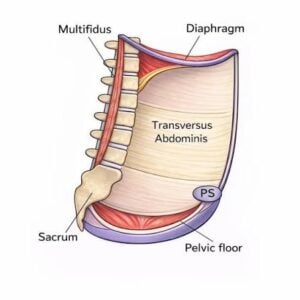
| Muscle Group | What It Does | How It Protects Your Back |
|---|---|---|
| Transverse Abdominis | Your deepest ab muscle, wrapping around your midsection like a corset. | It tenses to create intra-abdominal pressure, stiffening the spine before you even move. |
| Multifidus | Small, deep muscles that run along either side of your spinal column. | They provide segment-by-segment stability, preventing excessive or shearing movements between vertebrae. |
| Pelvic Floor | A muscular “hammock” that forms the base of your core canister. | It co-contracts with your deep abs and diaphragm to control pelvic stability and support your organs. |
| Diaphragm | Your primary breathing muscle, which acts as the “roof” of the core. | It works with the other core muscles to regulate pressure and stabilize the spine during breathing and movement. |
Learning to engage these muscles correctly is the foundation for a pain-free back. To truly fortify your spine, it’s essential to understand and use effective core stability exercises for a stronger, more resilient back.
The Evidence Is Clear: A Stronger Core Works
The idea that core stability is a top-tier solution for back pain isn’t just a clinical opinion—it’s backed by solid, evidence-based research. One landmark meta-analysis revealed that core stability exercises were statistically better than general exercise for reducing both pain levels and functional disability in people with chronic low back pain.
Exercises like planks and bird-dogs create a natural brace for the spine, waking up those deep stabilizers that generic fitness programs often miss.
“The biggest mistake we see is people focusing only on the ‘mirror muscles’ like the rectus abdominis. True spinal health comes from the inside out, by training the deep core muscles to anticipate and support your every move.” – A Peak Therapy Physical Therapist
By focusing on these foundational muscles, our physical therapists help you build a truly resilient spine. This approach gets to the root cause of instability instead of just chasing temporary fixes. If you’re struggling to get a handle on your pain, our detailed guide to back pain and sciatica relief can help. With expert guidance, you can reclaim your life from back pain.
Starting Safely with Foundational Core Exercises
Knowing you need a stronger core is half the battle. Figuring out where to start—especially when you’re already in pain—is the other half. We see it all the time in our Massachusetts clinics: the fear of doing the wrong exercise and making the pain worse can be a huge hurdle.
That’s precisely why our licensed physical therapists always start with gentle, foundational movements. The goal isn’t to build a six-pack; it’s to safely “wake up” the deep core muscles that protect your spine.
Forget about endless crunches and old-school sit-ups. We now know these movements can actually put a ton of unnecessary stress on your spine by repeatedly flexing it. Instead, our focus is on building stability and control from the inside out. This process is simple but incredibly effective.

This flowchart illustrates our philosophy perfectly. Your daily activities, when supported by physical therapy, build a strong, stable core, which in turn acts as a shield for your spine against the demands of life.
The Foundational Four Core Exercises
Below are the “Foundational Four”—the exact exercises our therapists use with patients across Massachusetts to build a solid base of core control and confidence. These four movements are the building blocks for a pain-free back.
Remember, the goal here is quality over quantity. Slow, deliberate movements are key.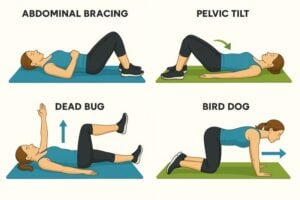
1. Abdominal Bracing
This isn’t so much an “exercise” as it is a fundamental skill. It’s all about learning to activate your transverse abdominis—that deep, natural corset we talked about earlier.
- How to do it: Lie on your back, knees bent, feet flat on the floor. Place your fingertips on the soft part of your belly just inside your hip bones. Now, gently pull your belly button in toward your spine, like you’re tightening a belt by one notch.
- What to feel: You should feel the muscles under your fingers tense up slightly. Ensure your back doesn’t arch and your ribs don’t pop up.
- Starting point: Hold this gentle tension for 5-10 seconds while breathing normally. Perform 10 repetitions.
2. Dead Bug
This one is a game-changer for many of our patients. It teaches your core to keep your spine stable while your arms and legs are moving—a skill you use constantly without even realizing it.
- How to do it: Start on your back with your arms reaching for the ceiling. Lift your legs so your knees are bent and stacked directly over your hips (the “tabletop” position). Engage your core with that abdominal brace.
- The movement: While exhaling, slowly lower your right arm and left leg toward the floor. Only go as far as you can without letting your lower back arch off the floor. Return to the start and repeat on the other side.
- Starting point: Aim for 8-12 repetitions per side.
“The biggest mistake I see with the Dead Bug is moving too fast or letting the lower back lift. If you feel your back start to arch, you’ve gone too far. A physical therapist can help you shorten your range of motion until you can keep your spine completely stable.” – A Peak Therapy Physical Therapist
3. Glute Bridge
So many cases of low back pain are linked to underactive glutes. The glute bridge is a perfect exercise our therapists use to “wake up” these powerful muscles and teach them to work alongside your core.
- How to do it: Lie on your back with your knees bent, feet flat, and arms resting at your sides. Squeeze your glutes and lift your hips toward the ceiling until you form a straight line from your shoulders to your knees.
- What to feel: You should feel this in your glutes and hamstrings, not your low back. Keep your abs braced to avoid over-arching.
- Starting point: Hold for 2-3 seconds at the top. Perform 10-15 repetitions.
If you’re brand new to this, you can also add a gentle challenge to the glute bridge with some simple resistance band exercises for beginners.
4. Bird-Dog
A classic in the physical therapy world for a reason. This exercise is fantastic for improving balance and strengthening the small, important muscles that run along your spine (like the multifidus).
- How to do it: Start on your hands and knees, with hands under your shoulders and knees under your hips. Keep your back flat and brace your core.
- The movement: Extend your right arm straight forward and your left leg straight back at the same time. The key is to keep your hips and shoulders perfectly square to the floor—imagine you’re balancing a glass of water on your low back.
- Starting point: Hold the extended position for a 2-second count, then return to the start. Aim for 8-12 repetitions per side.
These four movements are incredibly powerful, but they are just the start. For anyone looking for extremely low-impact options that are especially kind to an aching back, check out our guide to swimming pool exercises for lower back pain. The water provides natural support and resistance, creating a perfect environment for core work.
How to Safely Progress Your Core Program
After consistently working on the foundational exercises, you may start to feel a real difference. Maybe getting out of the car feels less like a chore, or you can stand for longer without that familiar ache. This is a sign you’ve built a solid base of stability. Now it’s time to build on that success—without risking a setback.
Progressing your core program isn’t about jumping into the most difficult exercises you can find online. At our Peak Therapy clinics, we guide patients through this process by focusing on smart, gradual challenges. This evidence-based approach ensures your muscles adapt and get stronger without overwhelming a healing back.
Listen to Your Body First
The most important rule when moving forward is to abandon the old “no pain, no gain” mentality. That philosophy is not only outdated but dangerous when you’re dealing with back pain. Your body gives you constant feedback; learning to interpret it is your best tool for safe progress.
- “Good” Discomfort: This is the feeling of muscle fatigue—that gentle burn in your abs or glutes that tells you the muscles are working hard and getting stronger.
- “Bad” Pain: This is anything sharp, pinching, or radiating, especially in your lower back. This is a stop sign. It means the exercise is either being done with poor form or is simply too advanced for you right now.
At Peak Therapy, we tell our patients, “Listen for the whisper, so you don’t have to hear the scream.” If you feel even a hint of sharp pain, stop and reassess. Pushing through it is how flare-ups happen, and it’s a sign you should consult a professional.
It’s crucial to know the difference between normal muscle soreness and the warning signs of a bigger issue. While some post-workout achiness is expected, you should familiarize yourself with the red flags for upper back pain and other spinal conditions that require professional attention.
Three Ways a PT Can Help You Progress
Once you can comfortably perform foundational exercises with perfect form, a physical therapist can help you layer in more difficulty. We typically introduce challenges in one of three ways.
-
Increase Duration or Reps: The simplest way to progress is to do more of what you’re already doing. If 10 glute bridges feel easy, your PT might recommend trying for 15. If a 20-second plank hold is no longer a challenge, they’ll guide you up to 30 or 45 seconds. This builds muscular endurance.
-
Introduce Light Resistance: Adding resistance forces your core to work harder to maintain stability. A simple resistance band is a fantastic and safe tool for this. For example, your therapist may suggest wrapping a band around your thighs during a glute bridge to fire up your hip muscles even more.
-
Move to More Dynamic Variations: This involves advancing to exercises that challenge your stability in new ways. Instead of just holding a static position, you’ll start to introduce controlled movement under the guidance of a professional.
Your Next-Level Core Exercises
Ready to take that next step? These exercises are the logical progression from the Foundational Four. They build on the stability you’ve already developed and prepare your core for more complex, real-world movements.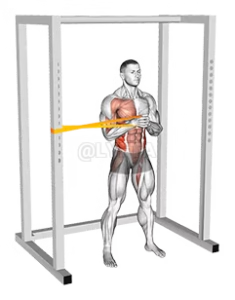
1. Forearm Plank
The plank is a cornerstone of core training for a very good reason. It teaches your entire core musculature to work together to hold your spine in a safe, neutral position. It’s a far better choice than sit-ups, which research shows can put unwanted pressure on your spinal discs.
- How to do it: Lie on your stomach and prop yourself up on your forearms, keeping your elbows directly under your shoulders. Lift your hips so your body forms a straight line from your head to your heels.
- What to feel: Your whole core should be braced. Don’t let your hips sag toward the floor or pike up toward the ceiling.
- Progression: Start by holding for 20-30 seconds. As you get stronger, work on increasing the hold time.
2. Pallof Press
This is an incredible anti-rotation exercise. It trains your core to resist twisting forces—a critical skill for protecting your back when you lift or move something unexpectedly.
- How to do it: Stand sideways to a resistance band anchored at chest height. Grab the handle with both hands at the center of your chest. Step away from the anchor point just enough to create tension.
- The movement: Brace your core and press your hands straight out in front of you, fighting the band’s pull to twist you. Slowly bring your hands back to your chest.
- Progression: Aim for 8-12 repetitions per side. The key here is slow, controlled movement, not speed.
The move away from flexion-based exercises like sit-ups toward stabilization movements like planks is backed by solid evidence. A 2012 U.S. Army study found that soldiers who replaced sit-ups with core stabilization exercises saw their fitness test pass rates improve significantly more than the group that kept doing sit-ups. This shows how these movements build true, functional spinal stability without the harmful shearing forces of crunches.
By adding these progressions under the care of a therapist, you’re not just “doing exercises.” You’re building a core that can support you through a long day at work, a weekend of gardening, or a run along the coast in Scituate—all without a second thought about your back.
Unlocking Performance with Advanced Core Training
Once you’ve mastered the foundational movements and built a solid base of core stability, you’re ready to move beyond just managing pain. It’s time to start unlocking your body’s true performance potential. This next phase is for the active individual—the weekend warrior who wants to hit a golf ball farther at Pinehills in Plymouth, the runner training for a race along the Charles River, or anyone who wants a truly resilient, “bulletproof” core.
Advanced core training is about challenging your body in dynamic, functional ways. It’s not just about holding a position anymore. It’s about controlling your trunk while generating power and resisting forces from the outside world. This is how you build the kind of strength that prevents future injuries and elevates your athletic game.
Integrating Pilates and Resistance for Optimal Results
For those ready to push their core strength to the next level, our therapists often integrate two methods that stand out for their proven effectiveness: Pilates-based movements and core resistance training. While they both build a stronger midsection, they offer slightly different benefits, which lets you fine-tune your training to match your specific goals.
Here’s how they differ:
-
Pilates-Based Exercises: Known for an intense focus on control, precision, and breathing, Pilates movements are exceptional for building deep core endurance and improving motor control. They train your muscles to fire in coordinated patterns, which is fantastic for activities that require finesse and stability, like running or swimming.
-
Core Resistance Training: This involves using tools like resistance bands or weights to actively challenge your core’s ability to resist movement—like twisting or bending. This is crucial for building the raw strength needed to protect your spine during powerful, explosive actions, such as lifting heavy objects or swinging a tennis racket.
Recent research actually highlights how these methods shine in different areas. A 2026 systematic review found that while Pilates was superior for achieving pain relief, core resistance training proved most effective for improving functional status—your ability to perform daily tasks and activities. You can read the full research about these core training findings to see how each method contributes to a well-rounded program. It really shows that the best approach often involves a blend of both.
“A truly functional core isn’t just strong—it’s smart. It knows how to stabilize during a slow, controlled yoga pose and how to instantly brace for a sudden, powerful movement. Combining different training styles under a therapist’s guidance is how you build that intelligent strength.” – A Peak Therapy Physical Therapist
Matching Advanced Core Training to Your Goals
So, how do you decide what to focus on? A physical therapist can help you choose the advanced core training style that best aligns with your personal fitness and recovery objectives, based on scientific evidence.
| If Your Goal Is | The Best Training Style Is | An Example Exercise Is |
|---|---|---|
| Maximum Pain Relief & Postural Control | Pilates | The Pilates “Hundred,” which challenges core endurance and breath control. |
| Improved Daily Function & Raw Strength | Core Resistance Training | A “Wood Chop” using a resistance band to train rotational strength and control. |
| Better Athletic Stability for Running/Cycling | Stability & Balance Training | A single-leg stance on an unstable surface, forcing your core to make constant micro-adjustments. |
By understanding these distinctions, a therapist can customize your routine. For example, a runner getting ready for a trail run in the Blue Hills Reservation might be prescribed Pilates and stability work for endurance and control on uneven terrain. Meanwhile, a firefighter in Hanover might focus more on core resistance training to build the strength needed for lifting and carrying heavy equipment safely.
Ultimately, advanced core work is about building a body that’s ready for anything life throws at it. It’s the final piece of the puzzle that takes you from simply being “pain-free” to feeling powerful and confident. This proactive approach not only enhances your performance today but also serves as your best insurance policy against future back pain.
When You Need an Expert Evaluation for Your Back Pain
A self-guided core strengthening program is a fantastic first step. But sometimes, even the best at-home exercises have their limits. It can be incredibly frustrating to feel like you’re hitting a wall or, worse, to be afraid that you might be making things worse.
If your pain isn’t getting better, or if you’re not sure you’re doing the exercises correctly, that’s a clear sign you need a professional, personalized evaluation. What feels like simple muscle tightness might actually be a symptom of an underlying issue that needs a specific, expert-led approach.
Signs You Should See a Physical Therapist
A licensed physical therapist is a movement detective. We don’t just treat symptoms; our comprehensive evaluation is designed to uncover the true root cause of your pain. This is the difference between temporary relief and lasting recovery.
While some aches are a normal part of building strength, certain symptoms are red flags that warrant an expert evaluation right away. It’s crucial to listen to what your body is telling you.
Don’t wait to get help if you experience any of the following:
- Pain that radiates down your leg, especially if it goes past your knee.
- Numbness, tingling, or weakness in your leg, foot, or buttocks.
- Pain that doesn’t improve after 2-3 weeks of consistent, gentle core work.
- A sudden spike in pain after a specific incident or injury.
- Pain that wakes you up at night or is constant throughout the day.
- Difficulty with bladder or bowel control—this is a medical emergency, and you should seek immediate help.
If you’re feeling uncertain, it’s always better to get it checked out. A physical therapist can provide an accurate diagnosis and peace of mind, ensuring you’re on the safest and most effective path to recovery.
The Value of Personalized, Hands-On Care
What happens when you see a physical therapist at Peak Therapy? We go far beyond just handing you a sheet of exercises. Your first visit involves a comprehensive evaluation where we discuss your pain, your lifestyle—whether you’re commuting daily from Quincy or coaching youth sports in Weymouth—and your personal goals.
Based on this evaluation, we build a personalized treatment plan that is much more than just a list of core strengthening exercises for your back. Your plan will likely include a combination of specialized techniques:
- Manual Therapy: We use hands-on techniques like soft tissue mobilization and joint manipulation to reduce pain, improve your mobility, and restore proper movement patterns.
- Neuromuscular Re-education: These are specific exercises designed to retrain the communication between your brain and your muscles, ensuring your core activates correctly and automatically.
- Customized Exercise Progression: We’ll guide you step-by-step, making sure each new exercise is appropriate for your current stage of healing. We adapt your program as you get stronger, ensuring you are always making progress without setbacks.
We understand how exhausting it is to live with back pain that just won’t go away. You shouldn’t have to give up the activities you love, whether it’s hiking, golfing, or simply keeping up with your kids.
At Peak Physical Therapy, our compassionate team is here to help you move past the pain. With clinics conveniently located across Massachusetts’ South Shore—from Hanover to Quincy to Plymouth and beyond—expert care is never far away. We’ll work with you to create a plan that gets you back to feeling strong, confident, and pain-free. Find a Peak Therapy location near you and take the first step toward lasting relief.
Your Questions on Core Strengthening Answered
Starting a new exercise routine, especially when you’re already in pain, is bound to bring up some questions. It’s completely normal to feel a mix of hope and uncertainty. At our Peak Therapy clinics, we hear these questions every day, and our goal is to give you clear, trustworthy answers.
This section tackles some of the most common concerns we address. We want to clear up any lingering doubts so you can feel confident and safe as you work toward building a stronger, healthier back.
How Often Should I Do Core Exercises?
When you’re starting out, consistency is far more important than intensity. Our physical therapists typically recommend performing your foundational core strengthening exercises for back pain relief 3-4 times per week.
It’s best to do them on non-consecutive days. This schedule gives your muscles crucial time to recover and adapt, which is when they actually get stronger. A session doesn’t need to be long, either—just 10-15 minutes of focused, high-quality work is incredibly effective. Remember, the goal is to build endurance in your stabilizing muscles, not to exhaust them.
What If I Feel Some Pain During an Exercise?
This is a critical question, and the answer is simple: you have to listen to your body. It’s vital to differentiate between the gentle burn of muscle fatigue and a sharp, pinching, or radiating pain.
- Muscle fatigue is that “good burn” and a sign of a productive workout.
- Sharp pain is your body’s non-negotiable stop signal.
If you feel any sharp pain in your back during an exercise, stop immediately. This is a sign that your form needs to be corrected or that the exercise is too advanced for you right now. A physical therapist can provide a professional assessment to ensure you are moving safely. Never push through that kind of pain.
How Long Until I See Results?
This is different for everyone, but with a consistent, PT-guided program, many patients start to feel a noticeable difference within 2 to 4 weeks. These initial changes might be subtle; you might just notice that you can stand for longer without aching, or that getting out of bed feels a little easier.
True, lasting strength that protects you during activities like running or lifting takes longer to build—often 2-3 months or more. The key is to be patient and trust the process. You are rebuilding your body’s foundation from the ground up, and that takes time. Celebrate the small victories along the way, because they are real signs of progress.
The journey to a pain-free back is a marathon, not a sprint. If you find your progress has stalled or you’re not sure if you’re on the right track, our expert team at Peak Physical Therapy and Sports Performance is here to provide the personalized evaluation and guidance you need. With convenient locations across Massachusetts’ South Shore, we make it easy to get the expert care you deserve. Don’t let uncertainty hold you back—schedule your evaluation today.