


Knee surgery is a huge first step toward getting your life back, but the work doesn’t stop in the operating room. The real journey begins with your physical therapy. We understand the mix of hope and anxiety you might be feeling. This guide is your personalized roadmap back to moving with strength, mobility, and confidence. A dedicated physical therapy plan is absolutely essential for a strong recovery and a successful return to all the activities you enjoy here in Massachusetts.
Your Roadmap To A Stronger Recovery

Thinking about life after surgery can be overwhelming. You're probably asking yourself what the next few weeks and months will hold. Will you be able to manage the stairs in your two-story home in a town like Norwell? Will you get back to walking the dog along the trails at Wompatuck State Park? We get it. These are the real-life questions our licensed physical therapists help patients answer every single day. You shouldn't have to stop doing what you love because of knee pain, and we're here to help.
Your recovery is a marathon, not a sprint. Think of it as a progressive journey made up of distinct phases, with each one building on the successes of the last. Our goal isn't just to heal the incision site; it's to perform a comprehensive evaluation and develop a personalized treatment plan to rebuild your knee's function, restore its motion, and regain the specific strength you need for your life.
Recovery happens through a series of small, consistent victories that add up to a major transformation. By focusing on each step of your physical therapy plan, you are actively investing in a better long-term outcome and a return to the life you've been missing.
Your physical therapist will break down this journey into manageable phases, each with its own set of goals. While every person's timeline will be a bit different, this structured approach ensures you're always challenged safely and moving forward effectively.
The table below gives you a general idea of what to expect as you progress through your rehab.
Phases of Knee Surgery Rehabilitation
| Recovery Phase | Typical Timeline | Primary Goals |
|---|---|---|
| Maximum Protection Phase | Weeks 1-2 | Control pain and swelling, protect the new joint, and start gentle motion to prevent stiffness. |
| Moderate Protection Phase | Weeks 3-6 | Improve the knee's range of motion and begin to gently reactivate the supporting muscles. |
| Minimum Protection & Strengthening Phase | Weeks 7-12 | Build functional strength, improve balance, and normalize your walking pattern without an assistive device. |
| Return to Activity Phase | Month 3+ | Prepare the knee for specific demands like sports, gardening, or playing with grandkids. |
This roadmap gives you a clear picture of the path ahead, but remember your therapist is there to adjust the plan based on your unique progress and needs.
As you focus on your exercises, it's also smart to support your body from the inside out. The right nutrients can play a key role in healing. Learning about the best supplement for bones and joints can give your knee the building blocks it needs to recover. Your Peak Therapy team can help you build a well-rounded plan that covers all your bases.
Navigating the First 48 Hours at Home
Making it home from the hospital or surgical center in Massachusetts is a huge first step. But those first two days can be a strange mix of relief and nervousness. You’re finally in your own bed, but now you’re in charge. We understand this feeling is totally normal, and we're here to give you a clear, calm plan to get you through this critical window with confidence.
Your focus for the first 48 hours is simple: keep pain and swelling down, move around safely, and start the very basic exercises your surgeon gave you. Getting these things right from the get-go sets the stage for a much smoother recovery.
Controlling Pain and Swelling
Right after surgery, your knee is going to be painful and swollen. There’s no way around it—it’s just part of the healing process. Your surgeon will have prescribed a pain management plan, and it's absolutely vital to stick to it, especially at the beginning. It's far easier to stay ahead of the pain than to chase it down once it’s ramped up.
Beyond your medication, your best friend is the R.I.C.E. method: Rest, Ice, Compression, and Elevation.
- Rest: Your body is working overtime to heal. Give it the break it needs and limit your activity.
- Ice: Applying a cold pack is one of the most powerful tools for fighting swelling and numbing pain. Try to ice for 20 minutes at a time, several times a day. Always place a thin towel between the ice and your skin to avoid an ice burn.
- Compression: That post-op dressing or compression wrap is there for a reason—it helps put a lid on swelling. Keep it on just as your surgeon’s team instructed.
- Elevation: Anytime you’re off your feet, get that leg propped up on pillows. The real trick is to get your knee above the level of your heart. This lets gravity do the work of draining fluid away from the joint.
Tip: The easiest way to nail elevation is to lie down on the couch and prop your foot on a stack of three or four pillows on the armrest. This gets your knee well above your heart and makes a real difference.
Gentle Movement and Early Exercises
It feels backwards, we know, but starting gentle movement right away is crucial. Moving helps keep stiffness at bay and lowers the risk of serious complications like blood clots. Your first official physical therapy after knee surgery session might still be a few days out, but your surgeon likely wants you to get a head start with a few simple exercises.
Don’t worry, these aren’t intense workouts. They’re just small movements designed to wake up the muscles and keep the joint mobile.
Common "Day One" Exercises:
- Ankle Pumps: While you're resting, just point your toes toward the ceiling, then point them down and away. Do this 10-15 times every hour you're awake. It’s a simple move, but it gets your calf muscles pumping, which helps push fluid out of your leg and keeps your circulation moving.
- Quad Sets: Lying down with your leg straight, focus on tightening the big muscle on the front of your thigh (your quadriceps). Think about pushing the back of your knee down into the mattress. Hold it for 5 seconds, then relax completely.
- Heel Slides: Lying on your back, gently slide the heel of your surgical leg toward your butt, letting the knee bend as much as it comfortably can. Don't push into sharp pain—just work within a comfortable range.
For some more great tips on cold therapy, be sure to check out our guide on the proper use of ice packs in physical therapy.
Knowing When to Call Your Doctor
Some pain, swelling, and bruising are a given, but it’s important to recognize the red flags that mean you should call your surgeon’s office right away.
Get in touch with them immediately if you experience any of these:
- A fever over 101.5°F
- Drainage from the incision, or increasing warmth and redness around it
- Severe pain that your medication isn't touching
- Sudden, sharp pain and swelling in your calf muscle (this can be a sign of a blood clot)
- Shortness of breath or chest pain
By taking charge of these first 48 hours, you’re creating the best possible healing environment for your knee. You’re taming the swelling, managing the pain, and starting gentle motion—all things that will put you in a great position for when your formal physical therapy begins.
Your Week-by-Week Physical Therapy Progression
Once you’re home and settled after surgery, the real work of recovery begins. This is where your formal physical therapy journey kicks off. We shift from just getting through the day to making steady, measurable progress. While every patient’s timeline is unique, we can map out a general week-by-week plan to give you a clear picture of what’s ahead.
Think of it this way: you can't just jump back into your old routine. Recovery is built one step at a time, and skipping ahead often leads to setbacks. Your Peak Therapy therapist is your guide, making sure every step you take is safe, confident, and moving you forward.
This timeline shows where our focus lies in the very beginning.
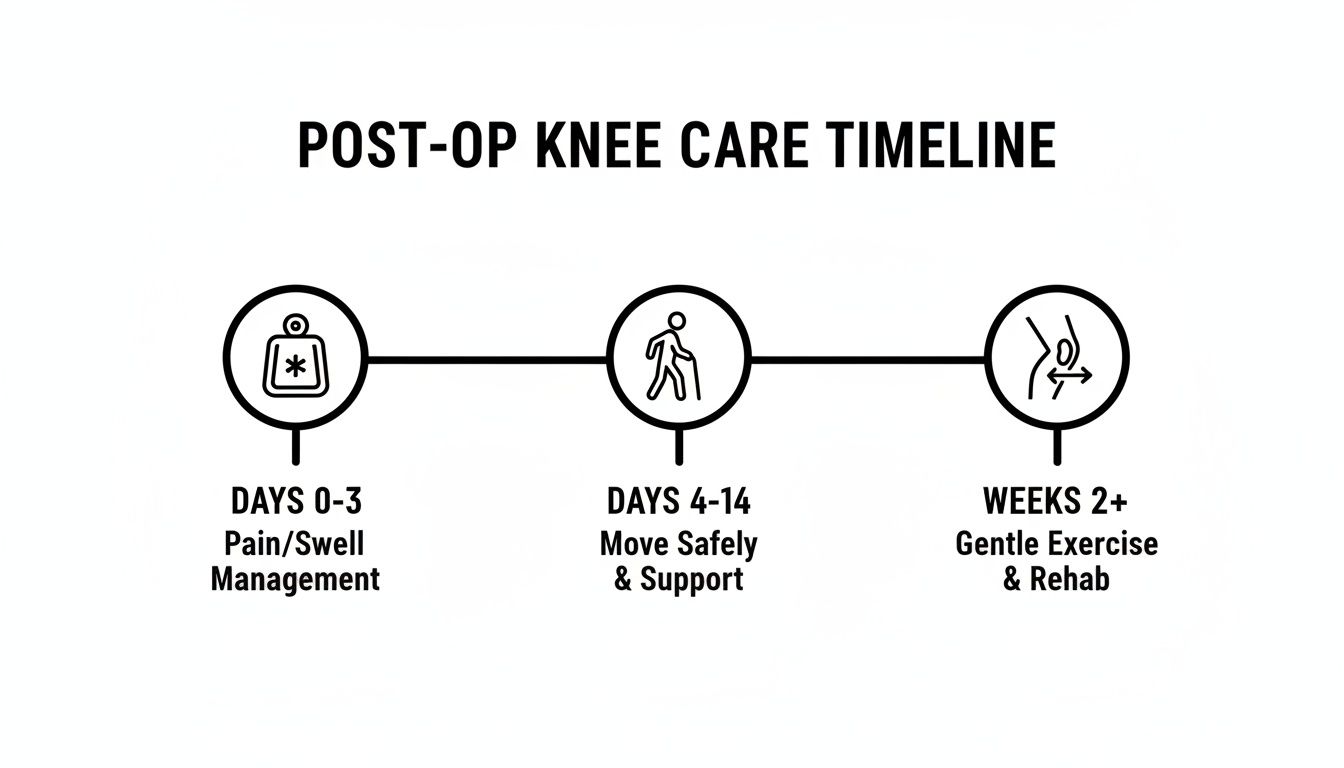
As the graphic shows, our first priorities are simple but crucial: managing your pain, helping you move safely (with assistance), and starting gentle exercises to keep stiffness from setting in.
Weeks 1-2: The Foundation of Motion
The first two weeks are all about protecting your new joint while encouraging it to move. Don’t be discouraged if progress feels slow. These small gains are the bedrock for everything that follows.
Our primary goals here are to keep pain and swelling down, get the muscles around your knee firing again, and hit some key range-of-motion benchmarks.
Your therapist will guide you through foundational exercises like:
- Heel Slides: Gently improving your knee’s ability to bend (flexion).
- Quad Sets: To “wake up” the big muscle on the front of your thigh.
- Straight Leg Raises: To start building the basic strength you need for walking.
A huge milestone we’re aiming for by the end of week two is achieving about 80 degrees of active knee flexion. Getting this early motion is critical, and the one-on-one guidance in our outpatient clinic really helps patients hit these goals safely.
Weeks 3-7: Building Strength and Normalizing Your Walk
Around week three, you’ll start to feel a shift. The focus moves from just activating the muscles to building real, functional strength and improving how you walk. This is when your therapist will slowly add resistance and more challenging balance work.
You’ll begin to leave the walker or crutches behind as you work on walking with a smooth, even stride.
This is the phase where our patients truly start to feel like they're getting their independence back. Walking without a limp and tackling stairs with more confidence are huge victories that signal you’re on the right track.
Activities we often introduce during this time include:
- Stationary Biking: An excellent, low-impact way to improve motion and endurance without stressing the joint.
- Mini-Squats and Lunges: To build strength in a controlled, functional pattern that mimics daily life.
- Balance Training: Things like standing on one leg or using an unstable surface to retrain your body’s stability systems.
Your therapist will constantly adjust the difficulty of these exercises based on how you're feeling. A core concept we follow is the principle of progression, which ensures we gradually increase the demand on your knee without causing flare-ups or setbacks.
Month 2 and Beyond: Returning to Your Life
After the second month, physical therapy becomes highly personalized to your specific goals. Are you dreaming of getting back on the golf course? Need to be able to garden without pain? Or maybe just chase your grandkids around a park on the South Shore? Now is when we build the specific strength and endurance for those activities.
This advanced phase gets much more dynamic and may involve:
- Agility Drills: To prepare you for quicker, more sudden movements.
- Plyometric Exercises: This could include light jumping, but only if it’s appropriate for your surgery and goals.
- Sport-Specific Training: We’ll simulate the exact movements your favorite activities require.
Your therapist at Peak Physical Therapy will work with you to define what a full recovery looks like for you and then create the plan to get you there. While this timeline is a great overview, our detailed knee replacement recovery timeline dives even deeper into what to expect. Just remember, your dedication combined with our expert guidance is the formula for success.
Finding the Right Physical Therapy Partner
Choosing the right physical therapy clinic after your knee surgery is one of the biggest decisions you'll make in your recovery. It’s about more than just finding a convenient location; it’s about finding a true partner who is just as invested in your success as you are. Not all physical therapy is the same, and the clinic's philosophy can completely shape your journey back to an active life.
Your surgeon has done their part. Now, the work of regaining your strength, motion, and confidence falls to you and your physical therapy team. You need someone who sees you as a person, not just another knee replacement on the schedule. This is where the difference between a high-volume clinic and a patient-first practice like Peak Therapy really shows.
Why Your Choice of Clinic Matters
Some healthcare models, unfortunately, can prioritize the number of visits over the quality of care. It’s a reality of the system, and it can directly impact your personal recovery. For instance, research shows significant differences in care depending on who owns the clinic.
One revealing study found that patients treated at clinics owned by their referring surgeon attended an average of 8.3 more physical therapy visits than those at independent clinics. Despite the extra sessions, these patients often received fewer intensive, hands-on services. You can explore the full research findings on PT utilization to see how different models can affect treatment. It really highlights why it's so important to find a clinic focused on effective, personalized care in every single session.
At Peak Therapy, our model is built differently from the ground up. Our only focus is you and your goals. We believe in dedicated, one-on-one care where you work consistently with the same licensed physical therapist who knows your history, your challenges, and what you want to get back to doing.
Questions to Ask Any Physical Therapy Clinic
Before you commit to a clinic for your post-op rehab, you should feel totally comfortable asking some direct questions. Their answers will tell you everything you need to know about their approach to care and whether they’re the right fit for you.
Think of it as an interview—you're hiring a crucial member of your recovery team.
Key Questions for Your Potential PT Clinic:
- Will I work with the same physical therapist at every visit? Consistency is non-negotiable. Building a relationship with one therapist ensures your plan progresses smoothly and nothing gets lost in translation between appointments.
- What does a typical one-hour session look like? Ask if you'll get dedicated one-on-one time with your therapist or if they’ll be juggling multiple patients at once.
- How much of my treatment will be hands-on manual therapy versus independent exercise? A great program balances both. Manual therapy helps improve your mobility so the exercises you do are that much more effective.
- How will you tailor my program to my specific goals? Your rehab shouldn't be a generic protocol. It should be built around getting you back to walking your dog at Bare Cove Park in Hingham or easily navigating the aisles at the grocery store in Quincy.
Choosing a physical therapy partner means finding a team that listens, adapts, and is genuinely dedicated to your progress. You should feel like the most important person in the room during your appointment, because you are.
At Peak Therapy, our standard of care answers these questions before you even have to ask. Across our Massachusetts locations, from Pembroke to Scituate, we provide consistent, one-on-one, hands-on care in a positive and uplifting environment. For a deeper look into our philosophy, read our post on the importance of personalized rehabilitation care after surgery. Your recovery is too important to settle for anything less.
The Power of Pre-Op and Outpatient Rehab
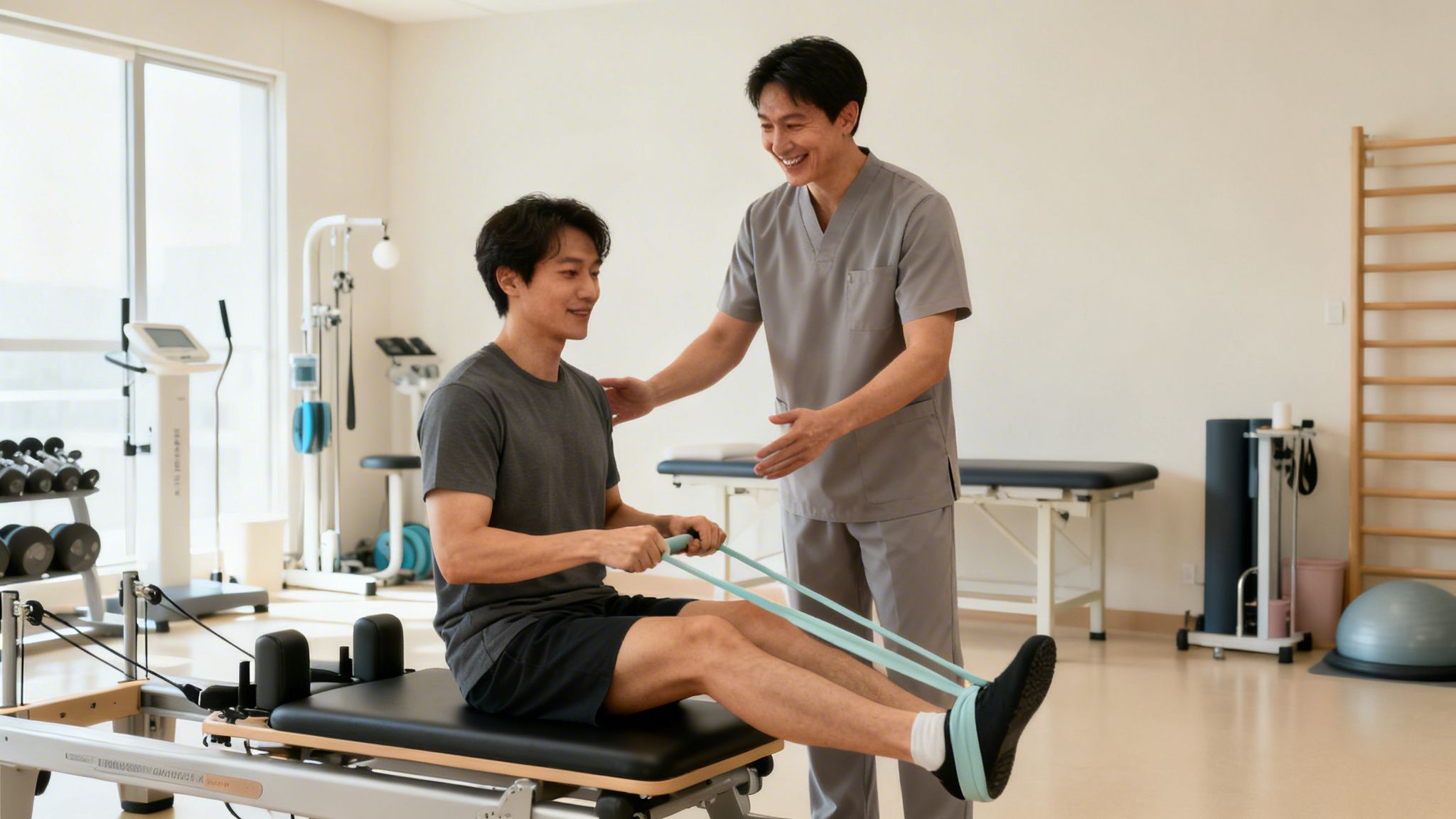
What if you could make your recovery faster and easier before you even have surgery? This isn't just wishful thinking—it's the reality of "prehab," or preoperative physical therapy. It’s an often-overlooked step that can have a massive impact on how well you bounce back from knee surgery.
Think of it as giving your body a head start. By strengthening the muscles around your knee and improving your range of motion before the procedure, you go into the operating room in much better shape. This proactive work makes those first few days and weeks of recovery significantly smoother.
The benefits are clear. Research shows that even a single session of pre-op physical therapy can shorten a patient's hospital stay. It also makes it more likely you'll be discharged directly home to start outpatient rehab, rather than needing an intermediate stop at a skilled nursing facility.
The Overlooked Value of Outpatient Rehab
Despite the clear advantages, a surprisingly low number of patients are referred for dedicated outpatient physical therapy after knee surgery. This is a critical gap in care that can lead to long-term problems, and it’s a gap we are passionate about closing for our communities across Massachusetts.
The statistics are eye-opening. Data on post-surgery outcomes shows that just 26% of total knee replacement patients receive any outpatient rehab. This has a direct, negative impact one year down the road. Compared to their healthy peers, these patients walk 18% slower, struggle 51% more with stairs, and have a 40% weakness in their quadriceps muscles. These issues contribute to a 24% higher rate of falls. You can discover more insights about these post-surgery rehabilitation statistics to see the full picture.
These numbers tell a compelling story: formal, outpatient physical therapy after knee surgery isn't just a nice-to-have. It's essential for regaining full function, staying safe, and getting back to your life with confidence.
When patients don't complete a full course of physical therapy, they often never fully regain their strength or mobility. They might continue walking with a limp, avoid stairs, or live with a persistent fear of their knee giving out. That’s not the outcome anyone wants after going through a major surgery.
Bridging the Gap from Surgery to Real Life
This is precisely why we are so committed to post-surgical care at Peak Therapy. We see it as our job to bridge the gap between the operating room and a full, active life. We provide the expert guidance and one-on-one attention needed to overcome the hurdles that can derail a recovery.
Our approach to physical therapy after knee surgery is built on a true partnership. We work closely with you and your surgeon to create a seamless transition from the hospital to one of our local clinics.
- Individualized Plans: Your recovery plan is built for you. It’s not a cookie-cutter protocol but a strategy based on your specific surgery, your progress, and your personal goals.
- Expert Guidance: Our licensed physical therapists use evidence-based techniques to help you safely restore motion, build strength, and improve your balance.
- Local Focus: We know what it takes to live an active life in Massachusetts. Whether your goal is walking the beaches in Scituate, navigating the hills of Milton, or just keeping up with your grandkids in Hanover, we tailor your rehab to get you there.
Ultimately, prehab and dedicated outpatient rehab are two of the most powerful tools in your recovery toolkit. They empower you to take an active role in your outcome, making sure your knee surgery leads to a real, lasting improvement in your quality of life.
Common Questions About Knee Surgery Rehab
Heading into physical therapy after knee surgery comes with a lot of questions. It’s completely normal to feel a mix of hope and uncertainty—we hear the same concerns from patients every day across our Massachusetts clinics, from Braintree to Plymouth.
We want to give you clear, straightforward answers to put your mind at ease so you can feel confident and prepared as you start your recovery.
How Much Will Physical Therapy Hurt?
This is usually the first question people ask, and it’s a fair one. You’ve just had major surgery, and the last thing you want is more pain. The short answer is that while you'll feel some discomfort, our goal is never to cause sharp or unbearable pain.
Think of it as challenging, not torturous. We'll be working together to gently push the boundaries of your new knee's movement and strength. This often creates sensations of deep stretching, muscle fatigue, and soreness—all productive signs that you're healing and getting stronger.
Your Peak Therapy therapist will be in constant communication with you during every exercise. We’ll ask for your feedback and watch for non-verbal cues to make sure we’re in that "sweet spot"—a range that encourages healing without causing a painful flare-up.
How Long Will I Need Physical Therapy?
Every person’s recovery is different, but we can offer a general timeline. For most people recovering from major knee surgery, like a total knee replacement, outpatient physical therapy typically lasts for about 8 to 12 weeks.
However, that’s just a guideline. The actual duration of your care will depend on a few key things:
- The exact type of surgery you had.
- Your fitness level before the operation.
- How consistent you are with your home exercise program.
- Your personal goals for recovery.
Your physical therapist will develop a personalized treatment plan from day one. We continuously reassess your progress and adjust the plan as you get stronger, making sure your time with us is as efficient and effective as possible.
How Do I Know if My Recovery Is on Track?
It’s easy to get anxious about whether you’re “ahead” or “behind” schedule. At Peak, we take the guesswork out of the equation. We believe in celebrating your progress with you by showing you the tangible results of all your hard work.
During your sessions, we track key objective measurements, including:
- Range of Motion: We use a goniometer to measure precisely how far you can bend and straighten your knee.
- Strength: We assess the power in your quadriceps, hamstrings, and hip muscles as they recover.
- Functional Tasks: We watch how you walk, go up and down stairs, and perform other daily movements.
We don't just tell you you're getting better; we show you the data. Seeing your knee bend an extra 10 degrees or watching yourself walk down the hall without a limp—these are the real-world wins that prove your recovery is right on track.
Your therapist will explain what each new milestone means for getting you back to what you love, whether that’s walking your dog at a park in Milton or playing a round of golf in Duxbury. We’re your partners every step of the way.
At Peak Physical Therapy and Sports Performance, we understand the road back from knee surgery. Our team of licensed physical therapists is ready to perform a comprehensive evaluation and create a personalized plan to help you get back your strength, mobility, and confidence.
If you’re ready to start your journey back to an active life, we invite you to schedule your appointment online at one of our convenient Massachusetts locations. Let’s get you moving again.