


You wake up and feel it again. A sharp pinch along the shoulder blade when you roll over. Later, it turns into a deep ache while you sit at your laptop. By the end of the day, reaching into the back seat or lifting a grocery bag makes you stop and wince.
That kind of pain is frustrating because it doesn’t always behave the way people expect. Sometimes it feels muscular. Sometimes it burns. Sometimes it seems to come out of nowhere. Many people try to stretch it, massage it, or wait it out, only to find that it keeps coming back.
That Nagging Pain Behind Your Shoulder What's Really Going On
For a lot of people, shoulder blade pain starts as something easy to ignore. Maybe it shows up after a long commute, a few hours at a desk, a weekend tennis match, or a tough upper-body workout. Then it lingers.

If that sounds familiar, you’re not overreacting. Shoulder pain is common, with annual incidence reported as high as 62 per 1,000 people in epidemiological research on shoulder pain. It’s seen most often in working-age adults, which fits what many patients already know from experience. Work, sports, training, parenting, and daily routines all put repeated demand on this area.
The hard part is that shoulder blade pain causes aren’t all the same. Two people can point to the exact same spot on their back and have completely different problems.
One person may have irritated muscles from posture and overuse. Another may have a shoulder blade that isn’t moving well. Someone else may be feeling pain referred from the neck. In a smaller number of cases, the source isn’t musculoskeletal at all.
Shoulder blade pain isn’t a diagnosis by itself. It’s a symptom, and the right treatment depends on finding where that symptom is really coming from.
That’s why guessing often fails. Stretching a nerve problem like it’s a tight muscle won’t help much. Strengthening an area that needs a medical workup can delay the right care. A careful evaluation matters because the same symptom can have very different explanations.
Understanding Your Shoulder Blade A Crucial Hub for Movement
Your shoulder blade, also called the scapula, works like a moving platform for your arm. It’s not just sitting on your back. It glides, tilts, rotates, and stabilizes every time you reach, lift, push, pull, throw, or carry.
A simple way to think about it is this. The shoulder blade is the hub that helps the arm connect to the rest of the body. If that hub moves smoothly, your shoulder usually feels stronger and more efficient. If it doesn’t, nearby muscles and joints often have to compensate.
Why this area gets irritated so easily
The shoulder blade has a big job. It needs to be stable enough for force, but mobile enough for reach and overhead movement.
That balancing act matters when you:
- Reach overhead for a cabinet or shelf
- Push and pull during chores, workouts, or work tasks
- Carry loads like bags, kids, laundry, or equipment
- Rotate your trunk and arm together in sports and daily movement
If the shoulder blade loses that balance, pain can show up in several ways. Some people feel a knot between the spine and the blade. Others describe pain under the blade, on top of it, or along the inner border.
Why physical therapists pay such close attention to it
When a physical therapist looks at shoulder blade pain, they’re not only checking the sore spot. They’re watching how the scapula behaves while the arm moves, how the rib cage supports it, and whether the neck or thoracic spine is influencing it.
That’s important because the shoulder blade often reflects a broader movement problem. The painful area may be real, but it may not be the true starting point.
A painful shoulder blade can be the end result of poor mechanics somewhere else in the chain.
That’s also why one-size-fits-all advice tends to disappoint. The same stretch that helps one person can aggravate another if the underlying cause is different.
The Most Common Culprits Local Muscle and Joint Pain
Most shoulder blade pain comes from local mechanical problems. In plain language, that means the source is usually in the muscles, joints, or movement patterns around the shoulder blade itself.
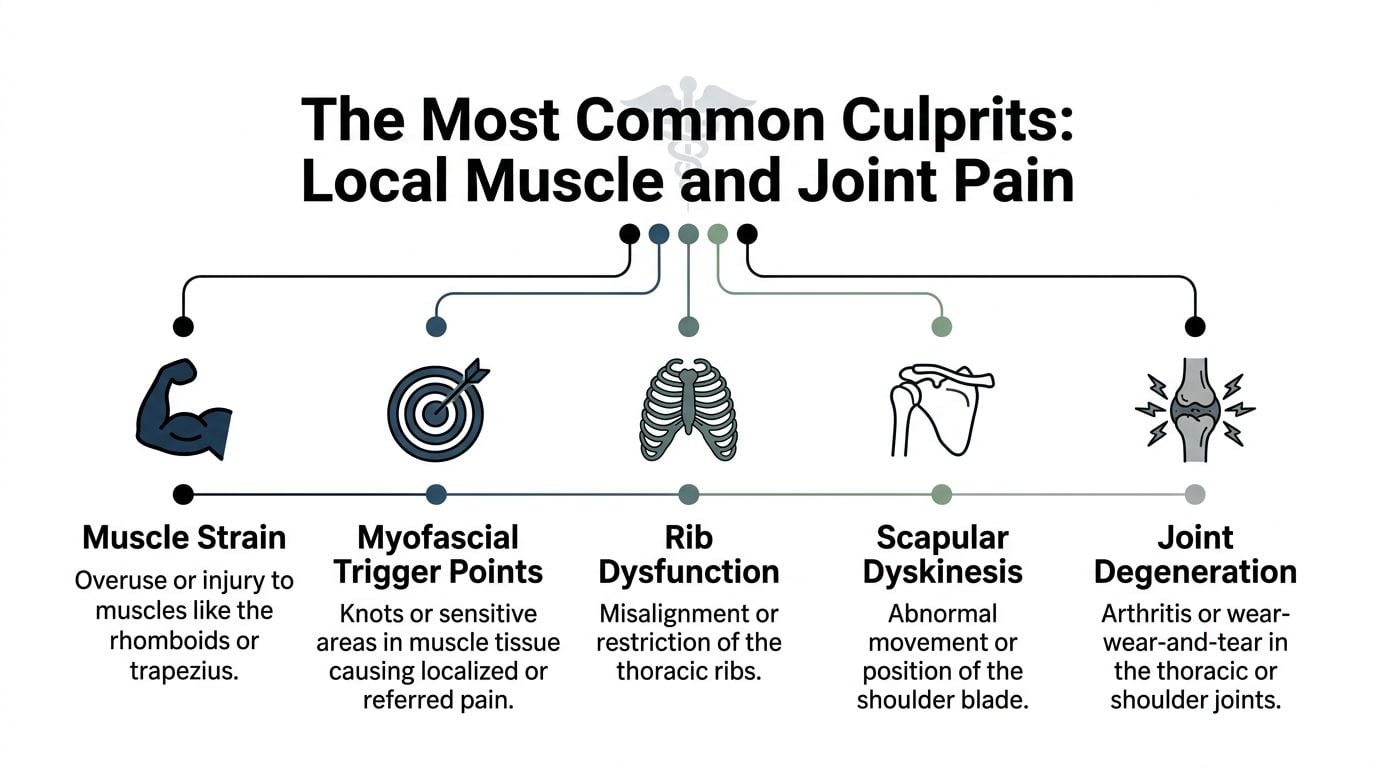
Research and clinical guidance consistently point to muscle strain and overuse as the most frequent causes, especially when tied to postural dysfunction and repetitive activity, as described in this clinical overview of shoulder blade pain. That fits what physical therapists see every day.
Posture and overuse often work together
Rarely does someone walk in and say, “I had perfect posture and then my shoulder blade started hurting for no reason.” More often, the pain builds from repetition.
A few familiar examples:
- Desk work: Sitting slouched over a laptop can leave the upper back muscles stretched and under strain.
- Hands-on jobs: People who reach often, lift repeatedly, or work overhead place more demand on the muscles that control the shoulder blade.
- Sports and training: Swimming, tennis, basketball, and weightlifting all ask the shoulder blade to support repeated arm motion.
- Weekend activity: Kayaking off the South Shore, yard work, painting, or a sudden burst of house projects can overload tissues that weren’t ready.
When this kind of pain is local, it often feels sore, achy, stiff, or sharp with certain motions. It may improve with position changes, heat, movement, or rest. It may also feel tender when you press into the muscles around the blade.
Common local pain patterns
Here’s a simple way to sort mechanical shoulder blade pain:
| Pattern | What it often feels like | Typical clue |
|---|---|---|
| Muscle strain | Ache, pinch, soreness | Worse after activity or awkward lifting |
| Trigger point irritation | Knot-like pain, local tenderness | Pain with pressure into a tight spot |
| Joint or rib irritation | Sharp pain with twisting, deep breath, or certain positions | Feels more specific and movement-linked |
| Movement dysfunction | Recurrent pain with reaching or overhead use | Symptoms keep returning despite rest |
These categories can overlap. A person may start with a simple strain, then develop guarded movement and more irritation around the ribs or shoulder.
The overlooked issue called scapular dyskinesis
One cause that many patients haven’t heard of is scapular dyskinesis. That means the shoulder blade isn’t moving or positioning itself the way it should.
This matters more than people realize. Scapular dyskinesis is a primary cause of pain and affects up to 100% of overhead athletes, according to this review on pain under the shoulder blade. It’s commonly linked to weakness in stabilizing muscles such as the serratus anterior.
When those stabilizers don’t do their job well, the shoulder blade may:
- tilt or rotate inefficiently
- sit unevenly against the rib cage
- “wing” or stick out more than expected
- force the neck, upper trap, or smaller support muscles to overwork
That can create a cycle. The shoulder blade moves poorly, nearby tissues get irritated, and then pain changes how you move even more.
Practical rule: If your pain keeps returning with reaching, lifting, serving, throwing, or overhead pressing, movement control may be the issue, not just muscle tightness.
Why people get confused about this diagnosis
Patients often assume that pain near the shoulder blade must mean a rhomboid strain. Sometimes that’s true. But in many cases, the painful muscle is only the one doing extra work.
A desk worker might have pain between the spine and shoulder blade because the shoulder blade sits in a poor resting position all day. A swimmer may feel pain under the blade because the stabilizers fatigue and mechanics change over the course of practice. Someone sleeping on one side may wake up with recurring irritation because that position changes how the scapula rests against the rib cage.
That’s one reason broad online advice can be hit or miss. Generic strengthening may help, but targeted work is usually better. If you’re also dealing with shoulder symptoms, this guide to rotator cuff exercise options can help you understand how the shoulder and shoulder blade often work together.
What usually helps local mechanical pain
Treatment depends on the exact problem, but local shoulder blade pain often responds well to a combination of:
- Hands-on treatment: to calm irritated tissues and improve motion
- Strengthening: especially for the upper back and scapular stabilizers
- Movement retraining: so the shoulder blade glides better during daily tasks
- Activity changes: reducing the motion or position that keeps provoking symptoms
- Ergonomic fixes: adjusting laptop height, chair setup, or reaching patterns
The key is matching the treatment to the reason the pain developed in the first place.
When the Pain Isn't Local Neck and Nerve-Related Causes
Sometimes the shoulder blade is innocent.
A person feels pain near the blade, points to that spot, and assumes the problem is there. But the source may be in the neck or upper spine, where a nerve is getting irritated.
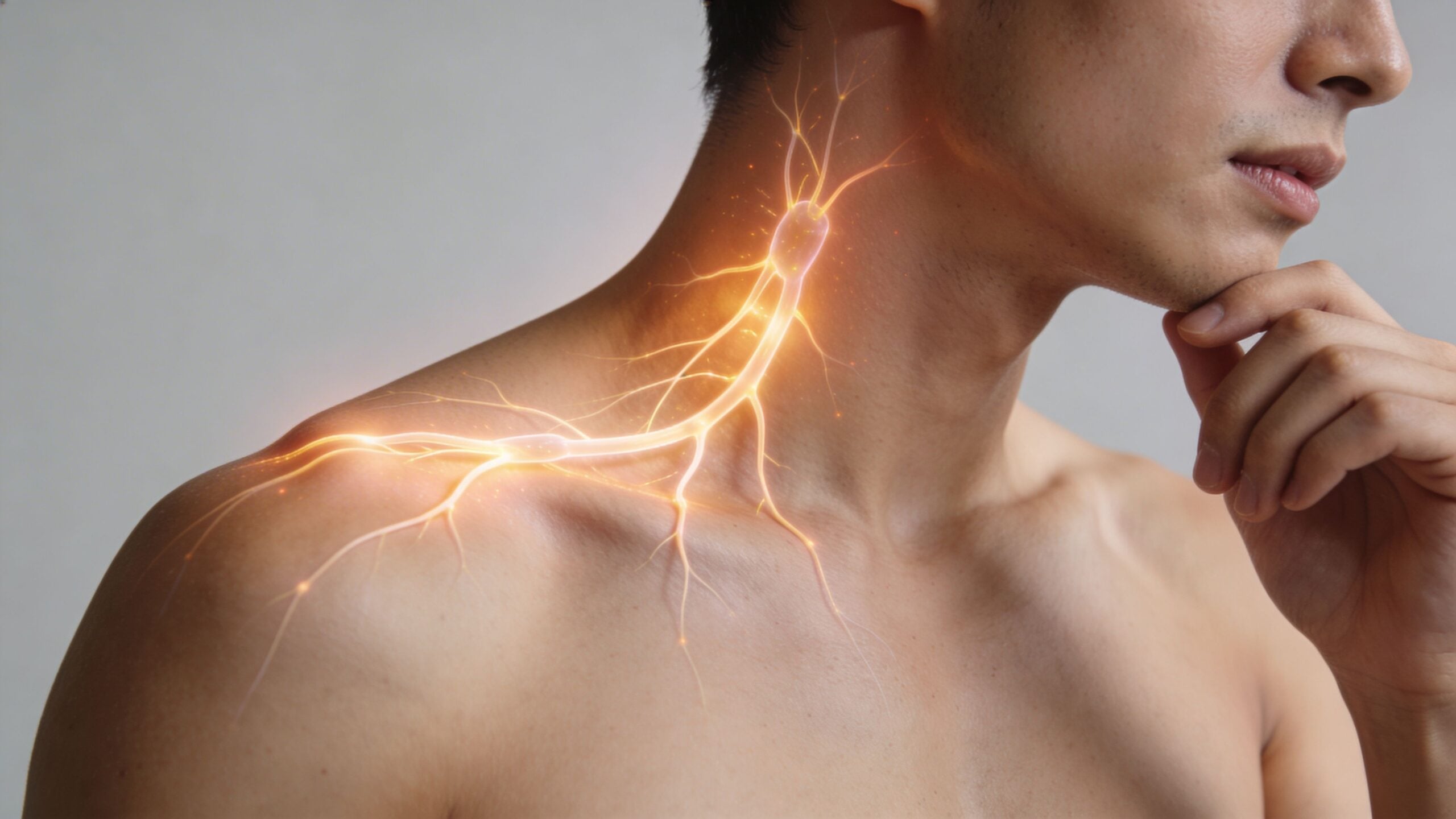
Referred pain from a cervical or upper thoracic disc issue accounts for 15 to 25% of chronic shoulder blade pain cases, and this pain is often described as burning or sharp in this guide to shoulder blade pain and relief. That’s different from the dull ache people often describe with a simple strain.
How neck problems create pain in the shoulder blade
Think of a nerve like a cable traveling from the neck out toward the shoulder and arm. If that cable gets irritated near its starting point, you may feel symptoms farther down the line.
That can create patterns such as:
- pain along the inner border of the shoulder blade
- burning pain that doesn’t feel muscular
- tingling, numbness, or arm symptoms with the shoulder blade pain
- discomfort that changes when you move your neck more than when you move your shoulder
A person may say, “I keep rubbing the spot on my back, but it never really gets better.” That’s a clue worth paying attention to.
Clues that suggest a nerve problem
Neck-related shoulder blade pain often behaves differently from local muscle pain.
| More suggestive of local tissue pain | More suggestive of neck or nerve involvement |
|---|---|
| Sore with pressure into the muscle | Burning, sharp, or radiating |
| Worse after overuse of the area | Changes with neck position |
| Improves with local massage or heat | May include numbness or tingling |
| Feels mechanical and localized | May travel into shoulder, arm, or hand |
Poor head and neck posture can also add to the problem over time. If that sounds familiar, this article on How to Fix Forward Head Posture and Reclaim Your Comfort offers useful background on a posture pattern that often feeds upper back and scapular symptoms.
If moving your neck reliably reproduces the pain under your shoulder blade, the neck deserves a close look.
Why treatment has to change
Such missteps lead to wasted time. They keep stretching the shoulder blade, digging into knots, or changing shoulder workouts, but the irritated structure is a nerve root or a neck joint.
That doesn’t mean the situation is hopeless. It means the plan should fit the source. For some people, treatment focuses on improving neck mobility, calming nerve irritation, changing posture, and restoring how the upper quarter moves together. If you want a simple starting point, these exercises for neck pain relief can help you understand the kind of work that may be more useful than endless shoulder blade massage.
Serious Red Flags When Shoulder Blade Pain Is an Emergency
Most shoulder blade pain causes are musculoskeletal. That’s the good news. But this is one area where caution matters because not all pain near the shoulder blade comes from muscles, joints, or nerves.
Right-sided pain can be linked to gallbladder issues, and pain with shortness of breath may signal a pulmonary embolism, as noted in this overview of possible causes of pain under the shoulder blade. Those situations need medical attention, not a home stretching routine.
Symptoms that shouldn't be brushed off
Seek urgent medical help right away if shoulder blade pain comes with symptoms such as:
- Shortness of breath: especially if it feels sudden or out of proportion
- Chest pressure or chest pain: even if the shoulder blade is where you feel it most
- Sweating, nausea, or lightheadedness: particularly when the pain seems unrelated to movement
- Pain at rest that won’t let up: especially if position changes don’t affect it
- Unusual right-sided pain after eating or in waves: which can fit a non-musculoskeletal pattern
A helpful general resource on deciding the right level of care is this article on the difference between urgent care and primary care. Still, if symptoms feel severe, sudden, or alarming, the safest choice is immediate medical evaluation.
A quick way to think about the difference
Musculoskeletal pain often changes with motion, posture, pressure, or activity. Referred pain from an internal issue may not behave that way.
Here’s a simple comparison:
| Pattern | More common in musculoskeletal pain | More concerning for emergency evaluation |
|---|---|---|
| Changes when you move | Yes | Not always |
| Reproduced by pressing the area | Often | Often no |
| Linked to exercise or posture | Often | Sometimes unrelated |
| Comes with breathing trouble or systemic symptoms | Uncommon | Concerning |
This is not a “wait and see” situation if pain feels unusual, intense, or paired with breathing trouble, chest symptoms, or sudden illness.
If you’re unsure, err on the side of safety. For more context on warning signs in this region, this article on what are red flags for upper back pain is a useful next read.
How We Find the True Source A PT's Diagnostic Approach
Patients often come in after trying a few things on their own. Maybe they stretched. Maybe they switched pillows. Maybe they used a massage gun, heat, or rest. Sometimes one of those things helps a little, but not enough to solve it.
A good physical therapy evaluation starts with a conversation, not a guess.

What a therapist wants to know first
The history tells us a lot. We want to hear:
- when the pain started
- whether it came on suddenly or gradually
- what movements bring it on
- whether it aches, burns, stings, or travels
- whether sleep, work, sports, or driving affect it
- whether you also have neck pain, tingling, weakness, or chest symptoms
Those details help narrow the list quickly.
Then we watch how you move
A therapist doesn’t just ask where it hurts. We look at how your body handles movement.
That may include watching you raise your arm, turn your neck, reach behind your back, rotate your trunk, or do the specific movement that triggers symptoms. If the shoulder blade moves awkwardly, if the neck reproduces the pain, or if the ribs and thoracic spine seem restricted, the picture starts to come together.
Hands-on testing fills in the rest
This part is more specific. A therapist may check:
- muscle tenderness and trigger points
- joint motion in the shoulder, neck, or upper back
- scapular control and stability
- strength in key muscle groups
- sensation and reflexes when nerve involvement is suspected
The exam should leave you with more clarity, not more confusion. You should understand what the likely source is and why the plan matches it.
That process matters because shoulder blade pain causes can overlap. Someone may have a desk-posture issue plus a stiff neck. An athlete may have local overload plus poor scapular control. The evaluation helps sort out what’s primary, what’s secondary, and what to address first.
Your Personalized Path to Relief with Peak Physical Therapy
Once the source is clear, treatment becomes much more straightforward.
If the problem is mostly muscular, the plan often focuses on calming irritation, restoring mobility, and building strength where support is missing. If the issue is coming from movement control, treatment shifts toward retraining how the shoulder blade, rib cage, neck, and arm work together. If the neck is involved, the program has to reflect that.
What treatment often includes
Care is usually a mix of approaches rather than a single exercise sheet.
- Manual therapy: hands-on techniques can help improve motion and reduce guarding in stiff or irritated areas.
- Targeted strengthening: especially for the upper back, rotator cuff, and scapular stabilizers.
- Posture and workstation changes: useful for people who spend hours at a desk, in the car, or working from a laptop.
- Movement retraining: teaching better mechanics for reaching, lifting, carrying, training, or sport.
- Activity modification: changing the aggravating pattern so healing can happen.
That approach makes sense because muscle strain and overuse, often tied to postural dysfunction, are the most frequent causes of shoulder blade pain, and physical therapy that addresses posture, upper back strength, and activity modification is highly effective for long-term relief in this clinical guide on shoulder blade pain.
A few safe things you can try now
If your pain seems mechanical and you don’t have red-flag symptoms, these simple steps are often reasonable:
- Change positions more often: don’t stay folded over a laptop for long stretches.
- Support your screen height: bring work closer to eye level when possible.
- Use gentle movement: easy shoulder rolls, walking, and pain-free range of motion often help more than complete rest.
- Ease back into overhead work: don’t test the area repeatedly when it’s already irritated.
- Notice patterns: if one sleep position, workout, or task keeps setting it off, that’s useful information.
For people across the South Shore, from Quincy and Braintree to Hanover, Duxbury, Plymouth, and Scituate, the encouraging part is this. You don’t have to keep guessing. Shoulder blade pain usually becomes much less overwhelming once someone identifies the driver behind it.
If shoulder blade pain is interfering with work, sleep, workouts, or daily life, Peak Physical Therapy and Sports Performance offers personalized, evidence-based care across Massachusetts’ South Shore. With convenient clinics in Braintree, Quincy, Weymouth, Cohasset, Duxbury, East Bridgewater, Hanover, Kingston, Milton, Norwell, Pembroke, Plymouth, and Scituate, their team can help you figure out what’s causing the pain and build a treatment plan that fits your goals. Schedule an evaluation and take the next step toward moving more comfortably.