

Pain has a way of shrinking life fast. A sore back turns the drive through Weymouth into a chore. A knee injury makes it harder to keep up with weekend plans, get through work comfortably, or cheer from the sidelines without thinking about every step. For families, it can look like a child who suddenly stops running, limps after practice, or struggles with movement that other people keep saying they'll “grow out of.”
That's usually when people start searching for physical therapy weymouth ma. Not because they want more information for information's sake, but because they want a clear next step close to home.
At our Weymouth clinic, recovery should feel less confusing than the injury itself. The process starts with a real conversation, moves into focused hands-on care and guided exercise, and ends with something that matters more than a diagnosis. You get back to walking, lifting, working, training, parenting, and living with more confidence.
Table of Contents
- Your Partner in Pain Relief and Recovery in Weymouth
- Why Weymouth Chooses Peak Physical Therapy
- Comprehensive Care for Your Condition
- Your First Step to Recovery The Initial Evaluation
- Crafting Your Path to Wellness Our Treatment Services
- Planning Your Visit Directions and Insurance
- Frequently Asked Questions About PT in Weymouth
Your Partner in Pain Relief and Recovery in Weymouth
A lot of recoveries in Weymouth start with a small moment that doesn't seem small at all when it happens. Someone tweaks an ankle on a walk, wakes up with neck pain after a long week of commuting, or realizes their shoulder still hurts weeks after they expected it to settle down. Parents often notice it first in the way their child moves. Less sprinting, less jumping, more hesitation.
When that happens, people want care nearby that feels grounded and practical. They don't want a vague plan. They want to know what's wrong, what to do next, and whether they can get back to normal without wasting weeks on the wrong approach.
That's where a neighborhood clinic makes a difference. The Weymouth team is here to help people move from frustration to a real plan, with one-on-one guidance that meets them where they are. If you want a sense of how the local clinic became part of the community, you can read about the opening of the Weymouth location.
You shouldn't have to choose between expert care and convenient care. In Weymouth, those should be the same thing.
Recovery rarely follows a perfectly straight line. Some people need hands-on help to calm pain down first. Others need strength, balance, or sport-specific progression. The important part is having a team that adjusts the plan when your body gives useful feedback, instead of forcing you through a generic routine.
Why Weymouth Chooses Peak Physical Therapy
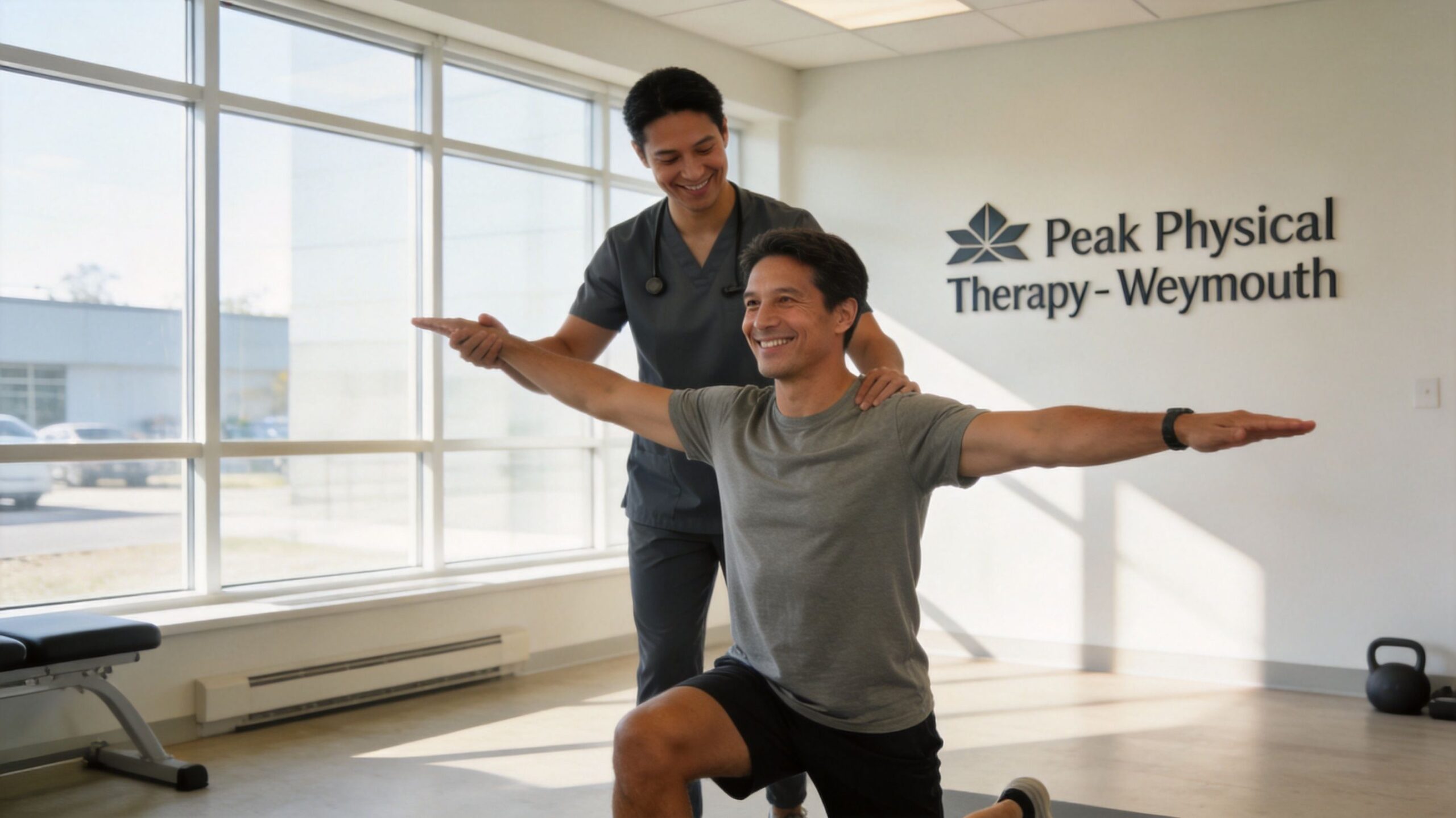
Weymouth has options for rehabilitation care, and that's a good thing. The local market includes 941 specialists with an overall average rating of 4.5 stars, which shows both strong demand and a deep healthcare presence in town, according to Healthgrades' Weymouth physical therapy directory. In a market with that much choice, the right question isn't “Can I find a PT?” It's “Who will give me the most thoughtful care for what I need?”
Local care should feel personal
Good physical therapy doesn't feel like being moved through a system. It feels like being known.
In practice, that means your therapist pays attention to the details that change the plan. The runner with knee pain doesn't need the same progression as the adult recovering after surgery. The office worker with headaches and neck stiffness needs a different strategy than the middle school athlete who wants to get back on the field without repeating the same injury.
What people respond to most is usually simple:
- They feel heard: The first conversation isn't rushed, and their goals matter.
- They understand the plan: They know what they're doing in the clinic and what to keep doing at home.
- They see progress: Pain, movement, balance, strength, or confidence start shifting in a way that feels meaningful.
What matters in a crowded market
When there are many providers nearby, the trade-offs become clearer. A clinic can offer convenience but still feel impersonal. It can provide exercise but skip the hands-on assessment that identifies what's driving the problem. It can focus on symptoms but miss the activity or movement pattern that keeps the issue coming back.
A stronger approach looks different. It blends careful evaluation, hands-on treatment when appropriate, progressive exercise, and regular check-ins on what's improving and what isn't.
Practical rule: The right PT plan should make sense to you. If you leave your visits unsure why you're doing certain exercises or what the next milestone is, the plan needs more clarity.
People in Weymouth also value care that fits real life. Some want help staying active on the South Shore. Others want to return to work, carry groceries without pain, or move more confidently around the house. Those goals deserve the same seriousness as any sport-specific return.
Comprehensive Care for Your Condition
Pain rarely fits into a neat category. One person comes in because turning their head while driving hurts. Another wants to get through a workday without back spasms. Someone else is a few weeks out from surgery and still does not trust the leg under them. Good physical therapy starts by identifying what your body is struggling to do, then matching treatment to that problem and to the life you need to return to here in Weymouth.
At Peak Physical Therapy and Sports Performance, care is built around the full recovery process, not a single appointment. From the first phone call to the day you finish care, the goal is to give you a plan that makes sense, changes as you improve, and fits real routines at home, at work, and in the community.
Conditions we commonly treat
Our Weymouth team regularly works with:
- Back and neck pain: stiffness, disc-related symptoms, posture-related pain, and recurring flare-ups
- Shoulder, hip, knee, foot, and ankle problems: from overuse irritation to ligament, tendon, and joint issues
- Sports and exercise injuries: running pain, lifting injuries, sprains, strains, and return-to-play concerns
- Post-surgical recovery: strength loss, swelling, gait changes, mobility limits, and confidence after procedures
- Balance and mobility problems: unsteadiness, fall concerns, and movement changes that make daily tasks harder
- Arthritic joint pain: especially knees, hips, and shoulders that feel stiff, weak, or sore with regular activity
The treatment approach changes with the person in front of us. A runner with knee pain may need load management, hip strength work, and form changes. A retiree with the same knee pain may need better joint motion, more leg strength, and a plan for stairs, errands, and walking without fear of a flare-up. Same body part. Different demands. Different plan.
We also use hands-on care and targeted exercise together when that combination fits the problem. Depending on the diagnosis and irritability level, treatment may include joint mobilization, dry needling, soft tissue techniques, guided strength work, balance training, and home exercises that support what happens in the clinic.
If knee arthritis is part of your picture, MEDISTIK's arthritis exercise guide can be a helpful starting point for questions. The key is choosing exercises that match your current tolerance. Too little movement can leave the joint stiffer. Too much, too soon can stir it up.
That balance matters.
Children, teens, adults, and older adults do not recover the same way, and a useful PT plan accounts for that. A middle school athlete, a parent lifting a toddler, and an older adult working on steadier walking each need different cues, different progressions, and different success markers. Good care respects those trade-offs instead of forcing everyone into the same routine.
If you are dealing with pain, weakness, dizziness, stiffness, or a movement problem that keeps getting in the way, the next practical step is to schedule a physical therapy appointment in Weymouth. Getting the right diagnosis and plan early usually makes the path clearer.
Your First Step to Recovery The Initial Evaluation
The first visit often feels easier once you know what to expect. Patients often come in carrying two things. Pain, and uncertainty. They're wondering whether the visit will be rushed, whether they'll be pushed too hard, or whether anyone will really connect the symptoms to their day-to-day life.

What happens when you walk in
Your first appointment starts with conversation, not guesswork. Your therapist asks where it hurts, what makes it worse, what eases it, how long it's been going on, and what you need to return to. Sometimes the most important information is not the pain itself, but the activity you've stopped doing because of it.
Then comes the movement assessment. You may be asked to bend, reach, walk, squat, balance, or perform a motion that reproduces the problem. That gives your therapist a clearer picture of mobility, strength, control, irritability, and compensation patterns.
Patients usually feel more comfortable once they realize the evaluation is collaborative, not a test they can fail.
- You can speak up: If a motion is painful, say so. That helps guide the exam.
- You can ask questions: If a technique or recommendation doesn't make sense, your therapist should explain it.
- You'll leave with direction: The goal isn't to “wait and see” without a plan.
What your therapist is looking for
A good initial evaluation separates symptoms from drivers. Shoulder pain might involve joint stiffness, poor scapular control, irritated tissue, or overload from activity. Back pain may reflect limited hip motion, poor lifting mechanics, or a flare-up in a sensitive area that now needs graded movement instead of total rest.
What patients often find reassuring: We're not looking for perfection. We're looking for the clearest starting point.
By the end of that first visit, you should understand what the early priorities are. That might mean calming pain, restoring motion, rebuilding strength, improving balance, or protecting healing tissue while still making progress.
If you're ready to take that first step, you can schedule an appointment online.
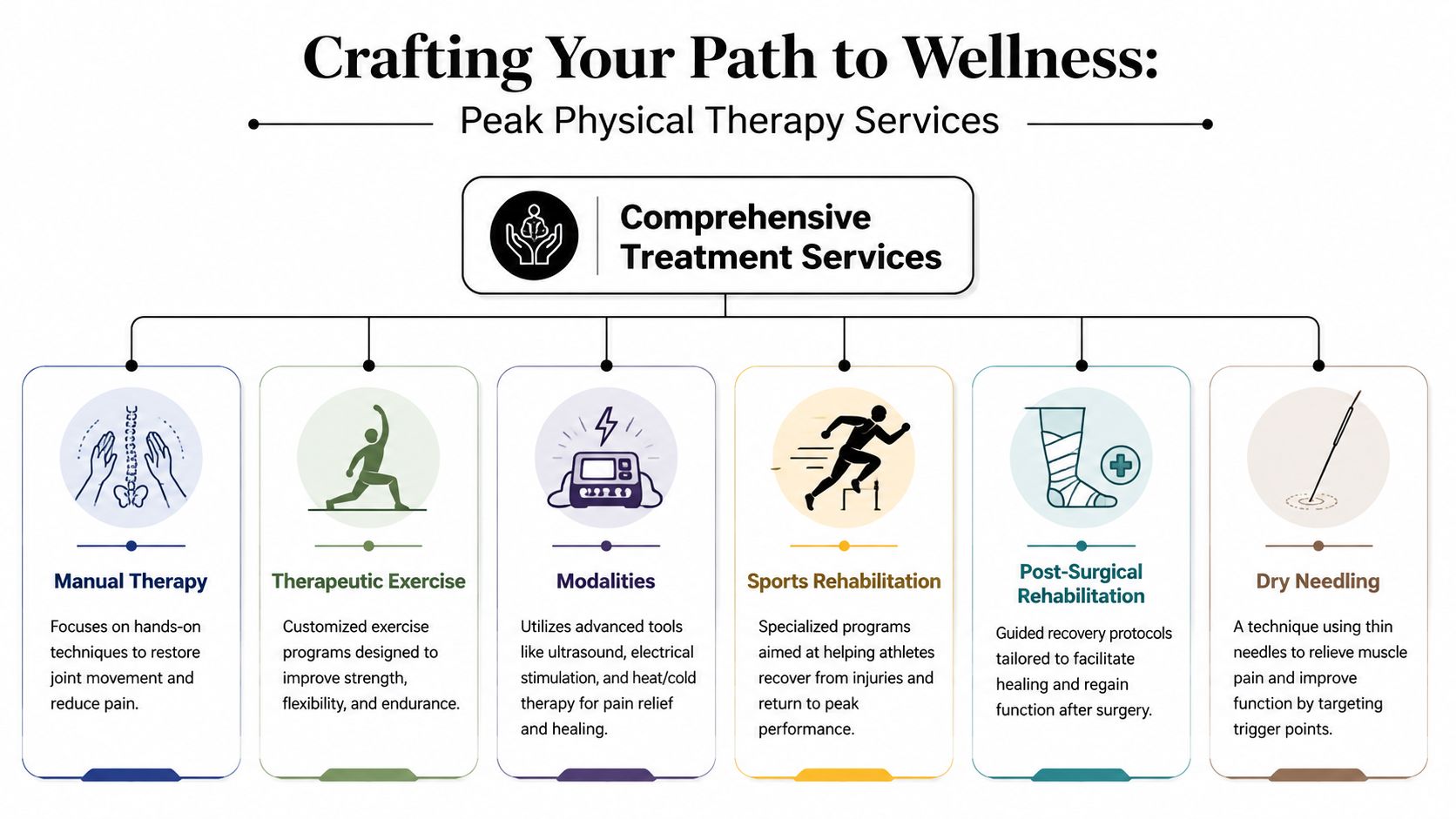
Crafting Your Path to Wellness Our Treatment Services
You have finished the evaluation, you know what is driving the pain, and the next question is simple. What will treatment look like once you walk back into the Weymouth clinic?
For most patients, recovery does not come from one technique repeated over and over. It comes from using the right treatment at the right stage, then adjusting the plan as your body responds. Some visits focus on calming an irritated area so you can move with less guarding. Later visits often shift toward strength, balance, stamina, and getting back to the tasks that matter in your day.
Treatment is built around your stage of recovery
Early care usually needs a different mix than late-stage rehab. A stiff, painful shoulder may need hands-on work and gentle movement first. A runner returning after knee pain usually needs loading, mechanics work, and gradual mileage progression. The plan should change as you improve.
That is what one-on-one outpatient care is supposed to do.
Here are the building blocks we commonly use at Peak Physical Therapy and Sports Performance:
- Hands-on care: Joint and soft tissue techniques can improve motion and reduce guarding when pain is making movement harder than it should be. Patients who want more detail on this approach can read about manual physical therapy techniques and when they help.
- Corrective and strengthening exercise: Exercises are chosen for a reason. Sometimes the goal is to restore motion. Sometimes it is to rebuild strength, improve balance, or retrain control during a squat, step, reach, or lift.
- Dry needling or instrument-assisted soft tissue work: These tools can help in the right case, especially when muscle irritability or tissue restriction is part of the problem. They work best as part of a larger plan, not as the whole plan.
- Sport and activity-specific retraining: Near the end of rehab, treatment should look more like real life. That may include lifting from the floor, climbing stairs, jogging, changing direction, or carrying a child without bracing.
- Load progression: Once symptoms are more settled, the body has to be challenged enough to adapt. A gradual increase in demand is how strength and confidence come back. Patients who like training concepts often understand this well through progressive overload training.
What tends to work best
The right treatment plan respects trade-offs. Manual therapy can help someone get moving, but it will not build lasting capacity by itself. Exercise builds that capacity, but if the dosage is off, it can flare symptoms instead of helping. Dry needling may reduce muscle irritability for one patient and add little for another.
This is the clinical judgment patients deserve. Two people with low back pain may have very different problems. One needs to regain hip motion and learn how to hinge without overloading the back. Another needs to stop protecting the area so much and start rebuilding tolerance to bending, walking, and lifting.
| Approach | Usually works better when | Usually works worse when |
|---|---|---|
| Manual therapy | Pain and stiffness are limiting movement, and you need a lower-irritation starting point | It is used without follow-up exercise or movement practice |
| Exercise progression | The goal is to restore strength, endurance, balance, or control | The program advances too quickly or stays too easy |
| Dry needling | Muscle-driven pain and guarding are part of the presentation | It is treated like a stand-alone solution |
| Sports rehab | You need to return to a specific activity with clear physical demands | Rehab stops before cutting, jumping, sprinting, or lifting are rebuilt |
Good treatment should feel purposeful. You should know why a technique is being used, what response we are looking for, and how that visit fits into the bigger recovery picture.
That is how a care plan becomes a recovery journey instead of a stack of disconnected appointments.
Planning Your Visit Directions and Insurance
Once you've decided to start, logistics shouldn't become the next obstacle. Most patients want the same practical details. Where do I go, what do I bring, and how do I avoid insurance surprises?
Getting here without extra stress
The Weymouth clinic is located at 544 Main Street, Weymouth, MA 02190. If you're coming from elsewhere on the South Shore, it helps to plan a few extra minutes for traffic, especially around busier commuting windows. Give yourself enough time to park, walk in, and settle before the appointment starts.
A few simple moves make the first trip easier:
- Use the full address when mapping your route: This helps avoid ending up at a nearby medical office by mistake.
- Arrive a little early: First visits usually go smoother when you're not rushing in tense from traffic.
- Bring your essentials: Your photo ID, insurance card, and any referral or post-op instructions you've been given are worth having on hand.
What to bring and how to check coverage
Insurance questions can make people delay care longer than they should. In most cases, the fastest path is to verify benefits before the first visit so you understand your plan's expectations.
Bring anything that gives helpful context to your therapist, such as imaging reports, a list of current medications, or surgical paperwork. Wear clothing that lets the involved area move easily. If your knee is the issue, for example, pants that don't allow access to the knee make the exam harder than it needs to be.
The less guesswork there is on day one, the faster your therapist can focus on treatment.
If you're unsure about coverage or paperwork, calling ahead is often the simplest move. A short conversation can save a lot of stress at check-in.
Frequently Asked Questions About PT in Weymouth
Some questions come up right before booking. That's normal. People want to feel prepared, not sold to.
Do I need a referral
Sometimes yes, sometimes no. It depends on your insurance plan and your situation. If you're unsure, call before booking and ask what your plan requires. That's the cleanest way to avoid unnecessary delay.
How long will my appointments take
Your first visit is usually the most detailed because it includes the evaluation and the first steps of your plan. Follow-up visits are more focused. They typically include reassessment, hands-on care when needed, exercise progression, and guidance for what to do between sessions.
What should I wear
Wear something comfortable that lets the involved area move and be examined. For shoulder issues, a loose top helps. For hip, knee, ankle, or low back concerns, choose clothing you can move in easily. Sneakers are usually a good idea.
What if my schedule is packed
That's common in Weymouth. Work, family life, school pickups, and sports can make rehab feel hard to fit in. The answer isn't cramming in random exercises without a plan. It's finding appointment times you can stick to and building a home program that feels realistic.
For clinic operations, scheduling matters more than people think. If you're curious why smooth booking systems help healthcare teams stay organized and responsive, this overview of choosing the right scheduling system gives useful context.
If you're still deciding, keep one thing in mind. Waiting doesn't always simplify the problem. It often allows compensation, stiffness, and frustration to build. Starting with an evaluation gives you information, a plan, and a way forward.
If you're looking for a clear, local path forward, Peak Physical Therapy and Sports Performance can help you get started with care close to home in Weymouth. Book your initial evaluation, get answers about what's driving your pain, and begin a treatment plan built around getting you back to the life you want to live.