

If you've been living with persistent pain in Massachusetts, you’ve probably tried just about everything—from rest and ice to over-the-counter medications. But what if the problem isn’t something that can be fixed with a pill? What if it’s a specific restriction in your joints or muscles that needs a more direct, hands-on solution?
This is where manual physical therapy comes in. We understand how frustrating it is when pain keeps you from your daily life, whether it’s your commute, your weekend activities, or just getting a good night's sleep. Manual therapy is a specialized field of physical therapy where a licensed therapist at Peak Therapy uses their hands—not just machines or general exercises—to diagnose and treat the source of your discomfort. It's a targeted, expert-driven treatment that goes far beyond a general massage, focusing on one thing: getting you moving freely and without pain again.
What Is Manual Physical Therapy Anyway?
When pain or stiffness starts to disrupt your life, it's often because of a specific issue in your muscles, joints, or the connective tissues that hold everything together. While therapeutic exercise is a huge part of recovery, sometimes your body needs a direct, skilled nudge to get things unstuck and moving correctly again. That’s exactly what manual physical therapy provides.
Think of it like this: if your car is making a strange noise, you don't just want a mechanic who turns up the radio to drown it out. You want a specialist who gets under the hood, uses their expertise to find the exact part that's causing the problem, and fixes it. Our licensed physical therapists are those specialists for the human body, using skilled hand movements to feel for restrictions in joints, tension in muscles, and irritation around nerves. This allows us to create a personalized treatment plan based on the root cause of your pain.
More Than Just a Massage
It's a common misunderstanding to think manual therapy is just a fancy term for massage. We understand why—both involve hands-on work. However, while some of the techniques might feel relaxing, the clinical goal is entirely different. A massage is primarily focused on general muscle relaxation. Manual therapy, on the other hand, is a precise diagnostic and treatment tool used by licensed physical therapists.
Our therapists use their hands to:
- Assess joint mobility to pinpoint exactly where you're stuck.
- Improve range of motion by gently mobilizing stiff joints and releasing tight tissues.
- Reduce pain by calming down irritated nerves and decreasing muscle guarding.
- Restore normal mechanics so your body can move efficiently and without compensation.
This isn’t just a trend; it's a cornerstone of modern, effective physical therapy. The growing recognition of these evidence-based, hands-on methods is a key reason the global physical therapy market was valued at USD 30,553.2 million in 2024. You can review additional details on physical therapy market growth to see how these proven techniques are shaping patient care worldwide.
Who Can Benefit from Manual Therapy?
At Peak Therapy, we see people from all walks of life across Massachusetts find relief with manual therapy. It could be a commuter with nagging neck pain from sitting in traffic on the Mass Pike, a high school athlete from a local team with a sports injury, or a post-surgical patient recovering from a procedure at a nearby hospital.
We believe that your body has an incredible capacity to heal. Our role is to use our hands-on expertise to remove the barriers preventing that from happening, giving you the specific push you need to get better.
This philosophy is at the heart of what we do. By combining these skilled techniques with a personalized exercise program, we don't just offer temporary relief. We give you a clear, hopeful path back to the activities you love, free from the frustration of nagging pain.
The Hands-On Techniques We Use to Restore Your Movement
When a physical therapist talks about “hands-on therapy,” what comes to mind? For many, it’s a vague idea of massage or cracking a joint. But true manual physical therapy is so much more—it's a collection of highly skilled and precise techniques our therapists use to diagnose and treat the root cause of your pain.
At Peak Therapy, our therapists’ hands are their most important tools. They aren’t just applying random pressure; they are performing a comprehensive evaluation, feeling for subtle changes in your muscles, joints, and nerves. This detailed, hands-on assessment allows them to choose the exact technique needed to relieve your pain, restore your movement, and get you back to feeling like yourself again.
Let's break down some of the core techniques we use every day to help our patients across our Massachusetts communities.
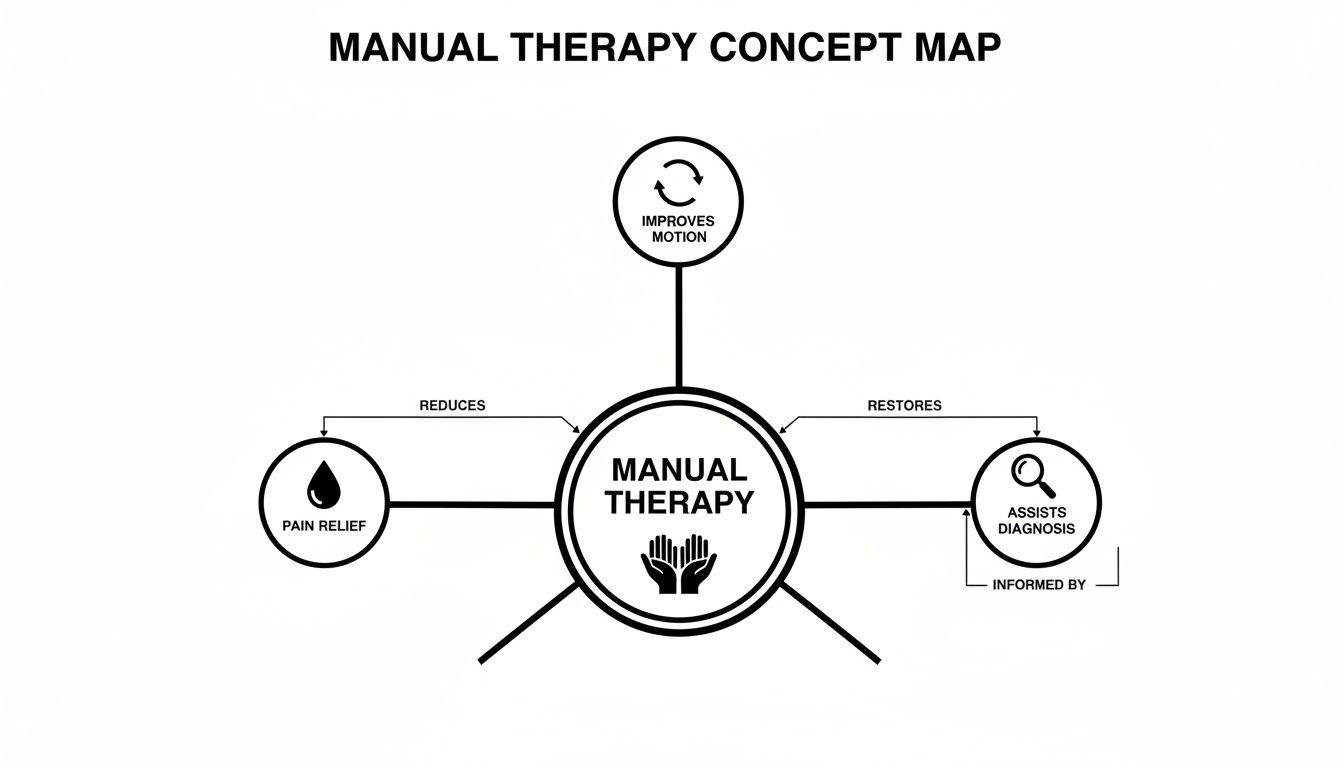
As you can see, it's all connected. We use our hands to perform a comprehensive evaluation, which then guides us to the right techniques to reduce your pain and help you move better.
Soft Tissue Mobilization
Imagine a muscle that’s been tight for weeks on end, perhaps from repetitive work or an old injury. Over time, that constant tension can create tiny bits of scar tissue, or adhesions, that restrict movement and cause nagging pain.
Soft tissue mobilization uses targeted strokes and pressures to gently break down this restrictive tissue. It's much more specific than a general massage because our therapists focus on the exact layers of muscle and connective tissue causing the problem, helping them regain their normal, pliable texture. This is often a crucial first step to calming an irritated area and preparing it for further treatment.
Joint Mobilization and Manipulation
Think about a rusty door hinge. You can’t just force it open; you have to gently wiggle it back and forth to work the rust out and get it swinging smoothly again. That's a great way to understand joint mobilization.
When injury, arthritis, or even just inactivity makes a joint stiff, it loses its natural ability to glide. Your physical therapist will apply gentle, rhythmic movements to the joint, always staying within your comfort zone, to slowly restore that lost motion.
Joint manipulation, on the other hand, is a quick, small movement that’s often what people think of when they hear a “pop.” That sound is just a release of gas from the joint, similar to cracking your knuckles. Our highly trained therapists use this technique to break through a stubborn restriction and immediately improve a joint’s mobility, but only when it’s completely safe and appropriate for your condition.
A stiff joint doesn't just limit your movement; it forces surrounding muscles to overwork and compensate, often leading to a cycle of pain and dysfunction. Our licensed therapists focus on restoring proper joint mechanics as a foundation for long-term relief.
Myofascial Release
Picture yourself wearing a wool sweater. If you grab and twist the fabric at your shoulder, you’ll likely feel the pull all the way down at your hip. Your body has a similar system called fascia—a continuous web of connective tissue that wraps around every single muscle, bone, and organ.
If that fascial web gets tight in one spot, it can create tension and pain in places that seem totally unrelated. Myofascial release uses slow, sustained pressure on these tight areas, giving the fascia time to “melt” and release its grip. It’s a game-changer for those dealing with widespread, chronic pain that doesn’t seem to have a clear source.
Trigger Point Therapy
Have you ever found a tiny, tender knot in a muscle that, when you press on it, sends pain shooting to another area? That’s a trigger point. It’s a hyperirritable spot that can cause a surprising amount of trouble—for example, a knot in your shoulder muscle could be the real culprit behind your recurring tension headaches.
Trigger point therapy is like finding and flipping a faulty off-switch. By applying direct, steady pressure to the knot, your therapist can get it to release, which quiets the pain signals it's sending out, providing much-needed relief.
Neural Mobilization
Just like your muscles and joints, your nerves need to be able to move freely. When an injury or inflammation causes a nerve to get pinched or “stuck” by the tissues around it, you might feel pain, tingling, or numbness that shoots down your arm or leg. We understand how frightening these symptoms can be.
Neural mobilization, sometimes called “nerve flossing,” uses very specific and gentle movements to help free up the entrapped nerve. It’s a delicate but powerful technique that restores the nerve’s ability to slide and glide as you move, improving its health and calming those painful symptoms. These specialized manual techniques are even recognized with their own billing codes, such as CPT code 97140, which helps to show how established they are in modern medical practice.
Common Conditions We Treat with Manual Therapy
It’s one thing to understand the names of the techniques, but what really matters is how they solve your specific problem. For our patients in Massachusetts, manual physical therapy isn’t just a term—it’s the hands-on solution that gets them back to their lives. This is where a therapist's skilled touch meets the real-world injuries and chronic conditions that keep you from working, playing sports, or even just sleeping through the night.
At Peak Therapy, we see firsthand how applying the right technique to the right problem makes all the difference. We use these targeted methods to address a wide range of musculoskeletal issues, often providing relief that patients thought was out of reach.

Chronic Back and Neck Pain
Few things are more draining than persistent back and neck pain. It might come from long commutes on I-93, years of sitting at a desk in a Boston office, or an old injury that never quite went away. We understand how exhausting chronic pain can be. When you live with this day in and day out, your joints can become stiff and compressed while the surrounding muscles get stuck in a state of constant tension.
Our physical therapists perform a comprehensive evaluation to determine the root cause of your pain. We may use joint mobilization to gently create space between your vertebrae, taking pressure off sensitive discs and nerves. We often follow this with soft tissue work to release the tight, guarded muscles that are contributing to the pain cycle. For many, this brings the first real sense of relief they’ve had in years. If you're struggling, check out our guide on the best way to treat back pain for more insights.
Shoulder, Hip, and Knee Pain
You shouldn’t have to stop doing what you love because of knee pain. Whether you’re a high school athlete in Norwell, a runner training for a race in Boston, or a weekend warrior from Quincy, joint pain can stop you in your tracks. We understand the frustration when simple things like reaching into a high cabinet or walking your dog become dreaded tasks. Manual therapy gets right to the heart of the mechanical issues causing this pain.
For a “frozen shoulder,” we use specific mobilization techniques to restore the joint’s natural glide. With hip or knee pain, our personalized treatment plans can improve how the joint moves and release tight muscles that are pulling it into a painful position. This is a core part of orthopedic care, a specialty that accounted for 31.5% of the physical therapy market in 2026 and is expected to grow, highlighting the need for effective, evidence-based treatments like manual therapy.
Headaches and TMJ Disorder
Did you know that many recurring headaches don’t start in your head at all? They often originate from tension in your neck. We call these cervicogenic headaches, and they tend to respond incredibly well to manual therapy.
By using myofascial release and trigger point therapy on the small muscles at the base of the skull, we can release the tension that sends pain signals into your head. It’s a direct, non-medicated solution for a problem that can be debilitating.
Similarly, for jaw pain (TMJ Disorder), our therapists use gentle soft tissue techniques both inside and outside the mouth to relieve the muscle spasms that cause clicking, locking, and pain, helping you get back to eating and talking comfortably.
Post-Surgical Rehabilitation
Recovering from a major surgery like a rotator cuff repair, an ACL reconstruction, or a knee replacement is a journey. After your procedure, the body’s natural healing process creates scar tissue. While this is a normal part of healing, that scar tissue can severely restrict your movement and cause lasting stiffness if it isn't managed correctly.
Manual physical therapy is essential in this post-surgical phase. Our licensed physical therapists use their hands to:
- Reduce swelling and inflammation with gentle, targeted techniques.
- Minimize restrictive scar tissue by carefully mobilizing the healing tissues as they form.
- Restore joint mobility safely and progressively, preventing the joint from becoming permanently stiff.
This hands-on approach helps you heal with better function, getting you back to your goals faster. It creates the foundation that makes all your strengthening exercises more effective, paving the way for a smoother, more successful recovery.
Your First Manual Therapy Session at Peak Therapy
Walking into a physical therapy clinic for the first time can feel a little intimidating, especially when you're already dealing with pain. We get it. At Peak Therapy, our goal is to make your first session a calm, reassuring, and collaborative experience, setting you on a clear path toward relief from day one.
It all starts with a conversation. You aren’t just a sore back or a stiff shoulder to us; you’re a person whose life has been disrupted by pain, and your story is the most important part of our evaluation.

A Comprehensive and Collaborative Evaluation
Your first visit is all about a thorough evaluation. This isn’t a quick, superficial check-up. Instead, your therapist will work to uncover the true source of your symptoms with a deep dive into your body's unique mechanics.
Here’s what you can expect:
- Your Story First: We’ll begin with a detailed chat about your pain—how it started, what makes it better or worse, and most importantly, what it’s stopping you from doing. Are you missing your weekend hikes in the Blue Hills? Is it getting harder to play with your kids? Your goals become our goals.
- Hands-On Assessment: Your therapist will then use their hands to feel for stiffness in your joints, tension in your muscles, and restrictions in your soft tissues. This hands-on analysis gives us critical information that a simple visual exam can’t.
- Movement Analysis: We'll ask you to perform specific movements to see precisely where your limitations are. This helps us identify how your body might be compensating for pain and which patterns are contributing to the problem.
This detailed process ensures we’re not just chasing symptoms. We’re pinpointing the underlying issue that’s causing them in the first place.
Creating Your Personalized Treatment Plan
Once your licensed physical therapist has identified the root cause of your pain, they’ll explain their findings in clear, easy-to-understand terms. You’ll learn not just what is wrong but why it’s happening. This is a crucial step because it empowers you to take an active role in your own recovery.
At Peak Therapy, a treatment plan is a partnership. We combine our clinical expertise with your personal goals to create a roadmap that is both effective and meaningful to you.
Your plan will be a blend of specific manual therapy techniques and targeted exercises. We use hands-on work to create a "window of opportunity"—it reduces pain and restores motion so you can then perform your exercises with better form and less discomfort. This makes them far more effective. If you’re new to this, it can be helpful to see what to expect; you can read more about what a first appointment looks like on our blog.
What to Expect During Hands-On Treatment
The treatment itself is an interactive process. Your licensed physical therapist will be in constant communication with you, making sure every technique is applied at a level that feels both comfortable and effective.
Throughout the session, your therapist might use different manual techniques we’ve discussed, like joint mobilizations to improve mobility or soft tissue work to release muscle tension. They will check in with you frequently, asking for feedback to gauge how your body is responding. This isn’t a passive treatment where you just lie there; it’s a dynamic process where your feedback guides the therapist’s hands.
Our ultimate aim goes beyond temporary relief. We’re committed to giving you the knowledge and tools to manage your condition on your own and prevent future issues. Your first session is the beginning of a journey not just to feel better, but to live better—with less pain and more freedom.
Why a Manual Therapy Specialist Makes a Difference
When you’re in pain, you want more than a quick fix. You need someone who can get to the bottom of what’s really going on, and that’s where a physical therapist with specialized training in manual physical therapy can be a game-changer for your recovery.
This level of expertise doesn’t come from a weekend workshop. It’s a dedicated, post-graduate path requiring hundreds of hours of advanced study in anatomy, biomechanics, and highly specific hands-on techniques. It's also a cornerstone of our practice, where our specialists apply the principles of Evidence Based Physical Therapy to ensure every treatment is backed by solid research and clinical experience.
Beyond Symptoms to a True Diagnosis
A therapist with advanced manual therapy training develops a much deeper level of diagnostic skill. Their hands become finely tuned instruments, able to feel subtle problems in your joints, muscles, and nerves that even an imaging scan might miss. This lets them move past just chasing your symptoms.
Instead of only focusing on your shoulder pain, they can figure out if the problem actually starts with a stiff joint in your upper back or a restriction in your neck. This ability to pinpoint the true source of the problem is often what separates a good outcome from an outstanding one.
This level of expertise is so valued that the global physiotherapy services market is projected to grow from USD 58.27 billion in 2025 to USD 84.83 billion by 2032. North America holds a dominant 40.6% of that market, showing just how much people are investing in specialized, expert-driven care.
The Right Technique at the Right Time
Advanced training also means a bigger and more refined toolkit. A manual therapy specialist doesn’t just know how to perform a joint mobilization or myofascial release—they understand precisely why and when to use it for the best results, based on your comprehensive evaluation.
A certified manual therapist doesn’t just follow a protocol; they connect every hands-on intervention directly to your specific diagnosis and functional goals. They understand the "why" behind every touch and movement.
This precision is crucial for complex issues, including:
- Chronic Pain: When pain has stuck around for months or even years, a specialist can identify the compensatory patterns your body has developed and start to unwind them layer by layer.
- Post-Surgical Recovery: After a procedure like a rotator cuff repair, a specialist knows how to apply techniques safely to reduce scar tissue and restore motion without disrupting the healing process.
- High-Level Athletes: For an athlete, even a tiny mechanical flaw can lead to recurring injuries. A specialist can fine-tune movement patterns to boost performance and prevent future problems.
At Peak Therapy, we believe this advanced training is essential for providing the highest quality of care. Our therapists’ dedication to mastering these skills means you get a more accurate diagnosis, a more effective treatment, and a clearer path back to doing what you love. You can learn more about what it takes to become a PT specialist and see why this commitment to education truly matters for your results.
Frequently Asked Questions About Manual Therapy
We get it—starting physical therapy brings up a lot of questions. Deciding to take charge of your health is a big step, and you deserve clear, honest answers. We want you to walk into our clinic feeling confident and prepared.
Here are some of the most common questions we hear from patients in our Massachusetts clinics about manual physical therapy.
Is Manual Physical Therapy Supposed to Hurt?
This is probably the number one question on everyone’s mind, and we can answer it simply: no, manual physical therapy is designed to provide relief, not cause significant pain. Our goal is always to make you feel better.
Certain techniques, like working out a stubborn knot or mobilizing a stiff joint, might create a feeling of deep pressure or temporary soreness. But it should always feel productive—like we’re finally getting to the right spot. Your licensed physical therapist will check in with you constantly, making sure every technique stays well within your comfort zone. You are always in control.
The entire point of manual therapy is to calm down an irritated system and get you moving again. If something we’re doing causes sharp pain, it’s not helping, and we’ll change our approach immediately.
Think of it as a "good hurt," similar to the feeling you get after a really effective stretch. Any soreness you feel after a session should be mild and usually fades within 24 hours. The result you should feel long-term is less pain and freer movement.
How Many Sessions Will I Need to Feel Better?
That’s an important question, but the answer is completely unique to you. The number of sessions you'll need depends on a few key things: the type of injury you have, how long you’ve been dealing with the pain, your overall health, and what you want to achieve. There’s no cookie-cutter timeline.
What we can promise is a clear, transparent plan. After your full evaluation on day one, your physical therapist will explain exactly what they found and collaborate with you on a personalized treatment plan. This roadmap will include an estimated number of visits and a timeline for hitting specific, measurable goals.
For example:
- An acute injury, like a recent muscle strain, might only need a few sessions over two to four weeks.
- A chronic condition, like long-term back pain, often needs a more extended plan to unwind deep-seated movement habits and build lasting strength.
- Post-surgical rehabilitation typically follows guidelines from your surgeon, but we always tailor it to how you’re progressing individually.
Our focus is always on getting you results efficiently. We want to help you reach your goals and give you the tools to stay healthy, not keep you coming back to therapy forever.
Is Manual Therapy Covered by My Health Insurance?
Yes, in most situations, manual physical therapy is covered by health insurance. It’s a standard, evidence-based part of a physical therapy plan of care, not an “alternative” or experimental treatment.
The specific hands-on techniques we use—like joint mobilization or myofascial release—fall under the umbrella of skilled interventions provided by licensed physical therapists. Our administrative team at Peak Therapy has years of experience working with all major insurance providers in Massachusetts. We’ll help you verify your benefits before you even start, so there are no surprises about your coverage.
How Is This Different from Chiropractic or Massage?
That's a great question, since all three professions use hands-on techniques. While there can be some overlap, the core philosophy, diagnostic process, and ultimate goals are quite different.
Massage therapy is fantastic for overall wellness. It primarily focuses on relaxing muscles, easing general tension, and improving circulation, but it isn’t typically designed to diagnose and treat a specific musculoskeletal injury.
Chiropractic care generally centers on the spine, using manipulations (or adjustments) to improve spinal alignment and nervous system function.
Physical therapy with a manual therapy focus takes a much broader view of the body. Here’s what sets us apart:
- Comprehensive Diagnosis: A licensed physical therapist performs a detailed evaluation of your entire movement system to find the true source of your pain. It might be a joint issue, but it could also stem from muscle weakness, poor coordination, or a problem in a completely different part of your body.
- Integrated Treatment: Manual therapy is a powerful tool, but it's just one part of your recovery. We combine hands-on work with a custom therapeutic exercise program designed to build strength, correct faulty movement patterns, and give you long-term stability.
- Empowerment and Education: Our biggest goal is to make you independent. We teach you how to manage your condition on your own, perform exercises correctly at home, and understand your body better so you can prevent the problem from coming back.
In short, a physical therapist uses manual therapy to jumpstart the healing process. It unlocks your body’s potential, making it possible for you to get the most out of the active, exercise-based recovery that creates real, lasting change.
At Peak Physical Therapy and Sports Performance, our team is passionate about providing clear answers and personalized care that truly works. If you’re tired of living with pain and ready to feel better, we’re here for you. Schedule your evaluation today and discover how our hands-on approach can make all the difference.