You're probably here because performance matters, but so does staying healthy enough to keep playing.
Maybe your daughter in Hanover is heading into soccer tryouts and wants a quicker first step. Maybe your son in Quincy is deep into youth hockey and keeps dealing with the same groin tightness every winter. Maybe you're training for a road race near Plymouth or the Duxbury Beach Race and your knee isn't bad enough to stop you, but it's bad enough to make you wonder if you're headed in the wrong direction. That's usually the moment people start looking into sports performance training on the South Shore.
The important part is this. Good training isn't just harder workouts. It's a smarter plan that improves how you move, how you produce force, and how well your body handles the demands of your sport or activity. It should help you perform better, but it should also lower the odds that a minor issue turns into missed games, skipped runs, or a longer rehab process.
For athletes and active adults who want a broader view of athletic performance strategies, it helps to think beyond speed drills or weight room numbers alone. Optimal performance usually results from combining strength, movement quality, recovery, and sport-specific planning in a way that fits your body and your season.
Table of Contents
- Your Guide to Gaining an Edge on the South Shore
- What Is Sports Performance Training Really
- The Building Blocks of an Effective Training Program
- Who Can Benefit from Sports Performance Training
- How to Choose the Right Provider in South Shore MA
- Your First Visit at Peak Physical Therapy
- Common Questions About Sports Performance Training
Your Guide to Gaining an Edge on the South Shore
It is 6 a.m. in February, and a Quincy hockey player is heading to the rink before school. By spring, that same athlete may roll into club tryouts, extra skating sessions, and strength work with barely any downtime. Parents usually ask the right question first. How do we help this athlete improve without piling on the kind of workload that leads to knee pain, back irritation, or a missed season?
That same question shows up all over the South Shore. A Milton high school athlete wants to feel stronger before preseason. A Weymouth parent is trying to figure out whether extra training will build capacity or just add fatigue. A Scituate runner getting ready for the Duxbury Beach Race wants more power on hills, but not at the cost of an old ankle problem flaring up again.
Good performance training solves a real problem. It gives athletes and active adults a plan for getting better while respecting how the body handles load.
The local version of performance training
The South Shore has deep roots in youth sports, adult leagues, road races, and year-round activity. That creates a different demand than a general gym program can meet. Local athletes need to sprint, cut, land, rotate, absorb contact, and recover well enough to do it again in two days. Active adults need training that fits around long work hours, commute stress, and a body that may already have a few miles on it.
The part that often gets missed is injury risk. A lot of programs promise speed, power, and conditioning. Fewer explain how training should reduce the chance of common setbacks in the first place. That matters if you are trying to keep a soccer player on the field, a baseball pitcher throwing comfortably through the season, or a runner building toward a local race without another overuse flare-up.
That is why evidence-based, neuromuscular training matters. It is not just about working hard. It is about teaching better landing mechanics, cleaner deceleration, stronger single-leg control, and more organized movement patterns under fatigue. Those pieces can improve performance, but they also help lower stress on the tissues that tend to break down first.
You can see similar themes in practical athletic performance strategies, but the key is matching those ideas to the athlete in front of you, their sport, and their current capacity.
Sports performance work should match the athlete in front of you, not just the sport listed on the intake form.
Where people often go wrong
The common mistake is not laziness. It is mismatch.
I see athletes stack team practices, private skill work, lifting, speed sessions, and weekend games until every session feels heavy. I also see active adults jump into high-intensity workouts when their body is asking for better control, better progression, and a clearer starting point. Effort is not the issue in either case.
A PT-informed approach helps sort out what the body can handle right now, what needs to improve first, and which warning signs should not be ignored. That means looking at movement quality, previous injuries, joint control, training volume, and recovery habits, then building from there.
On the South Shore, that kind of plan tends to work better because life is busy and sports schedules fill up fast. The goal is not to do more for the sake of more. The goal is to train in a way that supports performance and makes the next practice, game, or race more sustainable.
What Is Sports Performance Training Really
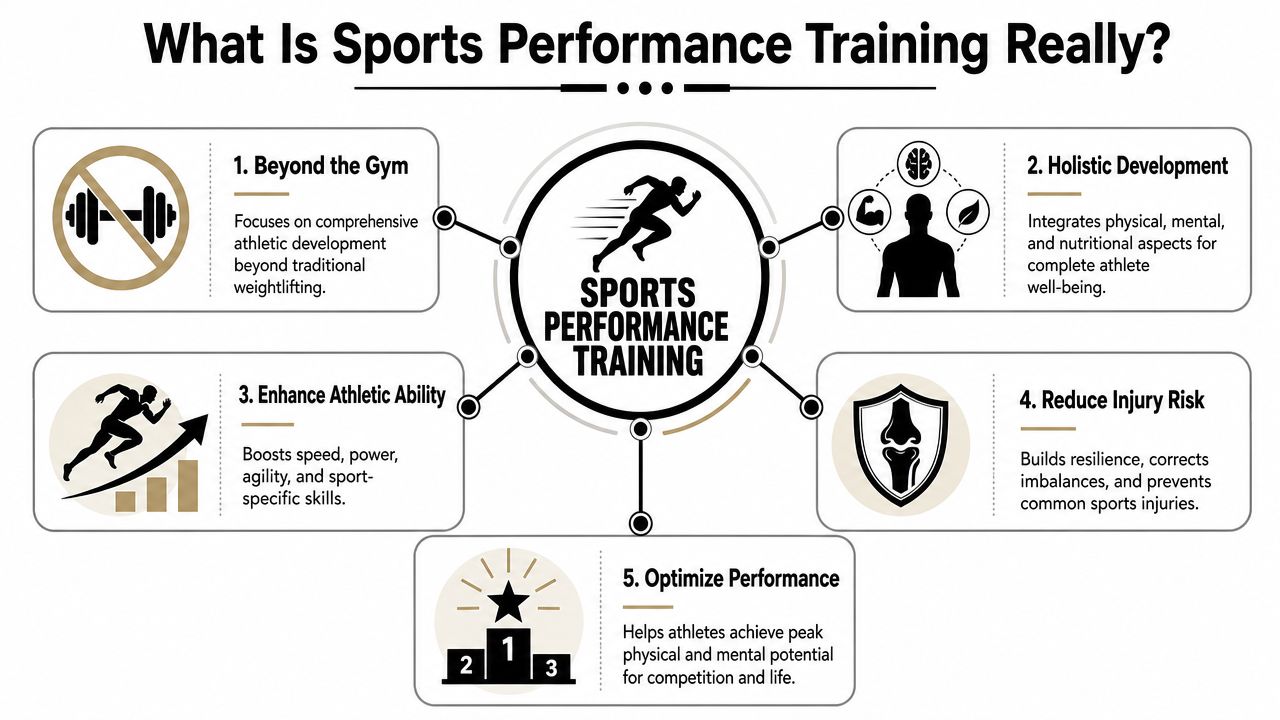
Sports performance training is goal-driven physical preparation for a sport, position, event, or active lifestyle demand. It isn't random exercise. It's a system.
A simple way to think about it is this. General fitness is like keeping your car clean, fueled, and running. Performance training is more like a pit crew tuning braking, traction, acceleration, and handling for the track you race on. Both matter, but they're not the same job.
More than general fitness
A standard gym program may help you feel stronger or fitter. That can be useful. But if you play hockey in Quincy, lacrosse in Scituate, baseball in Braintree, or tennis in Cohasset, you need more than general conditioning.
You may need to improve:
- Force production so you can sprint, cut, jump, or accelerate more effectively
- Movement efficiency so wasted motion doesn't slow you down
- Joint control so your body handles landing, deceleration, and directional change with less stress
- Resilience so repeated practices and games don't keep pushing the same weak link
That's why good sports performance training usually blends coaching, movement analysis, strength work, power work, and recovery planning.
What the work is trying to change
The goal isn't to make every athlete look the same. The goal is to improve the qualities that matter for that person.
For a middle school athlete, that may mean building basic coordination, balance, and safe strength habits. For a high school player chasing varsity minutes, it may mean more explosive movement and better change-of-direction control. For an adult returning to rec softball or training for a local race, it may mean getting stronger without aggravating a knee, hip, or Achilles tendon that's been unreliable.
A strong program also respects the difference between training hard and training well.
Practical rule: If a program can't explain why you're doing a drill, how it connects to your sport, and what progression comes next, it's probably not specific enough.
This is also where clinical thinking matters. The body doesn't separate performance from injury history as neatly as marketing pages do. If you've had ankle sprains, ACL rehab, recurring hamstring strains, or low back flare-ups, your training plan has to account for that history. Otherwise, “performance” work can inadvertently become overload.
The Building Blocks of an Effective Training Program
A solid sports performance program should look organized on paper and even more organized in practice. Sessions shouldn't feel random from week to week. There should be a reason for the exercise choices, the volume, the rest periods, and the progressions.
The pieces that should be in the plan
Most effective programs pull from the same core buckets, but they scale them differently depending on the athlete.
| Component | Why it matters | Example local fit |
|---|---|---|
| Strength work | Builds the force base behind speed and durability | Helpful for hockey, football, field sports, and adult return-to-running plans |
| Power training | Improves explosive movement | Useful for jumping, sprinting, and first-step quickness |
| Speed and agility | Trains acceleration, deceleration, and direction changes | Important for soccer, lacrosse, basketball, and court sports |
| Mobility and control | Improves positions the body can safely access | Often important for runners, lifters, and overhead athletes |
| Conditioning | Matches the demands of the sport or event | Different for a distance runner than for a short-shift field athlete |
A runner training around Plymouth, for example, may spend less time on pure lateral agility and more time on lower-body strength, trunk control, calf capacity, and impact tolerance. If you want a simple outside resource that lines up with that thinking, these essential exercises for runners offer a practical starting point.
What structure looks like in real life
Evidence matters here because it keeps training from becoming guesswork. NASM summarizes that two to three sessions per week for each major muscle group is sufficient for strength and hypertrophy development. The same summary notes that endurance athletes can benefit from 2 to 4 resistance exercises at 40 to 70% of 1RM, paired with plyometric training 2 to 3 times per week for at least 8 to 12 weeks. Those guidelines are outlined in NASM's review of sports performance training principles.
That tells you something important. Effective performance work usually has a defined weekly rhythm and a real progression window. It isn't “show up and sweat.” It's dosage.
A good plan also includes recovery logic. If an athlete has heavy practices, tournament weekends, or a school-season schedule that already creates a lot of fatigue, the performance work has to fit around that load. More isn't always better. Better planned is better.
For a deeper local discussion of the rehab side of this topic, Peak's article on how to prevent sports injuries is a useful next read.
- Early phase focus: Clean up movement quality, build foundational strength, and find what the athlete tolerates well.
- Middle phase focus: Layer in more power, faster intent, and sport-relevant patterns.
- Later phase focus: Make drills look and feel closer to game demands, without losing control of recovery.
Who Can Benefit from Sports Performance Training
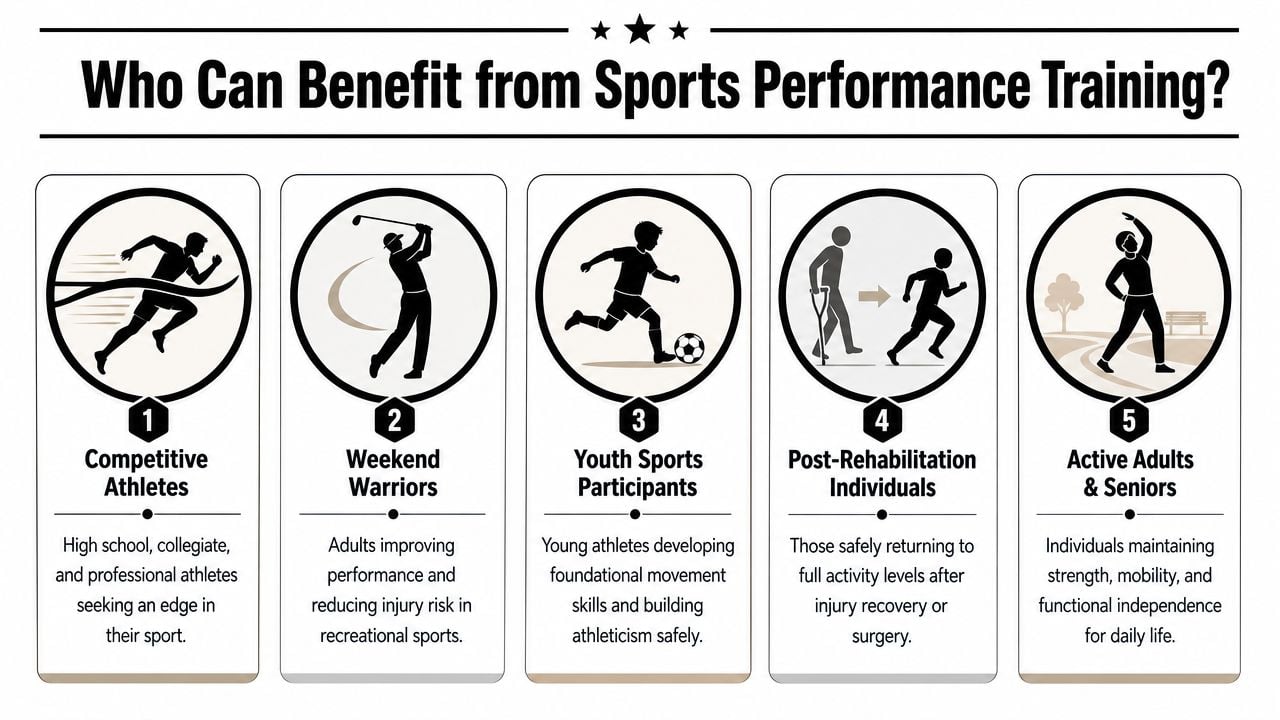
A lot of people hear “sports performance” and picture only high-level athletes. In practice, the group is much broader across the South Shore.
Local athletes and active adults
Take a few common South Shore examples.
A youth hockey player in Quincy may need better hip strength, edge control support, and change-of-direction mechanics so the season doesn't become a cycle of groin tightness and missed practices. A high school lacrosse player in Scituate may be fast in a straight line but lose efficiency when decelerating or cutting. A soccer player in Hanover might already work hard, but still need coaching on landing and trunk control to translate strength into cleaner movement.
Adults fit this picture too. The Kingston weekend softball player who tweaks a hamstring every spring benefits from performance work. So does the Norwell tennis player who wants more rotation power without stirring up back pain. So does the Plymouth runner who wants to train consistently instead of stringing together good weeks and setback weeks.
Better movement quality often feels less dramatic than a hard workout. It's also what lets many athletes keep training long enough to improve.
Performance training is not just for elite players
Some of the most appropriate candidates are people in transition:
- Post-rehab athletes: Someone in Pembroke coming back after ACL surgery or a major ankle injury needs a bridge between “pain is down” and “I trust my body again.”
- Growing athletes: Middle and high school players often need structure during growth spurts, when coordination can temporarily feel off.
- Active older adults: Golfers, pickleball players, and recreational athletes often want strength and balance that carry into both sport and daily life.
- Busy adults returning to exercise: They usually need a plan that respects prior injuries, work stress, and inconsistent recovery.
This is one place where a physical therapy lens can matter. Peak Physical Therapy and Sports Performance offers sports rehab and return-to-play programming across South Shore clinics, which can make sense for athletes and active adults who need training that considers both performance goals and injury history.
Not everyone needs the same environment. Some people do well in group settings. Others need one-on-one progression because their body has too many variables right now for a generic template to work. The key is matching the setup to the person.
How to Choose the Right Provider in South Shore MA
A parent in Quincy might hear “injury prevention” at a speed clinic and assume every program is built the same. They are not. The difference usually shows up a few weeks later, when one athlete is training with a clear plan and another is piling hard sessions on top of hockey practice, school lifting, and weekend games.
Start by asking how the provider screens movement and how they decide what comes next. A good program should not jump straight to ladders, jumps, and sprint work without first looking at control, landing mechanics, side-to-side differences, and training history. That matters for performance, but it also matters for safety.
A 2025 systematic review on youth athletic development found that neuromuscular training can reduce lower-extremity injury risk when it is coached well, performed consistently, and placed appropriately within the athlete's overall schedule. That last part gets missed all the time. The exercise menu is only part of the program. The timing, supervision, and weekly workload matter just as much.
That is why I would look past the highlights on social media and ask for specifics.
What a provider should be able to explain
A strong provider should be able to tell you, in plain language:
- How athletes are assessed before training starts
- How exercises are progressed from simple to demanding
- How in-season volume is adjusted
- How previous injuries change programming
- Who is supervising sessions and making decisions
Those answers should sound clear and practical, not vague or performative.
Questions worth asking before you commit
Ask direct questions. The quality of the answers usually tells you a lot.
- Who oversees the program: Credentials matter more when the athlete has pain, a surgery history, or repeated setbacks.
- How individualized is the plan: Group training can work well, but a middle school soccer player in a growth spurt does not need the same progression as a Duxbury Beach Race runner building power and durability.
- How is in-season training handled: Good programs account for games, practices, tournaments, and fatigue. They do not push max intensity every week of the year.
- What happens if pain starts during training: There should be a process for modifying, reassessing, and deciding whether the athlete should keep going or get evaluated.
Clinical training can help here because return-to-sport decisions, load management, and movement assessment all sit close to physical therapy practice. If you want a practical checklist, this guide on how to choose a physical therapist is useful.
One more point matters on the South Shore. Logistics shape results. A solid program has to fit real life. School schedule, club schedule, commute, sleep, and recovery all affect how much training an athlete can absorb. The right provider accounts for those trade-offs instead of pretending more work is always better.
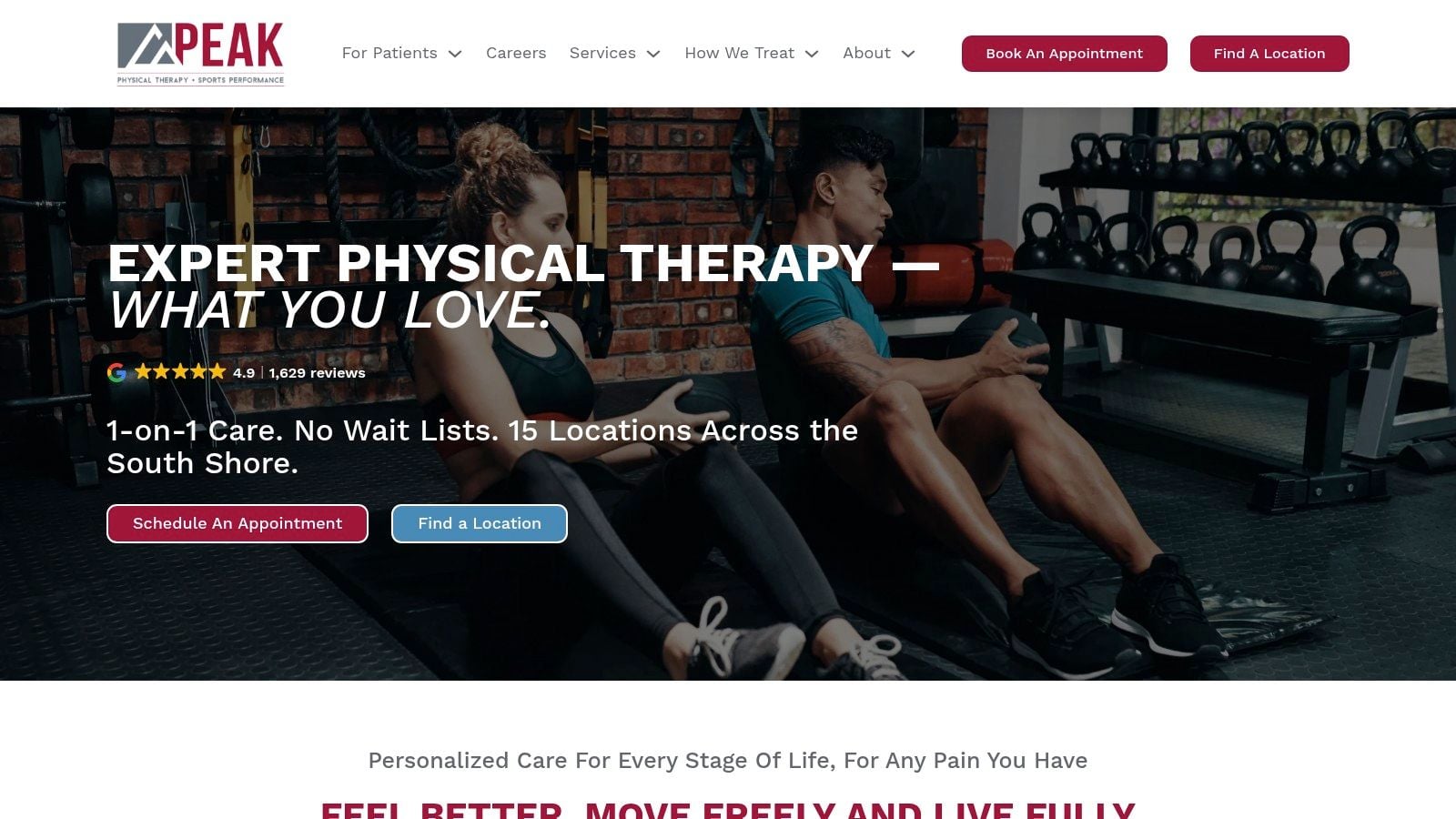
Your First Visit at Peak Physical Therapy
For many people, the first appointment is the biggest hurdle because they don't know what to expect. The process should feel clear, not mysterious.
What happens first
At an initial visit, the first priority is understanding your goal. That sounds obvious, but it changes everything.
A high school athlete trying to get quicker for preseason testing needs a different plan than an adult returning to tennis after an ankle sprain. A runner training for a local event needs a different setup than a post-op field athlete rebuilding confidence in cutting and landing. The evaluation should start with your sport, your current routine, your injury history, and what defines “success” for you.
From there, the therapist typically looks at movement. That may include mobility, control, balance, landing mechanics, force production patterns, and side-to-side differences. If pain is part of the picture, that gets folded in early rather than ignored.
How the plan gets built
After the assessment, the program should feel personalized, not copied and pasted.
That usually includes a few elements:
- A clear starting point: What you do well, what needs work, and what needs to be protected right now
- Short-term priorities: The first pieces to address so you can train productively
- A progression path: How the work will become more demanding as your tolerance improves
- Practical scheduling: A plan that fits school, practices, games, work, and family life
For readers who want a closer look at the overlap between rehab and athletic development, Peak's overview of sports physical therapy on the South Shore gives helpful context. For broader educational content on recovery, anatomy, and return-to-activity topics, Highbar Health has deeper resources at highbarhealth.com.
The most reassuring part for most athletes and parents is this. You don't need to show up already fit enough or coordinated enough. You just need a starting point that makes sense, plus a plan that can move with you as you improve.
Common Questions About Sports Performance Training
A parent in Weymouth might ask after a weekend tournament, “Does my kid need this, or do they just need more ice time?” An adult training for the Duxbury Beach Race might wonder if performance work is only for college athletes. Those are fair questions, and the right answer usually comes down to goals, injury history, and how the body is moving right now.
Quick answers to practical concerns
Is this only for serious athletes?
No. Sports performance training helps youth athletes, adult recreational athletes, runners, and people returning from injury who want to build capacity safely. That matters on the South Shore, where the goal is often not just better speed or power, but fewer setbacks during a long season.
How is this different from a gym trainer?
A good performance program connects training to your sport, your movement patterns, and your injury risk. For a Quincy hockey player, that may mean looking at cutting, landing, and hip control. For a runner, it may mean stride mechanics, calf strength, and load progression. The work should have a reason behind it, not just make you tired.
What if I'm coming back after surgery or an old injury?
That is often where structured performance training helps the most. A lot of athletes finish rehab with less pain but still need work on force production, deceleration, balance, and confidence under speed. If those pieces get skipped, the return to full play can feel shaky, even when daily life feels fine.
Does this kind of training help reduce injury risk, or is it just about performance?
Both. The stronger programs use neuromuscular training principles, which means practicing how the body controls position, absorbs force, changes direction, and reacts under fatigue. That is the part many families care about most. Better output is great, but staying available for the season matters more than shaving a tenth off a sprint.
Has sports performance training been part of the South Shore for a while?
Yes. Dedicated athlete development has been part of the local sports community for years. The approach has also matured. Current programs are less about random hard workouts and more about sport-specific progressions, movement quality, and reducing avoidable injuries.
What should I wear or bring?
Wear comfortable athletic clothes and shoes you can move in. Bring any relevant imaging reports, post-op instructions, or notes about recent injuries if you have them. If you play a field or court sport, it also helps to share what positions you play and what movements tend to bother you.
If you're looking for sports performance training South Shore MA athletes and active adults can use, the next step is a professional evaluation that matches training to your body, your sport, and your goals. Peak Physical Therapy and Sports Performance has clinics across the South Shore, including Quincy, Weymouth, Pembroke, Plymouth, Hanover, Norwell, Scituate, Braintree, Cohasset, Duxbury, East Bridgewater, Kingston, and Milton. Book an appointment to get a plan built around how you want to move, compete, and stay in the game.