


A lot of South Shore sports injuries start with a small decision that didn't seem like a big deal. You finish a run near Duxbury Beach and feel that tug in your calf. Your middle school pitcher in Quincy says their elbow “just feels tight.” You tweak a knee in a local basketball league and expect it to settle down by next week.
Sometimes it does. Often, it doesn't.
That's where sports physical therapy South Shore MA becomes different from just waiting things out. The right plan doesn't only calm pain down. It helps you move well again, rebuild confidence, and get back to the things that make life here feel like life here, from youth sports and weekend road races to golf, tennis, strength training, and coastal recreation.
Table of Contents
- Your Partner in Recovery on the South Shore
- How Sports Physical Therapy Goes Beyond Basic Rehab
- Our Advanced Services for Peak Performance
- Common Conditions We Treat From Plymouth to Braintree
- Your Recovery Journey with Peak Physical Therapy
- Find a Peak Sports Therapy Clinic Near You on the South Shore
- Frequently Asked Questions
Your Partner in Recovery on the South Shore
You feel the ankle on the stairs Monday morning. By Tuesday, your child has practice, your commute is still there, and the weekend race or league game is getting closer. That is how sports injuries usually show up on the South Shore. They do not happen in isolation. They interrupt routines people care about.
A South Shore athlete usually has a specific goal. A high school soccer player wants to finish the season. A runner wants to train without knee pain on hills or uneven paths. A parent wants a clear answer about safe return to baseball, lacrosse, or hockey, not vague reassurance.
Context shapes quality care. Rehabilitation for individuals balancing work, school, family schedules, and a full sports calendar must reflect real-world demands. At Peak Physical Therapy and Sports Performance, sports physical therapy is designed around the way people in this region move, from youth sports in Braintree and Plymouth to beach runs, surfing, paddle sports, and adult leagues along the coast.
Local goals matter more than generic recovery
The first question is often simple. What are you trying to get back to?
The answer changes the plan. A Scituate surfer with shoulder pain needs different loading and control work than a Plymouth runner dealing with Achilles irritation. A student-athlete returning to cutting sports after a knee injury needs more than basic exercise. They need to rebuild timing, confidence, and movement quality that holds up outside the clinic.
That is also why local injury prevention advice matters. Runners training on roads, trails, and beach terrain often do better when they adjust mileage, surfaces, and recovery habits early. Peak shares practical guidance in this article on how to prevent sports injuries, and some athletes also look at outside resources like Visual Sales Pitch Strategy for running gear when they are sorting through footwear and training changes.
Recovery should fit the South Shore lifestyle
Sports rehab should fit your week, not just your appointment slot.
That means accounting for long commutes, school schedules, tournaments, road races, lifting before work, and the extra strain that comes with coastal recreation. Sand, hills, cold-weather deconditioning, and repeated overhead activity all change what recovery looks like. A shoulder irritated by paddling or swimming often responds well to a different progression than a shoulder aggravated by throwing. A runner with joint irritation may need lower-impact loading first, which is one reason aquatic therapy can be useful. Someone with persistent muscle tightness that is limiting motion or training tolerance may benefit from dry needling as part of a broader plan, especially when it helps them move better enough to strengthen well.
The point is not to do more treatment. The point is to choose the right treatment for the demands waiting outside the clinic.
If rehab does not match the sport, the season, and the way life works on the South Shore, people often feel decent in a controlled setting and then flare up when practice, hills, sand, or game speed return. A better plan gives you a realistic path back to the activities you care about.
How Sports Physical Therapy Goes Beyond Basic Rehab
You finish a few weeks of rehab and day-to-day pain is better. Then you try to open up your stride on Duxbury Beach, cut during a rec league game in Quincy, or throw hard at practice, and the problem shows up again. That is the point where sports physical therapy needs to do more than calm symptoms.
Basic rehab often focuses on comfort with daily tasks. Sports physical therapy focuses on capacity. The goal is to rebuild your ability to sprint, decelerate, jump, rotate, change direction, and repeat those efforts without your body breaking down later that day or the next morning.

What sports rehab changes
A good sports rehab plan looks past the painful area and checks the full chain around it. If a South Shore runner has persistent knee pain, the underlying problem may include hip weakness, poor load tolerance, training errors, or trouble controlling impact on hills and uneven ground. If a swimmer or paddler has shoulder pain, we also look at thoracic mobility, shoulder blade control, and how the tissue handles repeated overhead work.
That matters here. South Shore athletes are not training in a vacuum. Youth players move from school sports to club schedules. Adult athletes mix gym work with road races, pickup basketball, hockey, golf, tennis, surfing, paddling, and beach running. Sand changes loading. Cold months change conditioning. Long tournament days test endurance in a way a clinic table never will.
Sports PT also uses the right tool for the stage of recovery. An irritated runner or field athlete who is not ready for full land impact may benefit from aquatic therapy to restore movement and build tolerance with less joint stress. An athlete whose motion is being limited by stubborn muscle guarding may do better once dry needling helps reduce that barrier enough to strengthen well. Those services are not add-ons for the sake of doing more. They are options that fit a specific problem.
For runners, prevention work belongs in the same conversation as rehab. Footwear choices, training volume, and surface changes all affect load, which is why practical resources like this Visual Sales Pitch Strategy for running gear can help alongside a personalized treatment plan. Peak also shares more local guidance in this South Shore sports injury prevention article.
What tends to stall progress
A few patterns show up again and again in athletes who feel better but are not ready to return:
- Stopping once pain drops: Pain relief helps, but strength, balance, power, and repeated effort still need to be rebuilt.
- Relying only on passive treatment: Hands-on care can settle symptoms, but active retraining is what restores performance.
- Skipping sport-specific demands: If rehab never includes cutting, landing, sprinting, rotation, or overhead loading, return to play is still a guess.
- Ignoring the local environment: A plan that works on flat clinic flooring may fall apart on sand, hills, turf, hardwood, or water.
I often tell patients that feeling okay is only one checkpoint. Readiness means your body can handle the actual demands waiting outside the clinic, whether that is a youth soccer tournament in Plymouth, rec basketball in Braintree, or a weekend run along the coast.
Our Advanced Services for Peak Performance
The right service depends on the stage of recovery and the demands waiting outside the clinic. A middle school soccer player in Hingham, an adult runner training for a local road race, and a surfer dealing with shoulder pain after a choppy weekend near the coast may all need very different plans, even if they share the same diagnosis on paper.
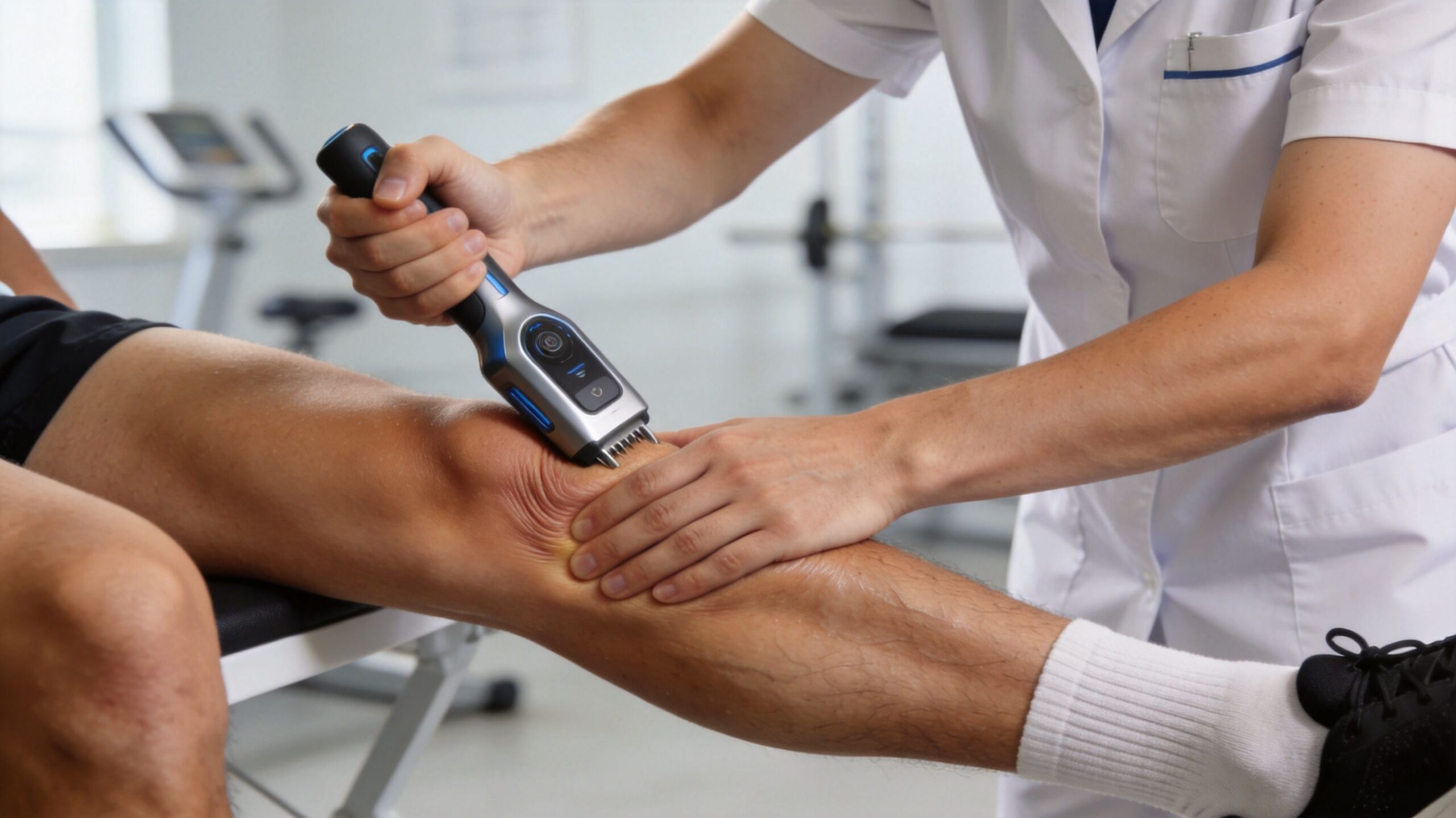
Return-to-play and post-surgical progression
Return-to-play work builds the physical skills an athlete uses. That may include landing, cutting, changing speed, rotating, pushing off one leg, or repeating effort without swelling or soreness building up later.
After surgery, the sequence matters. Early treatment often focuses on restoring motion, calming irritation, improving muscle activation, and helping the joint tolerate load again. Later, the work becomes more demanding and more specific to the person's sport or routine. A baseball player needs different progressions than a rec league basketball player. A beach runner needs different loading strategies than someone returning to indoor court sports.
Runner's knee is a good example. The knee is often only part of the problem. We also look at hip strength, trunk control, stride habits, training volume, and the surfaces the runner uses across the South Shore. Better movement at the hip and foot can reduce stress at the knee and make each step feel more stable.
For athletes who need structured progression beyond basic rehab, sports performance training support for return to activity can help bridge the gap between feeling better and performing with confidence.
Dry needling and aquatic therapy for local athletes
Dry needling is useful in the right situation. If a calf, hip, shoulder, or forearm is staying guarded and limiting normal movement, it can help reduce that protective tension so strengthening and movement retraining go better. I tell patients the same thing every time. It can make exercise easier to tolerate, but it does not replace exercise.
Aquatic therapy is one of the most practical tools we have for South Shore patients who need to keep moving while reducing impact. Water can be a strong fit after surgery, during flare-ups of joint pain, or in the early phase of returning from a running or overuse injury. It lets people work on gait, balance, mobility, and conditioning with less irritation than land-based exercise.
That matters here because local activity is not limited to organized sports. People walk long beaches, carry paddleboards, play summer tennis, train for fall races, and spend hours on uneven ground. Coastal recreation asks a lot from the ankles, hips, shoulders, and core. Articles like this one on balance training for surfers reflect the same principle we use in clinic. Better balance and body control support safer movement on unstable surfaces.
The service matters less than the match. We choose the tool that fits the problem, then build treatment around getting you back to the way you live and move on the South Shore.
Common Conditions We Treat From Plymouth to Braintree
A soccer player from Braintree rolls an ankle on a wet field. A runner in Plymouth tries to push through nagging Achilles pain before a local race. A middle school pitcher starts saying his elbow only hurts after games. Those are different problems, but the question is usually the same. How do I get back without making this linger for months?
On the South Shore, injuries are shaped by the way people live here. Kids often play overlapping seasons. Adults squeeze training around work and family. Weekend activity can mean basketball, road races, tennis, lifting, beach runs, or long hours on uneven sand. That mix creates a pattern we see every week in clinic. Pain rarely shows up as one neat diagnosis. It usually comes with stiffness, swelling, compensation, and some hesitation about returning to full speed.
Injuries tied to South Shore activities
Certain conditions come up often from Plymouth to Braintree because the local routine places repeat stress on a few key areas:
- Running and road racing injuries: Patellofemoral knee pain, Achilles tendinopathy, calf strains, plantar fascia irritation, and bone stress reactions
- Court and field sport injuries: Ankle sprains, ACL injuries, meniscus irritation, hamstring strains, and shoulder pain from throwing or contact
- Strength training problems: Low back pain, hip pinching, shoulder pain with pressing, and tendon irritation from rapid training increases
- Coastal recreation complaints: Balance-related ankle injuries, lower leg overload, and shoulder irritation from paddling, carrying gear, or repeated overhead use
We match treatment to the problem and to the activity you want back.
| Common Activity / Injury | Primary Peak Service | How it helps |
|---|---|---|
| Running-related knee pain | Sports rehab and movement retraining | Builds load tolerance, improves stride mechanics, and makes return to running more predictable |
| Ankle sprain from court sports | Manual therapy and balance progression | Restores mobility and stability for cutting, landing, and quick changes of direction |
| Post-op knee recovery | Structured post-surgical rehabilitation | Rebuilds strength, motion, and confidence step by step |
| Shoulder pain from tennis or overhead sport | Dry needling plus targeted strengthening | Reduces protective muscle tension and improves controlled overhead movement |
| Stress-related lower leg pain | Aquatic therapy and graded loading | Lets you keep conditioning up while impact is added back gradually |
| Rec league or adult weekend athlete flare-ups | Return-to-sport progression | Closes the gap between feeling better in daily life and tolerating game speed |
Two services matter a lot for common South Shore cases. Dry needling can help when a shoulder, calf, or hip is staying guarded and making exercise harder to do well. Aquatic therapy is useful for runners, post-op patients, and athletes with joint irritation who need to keep moving with less impact while strength and tolerance build back up.
Youth sports need a different plan
Youth athletes on the South Shore need a plan that fits growth, school schedules, and the demands of year-round sports. Baseball, soccer, basketball, lacrosse, hockey, and club play can stack stress on the same body part before it has fully recovered from the last season.
That is why overuse injuries matter so much in this area.
A teenager with Osgood-Schlatter symptoms, heel pain, or throwing-related elbow pain usually does better with clear activity limits, specific strength work, and honest return-to-play guidance than with complete rest or a generic exercise sheet. The trade-off is real. Rest alone may calm symptoms for a week, but it often does not fix the movement or loading issue that brought the athlete in. Pushing through can turn a mild problem into one that affects the whole season.
Young athletes are not smaller adults. They need instruction that makes sense to them and to their parents.
When a young athlete says, “It only hurts a little,” that usually means it is time to look closer, not speed things up.
Your Recovery Journey with Peak Physical Therapy
A good rehab process should feel organized from the start. You shouldn't have to guess what the next visit is for, whether you're making progress, or how close you are to getting back to your sport.
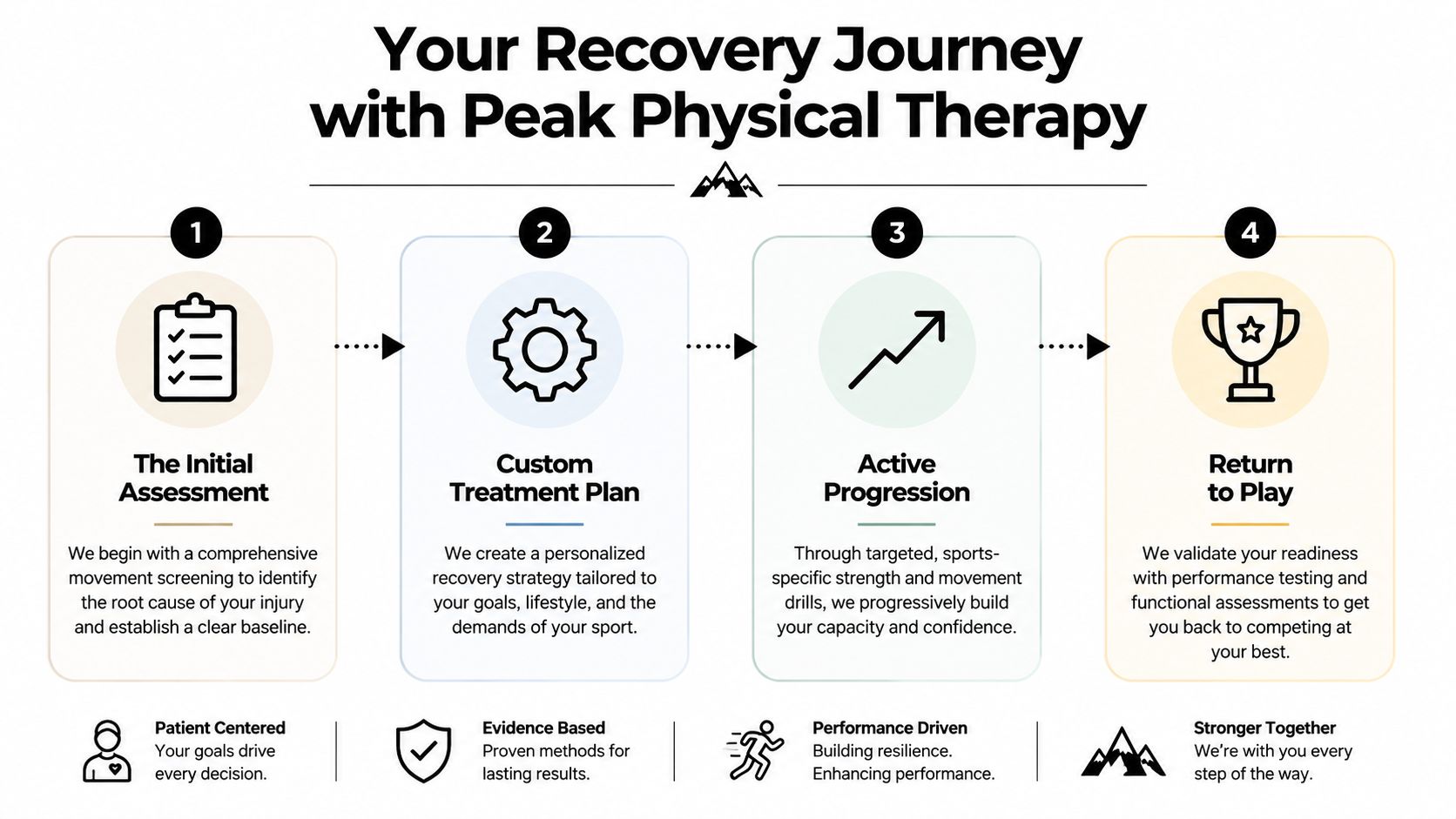
Step one and step two
The first visit is about listening, testing, and connecting the dots. Pain location matters, but so do training habits, movement patterns, sport demands, prior injuries, and the specific activity you want back.
From there, your plan should make sense on paper and in real life.
Initial assessment
Your therapist looks at how you move, what reproduces symptoms, what feels weak or guarded, and what your goals are.Custom treatment plan
The plan should match your schedule and your sport. Someone preparing to return to beach running needs different progressions than someone getting back to weight training or baseball.
Step three and step four
The middle of rehab is where consistency matters. This is usually a mix of hands-on care, strengthening, movement correction, and graded return to more demanding tasks.
4 clear markers tend to matter most:
- Pain response: Are symptoms settling faster after activity?
- Movement quality: Do squats, step-downs, reaches, or overhead patterns look more controlled?
- Strength and tolerance: Can you handle more load, distance, or repetition?
- Sport readiness: Can you do what your activity requires?
Then comes the final step.
Active progression
The work progresses to resemble your real activity. Running drills, landing work, directional changes, overhead control, or repeated loading come back in a measured way.Return to play
Returning doesn't mean hoping for the best. It means you've built enough capacity to step back into practice, competition, training, or recreation with a plan.
Some people move through that process quickly. Others need more time because life, pain irritability, surgery, or schedule demands slow things down. The timeline matters less than whether the plan is moving you toward something meaningful.
Find a Peak Sports Therapy Clinic Near You on the South Shore
Convenience matters more than people admit. Even a strong rehab plan can fall apart if care is too far away, hard to schedule, or unrealistic for your weekly routine.
That's why local access is a major part of effective sports physical therapy South Shore MA care. Whether you live closer to the coast or inland, expert treatment should be within reach of your home, work, school, or training route.

Care close to home
Peak clinics serve patients across the South Shore in:
- Braintree
- Quincy
- Weymouth
- Cohasset
- Duxbury
- East Bridgewater
- Hanover
- Kingston
- Milton
- Norwell
- Pembroke
- Plymouth
- Scituate
If you're searching for care near Braintree, you can start with the Peak Braintree physical therapy clinic page. The same local convenience applies across the broader South Shore network, which helps people stay consistent with treatment instead of dropping off after the first few visits.
What to do next
When you're choosing a clinic, keep it simple:
- Pick the location you can get to. Consistency beats good intentions.
- Look for the service that matches your problem. Sports rehab, post-surgical rehab, aquatic therapy, pediatric PT, and dry needling all serve different needs.
- Ask about insurance verification early. That removes a common delay.
- Book before the issue gets older. A small compensation pattern can become a bigger problem if you keep training through it.
If your knee, shoulder, ankle, hip, or lower leg is already changing the way you move, this is the right time to act.
Frequently Asked Questions
Do I need a doctor's referral to start physical therapy
In many cases, patients can start by contacting a clinic directly. Referral requirements can vary based on your insurance plan and your situation, so it's smart to ask when you schedule. The front desk can help you sort that out before your first visit.
What insurance plans do you accept
Insurance participation varies by clinic and plan. The easiest path is to contact the location you want to visit and ask for insurance verification before your appointment. That gives you a clearer picture of coverage and next steps.
What should I expect during my first visit
Expect a conversation first, then movement testing. Your therapist will want to know what hurts, what activities matter to you, what you've already tried, and what your recovery goals are. You'll usually leave with a working plan and a clearer idea of what's driving the problem.
How long does a typical treatment plan last
That depends on the injury, your activity goals, irritability level, and whether surgery is involved. Some people need a shorter burst of care. Others need a longer progression because the demands of their sport are higher or because they're returning from a more serious setback.
Is sports physical therapy only for competitive athletes
Not at all. Sports PT is useful for anyone trying to return to an active lifestyle that includes running, lifting, tennis, golf, rec leagues, beach activity, or youth sports. You don't need to be chasing a medal for your movement goals to matter.
What if I'm not sure whether my pain is serious enough for PT
That's common. Many people wait because they can still function, even if they're limping a little, avoiding certain movements, or changing how they train. If pain is lingering, recurring, or making you move differently, it's worth getting evaluated before the issue becomes harder to unwind.
If you're looking for sports physical therapy South Shore MA, Peak Physical Therapy and Sports Performance offers local care that fits real life on the South Shore. Whether you're trying to get back to school sports, rec league play, running, or coastal recreation, you can book an appointment at the clinic that's most convenient for you and start with a plan built around your actual goals.