

You notice it when you reach into a kitchen cabinet, pull on a sweatshirt, or try to get comfortable in bed. The shoulder catches. The ache lingers. By the end of the day, even simple things feel annoying.
Around Weymouth, that pain shows up in real life fast. It can ruin a round at Weathervane, make it hard to lift a kayak or beach gear, or turn a walk at Webb Memorial State Park into a constant reminder that something isn't right. If you've been searching for rotator cuff physical therapy Weymouth MA, you probably don't need another generic article. You need a clear local plan and a clinic that understands how to get your shoulder working again.
Table of Contents
- Living with Shoulder Pain on the South Shore
- Is It Your Rotator Cuff What to Look For
- Your Personalized Recovery Plan at Peak in Weymouth
- Advanced Techniques to Accelerate Your Healing
- How to Keep Your Shoulder Strong for Life
- Why Weymouth Residents Trust Peak Physical Therapy
- Your Questions About Rotator Cuff Rehab Answered
Living with Shoulder Pain on the South Shore
Shoulder pain has a way of shrinking your world. First you avoid the high shelf. Then you stop carrying groceries on that side. Then sleep gets choppy because every time you roll onto the sore shoulder, you wake up.

That's especially frustrating for people on the South Shore who want to stay active without overthinking every movement. Maybe you're trying to get through work without guarding your arm all day. Maybe you just want to toss a ball with your kid, get back to the gym, or sleep through the night without that deep shoulder ache.
Why local follow-through matters
A lot of people assume shoulder pain will settle down if they just “take it easy.” Sometimes it does. Often, it drags on because the problem isn't only irritation. It's weakness, stiffness, poor shoulder mechanics, or a tendon that isn't tolerating load well.
A 2024 national study on rotator cuff repair found that patients in the Northeast, including Massachusetts, were up to 33% less likely to receive rehabilitation, even though over 81% of patients nationwide utilized rehab after surgery, according to this rotator cuff repair rehabilitation study. That matters here in Weymouth because delayed or skipped rehab often means more pain, slower progress, and more uncertainty about what's safe.
Practical rule: Shoulder pain that changes how you sleep, reach, lift, or dress is worth getting assessed early.
Small daily problems turn into bigger ones
Rotator cuff issues rarely feel dramatic at first. They feel inconvenient. Then stubborn. Then limiting.
A few common examples I hear from South Shore patients:
- Overhead reaching hurts: putting away dishes, grabbing a bag from the back seat, or washing your hair becomes awkward.
- Night pain builds up: you're tired, but you can't find a comfortable position.
- Strength drops off: carrying laundry, lifting a pan, or pushing a door feels weaker than it should.
- You change how you move: shrugging, leaning, or using the other arm becomes your workaround.
If night pain is part of your problem, shoulder positioning during sleep can help reduce irritation. Some people also do better when they improve support and comfort for side sleepers so the shoulder isn't getting compressed for hours.
The good news is that shoulder rehab works best when it's specific. Not random stretches. Not internet guessing. A plan that matches your pain pattern, your strength loss, and your goals in Weymouth life.
Is It Your Rotator Cuff What to Look For
Not every sore shoulder is a rotator cuff problem. But there are some patterns that show up again and again.
The rotator cuff helps control the ball-and-socket joint of the shoulder while you lift, reach, and carry. When it's irritated or torn, the symptoms usually show up during ordinary tasks long before someone uses the words “rotator cuff.”
Signs that fit the pattern
These are the most common clues:
- Pain with reaching away from your body: putting groceries on the counter, reaching into the back seat, or lifting a coffee mug into a cabinet can trigger a sharp catch.
- Trouble raising your arm overhead: washing your hair, pulling on a shirt, or getting something off a shelf becomes harder than it used to be.
- Pain at night: especially when you roll onto that side or let the arm rest overhead.
- Weakness more than stiffness: the arm may move, but it doesn't feel reliable when lifting or lowering.
- Pain that lingers after activity: yard work, house projects, or a workout may leave the shoulder sore for hours afterward.
What usually doesn't work
People often try one of two extremes. They either push through everything and keep aggravating it, or they stop using the arm almost completely and get stiff.
Neither approach is ideal.
If your shoulder hurts every time you repeat the same motion, your body is giving you useful information. Listen to it before the problem gets more stubborn.
A better next step is getting the shoulder examined so you know whether you're dealing with tendon irritation, a tear, postural overload, or a motion problem. If you want a quick overview of the condition itself, our rotator cuff injury page is a good starting point.
When to stop waiting
It's time to book an evaluation if any of these are true:
- You've had shoulder pain for weeks and it isn't improving.
- Sleep is getting disrupted.
- You're avoiding work, exercise, or household tasks.
- Your shoulder feels weaker on one side.
- You're recovering from an injection, orthopedic visit, or surgery and need a plan.
Clarity helps. Patients often feel less anxious once they understand what's irritated, what movements are safe, and what recovery should look like week to week.
Your Personalized Recovery Plan at Peak in Weymouth
A good shoulder rehab plan should feel organized, not confusing. You should know what you're working on now, what comes next, and why certain movements are limited early on.
For many rotator cuff problems, a phased physical therapy plan can be as effective as surgery. In PT-only groups, pain scores dropped from 6.5 to 2.1 and functional scores improved substantially, with a key benchmark of 140° of forward arm elevation by week 12, based on the evidence summarized in this shoulder physical therapy resource. That's one reason a non-operative first approach often makes sense.
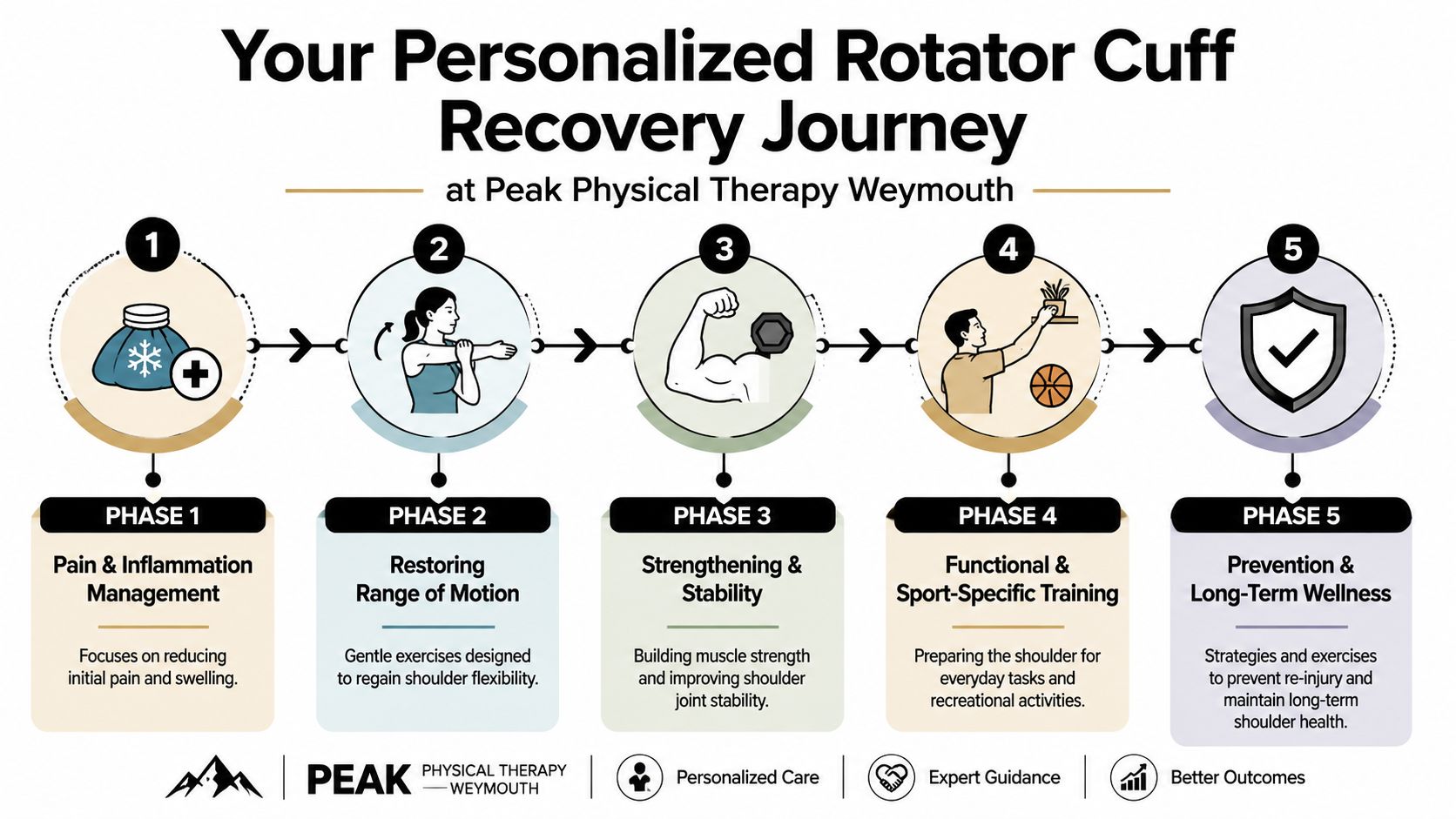
Phase 1 pain and inflammation management
Early rehab is about calming things down without letting the shoulder get lazy or guarded. If every motion is painful, jumping straight into hard strengthening usually backfires.
In this phase, treatment often includes:
- Activity modification: changing how you lift, reach, sleep, and work so the shoulder gets a chance to settle.
- Gentle mobility work: controlled motion to prevent the joint from stiffening up.
- Isometric muscle work: light activation that wakes up the cuff without overloading it.
If you've had surgery, this stage is even more important. Protecting healing tissue matters as much as reducing pain.
Phase 2 restoring motion and early strength
Once pain starts easing, the focus shifts. Now we want the shoulder to move more normally and the right muscles to start pulling their share.
That usually means:
- Active-assisted motion: helping the arm move without forcing it
- Scapular control work: improving how the shoulder blade supports motion
- Early strengthening: adding tolerated resistance before bad compensations take over
This is often the stage where patients say, “It still hurts, but it feels more usable.” That's progress.
Shoulder recovery isn't linear. A sore day after a new exercise doesn't automatically mean you've set yourself back.
Phase 3 advanced strengthening and return to activity
Here's where rehab gets more specific. A desk worker, golfer, parent lifting toddlers, and overhead athlete don't all need the same end-stage program.
Later-stage work usually includes:
- Progressive resistance: building strength through larger ranges
- Control under load: teaching the shoulder to manage reaching, carrying, and lowering
- Task-specific drills: movements that match your actual life on the South Shore
For someone getting back to housework, that may mean repeated overhead reaching. For someone returning to fitness, it may mean pressing, pulling, or controlled carries. For others, it's being able to sleep, drive, and get dressed without thinking about the shoulder every hour.
What patients usually need to hear
Recovery goes better when the plan is individual. Some people need more pain control. Some need more mobility. Some feel pretty mobile but have poor cuff strength and shoulder blade control.
That's why rotator cuff physical therapy Weymouth MA shouldn't be generic. The right program is based on your symptoms, your exam, your timeline, and what you need your arm to do.
Advanced Techniques to Accelerate Your Healing
Exercise is the foundation of rotator cuff rehab. But sometimes exercise alone isn't enough to move someone forward, especially when pain is limiting motion or the shoulder stays irritated after activity.
That's where targeted hands-on and adjunct techniques can help.
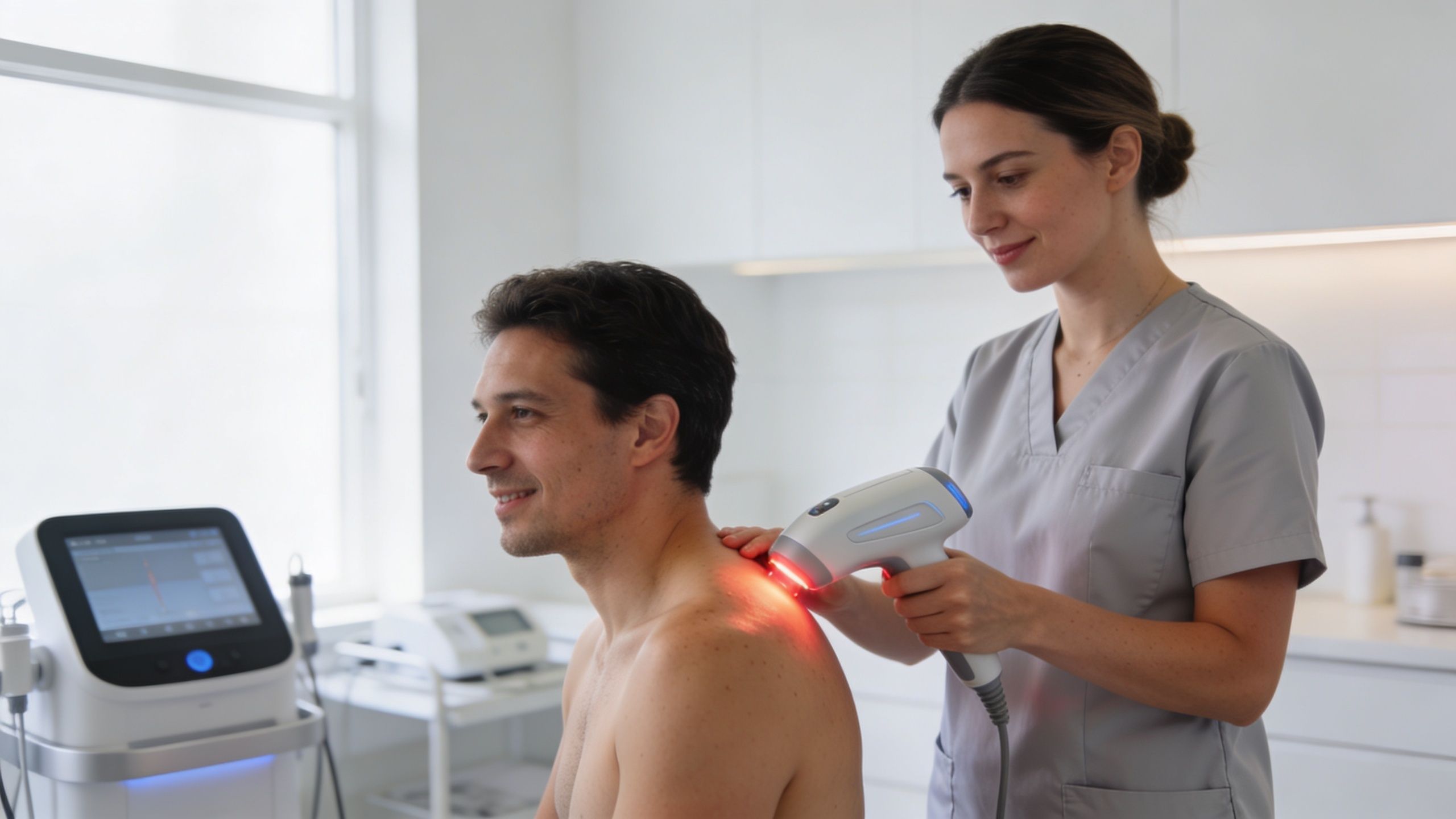
At South Shore clinics, Instrument-Assisted Soft Tissue Mobilization (IASTM) has been associated with a 35% greater improvement in shoulder abduction and a 28% reduction in pain compared with traditional methods, and the same source reports 85% return to normal activities within 12 weeks in the described protocol, as outlined in this shoulder pain treatment article.
When advanced care makes sense
These techniques are most useful when they solve a specific problem, not when they're added just to make the session feel busy.
A few examples:
- IASTM for restricted tissue movement: helpful when the shoulder feels bound up and painful with overhead motion.
- Joint mobilization for stiff mechanics: useful when the shoulder joint isn't gliding well and motion feels blocked.
- Neuromuscular re-education for poor control: important when the upper trap is taking over and the cuff isn't doing enough.
- Dry needling for persistent muscle guarding: a useful option when trigger points in the shoulder region keep limiting movement.
If you're curious about that last option, our dry needling treatment page explains how it fits into a broader rehab plan.
What works and what doesn't
What works is combining the right technique with the right exercise at the right time. Hands-on treatment can reduce pain and improve motion, but it won't hold if the shoulder still lacks strength and control.
What doesn't work is chasing passive treatment forever. Massage alone won't rebuild lifting tolerance. Modalities alone won't restore overhead strength. The shoulder has to relearn.
The fastest route isn't always the most aggressive one. It's the one that reduces irritation while steadily rebuilding capacity.
Nutrition can also support recovery, especially if you're training or trying to maintain strength while rehabbing. Patients who prefer plant-based eating sometimes ask what to focus on after sessions, so this guide to essential recovery foods for plant-based athletes can be a useful add-on.
The point of advanced treatment isn't to replace the basics. It's to help the basics work better.
How to Keep Your Shoulder Strong for Life
A common South Shore pattern looks like this. Shoulder pain settles down, formal PT ends, and life fills back in fast. A few weeks later, the same shoulder starts barking again when you lift a bag into the car, reach overhead in the kitchen, get back to the gym, or try to enjoy a paddle, yard work, or a long day on the water.
That usually is not a sign that rehab failed. It usually means the shoulder was feeling better before it was fully ready for the demands of normal life.
Formal physical therapy and long-term self-care are not the same job. In the clinic, we reduce irritation, restore motion, rebuild strength, and check that the shoulder is moving well. After discharge, the goal changes. You keep enough mobility, cuff strength, and shoulder blade control to handle work, exercise, and the activities you want to keep doing around Weymouth and the South Shore.
The mistake people make after discharge
The usual problem is not one bad workout. It is a slow drop-off in the habits that kept the shoulder improving.
Once pain eases, people naturally do less. That makes sense, but the rotator cuff still needs regular loading, especially if your routine includes lifting, reaching, golf, rowing, gym training, home projects, or repetitive tasks at work. A shoulder that feels 90 percent better can still lose capacity pretty quickly if it stops getting challenged.
A simple maintenance plan
The best long-term plan is short enough to keep doing.
| Exercise | Goal | Frequency |
|---|---|---|
| Wall push-ups | Build shoulder and scapular control | 2 to 3 times per week |
| Doorway stretch | Maintain chest and front-shoulder mobility | Most days |
| Theraband external rotations | Support rotator cuff strength | 2 to 3 times per week |
| Scaption raises | Improve overhead control | 2 to 3 times per week |
| Row variation | Balance shoulder blade strength | 2 to 3 times per week |
For many people, 10 to 15 minutes a few times per week is enough to protect the progress they earned in PT. The trade-off is simple. A smaller plan you follow works better than a perfect program you abandon after ten days.
How to make it stick
Keep your band where you can see it. Pair your exercises with something that already happens, like after a walk, before a shower, or right after the gym. If form starts slipping, cut the reps and clean up the movement first.
If you want examples of what a practical home routine can include, our rotator cuff exercise guide walks through common options.
Peak Physical Therapy and Sports Performance also provides patient resources that help people transition from supervised rehab to independent care. That handoff matters. Formal PT gets you back on track. Your home program helps you stay ready for everyday life in Weymouth, from work demands to weekend activity.
Home exercise works best when it is simple, repeatable, and matched to the way you actually live.
Why Weymouth Residents Trust Peak Physical Therapy
You feel it when you reach into the back seat, pull on a sweatshirt, or try to get comfortable in bed after a long day. Shoulder pain has a way of turning ordinary routines in Weymouth into constant reminders that something is off.
That is usually why trust matters so much in rotator cuff rehab. People want a straight answer about what is happening, what needs to change, and what kind of progress is realistic over the next few weeks, not vague reassurance.
At Peak Physical Therapy, that trust is built through the details. The shoulder gets examined carefully. The plan is matched to the person in front of us. If sleeping is the biggest problem, treatment needs to address that. If the goal is getting back to lifting at work, paddling, golfing, training, or handling weekend projects around the South Shore without that sharp pinch overhead, the program has to reflect real life in Weymouth.
What patients usually respond to is simple:
- Clear guidance: what structure looks irritated, what movements are safe, and what symptoms mean you should modify the plan
- Hands-on coaching: feedback on form, pacing, and load so exercises help instead of stirring things up
- Changes when recovery stalls: a program that adjusts if pain stays high, strength lags, or overhead motion is slower to return
- Care that fits local routines: appointments close to home make it easier to stay consistent through work, family, and commuting demands
Good rehab should make sense to you.
That also means being honest about trade-offs. Some shoulders calm down quickly with exercise and activity changes. Others need a slower build because the tissue is irritable, sleep is poor, or the job keeps stressing the arm. Formal PT is the part where we guide the progression, watch the mechanics, and make decisions based on how your shoulder responds. After discharge, the goal shifts. You are maintaining strength and control on your own so you can keep doing the things you enjoy around Weymouth without sliding backward.
If shoulder pain is changing how you sleep, work, lift, or stay active, getting it checked sooner usually makes the path clearer.
Your Questions About Rotator Cuff Rehab Answered
How long does rotator cuff PT take
It depends on whether you're dealing with irritation, a partial tear, a larger tear, or post-surgical rehab. Some people improve steadily over a shorter course. Others need a longer progression to restore strength and overhead tolerance. What matters most is matching the timeline to your actual exam and goals.
Will my insurance cover physical therapy in Weymouth
Many plans include outpatient physical therapy, but coverage details vary. The easiest next step is to book an evaluation and have benefits reviewed so you know what to expect before treatment begins.
Do I need PT if I'm having surgery
Yes. PT often matters before surgery and after surgery. Before surgery, it can improve motion, reduce guarding, and help you go in stronger. After surgery, rehab helps protect the repair while rebuilding motion, strength, and function over time.
What if I'm not sure it's my rotator cuff
That's common. Shoulder pain can come from several structures that feel similar at home. A focused exam helps sort out what's driving your symptoms and what kind of plan makes sense.
If you're ready to stop working around shoulder pain and start addressing it directly, schedule an evaluation with Peak Physical Therapy and Sports Performance. Our South Shore team can help you build a practical recovery plan for life in Weymouth, whether your goal is sleeping comfortably, getting through work, or returning to the activities you miss.