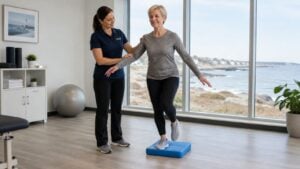
You get home after surgery, settle into the recliner, and realize the procedure was only one part of the process. The discharge papers are on the counter. Your leg feels heavy, your shoulder feels guarded, or your knee is stiff every time you try to stand. You're relieved the surgery is behind you, but now key questions start. When do you begin therapy? Where should you go? What if getting in and out of the house still feels hard?
That's a familiar moment for people across the South Shore. We see it with someone in Quincy trying to manage stairs, a parent in Pembroke wondering how soon they can drive again, or a retiree in Duxbury who just wants to get back to walking the beach without feeling unsteady. The early days after surgery can feel confusing, especially when instructions are short and life at home is not.
If you're searching for post surgical rehab on the South Shore, MA, you probably don't want a generic explanation of exercises. You want to know how recovery works here, what your first outpatient visit looks like, and how to move from hospital discharge to a clear plan. If you also want a town-specific starting point, this look at physical therapy in Braintree, MA can help you orient locally too.
Table of Contents
- Your Guide to Post-Surgical Rehab on the South Shore
- What Post-Surgical Rehab Actually Aims to Achieve
- Recovery Timelines for Common Orthopedic Surgeries
- Navigating Your First Appointment in the South Shore
- What to Expect During Your Rehab Sessions
- Why Choose Peak for Your South Shore Recovery Journey
- Frequently Asked Questions About Post-Surgical Rehab
Your Guide to Post-Surgical Rehab on the South Shore
A lot of people think recovery starts when the incision closes. In real life, recovery starts when you need to get out of bed safely, walk to the bathroom without panicking, and figure out how to move through your own house again.
On the South Shore, those details matter. Daily life here isn't abstract. It's getting into the car for a follow-up in Weymouth, carrying groceries in Quincy, managing front steps in Milton, or getting back to a walk along the shoreline in Scituate. Surgery may fix the structural problem, but rehab is what helps you trust your body again.
Recovery has to fit real life
Post-surgical rehab works best when it's tied to the things you need to do. For one person, that means walking without a limp. For another, it means getting off a low couch without using both arms. For someone else, it means returning to youth sports sidelines, errands, work, or a commute that suddenly feels longer than it used to.
Most people don't need a more complicated recovery plan. They need a clearer one.
That's especially true after orthopedic surgery. You're often balancing pain, swelling, precautions from your surgeon, sleep disruption, transportation issues, and insurance questions at the same time. A useful rehab plan has to account for all of that, not just the joint that was operated on.
What people usually want to know first
The first questions are usually practical:
- When should therapy start if you still feel sore and stiff?
- Which setting makes sense if home is hard to manage right now?
- What happens at the first visit once you get to an outpatient clinic?
- How will progress be measured so you know you're not just going through motions?
Those are the questions that shape a good start. And around the South Shore, they're easier to answer when your rehab team understands the local hospital system, common discharge pathways, and the day-to-day logistics patients are dealing with after surgery.
What Post-Surgical Rehab Actually Aims to Achieve
Surgery changes tissue. Rehab helps you use your body well again.
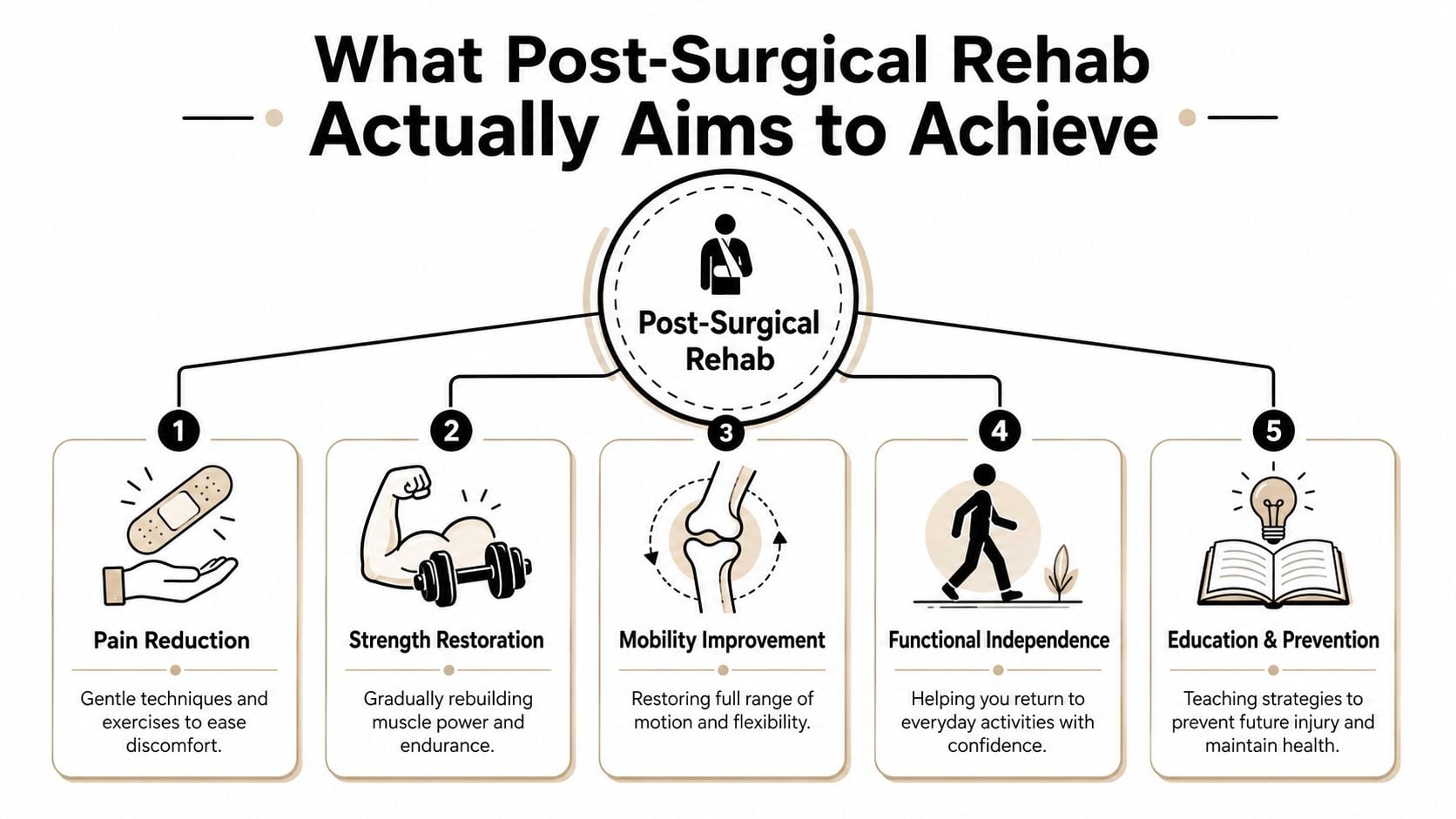
That sounds simple, but it matters. The point of post-surgical rehab isn't just to “do exercises.” It's to rebuild movement, strength, control, and confidence in a way that respects healing while preventing the stiffness and weakness that can pile up fast after an operation.
Recovery is about function, not just healing
When people come in after surgery, they usually care about a handful of very concrete things:
- Less pain and swelling so normal movement doesn't feel threatening
- Better mobility so the joint starts moving without as much guarding
- More strength and control so walking, stairs, reaching, or transfers feel safer
- More independence with home tasks, work tasks, and community mobility
- Better understanding of what to do at home between visits
Those goals are connected. If swelling stays high, motion often stays limited. If motion stays limited, strength work gets harder. If strength lags, everyday function lags with it.
For a deeper educational breakdown of specific joints, surgical procedures, and anatomy, that content belongs on Highbar's main education hub at highbarhealth.com.
Why milestone-based progress works better
Modern rehab is built around criterion-based progression, not just waiting for the calendar to change. A core rehab principle is that progress should follow measurable milestones such as pain-controlled range of motion and strength symmetry, instead of a rigid timetable. Starting movement as soon as the surgeon's tissue-healing restrictions allow helps reduce the risk of stiffness and muscle atrophy, as explained in this overview of post-surgery rehab principles.
That's why a good therapist doesn't just say, “It's week four, so now we do this.” The better question is, “Has your swelling settled enough? Can you control the joint? Can you walk with better quality? Is the tissue tolerating more load?”
Practical rule: The body doesn't care what week it is. It responds to the right load at the right time.
This matters for South Shore patients who want a steady recovery instead of random good days and bad days. Early on, the plan may look modest. Gentle motion, swelling control, gait work, and simple strength work often matter more than flashy exercises. Later, the program becomes more demanding because your body is ready for it.
If arthritis is part of the picture around the surgery or in nearby joints, some people also like reviewing low-impact movement ideas such as BionicGym's no-impact arthritis exercises as a supplement to what they're doing in clinic.
Recovery Timelines for Common Orthopedic Surgeries
People understandably want a timeline right away. They ask when they'll walk normally, sleep better, drive, or return to the gym. The honest answer is that recovery has phases. The calendar helps, but the bigger story is whether you're hitting the right milestones in each phase.
The phases matter more than the exact week
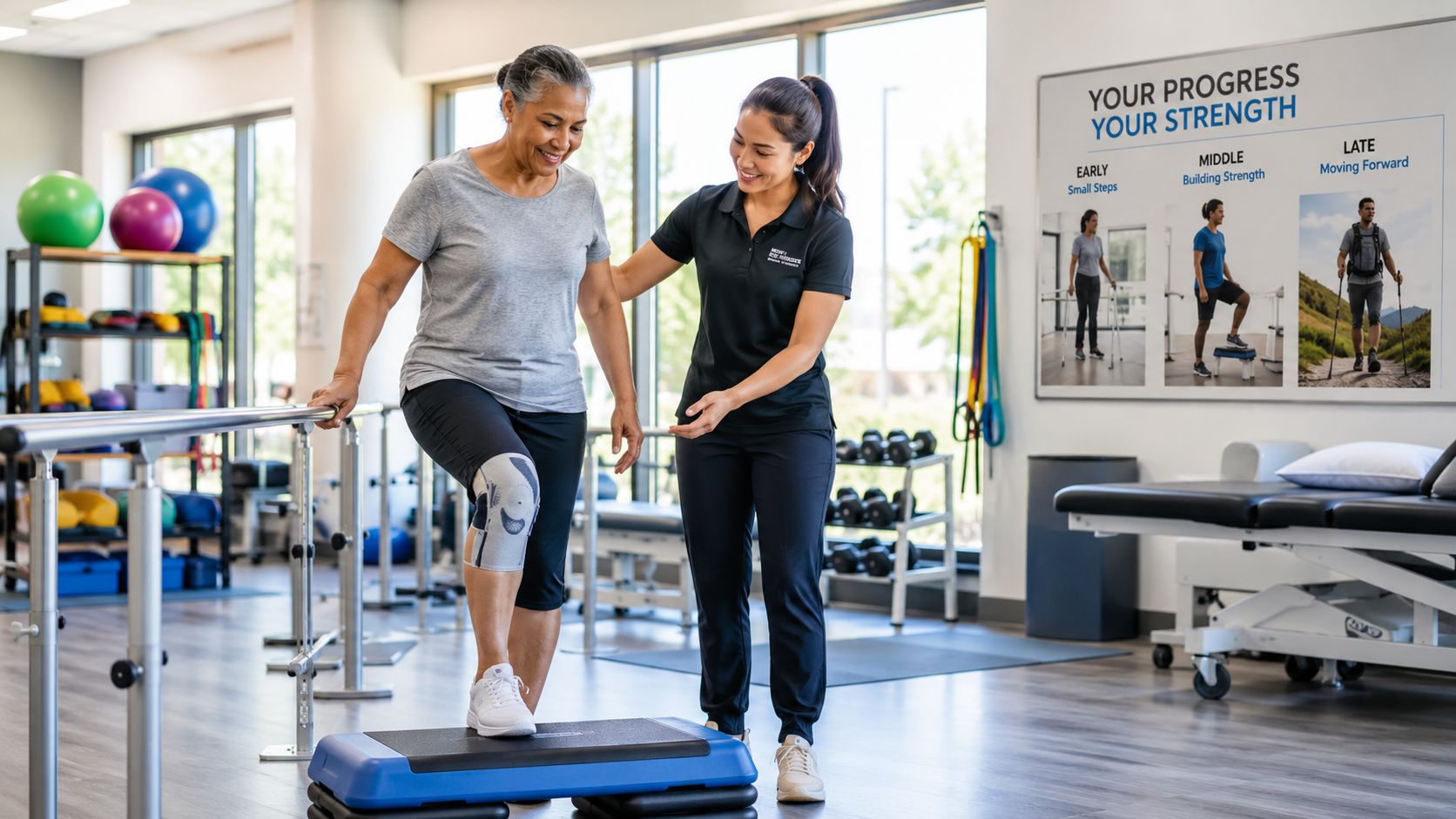
A knee replacement, hip replacement, ACL reconstruction, and rotator cuff repair don't recover the same way. But they do share a pattern. Early rehab protects healing tissue and manages pain and swelling. The middle phase restores motion and baseline strength. Later rehab builds endurance, symmetry, and return to higher-level activity.
That's one reason “more” isn't always “better.” In a large hip-fracture study involving skilled nursing rehabilitation, Medicare Advantage patients had an average stay of 36.9 days versus 44.7 days for fee-for-service patients, received 12.1 fewer minutes of rehabilitation therapy per day, and were still 3.2 percentage points more likely to be successfully discharged to the community, with 18% higher odds of community discharge overall, according to this retrospective cohort study on rehabilitation outcomes. For patients, the takeaway is practical. Longer stays or more minutes alone don't guarantee better recovery. The right plan matters more.
If you're preparing for or recovering from a hip procedure specifically, this local guide to hip surgery rehab can help you compare what your next steps may look like.
General post-surgical recovery phases
| Recovery Phase | Primary Goals | Common Procedures |
|---|---|---|
| Early phase | Control pain and swelling, protect healing tissues, begin safe motion, improve transfers and walking | Knee replacement, hip replacement, rotator cuff repair, ACL reconstruction |
| Middle phase | Restore range of motion, improve muscle activation, rebuild basic strength, improve movement quality | Knee replacement, hip replacement, rotator cuff repair, ACL reconstruction |
| Late phase | Build higher-level strength, endurance, balance, task-specific control, and return to activity | Knee replacement, hip replacement, rotator cuff repair, ACL reconstruction |
What this looks like in real life
For a knee or hip replacement, people often notice quick wins in basic mobility, but they may still have stiffness, swelling, and fatigue that limit longer walks or stairs. Progress depends on gait quality, extension or hip mobility, swelling control, and leg strength.
For ACL recovery, the timeline feels longer because the goals are bigger. It's not just about walking. It's about restoring control, symmetry, deceleration, and confidence under load.
For a rotator cuff repair, the challenge is usually patience. People often feel tempted to do too much with the arm before the tissue is ready, then get frustrated by pain or guarding. Good shoulder rehab moves forward when motion quality and tissue tolerance say it's time.
Recovery goes faster when patients stop chasing arbitrary deadlines and start focusing on the next useful milestone.
Navigating Your First Appointment in the South Shore
The first outpatient rehab visit shouldn't feel like another obstacle. But for many people, it does. They're trying to decode discharge paperwork, sort out insurance questions, and figure out whether they're even ready to leave the house.
How the handoff usually works
Around the South Shore, a lot of patients come to outpatient rehab after surgery performed through a regional hospital system or affiliated orthopedic practice. That local context matters. South Shore Hospital in South Weymouth is a major anchor in the area. The state hospital profile lists it as an Adult Level 2 Trauma Center and reports 4,315.32 total FTEs in HFY 2024 in its care ecosystem, according to the Massachusetts hospital profile for South Shore Hospital.
That scale is one reason the transition from surgery to rehab is such a common pathway here. The practical steps usually look like this:
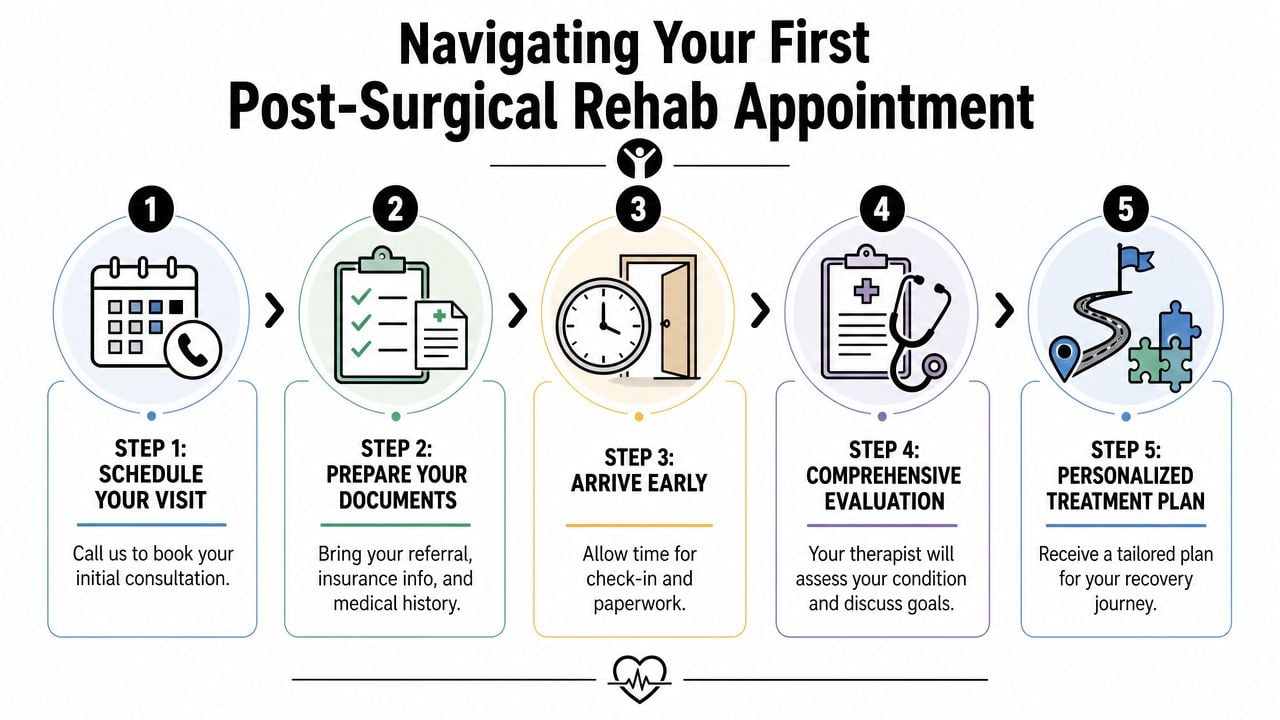
- You receive post-op instructions from your surgeon. Sometimes that includes a direct PT referral. Sometimes it includes timing guidance and precautions first.
- You call the outpatient clinic you want to use. This is usually when insurance questions, scheduling, and location convenience get sorted out.
- The clinic verifies what's needed. Depending on your plan, that may include referral details, authorization requirements, or confirming the diagnosis and surgical procedure.
- Your first evaluation gets scheduled around your mobility and follow-up appointments. That may mean choosing a clinic close to home, work, or a caregiver's route.
What to bring and how to prepare
A smooth first visit usually starts with simple preparation:
- Bring your referral if you have one. If your surgeon already sent it, great. If not, keep a copy with you.
- Bring your insurance card and ID. That cuts down on check-in delays.
- Wear clothes that let the surgical area move. Shorts work well for hip or knee rehab. A loose top helps after shoulder surgery.
- Bring your questions. Write them down if you're tired or on pain medication. People often forget what they wanted to ask once the appointment starts.
If getting to outpatient PT feels like a major event, say that up front. Transportation, stair tolerance, and home setup are part of the rehab plan, not side issues.
Across the South Shore, convenience matters more than people expect in the first few weeks. A clinic that fits your route and your tolerance for car rides often makes attendance easier, and consistency is what keeps recovery moving.
What to Expect During Your Rehab Sessions
The first few sessions usually feel more practical than dramatic. You won't walk in and do a boot-camp workout. A strong rehab visit is targeted. It looks at what your body can handle today, then builds from there.
What happens in a typical visit
Your therapist starts by checking how you're doing since the last visit or since surgery. That includes pain behavior, swelling, incision-related restrictions, sleep, walking tolerance, and how basic tasks are going at home. Then the session moves into hands-on assessment and treatment based on what's limiting you most.
A session often includes:
- Movement assessment to see how you're walking, transferring, reaching, or protecting the area
- Manual techniques when needed to help with stiffness, soft tissue restriction, or guarded movement
- Therapeutic exercise aimed at the specific deficits that surgery left behind
- Gait or functional training so gains in the clinic carry over to daily life
- Home guidance so you know what to do between visits and what to avoid
The home program matters more than people think. In clinic, you get direction and progression. At home, you build consistency. That combination is what changes function.
For patients dealing with post-op edema, this local article on managing post-operative swelling through effective rehabilitation can help you understand why swelling control often drives the pace of early progress.
When your plan needs more than basic exercise
Some recoveries need a broader approach. For lower-body surgeries with swelling or weight-bearing limits, a multidisciplinary plan can include aquatic therapy because water buoyancy reduces joint stress while allowing earlier movement and walking practice, as described in South Shore Health's overview of physical therapy services including aquatic therapy and lymphedema treatment.
That can be especially helpful when land-based walking still feels too painful, too stiff, or too guarded.
Caregiver support also matters more than people expect, especially after joint replacement or when an older adult is regaining confidence at home. If a family member is helping with daily routines, this caregiver guide to senior fitness can be a useful companion resource for thinking about safe activity outside formal rehab.
The best sessions don't leave you crushed. They leave you moving better, understanding more, and knowing what your next step is.
Why Choose Peak for Your South Shore Recovery Journey
After surgery, convenience and clarity matter almost as much as clinical skill. If getting to rehab is hard, if the plan feels vague, or if progress isn't measured in a way that makes sense, people get frustrated fast.
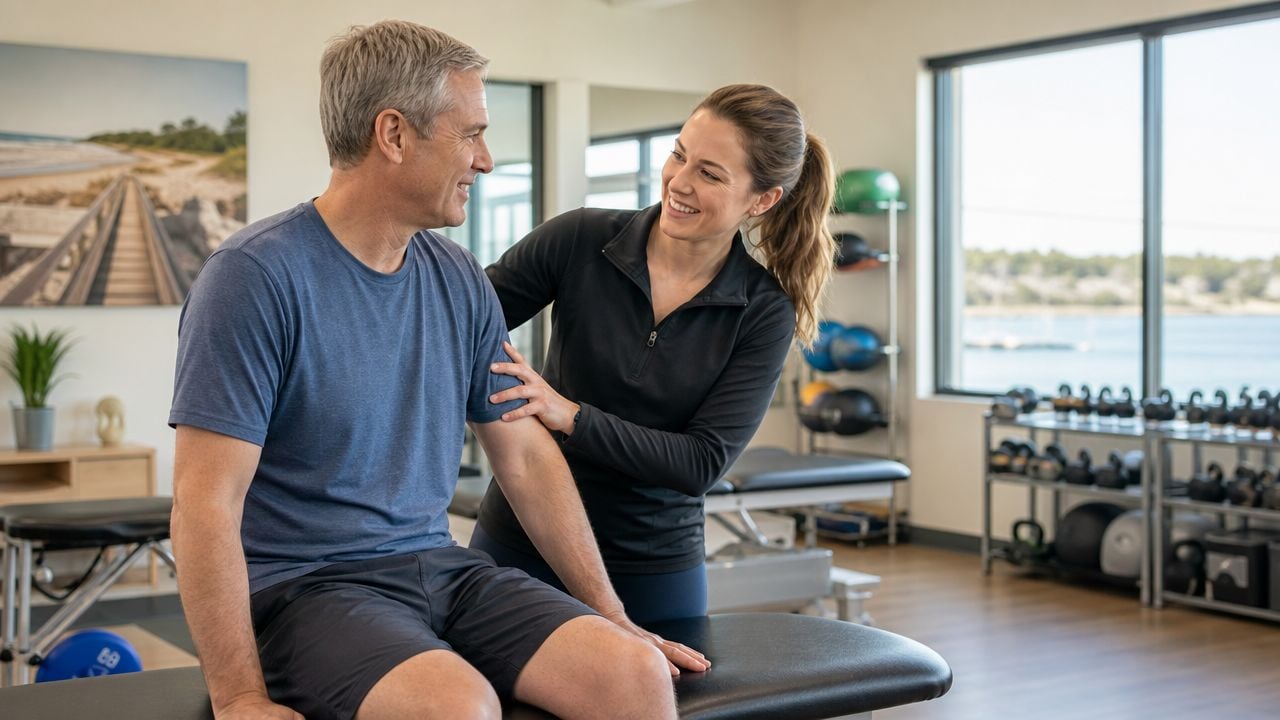
Local access matters after surgery
For South Shore patients, location isn't a small issue. It affects whether you can consistently get care while you're still sore, sleeping poorly, and trying to coordinate follow-up appointments. Peak Physical Therapy and Sports Performance offers outpatient care across South Shore communities including Braintree, Quincy, Weymouth, Cohasset, Duxbury, East Bridgewater, Hanover, Kingston, Milton, Norwell, Pembroke, Plymouth, and Scituate.
That matters because post-surgical recovery usually isn't one appointment. It's a series of decisions and adjustments over time. Being able to choose a clinic near home, work, or family support can make the process more manageable.
Good rehab is efficient, not endless
Patients sometimes assume a good rehab plan means more visits, longer sessions, or dragging things out until the calendar says they're done. That isn't how solid rehab works. Structured recovery should focus on measurable function and discharge readiness, not solely on length of stay or raw therapy volume. That's the practical takeaway from the earlier rehabilitation outcome data.
What usually works better is:
- Clear goals tied to function instead of vague “keep working on it” advice
- Progression based on tolerance and quality rather than pushing too hard too soon
- Communication with the surgeon's plan so precautions and progression line up
- A program that fits your life including driving tolerance, work demands, and home setup
You should feel like your therapist knows where you're going and what needs to happen next to get you there.
A good South Shore rehab experience also feels local in the right ways. Your therapist understands that your “return to normal” might mean beach walks, youth sports sidelines, commuting, stairs in an older home, or feeling steady enough to move around the neighborhood without thinking about every step.
Frequently Asked Questions About Post-Surgical Rehab
What red flags should I watch for
Call your surgeon or medical team if you notice uncontrolled pain, wound concerns, or a sudden drop in your ability to move safely. Other common reasons to check in quickly include trouble with transfers, worsening walking tolerance, or a level of swelling that feels out of step with your recent activity. If something feels sharply worse instead of gradually improving, don't wait it out without guidance.
How much pain is normal in therapy
Some discomfort is common. Rehab asks healing tissues to move and work again, so mild soreness or temporary fatigue can happen. What usually isn't the goal is pain that keeps climbing during the session, pain that stays high long after, or symptoms that make you less functional the next day. Good therapy should challenge you without making the recovery spiral.
Should I do short-term rehab, home care, or outpatient PT
That depends on your surgical complexity, mobility at discharge, support at home, and other medical factors. The right setting isn't just the one closest to you. It's the one that matches how safely you can move and what level of help you need after discharge. South Shore rehab guidance also points out that people and families often need help deciding among short-term rehab, home-based care, or outpatient therapy, especially when discharge happens quickly. This overview of post-hospital care and recovery planning is useful for understanding that transition.
A simple way to think about it:
- Short-term rehab often fits when mobility and self-care still need close support
- Home-based care can make sense when leaving home is difficult early on
- Outpatient PT often fits when you can travel safely and are ready for more progressive rehab
How do you coordinate with my surgeon
Your rehab plan should follow the surgeon's precautions and healing guidelines. That includes procedure-specific restrictions, follow-up timing, and updates if something isn't progressing as expected. Patients do best when the outpatient plan doesn't compete with the surgical plan. It should extend it.
If you're looking for a local team to help you with post surgical rehab on the South Shore, MA with a clear, practical plan, Peak Physical Therapy and Sports Performance can help you get started. Book an appointment at the clinic location that's most convenient for you, and get a recovery plan built around how you move, where you live, and what you need to get back to.