
You notice it in ordinary moments first. Your toddler avoids crawling across the living room floor. Your grade-schooler skips the ladder at the playground in Hingham or Weymouth because they don't trust their balance. Your middle school athlete comes home from practice on the South Shore limping a little, then insists they're fine the next morning.
For most parents, that uncertainty is the hardest part. Is this just a phase, a growth spurt, a confidence issue, or something worth checking out?
Pediatric physical therapy often helps when a child isn't moving comfortably, efficiently, or confidently in daily life. That can mean early motor delays, coordination concerns, toe walking, recovery after an injury, or trouble keeping up with sports, recess, stairs, and school routines. If you're looking for pediatric physical therapy on the South Shore, MA, it helps to have a local roadmap that makes the process feel manageable instead of overwhelming.
Table of Contents
- A Parent's Guide to Pediatric Physical Therapy on the South Shore
- What Is Pediatric Physical Therapy Really Like
- Common Signs Your Child Might Benefit from PT
- Your Child's First Visit at Peak Physical Therapy
- Navigating Referrals Schools and Insurance
- Find Expert Pediatric Care Near You on the South Shore
- Frequently Asked Questions by South Shore Parents
A Parent's Guide to Pediatric Physical Therapy on the South Shore
Your child gets through the day, but something feels off. Maybe your baby always turns to one side during feedings. Maybe your preschooler avoids the playground steps in Hingham or Scituate, or your middle school athlete in Quincy is back on the field but still looks hesitant when it is time to sprint or cut.
Parents usually notice these patterns before anyone else does. That early concern matters. Children often find workarounds for weakness, tightness, balance problems, or coordination issues long before they can describe what feels hard.
On the South Shore, the hardest part is often not deciding whether to ask for help. It is figuring out where to start and who should be involved. A pediatrician may raise the first concern. A teacher or school team may notice it in the classroom. An outpatient clinic may be the right place to work on strength, gait, endurance, or return to sport. Families do better when those pieces connect and the plan fits real life, including school schedules, sibling logistics, and the drive across town.
That is the lens parents need. This is not just a medical question. It is a day-to-day question about how your child moves through home, school, recess, sports, and the community.
At Peak, we see the most progress when concerns are translated into specific examples. Your child trips on uneven ground. They avoid sitting on the floor. They need help on stairs longer than expected. They fatigue halfway through practice. Those details guide treatment far better than a vague sense that something is "not quite right." Families can review Peak's pediatric physical therapy services before scheduling so they know what outpatient care can address.
Some children also learn movement best when they can feel and try it, not just hear instructions. For parents who have noticed that pattern, Space Ranger Fred's guide gives a useful explanation of kinesthetic learning and why hands-on practice can matter.
A good pediatric PT plan should make sense in your child's real world. It should help parents understand what they are seeing, clarify whether school-based services and outpatient therapy serve different goals, and give the family a practical next step instead of more uncertainty.
What Is Pediatric Physical Therapy Really Like
For most children, physical therapy doesn't look like a boot camp and it doesn't feel like a lecture. It looks like guided movement with a purpose. A therapist might use games, obstacle courses, floor transitions, balance activities, or sport-specific drills, but each activity is chosen to build a missing skill.
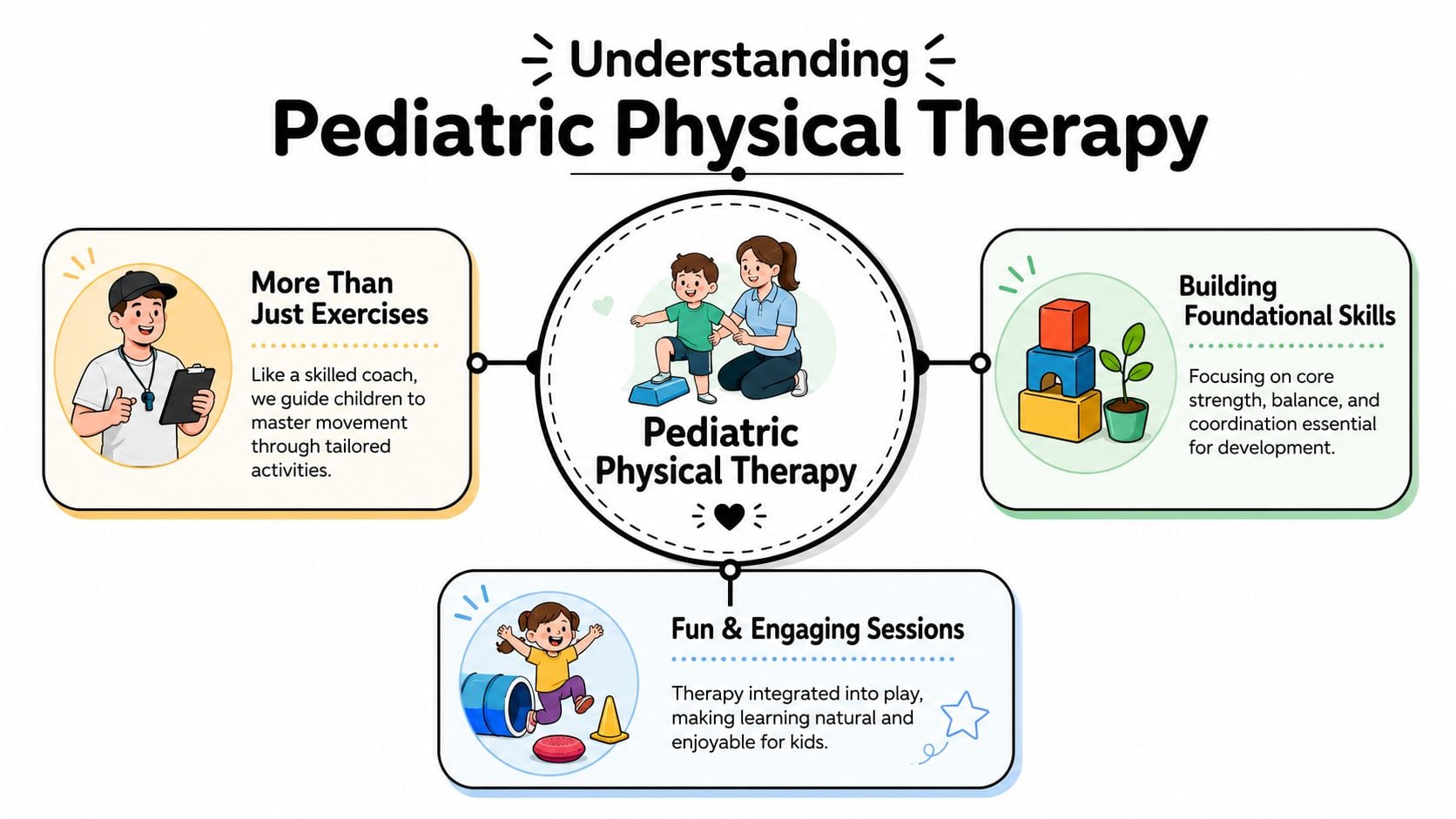
Why function matters more than pain alone
With children, the most useful question usually isn't "Does it hurt?" It's "What can't they do well right now?"
That's because pediatric PT is measured by function-based outcomes. Programs commonly target age-appropriate skills like rolling, sitting, crawling, standing, walking, stair climbing, and return to sport so children can improve participation, motor development, endurance, and independence, as outlined in this overview of pediatric physical therapy outcomes.
In practice, that means goals sound very concrete:
- For a toddler: getting up from the floor without help, climbing onto a low step, or moving more evenly side to side
- For a school-age child: keeping balance during playground games, managing stairs more safely, or improving coordination during PE
- For a teen athlete: cutting, sprinting, landing, and returning to practice with better control
That shift matters. When therapy focuses on function, parents can tell whether it's working because they see change in daily routines.
What sessions usually look like
A strong session should feel active, child-centered, and structured. The therapist is watching how your child moves, but also how they solve movement problems. Do they avoid one side? Rush through a task? Use momentum instead of control? Need verbal cues to organize their body?
The best pediatric sessions also match how many kids learn. If your child responds better when movement is built into doing, touching, and trying, you may find Space Ranger Fred's guide useful because it gives parents a simple way to think about hands-on, movement-based learning.
Here are a few signs therapy is on the right track:
- The activities have a purpose: play is being used to practice balance, strength, coordination, endurance, or transitions
- Goals are easy to picture: parents know what success looks like in home and community routines
- Home practice is realistic: a few repeatable activities usually work better than a complicated program
- The child stays engaged: progress is better when therapy feels challenging but doable
Practical rule: If a session looks like fun but you can't tell what skill is being trained, ask. A pediatric PT should be able to connect each activity to a functional goal in plain language.
Common Signs Your Child Might Benefit from PT
Sometimes the sign is obvious. A sports injury changes the way your child runs. Other times it's subtle. Your child avoids kneeling, struggles with hopping, or seems more cautious than peers during active play.
Early childhood signs parents often notice first
In infants and toddlers, concerns often show up during routine caregiving. A baby may turn their head more easily one way than the other. A toddler may be late to pull to stand, cruise, or walk confidently. Another child may walk, but still seem unstable on uneven ground or stairs.
Parents often compare what they see to milestone checklists. That can be helpful as a starting point, and guides like major baby milestones can give useful context. Still, a checklist doesn't replace an in-person movement assessment when something feels off.
Common reasons families seek pediatric PT include:
- Positioning or asymmetry concerns: head turning preference, body stiffness, or uneven movement patterns
- Delayed motor skills: trouble with rolling, sitting, crawling, standing, or walking
- Balance and coordination issues: frequent falls, awkward running, difficulty with jumping or stairs
- Gait differences: toe walking, unusual foot positioning, or a limp that keeps returning
School age and teen concerns that show up in real life
For older kids, the pattern often appears in the places they spend their time. A child in elementary school may struggle to keep up at recess. A middle schooler may avoid field games because they can't change direction smoothly. A teen athlete may be cleared to be active but still lack the strength, control, or confidence to move well.
On the South Shore, those concerns often surface during busy weeks packed with school, practices, and weekends outdoors. A soccer player in Hanover may develop knee pain that changes mechanics. A hockey player in Quincy may come back from an injury but hesitate during quick pivots. A child who isn't in sports may still need help if playground movement, neighborhood biking, or simple family outings feel harder than they should.
For parents trying to connect the dots, this article on kids and motor skills development is a practical place to start.
If your child is limiting activity, losing confidence, or using workarounds to get through movement, that's often enough reason to ask for an evaluation.
What doesn't work well is waiting for a child to "grow out of it" when the same movement problem keeps showing up across different settings. What usually works better is looking early at how strength, balance, coordination, endurance, and motor planning are affecting daily life.
Your Child's First Visit at Peak Physical Therapy
A lot of first visits start the same way. A parent walks in wondering whether they are overreacting, and a child is unsure about a new place, new person, and new routine. The evaluation should make that feel easier, not heavier.
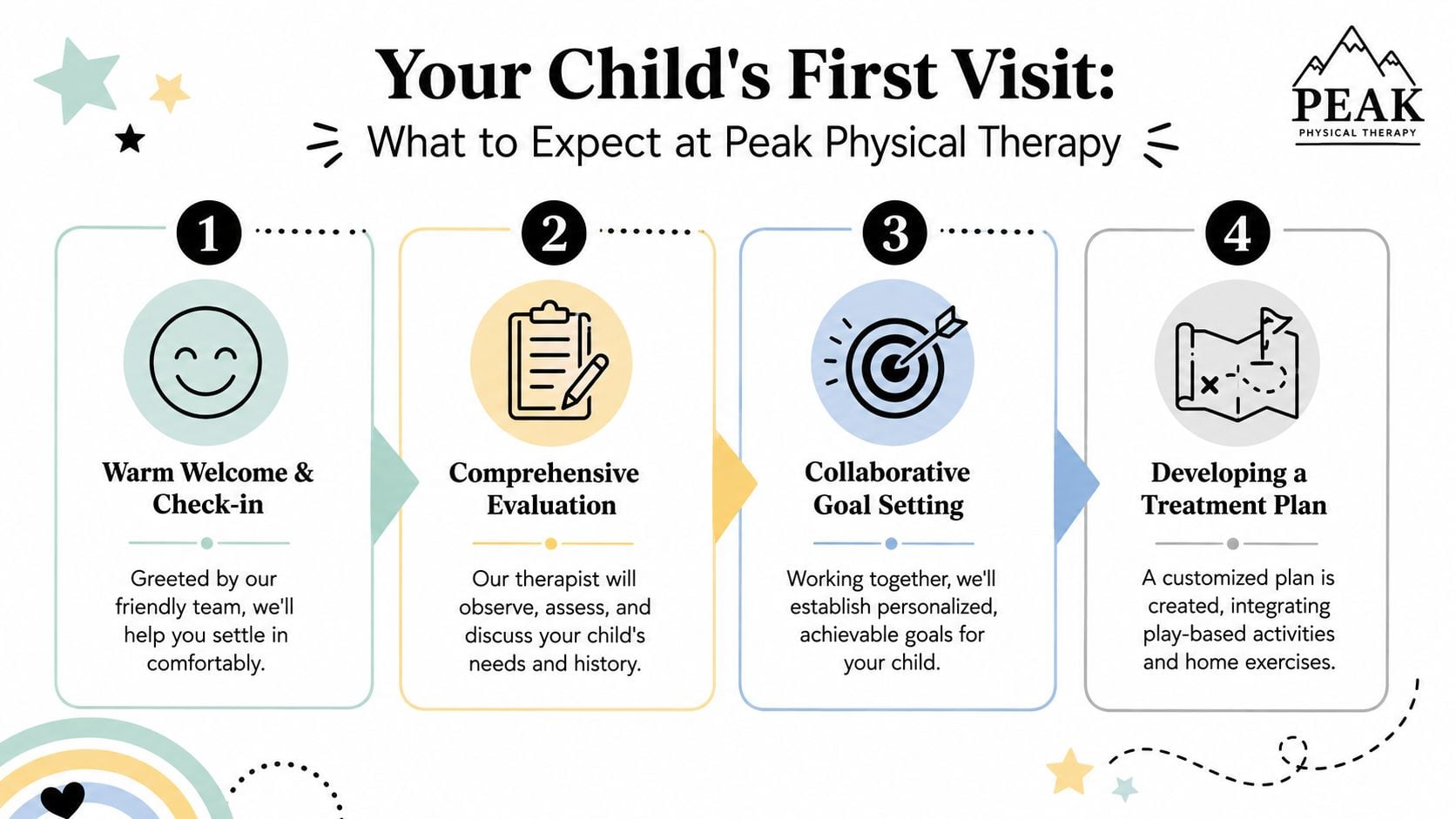
What happens when you arrive
The first visit is part conversation, part observation. Parents usually share the history, what they have noticed at home or in the community, what their pediatrician or school has said so far, and what daily activities are becoming frustrating. That context matters because the same movement problem can look very different in a toddler, a grade school student, or a teen returning to sports.
Then the therapist watches how your child moves. For younger children, that often looks like play on the floor, climbing, reaching, and changing positions. For older kids, it may include walking, running, single-leg balance, stairs, squatting, hopping, or sport-related movement. The goal is not to catch a child doing something wrong. It is to see what their body is doing well, where they are compensating, and what may be limiting confidence, comfort, or coordination.
We also pay attention to regulation. Some children warm up quickly. Others need time, a parent nearby, or a clear routine before they show us their usual movement. If your child tends to worry in new settings, it can help to prepare with simple language, a favorite comfort item, and a predictable plan. Some families like to discover anxiety coping strategies before the appointment so the visit feels more familiar.
How goals and next steps are decided
A useful evaluation ends with a plan you can picture in real life.
That might mean easier stair climbing, better balance at the playground, less toe walking, more confidence getting on and off the floor, or a safer return to running after an injury. For some children, the right starting point is weekly outpatient PT. For others, the better plan may be home practice, a short episode of care, communication with the pediatrician, or coordination with school services if school function is part of the concern.
Parents should leave knowing three things. What we found. What we are going to work on. What you can watch for at home.
Specific examples help more than broad worry. “He drops to the floor after walking through the store,” “She avoids uneven ground at the beach,” or “He always uses the railing and leads with one leg on stairs” gives the therapist something concrete to assess.
The first visit is also a chance to ask practical questions. How often should we come. What can we do between visits. How long does progress usually take. Good pediatric PT should fit your child's actual week, including school, activities, family schedules, and the realities of South Shore life.
Navigating Referrals Schools and Insurance
A common South Shore scenario goes like this. A parent notices their child avoids stairs at school, melts down after long walks in the grocery store, or keeps sitting out at the playground. The hard part is not always recognizing that something feels off. The hard part is figuring out who to call first, whether school services fit the concern, and what insurance will ask for before therapy can begin.
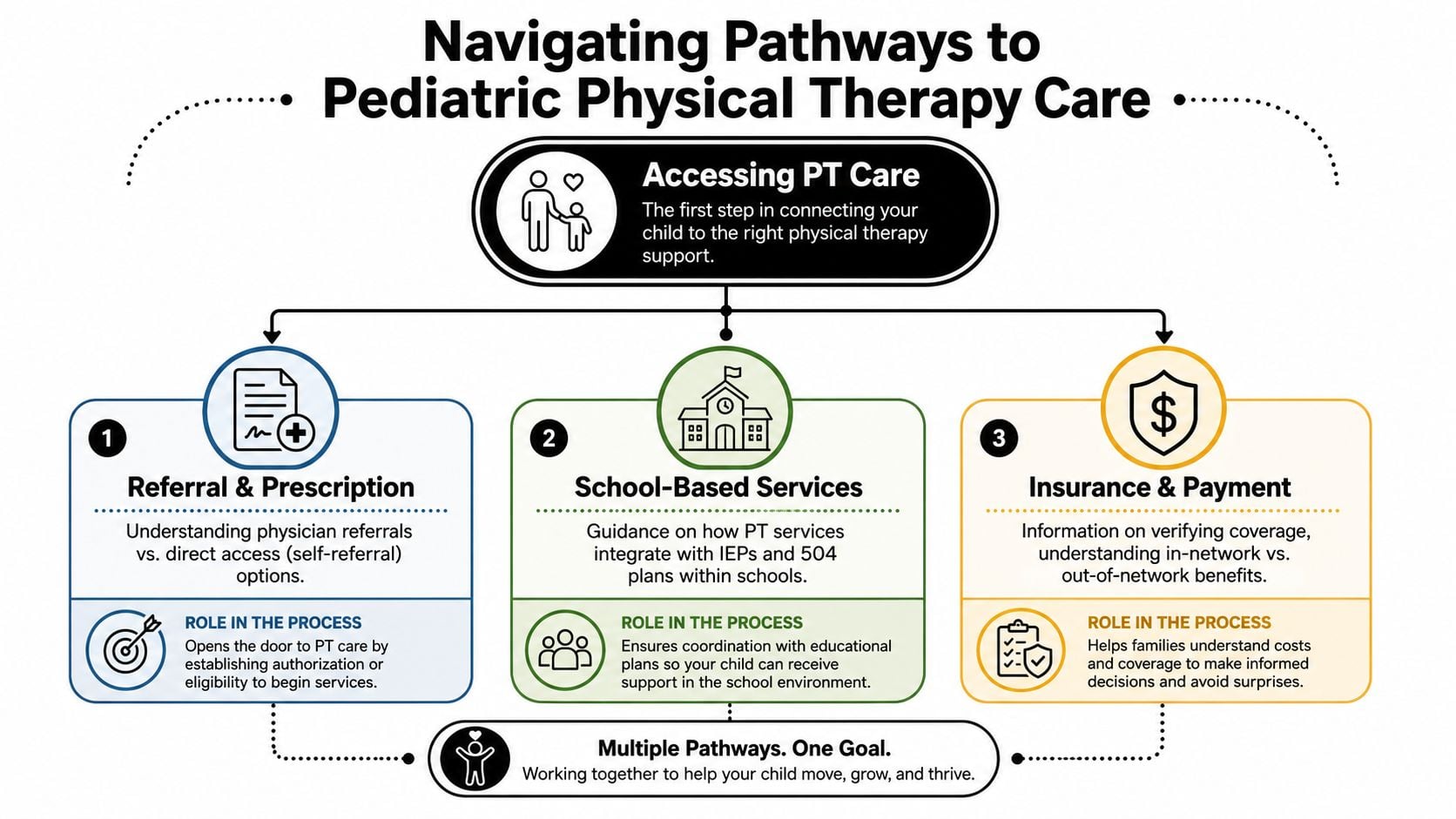
When to start with your pediatrician
Start with the pediatrician if your child has a recent injury, a new diagnosis, a clear change in walking or balance, pain, frequent falls, or anything that may need medical workup first. That visit helps document the concern and can make the next step clearer, especially if your insurance plan requires a referral.
Pediatricians also help when several people are involved and someone needs to connect the pieces. That may include specialists, school staff, and an outpatient clinic.
Some families start with outpatient PT instead. That can make sense when the concern is mostly functional and easy to describe in daily life. A child who cannot keep up on the playground, struggles with curbs and uneven sidewalks, or avoids climbing at the beach may benefit from an evaluation even if there is no recent diagnosis.
School based PT and outpatient PT solve different problems
Parents often hear "PT" and assume it is all the same. In practice, school-based PT and outpatient PT serve different purposes, and some children need both.
School-based PT supports access to education. The question is whether movement is affecting school function. That may include getting around the building, managing stairs, moving safely in class, or participating during recess and the school day.
Outpatient PT looks at movement across the rest of your child's life. That includes gross motor skills, strength, balance, coordination, endurance, gait, recovery after injury, and participation at home, in sports, and in the community.
A published review on school-based physical therapy access describes the mismatch that can happen between what children need and what schools are able to provide. On the South Shore, families usually feel that mismatch as a practical question. Is the problem showing up only at school, across multiple settings, or both?
Here is a simple way to sort it out:
| Situation | Best first question |
|---|---|
| Your child struggles mainly with classroom access, school stairs, or participation during the school day | Should I request a school-based evaluation? |
| Your child has broader movement concerns at home, on the playground, in sports, or in community activities | Would an outpatient PT evaluation help? |
| Your child has both school and outside-of-school challenges | Do we need support in both settings? |
What referrals and insurance usually look like
Referral rules depend on the insurance plan, not just the clinic. Some families can schedule outpatient PT directly. Others need a pediatrician referral or prior authorization before visits are covered.
Ask those questions before you book:
- Do I need a referral or authorization for pediatric PT?
- How many visits are covered, and are there visit limits?
- Is this clinic in network for my plan?
- If school services are already in place, does that affect outpatient coverage?
- What paperwork should I bring on day one?
Those details matter. They can save a week or two of back-and-forth, which is a big deal when your child is struggling now.
How to coordinate school, pediatrician, and outpatient care
The smoothest plan usually starts with one clear description of the problem. Parents do not need special terminology. Specific examples work better than broad labels. "He needs the railing for every stair." "She avoids walking on sand and grass." "Gym class is much harder than it used to be."
Use the same examples with the pediatrician, the school team, and the outpatient therapist. That helps everyone focus on the same functional concerns instead of talking past one another.
If you are still deciding where to start, a South Shore physical therapy clinic guide can help you look at local options in the context of your family's schedule, school district, and drive time. On the South Shore, that practical piece matters more than people expect. The right plan is the one your family can follow consistently.
Find Expert Pediatric Care Near You on the South Shore
Families usually need two things from pediatric PT care. Clinical skill, and a location that fits the school week without turning every visit into a long drive.
Peak Physical Therapy and Sports Performance is one local option for families seeking pediatric PT, with South Shore clinics in Braintree, Quincy, Weymouth, Cohasset, Duxbury, East Bridgewater, Hanover, Kingston, Milton, Norwell, Pembroke, Plymouth, and Scituate. For care close to home, this local guide to physical therapy near me on the South Shore can help you narrow down where to start.

A broad clinic footprint matters in family life. Shorter drives make it easier to stay consistent with visits, coordinate school pickups, and keep home programs realistic instead of overwhelming.
Peak Physical Therapy South Shore Locations
| Town | Contact Information |
|---|---|
| Braintree | Book through the Peak website |
| Quincy | Book through the Peak website |
| Weymouth | Book through the Peak website |
| Cohasset | Book through the Peak website |
| Duxbury | Book through the Peak website |
| East Bridgewater | Book through the Peak website |
| Hanover | Book through the Peak website |
| Kingston | Book through the Peak website |
| Milton | Book through the Peak website |
| Norwell | Book through the Peak website |
| Pembroke | Book through the Peak website |
| Plymouth | Book through the Peak website |
| Scituate | Book through the Peak website |
If your child needs help with motor skills, balance, gait, injury recovery, or return to sport, the most useful next step is to schedule an evaluation and get a specific plan.
Frequently Asked Questions by South Shore Parents
A common scene on the South Shore looks like this. A parent is trying to get out the door after school, a child is unsure about therapy, and everyone wants to know what the visit will be like. These are the questions families ask most often, and clear answers make the process easier.
What should my child wear
Pick clothes your child can move in comfortably. Leggings, shorts, T-shirts, athletic pants, and sneakers are usually the right choice.
If the concern involves feet, ankles, walking, or orthotics, bring the shoes your child wears most often. I also like families to bring braces or inserts if their child uses them, because what happens at home and school matters more than how a child moves barefoot for five minutes in the clinic.
How is progress tracked
Progress shows up in daily life. A child gets on and off the floor more easily, keeps up better at the playground, climbs stairs with less help, or feels steadier during sports and gym class.
Parents should hear what is improving, what still needs work, and what to practice at home. Good PT tracking is specific. It should connect the exercises in the clinic to the routines you care about, whether that is getting dressed faster, sitting with better posture at school, or running without frequent falls.
What if my child is nervous
That is very common.
Some children walk in ready to play. Others need time to watch, stay close to a parent, or test the room before they join in. Both responses are normal. The goal of the first visit is not to force perfect participation. The goal is to help your child feel safe enough to show us how they move.
A simple explanation usually works best. Bring a comfort item if that helps, and avoid presenting the visit like a big test.
Try: "You're going to play some movement games, and we're going to learn what helps your body feel stronger."
How do families handle scheduling and insurance questions
Ask these questions early, especially if your week already includes school services, sports, or specialist appointments. Confirm whether your insurance requires a referral, whether the clinic is in network, and what forms you should bring.
If your child also receives help through school, bring the IEP, 504 plan, school PT notes, or any recent evaluations. That helps everyone work from the same information and reduces mixed messages between the pediatrician, school team, and outpatient care.
For families searching for pediatric physical therapy South Shore MA, the right clinic fit usually comes down to three things. A therapist who connects well with your child, appointment times your family can keep, and communication clear enough that you know what to do between visits.
If you're ready to talk through your child's movement concerns, schedule an evaluation with Peak Physical Therapy and Sports Performance. A local pediatric PT visit can help you sort out what looks typical, what may need support, and which next steps make sense for your family on the South Shore.