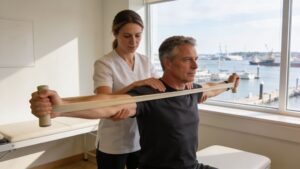
If you're reading this in running shoes but not running, you're probably in that frustrating middle ground. The sharp pain may be gone, but the leg still doesn't feel trustworthy. You miss your loop through Quincy, the packed-dirt trails in Wompatuck, the ocean air in Duxbury, or just the routine of getting out before work.
That's the tricky part of return to running after injury. Most runners don't struggle because they're unmotivated. They struggle because they try to restart based on emotion instead of objective signs that the body is ready. On the South Shore, where people want to get back to road races, weekend long runs, and neighborhood miles fast, that impatience is understandable. It's also where setbacks happen.
Table of Contents
- The Frustration of Being Sidelined on the South Shore
- The Am I Ready to Run Checklist
- Your Phased Walk-Run Program and Pain Rules
- Building a Stronger Foundation with Targeted Exercises
- Smart Load Management and Cross-Training on the South Shore
- When to Get Expert Help from a Peak Physical Therapist
The Frustration of Being Sidelined on the South Shore
A lot of injured runners tell the same story. They felt decent, tested a short jog, got excited, then pushed it just a little too far. Maybe it was a quick run along the beach, a few miles around the neighborhood, or a return to a favorite route because “it felt fine.” Then the soreness lingered, the limp came back, or the next morning told the truth.
That cycle is common because running injuries are common. Yale Medicine notes that about 65% of regular runners get hurt each year in its overview of running injury frequency and recurrence concerns. That number matters because it changes the mindset. This isn't about being weak or unlucky. It means running places a high demand on the body, and coming back well usually takes more structure than people expect.
Why waiting for pain to disappear isn't enough
A runner can feel better and still not be ready for repeated impact. That's where people get stuck. They use comfort at rest as their green light, but running asks for much more than sitting, standing, or even normal daily walking.
Practical rule: A successful comeback is rarely about toughness. It's about matching load to what the tissue can handle right now.
Around the South Shore, the temptation is real. The weather turns, your friends are back out, local races are on the calendar, and you want your normal routine back. But the body doesn't care what date is circled.
What works better than guesswork
The runners who do best usually follow a simple idea. They earn the next step. They don't jump from “not running” to “normal training.”
That means checking readiness first, then using a gradual return, then building strength underneath the miles. It also means respecting trade-offs. If you push pace too early, you often lose consistency. If you stay patient, you usually get the consistency that rebuilds confidence.
On the South Shore, that might mean postponing your run through Wompatuck this week so you can run there comfortably for months instead of forcing one shaky effort now and starting over again.
The Am I Ready to Run Checklist
Before your first run, use the same kind of practical screen a sports PT would use in Hanover, Pembroke, or Plymouth. The point isn't to pass a perfect test. It's to avoid starting from a place your body hasn't earned.
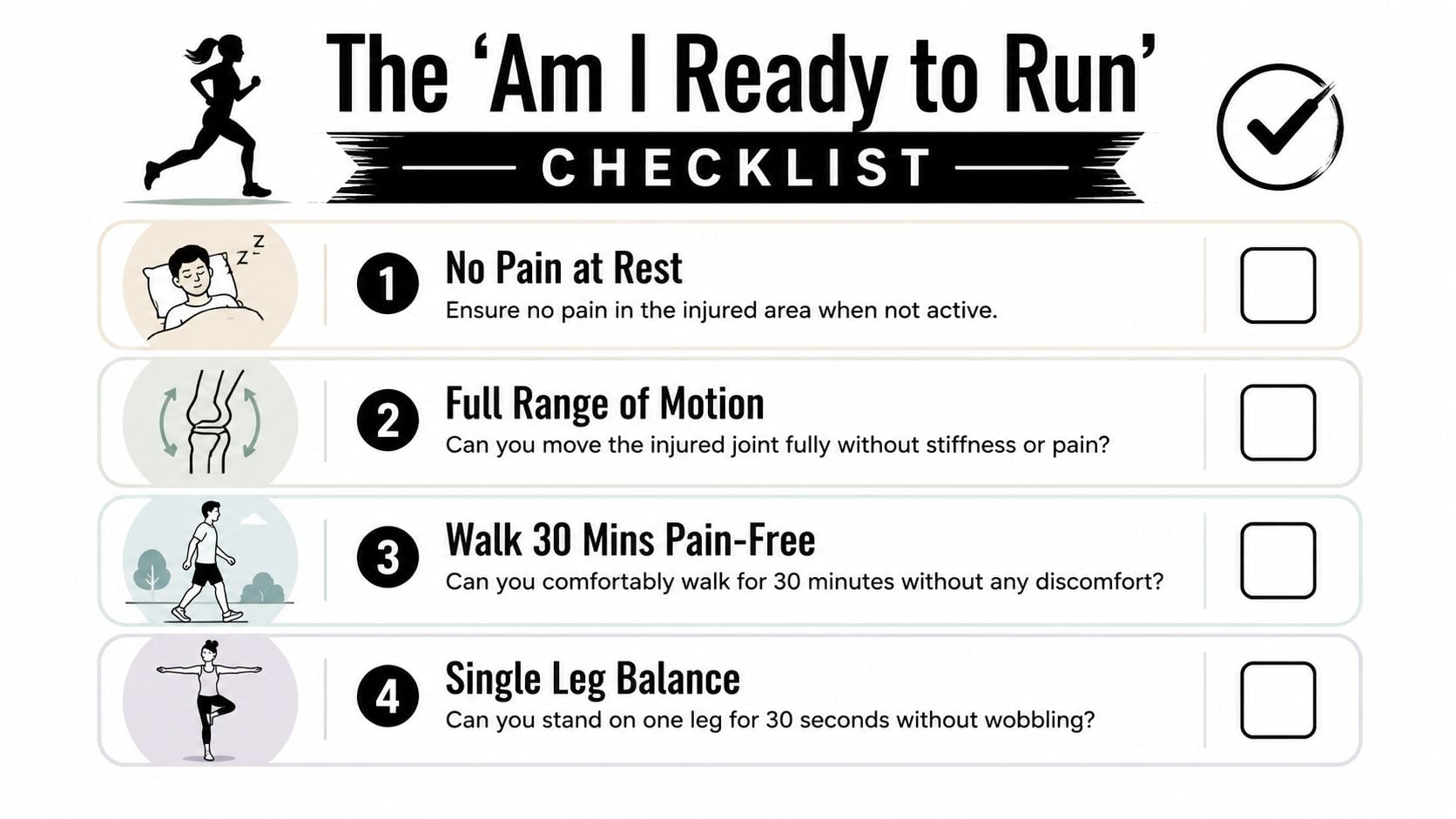
Evidence-based frameworks recommend that runners should be able to walk for 30+ minutes pain-free and complete 20 pain-free hops on each leg before starting a run-walk progression, according to this return-to-running framework.
What to test before your first run
Use this checklist carefully:
- Pain at rest: If the injured area still aches while you're sitting around or doing normal day-to-day activity, running is usually premature.
- Full movement: You should be able to move the involved joint or area without obvious guarding, stiffness, or a pinch that changes how you move.
- Walking tolerance: A brisk half-hour walk should feel controlled, not tentative.
- Single-leg confidence: You should be able to stand on one leg without feeling unstable, and hopping shouldn't make you brace for impact.
For many runners, the hop test is where the truth shows up. Walking can be fine while impact is still irritating. If hopping feels sketchy, stiff, or painful, running usually won't go well.
What usually means wait a little longer
Some runners are technically capable of jogging, but they're not ready for productive running. Those are different things.
A few common signs to hold off:
- You're still protecting the leg: If you catch yourself unloading one side on stairs, that pattern tends to show up more once you run.
- You dread impact: Fear matters. If every test step feels uncertain, your movement often gets choppy and guarded.
- Symptoms keep bouncing around: Better one day, worse the next usually means your baseline isn't steady enough yet.
If you're unsure whether you've passed the checklist, assume you need more preparation, not more optimism.
A simple home screen is useful, but it has limits. Balance, hopping, and pain response tell you a lot. They don't tell you everything about load tolerance, movement quality, or whether you're compensating through the hip, knee, or foot. That's why some runners clear the checklist loosely and still stall out once they start.
Your Phased Walk-Run Program and Pain Rules
Once you've passed the basic readiness checks, don't go straight to a continuous run. Start with a phased walk-run plan. Discipline in this phase brings rewards.
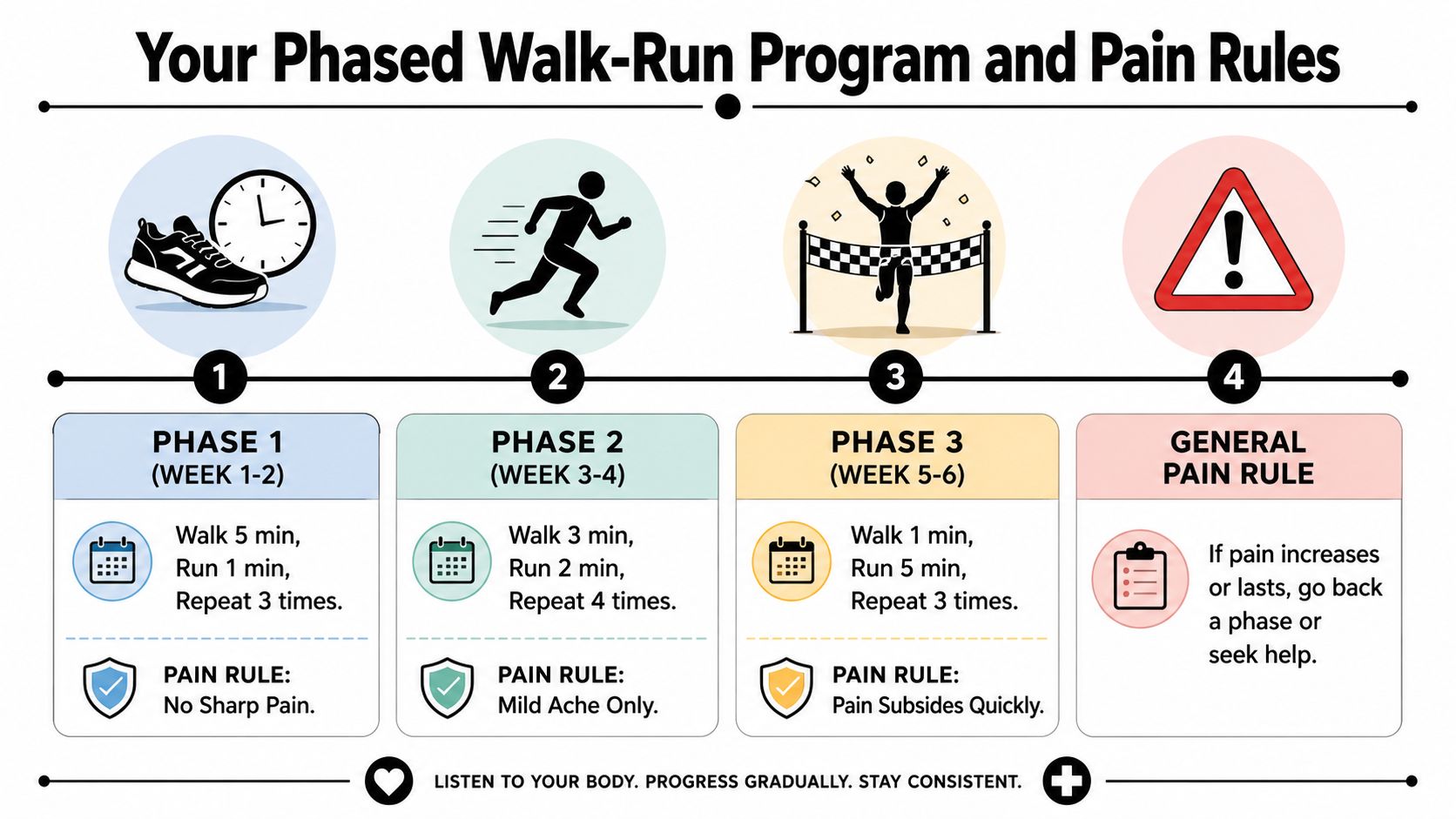
A commonly used starting point is 2 minutes of running and 1 minute of walking, repeated 5 times, with progression only if pain stays at 3/10 or less. Runners who come back too soon can face reinjury rates as high as 70%, as discussed in this return-after-injury guide.
How to start the first phase
Your first few weeks should feel almost too easy. That's a good sign.
A practical starting structure:
- Warm up with walking
- Run 2 minutes
- Walk 1 minute
- Repeat that sequence 5 times
- Finish and reassess later that day and the next morning
Do that on non-consecutive days. Keep the pace conversational. If you can't talk easily, you're probably moving too fast for this stage.
For many South Shore runners, a flat, predictable route works better than uneven trails or hilly neighborhoods at first. Save the scenic challenge for later. Early comeback running should be boring enough to be repeatable.
How to use pain as a guide
Pain doesn't have to mean immediate failure, but it does need rules. A simple traffic-light approach helps.
| Pain response | What it means | What to do |
|---|---|---|
| 0 to 3 out of 10 | Acceptable if it settles quickly and doesn't build during the run | Stay at the same level or progress carefully |
| Above 3 out of 10 | The load is likely too much right now | Stop, reduce, or return to the previous level |
| Pain that lingers into the next day | Recovery didn't match the stress | Hold steady or step back |
Mild awareness is one thing. A symptom that climbs as you run is a warning, not background noise.
Runners often make one of two mistakes. They either panic over any sensation and stop too early, or they ignore a clear flare because they wanted the run to count. The middle ground is better. Respect the response and adjust.
What progression should look like
Progression should be earned, not improvised. Repeat a level until the body handles it cleanly. Then advance one variable at a time.
A good pattern early on looks like this:
- Keep runs spaced out: Leave recovery days between running days.
- Increase duration before speed: Longer easy running comes before quicker running.
- Use symptom response as your filter: If soreness hangs on, don't push the next step.
As your tolerance improves, the run portions lengthen and the walk breaks shrink. The goal is steady exposure, not proving fitness. That's especially true after tendon issues, bone stress problems, or injuries that felt “mostly fine” for weeks before flaring again.
For runners who want more structure close to home, Peak Physical Therapy and Sports Performance offers a return-to-run process that uses graded intervals, gait review, and progression based on symptom response rather than guesswork.
Building a Stronger Foundation with Targeted Exercises
Running doesn't just test the injured spot. It exposes whatever else isn't doing its job. That's why many runners feel fine during rehab exercises, then get symptoms back once the mileage returns. The weak link wasn't just pain. It was capacity.
Why strength work matters for runners
If your hip control is poor, the knee often absorbs more stress. If your calf and foot don't handle force well, the ankle, shin, or plantar tissues may take the hit. If your trunk is unstable, your stride usually gets less efficient as fatigue builds.
This is why strength work is not optional. It's the part that makes the comeback durable.
A clean return to running after injury usually comes from two things working together. Gradual running load and enough strength to tolerate that load.
Runners also tend to overlook recovery outside the clinic. Nutrition plays a role in tissue support and training tolerance, especially when you're rebuilding after time off. If you want a practical overview of muscle repair and rebuilding, that resource is a useful companion to the exercise side of rehab.
The muscle groups that usually need attention
Most return-to-run programs spend time on a few key regions:
- Glutes and lateral hip: These help control pelvic drop and knee position during single-leg loading.
- Calves and foot-ankle complex: These tissues absorb and transfer force every step.
- Core and trunk: These improve balance, control, and consistency when fatigue creeps in.
The actual exercise list can stay simple. Bridges, split squats, calf raises, step-downs, planks, and controlled single-leg work cover a lot of ground when done well. The key question isn't whether an exercise looks athletic. It's whether you can perform it with control and without dodging load away from the injured side.
A runner with recurrent knee pain often needs more than just rest and stretching. Better hip strength and better single-leg mechanics usually make a bigger difference over time. For runners dealing with that pattern, these knee pain exercises for runners can help you understand where to start.
What doesn't work well is treating strength like an accessory. One rushed session every now and then won't support a meaningful return. Consistent, targeted work usually does.
Smart Load Management and Cross-Training on the South Shore
A lot of runners think the hardest part is getting cleared to run again. Usually, the harder part is managing the weeks after that. During these weeks, people feel better, get ambitious, and start stacking stress too quickly.
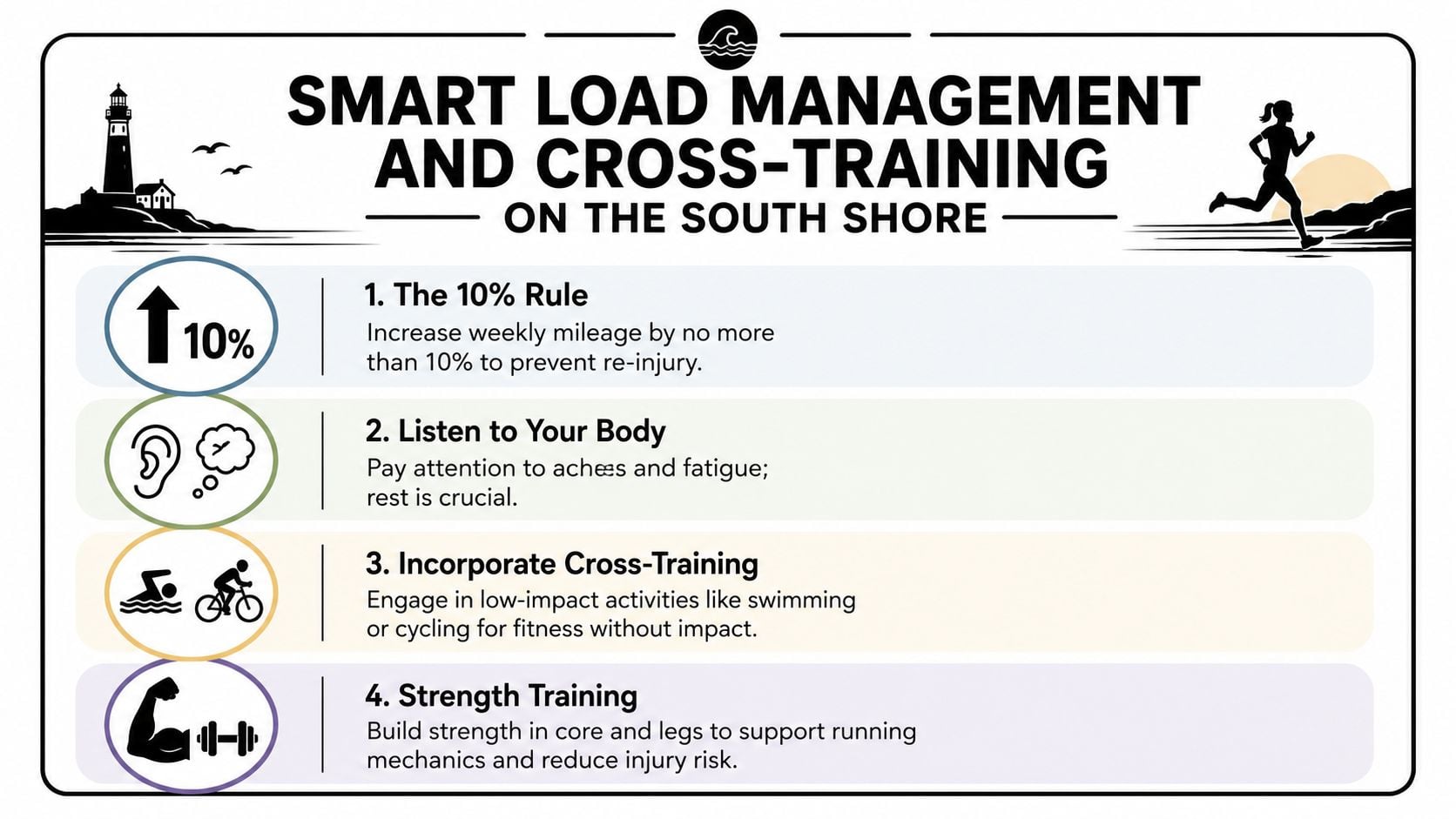
A conservative rule many clinicians use is the 10% rule, meaning weekly running volume increases by no more than 10%, and one expert source also notes that runners may need up to 12 weeks of consistent easy running before adding harder work. The usual order is frequency, then volume, then intensity, as described qualitatively in current return-to-run guidance.
The order matters more than most runners think
Most setbacks don't come from one terrible run. They come from layering stress in the wrong sequence.
A better progression looks like this:
- First restore frequency: Get used to running regularly again.
- Then build volume: Add time and total weekly minutes at an easy effort.
- Only then add intensity: Save hills, speed, and workouts until easy running feels normal again.
That order sounds slow, but it works because it separates adaptation from excitement. If you add hills while also adding distance, it's hard to tell which stressor caused the flare. If you change one variable at a time, the body gives clearer feedback.
If you want a broader training lens on understanding progressive overload, that framework helps explain why gradual exposure works better than big jumps.
Local ways to keep fitness up without pounding the injury
Cross-training can keep your engine going while your running tissues catch up. On the South Shore, there are plenty of ways to do that without forcing impact.
Consider options like:
- Cycling on flatter local routes: Good for aerobic work when running tolerance is limited.
- Pool work or swimming at a local YMCA: Useful when impact is the main trigger.
- Kayaking around Cohasset or easier rowing sessions: Helpful for variety when the legs need less pounding.
- Strength-based conditioning days: A good substitute when another run would be too much.
The key is to use cross-training to support the plan, not to sneak in extra hard effort because you miss training. A hard bike session plus a progressing run plan can still overload the same system if recovery is poor.
For runners rebuilding toward races or performance goals, this sports performance training program gives a useful look at how strength, conditioning, and progression can fit together once the basics are back in place.
When to Get Expert Help from a Peak Physical Therapist
Some runners can manage an uncomplicated return with a solid plan. Others need a closer look sooner. The hard part is knowing which group you're in.

Signs you should stop guessing
Book an evaluation if any of these sound familiar:
- Pain keeps coming back: You can jog a little, but every attempt seems to restart the same issue.
- You've stalled: Your progression hasn't moved for more than a couple of weeks.
- Your symptoms are changing: The pain is shifting, spreading, or showing up in a new area.
- You're not sure what the injury is: Different tissues need different loading strategies.
This is especially common with runners who are trying to self-manage a tendon problem, foot pain, or a bone stress history. A generic plan may be reasonable at first, but once progress gets inconsistent, details matter.
What a PT can measure that you can't reliably check alone
One major reason to get assessed is functional testing. In return-to-run decision-making, asymmetry below 90% on hop tests between the injured and uninjured leg is correlated with a 3-fold increase in reinjury risk, according to this return-to-running assessment discussion. That's not the kind of detail most runners can judge accurately on their own.
A PT can also look at things an article can't measure for you:
- Movement quality: Are you twisting, unloading, or shortening stride to avoid force?
- Load tolerance: Are you technically completing the runs but paying for them later?
- Exercise selection: Are you doing the right strengthening work for your specific problem?
- Progression decisions: Are you ready for more volume, or just eager for it?
If you want a more local overview of care for runners, this running physical therapy on the South Shore, MA page is a good next step. For deeper educational content on injury anatomy and recovery topics, Highbar Health has additional resources at Highbar Health.
Peak has clinics across the South Shore, including Braintree, Quincy, Weymouth, Cohasset, Duxbury, East Bridgewater, Hanover, Kingston, Milton, Norwell, Pembroke, Plymouth, and Scituate. If your goal is to get back to neighborhood runs, local races, or feeling steady again on your feet, a personalized plan usually beats another cycle of trial and error.
If you're dealing with a setback and want a clear path forward, book a consultation with Peak Physical Therapy and Sports Performance. A physical therapist can help you figure out what's holding you back, test whether you're fully ready to run, and build a return-to-running plan that fits your injury, your training history, and your South Shore routine.