


When you want to fix knee pain from running, the secret isn't to focus solely on the knee itself. The most effective exercises build up the muscles that support the knee—your hips, glutes, and core. Low-impact movements like glute bridges, clamshells, and single-leg deadlifts are fantastic because they target the exact muscular imbalances that lead to pain. It all starts with creating a strong, resilient foundation for pain-free miles ahead.
Why Your Knees Hurt When You Run
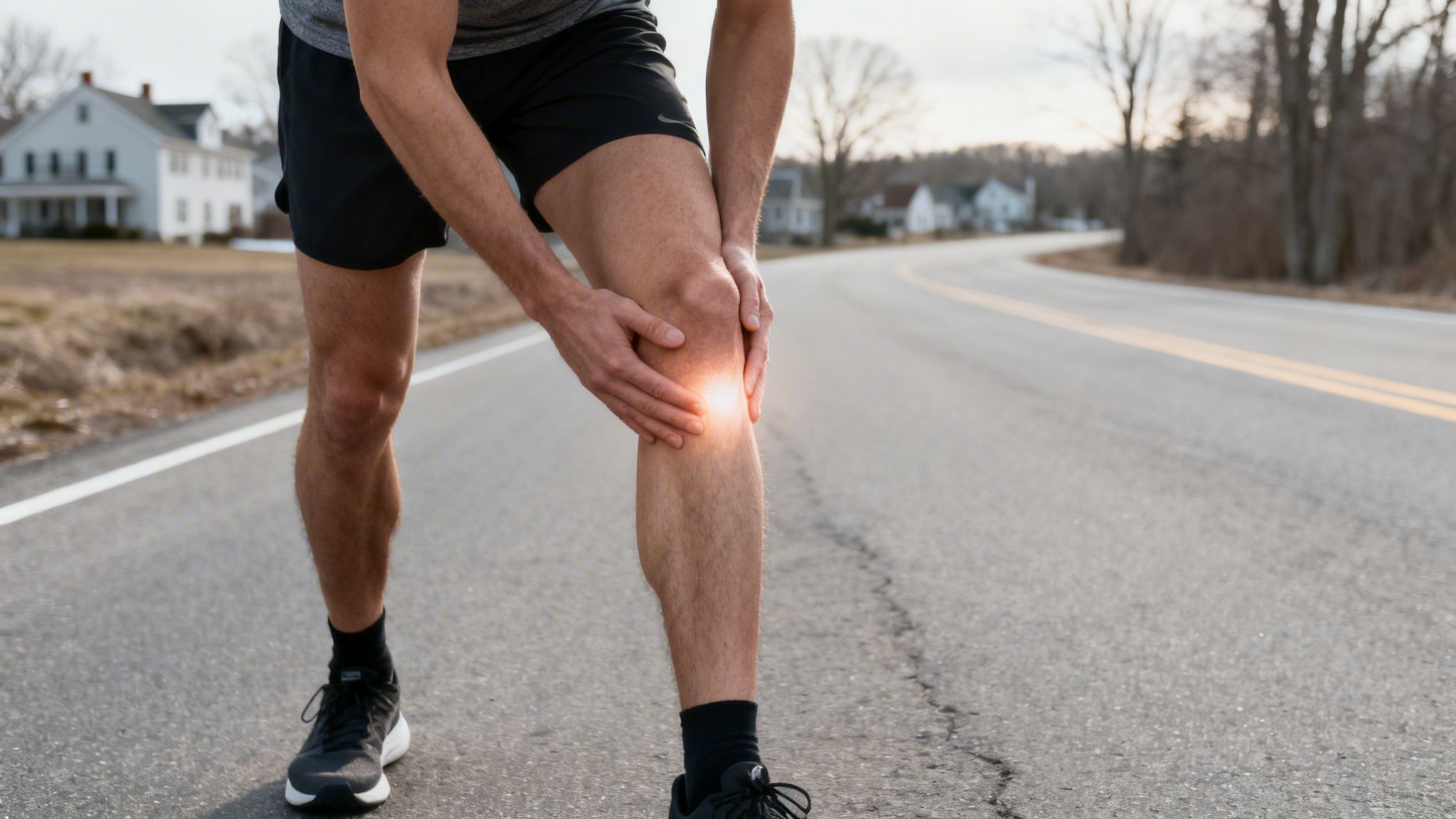
It’s a feeling almost every runner knows: that nagging ache or sharp twinge around your kneecap that just won't quit. We understand how frustrating it is to be sidelined from your favorite loop, whether that's along the Charles River Esplanade or through the Blue Hills Reservation. You shouldn’t have to stop doing what you love because of knee pain.
When your knee starts acting up, it’s easy to blame running itself. But more often than not, the pain is just a symptom. It's a signal flare from your body that something else is off-balance, and the real culprits are usually hiding in plain sight.
Common Sources of Runner's Knee Pain
In our Massachusetts physical therapy clinics, two of the most frequent diagnoses we see are Patellofemoral Pain Syndrome (PFPS)—better known as "Runner's Knee"—and Iliotibial (IT) Band Syndrome.
- Runner's Knee (PFPS): This usually shows up as a dull, aching pain in the front of your knee, either around or behind the kneecap. It tends to get worse when you're running, climbing stairs, or even after sitting for a while with bent knees.
- IT Band Syndrome: This condition creates a sharp, burning pain on the outside of the knee. It happens when the IT band, a thick strip of tissue running from your hip down to your shin, gets irritated from rubbing against the bony part of your knee.
These conditions are incredibly common. Patellofemoral pain affects around 23% of the general population. For new runners, the risk is even steeper, with incidence rates hitting nearly 21% in just a 10-week training window. Research also indicates that women are 2.2 times more likely than men to develop this condition, which underscores the need for a personalized treatment plan from a licensed physical therapist. You can explore the full research about these findings on patellofemoral pain to dig deeper into the science.
The Real Problem Is Often Upstream
While the pain is happening at your knee, our physical therapists often find the root cause "upstream" in your hips and glutes, or even "downstream" in your feet and ankles. Running is a series of single-leg hops, repeated thousands of times. If the powerful muscles in your hips and glutes aren't strong enough to keep your pelvis stable with every step, your knee is forced to take on extra stress.
Think of your leg as a chain. If a link at the top (your hip) is weak, the links below it have to work overtime to compensate. Over miles and miles, this compensation pattern leads to strain, inflammation, and eventually, pain in your knee.
This is actually good news. It means your knee pain isn't a life sentence, nor is it a sign you have to hang up your running shoes for good. Instead, it’s a clear signpost pointing you toward an underlying weakness that you can absolutely address with a proper plan.
By focusing on targeted knee pain exercises for runners that strengthen these key support muscles, you're not just putting a band-aid on the pain—you’re correcting the problem at its source. This proactive approach is the key to a successful recovery and will get you back out on the roads of Massachusetts, stronger and more resilient than before.
Debunking a Myth: Running Does Not Ruin Your Knees
Let's address one of the biggest myths in the running world: the idea that every mile you log is a step closer to ruining your knees. If you’ve ever winced after a long run and felt that fear of long-term damage, you are not alone. It’s a concern we hear from runners all the time, from those training for the Boston Marathon to those just enjoying a casual jog around Horn Pond in Woburn.
This belief is so common that it often stops people from enjoying an activity they love. We see patients at our Massachusetts physical therapy clinics who have given up running entirely, convinced they are causing irreversible harm. The truth, however, is far more encouraging.
The fear that running inevitably causes knee arthritis is largely unfounded. In fact, a growing body of evidence suggests the opposite. The cyclical loading and unloading of your joints during a run can stimulate cartilage, helping it become stronger and more resilient—much like how lifting weights builds stronger muscles.
What The Science Actually Says
Instead of causing joint breakdown, properly managed running might be one of the best things you can do for your knees. Research consistently shows that recreational runners have a lower incidence of knee osteoarthritis compared to their sedentary, non-running peers.
A major review of existing studies found something that surprises many runners. It turns out non-runners had a higher prevalence of knee pain and a greater risk of needing a total knee replacement (4.6%) compared to runners (2.6%). This powerful evidence directly challenges the old narrative. It suggests that properly conditioned runners may actually develop more durable knee joints over the long haul. You can see the data for yourself and read more about the connection between running and knee health on HoustonMethodist.org.
A New Mindset From Fear To Action
This shift in understanding is crucial for any runner dealing with knee pain. It helps you move away from the fear-based question—"Is running destroying my knees?"—and toward a proactive one: "What can I do to run more safely and effectively?"
Your knee pain is not a stop sign. It's a signal to investigate the root cause—often muscle imbalances or mechanical issues—and address it with the right exercises and strategies developed with a physical therapist.
Thinking of running as beneficial for your joints changes everything. It gives you the confidence to know you can run for years without doing long-term damage. The key isn't to stop running; it's to learn how to run smarter. With a physical therapist as your guide, you can build the strength and stability needed to enjoy the roads of Massachusetts for a lifetime.
Build Your Foundation With Core Strengthening Exercises

When your knee starts hurting, the first instinct for many runners is to stop moving altogether. But the right kind of movement is actually the key to your comeback. Our physical therapists start with foundational, low-impact exercises designed to activate and strengthen the muscles that truly protect your knees.
For a runner, your power doesn’t just come from your legs—it comes from your core, hips, and glutes. These muscles form a stable base that controls your alignment and absorbs impact with every stride. When they’re strong and firing properly, they take a massive amount of pressure off your knee joints.
The problem is, our modern lifestyles often leave these crucial muscles weak or "switched off." This forces smaller, less-equipped muscles and joints (like your knees) to pick up the slack, which is a classic recipe for strain and pain. Our goal is to rebuild that strong foundation from the ground up.
Waking Up Your Glutes
Your glutes are the powerhouse of your running stride, but they can be notoriously "sleepy." These first few exercises are all about re-establishing that mind-muscle connection with controlled, focused movements. Think precision over power here.
Table: Foundational Knee Strengthening Routine
Here is a sample routine to get you started. A physical therapist can personalize this based on your specific needs. The focus at this stage should always be on proper form—don't rush through the reps. We recommend completing this routine 3-4 times per week on non-consecutive days.
| Exercise | Focus Area | Sets x Reps | Key Cue |
|---|---|---|---|
| Glute Bridge | Glutes & Hamstrings | 3 x 10-15 | Squeeze your glutes to lift, not your back. |
| Clamshell | Gluteus Medius (Side Hip) | 3 x 15-20 per side | Keep your pelvis still; don't rock backward. |
| Bird-Dog | Core & Pelvic Stability | 3 x 10-12 per side | Keep hips square to the floor as you extend. |
Remember to listen to your body. If you feel any sharp pain, stop and reassess. These movements are meant to build you up, not cause more irritation.
Building a Stable Core for Running
A strong core is your secret weapon for efficient running. It stabilizes your pelvis and torso, which prevents energy leaks and keeps your legs moving in a clean, straight line. The exercises here target the deep core muscles that are critical for maintaining good running form, especially when you start to get tired.
While most people connect core work with back health, it's just as vital for preventing lower-body injuries. For a deeper dive, you can explore our guide on core strengthening exercises for back pain for even more ideas.
Let’s look at a few key movements.
Glute Bridges: Lie on your back with knees bent and feet flat on the floor. Squeeze your glutes to lift your hips until your body is in a straight line from shoulders to knees. Hold for a couple of seconds, focusing on that glute squeeze, then slowly lower. You should feel this in your glutes, not your lower back. If this causes any discomfort, just lift your hips a few inches. For a challenge, try a Single-Leg Glute Bridge, keeping your hips perfectly level.
Clamshells: This is fantastic for the gluteus medius, the muscle on the side of your hip that prevents your knee from collapsing inward. Lie on your side with your knees bent around a 45-degree angle and heels together. Keeping your feet touching, lift your top knee without rocking your torso back. You should feel this deep in the side of your top glute. To progress, add a resistance band just above your knees.
Bird-Dog: This is a phenomenal move for core stability and balance. Start on all fours with your back flat. Slowly extend your right arm forward and your left leg straight back at the same time. The trick is to keep your hips completely square to the floor. Return to the start with control and repeat on the other side.
Physical Therapist's Tip: Imagine you're balancing a glass of water on your lower back while doing the Bird-Dog. The goal is to move so smoothly that you don’t spill a single drop. This mental cue is excellent for maintaining a neutral spine and engaging your core.
Recent studies confirm why this targeted approach works. Research on runners with chronic knee pain has shown they have significant weakness—and even smaller muscle size—in specific hip muscles compared to uninjured runners. This tells us that generic leg exercises aren't enough. An effective physical therapy plan needs targeted knee pain exercises for runners that address these specific deficits, which is exactly what this routine is designed to do. You can discover more about these findings on targeted muscle strengthening on Today.UConn.edu.
By consistently performing these foundational movements, you're not just getting stronger; you're building a more resilient body. You're teaching the right muscles to do their job, creating a support system that will protect your knees and let you return to the paths around Norwell or the shores of Plymouth with confidence.
Advance to Running-Specific Strength Training
Once you’ve built a solid foundation and can perform core work without pain, it’s time to progress to running-specific strength. This is where we bridge the gap between basic rehab exercises and a powerful, resilient return to the roads and trails. We're now moving beyond simple holds and into dynamic exercises that truly mimic the demands of running.
These movements are all about building power, improving your body's ability to absorb shock, and fine-tuning the muscle control you need for every footstrike. We’ll focus heavily on control through the entire movement, especially the eccentric (or lowering) phase. This teaches your muscles how to properly decelerate and manage impact forces—an absolutely critical skill for any runner.
Single-Leg Squats to Build Unilateral Stability
Running is a series of single-leg hops. That's why single-leg squats are one of the best knee pain exercises for runners. They challenge your strength, balance, and control all on one leg, which translates directly to a more stable running stride.
How to Perform It:
- Stand on one leg, with your other leg lifted slightly off the floor in front of you.
- Keep your chest up and back straight as you slowly lower yourself down, as if you're about to sit in a chair. Only go as deep as you can without pain or your knee caving inward.
- Drive through your standing heel to push yourself back up to the starting position. Your goal here is control, not depth, especially when you're just starting.
If a full single-leg squat is too difficult at first, simply start by squatting down to a chair or a bench. As you get stronger, you can progress to a lower surface or remove it completely.
Physical Therapist's Insight: Watch your standing hip closely in a mirror. Does it drop out to the side when you squat? That's often a sign that your hip abductors aren't quite strong enough to keep your pelvis level. This is the exact same instability that can contribute to knee pain when you run, and it's something our therapists look for during a running gait analysis.
Walking Lunges for Dynamic Control
Walking lunges take the stability challenge up a notch by adding forward momentum. They force your muscles to stabilize your knee and hip while you move through space, which is exactly what happens during a run. This is a fantastic exercise for building endurance in your quads, glutes, and hamstrings all at once.
How to Perform It:
- Stand with your feet together, then take a large step forward with your right leg.
- Lower your hips until both knees are bent at roughly a 90-degree angle. Make sure your front knee stays directly above your ankle and your back knee hovers just above the ground.
- Push off your back foot and bring it forward to step directly into the next lunge on your left leg.
Keep your torso upright and your core engaged the entire time. If you feel wobbly, it's perfectly fine to pause and reset your balance between each lunge. The controlled movement in walking lunges can also help improve mobility in your hip flexors, an area that’s tight for many runners. For those also dealing with hip discomfort, our guide to hip pain relief exercises offers a great complement to this routine.
Step-Ups for Propulsive Power
Step-ups might seem simple, but they're an incredibly effective way to develop single-leg power for running. This movement directly imitates the push-off phase of your stride, strengthening the glutes and quads that are essential for propelling you forward.
How to Perform It:
- Stand facing a sturdy box, bench, or stair step that's about knee height.
- Place your entire right foot firmly onto the step.
- Press through your right heel to drive your body upward until your right leg is straight. Avoid pushing off with your back foot—let the front leg do all the work.
- Step back down with the left foot, then the right. Complete all your reps on one side before you switch to the other.
To make it more challenging, a physical therapist may recommend increasing the height of the step or holding light weights. Remember to control the lowering phase on the way down to maximize the eccentric strengthening benefits for your quads.
By incorporating these running-specific movements into your routine 2-3 times per week, you’ll be building a body that’s not just pain-free but truly prepared for the demands of running. This is how you build long-term resilience and get back to doing what you love with confidence.
Create Your Smart Return-to-Run Plan
You’ve put in weeks of hard work strengthening your core and hips, and now you’re itching to get back out on the road. That excitement is a great thing, but this is a critical moment for your recovery.
Feeling better can trick you into thinking you can jump right back to your old mileage and pace. We see it all the time in our clinics—a runner goes out for a "test" run, feels great, and then the pain comes roaring back. A smart return-to-run plan is gradual and structured, allowing your body to adapt without setbacks.
The Foundation: A Walk/Run Program
A walk/run program is the safest, most effective way to return from an injury. It’s the gold standard for a reason. By slowly reintroducing the stress of running in manageable doses, you give your muscles, tendons, and cartilage time to adapt.
This approach lets you test your knee's tolerance and rebuild your running confidence without risking a major flare-up. The key is to be completely pain-free during and after every single session. If you feel any pain, simply drop back to the previous week's level until you can progress without discomfort.
Sample Week 1 Protocol (Perform 3 times per week):
- Warm-up: 5 minutes of brisk walking.
- Main Set: Repeat 6 times:
- Run for 1 minute at an easy, conversational pace.
- Walk for 4 minutes to recover.
- Cool-down: 5 minutes of slow walking and gentle stretching.
As you feel good, you can gradually increase the run interval and decrease the walk time. For example, your next step might be repeating 2 minutes of running with 3 minutes of walking.
This infographic shows how your running-specific strength work builds a foundation for your return to the road.
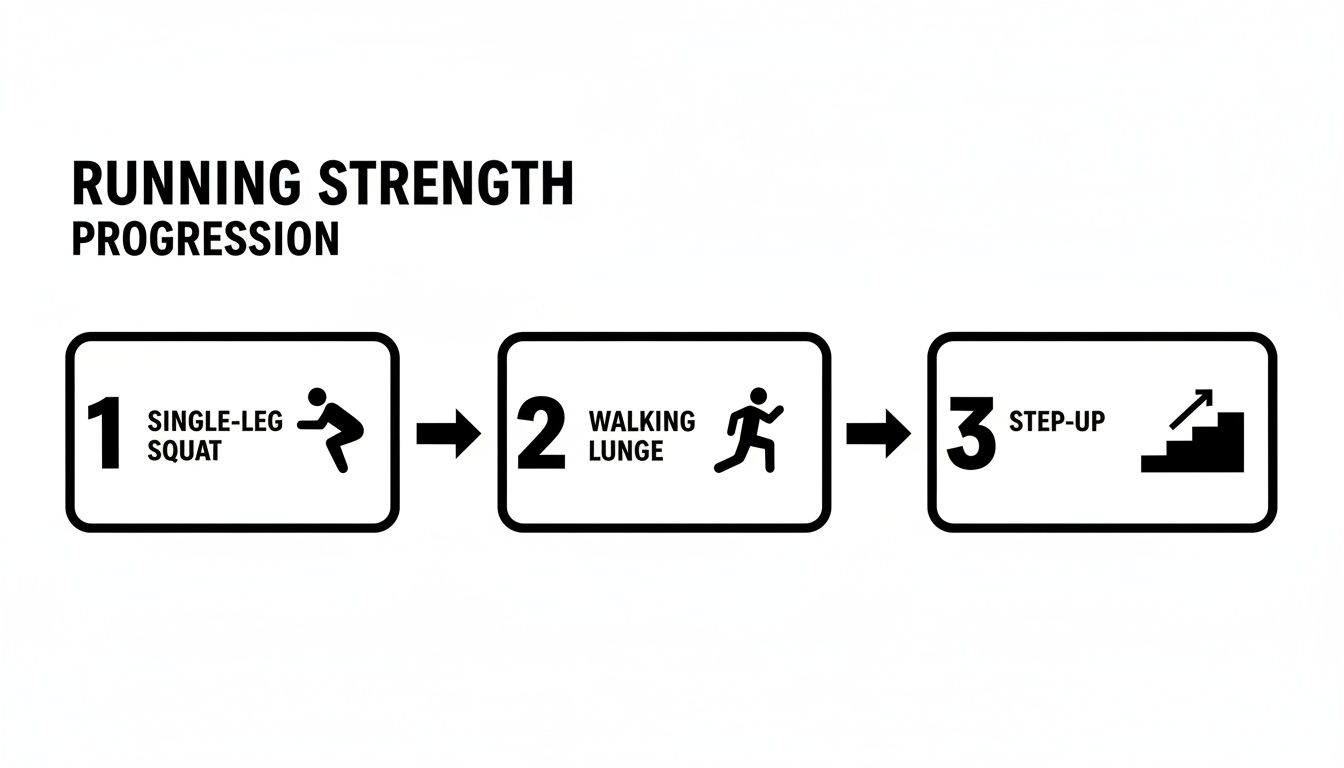
You can see how foundational moves like the single-leg squat create the control needed for more dynamic exercises like lunges and step-ups, getting your body ready for running again.
Smart Modifications for Massachusetts Runners
Beyond just how far you run, a few other tweaks can make a huge difference in the stress on your knees. Paying attention to these is especially important when running in our local Massachusetts communities.
Cadence (Step Rate):
Try increasing your step rate by just 5-10%. This small change can dramatically reduce the impact forces traveling up to your knee. A slightly shorter, quicker stride helps prevent over-striding, where your foot lands too far out in front of you. Think "light and quick." You can use a running watch or a simple metronome app to dial in your rhythm.
Running Surface:
Softer surfaces, like a dirt trail at Wompatuck State Park or a local high school track, can definitely feel gentler on the joints. That said, it’s also important to train on the surfaces you plan to use most often. Many roads in towns like Milton or Quincy have a noticeable camber (slope) for water drainage. Always running on one side of a sloped road can create imbalances, so try to run out-and-back routes to even out the stress.
Footwear:
This is absolutely not the time to be running in old, worn-out shoes. The cushioning and support in running shoes break down after about 300-500 miles. Make sure your shoes are in good shape and right for your foot type. If you’re not sure, a gait analysis at a specialty running store is a fantastic investment in your knee health.
A critical rule for your comeback is the "no more than a 10% increase" rule. Never increase your total weekly running time or mileage by more than 10% from the week before. This simple guideline is one of the best tools our physical therapists use to prevent re-injury and build back up sustainably.
When to See a Physical Therapist for Your Knee Pain
While the exercises in this guide are a fantastic starting point for managing runner's knee, some situations require a professional, hands-on evaluation. A little soreness as you build strength is one thing, but sharp or persistent pain is your body's way of telling you to stop and get help.
Knowing when to switch from self-care to professional guidance is one of the smartest things a runner can do. Pushing through the wrong kind of pain can set you back, delay your healing, or even make the original problem worse.
Red Flags That Signal It’s Time for a PT Visit
It’s frustrating when you’re doing the work, but your symptoms are getting worse. If that’s happening, it's time to pause and get a proper evaluation from a licensed physical therapist.
Keep an eye out for these specific red flags:
- Pain that increases or doesn't improve: If your pain isn't getting better after a week or two of gentle, consistent exercise and modifying your runs, a PT can perform a comprehensive evaluation to find out why.
- Pain that disrupts daily life: When your knee starts hurting when you walk, sleep, or tackle the stairs, it’s a clear sign you need professional help.
- Mechanical symptoms: Feelings of clicking, locking, or your knee "giving way" are not normal. These symptoms point to issues that need a thorough assessment.
- Significant swelling or warmth: If you see noticeable swelling or the joint feels warm—and it doesn’t go down with rest and ice—it could be a sign of significant inflammation or injury that requires a diagnosis.
You shouldn't have to navigate a painful injury alone. A physical therapist acts as your personal guide, taking the guesswork out of your recovery and creating a clear, step-by-step path back to the activities you love.
We get it. The anxiety that comes with an injury that won't go away is real. You're worried you might need surgery, or that you'll never get back to running along the Scituate coastline. A physical therapy evaluation is the best first step to getting clear answers and a personalized treatment plan.
What to Expect at Your Physical Therapy Evaluation
When you visit one of our Peak Therapy clinics in Massachusetts, you won’t just get a handout of generic exercises. Your first visit is all about digging deep to find the real "why" behind your pain.
Our licensed physical therapists conduct a comprehensive evaluation that includes:
- A Detailed History: We’ll talk about your training history, when and how the pain started, and how it's affecting your life.
- Movement Analysis: We'll watch you walk, squat, and perform other key movements to spot any biomechanical glitches or compensation patterns.
- Hands-On Assessment: Your therapist will use manual therapy techniques to check your joint mobility, muscle flexibility, and strength to zero in on specific weaknesses or imbalances.
- Personalized Goal Setting: We’ll talk about what matters most to you—whether that’s running a 5K in Plymouth or just being able to play with your kids without pain.
This complete approach allows us to design a treatment plan that’s truly built for your body and your goals. If your knee pain persists or worsens, understanding the services offered by professional Physical Therapy Clinics can be crucial for a comprehensive recovery plan. It gives you the structure you need to move forward with confidence. You can also learn more about preventing knee injuries in our detailed guide for additional strategies.
With convenient locations across Massachusetts—from Quincy and Braintree to Duxbury and Pembroke—expert help is closer than you think. Our team is here to be your partner, providing the expert guidance and reassuring support you need to get back on your feet and back to the life you love.