


That unsettling feeling of being unsteady on your feet is more than just a physical sensation—it can be genuinely frightening. We understand how unnerving it can be. Whether you're crossing your living room in Quincy or walking down a busy street in Hanover, a sudden loss of balance can shake your confidence.
It's a common experience, but it’s absolutely not an inevitable part of getting older. In fact, taking proactive steps to improve your stability is one of the most powerful things you can do to maintain your independence and keep doing the things you love, right here in Massachusetts.
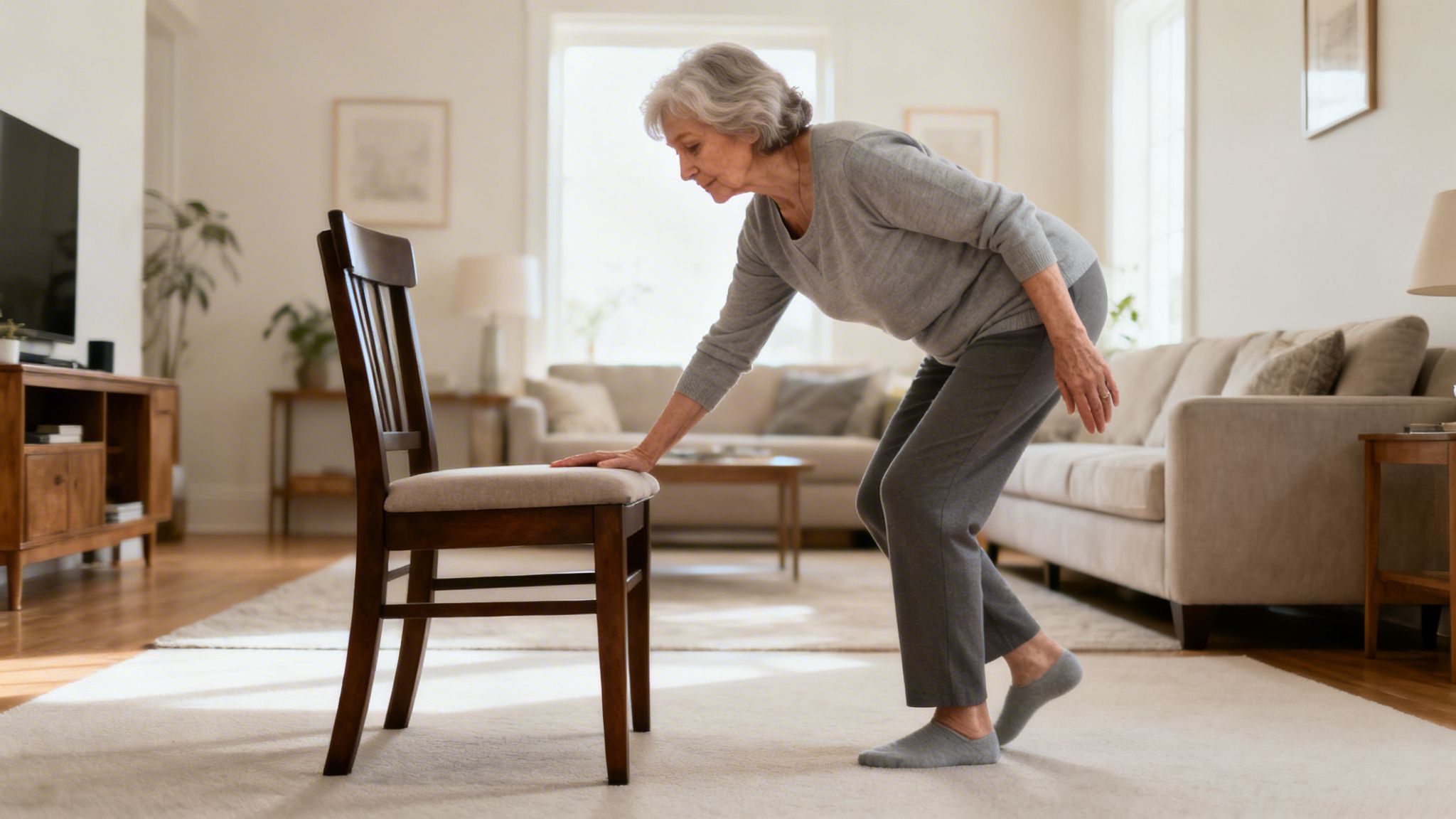
This fear is completely understandable. It can make you hesitant to do things you once enjoyed without a second thought, from taking a walk at Borderland State Park to simply reaching for something on a high shelf in your kitchen. But that fear doesn’t have to run your life. Our licensed physical therapists are here to help you move from a place of worry to a place of confidence.
A Quick Look at Your Fall Risk
The statistics on falls are sobering. In the United States, 1 in 4 adults aged 65 and older falls each year, and falling once actually doubles the chances you'll fall again. What’s more, less than half of seniors who fall bring it up with their doctor, which means too many people are struggling in silence with a problem that can be addressed.
To better understand foundational strategies for staying safe, this overview on Fall Prevention is an excellent starting point.
Use this checklist to understand some of the most common risk factors. Answering 'Yes' to one or more of these suggests that a personalized fall prevention plan is a smart next step for you.
| Risk Factor | Check If 'Yes' | Why It Matters for Stability |
|---|---|---|
| I have fallen in the past year. | ☐ | A previous fall is the single biggest predictor of a future fall. |
| I use or have been told I need a cane or walker. | ☐ | Needing an assistive device often indicates underlying weakness or balance issues that a physical therapist can address. |
| I sometimes feel unsteady when I'm walking. | ☐ | This sensation is a direct warning sign that your balance systems aren't working optimally. |
| I worry about falling. | ☐ | Fear of falling can lead to decreased activity, which ironically weakens muscles and increases fall risk. |
| I have to rush to the toilet. | ☐ | Rushing increases the chance of a misstep, especially if you have balance or strength deficits. |
| I take four or more medications a day. | ☐ | The more medications you take, the higher the risk of side effects like dizziness or drowsiness that can lead to falls. |
| I have been diagnosed with a chronic condition like arthritis, diabetes, or stroke. | ☐ | These conditions can affect sensation in the feet, muscle strength, and overall stability. |
If you checked any of the boxes above, it doesn't mean a fall is inevitable—it simply means it's time to take action with a clear, expert-guided plan.
How a Physical Therapist Can Help
While a self-check is a great first step, a professional evaluation at one of our Massachusetts clinics is the most effective way to determine the root cause of your instability. At Peak Therapy, our licensed physical therapists perform a comprehensive evaluation to pinpoint exactly what's causing your balance issues.
The culprit could be any number of things, including:
- Weakness in your leg and core muscles
- Inner ear problems that cause dizziness or vertigo
- Reduced flexibility in your ankles or hips
- Issues with your gait (the specific way you walk)
For many people, dizziness is a major contributor to feeling off-balance. This can be especially true during our harsh Massachusetts winters, a topic we cover in our guide on winter dizziness and how to manage it.
A physical therapy evaluation provides a clear roadmap for your care. It moves you from uncertainty and fear to a place of confidence, equipped with a personalized treatment plan to help you stay active and safe.
This expert guidance ensures you're doing the right exercises for your unique situation. It's the most effective way to build real, lasting stability and get back to living your life with confidence.
Core Exercises for Better Balance
When we talk about preventing falls, improving your balance is the most important piece of the puzzle. It’s not just about being steady—it's about having a strong, stable core and training your body's equilibrium so you can move with confidence. Let's get past the generic advice and walk through the same practical, evidence-based exercises our physical therapists at Peak Therapy use to help seniors all across Massachusetts feel steadier on their feet.
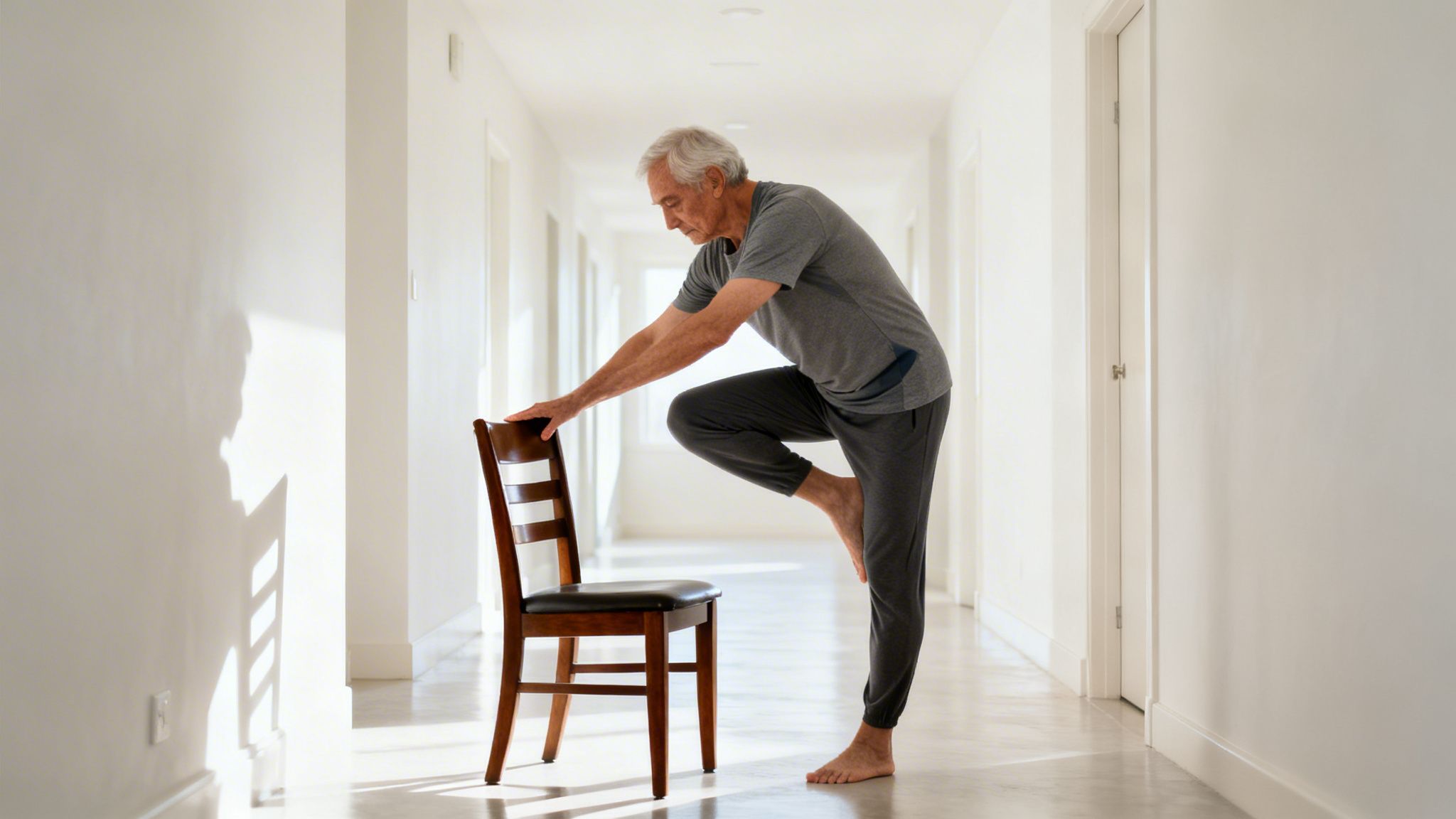
The secret to seeing real improvement is starting safely and adding challenge slowly. Always perform these exercises near a sturdy support, like a kitchen counter or a heavy, non-rolling chair.
Setting Up Your Safe Exercise Space
Before you even think about the first exercise, take a moment to set up your space. This is just as crucial as the movements themselves.
- Clear the Area: Look around and remove any tripping hazards. This means getting throw rugs, cords, low coffee tables, and general clutter out of the way. You need an open space to move without risk.
- Choose Your Support: Find a stable surface to hold onto. A kitchen counter is perfect. A heavy dining room chair pushed against a wall also works well. Absolutely avoid chairs with wheels or any light, wobbly furniture.
- Wear Proper Footwear: Put on a pair of supportive, well-fitting shoes that have non-slip soles. Exercising in just socks, loose slippers, or backless shoes is a recipe for a slip.
Fundamental Balance Exercise 1: Single-Leg Stance
This is the bedrock of balance training. It teaches your body to stay stable on one foot, a skill you use every time you walk, turn, or navigate uneven ground—whether that’s a bumpy path in a local park or just getting out of the car.
How to Perform:
- Stand behind your sturdy chair or next to the counter, holding on with both hands for support.
- Put your weight onto your right foot, keeping a slight, soft bend in your knee.
- Slowly lift your left foot off the floor.
- Try to hold this pose for 10-15 seconds, focusing on staying upright and steady.
- Lower your foot back down with control. Repeat 3-5 times on this side before switching to do the same on your left leg.
Progression Is Key: Once holding for 15 seconds with two hands feels easy, it's time to challenge yourself. Try holding on with just one hand, then maybe just your fingertips. The goal is to eventually do this without any hand support, but only move to the next level when you feel completely safe and confident. A physical therapist can guide you on when and how to progress safely.
Fundamental Balance Exercise 2: Heel-to-Toe Walk
Also known as a Tandem Walk, this movement directly sharpens your dynamic balance—your ability to stay stable while you’re in motion. It mimics the challenge of walking on a narrow path and improves the vital communication between your brain, legs, and feet.
How to Perform:
- Stand alongside a wall or a long countertop, resting one hand on it lightly for support.
- Place the heel of one foot so it’s touching the toes of your other foot, like you’re walking on a tightrope.
- Take a slow, deliberate step forward, again placing your heel right in front of the toes of your other foot.
- Continue for 10-15 steps. Try to keep your eyes looking forward, not down at your feet.
- Turn around carefully and repeat, walking back to your starting point.
As you get more comfortable, rely less on the wall. You might just hover your hand over the surface for safety. The objective here is smooth, controlled walking without wavering.
Core Stability for Enhanced Balance
While these balance drills are focused on your legs, a strong core is the anchor for every move you make. Engaging your abdominal and back muscles gives you the central stability needed to stop swaying and hold a good posture.
If you’re interested in building this foundational strength, our guide to core strengthening exercises for back health offers more movements that support your overall stability.
Always remember to listen to your body and never push through sharp pain. A few minutes of these balance exercises each day can make a huge difference—consistency will bring far better results than intensity.
Building Strength to Support Your Body
While balance exercises fine-tune your body's stability, building foundational strength provides the raw power to stand tall, move with confidence, and catch yourself if you stumble. Think of strong leg, hip, and core muscles as your body's built-in support system against falls.
This kind of functional strength is essential for navigating the world around us. It's what you need to get up from a low chair, climb stairs without holding the railing, or step confidently off a curb in your neighborhood.
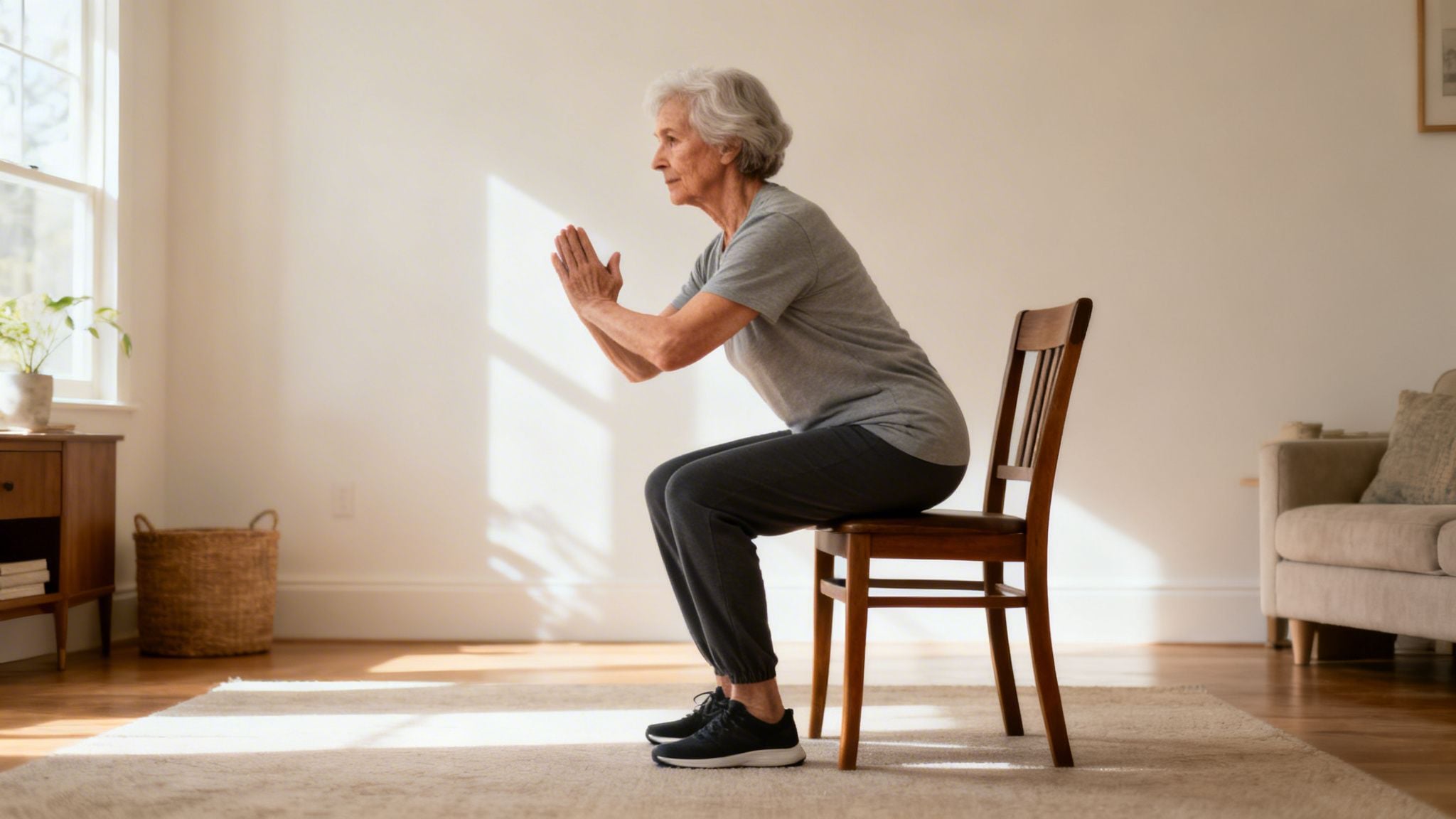
The good news is you don’t need a gym membership or fancy equipment. These key strengthening exercises can be done right in your home. The goal isn’t bodybuilding; it’s about building practical strength that keeps you independent and engaged in the activities you love.
How Stronger Muscles Prevent Falls
It’s easier to stay motivated when you know why an exercise helps. Let’s connect the dots between the movements and your daily life:
- Strong Quadriceps (front of thighs): These are your powerhouse muscles. They give you the strength to stand up from a chair, get out of a car, and climb stairs.
- Strong Glutes (buttocks): Your glutes are critical for a steady walking pattern and maintaining your balance when you bend over to pick something up.
- Strong Core (abdominals and back): A stable core is the anchor for your entire body. It prevents you from swaying and helps you stay upright if you trip.
Every repetition is a direct investment in your safety, making these everyday movements feel easier and more secure.
Foundational Strength Exercise 1: Chair Squats
This is one of the most effective fall prevention exercises for seniors because it perfectly mimics the motion of getting in and out of a chair—a movement we all do countless times a day.
How to Perform:
- Stand in front of a sturdy, non-rolling chair (a dining room chair is perfect). Place your feet about shoulder-width apart.
- Hold your arms straight out for balance or cross them over your chest.
- Keeping your chest lifted and back straight, slowly bend your knees and send your hips back as if you’re about to sit down.
- Lower yourself until your bottom just grazes the chair, but try not to put your full weight on it.
- Push through your heels to powerfully and smoothly return to a standing position.
- Start with 2 sets of 8-10 repetitions.
Make it Easier: If a full squat feels like too much, start with a "mini-squat" where you only lower yourself a few inches. As you build strength, gradually increase how far you go down.
Foundational Strength Exercise 2: Glute Bridges
This is a fantastic exercise for your glutes and lower back, both crucial for a stable pelvis and a powerful walking stride. Best of all, it's done lying on the floor, making it a very safe option.
How to Perform:
- Lie on your back on a carpet or mat. Bend your knees and place your feet flat on the floor, about hip-width apart.
- Let your arms rest by your sides with your palms facing down.
- Squeeze your glute muscles and lift your hips off the floor until your body forms a straight line from your shoulders to your knees.
- Hold the top position for a moment, feeling the work in your glutes and the back of your legs.
- With control, slowly lower your hips back to the floor.
- Complete 2 sets of 10-12 repetitions.
The evidence for this approach is overwhelming. Large-scale studies have shown that programs focusing on balance and functional exercise can reduce the rate of falls by 24%. Another major study found a 14.3% reduction in falls, and even more importantly, a 41% reduction in falls that cause a serious injury. You can explore more about how multi-component exercise is a cornerstone for fall prevention and read the full research about these findings.
At Peak Physical Therapy, our therapists design personalized strength plans that start right where you are and progress you safely. We know that "strength" really means having the confidence and ability to live your life without the fear of falling.
Your Weekly Fall Prevention Exercise Plan
You’ve learned the key exercises, which is a fantastic start. But the real magic in building lasting strength and balance doesn’t come from doing an exercise once or twice—it comes from consistency.
Having a simple, structured routine removes the guesswork and helps turn these movements into a powerful habit. Let’s put it all together.

A great target to shoot for is 20-30 minutes of focused activity, about 3 to 4 times per week. Remember, this is your plan. Always listen to your body, take rest days when needed, and never push through sharp pain.
Putting It All Together: A Sample Week
We understand that it's frustrating to worry about something as simple as a weekly walk on the beach. Fear of uneven sand or a crowded boardwalk can keep you from enjoying the things you love. But with a consistent plan, you can build not just strength, but the confidence to get back out there.
The sample schedule below shows how you can weave balance, strength, and flexibility into your week. Feel free to swap the days around to fit your life, but try to give yourself a rest day between strength-focused sessions.
Sample Weekly Fall Prevention Schedule
Use this template to integrate balance, strength, and flexibility into your week. Remember to adjust based on how you feel and always warm up first.
| Day of the Week | Focus of the Day | Sample Exercises |
|---|---|---|
| Monday | Strength | Chair Squats (2 sets of 10), Glute Bridges (2 sets of 10) |
| Tuesday | Active Rest | Gentle walking, stretching |
| Wednesday | Balance & Flexibility | Single-Leg Stance (3 holds per leg), Heel-to-Toe Walk (10 steps) |
| Thursday | Rest | Complete rest day |
| Friday | Full Body | Chair Squats (1 set), Wall Push-ups (1 set), Single-Leg Stance (2 holds) |
| Saturday | Active Rest | Gardening, longer walk, or other light activity |
| Sunday | Rest | Complete rest day |
This is just a starting point. As you get stronger, you can increase the sets or reps, or hold the balance poses for a bit longer. The goal is progress, not perfection.
Your Most Important Cue: Listen to Your Body
Some days you'll feel energetic and ready for more; other days you might feel tired or stiff. The best plan is one you can stick with. If an exercise causes sharp pain, stop. If you're feeling overly fatigued, a shorter session or a full rest day is the wisest choice you can make.
Looking for more ways to round out your routine? This is a great resource for some of the best exercises for seniors.
Remember, these are general guidelines. If you’re dealing with joint pain, high-impact activities might not be the best choice. In that case, exercising in a pool provides fantastic resistance without the stress on your joints. For more on that, check out our guide on the best aquatic therapy exercises and see how it can support your goals.
When You Need an Expert Fall Prevention Plan
Doing exercises at home is a fantastic and empowering step toward better stability. But there are times when a general routine isn't enough, and working with an expert becomes the safest, most effective path forward. Think of it less as a setback and more as a proactive decision to secure your independence for years to come.
It can be hard to know when to make that call. You might feel like you’re managing well, but a few subtle signs could indicate that a professional evaluation would be a smart move. Recognizing these signs is the key to preventing a fall before it happens.
Key Signs It’s Time to See a Physical Therapist
If you're wondering whether your situation calls for one-on-one guidance, see if any of the following sound familiar. These are common reasons why people from across Massachusetts, from Plymouth to Pembroke, come to our clinics for help.
- You've Had a Recent Fall: This is the most significant red flag. Even if you weren't seriously hurt, a fall is a clear signal that something is off with your strength, balance, or reaction time.
- You Experience Dizziness or Vertigo: Feeling lightheaded, dizzy, or like the room is spinning is not something you should just live with. These sensations dramatically increase your fall risk and can often be treated with specialized physical therapy.
- You Have a Fear of Falling: If worry about falling is causing you to avoid activities you once loved—like gardening, walking in your neighborhood, or visiting family—it's time for help. This fear can create a vicious cycle of inactivity that actually makes you weaker.
- You Have an Underlying Medical Condition: Conditions like peripheral neuropathy (numbness in the feet), arthritis, Parkinson's disease, or recovery from a stroke all directly impact your balance. They require a specialized approach that goes beyond basic exercises.
A physical therapy evaluation is not a sign of failure; it's a smart investment in your future. It's about getting an expert plan tailored precisely to your body, your history, and your goals so you can live your life with greater confidence.
What to Expect During a Fall Prevention Evaluation
The idea of a physical therapy evaluation might seem intimidating, but our goal is to make it a calm, reassuring, and informative experience. At any Peak Physical Therapy clinic, you will work one-on-one with a licensed physical therapist dedicated to understanding your unique situation.
First, we will perform a comprehensive evaluation that begins with a conversation. We want to hear about your concerns, any falls or near-falls you've had, your medical history, and what activities you hope to get back to safely.
Next, your therapist will guide you through simple, pain-free assessments to measure the strength in your legs, hips, and core, as well as the flexibility in key joints like your ankles. We will also analyze your gait and balance by watching you walk and using standardized tests to get an objective measure of your stability.
This comprehensive assessment allows us to pinpoint the root cause of your instability. It's this precise diagnosis that allows us to develop a personalized treatment plan—one that includes the right fall prevention exercises for seniors with your specific needs in mind.
Don't let uncertainty or fear hold you back from feeling steady and secure. Taking this step is about choosing to stay active, independent, and safe. If you're ready to move with confidence, we invite you to book an evaluation at one of our convenient Massachusetts locations. Our dedicated team is here to help you get back on your feet, safely and effectively.
Common Questions About Fall Prevention
As you start working on your stability, it’s completely normal to have questions. Feeling confident about what you’re doing is just as important as the exercises themselves.
We’ve gathered some of the most common questions our physical therapists hear every day at our Peak Therapy clinics across Massachusetts. Here are our answers, based on years of experience helping seniors just like you.
How Long Will It Take to Notice Better Balance?
This is probably the most frequent question we get, and it’s an important one. While everyone’s body responds a little differently, most people start to feel more stable within 4 to 6 weeks of consistent, focused physical therapy.
At first, you’ll likely notice small but meaningful victories. Maybe you can stand on one leg for a few extra seconds without grabbing for support, or you feel steadier making a quick turn in the kitchen. Over time, these little improvements add up to a big, noticeable boost in your daily confidence.
A physical therapist can give you a more specific timeline after a full evaluation. By creating a plan that targets your unique needs, we can help you progress at a pace that is both safe and effective.
What Simple Changes Can I Make at Home to Prevent Falls?
Improving your balance with exercise is half the battle; the other half is making sure your home is set up for safety. Think of it as creating a "safety net" that’s working for you around the clock.
Here are some of the most effective changes you can make right away:
- Secure Your Rugs: Loose throw rugs are a major tripping hazard. The safest bet is to remove them, especially in hallways or other high-traffic areas. If you love your rug, make sure it’s secured with double-sided tape or a quality non-slip backing.
- Clear the Pathways: Take a walk through your home with an eye for clutter. Piles of mail, stray shoes, and electrical cords can all create unexpected obstacles. Keeping your main walkways clear is one of the simplest and most powerful things you can do.
- Let There Be Light: Falls often happen in poorly lit areas, especially during nighttime trips to the bathroom. Make sure every room has bright, easy-to-use light switches near the entrance. We often recommend motion-activated night lights for hallways, bedrooms, and bathrooms.
- Install Grab Bars and Handrails: A grab bar in the shower or next to the toilet provides a sturdy handhold right when you need it most. Also, check that every staircase—both inside and out—has a solid handrail on at least one side.
Our Peak physical therapists often provide a personalized home safety checklist during an initial evaluation. This helps you spot hazards in your own home that you might have overlooked, turning your living space into your safest place.
I Have Arthritis in My Knees, Can I Still Do These Exercises?
Yes, absolutely—and you should! Strengthening the muscles that support your knees is one of the best things you can do to manage arthritis pain and improve joint stability. When your muscles are weak, the joint itself takes all the impact. Strong muscles act like shock absorbers.
The key is to modify the exercises so they work for your body without causing pain.
- When you do squats, start with a smaller range of motion—what we call "mini-squats." Only lower yourself a few inches, and always hold onto a sturdy chair or countertop for support.
- Listen to your body. A feeling of muscle fatigue is great, but sharp, stabbing joint pain is a clear signal to stop.
- You might also consider aquatic therapy, which we offer at select Peak clinics. The water’s natural buoyancy supports your body, letting you build strength without putting stress on your joints.
Working with a physical therapist is the best way to get a routine that’s tailored specifically for arthritic joints. Our licensed therapists can show you the precise movements to get stronger without triggering a flare-up.
Does Being Afraid of Falling Make Me More Likely to Fall?
It’s a frustrating cycle, but unfortunately, the answer is yes. The "fear of falling" is a very real and well-documented phenomenon. When you're afraid, you might start walking more cautiously, looking down at your feet, or even avoiding activities you once enjoyed.
That hesitation and avoidance lead to less activity, which causes the muscles and balance systems to get weaker from disuse. This physical deconditioning then increases your actual risk of falling, which only reinforces the fear. It’s a tough loop to break on your own.
A huge part of our fall prevention program at Peak Therapy is rebuilding your confidence right alongside your physical strength. We start with gentle, progressive exercises in a safe, supportive environment to prove to you that you can move safely again. Our therapists also provide mental strategies to help you break that fear cycle, empowering you to get back to walking the dog or playing with your grandkids without that constant worry.
At Peak Physical Therapy and Sports Performance, we believe everyone deserves to move with confidence and live without the fear of falling. If you're ready to take control with an expert plan designed just for you, we invite you to request an appointment at one of our convenient Massachusetts locations.