

If a nagging pain in your back, hips, or shoulders is turning a beautiful day on a Quincy or Plymouth course into a painful ordeal, you aren't alone. We understand how frustrating it is when pain keeps you from the game you love. This guide is for you. At Peak Therapy, our licensed physical therapists specialize in helping golfers move past the pain, find the root cause of the issue, and build a body that’s ready for the demands of the game.
Feel Better and Play Longer on Massachusetts Courses
A crisp Massachusetts morning on the golf course is one of life’s simple pleasures. But when every swing comes with a sharp twinge in your lower back or a dull ache in your shoulder, that joy disappears fast. You might find yourself shortening your swing, dreading the back nine, or popping pain relievers just to finish a round. It's a frustrating cycle that keeps you from enjoying the game and can leave you worried about a worsening injury.
This experience is incredibly common for golfers all over the South Shore and throughout Massachusetts. Pain is your body’s alarm system, and in golf, it’s usually pointing to an underlying physical issue that your swing is bringing to the surface. It’s a sign that your body is compensating for a lack of mobility, stability, or strength somewhere.
Move Beyond Pain and Toward Performance
You don’t have to choose between giving up the sport you love and living with nagging pain. Specialized golf physical therapy offers a clear path forward, looking at you not just as a patient with back pain, but as a golfer whose body needs to move in a specific, powerful, and coordinated way.
Our licensed physical therapists at Peak Therapy perform a comprehensive evaluation to determine the root cause of your pain and develop a personalized treatment plan. This goes way beyond just treating the sore spot. We focus on:
- Finding the Root Cause: Is your lower back pain actually coming from stiff hips that can't rotate? Is your golfer's elbow the result of a weak shoulder? We perform a full evaluation to uncover these critical connections.
- Restoring Functional Movement: Our goal isn't just to make the pain stop. It's to restore the fundamental movements your body needs to swing a club efficiently and safely, round after round.
- Building a Resilient Body: We design personalized treatment plans that build strength, improve mobility, and increase stability, making your body more resilient to the stresses of golf.
At its core, golf physical therapy is about closing the gap between your body's current abilities and the physical demands of your swing. It’s about building a body that can support a better, more powerful game for years to come.
The Professional’s Choice for Longevity
It’s no secret that the best athletes in the world invest heavily in keeping their bodies in top shape. Pro golfers, in particular, have made physical therapy a core part of their training, and the results speak for themselves. In fact, 18 of the last 20 major champions and 25 of the top 30 players in the world work with Titleist Performance Institute (TPI) certified professionals. The data from the growing golf training aid market backs this up.
This isn’t just about fixing injuries after they happen; it's a strategy for a long, successful career. The same principles that help the pros win majors can help you play pain-free on weekends. At Peak Therapy, our mission is to move you from a cycle of pain and frustration to one of consistent, enjoyable play.
Why Your Swing Is Causing Pain
If you’ve ever walked off the 9th green at Granite Links in Quincy or Plymouth Country Club with a nagging ache in your lower back, you know how frustrating golf pain can be. That twinge in your shoulder or sharpness in your elbow isn't just a minor annoyance—it's your body's way of telling you something isn't working correctly in your swing.
The golf swing is an explosive, full-body movement. When everything fires in sequence, your body moves like a whip, transferring energy effortlessly from the ground up through your legs, core, shoulders, and finally into the club. But if one link in that “kinetic chain” is weak or stiff, another part has to overwork to pick up the slack, leading to strain, overuse, and eventually, injury.
This is where golf physical therapy comes in, helping you reduce pain, improve your game, and keep playing for years to come.
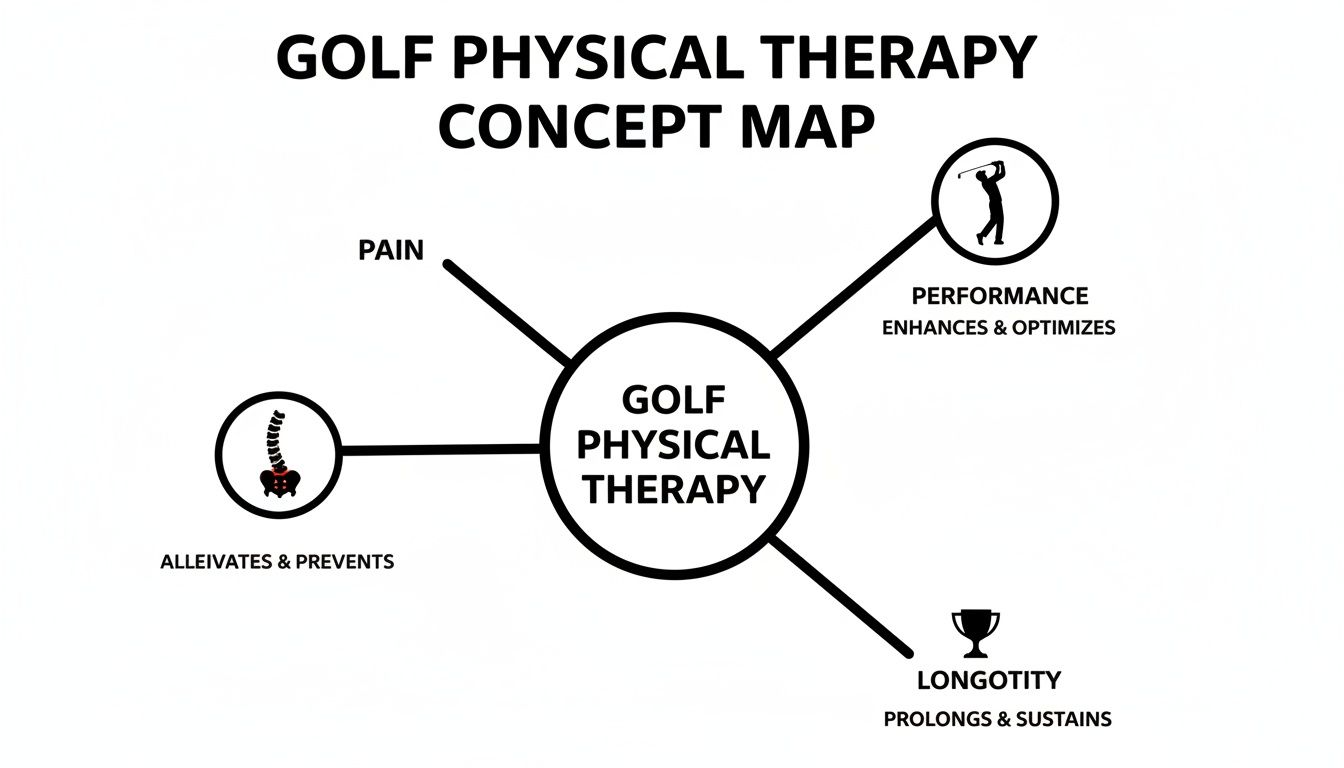
As you can see, these goals are all connected. When you eliminate pain, you naturally perform better. And when you’re performing better, you can enjoy the sport you love for a lifetime.
From Swing Faults to Physical Limits
Golfers often hear about common swing faults like "early extension" or having an "S-posture." What’s important to understand is that these aren’t just bad habits you need to break. They're usually your body’s solution to an underlying physical limitation. Your body is incredibly smart and will find a way to get the club to the ball, even if it has to cheat and put extra stress on your back, shoulders, or elbows to do it.
A physical therapist trained in golf biomechanics can look at your swing and decode what your body is trying to say.
- Poor Hip Rotation: If your hips are too stiff to turn properly in your backswing, your lower back is forced to over-rotate to get the club to the top. This is a massive contributor to the low back pain that plagues over 30% of amateur golfers.
- Weak Core and Glutes: When your core and glute muscles aren't firing, your body lacks stability. To compensate, you might lunge your hips toward the ball in the downswing—that dreaded "early extension." This kills your rotation and makes your arms and hands take over, a common cause of elbow and wrist injuries.
- Limited Thoracic Spine Mobility: A stiff mid-back prevents you from getting a full, connected shoulder turn. Your body might make up for it by lifting your arms or bending your lead elbow, putting your rotator cuff and shoulder joint at risk for impingement and strain.
Instead of just seeing a slice or a hook, a golf physical therapist sees a clue. That shot pattern is a form of communication, telling us exactly what your body needs—whether it’s more mobility in your hips, better stability from your core, or more rotation through your mid-back.
Connecting Common Golf Pains to Your Swing
That stubborn ache in your elbow or stiffness in your back isn't random. Very often, specific injuries can be traced directly to a breakdown in the swing where your body's compensation patterns finally catch up to you.
At Peak Therapy, our TPI-certified experts are trained to connect the dots between your pain and your movement patterns. We don’t just treat your "golfer's elbow"—our licensed therapists perform a comprehensive evaluation to determine the root cause of your pain and develop a personalized treatment plan.
The table below shows how these connections often play out.
Connecting Common Golf Pains to Your Swing
| Common Injury | Related Swing Fault | Potential Physical Limitation |
|---|---|---|
| Low Back Pain | S-Posture, Reverse Spine Angle | Limited hip rotation, weak core/glutes |
| Golfer's Elbow | Over-the-top, Casting | Weak core, poor separation of upper/lower body |
| Shoulder Pain | Lifting arms, "Chicken wing" | Limited thoracic spine rotation, poor scapular stability |
| Hip Pain | Sway or Slide | Weak glute muscles, limited hip internal rotation |
| Wrist Pain | Casting, Scooping | Poor grip, limited forearm rotation |
Understanding that your pain is a symptom of a movement problem is the most important step toward finding a real solution. It shifts the focus away from just popping anti-inflammatories and hoping for the best. Instead, you can start proactively correcting the physical limitations that are truly holding you back on the course.
What to Expect at Your First Golf PT Session
We understand how exhausting chronic pain can be. Walking into a physical therapy clinic when that pain is keeping you off the golf course you love can feel daunting. Here at Peak Therapy, we want to make sure your first golf physical therapy session feels less like a clinical exam and more like the first step toward getting you back on the course, pain-free.
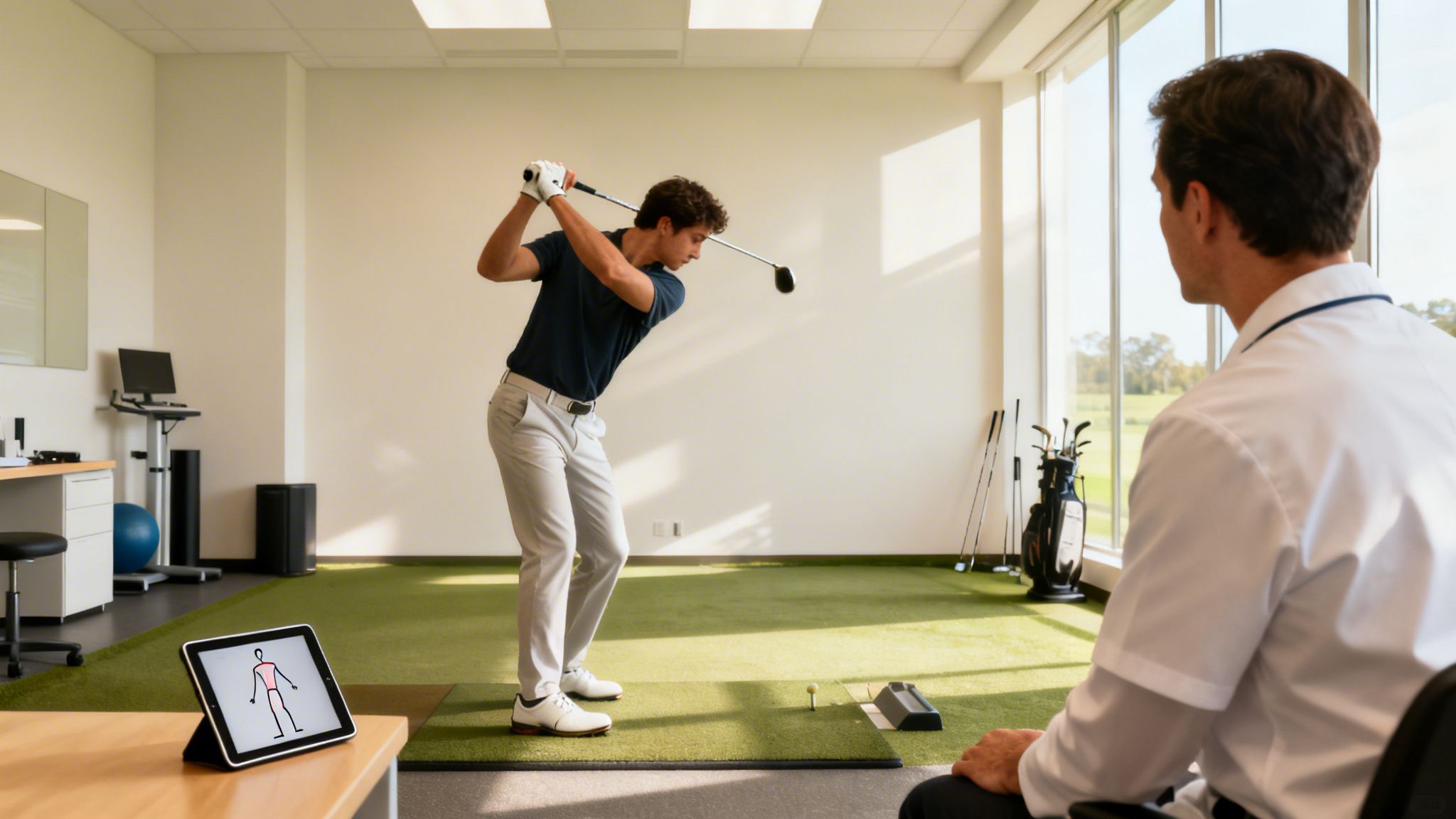
Our initial evaluation isn't just about charts and tests. It’s a conversation, an investigation, and a planning session rolled into one. Our main goal is for you to walk out with a crystal-clear understanding of why you hurt and a clear, personalized roadmap for your recovery. We do this by listening to your story, analyzing how you move, and connecting it all back to your golf swing.
A Conversation About Your Goals and Pain
Before we ever ask you to do a single movement, we listen. Your story holds the most important clues to what’s going on. Your dedicated physical therapist will sit down with you to talk about everything—your pain, your game, and your life outside of golf.
We’ll ask questions like:
- When did you first notice the pain? Did it happen suddenly on one swing, or has it been a slow burn?
- How would you describe the feeling—is it sharp, a dull ache, or more of a burning sensation?
- What part of your round or your swing makes it flare up?
- How is this injury affecting your life off the course? Is it bothering you at work or keeping you up at night?
- What are your ultimate goals? Do you just want to play a weekend round with friends without wincing, or are you hoping to get back to tournament play?
This conversation is fundamental. It helps us see you as a golfer and a person, not just a set of symptoms, and allows us to build a plan that actually fits your life.
A Comprehensive Movement Analysis
Next, we’ll move on to the physical assessment. This is where we get a clear picture of how your body moves—and, just as importantly, where it doesn't want to move. Our specialists often use a comprehensive screen from the Titleist Performance Institute (TPI), which is the gold standard for golf-specific physical evaluation.
Think of it as a head-to-toe audit of your body’s readiness for the demands of a golf swing. We'll take you through a series of straightforward movement tests that measure key areas:
- Mobility: How well do your hips, mid-back (thoracic spine), and shoulders rotate and flex? These are the engine rooms of your swing.
- Stability: Can you control your posture and stay balanced? We’ll look at your core strength, how well your glutes are firing, and your overall stability.
- Strength and Power: We’ll identify any muscle imbalances that might be forcing other parts of your body to pick up the slack.
This screening quickly highlights your body's unique movement patterns. We often find that learning how to improve your golf swing starts right here, by addressing these physical roadblocks. We can see if stiff hips are making your lower back over-rotate, or if a weak core is causing an inconsistent, off-balance swing. While we can't definitively diagnose the cause of back pain without an evaluation, you can learn more about your options in our guide on the best way to treat back pain.
Connecting the Dots and Creating Your Plan
In the final part of your evaluation, we put all the pieces together. We connect what you told us in our conversation with what we discovered during your movement screen. For many of our patients, this is the "aha!" moment.
You’ll see exactly how your limited hip rotation is causing that "reverse spine angle" and the back pain that follows, or how poor shoulder stability is contributing to your nagging elbow tendinitis. The pain is no longer a mystery.
You will leave your first session with a clear diagnosis and the first few steps of your personalized recovery plan. This usually includes some hands-on therapy for immediate relief and a few key exercises to start tackling the root cause of the problem. This is a team effort, and you are always the most important member of that team.
More and more people are turning to physical therapy for expert care, and the industry is growing to meet that need. The global physical therapy market is projected to grow from USD 30,553.2 million in 2025 to USD 58,577.8 million by 2034 as people increasingly seek out specialists for their musculoskeletal health.
Your Personalized Golf Treatment Plan
After your initial evaluation, we shift from figuring out what's wrong to making it right. This is where your dedicated Peak Therapy physical therapist, serving Massachusetts communities from Norwell to Duxbury, designs a treatment plan that’s anything but one-size-fits-all. It’s a dynamic roadmap created specifically for your body, your pain, and your goals on the course.
This plan isn't set in stone; it evolves right along with you as you get stronger. We combine hands-on techniques for immediate relief with active exercises to build long-term resilience. Our goal is to make sure you don’t just get better, but you stay better.
Hands-On Manual Therapy
The first step for many golfers is simply getting out of pain and moving more freely. Manual therapy is a cornerstone of our approach, where our licensed physical therapists use skilled, hands-on techniques to work directly on the joints and soft tissues causing your pain.
This isn’t just a general massage. It's a precise application of force designed to:
- Reduce Joint Stiffness: We can gently mobilize stiff joints in your mid-back, hips, or shoulders—the very restrictions that can throw your swing out of whack and force other areas to overcompensate.
- Ease Muscle Tension: Targeted soft tissue work helps release those chronic muscle knots and spasms that contribute to pain and limit how far you can move.
- Improve Tissue Flexibility: Techniques like active release can break up adhesions and scar tissue, allowing muscles and fascia to glide freely once again.
By restoring mobility with manual therapy, we create a window of opportunity. With less pain, your joints can move through a much greater range, preparing your body for the next crucial phase of recovery—rebuilding strength. Our guide on the best shoulder mobility exercises offers some great examples of how to maintain this newfound movement.
Therapeutic Exercise: A Custom Fitness Program
With your pain dialed down and your mobility on the upswing, we can start rebuilding your body's foundation through therapeutic exercise. This isn't about hitting the gym with a generic workout sheet. It's a specific set of exercises prescribed to correct the exact imbalances and weaknesses we found in your assessment.
Your program is built to bridge the gap between where your body is now and what the golf swing demands. For a golfer, this often means zeroing in on:
- Core and Glute Activation: We teach you how to properly fire up your deep core muscles and glutes, which create the stable "chassis" your swing depends on.
- Rotational Strength: Using tools like resistance bands or medicine balls, we help you build powerful and controlled rotation through your torso—the engine of your clubhead speed.
- Postural Endurance: We strengthen the muscles in your upper back and shoulders to help you hold a strong, athletic posture from your first drive to your final putt.
Think of it like this: Manual therapy unlocks the door to better movement, and therapeutic exercise gives you the strength and control to walk through it confidently. Each exercise has a purpose, directly targeting a weakness that was contributing to your pain and holding back your game.
Advanced Treatments for Lasting Results
For stubborn pain or more complex injuries, we have advanced services at our Massachusetts clinics that can help accelerate your healing. Your physical therapist might recommend these as part of your comprehensive plan.
- Dry Needling: This technique involves inserting a thin filiform needle into a muscle's trigger point—that tight, irritable "knot"—to release tension, reduce pain, and restore normal function. It can be incredibly effective for nagging muscle soreness in the back, neck, or hips that hasn't responded to other methods.
- Aquatic Therapy: For golfers dealing with significant pain, arthritis, or post-surgical recovery, our aquatic therapy program is a game-changer. The natural buoyancy of water unloads your joints, allowing you to strengthen muscles and improve mobility with far less pain than on land. It’s the ideal environment to safely rebuild strength after a flare-up or surgery.
Joining the 55 million people worldwide who play golf means embracing a sport with incredible health benefits. From better heart health to less stress, the game provides moderate-intensity activity that keeps you active. As research highlights, golfers often report better general health compared to non-golfers, making it vital to have a recovery plan that keeps you on the course. Our personalized approach ensures you can keep enjoying those benefits for years to come.
Building a Resilient Body for a Better Game
Great physical therapy isn't just about bouncing back from an injury. It's about building a stronger, more resilient body to prevent future problems and truly unlock your potential on the golf course. While hands-on treatments offer immediate relief, long-term success comes from preparing your body to handle the demands of the game.
This proactive mindset shifts the focus from simply fixing what’s broken to optimizing how you move. It’s about leaving the frustrating cycle of pain and rest behind and embracing consistent, healthy play. Imagine not having to worry if your back will hold up for all 18 holes and just focusing on your next shot.

The Pre-Round Dynamic Warm-Up
We’ve all seen it: a golfer steps up to the first tee, especially on a crisp Massachusetts morning, takes a few practice waggles, and immediately tries to crush their drive. This is practically an invitation for injury. A proper warm-up isn't a few lazy stretches—it's a dynamic routine designed to prepare your muscles and joints for the explosive power of the golf swing.
Think of it like waking up your body’s entire “kinetic chain.” A good dynamic warm-up only takes 5-10 minutes but makes a world of difference by activating the key muscles you need for a powerful, fluid swing.
A golf physical therapy expert might include these in your personalized routine:
- Leg Swings (Forward and Side-to-Side): These gently open up your hips and hamstrings, getting them ready for rotation.
- Torso Twists with a Club: Hold a club across your shoulders and gently rotate your torso. This warms up your mid-back and core muscles.
- Cat-Cow Stretches: This simple move mobilizes your entire spine, helping to prevent the dreaded lower back stiffness.
- Glute Bridges: These “turn on” your glutes, the powerhouse muscles that stabilize your pelvis during your swing.
A dynamic warm-up boosts blood flow, improves joint mobility, and primes your nervous system for action. It’s one of the best things you can do before a round to play better and stay healthy.
In-Season vs. Off-Season Training
A common mistake many amateur golfers make is treating their training the same all year round. Your approach should adapt with the seasons to maximize performance while avoiding fatigue and overuse injuries, especially with our distinct Massachusetts seasons.
During the golf season, your primary focus should be on maintenance and recovery. In the off-season, you have a valuable window to build foundational strength and address significant mobility deficits.
Here’s a simple way to think about your training schedule:
- In-Season (April-October): The goal here is to maintain the strength and mobility you built in the winter without causing too much fatigue. Training should be less intense, focusing on recovery, light strength work, and mobility drills. You're playing a lot, so you don’t want to be sore on the course.
- Off-Season (November-March): This is your time to get stronger. With fewer rounds on the calendar, you can dedicate more energy to intensive strength training. It’s the perfect time to fix the major weaknesses identified in your physical therapy evaluation, like building more powerful glutes or improving your thoracic spine rotation, preparing you for the next season.
Managing Your Body Between Rounds
How you recover between rounds is just as important as how you prepare for them. Smart recovery habits help reduce inflammation, ease muscle soreness, and ensure you feel fresh and ready for your next tee time.
These simple strategies can make a huge impact:
- Foam Rolling: Use a foam roller on sore muscles like your quads, glutes, lats, and mid-back. This helps improve blood flow and release muscle tightness.
- Targeted Stretching: After a round, hold static stretches for at least 30 seconds on areas that get tight, such as your hips, hamstrings, and chest.
- Core Engagement: A strong core is your back's best defense. If you're looking to build a more solid foundation, our guide on core strengthening exercises for your back is a great place to start.
- Active Recovery: On your days off, gentle activities like walking or swimming promote blood flow and aid recovery without adding stress to your joints.
Ultimately, building a resilient body is a huge part of overall Golf For Wellness, allowing you to enjoy the game for years to come. By working with a physical therapist to create a smart plan for your warm-ups, training, and recovery, you can build a body that supports a better, more powerful, and pain-free game.
Common Questions About Golf Physical Therapy
Deciding to finally do something about that nagging golf pain is a huge first step toward getting back to the game you love. But it’s completely normal to have questions about what golf physical therapy actually is, how it works, and what to expect.
We hear a lot of the same questions from golfers across our Massachusetts clinics. So, we've gathered them here to give you the clear, straightforward answers you need to feel confident about taking that next step. Our goal is to pull back the curtain and show you how partnering with a licensed physical therapist can not only help address what’s hurting but also build a stronger, more resilient foundation for your entire golf game.
When Should I See a Physical Therapist for Golf Pain?
The simple answer? As soon as you notice pain that’s interfering with your swing or your daily life. We see so many golfers who try to "play through" the discomfort, hoping it will just fade away. But that often leads to bad swing habits and compensations that can cause even bigger issues down the road. If you're feeling stuck, it's time to seek help.
You should book an evaluation if you’re experiencing any of these:
- Persistent Pain: A dull ache or sharp twinge in your back, shoulder, elbow, or hips that sticks around during or after a round.
- Modifying Your Swing: You’re shortening your backswing or changing your follow-through just to avoid hitting a painful spot.
- Relying on Medication: You find yourself taking anti-inflammatories before, during, or after playing just to make it through 18 holes.
- Missing Rounds: The pain is bad enough that you’re turning down tee times or can’t play as often as you want to.
Addressing pain early is the key to preventing a minor, manageable issue from becoming a chronic injury that could sideline you for an entire season. Early intervention means a faster, more effective recovery.
Do I Need a Doctor's Referral for PT in Massachusetts?
No, you don’t! This is one of the most empowering parts of seeking care in our state. Massachusetts is a Direct Access state, which means you have the right to see a licensed physical therapist directly, without getting a referral from your doctor first.
This is a huge advantage for golfers. It lets you get an expert evaluation and start treatment right away—often days or even weeks before you could get an appointment with a specialist. By coming straight to one of our Peak Therapy clinics—conveniently located and serving residents of communities like Braintree, Norwell, or Plymouth—you can start tackling the root cause of your pain immediately. Of course, we will always communicate with your primary care doctor or orthopedist to make sure your care is coordinated and everyone on your team is on the same page.
How Is Golf PT Different From Regular PT?
While they both fall under the physical therapy umbrella, golf physical therapy is a highly specialized field. It requires a deep understanding of the unique biomechanics of the golf swing and goes way beyond just treating a "sore back" or "painful shoulder."
Think of it this way: a general physical therapist might work to reduce your back pain so you can sit at your desk comfortably. A TPI-certified golf physical therapist, on the other hand, performs a comprehensive evaluation to determine the root cause of your pain. They’ll identify that your back pain is actually caused by limited hip rotation, which is forcing your lower back to over-rotate and take on stress it shouldn't during your swing.
The key differences really come down to:
- Specialized Assessment: We use golf-specific movement screens, like the TPI screen, to test your body's ability to perform the exact movements a safe and efficient golf swing demands.
- Swing-Specific Analysis: We connect the dots between your physical limitations and what’s happening in your swing. We analyze how your body moves—or fails to move—from your address all the way through your follow-through.
- Targeted Goals: The end goal isn't just to be pain-free. It's to restore functional movement that translates directly to a better, more powerful, and repeatable golf swing, helping you play better while lowering your risk of getting hurt again.
How Long Until I Can Play Golf Again?
This is the big question every injured golfer asks, and while there's no magic number, our focus is always on getting you back on the course as quickly—and as safely—as possible. Your personal recovery timeline depends on a few things, like the type and severity of your injury, how long it's been bothering you, and your overall health.
Many of our patients feel a real drop in pain and better movement within just the first few sessions. From there, our licensed physical therapists build a structured, progressive return-to-play program.
This program doesn't just throw you back into full swings. It’s a carefully managed process that usually looks something like this:
- Pain-Free Motion: First, we focus on getting your full, pain-free range of motion back.
- Short Game: We’ll start you with putting and chipping, which put very little stress on the body.
- Partial Swings: You’ll graduate to half-swings with short irons at the range.
- Full Swings: Once you're ready, you’ll move to full swings, still at the range.
- Return to the Course: Finally, you'll be cleared to play a full round, armed with a better understanding of your body and a proper warm-up routine to keep you healthy.
Our goal at Peak Therapy is to give you the knowledge and the physical tools to not just recover from your current injury, but to build a more resilient body for a long, healthy, and fun golf career.
Don't let pain keep you off the course any longer. The expert team at Peak Physical Therapy and Sports Performance is ready to help you understand your body, eliminate pain, and unlock your best game. With convenient locations across Massachusetts, we make it easy to get the specialized care you need. Book your evaluation today!