


Feeling unsteady on your feet or putting up with pain every time you walk is more than just frustrating—it can make you feel isolated and keep you from living your life. We understand how exhausting it can be to live with chronic pain or the fear of a fall. The good news is that improving how you walk often comes down to a few core ideas: understanding your unique walking pattern, strengthening key muscle groups, and practicing intentional movement.
This approach, guided by our licensed physical therapists, empowers you to take back control of your mobility and feel more confident with every step you take.
Your First Steps to a Better Walk
A change in your walk rarely happens out of the blue. It might start as a new ache in your hip that creates a slight limp you hope no one notices. Or maybe it’s a growing sense of instability on uneven ground, or the frustrating feeling that you can’t keep up like you used to.
These subtle shifts can be enough to keep you from enjoying a simple stroll through a local spot like Wompatuck State Park or make navigating icy Massachusetts sidewalks feel downright treacherous.
You shouldn’t have to live with the fear of falling or miss out on the activities you love. The path to a stronger, steadier walk is built on a few foundational concepts. It’s about more than just putting one foot in front of the other—it’s about creating a stable, efficient, and pain-free pattern of movement. Our physical therapists break this down into three key stages:
- Assess: First, we perform a comprehensive evaluation to pinpoint where the potential issues are. This involves looking for imbalances, weakness, or stiffness that could be throwing your alignment off.
- Understand: Next, it’s about connecting those findings to how your body actually moves. Once you understand what a "normal" gait cycle looks like, you can recognize where your own pattern deviates and, more importantly, why.
- Strengthen: Finally, you can begin a personalized treatment plan with targeted exercises to build the muscular support needed for a balanced and powerful stride.
This simple, three-part flow provides a clear path forward.
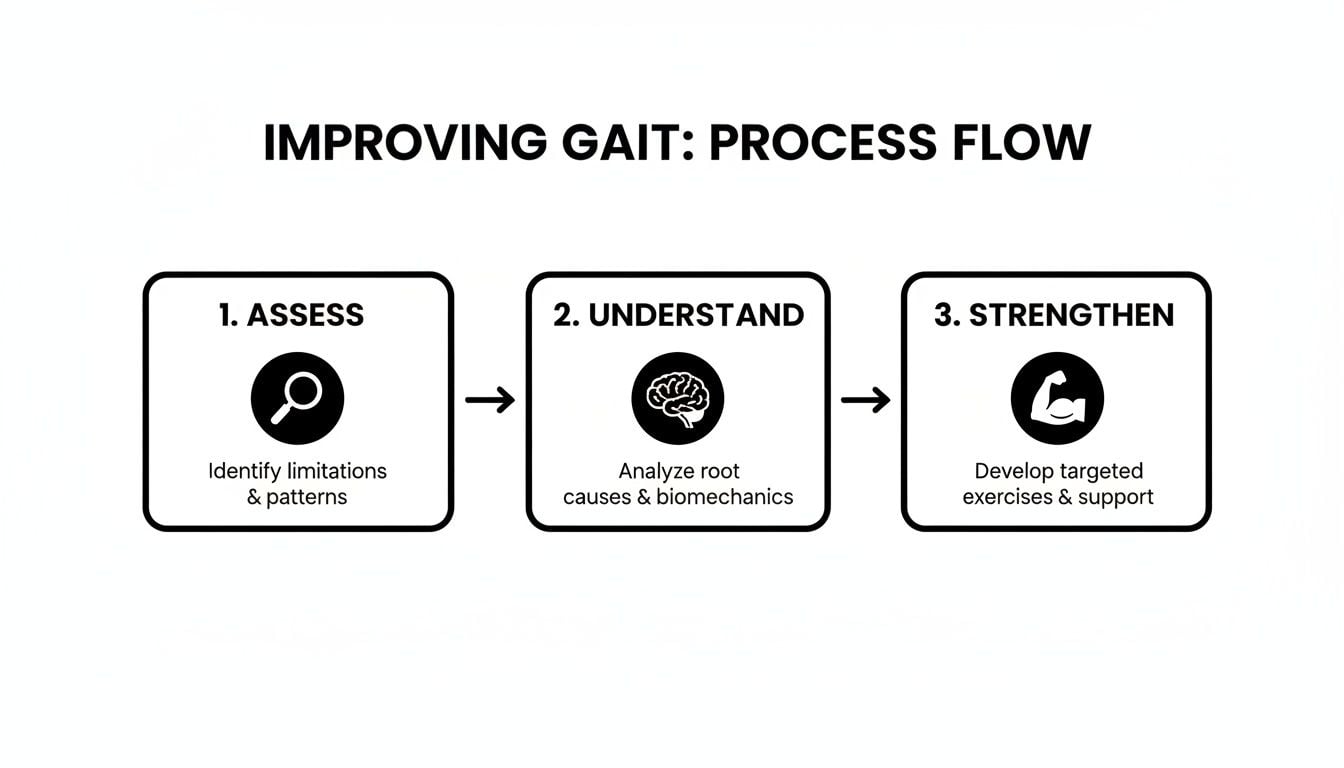
As the infographic shows, these three stages create a cycle of continuous improvement. It all starts with a professional assessment and leads directly to targeted action.
Quick Gait Improvement Checklist
To get a clearer picture of how these pieces fit together, here's a quick summary of the core components for improving your gait.
| Component | What It Means | Simple First Step |
|---|---|---|
| Assessment | Identifying specific weaknesses, imbalances, or areas of stiffness. | Try a simple balance test, like standing on one foot for 30 seconds. |
| Knowledge | Understanding the phases of a normal gait cycle and where yours deviates. | Pay attention to how your foot lands and pushes off as you walk. |
| Strength | Building up the muscles that support your hips, legs, and core. | Start with basic exercises like glute bridges or calf raises. |
| Flexibility | Ensuring your joints have the necessary range of motion for a smooth stride. | Gently stretch your calves and hamstrings daily. |
| Balance | Improving your stability to prevent falls and increase confidence. | Practice walking heel-to-toe along a straight line. |
This checklist gives you a starting point, breaking a complex process down into manageable actions.
The Role of Mindful Movement
Improving your gait is as much a mental game as it is a physical one. It requires paying close attention to how your body feels when you move. We call this proprioception, which is your body's awareness of its position in space.
By consciously thinking about your posture, foot placement, and which muscles are working, you can start to retrain your brain and muscles to work together more effectively.
For instance, just thinking "walk tall" can be a powerful cue. It encourages you to lift your chest and engage your core, which instantly improves your posture and stability. This mindful approach turns walking from an automatic action into a deliberate practice, laying the groundwork for real, lasting change.
Many people also find that adding low-impact activities helps. For those with joint pain, you might want to learn about the benefits of aquatic therapy as a great way to complement your walking routine.
The biggest takeaway here is that small, consistent efforts often bring the biggest results. You don't need to fix everything overnight. Focusing on one or two simple cues, like pushing off with your toes or keeping your steps even, can make a noticeable difference in your stability and confidence.
This guide will walk you through each step of this journey. We’ll start with a simple at-home assessment to help you spot potential imbalances. Then, we’ll break down the gait cycle in easy-to-understand terms, so you can see exactly how a smooth, efficient walk is supposed to look and feel.
Our goal is to give you immediate, actionable insights that empower you to achieve a stronger, more confident walk.
Decoding Common Walking Pattern Problems
Have you ever caught your reflection in a storefront window and thought, "Is that really how I walk?" Or maybe you've noticed a nagging pain that forces a slight limp you hope no one else sees. These changes in your walking pattern, or gait, are incredibly common.
Understanding why you walk a certain way is the first step toward moving with more confidence and less pain. These deviations aren't just random quirks; they are often your body's way of compensating for an underlying issue like muscle weakness, joint stiffness, or poor balance. Recognizing your own pattern can be the "aha!" moment that sets you on the path to recovery.
The Limp From Favoring A Painful Joint (Antalgic Gait)
One of the most recognizable gait issues is what we call an antalgic gait—a medical term for a limp caused by pain. If you’ve ever had a sore knee, a sprained ankle, or hip pain after a jog around Castle Island, you’ve probably experienced this firsthand.
You spend less time putting weight on the painful leg, which creates a short, quick step on that side and a longer step on your "good" side. It's a protective reflex, but over time, this uneven pattern can cause new problems in your back, hips, and even the non-painful leg from overuse.
The Frustrating Foot Slap Or Toe Drag (Foot Drop)
Does your foot seem to "slap" down with each step? Or do you catch your toe on the ground or on stairs, leading to stumbles? This is a classic sign of foot drop, which is an inability to properly lift the front part of your foot.
This isn't a disease itself but a symptom of an underlying issue affecting the muscles that lift your foot toward your shin. The result is often a high-stepping walk, almost like climbing invisible stairs, just to clear the dragging foot. This is not only inefficient but also creates a significant fall risk, especially on uneven Massachusetts sidewalks.
While we often discuss gait issues in adults, parents may also have concerns about their child's walking. Our guide to functional gait disorder in children offers more insight for pediatric cases.
The Hip Drop Or "Swaying" Walk (Trendelenburg Gait)
A Trendelenburg gait is marked by a noticeable drop of the pelvis on one side as you walk. When you put weight on your left leg, your right hip might dip down, causing your upper body to sway left to stay balanced. This is often a sign of weakness in the gluteus medius muscle, a key stabilizer for your pelvis.
When the gluteal muscles aren't strong enough to support the pelvis, the body compensates by swaying. This not only looks unstable but also puts extra strain on your lower back and hip joints, often leading to chronic pain.
Many common walking problems are linked to underlying postural habits. For a deeper dive, understanding how bad posture affects your health and how to correct your posture is a critical step in addressing these concerns.
At our Peak Therapy clinics across the South Shore, from Quincy to Scituate, our licensed physical therapists use advanced gait analysis to go beyond simple observation. This technology helps us perform a comprehensive evaluation to determine the root cause of your pain or instability, revealing hidden issues like uneven weight distribution. By precisely measuring your stride, joint alignment, and muscle firing patterns, our therapists develop a personalized treatment plan to help you move better. You can explore how gait analysis is used in physical therapy settings to see the data behind this approach.
Building a Foundation for a Stronger Walk
Once you’ve started to notice potential hitches in your walking pattern, it’s time to build the support system for a stronger, more stable gait. This isn't about just randomly doing exercises; it’s about a targeted approach focusing on the "big three" for confident walking: Strength, Flexibility, and Balance.
Think of these as the pillars that hold up your body's structure as you move. A weak foundation can lead to instability, pain, and inefficient movement. By methodically working on these three areas, you'll create a more resilient frame that supports a smooth, powerful stride.
Target Key Muscles for Strength
A stable walk starts with a strong core and powerful hips. These muscles are the engine and steering system for your lower body. In our clinical experience, weakness here is one of the most common reasons for gait issues like the Trendelenburg gait, which causes that noticeable hip drop.
Here are three foundational exercises to get you started:
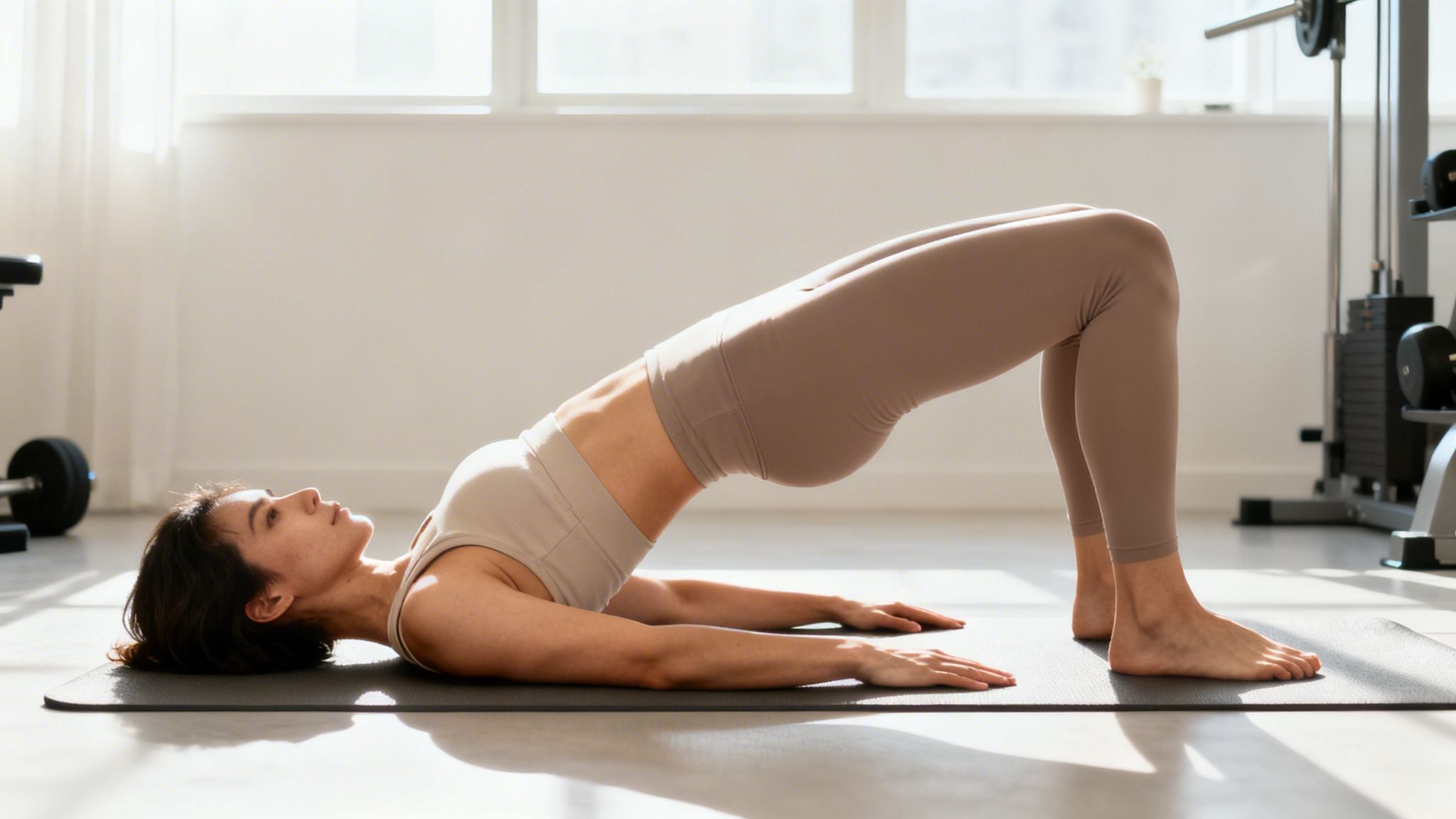
- Glute Bridges: Lie on your back, knees bent, feet flat on the floor. Squeeze your glutes and lift your hips until your body forms a straight line from shoulders to knees. This directly targets the muscles responsible for pushing you forward.
- Clamshells: Lie on your side with knees bent and stacked. Keeping your feet together, lift your top knee up without rocking your torso back. This isolates the hip abductors, which are crucial for preventing your pelvis from dropping side-to-side. For a deeper dive, check out our guide to hip pain relief exercises.
- Planks: Hold a push-up position, either on your hands or forearms, keeping your body in a straight line from head to heels. Planks build the core stability needed to transfer power efficiently from your upper to your lower body.
Improve Your Range of Motion with Flexibility
Even the strongest muscles can't do their job if your joints are too tight to move. Our physical therapists often see clients whose restricted flexibility is the primary reason for a shortened, shuffling stride.
Two common culprits often limit walking efficiency:
- Tight Hip Flexors: Sitting for long periods shortens the muscles at the front of your hips. This prevents your leg from fully extending behind you during the "push-off" phase of your stride, robbing you of power. A simple kneeling hip flexor stretch can make a world of difference.
- Stiff Calf Muscles: Tight calves can limit how well your ankle bends, which is essential for a smooth heel-to-toe roll. This can lead to walking more on your toes or having your foot slap down with each step. A classic runner's stretch against a wall is perfect for this.
A crucial part of this process is listening to your body. These exercises should feel challenging but not painful. If you experience sharp or increasing pain, it's a sign to stop and consult a professional.
Remember, starting slowly and focusing on proper form is far more important than rushing through repetitions.
Enhance Stability with Balance Training
Balance is a dynamic skill that keeps you upright and steady, especially on uneven ground or when you encounter unexpected bumps. Improving it is one of the most effective ways to build confidence and reduce your risk of a fall.
You can safely progress your balance training right at home:
- Static Balance: Start by simply standing on one leg. Aim to hold for 30 seconds without wobbling. Once that feels easy, try it with your eyes closed to really challenge your body's awareness in space.
- Dynamic Balance: When you're comfortable with static holds, add movement. Try walking heel-to-toe along a straight line in your hallway, or practice slow, controlled leg swings while balancing on the opposite foot.
This foundational work in strength, flexibility, and balance creates the physical capacity for a better gait. The power of task-specific practice is remarkable. For example, in children with cerebral palsy, targeted gait training has shown incredible results. A major 2016 meta-analysis found that dedicated gait training was highly effective at improving walking speed, far more so than general resistance training. This shows that practicing the act of walking itself, with proper form, is key. Our pediatric specialists at Peak Therapy clinics, from Braintree to Plymouth, use these evidence-based principles to create personalized plans that transform a child's mobility and confidence. Discover more details about these groundbreaking findings on gait training effectiveness.
Putting Strength Into Motion with Gait Drills
Now that you’ve started building foundational strength, it's time to put it to work. This is where we translate that muscle power into smarter, more efficient movement through active gait retraining. It’s all about consciously practicing how you walk to get your brain and muscles communicating better.
You don’t need a fancy gym for this, either. You can do these drills right in your hallway or at a local track in Hanover or Duxbury. The focus here is on being present and intentional with every single step, which helps rewire your body’s muscle memory for a smoother, more stable stride.
Master the Mechanics with Simple Drills
The goal of these drills is to break the walking motion down into its core parts and practice each one with purpose.
Here are a few simple drills you can start with:
- Heel-Strike Focus: Walk slowly, concentrating on letting your heel land first. Then, roll smoothly through your foot and push off with your toes. Many people with gait issues land flat-footed, and this drill helps re-establish that natural, efficient rolling motion.
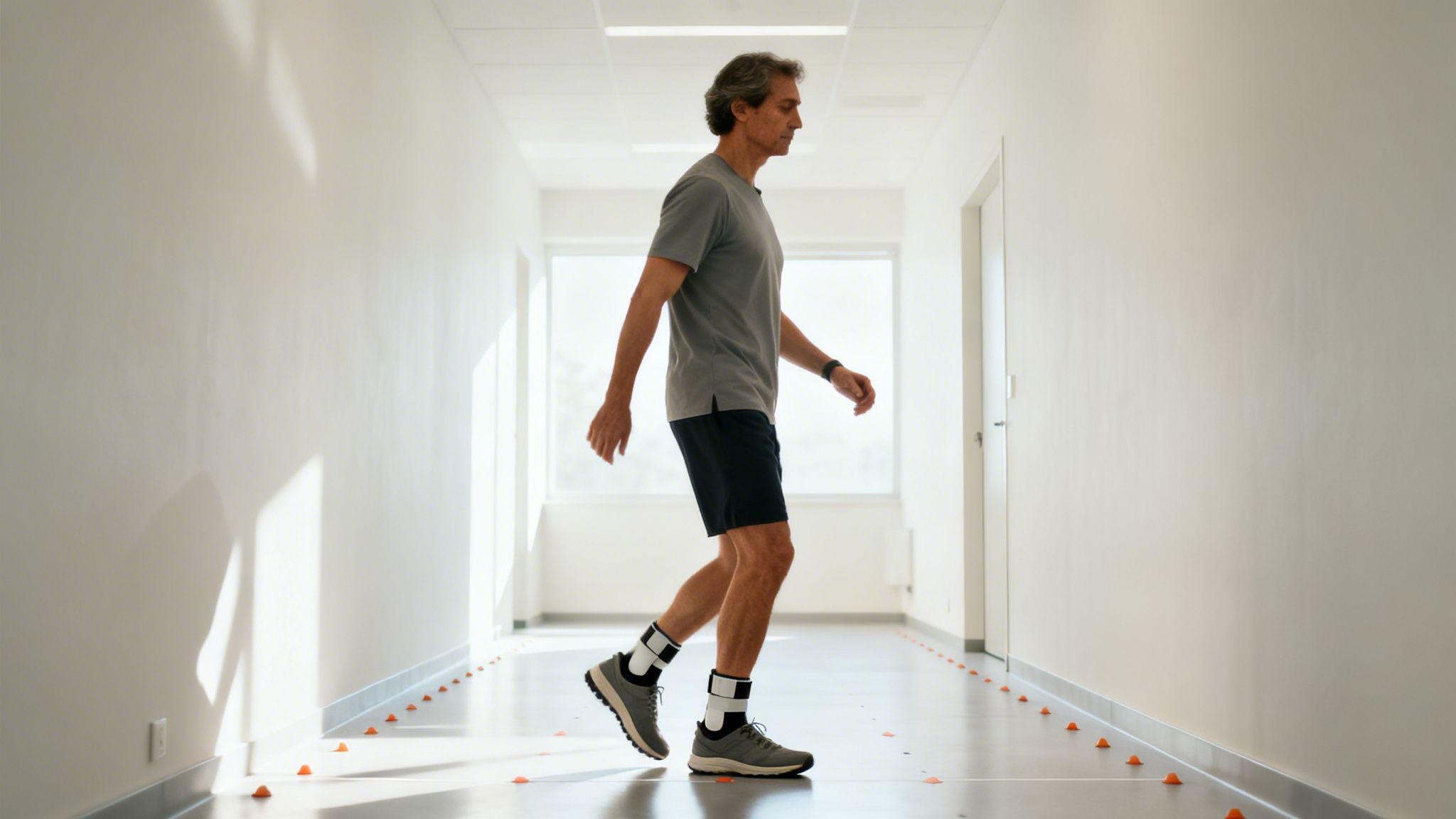
- Step Length Practice: Put small markers on the floor—tape or even a few pairs of socks will do the trick—at an equal distance. As you walk, focus on stepping on or just past each marker. This encourages a consistent and even stride, which is key for balance.
- Mindful Arm Swing: Pay attention to your arms as you walk. A proper arm swing, where your arms move opposite your legs (right arm forward with the left leg), provides momentum and boosts your balance.
Improving the mechanics of your walk often involves addressing specific limitations. For example, incorporating targeted ankle mobility exercises can make a huge difference, since proper ankle function is critical for a smooth heel-to-toe transition.
Use Powerful Mental Cues
Your brain is your most valuable tool for improving how you walk. Simple mental cues, or "mantras," can instantly change your movement patterns for the better.
Think of these cues as direct instructions to your body. Repeating them in your head as you walk helps create new neural pathways, making better movement feel more automatic over time.
Try these cues during your daily walks:
- "Walk Tall": This simple reminder helps you lift your chest, pull your shoulders back, and engage your core, instantly improving your posture.
- "Push Off with Your Toes": Focus on that final phase of your step. A powerful push-off from your big toe is what propels you forward and gets your glute muscles firing.
- "Squeeze Your Glutes": Actively thinking about squeezing the glute of your standing leg provides powerful hip stability and stops your pelvis from dropping to one side.
This kind of task-specific training gets results. For older adults and people recovering from a stroke, gait speed often jumps significantly during physical therapy. At our Peak Therapy clinics in Weymouth and Norwell, we see this firsthand every day. It's common for our patients to achieve significant gains in walking speed in just a few weeks with a personalized plan.
The Right Support from Footwear and Devices
Everything starts from the ground up, and your shoes are the foundation. The right footwear provides support, absorbs shock, and can make a world of difference. Look for a good walking shoe with a firm heel, adequate cushioning, and some flexibility where your foot bends.
In some situations, using an assistive device like a cane or walker is a smart move for safety and confidence. These aren't signs of weakness—they're powerful tools that provide stability, reduce weight on a painful joint, and help you stay active while preventing falls. A physical therapist can help you choose the right device and show you how to use it correctly for maximum benefit.
When to Get Professional Guidance for Your Gait
While the exercises and drills we’ve covered are a fantastic way to improve your walk on your own, sometimes they just aren't enough. Knowing when to ask for expert help is a crucial part of your journey toward pain-free movement.
Trying to push through certain issues alone can feel like you’re walking in circles. If you feel stuck or your progress has stalled, it simply means it’s time to bring in a specialist who can see what you can’t and get you back on track.
Clear Signs It’s Time to See a Physical Therapist
It can be tough to know when a small ache or a moment of unsteadiness is something more serious. But you shouldn't have to second-guess every step, especially when navigating uneven sidewalks in Braintree or crowded spaces in Plymouth.
Here are the clear "red flags" that mean it's time to schedule a professional gait analysis with one of our physical therapists:
- Persistent Pain: If walking consistently causes pain in your back, hips, knees, or ankles that doesn't go away with rest, it's a sign an underlying issue needs professional attention.
- A Sudden Change in Your Walk: Did you recently start limping, shuffling, or dragging a foot? Any sudden, unexplained change in your gait is a major reason to get a professional evaluation right away.
- Recurring Falls or Near-Falls: One of the most serious red flags is a loss of balance that leads to stumbling or actually falling. This points to significant issues with strength, stability, or your body's spatial awareness (proprioception).
- You Feel Stuck: Have you been diligently doing your exercises but aren't seeing any real improvement in how you feel or move? A physical therapist can offer a new perspective and more advanced techniques to break through that plateau.
We understand how disheartening it can be to live with pain or the fear of falling. Reaching out for professional help is a sign of strength and the most direct path toward getting back to the activities you love, whether it's walking the trails in Norwell or just keeping up with your grandkids.
Figuring out the next step can be confusing. To make it easier, we've put together a simple guide to help you decide when at-home care is appropriate and when it's time to call in the experts at Peak Therapy.
DIY vs. Physical Therapy: When to Make the Call
| Symptom or Situation | Try at Home First | See a Physical Therapist |
|---|---|---|
| Mild stiffness after sitting | ✓ Gentle stretches and mobility drills are a great start. | |
| Pain that worsens with walking | ✓ This indicates a mechanical issue that needs diagnosis. | |
| Feeling slightly off-balance | ✓ Work on the balance exercises from our guide. | |
| A recent fall or multiple near-falls | ✓ This is a safety issue and requires immediate evaluation. | |
| A new limp or shuffling gait | ✓ A sudden change in your walk is a clear red flag. | |
| Slow progress with exercises | ✓ Stick with the program for a few weeks to see change. | ✓ If you hit a plateau, an expert can identify the barrier. |
This table is a good starting point, but always trust your gut. If something feels seriously wrong, a professional evaluation is always the safest choice for your health and well-being.
What to Expect at a Peak Therapy Gait Analysis
Making the decision to seek help can feel a little intimidating, but we make the process as clear and reassuring as possible. When you come to one of our South Shore clinics, you won’t get a generic plan—you’ll get a partner in your recovery.
Your first visit starts with a simple conversation. We’ll listen to your story—what you’re feeling, what activities you’re missing out on, and what you want to achieve.
Next, your licensed physical therapist will perform a comprehensive evaluation. This includes:
- Observational Analysis: We'll watch you walk to identify obvious deviations like a limp, hip drop, or foot slap.
- Physical Assessment: We will test your muscle strength, joint range of motion, and balance to find the root causes behind your gait pattern.
- Hands-On Evaluation: Your therapist will use manual techniques to assess joint mobility and feel for muscle tension that could be restricting your movement.
Based on this thorough evaluation, we’ll build a personalized treatment plan designed specifically for you and your goals.
Your Personalized Path to Moving Freely
Your treatment at Peak Therapy is a collaborative process. We empower you with the tools and knowledge you need to move better for the long term.
Your plan isn't just a list of exercises. It might include powerful techniques like:
- Manual Therapy: Hands-on techniques to improve joint mobility and reduce muscle tightness.
- Dry Needling: A specialized technique to release trigger points and relieve muscular pain that may be altering your gait.
- Aquatic Therapy: Using the buoyancy of water to allow for pain-free strengthening, which is ideal for those with arthritis or severe pain.
- Advanced Gait Retraining: Using specific cues and drills tailored to your unique pattern.
Your journey to moving freely and confidently is just one step away. Don't let pain or instability hold you back any longer. Schedule an appointment online today or find a Peak Therapy clinic near you to get started.
Frequently Asked Questions About Improving Gait
It’s completely normal to have questions when you decide to work on improving your walk. We hear them all the time in our Massachusetts clinics from people feeling frustrated by pain or worried about their stability.
We've gathered some of the most common questions we get and provided the straightforward answers you need to move forward with confidence.
How Long Does It Take to Improve My Gait?
This is easily one of the first questions people ask, and the honest answer is: it’s different for everyone. Your timeline really depends on what’s causing the issue in the first place, your overall fitness level, and how consistently you stick with your personalized treatment plan.
That said, most of our patients start to notice small but encouraging changes within a few weeks of dedicated effort. This could be feeling a little more stable on your feet, experiencing less pain, or just having more confidence when you walk.
Making significant, lasting improvements that become second nature often takes a few months of consistent work. This process is much faster and safer when you’re guided by a licensed physical therapist, who can develop a plan that targets your specific needs and helps you sidestep any setbacks.
Can the Right Shoes Really Fix My Gait?
Proper footwear is a huge piece of the puzzle, but it’s rarely a magic fix all on its own. Think of your shoes as the foundation for your body. The right pair provides the support, cushioning, and stability your feet need to function correctly, which absolutely helps correct minor issues and prevent new ones.
But if your gait pattern is off because of muscle weakness, stiff joints, or poor coordination, even the best shoes in the world won't solve the root problem. They deliver the best results when they're part of a bigger plan that includes a personalized plan of strengthening, flexibility work, and specific gait drills. A physical therapist is the perfect person to assess your walk and recommend footwear tailored to your foot type and gait pattern.
Is It Safe to Do Gait Exercises If I Have Arthritis?
This is a great question. The most important rule is to listen to your body and never push through sharp or worsening pain. With that in mind, gentle, low-impact movement is often one of the best things you can do for arthritic joints. Movement helps lubricate the joints, eases stiffness, and strengthens the very muscles that support them.
If you have arthritis, we strongly recommend talking to a physical therapist before starting any new exercise routine. A PT will perform a thorough evaluation to understand exactly how arthritis is affecting you.
From there, they can design a safe, customized plan that strengthens the right muscles without aggravating your symptoms. They can also teach you modifications or introduce you to other options, like aquatic therapy, that let you build strength in a comfortable, low-impact environment. This expert guidance ensures you get all the benefits of movement while keeping your joints protected.
Don't let questions or uncertainty hold you back from walking with more confidence and less pain. The expert team at Peak Therapy is here to give you the clear answers and personalized care you deserve. Schedule an appointment online at one of our 13 Massachusetts clinics to get started.