
You wake up in Plymouth, swing your legs out of bed, and feel that familiar pull shoot from your low back into your buttock or down your leg. By the time you're driving on Route 3, sitting at your desk, or trying to make it through a walk near the waterfront, the ache has turned into burning, tingling, or numbness. A lot of people brush that off as “just back pain” until it starts changing how they work, sleep, and move.
That's usually the point where people search for sciatica treatment physical therapy Plymouth MA. They want one clear answer. What is this pain, and what helps?
In Plymouth, there's good reason to start with local, non-invasive care. The area supports about 95 licensed physical therapy specialists in the immediate Plymouth vicinity, and multi-location organizations operate across 13+ South Shore communities, reflecting strong access to conservative care options in this region (physical therapy availability in Plymouth). For deeper condition education beyond this local guide, visit Highbar Health at highbarhealth.com.
Table of Contents
- That Nagging Leg Pain Is More Than a Nuisance It's Sciatica
- Why Physical Therapy is Your Best First Step for Sciatica Relief
- Your Sciatica Treatment Plan at Peak Physical Therapy in Plymouth
- What to Expect During Your Visits at Our Plymouth Clinic
- Real Stories of Sciatica Recovery on the South Shore
- How to Start Your Sciatica Treatment in Plymouth
- Frequently Asked Questions About Sciatica Physical Therapy
That Nagging Leg Pain Is More Than a Nuisance It's Sciatica
A lot of Plymouth patients describe the same pattern. It starts as a tight back or sore hip. Then sitting gets harder, the pain runs into the buttock or down the back of the leg, and suddenly a normal day feels much longer than it should. Walking near Town Wharf, sitting through dinner, or driving across town becomes something you plan around.
That pattern often points to sciatica, which is irritation of the sciatic nerve or one of the nerve roots that feeds it. It isn't always about having a “bad back.” It's usually a nerve problem with a movement problem attached to it, which is why the pain can feel sharp, hot, electric, numb, or strangely weak all at once.

Some people feel it most when they sit. Others feel it when they bend, twist, or first stand up after being still. If you've been trying to stretch randomly, “walk it off,” or wait for it to disappear, you're not alone. Many people do that for weeks before realizing this isn't ordinary soreness.
What sciatica feels like in real life
Common descriptions include:
- Shooting pain: discomfort that starts in the low back or buttock and travels down one leg
- Burning or tingling: symptoms that feel more nerve-like than muscle-like
- Numbness: a patch of the leg or foot that doesn't feel normal
- Pain with sitting: especially during commuting or desk work
- Sudden weakness: the leg feels unreliable, heavy, or less steady
Sciatica often feels worse than it looks. You may not see much on the outside, but everyday tasks can become exhausting fast.
If you want a broader outside overview of comprehensive back pain physical therapy, that resource can help put sciatica into the bigger picture of spine-related pain. If you're looking specifically for local care, Peak's sciatica treatment page outlines how this condition is addressed in a physical therapy setting.
Why local access matters in Plymouth
When pain is traveling down your leg, convenience matters. You're more likely to follow through with treatment when care is close to home, close to work, and part of your normal week. Plymouth has a strong rehabilitation footprint, which makes that easier for South Shore residents who want a conservative option before moving toward more involved medical care.
Why Physical Therapy is Your Best First Step for Sciatica Relief
When sciatica strikes, individuals often initiallly attempt one of two strategies. They either rest excessively or seek temporary relief for their symptoms. While both approaches may provide minor benefits, neither effectively addresses the underlying cause of the nerve irritation.
Physical therapy works differently. It uses movement, hands-on treatment, and targeted progression to calm symptoms while improving the way your back, hips, and legs handle load. That matters because sciatica usually gets worse when the body keeps repeating the same aggravating pattern.
A structured PT program also has meaningful clinical upside. According to reported sciatica treatment outcomes, structured physical therapy can reduce the need for medications by 30-50%, lower the likelihood of needing injections or surgery, and 60-70% of patients find significant or complete symptom resolution through PT alone.
What tends to help and what usually doesn't
Here's the honest trade-off.
- Bed rest: may feel good for a day, but too much often makes stiffness and sensitivity worse
- Pain medication alone: can reduce symptoms, but it doesn't teach your body how to move better
- Generic stretching: sometimes helps, sometimes flares symptoms, especially if the wrong structure is being stressed
- Targeted physical therapy: addresses pain relief and the movement problem behind it
Practical rule: If your pain changes with position, movement, or activity, there's a good chance a movement-based plan can help.
That doesn't mean PT is passive or gentle all the time. Good sciatica rehab is specific. Early on, the goal is often to reduce nerve irritation and find positions or movements your body tolerates. Later, the goal shifts to rebuilding strength, confidence, and staying power so the pain doesn't keep returning every time life gets busy.
Why PT is often the smarter first move
Physical therapy makes sense as a first step because it gives you information as well as treatment. A good exam can tell you whether your symptoms behave more like disc irritation, stenosis, joint-related pain, or another pattern that needs a different plan. That's useful even when the next step isn't PT alone.
For many local patients searching for sciatica treatment physical therapy Plymouth MA, the primary question isn't “Can exercise help?” It's “Can someone figure out why this keeps happening?” That's where evaluation and progression matter more than random exercises online.
If you want a condition-specific look at this question, Peak's article on whether physical therapy can help sciatica gives a more focused overview.
Your Sciatica Treatment Plan at Peak Physical Therapy in Plymouth
A good plan starts with your actual day. If your leg pain hits halfway through a shift, flares after the drive home, or makes a walk near the Plymouth waterfront feel longer than it should, treatment has to match those demands. The goal is not just to calm symptoms in the clinic. The goal is to help you move through Plymouth life with less guarding, less hesitation, and more trust in your body.
For sciatica, the plan changes based on how your symptoms behave. Pain that worsens with sitting and bending usually needs a different approach than pain that builds with standing and walking. That difference shapes exercise choices, hands-on treatment, pacing, and the advice you get for work, sleep, and daily movement.
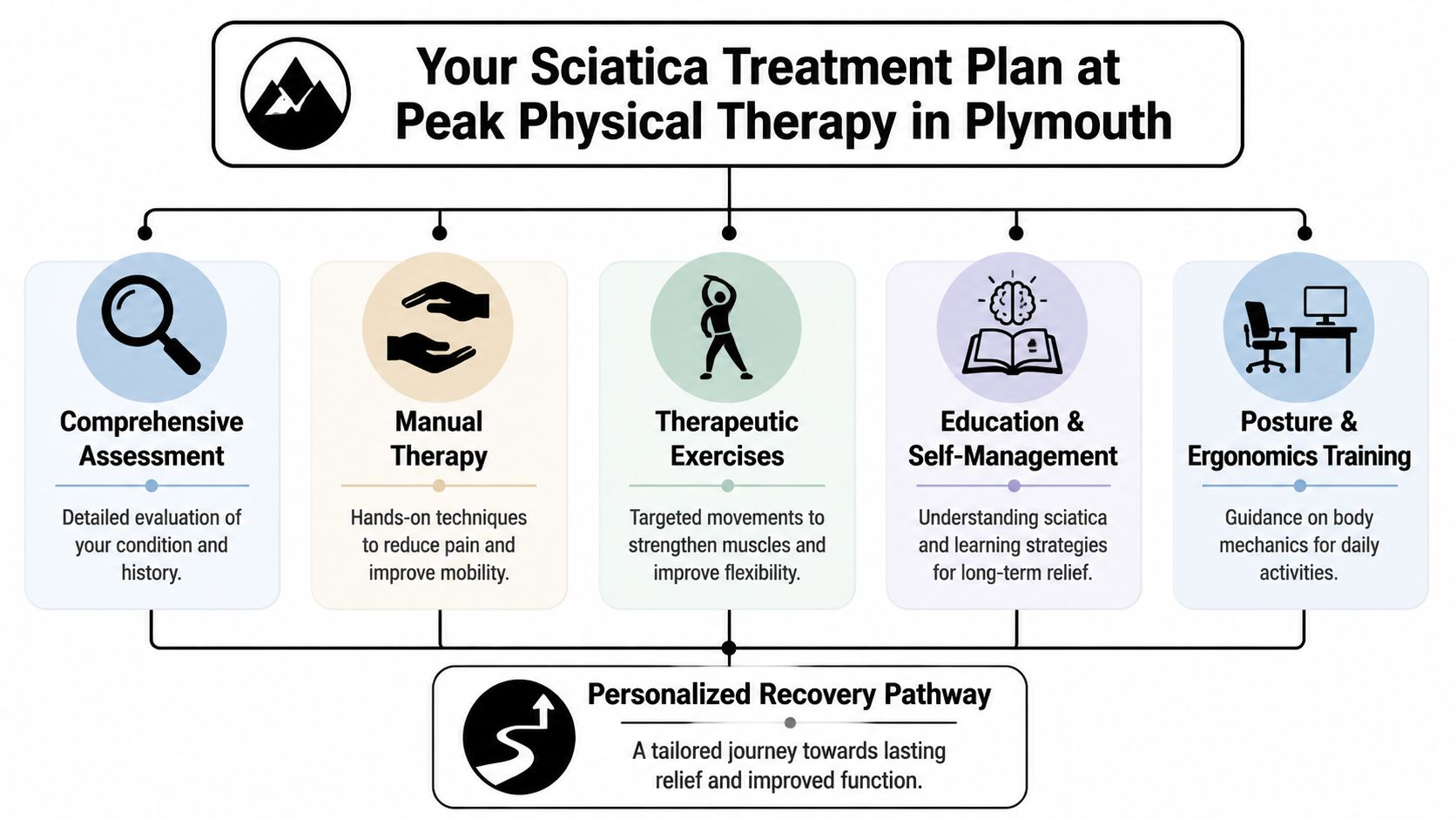
Why the evaluation matters so much
A useful evaluation answers the questions that affect your recovery right away:
- What tissue or movement pattern is driving the pain: low back, nerve root, hip region, or more than one area
- Which positions change your symptoms: sitting, standing, bending, walking, or lying down
- Whether the nerve is irritated enough to cause numbness, tingling, or weakness
- What you can still do safely right now: work tasks, stairs, lifting, walking, or exercise
Those answers keep the plan specific. They also keep you from spending two weeks doing stretches that only make the leg feel more angry.
What treatment may include
At Peak Physical Therapy and Sports Performance, treatment usually blends a few pieces together instead of relying on one technique. Each piece has a job.
Manual therapy can improve motion in the low back, hips, and surrounding joints when stiffness is feeding the problem. It can also settle down muscle guarding that makes every step feel tight or uneven.
Therapeutic exercise is what helps the change last. Depending on your presentation, that may mean repeated movements, trunk control work, hip strengthening, walking progression, or gradual loading so your body can handle a full day again.
Nerve mobilization is useful when the nerve has become sensitive with motion. These movements are controlled and light. They should reduce irritation over time, not force a stretch.
Education and activity modification matter more than many people expect. Small changes to your car setup, desk position, lifting strategy, or sleep posture can lower the number of times the nerve gets irritated during the day. For a parent, that may mean changing how you get down to the floor with your kids at Nelson Park. For someone with a long commute, it may mean breaking up sitting before symptoms build.
Some patients also do well with dry needling when the hip or buttock muscles are guarding and limiting movement. It is not the main event. It is one tool that can make exercise and walking easier when it fits the exam.
Treatment also changes as you improve. Early visits often focus on reducing leg pain, finding better movement options, and getting you through the day with fewer flare-ups. Later visits shift toward strength, stamina, lifting tolerance, and the activities you want back, whether that is getting through work without pain, walking farther along the waterfront, or picking up your child without bracing first.
Our Evidence-Based Approach to Sciatica Treatment
| Treatment Technique | How It Helps Your Sciatica |
|---|---|
| Manual therapy | Reduces stiffness, improves movement tolerance, and helps calm painful areas around the spine and hips |
| Therapeutic exercises | Builds support and control so the back and hips handle daily activity with less irritation |
| Nerve mobilization | Helps reduce sensitivity when the nerve feels tight, irritated, or limited with motion |
| Activity modification | Changes aggravating habits at work, in the car, or at home so symptoms stop getting poked all day |
| Posture and ergonomics training | Improves how you sit, stand, and move through routine tasks that may be feeding the problem |
| Dry needling when appropriate | May reduce muscle guarding in the buttock or hip so movement becomes easier and less reactive |
What to Expect During Your Visits at Our Plymouth Clinic
For many people, the hardest part is the first appointment because they don't know what's waiting for them. They picture a rushed exam, a printout of generic stretches, and a vague instruction to “come back next week.” Good PT shouldn't feel like that.
Your care should feel like a working session built around your story. If your pain started after lifting, after a long stretch of driving, or without any obvious trigger at all, that history matters. So does the exact way symptoms behave during your day.
Your first appointment
At the first visit, expect a conversation before anything else. You'll talk through where the pain goes, what makes it worse, what you've already tried, and what you need to get back to. For one person that's sitting through a workday. For another it's walking the dog, sleeping through the night, or picking up a grandchild without bracing first.
Then comes movement testing. Your therapist may look at walking, bending, standing, balance, hip motion, strength, and whether certain positions centralize or worsen symptoms. This doesn't feel like a pass-fail test. It's how the plan gets customized.
A first visit often ends with a short list of useful next steps rather than a huge program you'll never follow.
- One or two key movements: chosen because they match your pattern
- A simple aggravation plan: what to avoid for now, and what's safe to keep doing
- A realistic goal: something that matters in daily life, not just “less pain”
A good first session usually leaves you feeling clearer, even if you're not fully better yet.
Your follow-up visits
Follow-ups should build on what your body did after the evaluation. If a movement reduced your symptoms, you may progress it. If something flared you up, the plan gets adjusted. That kind of feedback loop is what makes rehab feel personal instead of canned.
A typical visit may include a mix of:
- Hands-on treatment: to reduce stiffness or calm a protective area
- Guided exercise: to improve control, strength, or tolerance
- Coaching: on sitting, driving, lifting, work setup, or pacing
- Reassessment: because small changes in symptoms often matter
Some sessions feel active. Some feel more focused on symptom reduction. Most are a blend. What matters is whether each visit is moving you toward daily function, not whether it checks a box.
Real Stories of Sciatica Recovery on the South Shore
Sciatica recovery in Plymouth usually shows up in small, meaningful wins. A shorter drive home without shifting in the seat every few minutes. A walk on the waterfront that does not end with burning pain down the leg. An evening at Nelson Park where you can focus on your family instead of counting the minutes until you can sit down.
A familiar pattern on the South Shore starts with someone trying to manage it alone. A local resident with a physical job, long commute, or busy home schedule feels pain in the buttock that starts traveling into the thigh or calf. At first, it seems manageable. Then the workday gets longer, the ride in the truck gets stiffer, and simple routines like carrying groceries or standing at a youth sports game start taking more effort than they should.

A familiar Plymouth story
One composite example is a parent who cuts back activity, rests when possible, and hopes the problem settles down. That can calm symptoms briefly. Then normal life picks back up, and so does the pain. Sitting through school events, loading the car, walking through errands, or spending time outside with the kids starts to feel like a calculation.
What helps is usually less dramatic than people expect. The right plan matches the person sitting in front of you. That means reducing the positions that keep stirring the nerve up, restoring motion where the body has become restricted, and rebuilding strength so the back, hips, and trunk can handle daily demands again.
What changed
Recovery is often judged by the first normal activity that feels normal again.
For some patients, that is getting through a full workday with less guarding. For others, it is sleeping through the night, sitting through the drive to and from work, or walking farther before the leg starts to tighten. Around Plymouth, it may mean getting back to the harbor, keeping up at Nelson Park, or making it through weekend errands without planning every stop around a place to sit.
Those changes matter because they reflect real function, not just a lower pain score. At Peak, that is the standard we care about. The goal is not to only calm symptoms in the clinic. The goal is to help you return to the parts of South Shore life that pain has been shrinking. If you want help from a local team that understands those day-to-day goals, start with our Plymouth physical therapy clinic.
How to Start Your Sciatica Treatment in Plymouth
Starting care should be simple, especially when you're already dealing with pain during work, driving, or sleep.
In Massachusetts, patients can often start physical therapy through Direct Access, which means you may not need to wait for a physician referral before scheduling an evaluation. That can remove a lot of delay when symptoms are making daily life harder by the week.
What to do first
The easiest next step is to book a visit with the Plymouth physical therapy clinic. From there, the clinic team can help with scheduling, explain what to bring, and answer practical questions about getting started.
If Plymouth isn't the easiest stop in your routine every week, nearby South Shore options such as Kingston or Duxbury may also fit better depending on where you live or work. Convenience matters more than people think. Rehab works better when it's easy to show up consistently.
What to bring and ask
When you schedule, it helps to have a few basics ready:
- Your insurance card: so benefits can be reviewed
- A short symptom timeline: when it started and what makes it worse
- Any prior imaging or notes: if you already have them
- Your questions: especially around work, exercise, driving, or sleep
A few useful things to ask on the first call:
- Do you accept my insurance
- What should I wear to the first visit
- Do I need a referral for my plan
- How soon can I get in
If you're searching for sciatica treatment physical therapy Plymouth MA, the most important step is not finding the perfect article. It's getting the leg pain examined while it's still disrupting your routine, not after months of compensation and frustration.
Frequently Asked Questions About Sciatica Physical Therapy
The biggest questions usually come down to timing, safety, and whether PT is the right place to start.
Based on local treatment guidance, most sciatica improves with conservative care, but red flags such as progressive weakness or bowel/bladder changes require urgent medical attention. Clear triage helps patients choose the right next step without delaying needed care.
Common Questions About Sciatica PT
| Question | Answer |
|---|---|
| How do I know if it's sciatica or just back pain? | Sciatica usually includes leg symptoms such as burning, tingling, numbness, or pain that travels below the buttock. A physical therapy exam helps sort out whether the problem behaves like nerve irritation or something else. |
| When should I seek urgent medical care instead of PT? | Seek urgent medical attention if you have progressive weakness, bowel or bladder changes, or symptoms after severe trauma. Those patterns need medical evaluation promptly. |
| Will physical therapy hurt? | Treatment shouldn't feel random or overwhelming. Some movements may reproduce symptoms briefly because they help identify the problem, but the overall goal is to calm irritation and improve tolerance, not push you through avoidable pain. |
| How long before I notice a change? | That depends on your symptom pattern, irritability, and consistency. Many people notice early shifts in comfort, movement, or tolerance before they feel fully recovered. |
| Do I need imaging first? | Not always. Many people start with conservative care first unless their symptoms include red flags or their presentation suggests a different medical workup is needed. |
| Can I keep walking or working? | Often yes, with modifications. The right plan usually keeps you moving in ways that help recovery instead of stopping activity completely. |
| What if sitting is my biggest trigger? | That's common with sciatica. Your therapist can look at positions, work setup, driving tolerance, and movement breaks that reduce repeated irritation during the day. |
If you're unsure whether to book PT or call your doctor first, the deciding factor is usually whether your symptoms look routine and mechanical, or whether they include warning signs that need medical triage.
If sciatica is making it hard to work, drive, sleep, or enjoy life around Plymouth, Peak Physical Therapy and Sports Performance can help you take the next step with a local evaluation and a plan built around how your symptoms behave. Book an appointment and get back to walking the waterfront, keeping up with family, and moving through your day with more confidence and less pain.