
You've had the surgery. The ride home is over. The discharge papers are on the kitchen counter, your leg or shoulder feels stiff, and now the main question starts to settle in. How do you get back to normal life on the South Shore without making a mistake in recovery?
That question is common whether you live in Quincy, Hanover, Weymouth, Duxbury, Plymouth, or one of the towns in between. You might feel some mix of relief, soreness, impatience, and uncertainty. You're glad the procedure is behind you, but you also know surgery alone doesn't restore your strength, balance, confidence, or daily routine.
That's where physical therapy after surgery South Shore MA becomes more than a referral on paper. It becomes the plan that helps you get back to walking the beach, driving comfortably, climbing your stairs without thinking about it, coaching, working, lifting, or moving through the day without guarding every step.
Table of Contents
- Your South Shore Surgery Is Done What Now
- Why Physical Therapy Is Essential After Your Operation
- Your Post-Surgical PT Timeline and Goals
- Your Role in Recovery Home Exercises and Red Flags
- Navigating Insurance and Scheduling on the South Shore
- Why South Shore Residents Choose Peak Physical Therapy
- Take Your First Step to a Full Recovery Today
- Frequently Asked Questions About Post-Surgical PT
Your South Shore Surgery Is Done What Now
The first few days after surgery often feel oddly quiet. Friends and family have checked in, your procedure is finally over, and then you're home in a recliner trying to figure out what's normal. The swelling. The awkward steps. The stiffness when you stand up. The worry that one wrong move could set you back.

For many South Shore patients, recovery starts in exactly that moment. You may be looking out at a cold morning in Braintree, planning how you'll manage stairs in a Hanover home, or wondering when you'll feel steady enough to walk around downtown Plymouth again. The details vary, but the need is the same. You need a clear plan, not vague reassurance.
What matters first
South Shore programs have supported residents recovering from injuries and illnesses for decades, with care designed for people regaining strength, balance, and function after procedures, and with rehabilitation integrated into orthopedic care from the start, according to South Shore Health's physical therapy program overview. That local history matters because post-surgical recovery works best when rehab isn't treated like an afterthought.
In practical terms, your early recovery usually needs structure around a few immediate priorities:
- Protect healing tissue: You need to move enough to avoid stiffness, but not so much that you irritate the surgical site.
- Control swelling: Swelling can shut muscles down and make normal movement feel much harder than it should.
- Start safe daily function: Getting in and out of bed, using stairs, walking with the right support, and doing basic self-care all count as progress.
The first stage after surgery isn't about doing more. It's about doing the right things in the right amount.
If you're still getting your home setup in order, DME Superstore's home recovery guide is a useful practical resource for thinking through comfort, mobility, and daily logistics at home.
What a good recovery plan feels like
A solid plan should reduce confusion. You should know what movements are encouraged, what should be limited, how to use your assistive device if you have one, and what the next milestone is.
That's especially important locally, because getting back to life here is personal. “Function” isn't an abstract medical word. It means carrying groceries in Quincy, getting back to the harbor walk in Scituate, standing comfortably at work in Weymouth, or returning to family routines without every movement feeling calculated.
Why Physical Therapy Is Essential After Your Operation
A lot of people think post-op PT means a sheet of exercises and a few stretches. It's much more specific than that. After surgery, the body often loses strength and mobility at the same time, and that combination can keep you limited far longer than the incision itself.
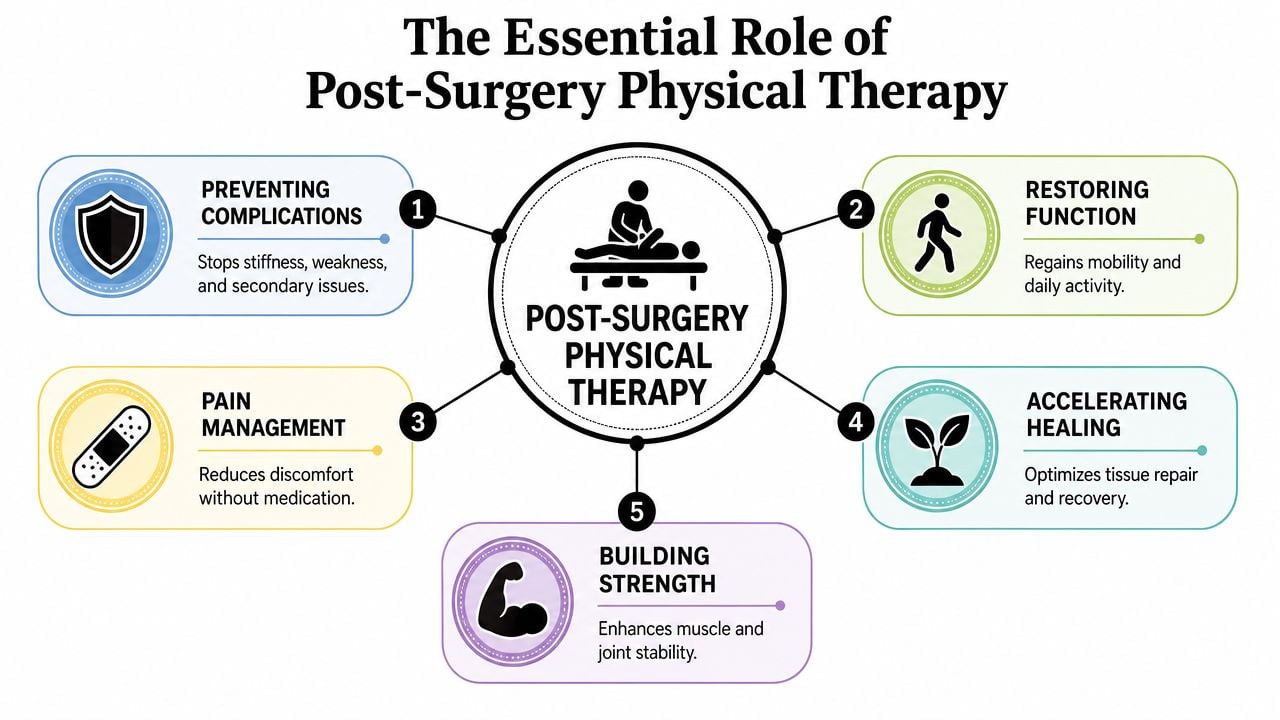
According to APRPT's post-surgical rehabilitation overview, the two biggest post-operative concerns are loss of strength and loss of mobility, and PT addresses both through targeted treatment and progressive exercise. That's the part many patients underestimate. If those problems aren't addressed early and correctly, they don't just disappear with time.
What therapy is actually doing
Think of surgery as repairing a part. Physical therapy helps the whole system work again.
A skilled post-surgical plan helps with:
- Motion that feels restricted: Scar tissue, swelling, and guarding can limit how far a joint wants to move.
- Muscles that stop firing well: Pain and inactivity often reduce activation, especially after orthopedic procedures.
- Movement habits that become compensation patterns: When you limp, shrug, twist, or avoid loading one side, other areas start taking stress they weren't built to handle.
What works and what usually doesn't
What works is guided progression. That means the therapist looks at the joint, surrounding muscles, swelling, balance, gait, and how your body handles load. Then treatment is adjusted based on how you're doing, not on guesswork.
What doesn't work is one of these extremes:
- Doing too little: Waiting too long to move often leads to more stiffness and more difficulty regaining normal mechanics.
- Doing too much too soon: Pushing through sharp pain, forcing range, or trying to “test” the repair can create irritation and setbacks.
- Treating rehab like generic fitness: Post-surgical rehab is not the same as a workout class or a random online routine.
Practical rule: If an exercise leaves you more swollen, more guarded, or moving worse later in the day, it may be the wrong dose, the wrong timing, or the wrong exercise.
Good therapy is proactive. It's not just about feeling a bit better after a visit. It's about protecting the surgical result while rebuilding the strength and mobility you need for real life on the South Shore.
Your Post-Surgical PT Timeline and Goals
The question almost every patient asks is, “How long will this take?” The honest answer is that recovery follows phases, but progress is based on criteria, not just the calendar. According to Flaherty Physical Therapy's post-surgery rehab overview, effective post-op rehab is driven by restoring motion, strength, and function, and you advance only when pain, incision status, and movement quality safely allow it.
That matters because two patients can have the same surgery and move at different speeds for good reasons. One may have more swelling. Another may have better baseline strength. A third may need more time to normalize walking or regain confidence.
What the first phase usually looks like
Early on, the goals are usually simple but important. Protect the repair. Manage swelling. Start safe movement. Re-establish basic muscle activity. Learn how to move well enough at home that every trip to the bathroom or kitchen doesn't feel like a project.
Later phases tend to build on that base rather than replace it. You don't skip from “I can barely get around the house” to “I'm ready for long walks at Duxbury Beach.” You earn that step by step.
If you're progressing well, you should notice not only less pain, but better control, better tolerance for daily tasks, and more confidence using the affected area.
Typical post-surgical recovery phases and goals
| Surgery Type | Phase 1 Goals (Weeks 1-4) | Phase 2 Goals (Weeks 4-12) | Phase 3 Goals (Months 3+) |
|---|---|---|---|
| Knee replacement | Reduce swelling, restore early knee motion, improve walking pattern, work toward safe transfers and stairs | Build leg strength, improve balance, increase walking tolerance, improve stair control | Return to longer community walking, better endurance, and more demanding daily activities |
| ACL repair | Protect the graft, regain knee extension and early flexion, reduce swelling, restore quad activation | Progress strength, single-leg control, balance, and movement quality | Advance toward running, cutting preparation, and higher-level activity when movement quality supports it |
| Rotator cuff surgery | Protect healing tissue, manage pain, begin approved shoulder motion, prevent guarding | Improve shoulder mobility, restore controlled strength, improve arm use for daily tasks | Build overhead strength, endurance, and function for work, recreation, and lifting tasks |
The table gives a general picture, not a promise. Your surgeon's protocol still matters, and your own presentation matters just as much.
For patients recovering from hip surgery, our local article on physical therapy after hip replacement can help you understand what a staged return to walking, strength, and daily activity often looks like.
How therapists decide you're ready to progress
Time alone isn't enough. A good progression usually asks practical questions:
- How is the incision and tissue healing?
- Can you move with better quality, not just more effort?
- Has swelling settled enough to allow stronger muscle work?
- Are daily tasks getting easier, or are you compensating more?
That's why physical therapy after surgery South Shore MA should feel individualized. The right next step is the one your body can handle well, not the one the calendar says you should be doing.
Your Role in Recovery Home Exercises and Red Flags
The sessions matter. What happens between sessions matters just as much.
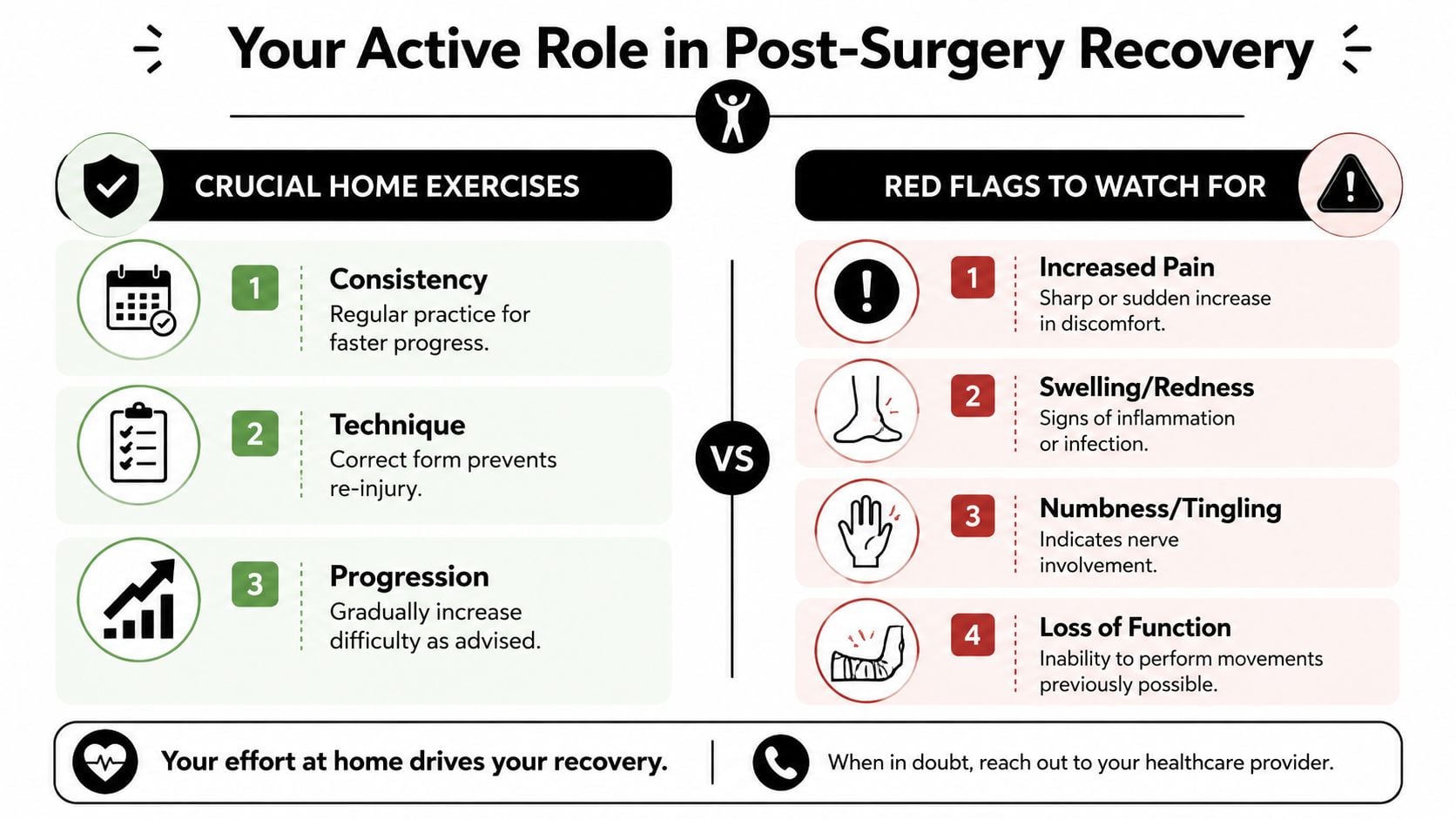
If you only work on recovery when you're in the clinic, progress tends to be slower and more uneven. Structured PT helps people manage pain, move recovery forward, and avoid secondary problems such as falls or re-injury that can delay normal life, according to South Shore Hospital's physical therapy page. The home side of the plan is a big reason why.
What to do between visits
Your home program should be safe, simple, and specific to your surgery. It should not feel random. For many patients, the best early exercises are basic and repeatable.
Examples of common foundational movements may include:
- Ankle pumps: Often used to encourage circulation and gentle lower-leg movement after lower extremity surgery.
- Quad sets: A simple way to re-engage the front of the thigh when swelling has made that muscle feel “asleep.”
- Gentle assisted range of motion: Sometimes appropriate when your surgeon and therapist want controlled motion without too much strain.
Those are examples, not prescriptions. Your actual plan should reflect your procedure, restrictions, symptoms, and stage of healing.
A strong home routine usually follows a few rules:
- Do the assigned dose: More is not automatically better after surgery.
- Use good form: Sloppy reps train compensation, not recovery.
- Pay attention to your response: Mild soreness can be normal. A sharp increase in pain or swelling is different.
If swelling is one of your biggest limiting factors, our article on managing post-operative swelling through effective rehabilitation gives a practical local overview of how therapists think about that problem.
If you're trying to understand medication timing alongside your rehab plan, this guide on how to safely alternate Tylenol and ibuprofen may be helpful as a conversation starter with your medical team.
Red flags that should not wait
Most recovery has normal ups and downs. Some changes deserve a call to your therapist or surgeon right away.
Watch for:
- Sudden increase in swelling: Especially if it's new, dramatic, or paired with heat or redness.
- Calf pain or unusual tenderness: Don't ignore symptoms that feel different from typical post-op soreness.
- Fever or signs of infection: If the incision looks concerning or you feel systemically unwell, speak up quickly.
- New numbness or tingling: Especially if it's worsening or paired with weakness.
- Loss of function: If you suddenly can't do something you could do the day before, that's worth attention.
Recovery should challenge you, but it shouldn't make you feel less stable, less safe, or less able to function from one day to the next.
Navigating Insurance and Scheduling on the South Shore
Administrative details can feel exhausting after surgery. When you're already managing pain, transportation, and follow-up appointments, the last thing you want is confusion over referrals, insurance, or scheduling.
The good news is that starting therapy is usually straightforward once you know the sequence.
What to expect before your first visit
Individuals move through a simple path:
- Get the referral or post-op order
Many surgical patients leave with instructions for therapy already included in their discharge planning or follow-up paperwork.
- Confirm the basics with the clinic
The office typically checks your surgery type, date, body part involved, and whether there are any restrictions from the surgeon.
- Verify insurance benefits
Questions about visit coverage, copays, deductibles, or authorization often come up. If you've ever wondered why this process can be so detailed, physical therapy billing services offers a useful behind-the-scenes look at how PT claims and verification work.
- Schedule quickly enough to avoid a gap
Post-op timing matters. Even when your surgeon wants a brief protective window, it helps to have appointments lined up so care starts when it should.
How to avoid delays
A few practical steps make the process easier:
- Keep your surgery paperwork handy: That saves time when the clinic asks about precautions or procedure details.
- Call before your first available opening disappears: Post-surgical slots often need specific timing.
- Ask what to bring: Insurance card, photo ID, referral, operative note if you have it, and any brace or assistive device you're using.
- Mention transportation needs: A location closer to home, work, or a family member's route can make consistency much easier.
One reasonable option for local post-operative care is Peak Physical Therapy and Sports Performance, which serves South Shore communities and provides post-surgical rehabilitation across multiple clinic locations. The main point is not brand first. It's getting the right level of care, at a workable location, without unnecessary delays.
Why South Shore Residents Choose Peak Physical Therapy
A lot of post-surgical recovery falls apart for a simple reason. The plan looks fine on paper, but it does not fit real life on the South Shore.
If you are trying to recover after a knee replacement, rotator cuff repair, ACL surgery, or spinal procedure, the right clinic should make it easier to show up, stay consistent, and keep progress tied to your actual goals. That might mean getting back to walking Duxbury Beach without feeling unstable, climbing the stairs at home in Quincy without bracing on the railing, or coaching youth soccer in Hanover without worrying about your knee every time you pivot.
That is a big reason South Shore residents choose Peak Physical Therapy and Sports Performance. Care works better when your therapist asks the right questions early. What do you need to get back to? What part of your week still feels limited? What is making you hesitate right now?
Care built around your life, not just your procedure
Surgery names the body part. Rehab has to address the person.
Two patients can have the same operation and need very different plans. One may need enough strength and endurance to get through long work shifts. Another may need balance and confidence for uneven ground, yard work, boating, or beach walks. A parent may care most about lifting a child safely. A retired patient may want to return to golf, tennis, or regular walks with less stiffness later in the day.
Those details matter because they shape treatment choices. Exercise progressions, walking goals, stair training, balance work, and return-to-activity planning should connect to what you do day-to-day in Weymouth, Plymouth, Scituate, Braintree, or the other towns you move through every week.
For people comparing clinics, our guide on how to choose a physical therapist for the right fit after surgery can help you evaluate communication style, convenience, and whether the clinic matches your recovery goals.
Consistency is easier when care is close by
Recovery after surgery usually involves multiple visits over several weeks or months. If the drive is a hassle, parking is difficult, or scheduling feels hard to manage around work and family, missed visits become more likely. Then progress slows.
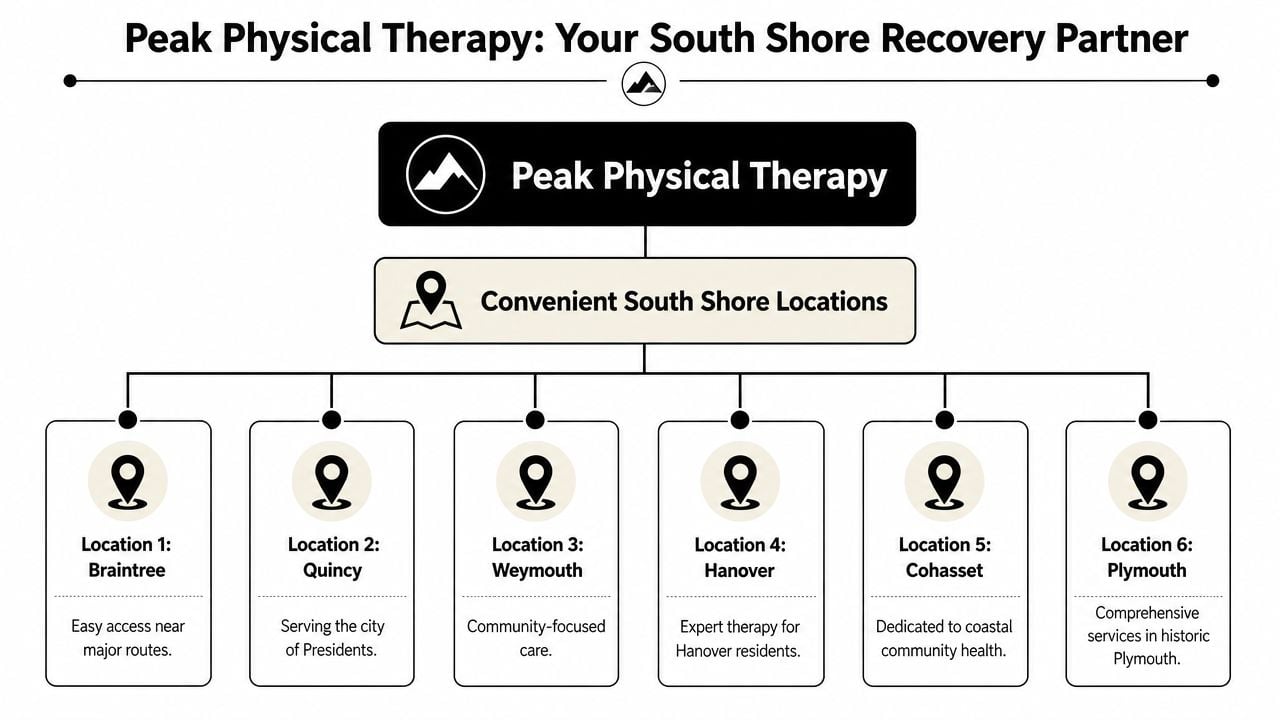
Peak clinics serve South Shore communities including Braintree, Quincy, Weymouth, Cohasset, Duxbury, East Bridgewater, Hanover, Kingston, Milton, Norwell, Pembroke, Plymouth, and Scituate. That local access helps patients stick with care long enough to regain motion, rebuild strength, improve confidence, and return to the routines that make life feel normal again.
Patients do not need a generic recovery plan. They need one that fits where they live, how they move, and what they want to get back to on the South Shore.
Take Your First Step to a Full Recovery Today
Surgery fixes one part of the problem. Recovery is where you rebuild the rest. Strength, motion, confidence, balance, walking, stairs, sleep, daily routines, and return to activity all improve faster when there's a plan behind them.
If you're looking for physical therapy after surgery South Shore MA, don't wait until stiffness, swelling, or hesitation become the new normal. Early guidance helps you move better, protect healing tissue, and avoid the stop-and-start pattern that frustrates so many patients.
The next step should be simple:
- Schedule your evaluation with a South Shore clinic that handles post-surgical rehab
- Find a location close to home or work so attendance stays realistic
- Call if you have questions about timing, insurance, or what to expect
Whether you're recovering in Quincy, Braintree, Hanover, Weymouth, Plymouth, Duxbury, or another nearby town, the goal is the same. Get back to your life with a recovery plan that matches how you live.
Frequently Asked Questions About Post-Surgical PT
How soon should I start PT after surgery
The right start date depends on your procedure and your surgeon's protocol. Some patients begin with protected movement soon after surgery. Others need a short period of rest before certain motions, weight-bearing, or strengthening are added.
The practical point is simple. Get your evaluation scheduled early so your care starts at the right time, instead of being delayed by paperwork, transportation, or a full calendar.
Will therapy hurt
You will likely feel effort, stretching, muscle fatigue, and some soreness. That is common after surgery. Sharp pain, a big increase in swelling, or feeling clearly worse later the same day is different, and it should be addressed.
Good post-surgical therapy pushes recovery without irritating healing tissue. That balance matters if your goal is more than getting through exercises. It matters if you want to climb your front steps comfortably, get back to work in Quincy, or walk Duxbury Beach without guarding every step.
Do I need PT if I already have home exercises
In many cases, yes.
A home program gives you part of the plan. Physical therapy adds the pieces patients usually cannot judge on their own, such as whether the joint is moving well, whether swelling is limiting progress, whether you are shifting your weight to avoid the surgical side, and whether it is time to progress or scale back. I often see patients doing their exercises faithfully but using compensations that slow recovery.
What should I wear to my visits
Wear clothes that make the surgical area easy to examine and treat. Shorts work well for hip, knee, ankle, and lower leg recovery. A tank top or loose T-shirt helps after shoulder or arm surgery. Supportive shoes are usually the safest option unless your therapist gives you different instructions.
If you use a brace, sling, crutches, or a walker, bring them.
Can I choose a clinic close to home or work
Yes, and that choice often makes recovery easier to stick with. After surgery, your schedule usually includes follow-up appointments, home exercises, rest, and help from family or friends. A clinic near home, work, or your regular route through Hanover, Weymouth, Plymouth, or another South Shore town makes missed visits less likely.
Consistency is a big part of progress. The best plan on paper does not help much if getting to appointments becomes a weekly struggle.
Where can I read more about surgery recovery
Your surgeon and physical therapist should be your first sources for advice that matches your procedure, precautions, and stage of healing. If you want more general background, ask your care team which educational resources they trust.
How long will post-surgical PT take
Recovery timelines vary. A straightforward arthroscopy, a joint replacement, and a tendon repair do not follow the same schedule. Your age, baseline strength, swelling, pain levels, sleep, and how closely you follow the home plan all affect the pace.
I usually tell patients to focus less on the calendar and more on milestones. Are you walking better, moving with less stiffness, handling stairs more confidently, and getting back to the routines that matter in your daily South Shore life? Those markers tell us more than a generic timeline.
If you're ready to move from “I had surgery” to “I'm getting my life back,” book an appointment with Peak Physical Therapy and Sports Performance. With South Shore locations and post-surgical care built around real daily goals, the team can help you return to walking, driving, working, and the local routines that make life feel normal again.