


If you've been living with a deep, nagging ache that just won’t go away, you might be dealing with a myofascial trigger point. It’s a common issue we see every day at our Peak Therapy clinics across Massachusetts. Think of it as a tiny, stubborn knot buried deep within a muscle—a small patch of tissue that’s become stuck in a contracted state.
This "knot" doesn't just cause pain right where it is. It can also send pain signals to seemingly unrelated parts of your body. This is called referred pain. We understand how frustrating and confusing this can be. Trigger point therapy is a specialized, hands-on treatment our licensed physical therapists use to find and release these knots, calming the irritated muscle and providing lasting relief.
The Hidden Source of Your Persistent Muscle Pain
That tension headache that seems to start at the base of your skull, the sharp pain in your shoulder when you reach for something, or that dull ache in your low back that makes driving from towns like Hanover or Scituate miserable—these are often signals from a dysfunctional muscle. A myofascial trigger point is frequently the hidden culprit behind these frustrating pains that appear without a clear reason.
A trigger point is much more than just a tight muscle. It’s a small, hyperirritable "knot" of muscle fiber that has become stuck in a contracted state. This chokes off its own blood supply, creating a painful cycle of inflammation and metabolic waste buildup.
This is where targeted therapy comes in. By applying skilled, direct pressure, a licensed physical therapist can perform a comprehensive evaluation to get right to the root of the problem. This personalized treatment plan helps:
- Release Muscle Tension: The focused pressure encourages the knotted muscle fibers to finally let go, relax, and lengthen back to their normal, healthy state.
- Restore Blood Flow: Releasing the knot is like unkinking a garden hose. Circulation improves immediately, flushing out pain-causing substances and bringing in fresh, oxygen-rich blood to promote healing.
- Alleviate Referred Pain: Once the trigger point is deactivated, it stops sending out those confusing pain signals. This can bring surprising relief to symptoms you might not have even realized were connected.
Trigger Point vs. General Muscle Tightness
It’s easy to confuse a specific trigger point with the general muscle soreness you’d feel after a tough workout or a long day of shoveling heavy Massachusetts snow. However, they are quite different, and understanding that difference helps explain why a targeted treatment approach from a physical therapist is so effective.
Here’s a quick breakdown to help you tell them apart:
| Characteristic | Myofascial Trigger Point ('Knot') | General Muscle Tightness |
|---|---|---|
| Sensation | A distinct, hard, palpable nodule within the muscle band. | A broader feeling of stiffness or tension across the entire muscle. |
| Pain | Often produces sharp pain upon pressure and can refer pain to other areas. | Typically feels like a dull, widespread ache that stays in the affected muscle. |
| Cause | Can be caused by acute injury, repetitive strain, or chronic postural stress. | Usually the result of overexertion, new activities, or muscle fatigue. |
| Relief | Responds best to targeted pressure, release techniques, and dry needling. | Often improves with general stretching, heat, massage, and rest. |
Distinguishing between the two is key. While general soreness might go away on its own, a true trigger point often needs specific, skilled intervention from a licensed physical therapist to be resolved.
Is This a Proven Treatment?
Absolutely. Trigger point therapy isn't a new trend; it’s a cornerstone of modern physical therapy, and its effectiveness is supported by a solid body of evidence-based research.
For instance, studies confirm that trigger point manual therapy is a safe and effective conservative treatment for myofascial pain, especially for conditions like TMJ disorder and chronic headaches. One recent review found that manual techniques significantly reduced pain intensity when compared to no treatment at all. You can explore the research on manual therapy's effectiveness to learn more.
At Peak Therapy, our approach is always evidence-based. We perform comprehensive evaluations and use proven techniques to make sure you receive a personalized treatment plan that is not only safe but highly effective for ending your pain and getting you back to the activities you love.
How Releasing a Knot Can Relieve Widespread Pain
Have you ever wondered how one tiny, sore spot in your neck can trigger a throbbing headache that ruins your day? It might not seem logical, but the answer lies in what happens inside a trigger point. Think of it like a stubborn kink in a garden hose.
When a small section of muscle fibers gets tangled up, it effectively pinches off its own blood supply. We physical therapists call this an "energy crisis." Without a steady flow of fresh blood, the muscle fibers don't get the oxygen they need to relax, and metabolic waste products start to build up.
This buildup creates a toxic little neighborhood that irritates the muscle and the nerves around it. The knot gets stuck in a frustrating cycle of contraction, oxygen deprivation, and pain—and it’s this vicious loop that makes trigger points so persistent and exhausting.
Breaking the Pain Cycle with Targeted Pressure
Trigger point therapy works by stepping in and breaking that dysfunctional cycle. When one of our licensed physical therapists at Peak Therapy applies focused, steady pressure to a knot, they’re essentially hitting a reset button on the entire process.
This therapeutic pressure manually encourages the tight, contracted fibers to lengthen and let go. Just as important, this action sends a message to your nervous system to dial things down, which allows the constricted blood vessels to finally open up again.
The real magic happens when the pressure is released. A rush of fresh, oxygen-rich blood floods the area. This influx flushes away all the accumulated toxins and waste, which immediately calms the irritated nerves that have been screaming pain signals to your brain.
Understanding Local vs. Referred Pain
The effects of a trigger point aren’t always felt right where the knot is. These troublesome spots can send pain signals to completely different parts of the body—a phenomenon known as referred pain. This is exactly why a knot in your shoulder could be the real culprit behind your tension headaches, or why a point in your hip muscle can send pain down your leg that feels a lot like sciatica. We understand how this can be confusing and make you worry about more serious issues.
This concept map helps visualize how a muscle knot can create both local pain at the site of the knot and referred pain in a different area.
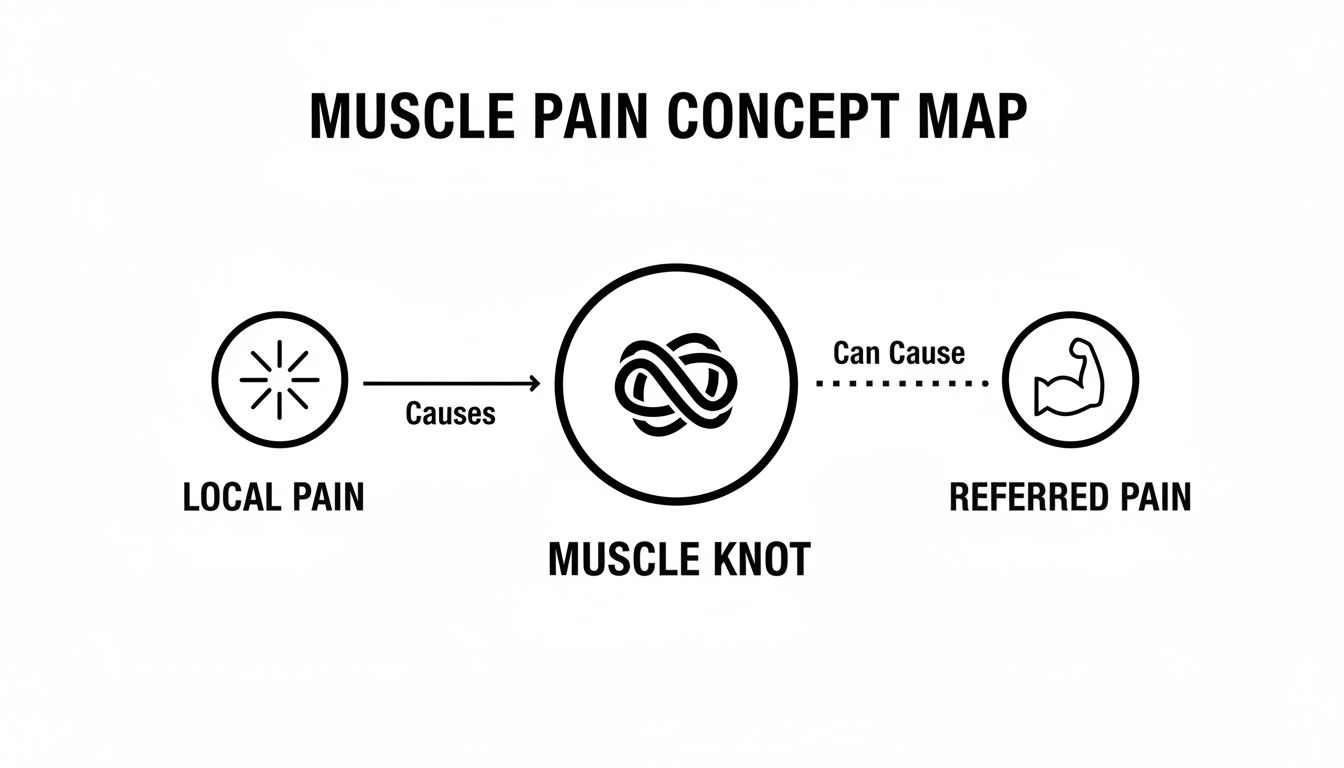
As the diagram shows, that single, nagging knot is the central problem, but it can broadcast its discomfort across a much wider area. It’s no wonder this can be so frustrating for the person feeling the pain!
A skilled physical therapist is trained to recognize these common referred pain patterns. That expertise is a game-changer because it allows us to treat the source of your pain, not just chase the symptoms. For our neighbors in Massachusetts communities like Quincy and Pembroke, this means our individualized care plans can finally get to the bottom of that mysterious ache. We don’t just treat the headache; we find and release the knot in the neck or shoulder that’s causing it in the first place.
Deactivating the trigger point breaks the pain cycle, providing both immediate relief and a foundation for long-term healing. It’s a powerful example of how understanding the body’s interconnected systems helps us resolve complex pain issues. While targeted treatments are key, it's also helpful to know that things like supplements for muscle recovery can support your body’s healing process. By combining our expert care with supportive lifestyle choices, we can help you get back to a life free from the grip of persistent muscle pain.
The Techniques Used to Release Muscle Knots
When you come to one of our clinics with a stubborn muscle knot, your physical therapist has a whole toolkit ready to go. Think of us as detectives for your muscles—we don’t just rub the sore spot. Instead, we perform a comprehensive evaluation to develop a personalized treatment plan, combining our deep knowledge of anatomy with skilled, hands-on techniques to get to the root of the problem.
At Peak Therapy, this is a partnership. We’ll walk you through every step, explaining what we’re doing and why. Our goal is to release those knots and get you moving comfortably again, whether it's through foundational manual therapy or more advanced methods for those particularly persistent trigger points.

This process is about precise, knowledgeable communication with your body. We’re using pressure and movement to talk directly to your nervous system and muscle tissue, using our understanding of the body to find the exact source of your pain and convince it to let go.
Hands-On Manual Release Techniques
The cornerstone of our approach is manual therapy. This is where your licensed physical therapist uses their hands, knuckles, or elbows to directly work on the trigger point. The real-time feedback we get through our hands allows us to feel the knot as it begins to release.
We often rely on two core techniques:
- Ischemic Compression: This is a very direct method. Your therapist applies steady, sustained pressure right on the trigger point and holds it. This momentarily reduces blood flow (ischemia) to that tiny area. Once the pressure is released, a rush of fresh, oxygen-rich blood floods the muscle, flushing out waste products and kicking off the healing process.
- Muscle Stripping or Gliding Strokes: In tandem with direct pressure, your therapist might use deep, smooth strokes along the length of the muscle. This technique helps to manually lengthen the tight muscle fibers, release any remaining tension, and improve the overall feel and function of the tissue around the knot.
These hands-on methods are fundamental to getting results. If you want to learn more about the different techniques involved, you can explore our manual physical therapy in our detailed guide.
Trigger Point Dry Needling: An Advanced Solution
Sometimes, a knot is just too deep, too stubborn, or has been there for too long for hands-on techniques to fully resolve it. In these cases, your licensed physical therapist might recommend trigger point dry needling. This is a highly effective, modern technique performed by our specially trained and certified physical therapists right here in our Massachusetts clinics.
It's really important to know that dry needling is not acupuncture. Although both use thin, sterile needles, they are worlds apart in their philosophy and application. Acupuncture is rooted in traditional Chinese medicine and focuses on balancing the body's energy flow (Qi). Dry needling, on the other hand, is a Western medical technique based entirely on modern anatomy and physiology.
During a dry needling session, the therapist inserts a very thin needle directly into the myofascial trigger point. The goal is to elicit a “local twitch response”—a small, involuntary muscle contraction that acts as a neurological reset, causing the knot to release on a deeper level than hands can sometimes reach.
This technique is a game-changer for reaching muscles that are layered under other tissues, like those deep in the hip or shoulder. If you're looking into specific therapies for muscle knots, you may come across information on dry needling.
The evidence backs it up, too. One systematic review found that dry needling reduced pain by an average of 1.27 points more on a 10-point scale compared to placebo or sham treatments over a 12-week period. You can read the full research about these findings in the Journal of Orthopaedic & Sports Physical Therapy.
At Peak Therapy, your comfort and safety come first. Whether we use manual techniques or dry needling, your licensed physical therapist will make sure you understand the entire process, communicating with you every step of the way to provide a personalized treatment that is both effective and reassuring.
Conditions That Respond Well to Trigger Point Therapy
You might be surprised to learn just how many common aches and pains are caused by hidden trigger points. Many of our patients from Quincy to Pembroke come in with persistent pain, only to discover the true source is a tight, knotted muscle that’s been overlooked. Our licensed physical therapists are trained to find that source and develop a personalized plan to resolve it for good.
This is what makes trigger point therapy so effective. Instead of just chasing symptoms, we can pinpoint and deactivate the specific knots responsible for your discomfort, offering a path to real, lasting relief.
Neck Pain and Headaches
That nagging headache that creeps in during a stressful workday or a long commute? Its origin is often not in your head at all. Trigger points in the muscles of your upper back, shoulders (like the trapezius), and neck are notorious for sending pain signals up into the base of the skull, temples, or even behind your eyes. We understand how debilitating these can be.
By locating and releasing these specific muscle knots, we can often dramatically reduce both how often these headaches happen and how intense they feel when they do, helping you get back to your life.
The evidence for this is impressive. One major analysis found that manual trigger point therapy significantly cut down on headache attacks, with patients experiencing an average drop of 3.50 attacks per month compared to those who didn't get the treatment. You can discover the full findings on headache reduction from this study.
Back Pain and Sciatica-Like Symptoms
Lower back pain is one of the most frequent complaints we treat in our clinics. While many things can cause it, trigger points in the low back (quadratus lumborum) and gluteal muscles are often the primary culprits.
Here’s a crucial point: trigger points in your glute muscles can send referred pain right down the back of your leg. This pain pattern perfectly mimics sciatica, tricking many people into thinking they have a nerve problem when the issue is entirely muscular.
A skilled physical therapist can tell the difference between true sciatica and pain referred from a trigger point. By deactivating these knots in the hip and lower back, we can bring significant relief to what feels like nerve pain, helping you stand, walk, and sit comfortably again.
Shoulder, Hip, and Knee Pain
When a major joint hurts, it’s easy to fear the worst, like surgery or a long-term injury. But often, the problem isn’t the joint itself—it’s the muscles surrounding it. Trigger points are frequently the missing piece of the puzzle in many common joint issues.
- Shoulder Pain: Rotator cuff problems, impingement, and even "frozen shoulder" are often made worse by trigger points in the surrounding muscles. Releasing them can restore proper mechanics, improve range of motion, and stop the pain when you reach overhead.
- Hip Pain: That deep ache in the hip joint or on the outside of your hip can often be traced to trigger points in the glutes and TFL (tensor fasciae latae). We see this all the time in runners and other active people across our Massachusetts communities.
- Knee Pain: Pain felt at the front, back, or sides of the knee isn't always from a ligament or meniscus tear. Trigger points in your quadriceps, hamstrings, or calf muscles can refer pain directly to the knee, creating symptoms that feel just like a joint injury.
Finally, trigger point therapy is also a game-changer for treating TMJ (Temporomandibular Joint) Disorder. Knots in the chewing muscles of the jaw are a primary cause of jaw pain, clicking, and tension headaches. By identifying and treating these underlying muscle issues, our licensed physical therapists at Peak Therapy help people find real answers and lasting relief from conditions that hold them back from their daily lives.
What to Expect at Your First Therapy Session
Walking into a new clinic for the first time can feel a little intimidating, especially when you’re already dealing with pain. We get it. That's why your first appointment at Peak Therapy is designed to be a straightforward, comfortable, and collaborative process. From the moment you walk in, our goal is to help you feel heard, understood, and confident in your path to recovery.

Everything we do begins with a simple conversation. We believe that truly understanding your story is the most important part of helping you feel better.
A Thorough and Empathetic Evaluation
Your session kicks off with a comprehensive evaluation, but this isn't about running through a checklist. It's dedicated time for your licensed physical therapist to listen. We want to hear about the pain you're experiencing, how it's affecting your day-to-day life, and what you’re hoping to get back to—whether that’s hiking the trails at Wompatuck State Park or just getting through a workday without that nagging neck ache.
After our talk, your therapist will conduct a physical assessment. Using their skilled hands, they will gently but precisely explore the muscles causing your discomfort, locating the exact trigger points that are creating your pain. This hands-on analysis is what allows us to develop a treatment plan that's truly personalized to you.
We understand how frustrating it can be to explain your pain. Our licensed physical therapists are trained to listen and connect the dots between your symptoms and their root cause, making sure you feel heard and understood every step of the way.
The Hands-On Treatment Experience
Once we’ve mapped out the target areas, the hands-on part of the session begins. So, what does trigger point therapy actually feel like? Most people describe a few key sensations as the therapist works:
- A "Good Hurt": As your therapist applies steady, focused pressure to the knot, you’ll probably feel a very specific, familiar ache. This is what patients often call a “good hurt”—it’s the feeling that tells you we’ve found the exact spot.
- Referred Sensation: Don't be surprised if you feel the sensation pop up in a different part of your body. This is a great sign, as it confirms the referred pain pattern we’re trying to break.
- A Sense of Release: After the pressure, many people report an immediate feeling of relief, lightness, or freer movement in the area. This is the knot finally letting go and the muscle starting to relax.
Communication is key here. Your therapist will always work within your comfort zone, adjusting their pressure and technique to ensure the treatment is effective but never overwhelming. Your feedback guides the entire session.
Creating Your Personalized Path to Recovery
Your first session is just the starting point. Our goal isn't just to give you temporary relief in the clinic; it's to give you the tools and knowledge you need to stay pain-free for the long haul. Before you leave, your physical therapist will start building your personalized recovery plan.
This individualized care plan will include:
- Corrective Exercises: We’ll show you specific stretches and strengthening exercises designed to fix the underlying imbalances that caused the trigger points in the first place.
- At-Home Strategies: You’ll learn how to safely manage your symptoms between appointments, often with simple tools like a foam roller or tennis ball.
- Education: We’ll take the time to explain why this pain happened and what you can do to keep it from coming back.
At Peak Therapy, our commitment is to empower you. We combine expert, hands-on care with practical education to help you move better, feel better, and get back to living your life fully.
Finding Lasting Pain Relief on the South Shore
Living with chronic muscle pain shouldn't be your new normal. That nagging ache in your neck during your commute to Boston or the sharp pain that cuts a walk on Duxbury Beach short doesn't have to be a daily reality. Trigger point therapy offers a clear path toward not just managing this pain, but resolving it at its source.
This targeted approach can be the difference between sitting on the sidelines and getting back to the life you love. At Peak Therapy, our expert physical therapists are dedicated to creating a personalized care plan that uncovers the true root of your discomfort, laying the groundwork for lasting relief.
A life with less pain and more freedom is absolutely within your reach. Our team is committed to helping you feel better, move without restriction, and live life to the fullest. We combine hands-on expertise with supportive coaching to guide you every step of the way on your recovery journey.
You shouldn't have to stop doing what you love because of muscle pain. Our goal is to give you the tools, education, and expert care you need to not just recover from an injury, but to build resilience for the future.
With 13 convenient South Shore locations, including Braintree, Weymouth, and Plymouth, our licensed physical therapists are ready to help. We are passionate about helping our Massachusetts neighbors find real solutions that let them get back to their active lives.
To learn more about what makes our approach unique, you can read about our physical therapy centers and our philosophy of care.
We believe everyone deserves to live without the limitations that pain imposes. It's time to stop just coping with your symptoms and start taking control of your health. Schedule your evaluation today to begin your journey toward feeling better and living a fuller, more active life.
Frequently Asked Questions About Trigger Point Therapy
When you're exploring a new treatment to finally get relief from stubborn muscle pain, it's completely normal to have questions. To help you feel more comfortable and confident, we’ve put together answers to the questions our licensed physical therapists at Peak Therapy hear most often.
Is Trigger Point Therapy Painful?
This is probably the most common question we get. The sensation is less like sharp, scary pain and more of a "good hurt"—a productive discomfort that tells you we're on the right track.
When your physical therapist applies pressure to a trigger point, you’ll likely feel a deep, sometimes tender sensation right on the knot. Most patients actually find this feeling reassuring because it confirms we’ve found the exact source of their problem. Our licensed therapists are always communicating with you, adjusting the pressure to make sure you're comfortable while still getting an effective release.
How Is Dry Needling Different From Acupuncture?
It's a common point of confusion, but while both treatments use very thin needles, their goals and the philosophies behind them are worlds apart. Understanding the distinction is key.
- Acupuncture: This ancient practice is a core part of Traditional Chinese Medicine. It's designed to balance the body's energy flow, or Qi (pronounced "chee"), by placing needles along specific meridian pathways throughout the body.
- Dry Needling: This is a modern, Western medical technique that’s all about anatomy and physiology. A licensed physical therapist inserts a needle directly into a myofascial trigger point to cause a "twitch response," which helps the muscle knot release and eases your pain.
Essentially, dry needling is a targeted attack on a specific muscular problem diagnosed by a physical therapist. Acupuncture, on the other hand, aims to restore the body's overall energetic harmony. To dig deeper, you can learn more about the differences between acupuncture and dry needling in our detailed guide.
How Many Sessions Will I Need?
There’s no one-size-fits-all answer here because your recovery journey is completely unique to you. The number of sessions you'll need depends on a few things, like whether your issue is recent or has been around for a while, how many areas are affected, and how your body responds to the therapy.
Some people with a new injury feel a world of difference after just one or two sessions. For those who've been dealing with chronic pain for months or even years, it often takes a series of treatments to get lasting results and correct the root cause. During your initial evaluation, your physical therapist will discuss your goals and provide a recommended, personalized treatment plan.
Can I Do Trigger Point Therapy on Myself?
We’re big believers in self-care, and it’s a crucial part of your recovery! Using tools like a foam roller or a massage ball at home can be a great way to manage general muscle tightness and maintain the progress you make in the clinic.
However, treating yourself at home isn't a replacement for professional care. A licensed physical therapist has the deep anatomical knowledge needed to accurately diagnose the true source of your pain and safely treat trigger points—especially tricky ones in sensitive areas like your neck or low back. Self-treatment can sometimes aggravate the issue if the wrong spot is targeted.
At Peak Therapy, we believe you deserve to live a life free from the limitations of pain. Our licensed physical therapists are here to perform a comprehensive evaluation and provide the hands-on care and guidance you need to feel better and move freely again. Schedule your evaluation today and take the first step toward a fuller, more active life.