


On the South Shore, the athlete who feels stuck usually doesn’t look stuck from the outside. It might be a Hingham soccer player who’s training hard but still can’t separate late in games. It might be a Plymouth parent getting ready for a local road race and wondering why the same mileage keeps producing the same pace. It might be a Weymouth high school athlete coming back from an injury and worrying that strength has returned, but confidence hasn’t.
That plateau is common. Working out isn’t the same as following a real sports performance training program.
The difference is purpose. A smart program ties together movement quality, strength, power, conditioning, recovery, and injury history so training matches the athlete in front of you. Around here, that matters. South Shore athletes aren’t all chasing the same goal. Some are trying to make varsity. Some want to get through football season healthy. Some want to sail, run, lift, or play adult league hockey without feeling one bad week away from the training room.
For athletes dealing with setbacks, a strong starting point is proper sports injury and athletics care. Performance and rehab aren’t separate worlds. They’re connected. When that connection is handled well, athletes stop guessing and start building toward something real.
Table of Contents
- Introduction Your Next Level of Performance Starts Here on the South Shore
- What a True Sports Performance Program Is and What It Is Not
- The Foundation Your Comprehensive Athlete Assessment Near You
- Building the Engine The Core Components of Performance Training
- The Game Plan Periodization and Your Weekly Training Structure
- Measuring What Matters How to Track Your Progress and See Results
- How to Choose the Right Sports Performance Program on the South Shore
- Conclusion Take the First Step to Your Peak Performance
Introduction Your Next Level of Performance Starts Here on the South Shore
A lot of athletes on the South Shore reach the same point. They’re disciplined, they show up, and they put in honest work. But the results start to flatten out.
That’s usually when frustration shows up. A runner adds more miles but still fades on hills. A football player lifts harder but doesn’t move better. A lacrosse athlete gets cleared after rehab, returns to practice, and realizes being healthy isn’t the same as being ready.
A professional sports performance training program closes that gap. It gives structure to effort. Instead of chasing random workouts, the athlete follows a plan built around their sport, their body, and the actual demands of the season.
Most athletes don’t need more motivation. They need better direction.
That’s especially true in this area. South Shore families juggle school schedules, club teams, summer road races, sailing seasons, and weekend tournaments. Training has to fit real life, not just look good on paper. It also has to respect the athlete’s injury history, current workload, and timeline.
When a program is built well, the athlete feels the difference quickly. Movements look cleaner. Recovery improves. Confidence starts to return. The point isn’t to train harder at all costs. The point is to train in a way that transfers to the field, the track, the water, or the road.
What a True Sports Performance Program Is and What It Is Not
A true sports performance program closes the gap between being cleared from rehab and being ready to compete. That matters on the South Shore, where a high school football player may be back at practice but still lack clean cutting mechanics, a runner may be healthy but unable to hold pace late in a race, and a sailor may have no pain yet still lose position because trunk control fades under fatigue.
A good program starts with the person in front of you. Sport matters. Position matters. Injury history matters. Training age matters. A Hingham sophomore starting strength work for the first time does not need the same plan as an adult road racer in Marshfield or a varsity lacrosse player returning after an ankle sprain.
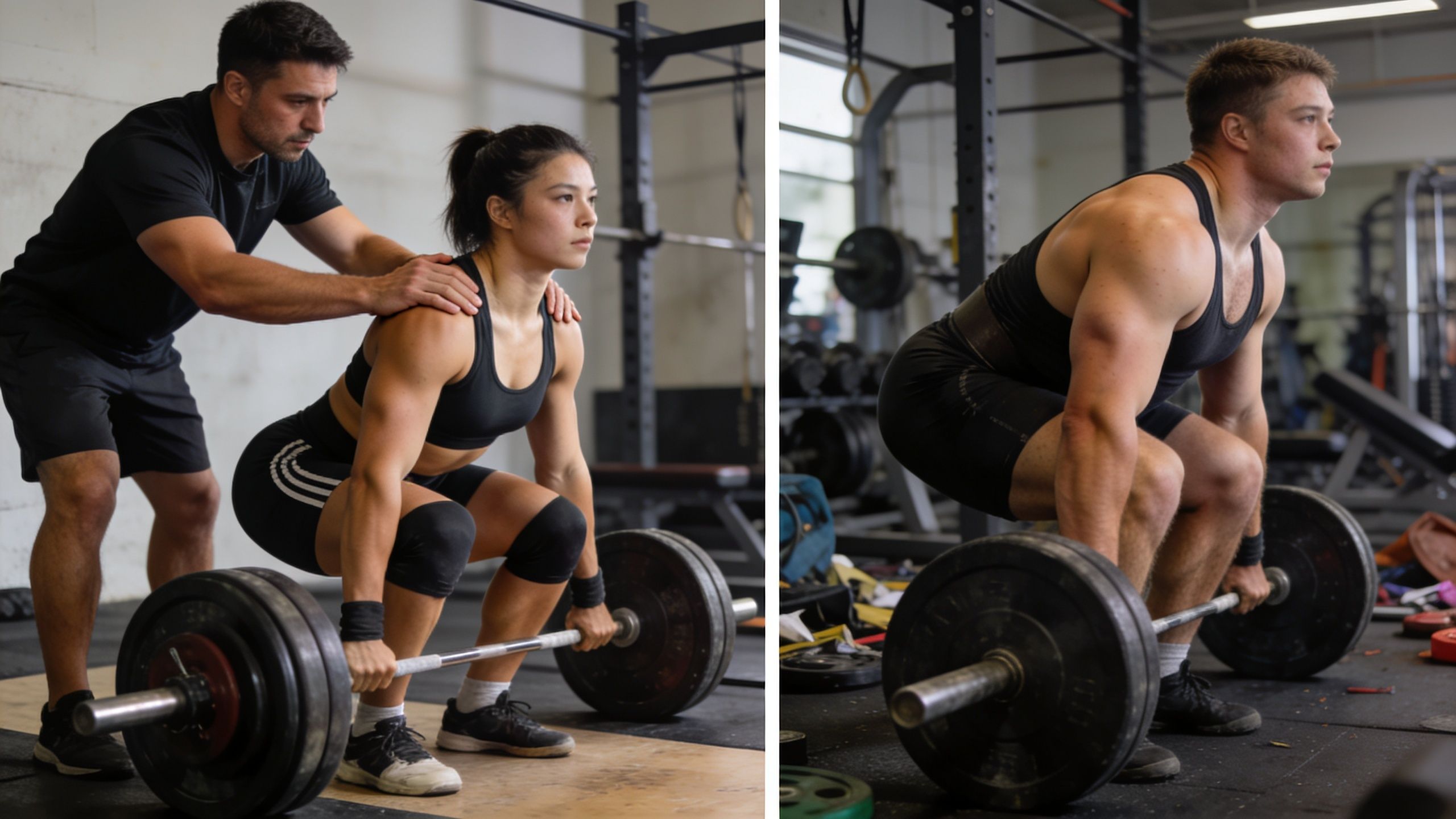
What it is
A real program is built around transfer. The work in the gym should improve what happens on the field, track, court, road, or water.
That usually includes:
- Training matched to the athlete’s sport and role, not a one-size-fits-all template
- Progressive loading, so strength, speed, and conditioning build without piling on fatigue too fast
- Movement coaching, so the athlete learns how to produce force well, not just work hard
- Recovery planning, based on practice volume, game schedule, school demands, sleep, and previous injuries
- Clinical judgment, especially for athletes who are coming off pain, surgery, or repeated overuse issues
This is the part generic gym programs miss. A PT-led sports performance program looks at performance and tissue tolerance at the same time. If an athlete has a history of knee pain, low back irritation, shoulder instability, or repeated hamstring strains, training should improve output without stirring that problem back up. That takes more than motivation and a whiteboard workout.
What it is not
It is not random hard work.
It is not a bootcamp that gives every athlete the same circuit. It is not a social media lift copied the night before. It is not maxing out year-round because heavier always feels productive. It is not extra conditioning stacked on top of practices until the athlete feels flat by midseason.
Those approaches can make someone tired. They do not always make someone better.
Families also ask a fair question about cost. Price matters, especially when school sports, club fees, travel, and equipment are already stretching the budget. If you want a sense of how training packages are structured in another market, you can compare Kentwood endurance training program pricing. The useful takeaway is not the location. It is whether the program explains what coaching, scheduling, and progression are included.
The bottom line is simple. A true sports performance program is specific, planned, and built around the athlete’s real demands. It should help a healthy athlete perform better, and it should help a post-rehab athlete return with more confidence than a discharge note alone can provide.
The Foundation Your Comprehensive Athlete Assessment Near You
Friday night football is three weeks away. A junior wide receiver from the South Shore feels healthy enough to practice, but he still does not cut with the same confidence after an ankle sprain in the spring. A runner training for a fall road race is piling on miles, yet the same hip starts barking every time volume goes up. A sailor has full shoulder motion again after rehab, but overhead strength fades late in a regatta.
Those athletes do not need a generic workout. They need a clear starting point.
Before a program is written, the first job is to assess how the athlete moves, what the sport asks of them, and whether any old injury still shapes performance. The American Council on Exercise notes that sports performance training should start with the athlete’s goals, training background, injury history, and sport demands in mind, as outlined in this ACE guide to building a sports performance fitness training program.
That matters even more for athletes who sit in the gap between rehab and full performance. A discharge note may say cleared. It does not always mean ready for sprinting, contact, repeated jumping, or a long week of practice.
What gets evaluated first
A good assessment starts with the history because the body usually leaves clues before testing begins.
Key areas include:
- Sport and position demands. A lineman, a cross-country runner, and a sailor stress the body in different ways.
- Training age. A freshman learning basic lifting patterns needs a different plan than a senior preparing for college athletics.
- Previous injuries. Old ankle sprains, shoulder irritation, low back pain, and knee problems often show up in loading patterns long after pain settles down.
- Current schedule. School sports, club play, lifting, sleep, and recovery all shape what an athlete can handle right now.
- Current goal. Returning to play, building an offseason base, and chasing a personal best each require a different starting point.
In the clinic, this is often where the issue shows up. An athlete may say, "My knee is fine." Then you watch a single-leg squat, landing pattern, or change-of-direction drill and see why the knee keeps getting overloaded.
What testing should reveal
Testing should answer practical questions.
Can the athlete control motion through the hips, trunk, and shoulders? Can they create force in the patterns their sport uses? Can they absorb force without losing position? Can they repeat effort once fatigue starts to build?
A useful screen may include movement quality, baseline strength patterns, balance, trunk control, power output, and side-to-side comparison. For a South Shore high school football player, that may reveal plenty of strength in the weight room but poor deceleration when it is time to stop and cut. For a runner, it may show limited single-leg control and reduced endurance through the trunk and hips. For a sailor coming out of shoulder rehab, it may show enough mobility but not enough repeatable strength overhead.
Practical rule: If the assessment does not change the program, it was not detailed enough.
That is the difference a PT-led program brings. The same screen that catches a performance limitation can also catch the leftover compensation from a prior injury. A standard gym intake usually misses that connection.
Why this step saves time later
Some athletes want to skip the assessment and get right to hard training. I understand the urge. Families are busy, seasons come fast, and motivated athletes want to feel like they are already behind.
Still, skipping this step usually costs time. The athlete may keep hammering conditioning when the limiter is force production. They may chase heavier lifts when the missing piece is landing control. They may feel "cleared" but still lack the capacity for a full week of practice, races, or games.
A strong assessment gives the plan direction. It shows what to push, what to clean up, and what to protect while performance builds. That is how training serves the actual athlete in front of you, not just the sport on the sign-up form.
Building the Engine The Core Components of Performance Training
A complete sports performance training program has several moving parts. If one is missing, another part usually gets overloaded. That’s when athletes feel like they’re working hard but still leaving performance on the table.
The big pieces below work together. They don’t compete with each other.
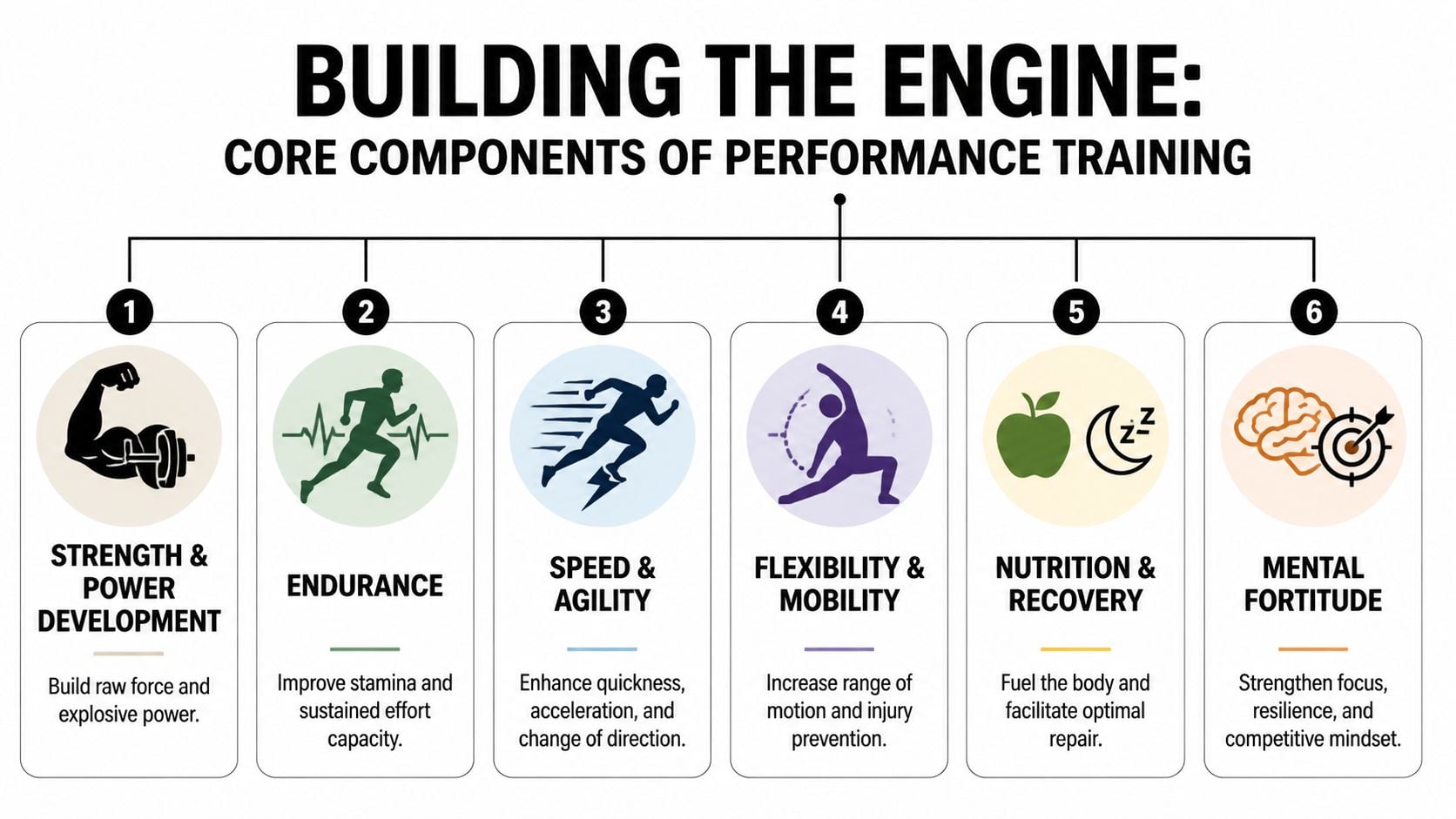
Strength and power development
Strength is your base. Power is how quickly you can use it.
For a Duxbury lacrosse player, strength helps with contact, positioning, and durability through a long spring. Power shows up in first-step acceleration, change of direction, and shot speed. For a runner, strength may not look flashy, but it supports stride efficiency and helps the athlete tolerate volume without breaking down.
Not every athlete needs the same menu of lifts. Some need more bilateral force work. Others need single-leg strength, rotational control, or explosive patterns that carry over to cutting, sprinting, or jumping.
Mobility and stability
Mobility without control can create loose movement. Stability without enough mobility can create stiff movement. Good training needs both.
Clinicians and performance coaches often see the same issue from different angles. The athlete says, “I’m tight.” What’s really happening may be poor joint motion, weak control at end range, or a compensation pattern that shows up under speed.
A smart program trains usable range of motion, then teaches the athlete to own it.
Sport-specific conditioning
Conditioning should match how the sport is played. A one-size-fits-all conditioning circuit misses that.
A high school football athlete needs repeated bursts and recovery between efforts. A sailor may need long bouts of postural endurance and trunk control. A road racer on the South Shore needs an engine that holds up over time, but also enough strength to manage hills, pace changes, and fatigue late in the event.
Nutrition also matters here, but most athletes get tripped up by extremes. If body composition is part of the goal, broad habits matter more than gimmicks. For readers who want a simple, food-focused overview, this definitive fat loss and muscle guide is a useful general resource.
Injury prevention
Injury prevention isn’t a separate day at the end of the week. It should be built into the whole program.
Core training plays a major role here. A meta-analysis found that core training programs significantly improve general athletic performance, with core endurance at SMD 1.32 and balance at SMD 0.99, while overall general athletic performance improved at SMD 1.38, based on this published review of core training in athletes. The same review supports core training as a key part of reducing risk around common back, hip, and knee issues.
That matters for South Shore athletes in every season. Better trunk control helps the soccer player cut cleaner, the sailor stay organized under load, and the runner hold form when fatigue builds.
If injury prevention is part of your current goal, it helps to understand the basics of how to prevent sports injuries before small problems become training interruptions.
The best injury prevention work rarely looks dramatic. It looks consistent.
The Game Plan Periodization and Your Weekly Training Structure
A good sports performance training program doesn’t stay the same all year. It changes because the athlete’s stress changes. Off-season training, pre-season build-up, and in-season maintenance all ask for a different balance of volume, intensity, and recovery.
That’s what periodization does. It organizes training so the athlete isn’t trying to peak in every month of the year.
Why training changes through the year
Most athletes get into trouble when they stack everything at once. Heavy lifting, hard conditioning, frequent practices, tournaments, and poor recovery can all fit into the same week. The body can handle a lot, but it still needs a plan.
The NASM OPT model gives a clear example of phased progression from stabilization to strength and power. In that framework, Phase 4 can produce 15 to 25% gains in 1RM strength, and Phase 5 can improve power output by 20%, as described in this NASM overview of the OPT model. The point isn’t that every athlete follows one identical model. The point is that sequence matters.
A younger athlete often needs more time building control and basic strength. A more advanced athlete may spend longer pushing force production, then shift toward speed and power as competition gets closer.
Training should match the calendar. If it doesn’t, even good exercises can land at the wrong time.
A sample pre-season week
For a South Shore high school athlete in pre-season, the week often blends lifting, movement work, sport practice, and recovery. Here’s what that can look like.
| Day | Focus | Example Activities |
|---|---|---|
| Monday | Lower-body strength and movement quality | Squat pattern, split squat work, landing mechanics, trunk control |
| Tuesday | Practice and recovery | Team practice, mobility work, easy recovery session |
| Wednesday | Power and speed | Jump variations, short accelerations, medicine ball throws, change of direction |
| Thursday | Practice and tissue recovery | Team practice, light mobility, recovery emphasis |
| Friday | Total-body strength | Hinge pattern, upper-body push and pull, single-leg work, core training |
| Saturday | Sport-specific conditioning | Repeated sprint efforts, tempo work, field or court conditioning matched to the sport |
| Sunday | Recovery | Walking, mobility, rest, sleep focus |
That structure isn’t rigid. A runner training for a local race might swap sprint work for threshold-based conditioning and lower-body durability work. A sailor might emphasize trunk endurance, balance, and shoulder resilience. A critical skill is adjusting the week so each session supports the next one instead of sabotaging it.
Measuring What Matters How to Track Your Progress and See Results
Athletes deserve more than “you look better” or “keep at it.” Progress should be visible in the right places and clear enough to guide decisions.
That starts with baseline testing. When you know where the athlete started, you can track whether the program is moving the needle or just creating fatigue.
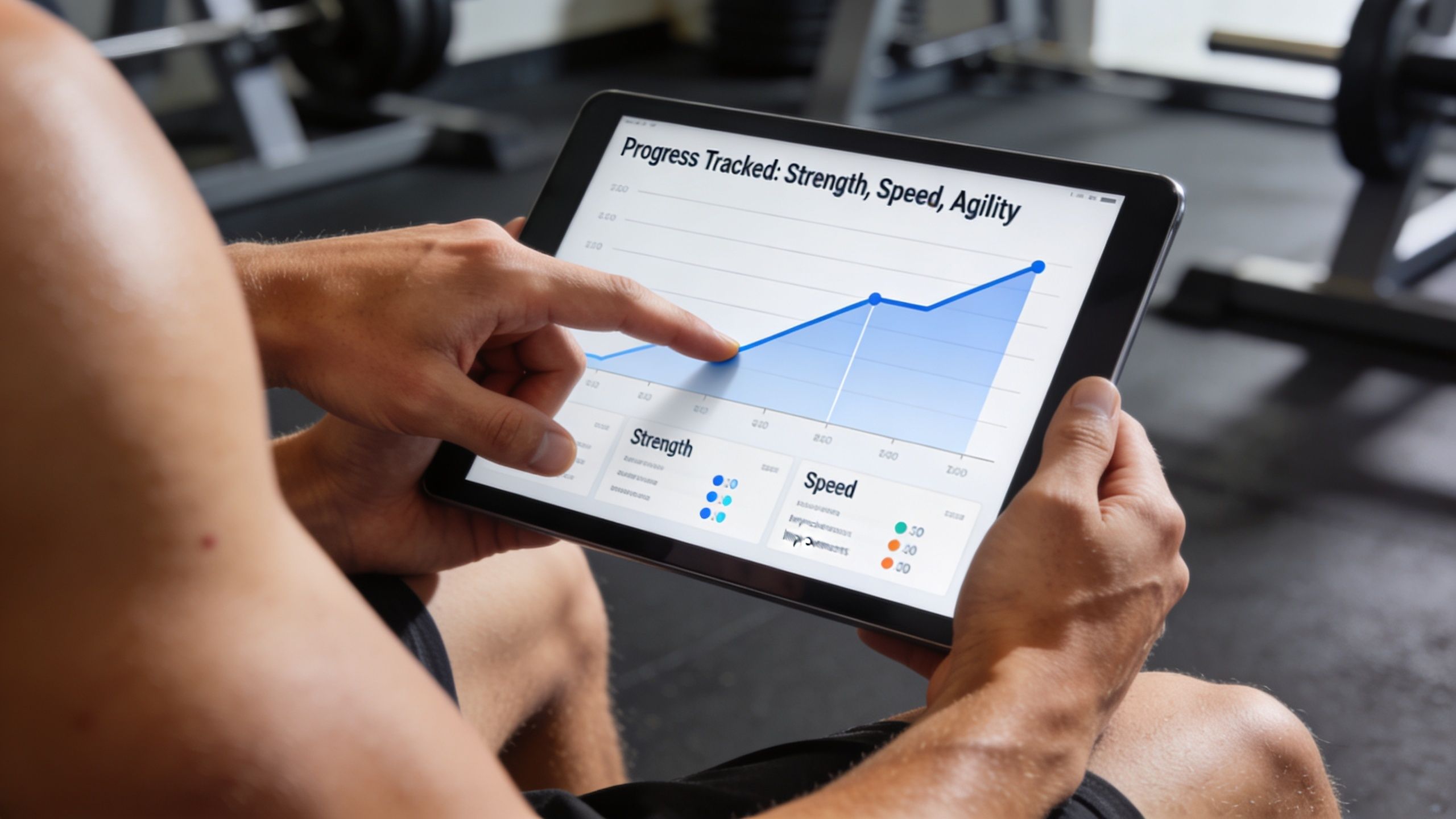
According to CoachMePlus on assessing athlete performance metrics, tracking measures such as jump height, sprint times, and workload helps identify strengths, weaknesses, and overtraining risk, and athletes with monitored progress show higher goal achievement. That same approach is especially useful for post-surgical patients because baseline testing creates an objective starting point and re-assessment shows what has changed.
What gets measured
The best KPIs depend on the athlete and the goal. A basketball player and a distance runner won’t be judged by the same numbers.
Useful markers often include:
- Power markers such as jump testing or explosive med ball work
- Speed measures like short sprint splits or acceleration times
- Strength progress in major movement patterns
- Workload tolerance across practices, lifts, and recovery days
- Return-to-play benchmarks that compare side-to-side function and movement confidence
What matters most is consistency. If you test too often or test the wrong things, the data becomes noise. If you test the right things at the right intervals, it becomes useful.
What progress also feels like
Performance data matters, but the athlete’s experience matters too. A good program usually changes how movement feels before the athlete can fully describe it.
That may sound like:
- “I’m not gassed at the end of practice anymore.”
- “My knee feels stable when I cut.”
- “I’m not waking up sore in the same spots every week.”
- “I trust my body again.”
Those reports shouldn’t replace objective testing. They should sit next to it. When both are moving in the right direction, confidence grows fast.
How to Choose the Right Sports Performance Program on the South Shore
A parent in Hingham watches their sophomore lineman finish physical therapy and asks the same question I hear every week. “He’s cleared, but is he actually ready for football?” A runner in Plymouth asks a version of it too after calf pain settles down. A sailor getting ready for a long spring season may feel fine day to day, but still lacks the strength and control to hold up under repeated training.
That is the gap a good sports performance program should fill.
On the South Shore, plenty of facilities can put an athlete through a hard workout. The better question is whether the program knows how to take someone from pain, rehab, or inconsistent training history and build them back into a stronger, more prepared athlete. That takes more than energy and equipment. It takes clinical judgment, sport-specific planning, and coaches who know when to push and when to pull back.
Questions worth asking before you sign up
Ask plain, direct questions. The answers should be clear, specific, and easy to understand.
- Who is leading the program? If there is an injury history, a PT-led or closely supervised model matters.
- How does the first assessment shape training? Good programs adjust to the athlete in front of them. They do not drop everyone into the same template.
- What does a normal training week look like? You want to hear how strength, speed, recovery, and sport demands fit together.
- What happens if pain shows up during training? A strong staff can modify quickly and explain why.
- How do they work with in-season athletes? A Norwell football player in August and a year-round adult runner need very different loading strategies.
- How do they handle the post-rehab athlete? Clearance is the starting line, not the finish line.
One answer usually tells you a lot. If the staff talks only about intensity, sweat, or motivation, that is a red flag. Athletes improve from the right dose of training, delivered at the right time, with a plan that matches the sport and the body.
Why the rehab-to-performance bridge matters
Many athletes get stuck at this point. They finish formal rehab, pain drops, and daily activity feels fine. Then they go back to sprinting, cutting, lifting, throwing, or higher mileage without rebuilding capacity first.
That is when old symptoms tend to return.
A true sports performance program should understand that middle ground. It should know how to progress an athlete who is no longer injured but is not yet fully prepared for the demands of high school soccer, weekend road races, club lacrosse, or a long sailing season. Generic gym programming usually misses that point because it treats everyone like they are already ready for full training volume.
Around here, that matters. A Marshfield baseball player coming back from shoulder trouble needs more than upper-body strength. A Duxbury runner needs load progression that respects tissue tolerance and mechanics. If running is your sport, this guide to running physical therapy for South Shore athletes can help you understand what that progression should look like.
The best choice is usually the program that can explain its reasoning. It should be able to tell you why an athlete is doing certain drills, how the workload will change over the next month, and what signs would lead the staff to modify the plan. That level of thought builds trust. It also keeps athletes from bouncing between rehab, random training, and another setback.
For South Shore families, that is often the difference between a program that looks impressive and one that actually helps an athlete stay on the field, on the road, or on the water.
Conclusion Take the First Step to Your Peak Performance
The right sports performance training program does more than make workouts harder. It gives athletes a plan they can trust. That plan starts with assessment, builds around the demands of the sport, changes across the season, and measures progress in a way that is meaningful.
That approach isn’t only for college recruits or professional athletes. It fits the South Shore high school player chasing a bigger role, the adult runner training for the next race, and the post-rehab athlete who wants to return with confidence instead of crossing their fingers.
If you’re tired of guessing, the next step is simple. Start with a thorough assessment, get a clear roadmap, and train with purpose.
If you're ready to build a smarter path from rehab to performance, book an evaluation with Peak Physical Therapy and Sports Performance. With South Shore locations that make care convenient for local families, athletes, and active adults, Peak can help you move better, perform better, and return to the activities that matter most.