


You wake up stiff, shift to the edge of the bed, and feel that familiar pull in your lower back before your day even starts. By the time you've sat through the drive near I-93, carried a few bags inside, or thought about getting out for a walk around Quincy, your back is already dictating your choices. That's frustrating, especially when the pain seems small one minute and completely disruptive the next.
If that sounds familiar, you're not alone. Back pain physical therapy Quincy MA searches usually come from people who are tired of guessing. They've tried resting, stretching on their own, or pushing through it, and now they want a plan that makes sense. The good news is that Quincy has strong access to care, with 2,255 physical therapy specialists in the area and an average patient rating of 4.4 stars according to local physical therapy listings in Quincy.
What clients want isn't a list of services. They want to know what happens next. They want to know who they'll talk to, what the first visit feels like, how treatment is chosen, and how long it takes to get back to normal life. That's what this guide covers, from the first call to the point where therapy is no longer something you need to think about.
Table of Contents
- Tired of Back Pain Ruling Your Life in Quincy
- Why Physical Therapy is Your First Best Step
- Your First Visit What to Expect at Peak in Quincy
- Your Personalized Treatment Plan at Peak
- Your Recovery Journey Timelines and Outcomes
- How to Get Started with Peak PT in Quincy
Tired of Back Pain Ruling Your Life in Quincy
Back pain rarely stays in one lane. It starts as an annoyance when you bend to tie your shoes or turn to check traffic. Then it creeps into the parts of life you care about, like walking the dog near Wollaston Beach, standing through a youth sports game, or lifting groceries out of the trunk without bracing yourself first.
For a lot of Quincy residents, the hardest part isn't just the pain. It's the uncertainty. You wonder if this will settle down on its own, if one wrong move will make it worse, or if you're heading toward a much bigger problem than the one you felt last week.
When back pain starts shrinking your routine
People often adapt in subtle ways before they ask for help. They stop carrying laundry upstairs in one trip. They avoid longer drives. They sit down to put on socks because standing on one leg suddenly feels risky. None of those choices are dramatic, but together they make life feel smaller.
That's usually the point where treatment starts to matter. Not because every case is severe, but because your back affects almost everything you do.
Back pain doesn't have to be constant to be disruptive. If it keeps changing how you move, work, sleep, or exercise, it deserves attention.
What local care should actually provide
A good physical therapy experience should make things clearer, not more confusing. You should leave knowing what seems to be driving your symptoms, what movements are safe, what needs to change now, and what recovery should look like over time.
That local, practical approach matters. Quincy patients aren't looking for a generic handout and a few random stretches. They want a plan that fits daily life on the South Shore, whether that means getting through a workday comfortably, returning to the gym, or picking up a grandchild without hesitation.
Why Physical Therapy is Your First Best Step
A lot of people try to outwait back pain. That instinct makes sense. If something hurts, resting seems like the safe move. The problem is that prolonged rest often turns a manageable issue into a longer, more stubborn one.

Back pain is common. Over 80% of people will experience back pain, and prolonged rest should be limited to no more than two days because muscle weakening can follow quickly. Structured physical therapy is described as a more effective and cost-efficient option than prolonged rest in this overview of back pain care and recovery.
Rest alone usually backfires
The back responds well to the right kind of movement. It responds poorly to fear, inconsistency, and long stretches of inactivity. When people stay still too long, they often become stiffer, weaker, and more cautious about normal movement. Then every bend, twist, or lift starts to feel more threatening than it really is.
That's why physical therapy is often the first best step. It gives structure to recovery. Instead of alternating between doing too much and doing nothing, you follow a progression that matches your symptoms and capacity.
Here's what tends to work better than “just take it easy”:
- Early guided movement helps you stay mobile without guessing which activities are safe.
- Targeted exercise builds support around the irritated area instead of waiting for pain to disappear.
- Hands-on care and movement coaching can reduce stiffness and improve confidence in everyday tasks.
- A clear home plan keeps progress going between visits.
If you want a practical starting point for symptoms that feel mechanical or flare with daily activity, this guide on how to relieve lower back pain is a useful next read.
Physical therapy treats the problem behind the pain
Pain in the low back doesn't always come from one simple source. Sometimes the issue is stiffness. Sometimes it's poor control through the hips and trunk. Sometimes it's a movement pattern that overloads the same tissues every day. Medication may reduce symptoms for a while, but it doesn't retrain how you move.
Physical therapy looks at the parts underneath the pain. Can you hinge through your hips? Do you lose control when you rotate? Does sitting bother you more than standing? Do symptoms travel into the leg, or stay local? Those details matter because treatment changes depending on the pattern.
Practical rule: The best treatment for back pain is rarely complete rest and rarely “push through it.” Most people do better with the middle path, which is guided activity.
There's also a local care reality worth knowing. Patients often find providers online through industry-specific networks for local leads, but what matters after that click is whether the clinic can turn general information into specific, in-person help. Back pain physical therapy Quincy MA should lead to an actual plan, not just a webpage.
Your First Visit What to Expect at Peak in Quincy
Starting physical therapy shouldn't feel intimidating. Patients often come in wondering if they need workout clothes, if they'll be pushed too hard, or if they'll be told to stop doing everything they enjoy. A good first visit answers those concerns quickly.

Before you arrive
Wear comfortable clothes that let you move easily. If bending, walking, or getting on and off a table tends to bother your back, mention that when you schedule and again when you check in. Those details help shape the visit from the start.
It also helps to think through a few simple questions beforehand:
- When did it begin and was there a clear trigger?
- What makes it worse such as sitting, standing, lifting, walking, or sleeping?
- What makes it ease up, even temporarily?
- Where do you feel it and does it stay in the back or travel elsewhere?
- What are you trying to get back to right now?
Those answers matter more than people think. Back pain isn't one-size-fits-all, and neither is the first session.
What happens in the evaluation
A strong treatment plan starts with precision. As noted in this Quincy spine care overview, effective care begins with a precise diagnosis using evidence-based assessment protocols to distinguish between patterns such as lumbar stenosis, herniated discs, or facet dysfunction so the right intervention is chosen.
In practical terms, that means your visit isn't just a quick chat followed by a list of exercises. Your therapist listens to your history, watches how you move, checks range of motion, looks at strength, and pays attention to positions that increase or reduce symptoms.
A typical first evaluation often includes:
Your story
The timeline matters. Sudden pain after lifting feels different from a back problem that has built up over months.Movement testing
You may bend forward, lean back, rotate, walk, or change positions so your therapist can see what your body does under load.Strength and control assessment
This helps identify whether the problem is just pain, or pain plus weakness, guarding, or poor movement coordination.A working plan
You should leave with a clear sense of what the next steps are, what to avoid for now, and what you can start doing right away.
Most patients feel better about their back after the first visit, not because the problem is solved in one day, but because they finally understand what they're dealing with.
Your Personalized Treatment Plan at Peak
After the evaluation, the plan should match your back, your goals, and your day-to-day life in Quincy. A parent trying to lift a toddler needs a different progression than a commuter who cannot sit through the drive to work, and both need something different from a runner hoping to get back to training without a setback.
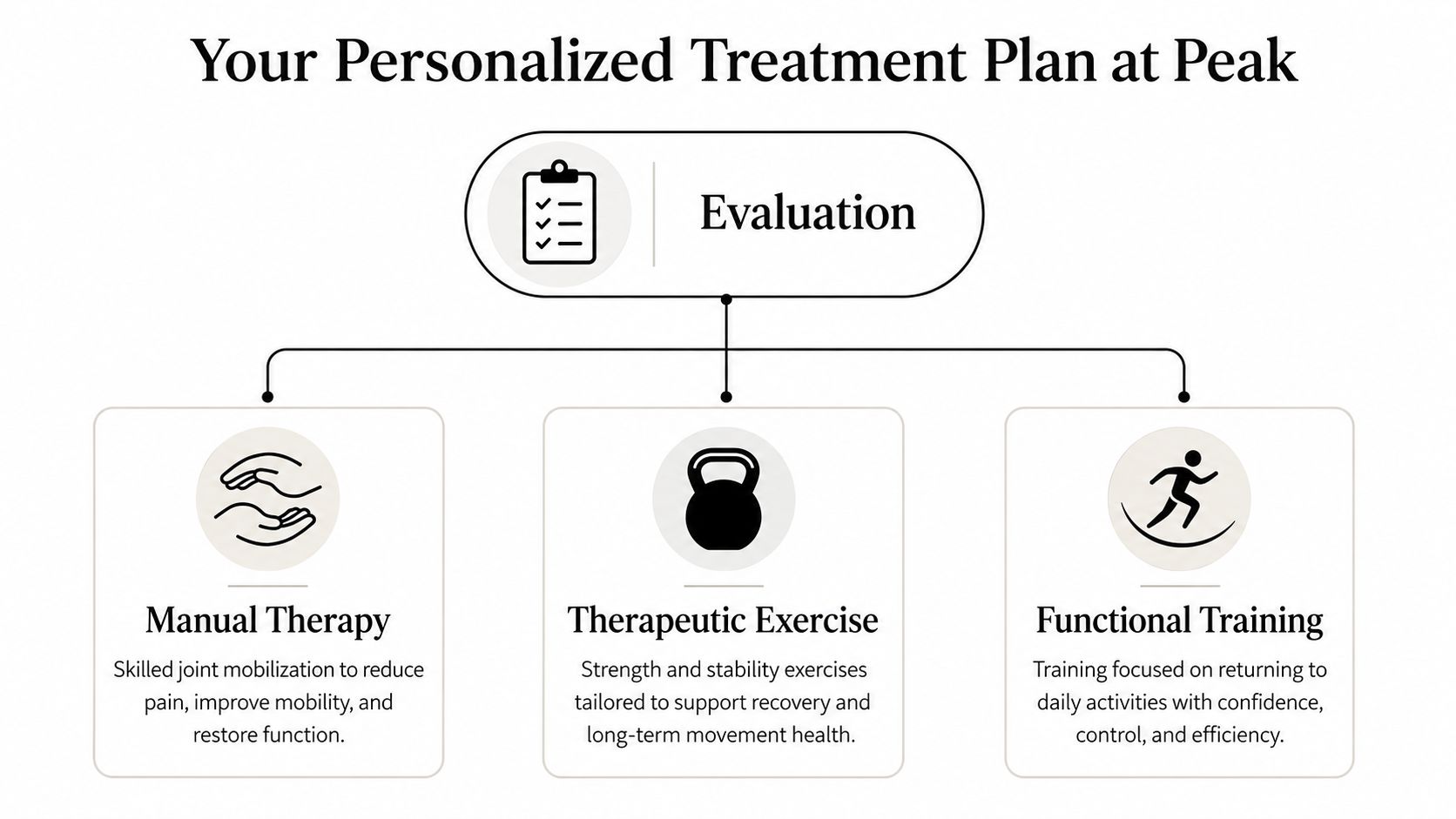
At Peak, treatment usually blends a few approaches instead of relying on one tool. Hands-on care can settle an irritated back enough for you to move better. Exercise builds the strength and control that keep symptoms from returning the minute life gets busy again. Education helps you understand what is safe, what needs to be modified for now, and how to handle a flare without feeling like you are back at square one.
The tools we may use
Here is how those pieces usually show up in a real plan:
| Treatment approach | What it may help with | What it can feel like |
|---|---|---|
| Manual therapy | Joint stiffness, muscle guarding, limited motion | Guided hands-on treatment to improve mobility |
| Therapeutic exercise | Weakness, poor control, repeated strain | Structured movements matched to your current level |
| Dry needling | Stubborn muscle tension or trigger points | Brief, targeted technique aimed at reducing tension |
| Aquatic therapy | Pain with weight-bearing or land exercise | Easier movement with water support |
| Education and pacing | Flare-ups, fear of movement, overdoing it | Clear guidance on what to do between visits |
Each option has a purpose. Manual therapy can help when your back feels stuck and every movement is guarded. Dry needling may help reduce muscle tension that keeps pulling you back into the same painful pattern. Aquatic therapy gives some patients a way to start moving sooner because the water reduces stress on the spine and lets them practice motion with less fear.
Exercise remains the core of your recovery plan. This does not always require intense workouts immediately. Initial movements might involve simple shifts in position, breathing techniques, short walks, or controlled motions of the hip and trunk. As your tolerance grows, the routine progresses toward lifting, carrying, rotational control, and the tasks that matter in your life. If you want a better sense of how trunk strength supports recovery, this article on core strengthening exercises for back pain is a useful place to start.
How those pieces fit together
Good treatment follows a sequence. Early visits often focus on reducing irritability and helping you move with less hesitation. Once that improves, the work gets more active and more specific.
A typical progression looks like this:
Phase one
Calm symptoms, improve motion, and find positions and movements that feel safe again.Phase two
Build strength and control through the hips, trunk, and legs so your back is not doing all the work by itself.Phase three
Practice the activities you want to return to, whether that is yard work, gym training, long drives, work duties, or getting through the day without bracing for pain.
This is also where real trade-offs matter. Passive treatment can bring short-term relief, and sometimes that relief is needed so you can tolerate movement. But relief alone rarely holds up. On the other hand, pushing straight into exercise without calming an irritable back can aggravate symptoms and shake your confidence. The plan works best when symptom relief and progressive loading are matched to your current tolerance.
Peak Physical Therapy and Sports Performance provides these treatment options as part of outpatient orthopedic care in Quincy, including treatment for back pain and sciatica, dry needling, and aquatic therapy.
You should be able to explain your plan in plain English. If you do not know why you are doing an exercise or how it connects to your goals, your plan needs more clarity.
Your Recovery Journey Timelines and Outcomes
Recovery from back pain is rarely a straight line. Some people improve quickly once they start moving better. Others deal with symptoms that have been hanging around long enough to affect sleep, work, exercise, or confidence. That doesn't mean progress isn't happening. It means progress needs to be measured by more than pain alone.

A prevention-focused plan matters because recurrence is common. One Quincy-area source notes that back pain recurrence can affect up to 70% of patients within a year, which is why progressive neuromuscular training and home programs are emphasized for long-term prevention in this discussion of back pain and sciatica care.
What progress usually looks like
Pain reduction matters, but it isn't the only sign that therapy is working. Patients also improve when they can roll in bed more easily, sit longer without needing to shift constantly, carry groceries with less hesitation, or return to a walk without symptoms building immediately.
A therapist usually watches for changes like these:
- Less irritation during daily tasks
- Better movement quality
- Greater tolerance for walking, sitting, lifting, or exercise
- More confidence with positions that used to feel risky
- Consistency with the home program
Those markers matter because healing isn't just about a pain score. It's about function.
A successful outcome means you trust your back again. The pain may fade before that happens, or after. Confidence is part of recovery.
What graduation from therapy really means
Graduating from care doesn't mean you'll never feel your back again. It means you know how to respond when it gets stiff, irritated, or overloaded. You understand your warning signs. You have a small set of drills or exercises that help. You can tell the difference between soreness and a true flare.
That's where long-term value shows up. The goal isn't to make you dependent on treatment. The goal is to help you move well enough, and understand your body well enough, that therapy becomes temporary support rather than a permanent crutch.
For some people, that means getting back to workouts. For others, it means lifting kids, working a shift, gardening, or sleeping through the night without planning every movement.
How to Get Started with Peak PT in Quincy
You wake up already planning around your back. Which way to roll out of bed. How long the drive will feel. Whether today is a work through it day or a cancel plans day. Starting physical therapy often feels like one more task when you are already tired of managing symptoms.
Getting started at Peak is simpler than people expect. The first goal is to get you on the schedule, answer the practical questions, and make that first visit feel clear instead of uncertain.
Simple next steps
A good place to start is the Peak Physical Therapy Quincy clinic page. You can review the location, request an evaluation, and get a sense of what to expect before you come in.
You can also call the clinic if you would rather talk with someone first. That is often the better option if you have questions about insurance, scheduling, paperwork, or whether physical therapy fits what your back has been doing.
When you reach out, a few details help us prepare:
- Where your pain shows up most and what seems to aggravate it
- How long it has been going on
- Any recent scans, injections, or medical visits
- What you want to get back to such as work, sleep, walking, exercise, or picking up your kids without bracing first
Bring comfortable clothes to the evaluation. Bring any referral or imaging report if you have one. If you do not have those things, that usually does not stop the process.
The point of the first step is not to sign up for months of care without answers. It is to get a skilled assessment, understand what may be driving the pain, and leave with a plan that makes sense for your life in Quincy.
If your back is limiting your routine on the South Shore, call or request a visit and get the process started. Peak Physical Therapy and Sports Performance helps patients move from that first frustrated phone call to a clear treatment plan, steady progress, and a return to the activities that matter to them.