


When that sudden, sharp lower back pain hits, it can stop you in your tracks. One moment you’re lifting a grocery bag, shoveling snow off your Massachusetts driveway, or just bending over, and the next, you feel a jolt that takes your breath away. We understand how frustrating and even frightening it can be to feel “stuck,” unable to move without a sharp reminder of the injury.
You’re probably wondering if you’ve done serious damage, how long you’ll be sidelined from your life, and what you can possibly do to find relief. The good news is that for most cases of acute back pain, a combination of relative rest, smart ice therapy, and gentle movement can make a world of difference. Our licensed physical therapists at Peak Therapy have helped thousands of patients across Massachusetts navigate this exact situation, and we're here to guide you through it.
Immediate Steps for Lower Back Pain Relief
That initial jolt of lower back pain is alarming. The feeling of being "stuck," unable to move without a sharp reminder of the injury, is frustrating and even a little frightening. It's natural to worry if you’ve done serious damage or wonder how long you’ll be sidelined from your favorite activities, whether that's running along the Charles River or just playing with your kids.
The good news is that there are safe, effective things you can do right now to manage this acute phase. Our approach isn't about pushing through pain, but about creating an environment where your body can calm down and begin to heal.
Rethink Rest and Start Moving Gently
The outdated advice to lie flat in bed for days often does more harm than good. Our physical therapists know that complete immobility can actually lead to more stiffness and muscle weakness, which only slows down your recovery. Instead, we recommend a concept called "relative rest."
This simply means you avoid the activities that bring on sharp pain while still incorporating gentle, pain-free movement throughout your day.
- Avoid Provoking Activities: Stop doing the specific motion that hurts. If lifting, twisting, or sitting for a long time are the culprits, take a break from them for now.
- Take Short, Frequent Walks: Even a five-minute walk around your house every hour can work wonders to prevent stiffness. Walking on a flat surface is a fantastic, low-impact way to encourage blood flow and help tense muscles relax.
- Change Positions Often: Try not to stay in any one position—whether you're sitting or lying down—for more than 20-30 minutes at a time.
Use Ice Therapy Correctly
During the first 24-48 hours of an acute injury, inflammation is a huge part of what's causing your pain. Ice is your best friend here. Applying cold constricts blood vessels, which helps tamp down swelling and numbs the area, providing some immediate, localized relief.
Pro Tip: Never put ice directly on your skin. Always wrap your ice pack in a thin towel or a T-shirt to prevent an ice burn. Apply it for 15-20 minutes, then give the area at least an hour-long break before icing again.
Deciding between cold and heat therapy can be confusing. For more detailed guidance, check out our article on when to use ice vs. heat for injuries.
Find a Comfortable Position
When your back is spasming, finding any position that doesn’t hurt can feel impossible. The key is to find a supported posture that takes pressure off your lumbar spine.
Try lying on your back with a pillow under your knees, which will help gently flatten your lower back against the floor. Another great option is to lie on your side with a pillow between your knees to keep your hips and spine in a neutral line. Experiment a little to find what gives you the most relief.
These initial steps are your first line of defense, helping you regain control and paving the way for a much smoother recovery.
Gentle Stretches to Restore Pain-Free Movement
When that first, sharp wave of back pain starts to fade, it's natural to feel hesitant. The fear of re-injury is real, and the instinct to protect your back by staying perfectly still is strong. But this is the exact moment when gentle, intentional movement becomes your best ally.
We’re not talking about pushing through sharp pain. The goal is to gently coax those tight, guarded muscles to relax and reintroduce your spine to safe, pain-free motion. This simple act can help reduce muscle spasms, get blood flowing to the area to promote healing, and start restoring your normal ability to move with confidence.
Think of it as a simple, three-part process: first, you calm the initial flare-up, and then you begin to move.
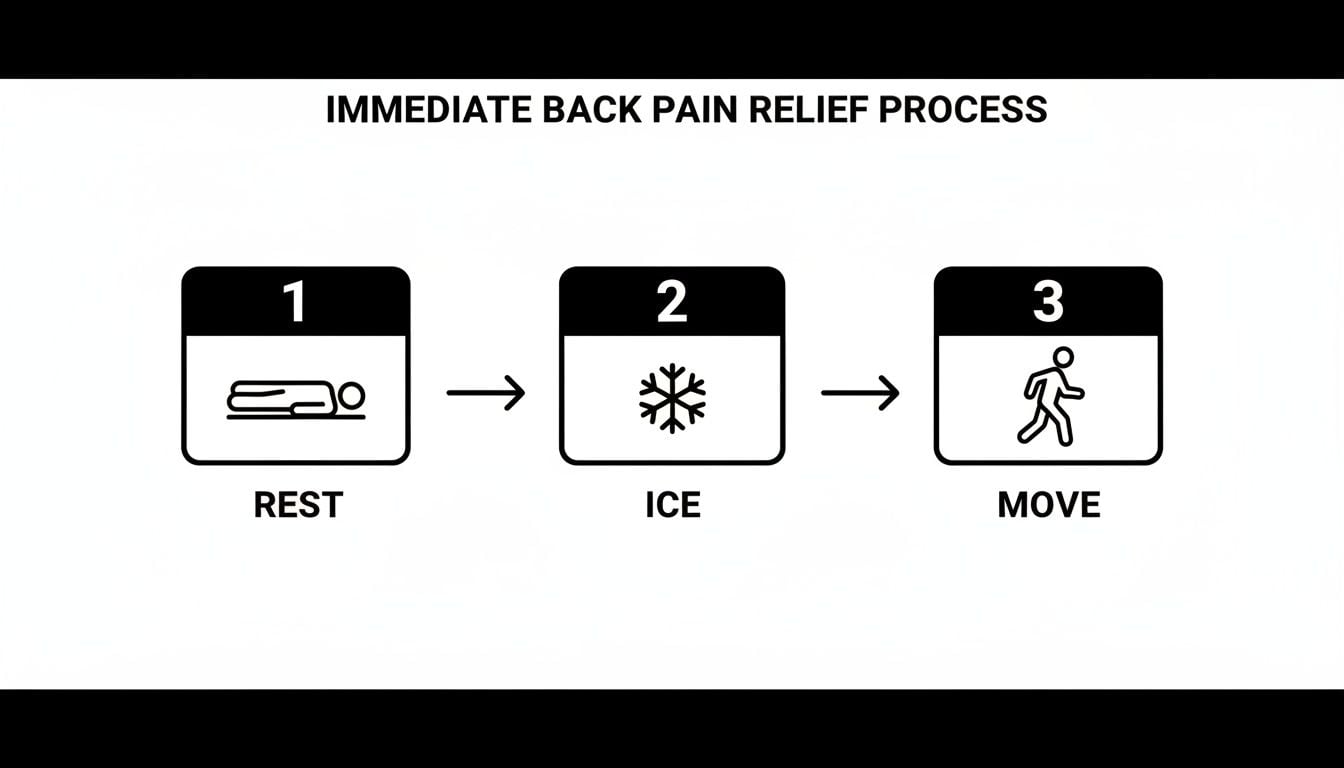
This progression from initial rest to gentle movement is the foundation for a successful recovery from acute lower back pain.
Foundational Stretches for Your Back
As you start any new movement, the golden rule is to listen to your body. These stretches are meant to feel relieving and gentle. If you experience any new or worsening pain, that’s your body’s signal to stop and consult a professional.
Pelvic Tilts
This is one of the safest and most effective movements you can do to begin. It gently mobilizes the lower spine and helps wake up the deep core muscles that act as your body’s natural corset.
- Lie on your back with your knees bent and feet flat on the floor, about hip-width apart.
- Let your upper body and arms relax.
- Gently press your lower back into the floor by tightening your stomach muscles, which will cause your pelvis to tilt slightly upward.
- Hold this gentle engagement for 5-10 seconds, then relax. Aim for about 10 repetitions.
Single Knee-to-Chest Stretch
During a back pain flare-up, it’s not just the back muscles that get tight—your glutes often join the party. This stretch helps address both areas.
- Start in the same position on your back.
- Gently draw one knee toward your chest, using your hands to hold behind your thigh, not on your kneecap.
- Hold for 20-30 seconds, breathing into the gentle stretch you feel in your lower back and buttock.
- Slowly lower that leg and repeat on the other side. Try for 2-3 repetitions per leg.
Cat-Cow Flow
Borrowed from yoga, this is a classic mobility drill for a reason. It encourages the entire spine to move through a controlled range of motion, making it fantastic for relieving morning stiffness or breaking up long periods of sitting.
- Get on your hands and knees, stacking your wrists under your shoulders and your knees under your hips.
- As you inhale, allow your belly to drop toward the floor and look slightly forward, creating a gentle arch in your back (the "Cow" pose).
- As you exhale, round your spine up toward the ceiling, tucking your chin toward your chest (the "Cat" pose).
- Flow smoothly between these two positions for 10-15 repetitions, letting your breath guide the movement.
How to Choose Safe Activities
Knowing what to do is just as important as knowing what not to do. When your back is sensitive, some activities can help, while others might set your recovery back.
Here's a quick guide to help you make smart choices during a flare-up.
Safe vs Unsafe Activities for Lower Back Pain
| Do This (Safe & Recommended) | Avoid This (Potentially Harmful) |
|---|---|
| Gentle walking on flat surfaces | High-impact running or jumping |
| Specific, prescribed back stretches | Deep forward bends (e.g., touching toes) |
| Swimming or water aerobics | Heavy lifting or overhead pressing |
| Using proper lifting mechanics (from the legs) | Twisting motions, especially while lifting |
| Modifying activities to avoid pain | Prolonged sitting or slouching |
| Taking frequent breaks to stand and move | "Powering through" the pain |
This table isn't exhaustive, but it provides a solid starting point for navigating daily life while your back is healing. The key is to keep moving in ways that feel good and avoid activities that cause a spike in your symptoms.
Practical Tips for Safe Stretching
Consistency trumps intensity every time. A few sessions of these gentle movements throughout the day will do far more good than one long, aggressive stretching session.
If you spend a lot of time at a desk, stiffness is your enemy. Breaking up long periods of sitting with a simple chair lower back stretch can make a world of difference. It's a discreet and easy way to keep your back from locking up.
A key principle we teach at our Peak Therapy clinics across Massachusetts is "motion is lotion." Gentle movement lubricates the joints and keeps tissues healthy, preventing the cycle of stiffness and pain from taking hold.
At our clinics, from Quincy to Plymouth, we guide patients through these exact movements to ensure they're performing them correctly for their specific condition. A physical therapist can be invaluable in identifying the true source of your pain, showing you which stretches to focus on, and—just as importantly—which ones to avoid. This personalized approach is what builds a solid foundation for lasting relief and helps you get back to your life without fear.
Building a Stronger Back With Progressive Exercises
While gentle stretches are fantastic for getting you moving again, true, lasting relief comes from building a back that’s resilient. This means shifting our focus from just flexibility to creating a strong, stable support system for your spine. This is where we move from managing the immediate pain to building long-term back health.
The goal isn't to become a bodybuilder. It's about waking up and strengthening the deep stabilizing muscles that often get weak or "shut off" during a bout of back pain. Think of your core, glutes, and back muscles as a natural corset that absorbs the stresses of daily life so your spine doesn't have to. This is, hands down, the best way to stop that frustrating cycle of pain from coming back.
Your Core Is More Than Just Abs
When a physical therapist talks about the "core," we're not just talking about your six-pack. We mean the entire muscular cylinder that wraps around your middle. This includes:
- Transverse Abdominis: Your deepest ab muscle, which functions like a built-in weightlifting belt.
- Multifidus: Tiny but mighty muscles running along your spine that provide critical, segment-by-segment stability.
- Glutes: Your powerful hip muscles are essential for supporting your pelvis and, by extension, your lower back.
- Pelvic Floor: This muscular “hammock” at the base of your pelvis provides foundational support from below.
When these muscles fire correctly and work together, they create a stable base for every move you make, whether you're getting out of a chair or picking up a heavy bag of groceries.
Start With Stability and Control
The secret to strengthening a sensitive back is to start with exercises that activate these key muscles without overloading the spine. Here, the quality of your movement is far more important than how many reps you do or how fast you go. The focus should always be on slow, controlled motions and perfect form.
Glute Bridges
This is one of our go-to exercises for waking up the glutes. They tend to get lazy when you have back pain, forcing your lower back to do work it shouldn't be doing.
- Lie on your back with your knees bent and feet flat on the floor, about hip-width apart. Keep your arms relaxed at your sides.
- Gently brace your core and squeeze your glutes, lifting your hips toward the ceiling. Your body should form a straight line from your shoulders to your knees.
- Hold this position for 2-3 seconds, focusing on that glute squeeze. Don't just lift—squeeze.
- Slowly lower your hips back to the starting position with control. Aim for 2 sets of 10-15 repetitions.
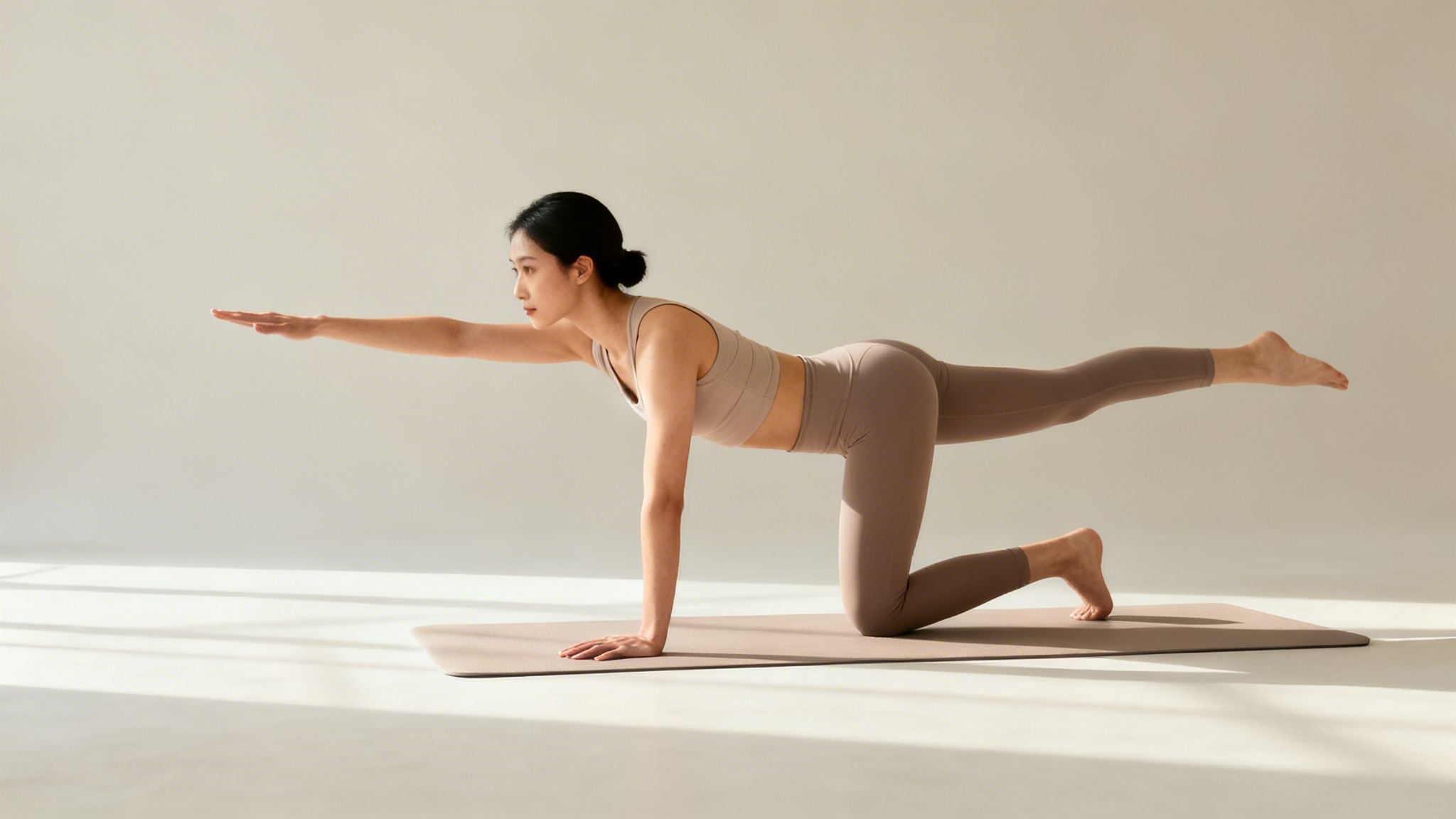
Bird-Dog
The bird-dog is a gold-standard physical therapy exercise because it's incredible for improving core stability and balance. It teaches your body to keep your spine in a safe, neutral position while your arms and legs are moving.
- Start on all fours in a tabletop position, with your hands directly under your shoulders and knees under your hips.
- Brace your core to keep your back flat—imagine you have a full glass of water balancing on your lower back.
- Slowly extend your right arm straight forward and your left leg straight back at the same time.
- Pause for a moment, then return to the start with control. Repeat on the other side. That’s one rep. Try to complete 2 sets of 10 reps.
Dead Bug
This one might look simple, but it’s exceptionally good at training your deep core muscles to stabilize your pelvis and lower back.
- Lie on your back, extending your arms toward the ceiling. Lift your legs and bend your knees to a 90-degree angle so your shins are parallel to the floor.
- Gently press your lower back into the floor to engage your core.
- Slowly lower your right arm and left leg toward the floor. Go only as far as you can without your back arching off the floor.
- Return to the starting position and repeat with the opposite arm and leg. That’s one rep. Aim for 2 sets of 10-12 reps.
Physical Therapy Insight: At our Peak Therapy clinics, we often see patients trying to rush through these exercises. The real benefit comes from slow, deliberate movement. This teaches your nervous system to fire the correct stabilizing muscles in the right sequence, which is the key to lasting change.
Consistency Is Your Superpower
Building strength doesn't happen overnight, but the effort is one of the most reliable investments you can make for your back. For chronic low back pain, exercise has been shown to be a clear winner for providing reliable pain relief. Staying active improves blood flow and flexibility while supporting the spine, which is why it helps the 80% of adults who experience back pain recover without needing more invasive options.
As these foundational exercises get easier, a physical therapist can help you progress safely by adding resistance, increasing your reps, or introducing more complex movements. For a closer look at building a strong foundation, check out our guide on core strengthening exercises for a healthy back. This guided progression is what builds true resilience and keeps you from hitting a plateau or causing a flare-up.
How Everyday Habits Affect Your Back Health
While specific exercises are a huge piece of the puzzle, lasting relief from lower back pain often comes down to what you do the other 23 hours of the day. The small things we do over and over again—how we sit, lift, and even sleep—have a massive cumulative effect on our spines.
Think about it this way: each time you slouch or lift something incorrectly, you’re making a tiny deposit into a "pain account." One day, a simple movement overdraws the account, and you're hit with a painful flare-up. The key is to stop making those deposits by fixing the hidden triggers in your daily life.
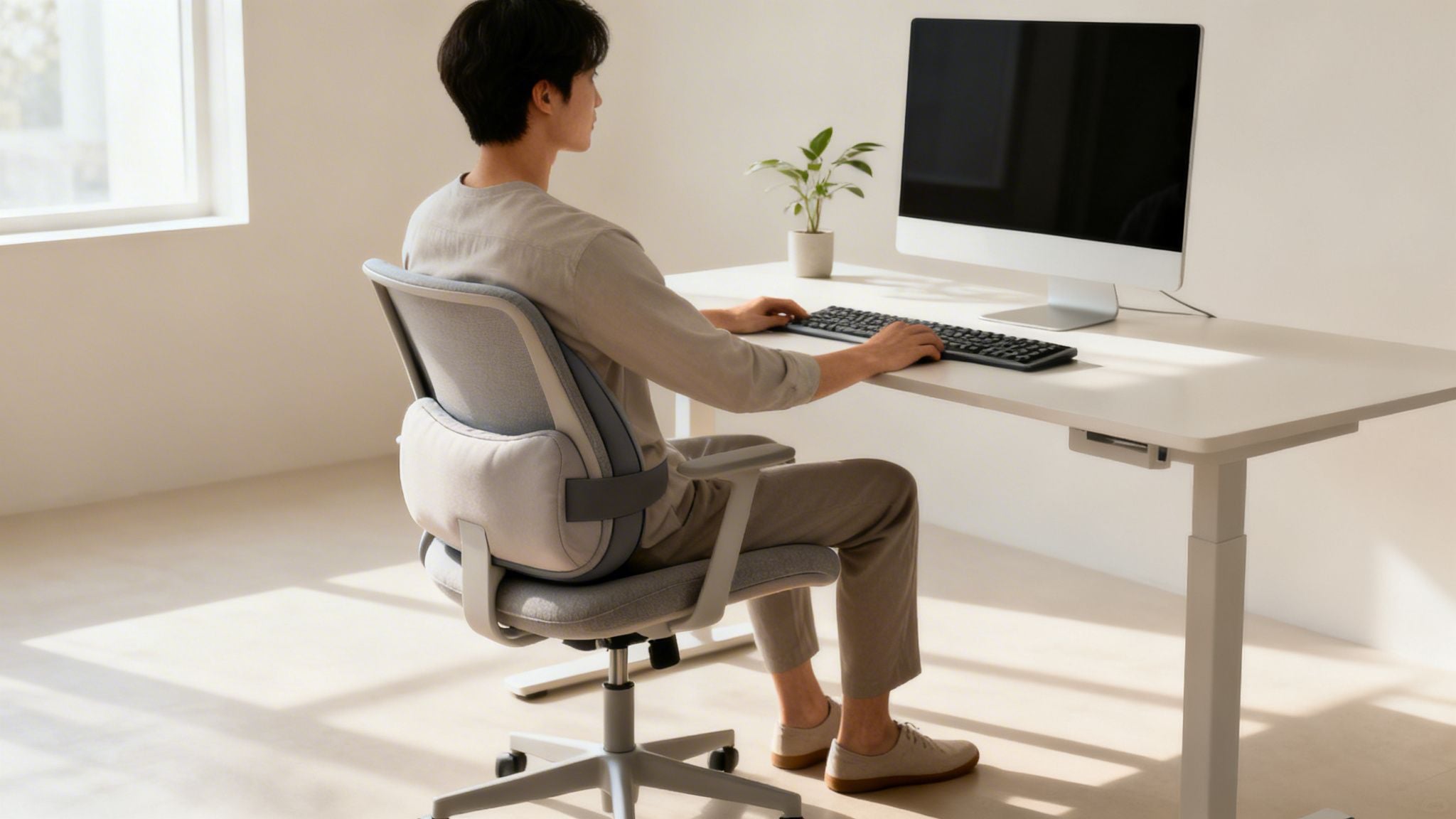
Your Workspace Ergonomics
With so many of us here in Massachusetts working from home, at least part-time, the home office has become a major source of back strain. We see it all the time in our clinics. Hunching over a laptop at the kitchen counter for eight hours a day is a perfect recipe for back pain.
The goal is to set up your space to maintain a neutral spine, which just means keeping your ears, shoulders, and hips in a relatively straight line.
- Your Chair Matters: Your chair needs to support the natural curve of your lower back. If it doesn't have built-in lumbar support, simply rolling up a towel and placing it in the small of your back can be a game-changer. Also, make sure your feet can rest flat on the floor with your knees bent at roughly a 90-degree angle.
- Get Your Monitor Height Right: The top of your computer screen should be at or just a little below eye level. This simple adjustment stops you from craning your neck forward, which creates a chain reaction of tension right down to your lower back.
- Movement is Your Best Friend: Even the most "perfect" posture becomes a problem if you hold it for too long. The body craves movement. Set a reminder to get up, stretch, or just walk around for a couple of minutes every 30-45 minutes.
Mastering Proper Lifting Mechanics
Improper lifting is probably one of the top three reasons people walk into our Massachusetts clinics with a new back injury. This applies to everyone, from the weekend warrior helping a friend move to a new parent scooping up their toddler a dozen times a day.
The most important rule is to hinge at your hips and lift with your legs, not with your back.
Instead of rounding your spine to bend down, keep your back straight and push your hips back as if you’re about to sit in a chair. Get a firm grip on the object, tighten your core muscles, and then drive up through your powerful leg and glute muscles to stand.
We often tell our patients at Peak Therapy: "Your legs are the crane; your core is the stabilizer." When you lift correctly, you use the right tools for the job.
The Critical Role of Sleep Ergonomics
You spend a third of your life in bed, so it’s no surprise that your sleeping setup can either help or hurt your back. If you consistently wake up feeling stiff and achy, it’s time to take a hard look at your mattress and sleeping position.
It's true that the right mattress can help alleviate back pain by promoting better spinal alignment, but your sleeping posture is just as important.
Here are a few tips we give our patients:
- For Back Sleepers: Try placing a pillow under your knees. This softens the arch in your lower back and immediately takes some pressure off your spine.
- For Side Sleepers: Put a firm pillow between your knees. This simple trick prevents your top leg from sliding forward, which can twist your pelvis and strain your lower back all night long.
- For Stomach Sleepers: We generally advise against this position. It flattens the healthy curve in your low back and forces you to twist your head to breathe, which can cause issues from your neck all the way down.
By making these small, mindful adjustments to your daily routines, you can dramatically reduce the stress on your back. It’s all about protecting your spine from the wear and tear of modern life.
When to See a Physical Therapist for Your Back Pain
While many of the self-care strategies we’ve covered are fantastic for handling mild or occasional back pain, there comes a point when you need an expert guide. It can be confusing trying to figure out if what you’re feeling is "normal" or something more serious. We’re here to help clear that up so you can confidently decide when it’s time to seek professional help.
First, let's talk about the urgent stuff. Certain symptoms are considered "red flags" that mean you should see a physician or head to an emergency room right away. These are not signs to wait on.
If your back pain is paired with any of the following, please seek immediate medical care:
- Sudden loss of bowel or bladder control
- Numbness or weakness in your legs, groin, or genital area
- Fever, chills, or unexplained weight loss
- Pain that is severe, constant, and getting worse, especially at night
These symptoms can point to a more serious underlying issue that needs a prompt diagnosis.
When Professional Guidance Becomes Essential
Beyond those red flags, there are many other times when seeing a physical therapist is the smartest next step. Self-diagnosing can only get you so far, and guessing at the root cause of your pain can sometimes lead you down the wrong path entirely. A licensed physical therapist is a movement expert trained to uncover the why behind your discomfort.
Consider booking an appointment if your back pain:
- Lasts for more than a few weeks: If you’ve tried rest, ice, and gentle movement but the pain just isn’t letting up, it’s a clear signal that something more is going on.
- Interferes with your daily life: You shouldn't have to give up the things you love. When back pain stops you from working, enjoying hobbies, or even getting a good night's sleep, it's time for help.
- Comes and goes frequently: Are you stuck in a frustrating cycle of feeling better for a bit, only for the pain to flare up again with a simple twist or bend? This often points to an underlying weakness or faulty movement pattern that a PT can correct.
- Started after a specific injury: If your pain began after a car accident, a fall, or a sports injury, getting a professional evaluation is crucial to ensure you recover properly and prevent long-term problems.
Your First Physical Therapy Visit: What to Expect
We get it—seeking help can feel intimidating, especially if you’ve never been to physical therapy. At our Peak Therapy clinics, our first goal is to make you feel comfortable and heard. We know how exhausting it is to live with pain, and we’re here to be your partner on the road to recovery.
Your first appointment is a dedicated evaluation where your therapist will:
- Listen to your story: You’ll have a one-on-one conversation about your pain, how it started, what makes it better or worse, and how it’s truly impacting your life. This is your time to be heard.
- Assess your movement: Your therapist will watch you walk, bend, and move to identify any limitations or dysfunctional patterns. They’ll look at your posture, flexibility, and range of motion.
- Perform hands-on tests: They will use specific tests to check your muscle strength, nerve function, and joint mobility to pinpoint the exact source of your symptoms.
This thorough evaluation is what sets professional care apart. It allows us to move beyond just chasing symptoms and develop a personalized plan that addresses the true cause of your back pain.
What Does a Treatment Plan Look Like?
Based on your evaluation, our licensed physical therapists perform a comprehensive evaluation to determine the root cause of your back pain and develop a personalized treatment plan. We don't believe in a one-size-fits-all approach. Your treatment will be a unique blend of techniques designed to help you reach your personal goals.
This might include:
- Manual Therapy: This involves skilled, hands-on techniques where the therapist mobilizes your joints and soft tissues. It's incredibly effective for reducing stiffness, improving mobility, and providing immediate pain relief. You can learn all about the benefits of manual physical therapy on our blog.
- Personalized Therapeutic Exercises: You’ll be guided through the exact stretches and strengthening exercises your body needs, ensuring you’re doing them with perfect form to get the most benefit.
- Pain-Relief Modalities: Depending on your condition, your therapist may use treatments like dry needling, heat, or electrical stimulation to help calm muscle spasms and reduce acute pain.
- Education: A huge part of our job is to empower you with knowledge. We’ll teach you about your body, proper posture, and ergonomic strategies to help prevent the pain from coming back.
Choosing to see a physical therapist is a proactive step toward taking back control from your pain. It’s a commitment to not just feeling better for a little while, but to building a stronger, more resilient back for the long haul.
Frequently Asked Questions About Lower Back Pain
If you're dealing with lower back pain, you probably have a lot of questions. It's only natural. We hear the same concerns every day in our Peak Therapy clinics across Massachusetts, so we wanted to provide some clear, PT-approved answers. Our goal is to cut through the noise and give you the confidence you need to start your recovery.
Is Walking Good for Lower Back Pain?
For most people, yes—walking is one of the best things you can do for an aching back. It's a gentle, low-impact activity that gets blood flowing to the muscles and discs in your spine, which is crucial for healing.
Movement is medicine, especially when it comes to preventing the stiffness that comes from sitting or lying down for too long. We always suggest starting with short, manageable walks on a flat surface, like a stroll around your neighborhood. The most important thing is to listen to your body. A little muscle soreness is perfectly fine, but you should never push through sharp, stabbing, or radiating pain.
How Long Does It Take for Lower Back Pain to Go Away?
This is the million-dollar question, and the honest-to-goodness answer is: it depends. The recovery timeline for lower back pain really varies based on what's causing it and how severe it is.
- Acute Pain: If you just tweaked a muscle or overdid it in the yard, that sharp pain often starts to improve within a few days to a couple of weeks, especially with the right self-care.
- Chronic Pain: We understand how exhausting chronic back pain can be. Pain that has stuck around for more than three months, or pain stemming from something like a disc issue or arthritis, can be a longer road.
A physical therapist can give you a much more accurate prognosis after a thorough evaluation. Our job is to pinpoint the root cause and work with you to set realistic expectations for getting back to your life.
Our PT Perspective: Recovery is rarely a straight line. You're going to have good days and bad days. The goal of physical therapy is to stack the deck in your favor—giving you more good days and the tools you need to manage the bad ones when they pop up.
Should I Use Heat or Ice for My Lower Back Pain?
This is a classic question, and the best answer really comes down to timing.
Ice is Your Friend at First: For the first 24 to 48 hours after an injury—that moment you feel your back "go out"—grab an ice pack. The cold helps constrict blood vessels, which is great for reducing swelling, inflammation, and numbing the area for some immediate relief. Just be sure to wrap the pack in a thin towel and apply it for about 15 minutes at a time.
Switch to Heat Later: After that initial 48-hour window has passed, or for those nagging chronic muscle aches, heat is usually the better choice. Heat gets the blood flowing, helping to relax tight, spasming muscles and soothe general soreness. A heating pad or a warm shower can feel incredible.
What Is the Best Sleeping Position for Lower Back Pain?
The best position is one that helps you maintain the natural, gentle curves of your spine. For most people struggling with lower back pain, sleeping on your stomach is the worst offender because it tends to flatten your lumbar curve and can twist your neck.
Instead, try one of these two positions:
- On Your Back: Slide a pillow under your knees. This simple trick takes the pressure off your hip flexors and allows your lower back to rest in a more neutral, relaxed position.
- On Your Side: Place a firm pillow between your knees. This stops your top leg from falling forward and twisting your pelvis, which helps keep your hips, pelvis, and spine in a nice, straight line.
Don't be afraid to experiment with different pillows and positions. Finding what works for your body is key to waking up with less stiffness and pain.
You shouldn’t have to stop doing what you love because of lower back pain. If your questions aren't answered here or your pain persists, it's time to get a personalized plan. At Peak Physical Therapy and Sports Performance, our experienced therapists across Massachusetts are ready to perform a comprehensive evaluation to determine the root cause of your pain and get you back to living fully.