
You feel it the moment the play ends. Maybe it happened cutting on a soccer field, reaching for a throw, or halfway through a run near Pond Meadow Park when something in your ankle, knee, or shoulder didn't feel right. You try to walk it off. Maybe you even tell yourself it's “just a tweak.” But by that night, the swelling, stiffness, or sharp pain tells a different story.
Around Braintree, sports injuries don't just affect varsity athletes. They hit weekend runners, youth athletes at Braintree High, adults playing pickup basketball, parents trying to stay active, and anyone on the South Shore who likes to move. The frustrating part isn't only the pain. It's missing the routines that make you feel like yourself.
That's where good rehab matters. Not generic exercises. Not a printout and a hope-for-the-best plan. Real sports injury rehab Braintree MA patients can use to rebuild confidence, restore movement, and get back to the field, court, gym, or trail with a body that's ready for the demand.
Table of Contents
- That Sideline Feeling We Know Too Well
- Understanding Sports Injury Rehab in Braintree
- Common Conditions We Help South Shore Athletes Overcome
- Your Personalized Recovery Plan at Peak Physical Therapy
- The Rehab Timeline From Injury to Recovery
- Clearing You for a Safe Return to Your Sport
- Why Your Neighbors Choose Peak PT in Braintree
- Frequently Asked Questions About Sports Rehab in Braintree
That Sideline Feeling We Know Too Well
There's a version of this story that plays out every week in Braintree. A student athlete goes down during a game and tries to act like it's nothing. A runner finishes the last stretch on grit, then wakes up the next morning barely able to get down the stairs. A weekend basketball player feels a shoulder shift, then spends the next few days avoiding overhead movement and hoping it settles.
The hard part is that sports injuries interrupt more than exercise. They interrupt identity. If your week usually includes practices, lifting, running, coaching, or just staying active enough to feel good in your body, being sidelined gets frustrating fast.
For a lot of people, the first instinct is one of these:
- Wait it out: hoping rest alone will fix the issue
- Push through it: because the season, tournament, or race doesn't stop
- Do random online exercises: without knowing what tissue is irritated or what movement caused the problem
Sometimes symptoms calm down. But just as often, the pain comes back the moment the activity ramps up again.
Practical rule: If an injury changes how you run, cut, jump, throw, land, or lift, it deserves more than guesswork.
Around the South Shore, that matters. Athletes here aren't training in a vacuum. They're trying to get back to school sports, weekend leagues, strength training, road races, and everyday movement without worrying that the next awkward step will set them back again.
Good rehab gives that process structure. It takes the fear and uncertainty out of the next step and replaces them with a plan that fits your sport, your body, and your actual goals.
Understanding Sports Injury Rehab in Braintree
A good rehab plan answers one practical question: what has to improve for you to get back to your sport without guessing every time you train?
In Braintree, that answer should fit real life. A high school athlete may need to cut, sprint, and stop with confidence before returning to a game. An adult runner training at Pond Meadow Park may need to build mileage without the same knee or Achilles pain showing up at week three. A parent coaching youth sports may care just as much about getting through a full Saturday on the fields as getting back to workouts.
Sports injury rehab is the process of restoring how your body handles force, speed, and repetition after an injury. Pain matters, but pain is only part of the picture. We also look at joint motion, strength, balance, timing, endurance, and the movement patterns your sport asks for under fatigue.
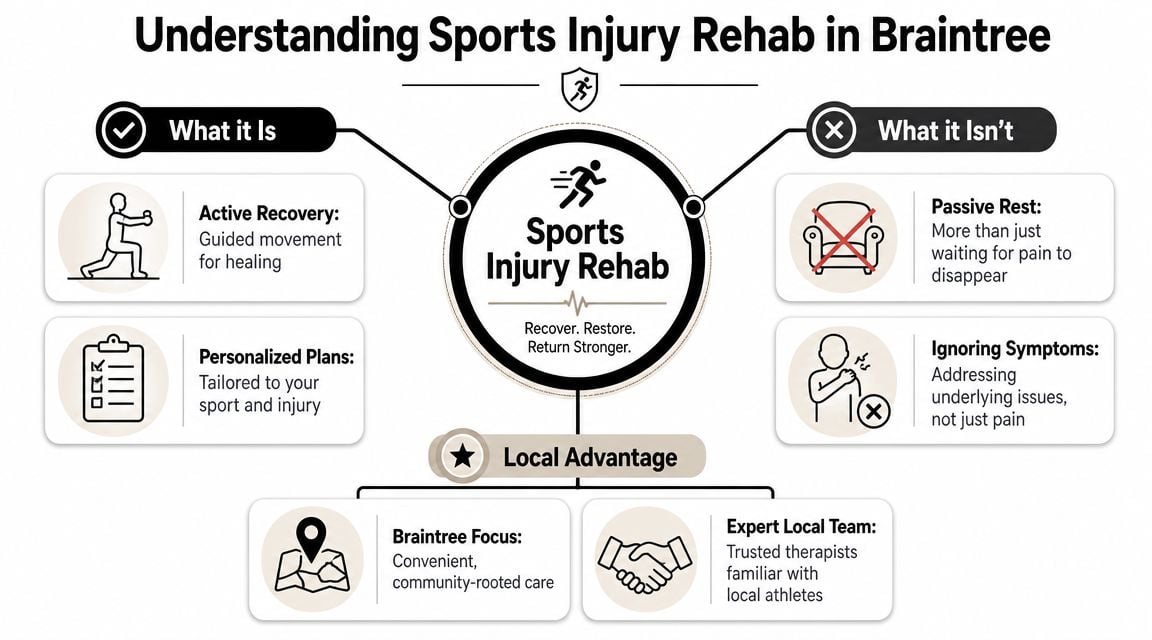
Rest alone rarely solves the full problem
Rest can settle an irritated area. It does not rebuild capacity.
That trade-off matters. If you fully shut things down for too long, symptoms may calm down while strength, coordination, and tolerance to impact drop off. Then the first hard practice, long run, or return to lifting brings the problem right back.
An ankle sprain is a good example. The swelling improves, but single-leg balance is still off and the ankle does not absorb force well. The same pattern shows up with shoulder pain in baseball and softball players, or with knee pain in athletes who can squat in the clinic but still struggle with cutting, landing, or stairs after practice.
What good rehab looks like in practice
Strong rehab starts with a clear evaluation. We look at what happened, what still hurts, what movements change your symptoms, and what your sport demands. Then we test the pieces that usually get missed when people try to self-treat, such as side-to-side strength differences, landing control, trunk stability, and how well the injured area tolerates repeated loading.
Treatment may include hands-on care to improve mobility or reduce guarding, but exercise is the part that changes function. That usually means progressive strengthening, balance work, impact tolerance, and sport-specific movement drills. The exact mix depends on the problem. A runner, a basketball player, and a baseball athlete should not be doing the same progression just because they all have pain in the same body part.
For local athletes who want a closer look at that approach, our page on sports physical therapy on the South Shore explains how sport-specific treatment is built around the demands of return to play.
Good rehab should feel organized. You should know what you can do today, what still needs work, and what milestones matter before you return to full speed. That is how recovery becomes more predictable, whether your goal is getting back on the field at Braintree High, finishing runs at Pond Meadow Park, or moving through your week without guarding every step.
Common Conditions We Help South Shore Athletes Overcome
A lot of South Shore athletes come in after the same frustrating moment. A Braintree High player cuts and feels the knee shift. A runner at Pond Meadow Park tries to push through foot pain for two more loops. A weekend basketball player rolls an ankle, rests a few days, then realizes quick direction changes still do not feel right.
Those injuries do not all behave the same way, and they should not be treated the same way. In our clinic, we regularly help athletes recover from problems that start with a single play and from issues that build over weeks of practice, lifting, running, or repeat overhead work.
The injuries we see most often
Some patterns show up again and again in Braintree and across the South Shore because they match how people here stay active. Student athletes are cutting, sprinting, and landing in school sports. Adults are running local roads and park trails, joining rec leagues, coaching, lifting before work, and trying to stay active between busy family schedules.
Common issues include:
- Ankle sprains: common in soccer, basketball, and any sport with jumping, landing, or fast changes of direction
- Knee injuries: including ligament injuries and overuse pain tied to cutting, pivoting, jumping, and running volume
- Shoulder pain: often seen in baseball, softball, strength training, and repeated overhead activity
- Hamstring and quad strains: frequent in sprinting sports and in athletes who return to full speed before the muscle is ready
- Foot and lower-leg pain: common in runners and court athletes dealing with repeated impact
The diagnosis matters. The movement problem behind it matters too.
A basketball player with an ankle sprain may need to regain balance, lateral control, and confidence landing in traffic. A runner with knee pain may need better load tolerance, hip strength, and training adjustments so the pain does not keep flaring up every time mileage climbs. That difference is why rehab has to match the sport and the person, not just the body part on the chart.
Common Sports Injuries Treated at Peak PT Braintree
| Injury | Commonly Seen In (Local Sports) | Primary Rehab Goal |
|---|---|---|
| Ankle sprain | Soccer, basketball, trail and park running | Restore stability, balance, and confidence with cutting and landing |
| ACL injury or recovery | High school field and court sports | Rebuild strength, control, and safe return to higher-speed movement |
| Rotator cuff irritation | Baseball, softball, lifting, adult rec leagues | Restore overhead strength and reduce painful mechanics |
| Shoulder instability | Throwing sports, contact sports, gym activity | Improve control so the shoulder feels strong and dependable again |
| Hamstring strain | Sprinting, soccer, track, field sports | Reload the muscle safely for acceleration and deceleration |
| Knee pain with running or jumping | Road races, school sports, fitness training | Improve load tolerance and movement quality under repeated demand |
Knee injuries deserve special attention because they often affect confidence as much as strength. If you are dealing with a pivoting injury, swelling, or a sudden pop during sports, our guide to ACL recovery physical therapy in Braintree MA explains what that rehab process usually involves.
At Peak Physical Therapy, the goal is not just to calm symptoms down for the week. The goal is to get you ready for the next sprint, next practice, next lift, or next run through Pond Meadow without feeling like the same problem is waiting for you.
Your Personalized Recovery Plan at Peak Physical Therapy
A good rehab plan starts by answering the question every injured athlete in Braintree asks right away. What do I need to do now, and what will it take to get back to my sport without second-guessing every cut, jump, or throw?
At Peak Physical Therapy, that plan is built around your injury, your sport, and your normal routine on the South Shore. A Braintree High athlete trying to return for the next stretch of the season needs a different plan than an adult runner aiming to get back to Pond Meadow Park or a parent who coaches and still wants to join drills pain-free.
What happens at the first visit
The first visit should give you clarity. We look at the injured area, but we also look at the movement patterns around it, because the painful spot is not always the whole problem.
That evaluation often includes:
A symptom review
We sort out how the injury started, what movements trigger it, how irritable it feels day to day, and what your training or sport looked like before the problem showed up.Movement testing
Squatting, stepping, balancing, reaching, landing, or changing direction can reveal what is driving extra stress. Knee pain may involve hip control. Shoulder pain may tie back to the trunk and shoulder blade. An ankle injury can change how the whole leg loads.Baseline measures
Range of motion, strength, tolerance to loading, and sport-relevant tasks give us a starting point. That baseline matters because progress should be measured, not guessed.Goal setting
Returning to a soccer schedule, getting through baseball practice, lifting comfortably, or staying active during a layoff all change how rehab is structured. If you are worried about losing strength while you recover, our guide on how long it takes to lose muscle during time away from training can help set expectations.
One local option for this kind of individualized sports rehab Braintree MA patients often look for is Peak Physical Therapy and Sports Performance, which offers sports injury and return-to-sport care in the area as part of its broader South Shore network.
How We Structure Your Progression
Progression works best when the load matches the stage of healing. Early on, the job is to protect the irritated tissue and restore movement that your body can handle well. Later, the focus shifts to building strength, control, and tolerance for the demands that matter in your sport.
Experience matters. Some athletes push too hard because they feel restless and want to test the injury every few days. Others stay guarded for too long, avoid loading, and come back weaker and less confident than they need to be.
We use a middle path. Symptoms guide the pace, but they do not make every decision on their own.
In practice, progression may include:
- Early phase work: reduce symptom flare-ups, restore basic motion, and keep nearby areas working well
- Strength and control work: reload the injured region with exercises that match the forces it will need to handle again
- Higher-level drills: add speed, deceleration, direction change, jumping, landing, or overhead work as the body shows it is ready
Supportive treatments can help too. Manual therapy, dry needling, or taping may reduce pain or improve tolerance to exercise for the short term. The main driver of recovery is still a plan that builds capacity step by step, with clear reasons for what gets added, what gets held back, and when it makes sense to progress.
The Rehab Timeline From Injury to Recovery
One of the most common questions in clinic is, “How long is this going to take?” The honest answer is that timelines vary based on the injury, tissue involved, severity, sport, and how your body responds to loading. What matters more than a guessed calendar date is whether you're moving through the right phases in the right order.
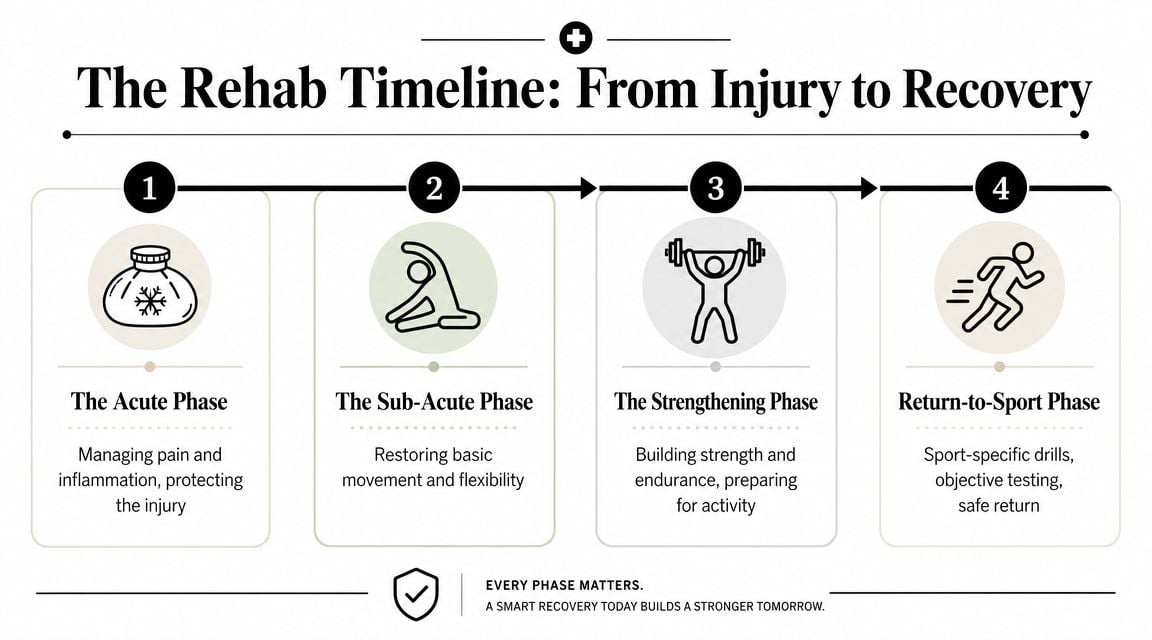
Early protection and symptom control
Right after an injury, the priorities are usually reducing irritability, protecting the area, and preserving as much safe movement as possible. This phase isn't about proving toughness. It's about controlling the situation so the next phase has something to build on.
During this stage, patients often work on:
- Pain and swelling management: using appropriate symptom-relief strategies and activity modification
- Protected mobility: keeping nearby joints and tissues moving without provoking the injury
- Basic muscle activation: preventing the area from going offline completely
If you're worried about deconditioning during time away from sport, this article on how long it takes to lose muscle gives helpful context.
Building back for real life and sport
Once the tissue is calmer and movement improves, rehab shifts from protection to rebuilding. At this stage, a lot of athletes get impatient, because they start to feel better before they're fully ready.
The middle and later phases usually focus on:
| Phase | Main Focus | What It Often Includes |
|---|---|---|
| Sub-acute phase | Restore motion and basic control | Mobility work, early strengthening, balance, clean movement patterns |
| Strengthening phase | Improve tissue capacity | Progressive resistance, endurance work, single-leg or single-arm control |
| Return-to-sport phase | Match the demands of activity | Hopping, cutting, sprint mechanics, landing, deceleration, sport-specific drills |
A rushed timeline usually backfires. If an athlete skips foundational strength and goes straight to explosive movement, symptoms often return fast. If they stay too long in low-level exercises, they may be pain-free in the clinic but unprepared for practice speed.
Recovery works best when each phase earns the next one.
A clear rehab plan should tell you not just what to do today, but what signs show you're ready for tomorrow's demand.
Clearing You for a Safe Return to Your Sport
A lot of athletes think the finish line is being pain-free. It isn't. Pain matters, but pain-free and ready for sport are not the same thing.
A shoulder can stop aching during daily activity and still lack the control needed for repeated throwing. An ankle can feel okay walking around Braintree and still fail under a quick cut or uneven landing. A knee can handle gym exercises and still struggle with deceleration, pivoting, or repeated jumping.
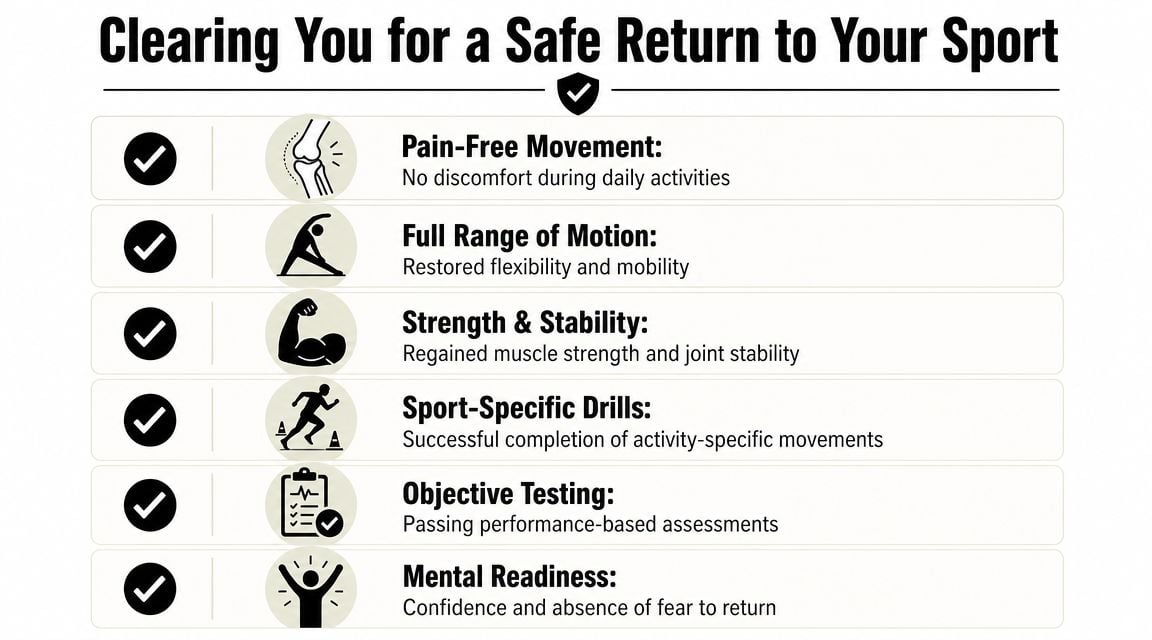
Pain-free is not the same as game-ready
Return-to-play decisions should be based on criteria, not hope. Waiting until something “feels pretty good” is one of the easiest ways to end up back in rehab.
What usually doesn't hold up:
- Testing the injury only in daily life: because sport adds speed, force, and unpredictability
- Judging readiness by one good day: because tissue tolerance has to be repeatable
- Ignoring confidence: because hesitation changes mechanics and can create new problems
This is also where recovery habits matter outside the clinic. Nutrition, sleep, hydration, and training balance can all affect how well an athlete handles the return to full activity. If you want a practical read on ways to improve athletic performance recovery, that guide offers helpful general ideas athletes can apply alongside rehab.
What we want to see before return
A safe green light usually includes a mix of objective findings and sport-specific performance. The exact checklist varies by injury, but the thinking stays consistent.
A therapist will often look for:
Movement quality
Can you squat, land, step down, hop, or reach without protective patterns?Strength and symmetry
Is the involved side keeping up well enough for the demands ahead?Load tolerance
Can the area handle repeated effort, not just one successful rep?Sport-specific readiness
Can you cut, sprint, pivot, throw, jump, or absorb force in a way that matches your sport?
Returning to sport should feel tested, not guessed.
The goal isn't to keep athletes out longer than necessary. The goal is to send them back when the body can fully perform the job. That's how you reduce the cycle of re-injury, partial recovery, and recurring frustration.
Why Your Neighbors Choose Peak PT in Braintree
When people look for sports injury rehab Braintree MA options, they usually want a few simple things. They want someone to listen, a plan that makes sense, and a clinic that feels connected to the community they live in.
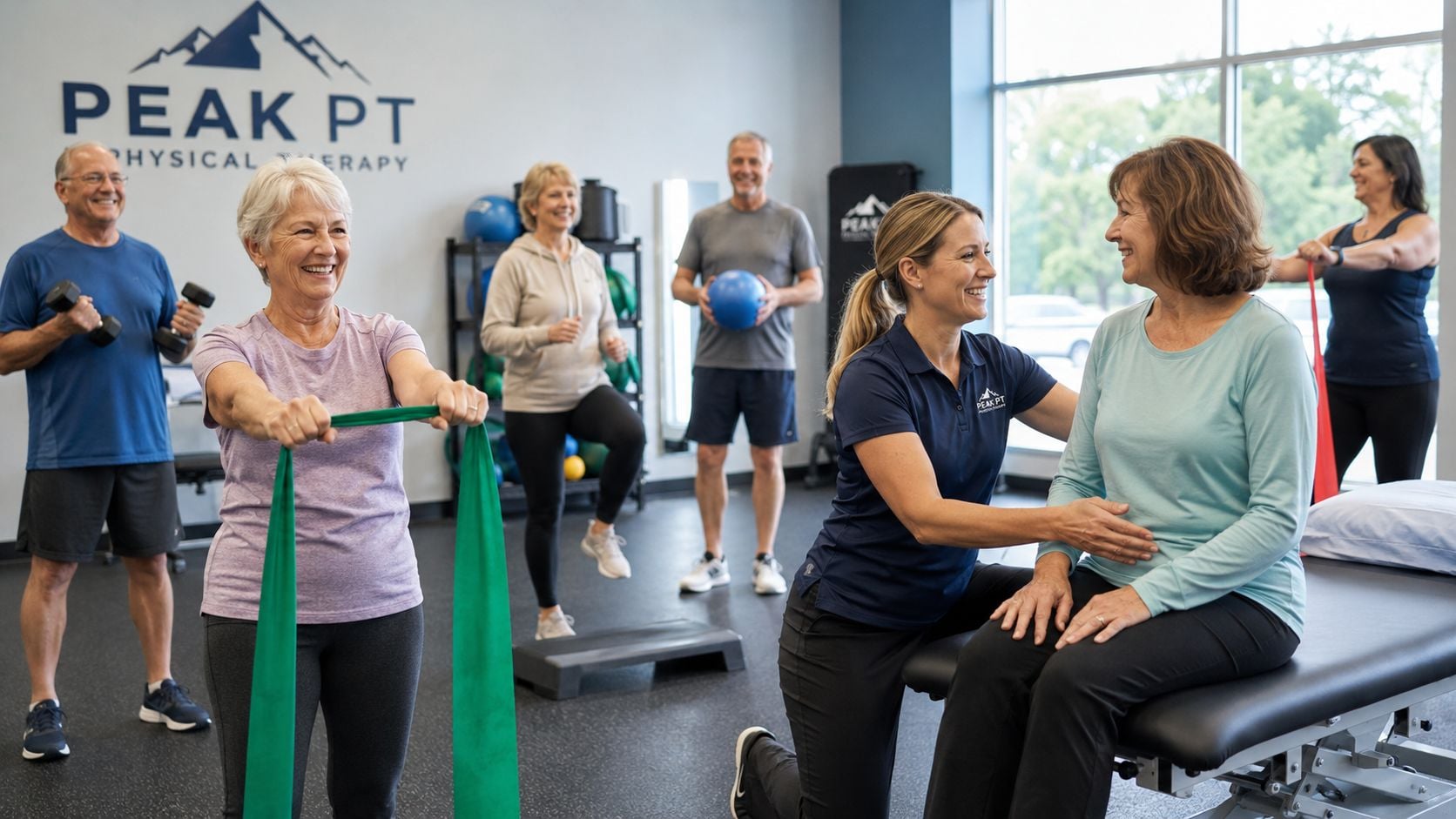
What people want from a local rehab clinic
Busy South Shore schedules are real. Between work, school pickup, practice times, and commutes, rehab has to fit into real life or it won't happen consistently.
Patients tend to value:
- Clear communication: knowing what the injury is doing, what the plan is, and what progress should look like
- A positive environment: because recovery is easier when the clinic feels encouraging instead of cold and transactional
- Practical logistics: online scheduling, help with insurance questions, and straightforward next steps
- Care that feels personal: not bouncing between providers who barely know your case
Why local context matters
There's a difference between generic rehab and rehab that understands how people around Braintree live. A runner training on local routes has different concerns than a student athlete trying to get back for school competition. A parent-coach wants to kneel, pivot, jog, and demonstrate drills without worrying about a setback.
That local awareness helps shape better decisions. Return goals become more specific. Home programs become more realistic. Progress gets tied to the activities that matter most to the person in front of you.
Peak's broader South Shore presence also helps patients who need flexibility across nearby communities. That matters for families balancing appointments around work and sports schedules.
If you want care that's hands-on, encouraging, and built around measurable progress, booking an evaluation is the next practical step.
Frequently Asked Questions About Sports Rehab in Braintree
Do I need a referral for physical therapy in Massachusetts
Many patients can start physical therapy without waiting to begin care, but referral needs can vary depending on your insurance plan and your situation. The easiest move is to contact the clinic and ask them to check your benefits and next steps.
What should I wear to my first appointment
Wear comfortable clothes you can move in. Athletic shorts, leggings, joggers, and a T-shirt usually work well. If your injury involves the knee, ankle, shoulder, or hip, clothing that allows the area to move and be examined easily helps a lot.
How long does each session last
Visit length depends on the evaluation versus follow-up treatment and on what your plan needs that day. Your first appointment is typically more in-depth because it includes history, testing, and goal setting.
Should I wait for the pain to calm down before starting
Usually, no. Waiting can be reasonable in some situations, but many sports injuries do better when you get the right guidance early. Early rehab can help protect healing tissue, maintain movement, and prevent compensations from becoming habits.
If you're dealing with a sports injury and want a local plan that matches your goals, schedule an evaluation with Peak Physical Therapy and Sports Performance. We'll help you figure out what's going on, what needs to improve, and how to get you back to the activities you care about on the South Shore.