You finish a workday, look up from your laptop, and realize your neck has been tight for hours. Or you get out of the car after a commute and feel that familiar pull from the base of your skull into your shoulder. For a lot of people around Weymouth, neck pain starts as “annoying” and slowly turns into something that affects sleep, driving, exercise, and even how long you can focus at work.
That's usually the point when people start searching for neck pain physical therapy Weymouth MA. They want a straight answer. What's causing this? Will physical therapy help? And what will the experience be like once they walk into the clinic?
Table of Contents
- That Nagging Ache Is Telling You Something
- Why Your Neck Hurts Common Causes on the South Shore
- How Physical Therapy Gets to the Root of Your Pain
- Your First Visit for Neck Pain at Peak in Weymouth
- Home Strategies to Keep You Moving Freely
- Your Questions About Neck Pain PT Answered
That Nagging Ache Is Telling You Something
A lot of neck pain stories sound ordinary at first. A Weymouth resident spends the morning at a home office table that was never meant to be a desk. A commuter grips the wheel through traffic and notices stiffness turning the head to check mirrors. Someone spends a Saturday doing yard work, wakes up Sunday, and can't comfortably look over one shoulder.

The problem isn't just the ache itself. It's what the ache starts to change. You stop turning your head fully while driving. You prop yourself up with extra pillows at night. You avoid workouts, long walks, or even simple time with family because your neck and upper shoulders feel guarded all day.
When pain stops being just a nuisance
Neck pain often sticks around because people keep trying to “be careful” instead of fixing the reason it's happening. They stretch randomly, use heat, rest a little, then go right back to the same posture, same workload, or same movement pattern that irritated things in the first place.
Pain that lingers is useful information. It usually means your neck isn't tolerating your current routine well, not that you have to give up that routine forever.
That's the practical value of physical therapy. You're not just looking for temporary relief. You're trying to understand what your neck is reacting to, what movements are limited, what muscles are overworking, and what needs to change so normal life feels normal again.
A local problem with a real solution
In outpatient rehab, neck pain isn't a rare complaint. It's one of the most common reasons people seek outpatient physical therapy, and the Global Burden of Disease study has consistently ranked it among the leading causes of years lived with disability worldwide, underscoring how much it can affect function, sleep, and work capacity according to the University of Utah neck pain outcomes overview.
If you're in Weymouth and your neck pain has started shaping your day, that's a good reason to act on it. Not because it's dramatic, but because it's common, treatable, and much easier to address before compensation patterns settle in.
Why Your Neck Hurts Common Causes on the South Shore
Neck pain usually isn't random. It tends to match the way you live.
On the South Shore, that often means long stretches of sitting, lots of driving, bursts of physical activity on weekends, and workdays that keep your eyes and arms in front of you for hours. The neck handles all of that load while also supporting head position, helping with vision, and coordinating with the shoulders and upper back.
The patterns we see most often
Some people feel more stiffness than pain. Others get pain with turning, looking down, or lifting. Some notice headaches, upper trap tightness, or a feeling that the neck is always “on.”
Common patterns include:
- Commuter strain from holding one posture too long and tensing through the shoulders
- Tech neck from prolonged screen time, laptops, and phones
- Weekend overload after yard work, lifting, painting, or recreational activity
- Recurring flare-ups where the pain settles down, then returns with stress or work demands
- Age-related stiffness that shows up with reduced mobility, sleep trouble, or balance-related concerns
How Physical Therapy Addresses Your Neck Pain
| Common Cause (Your Experience) | How PT Helps (Our Solution) |
|---|---|
| Long drives leave your neck stiff and turning feels restricted | We assess cervical motion, posture tolerance, and muscle guarding, then use mobility work, movement correction, and exercises to improve how your neck handles sustained positions |
| You work on a laptop and feel pain by midday | We identify position-related triggers, retrain postural support, and build strength in the areas that reduce strain on the neck during desk work |
| Yard work or home projects caused a sharp flare-up | We calm irritated tissue, restore movement, and guide a return to lifting, reaching, and overhead activity without re-aggravating symptoms |
| The pain keeps coming back every few weeks | We look for the movement and loading patterns behind the recurrence, then build a plan around control, strength, and self-management |
| Your neck feels stiff, achy, and harder to move than it used to | We use a combination of hands-on care, mobility work, and progressive exercise to improve function and reduce guarding |
A useful rule is simple. The activity that hurts your neck often points toward the movement system that needs attention.
That matters because treatment should match the pattern. If your symptoms are driven by long sitting, random massage won't solve the whole problem. If weakness and poor endurance are part of the issue, temporary relief won't hold unless the neck and shoulder system can support you better during the day.
For local patients, the encouraging part is that this is exactly what physical therapy is built for. It connects the symptom to the habit, the habit to the impairment, and the impairment to a practical treatment plan.
How Physical Therapy Gets to the Root of Your Pain
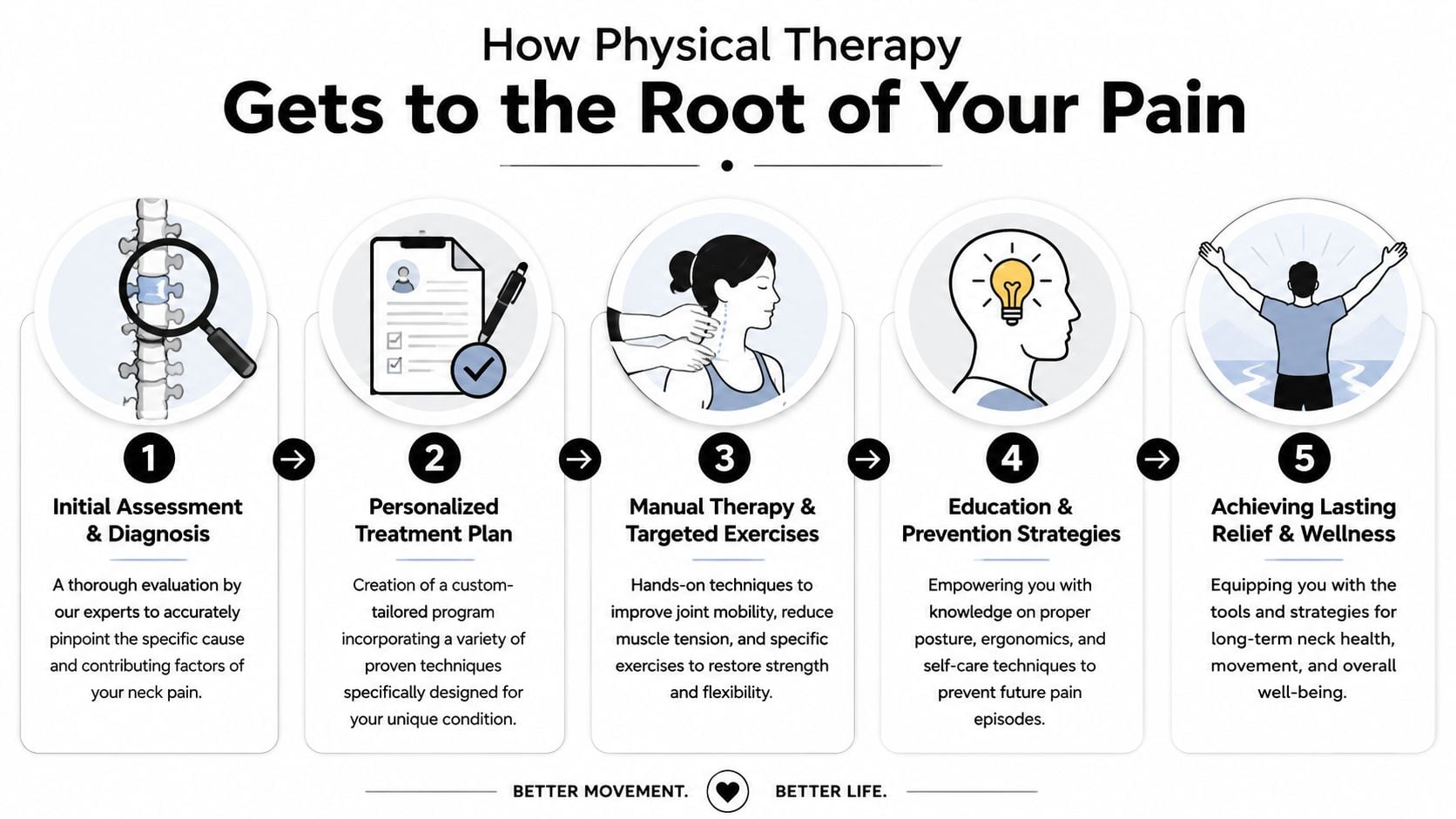
The most effective neck pain treatment isn't built around chasing soreness from one visit to the next. It's built around figuring out why your symptoms keep showing up, then changing the factors that keep feeding them.
Hands-on treatment has a role
Evidence-based neck pain PT combines manual therapy, targeted strengthening, and postural retraining. The aim is to reduce pain sensitivity, improve mobility, restore strength in the deep neck and scapular muscles, and use movement analysis plus progressive strengthening with a home program for lasting results, as outlined in this neck pain physical therapy overview.
Manual therapy often helps early because it can make movement feel less threatening. That may include joint mobilization, soft tissue work, or guided positioning to help a stiff neck move more normally again. If you want a practical look at what that type of treatment involves, this manual physical therapy guide gives a useful overview.
But hands-on care is only one piece.
Strength and control keep the pain from coming back
Once symptoms calm down enough, treatment has to move into active work. That's where progress becomes more durable.
A good plan may include:
- Deep neck flexor training to improve support and reduce overuse of superficial muscles
- Scapular strengthening so the shoulder blades and upper back share the load better
- Thoracic mobility work to reduce stress concentrated at the neck
- Movement retraining for looking down, turning, reaching, lifting, and screen use
- Home exercise dosing that fits your life instead of getting ignored after two days
The goal isn't to make you perfect. It's to make daily demands feel easy enough that your neck stops reacting to them.
Education matters more than people expect
People usually feel better when they understand what their symptoms mean. Not every stiff neck is fragile. Not every flare-up means damage. Often, the neck is irritated, guarded, deconditioned, or overloaded.
That's why treatment includes education on pacing, posture, sleeping positions, work setup, and activity modification. These are not generic tips handed out on a sheet. They work best when tied to your specific triggers.
For readers who want a deeper educational breakdown beyond the local clinic experience, Highbar Health has broader condition guides and recovery content at highbarhealth.com.
Your First Visit for Neck Pain at Peak in Weymouth
The first appointment usually feels easier than people expect. Most patients come in worried that they'll be rushed, handed a sheet of exercises, or told to stop doing everything they enjoy. A good first visit should feel more like a clear conversation with a plan attached to it.

What happens when you walk in
At the Weymouth location, the visit starts with the basics. You check in, get settled, and meet with your therapist for a one-on-one evaluation. If you're looking for location details ahead of time, the clinic page for physical therapy in Weymouth MA has the address and access information.
Then the core work begins. We want to know where the pain is, what brings it on, what eases it, how long it's been going on, and what it's stopping you from doing. That might mean trouble sleeping, pain turning your head while driving, headaches after computer work, or stiffness that builds as the day goes on.
The exam is about function, not guesswork
A neck evaluation usually includes observing posture, checking range of motion, testing which movements reproduce symptoms, and looking at the related areas that often influence neck pain. That includes the shoulders, upper back, and the way you control your head and shoulder blade position.
At Peak's Weymouth clinic at 544 Main Street, the team uses validated disability measures such as the Neck Disability Index, or NDI, to track progress objectively so treatment changes are based on meaningful functional improvement rather than guesswork. The underlying research also found that participation in an ongoing quality-improvement process was associated with greater patient improvement in neck pain care, according to this PubMed summary of the outcomes study.
That matters because pain alone doesn't tell the whole story. You may still feel some symptoms while also moving better, sleeping better, and getting back to normal activities. Tracking disability and function gives a clearer picture of whether the plan is working.
A strong first visit should leave you knowing what your main problem is, what you can do today, and what the next few visits are trying to accomplish.
Before you leave
Patients typically leave the first session with a starting plan, not a vague recommendation. That often includes a few specific exercises, one or two movement changes, and a clear idea of what to do if the neck flares between visits.
You should also know what treatment is trying to improve first. Sometimes it's turning your head while driving. Sometimes it's tolerating desk work. Sometimes it's reducing morning stiffness or easing end-of-day tension. Clear targets make physical therapy feel far less intimidating and much more useful.
Home Strategies to Keep You Moving Freely
The home program matters because your neck spends far more time with you than it does in the clinic. If treatment only helps during appointments, the results usually fade. If treatment changes what you do between appointments, the results tend to stick.
For persistent neck pain, exercise therapy, education, and graded activity should be the foundation of care. Passive treatments like heat or massage alone often produce less durable benefits, while hands-on care combined with an active home program tends to support better long-term outcomes, as discussed on Weymouth PT's neck pain care page.
What actually helps at home
A useful home plan is simple enough to follow even on a busy week. That may include:
- Short movement breaks during desk work instead of waiting until your neck locks up
- Position resets in the car, especially if driving is one of your triggers
- Targeted exercises that build tolerance, not just temporary stretching
- Activity modification so you keep moving without repeatedly provoking the same flare-up
If you want ideas for safe starting movements, these exercises for neck pain relief can help you understand the kinds of motions often used between visits.
Think independence, not dependence
The goal of PT isn't to make you need constant treatment. It's to help you understand your pattern well enough that you can manage minor flare-ups, stay active, and avoid the cycle of rest, stiffness, and repeat pain.
Some patients also like to support recovery with broader lifestyle habits such as sleep, regular walking, and anti-inflammatory nutrition. If that's part of your approach, this guide to natural solutions for joint health may be a helpful supplemental read.
Your Questions About Neck Pain PT Answered
Do I need to wait until the pain is severe
No. In most cases, it's smarter to come in when the problem is starting to interfere with work, sleep, driving, workouts, or daily movement. Waiting usually gives the irritation and compensation patterns more time to settle in.
What if I'm not sure physical therapy is right for my neck pain
That's exactly what an evaluation is for. The first visit helps sort out whether your symptoms look mechanical and movement-related, what's contributing to them, and what type of plan makes sense.
Where is the clinic and how do I book
The Weymouth clinic is located at 544 Main Street, Weymouth, MA 02190. It offers Saturday hours from 7:00 AM to 4:00 PM and can be reached for scheduling at (781) 817-3435, according to the clinic's Weymouth location page.
What should I bring to the first visit
Bring anything that helps tell the story clearly. A list of symptoms, questions, prior imaging if you have it, and a sense of what you want to get back to all help make the visit more productive.
Will I get exercises right away
Usually, yes. Patients typically leave with a starting home plan that matches their symptoms, goals, and current tolerance.
If neck pain is changing how you work, drive, sleep, or stay active, take the next step with Peak Physical Therapy and Sports Performance. You can book an evaluation at the Weymouth clinic on Main Street, get a clear plan, and start working toward relief that lasts.