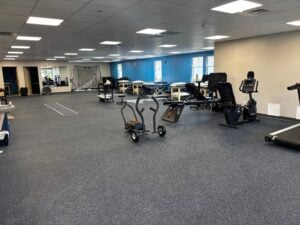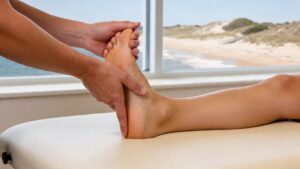
You wake up planning for a normal Scituate day. Maybe it's a walk near the beach before work, carrying chairs down for an evening by the water, getting your kid to practice, or climbing in and out of a boat at the harbor. Then your shoulder catches. Your knee stiffens halfway down the stairs. Your back reminds you, again, that something isn't right.
That's usually when people start searching for physical therapy in Scituate, MA. Not because they want to think about rehab, but because they want their routine back. They want to move without planning around pain.
In a town with a lot of options, choosing where to go matters. Healthgrades lists 241 specialists practicing physical therapy in Scituate with an average rating of 4.8 stars, and 278 specialists within 10 miles with an average rating of 4.5 stars. That tells you two things. People here use PT. And if you're looking for care, it helps to know what to look for beyond a name on a directory.
Table of Contents
- Your Guide to Physical Therapy in Scituate
- Meet Your Local Scituate Physical Therapy Team
- Conditions We Treat for Scituate Residents
- Advanced Physical Therapy Treatments We Offer
- What to Expect on Your First Visit
- Insurance and Easy Booking Options
- Find Our Scituate Clinic Location and Hours
- Frequently Asked Questions About Scituate PT
Your Guide to Physical Therapy in Scituate
Scituate life is active in ways that don't always look athletic on paper. Carrying coolers, getting back on the paddleboard, walking uneven sand, standing on the sidelines for youth sports, hauling gear in and out of the car, and trying to squeeze in a run before the weather changes all put real demands on the body.
That's why good PT in town needs to do more than hand out a few exercises. It should connect treatment to the life you live. If your goal is getting through a workday without neck pain, that matters. If your goal is beach walks, pickleball, lifting your grandchild, or feeling steady on the stairs, that matters too.
What good local care looks like
The strongest physical therapy Scituate MA experience usually has a few things in common:
- Clear listening: Your therapist should understand how the problem started, what makes it worse, and what you need to get back to.
- A plan with purpose: Random exercises don't work well. Progression matters.
- Hands-on problem solving: Sometimes the issue isn't just weakness. It's stiffness, fear of movement, poor loading habits, or doing too much too soon.
- Practical home guidance: You need a plan you'll stick to between visits.
Practical rule: The right PT plan should make sense in your daily schedule. If it only works in a perfect world, it usually doesn't work for long.
What tends to work and what usually doesn't
What works is consistency. A calm, steady progression beats the common cycle of resting too long, feeling a little better, then jumping back into everything at once.
What doesn't work is chasing pain from one spot to another without understanding the movement pattern underneath it. Knee pain might involve the hip. Shoulder pain might flare because of how you lift, reach, or sleep. Balance concerns rarely improve with “being careful” alone.
People in Scituate don't need a generic rehab experience. They need care that respects local routines, busy family schedules, and the fact that nobody wants to sit out summer, sports, or simple everyday independence any longer than necessary.
Meet Your Local Scituate Physical Therapy Team
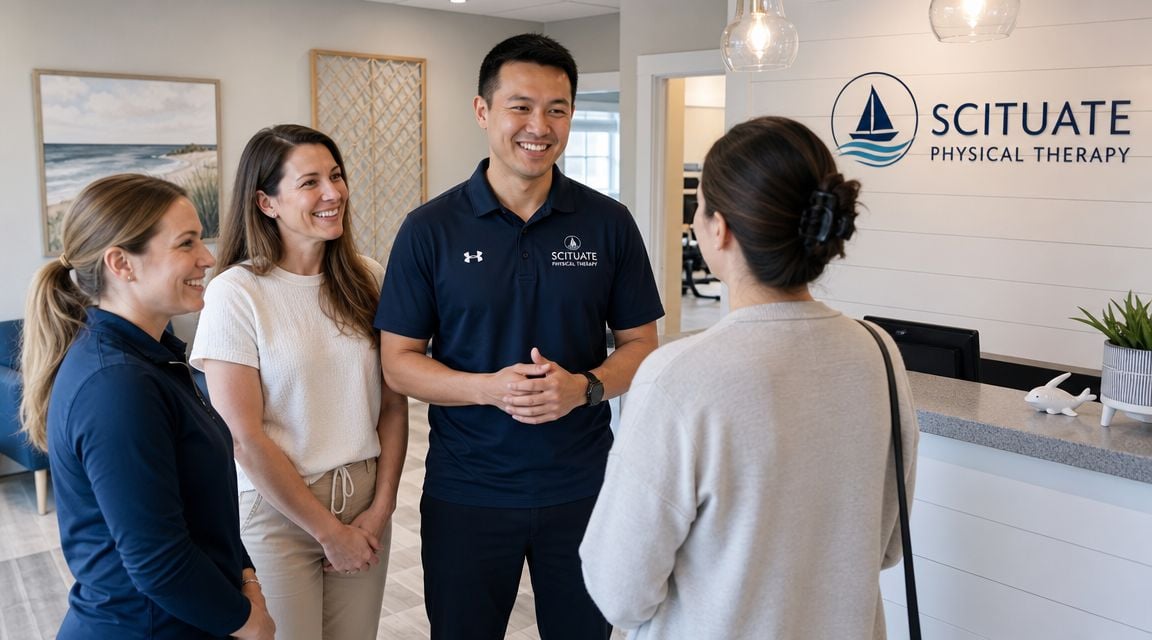
A clinic can have a convenient address and still feel impersonal. That's not what patients want when they're hurting, frustrated, or trying to recover after surgery. They want someone who knows how to read the problem, explain it clearly, and coach them without making the whole process feel intimidating.
Care that feels local and grounded
In a community like Scituate, trust matters. People want to know they'll be treated like a neighbor, not pushed through a script. That means asking better questions, adjusting the plan when life gets in the way, and being honest about trade-offs.
For example, there's a difference between “stop everything” and “keep pushing through it.” Most of the time, neither extreme is useful. Good PT lives in the middle. You modify the aggravating load, keep the body moving in smart ways, and build back capacity step by step.
That approach is especially helpful for South Shore patients who want to stay engaged in daily life while healing. Parents still have to parent. Commuters still have to drive. Active adults still want movement, even if they need to scale it.
Why the therapist relationship matters
Recovery goes better when you understand why you're doing what you're doing. It also goes better when the person guiding you can tell the difference between normal soreness, warning signs, and a plan that needs to change.
A strong PT team doesn't just instruct. They coach, reassess, and adapt. You can get to know the broader Peak care team and the kind of clinicians who work across the South Shore network, but what matters most in the room is whether your treatment feels individualized.
A good session should leave you feeling challenged, informed, and more confident than when you walked in.
Some patients need direct, hands-on guidance. Others need a plan that fits around work, school pickup, or return to sport. The point isn't to make every patient fit one rehab style. The point is to make the rehab style fit the patient.
Conditions We Treat for Scituate Residents
Some people come in with a clear injury. Others just know that normal movement has started to feel harder. Their back tightens on the drive. Their shoulder hurts reaching overhead. Their ankle never felt right after a “minor” twist. Their balance isn't what it used to be.
What walks through the door most often
In a local outpatient setting, the common themes are familiar:
- Back and neck pain: Often tied to work posture, lifting, long drives, sleep positions, or a flare after yard work and weekend activity.
- Shoulder pain: Reaching, carrying, paddling, lifting overhead, and repeated household tasks can all stir this up.
- Hip and knee problems: These show up with stairs, squatting, running, walking hills, and getting up from low seats.
- Foot and ankle issues: Beach terrain, uneven ground, prior sprains, and activity changes can expose weakness or stiffness fast.
- Post-surgical recovery: Many patients need guided progression after orthopedic procedures.
- Sports injuries: Youth athletes, weekend warriors, and adult league players all need return-to-play decisions that are realistic, not rushed.
- Balance and gait concerns: These often affect confidence before they fully limit activity.
For a broader look at the kinds of injuries and pain patterns treated in outpatient rehab, Peak lists its physical therapy conditions.
How we match treatment to real life
The body doesn't care what the diagnostic label says if the plan ignores your actual goals. A retiree who wants to feel steady at home needs a different emphasis than a teenager working back toward sports. A desk worker with neck pain needs something different from someone recovering after a knee operation.
Here's a practical view of how treatment gets matched to the problem.
| Common Condition or Goal | Our Physical Therapy Solution |
|---|---|
| Back pain after commuting, lifting, or yard work | Movement assessment, symptom calming strategies, strength progression, and coaching on better loading habits |
| Neck pain and tension headaches | Posture and movement retraining, manual techniques when appropriate, and home exercises that are simple enough to repeat |
| Shoulder pain with reaching, paddling, or lifting | Restore mobility, improve shoulder blade and rotator cuff control, and build tolerance for overhead use |
| Knee pain with stairs, running, or getting up from a chair | Strengthen the chain around the knee, improve mechanics, and rebuild confidence with everyday movement |
| Foot or ankle pain on uneven ground | Balance work, ankle mobility, strength, and a graded return to walking and activity |
| Post-operative rehab | Protect healing tissue, restore motion, regain strength, and progress function at the right pace |
| Youth sports injury | Sport-specific movement retraining, staged return to activity, and education to avoid the too-much-too-soon cycle |
| Balance concerns or fear of falling | Gait training, lower-body strengthening, stability drills, and task practice that feels relevant to daily life |
Waiting for pain to “settle down on its own” is sometimes reasonable for a brief flare. It's usually not a strong plan when the problem keeps changing how you move.
One of the biggest mistakes people make is treating symptoms as the whole issue. Pain matters, but so do weakness, stiffness, coordination, endurance, and confidence. Physical therapy works best when all of those pieces get addressed together.
Advanced Physical Therapy Treatments We Offer
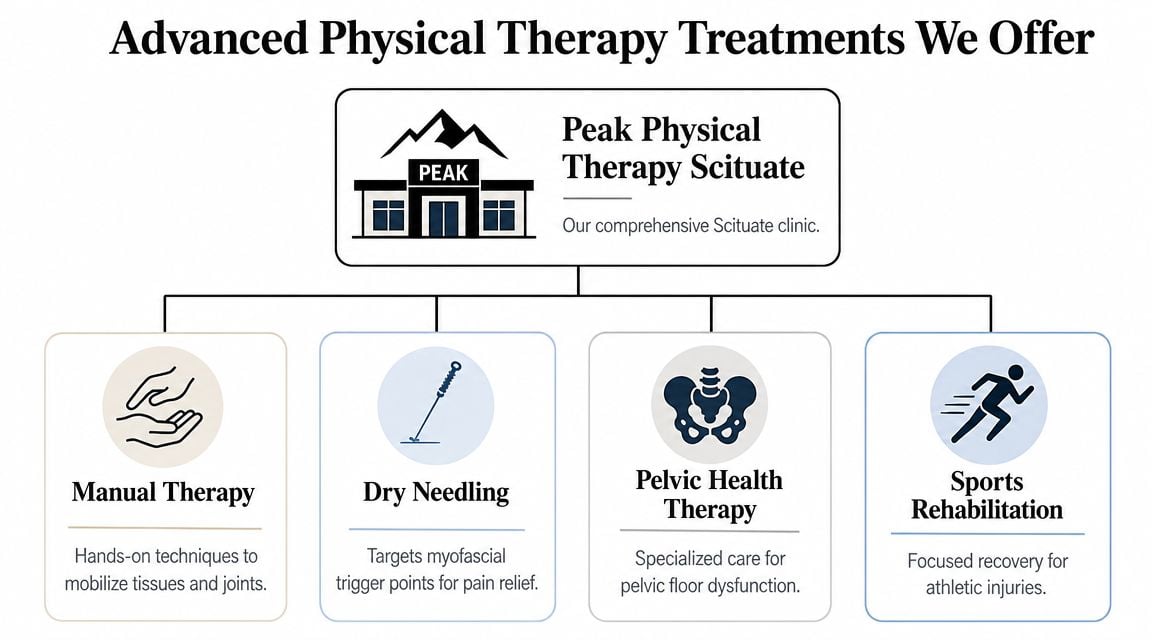
Some problems respond well to exercise alone. Others need a more layered approach. If pain is stubborn, movement is restricted, or a patient has specific pelvic, sports, or post-surgical needs, the treatment plan often benefits from more specialized tools.
When standard exercise alone is not enough
A skilled PT doesn't use advanced techniques just because they sound impressive. They use them when they solve a real problem.
- Manual therapy: Helpful when stiffness, joint restriction, or tissue irritability is keeping someone from moving normally enough to exercise well.
- Dry needling: Often considered when muscle tension, trigger points, or persistent guarding keep flaring the same area.
- Sports rehabilitation: Useful when the goal is more than “feel better.” Athletes often need cutting, jumping, sprinting, or rotational demands rebuilt in sequence.
- Aquatic therapy: A good fit when full weight-bearing is too aggravating early on and the body needs a lower-impact environment.
- Pediatric therapy: Children need treatment delivered in ways that make sense for their developmental stage and attention span.
For people who want deeper educational material on treatment methods, recovery timelines, and clinical topics, Highbar Health has more detailed resources at highbarhealth.com.
One option available locally is Peak Physical Therapy and Sports Performance, which provides physical therapy in Scituate along with one-on-one care, aquatic therapy, and pediatric therapy as part of its broader South Shore services.
Care options for different stages of life
Pelvic health deserves special mention because many people wait too long to ask about it. Leakage, pelvic pressure, postpartum symptoms, and pelvic pain are common reasons to seek help, and they're often more treatable than people expect.
Sports rehab also needs to be specific. “Rest until it feels better” can help in the short term, but it doesn't prepare an athlete for the demands that caused the issue in the first place. For athletes and parents thinking beyond rehab alone, this article on strategies for peak performance offers a useful performance lens that complements return-to-sport planning.
The best advanced treatment is the one that makes exercise more effective, not the one that replaces it.
That's the trade-off to keep in mind. Hands-on care and specialized methods can open the door. Lasting recovery still depends on building strength, control, and tolerance for real life.
What to Expect on Your First Visit
The first appointment usually feels easier once you know what's coming. Most patients are worried about one of three things. They're afraid it will hurt, they're unsure what to wear, or they think they'll be judged for how long they've been putting the issue off.
None of that is unusual.
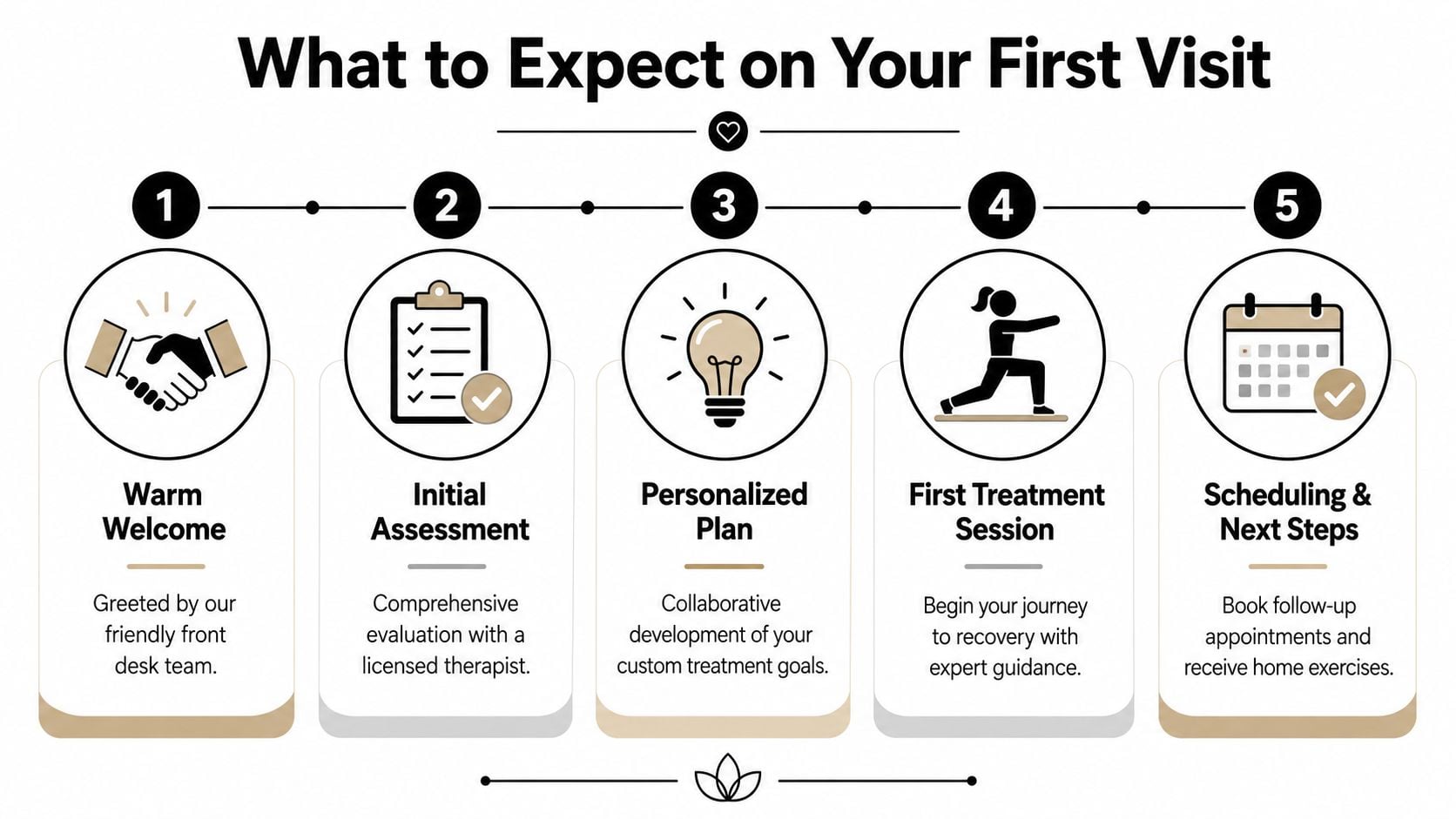
What happens when you arrive
Your first visit starts with a conversation. You'll talk through where the pain or limitation is, how long it's been going on, what makes it worse, what helps, and what you need to get back to.
Then the therapist looks at movement. That may include walking, reaching, bending, balance, strength, flexibility, or specific tests based on the body part involved. The point isn't to make you perform. It's to figure out what's driving the issue.
A useful first visit should answer questions like these:
- What's the main problem pattern
- What activities need to be modified right now
- What can you safely keep doing
- What are the first priorities for treatment
- What should improvement look like over the next stretch of care
How the first session usually feels
You should expect a mix of education, movement, and a starting treatment plan. Sometimes that includes hands-on work. Sometimes it starts with a few targeted exercises. Often it's both.
What surprises many people is that the first session isn't only about evaluation. It's also the beginning of progress. You leave with a clearer picture of what's going on and what to do next.
- Wear comfortable clothing: Think movement-friendly. If it's a knee issue, shorts help. If it's a shoulder issue, choose something easy to examine around the area.
- Bring relevant information: Imaging reports, post-op instructions, or a medication list can be helpful if you have them.
- Be honest about your routine: Your plan will work better if your therapist knows what your real week looks like.
- Ask direct questions: If you're worried about pain, exercise, sports, work, or timelines, say so early.
Some discomfort during testing or exercise can be normal. Feeling lost about the plan should not be.
The strongest first visits are collaborative. You're not there to be lectured. You're there to build a plan with someone who knows how to guide recovery.
Insurance and Easy Booking Options
Once someone decides they're ready for care, the next obstacle is usually logistics. Insurance, scheduling, and paperwork can feel like enough of a hassle to delay treatment another few weeks. That delay rarely helps.
How to make the paperwork easier
Start simple. Call the clinic or use the online booking path, then ask the practical questions right away. Do you need help checking benefits? What information should you bring? What should you expect around coverage and payment?
If you like having a checklist before you call your insurer, these Pounds Health Insurance verification steps are a useful way to organize the conversation and avoid missing basic details.
A few tips make the process smoother:
- Have your insurance card ready: Front and back details usually answer the first round of questions.
- Know your schedule before you book: Morning, lunch, and after-work preferences fill differently.
- Ask about paperwork in advance: Completing forms early saves time on day one.
- Don't wait for the perfect week: Starting with one appointment is often what gets momentum going.
The fastest way to get started
If you've been putting off physical therapy Scituate MA because the admin side feels annoying, keep it simple. Book the evaluation first. You don't need every detail perfectly sorted before that first conversation.
What matters is getting the process moving while the issue is still manageable. Small problems have a way of becoming compensations, and compensations have a way of becoming bigger setbacks.
The easier booking feels, the more likely people are to follow through. That's important, because recovery usually starts with one practical decision, not a huge leap.
Find Our Scituate Clinic Location and Hours
Convenience matters more than people think. A good plan can fall apart if getting to the clinic feels complicated, especially for commuters, parents, and anyone juggling appointments around work.

An easy stop for local families and commuters
Peak's Scituate clinic is located at 10 New Driftway, Suite 301 near Greenbush Station and Route 3A. That location makes it straightforward for local residents and for people trying to fit PT into the workday commute.
Being near familiar landmarks helps. If you're coming from around Scituate Harbor, from nearby neighborhoods, or along the commuter route, the clinic is positioned in a spot that's easier to work into regular life than a far-off medical trip would be.
When to come in
Flexible scheduling is a major part of access. In the surrounding Scituate rehab market, published weekday availability includes early and later appointments, with some sites listing hours from 7:00 AM to 7:00 PM on certain days and five weekday openings with weekend closures, which reflects scheduling designed for working adults and post-surgical patients who need options.
That kind of rhythm matters in real life. People need times that fit before school drop-off, between meetings, or after the end of the workday. When care is easier to reach, people tend to stay consistent, and consistency is what gives PT the best chance to work.
Frequently Asked Questions About Scituate PT
Do I need a referral to start physical therapy
It depends on your insurance plan and your situation. Some patients can begin care directly, while others may need a referral or prescription for coverage purposes. The safest move is to ask when you schedule so there are no surprises.
What should I wear to my appointment
Wear something comfortable that lets you move. If your knee or ankle is the issue, shorts are usually helpful. If it's your shoulder or neck, wear a top that allows the therapist to see and assess the area without a struggle.
How often will I need to come in
That depends on the problem, how irritable it is, and what you're trying to get back to. A fresh flare, a post-op recovery, and a return-to-sport case won't all follow the same schedule. Your therapist should explain the reasoning, not just hand you appointments.
Is physical therapy only for major injuries or surgery
Not at all. PT is often most helpful before a problem becomes a major interruption. Small issues like recurring stiffness, mild balance concerns, nagging tendon pain, or movement limitations are exactly the kinds of things that can respond well when addressed early.
A lot of people wait until they've already stopped doing the things they enjoy. That's understandable, but it usually makes the climb back longer than it needed to be.
If you want deeper educational content on diagnoses, anatomy, or broader rehab topics, Highbar Health has a full library of resources at highbarhealth.com. That's a good place to go when you want to learn more outside the local clinic conversation.
If pain, stiffness, or recovery after injury is changing how you move through your day in Scituate, it's worth getting it checked. Peak Physical Therapy and Sports Performance helps South Shore patients with one-on-one rehab, practical treatment plans, and local access that fits real life. Book an appointment and take the first step back toward beach walks, youth sports, errands, workdays, and the activities that make this community feel like home.