


You lean on your elbow for a few minutes at your desk, then notice that familiar soreness again. By the end of the day, the tip of the elbow feels puffy, tender, and oddly sensitive to simple things like resting your arm on a table or pulling on a sweatshirt.
That pattern is common with elbow bursitis, also called olecranon bursitis. If you’re searching for bursitis in elbow exercises, you’re probably looking for two things at once. You want the swelling to calm down now, and you want a plan that helps keep it from coming back.
A good recovery plan does both. The mistake many people make is jumping straight to strengthening before the elbow is ready, or doing nothing for too long and letting the joint stiffen up. The better path is phased. First, settle the irritation. Then restore motion. Then rebuild support around the joint so daily life, work, and exercise feel safer again.
Understanding That Nagging Elbow Pain and Swelling
The bursa is a small fluid-filled sac that sits over the tip of the elbow. Its job is simple. It helps reduce friction between tissues when you bend, straighten, and rest on the elbow.
When that sac gets irritated, it can swell. That swelling can be uncomfortable even when the pain itself isn’t sharp. For many people, the first thing they notice isn’t weakness. It’s the lump.

What it often feels like
Elbow bursitis usually shows up as:
- Tenderness at the tip of the elbow when leaning on a desk, armrest, or kitchen table
- Visible swelling that makes the area feel awkward or tight
- Annoying sensitivity with sleeves, jackets, or direct contact
- Stiffness when fully bending the elbow after it’s been irritated for a while
In moderate cases, swelling can reach golf ball size, and the condition was recognized historically in trades like plumbing and HVAC where workers lean on their elbows in tight spaces, accounting for 15-25% of upper extremity bursitis cases in those manual labor sectors according to this clinical summary on olecranon bursitis.
Why it happens
A lot of people expect elbow pain to come from lifting or sports. With bursitis, repeated pressure is often the underlying issue.
That includes:
- Desk work and studying where the elbow rests on a hard surface
- Remote work setups with poor arm support
- Trades and hands-on jobs that put direct pressure on the point of the elbow
- Floor exercises or yoga positions where body weight loads the elbow area
This can look different from person to person. A college student hunched over a laptop may trigger it one way, while a plumber working in a tight space may trigger it another way. The tissue doesn’t care why the pressure is happening. It responds to repeated irritation.
What helps most early on
The first priority is calming the irritated bursa, not forcing the elbow to work harder. That’s where many home routines go wrong.
Direct pressure usually keeps this condition going. Removing that pressure is often the first real turning point.
If the swelling is new, noticeable, or getting in the way of daily tasks, focus on reducing irritation before testing stretches or strength. Supportive strategies that reduce fluid buildup can make the next phase much easier. If swelling is one of your biggest concerns, this guide on how to reduce swelling gives a useful overview of what tends to help and what tends to prolong it.
Phase 1 Immediate Steps to Calm a Bursitis Flare-Up
When the elbow is hot, swollen, or freshly irritated, the right move is simple care done consistently. Not aggressive stretching. Not push-ups to “work through it.” Not repeated checking by pressing on the swollen spot.
The most useful first-line approach is RICE, especially when symptoms are driven by pressure or a minor flare-up.
Use ice with a real schedule
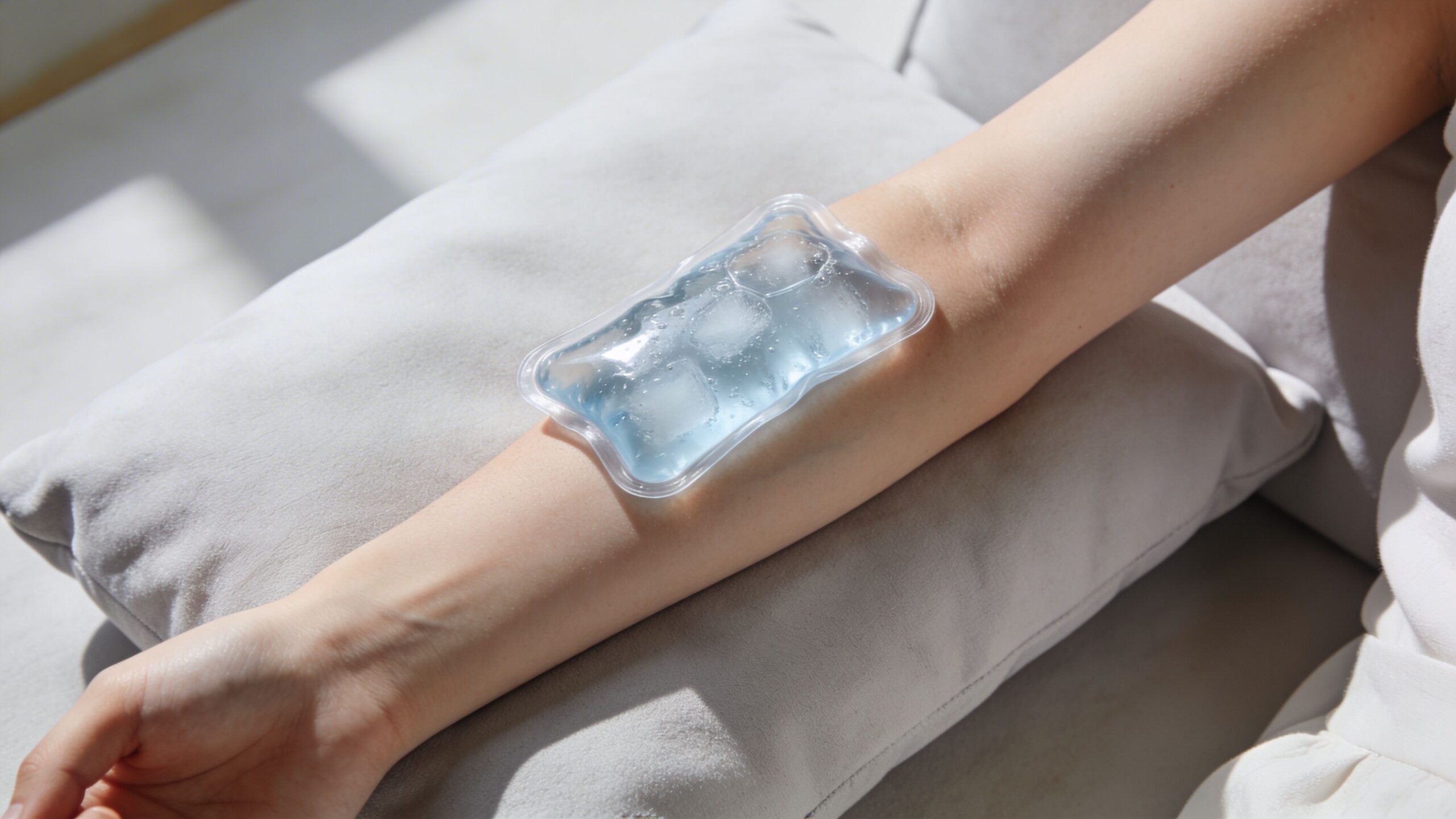
A cornerstone of conservative care is icing the base of the elbow for 10 minutes, repeated 3 times daily for at least 4 weeks. This helps reduce swelling and pain by constricting blood vessels and numbing nerves, and it’s part of the RICE protocol that helps resolve over 90% of non-infectious bursitis cases without more invasive care, as described in this exercise and care guide for elbow bursitis.
That schedule matters. A single ice session after a long day usually isn’t enough. The bursa responds better to steady, boring consistency than to occasional intense treatment.
If you’re unsure when cold is helpful and when warmth makes more sense, this article on when to use ice vs heat can help you avoid mixed messages.
Rest means reducing pressure, not freezing the joint
Rest gets misunderstood. It doesn’t mean hold the elbow still all day. It means stop doing the things that keep smashing or rubbing the irritated bursa.
That typically means:
- Stop leaning on the elbow
- Avoid planks, push-ups, and floor-based pressure
- Change your desk setup so the point of the elbow isn’t bearing weight
- Use padding if you can’t avoid contact during work
A padded elbow sleeve or folded towel can help during the day. The goal is to offload the area, not squeeze it aggressively.
Compression and elevation help control fluid
Gentle compression can reduce the sense of sloshy swelling around the elbow. It works best when it feels supportive, not tight.
Elevation can also help when the elbow feels full and irritated after activity. You don’t need a complicated setup. Resting the arm on a pillow while sitting or lying down is often enough.
Quick flare-up checklist
- Ice the area on schedule
- Stop direct pressure
- Use light compression if tolerated
- Prop the arm up when swelling increases
- Hold off on strengthening until the tenderness settles
Practical rule: If an exercise or position makes the swelling more pronounced afterward, it’s too much for the current phase.
Red flags that need medical attention
Most non-infectious bursitis flare-ups respond to conservative care. But a swollen elbow isn’t always a simple overuse problem.
Red flags
Seek medical care promptly if the elbow becomes intensely hot, increasingly red, rapidly more swollen, or if you feel unwell with fever. Those signs can suggest an infected bursa, and that needs a physician’s evaluation.
What usually doesn’t work
People often lose time by trying one of these approaches:
- Deep massage over the swollen tip. This usually irritates the bursa more.
- Heavy stretching during a hot flare-up. That can increase discomfort without improving anything.
- Ignoring it and continuing pressure-heavy activity. This is common with desk work and manual labor.
- Testing it over and over by leaning on it “just to see.” Rechecking becomes repeated aggravation.
When the swelling starts to settle and the elbow isn’t as reactive, gentle movement becomes useful. That’s the point where bursitis in elbow exercises starts to shift from symptom control to active recovery.
Phase 2 Gentle Mobility and Flexibility Exercises
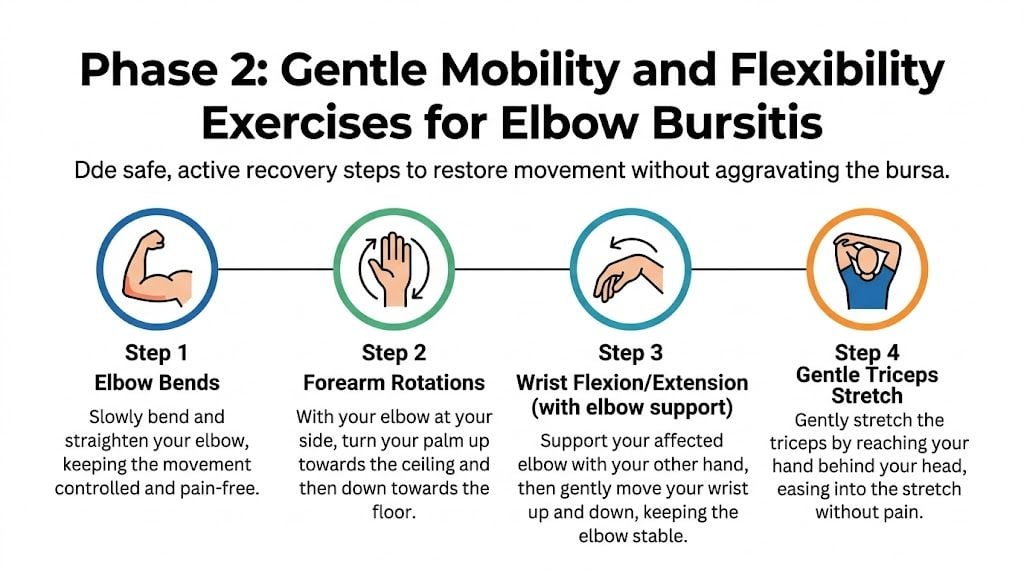
Once the elbow is less angry, movement matters. Not big movement. Not loaded movement. Just enough motion to keep the joint from stiffening and to help you return to normal use without poking the bursa back into a flare.
A lot of people stay too still because they’re afraid of making it worse. I understand that instinct. But gentle, controlled motion is often better than guarding the arm all day.
The goal in this phase
You’re trying to restore normal motion without increasing swelling. That means every rep should feel smooth, controlled, and tolerable.
Use this rule: move until you feel a gentle pull, not a sharp pain and not pressure directly into the swollen tip.
Exercise 1 Assisted elbow flexion
This is a useful starting stretch when bending the elbow feels tight.
How to do it:
- Sit comfortably with the arm relaxed.
- Bend the affected elbow as far as feels comfortable.
- Use your other hand to assist the movement a little farther, only into a mild stretch.
- Hold 20 seconds and repeat 3 times.
This gentle assisted elbow flexion approach is part of common conservative exercise routines because it helps restore mobility without forcing the joint.
Exercise 2 Forearm stretch with elbow extension
This one addresses the forearm flexors and can make straightening the elbow feel easier.
How to do it:
- Place your hand on a table.
- Turn the fingers backward if tolerated.
- Gently straighten the elbow until you feel a stretch through the forearm.
- Hold 20 seconds for 3 repetitions.
Don’t jam the elbow locked straight. Ease into it.
Exercise 3 Slow elbow bends
This is less about stretching and more about reintroducing normal motion.
Try this sequence:
- Bend and straighten slowly
- Keep the shoulder relaxed
- Stay in a pain-free range
- Pause if swelling ramps up later in the day
In early mobility work, slower is better. Fast reps tend to turn into compensations.
Recovery phases at a glance
| Phase | Primary Goal | Key Actions |
|---|---|---|
| Phase 1 | Calm irritation | Ice, reduce pressure, light compression, activity modification |
| Phase 2 | Restore motion | Assisted elbow flexion, forearm stretching, controlled bending |
| Phase 3 | Build support | Progressive triceps and forearm strengthening, careful loading |
What to watch while moving
A good mobility session should leave the elbow feeling looser, not fuller.
Look for these signs:
- Good response means the elbow feels less stiff afterward
- Too much load means the tip becomes more swollen or tender later
- Wrong target means pain shows up more on the outer elbow or forearm instead of the bursa area
If you like visual exercise references, simple resistance band exercises can be helpful later on when you’re ready to progress, but stay with unloaded motion first if the elbow still feels reactive.
Gentle movement protects you from the trap of “resting” so much that the arm becomes stiff and awkward to use.
When hands-on care helps
Some elbows move poorly because the surrounding muscles start guarding. In those cases, guided mobility and soft tissue work can make the exercises more comfortable and more precise. If you’ve never had that kind of treatment before, this overview of manual physical therapy explains why hands-on care can be useful when stiffness and swelling overlap.
Common mistakes in this phase
- Pushing into pain to gain range
- Doing too many reps because the movement seems easy
- Returning to pressure-heavy workouts too soon
- Skipping movement entirely because the lump is still visible
Visible swelling doesn’t always mean you should stop all motion. It means you need the right dose. That’s a big difference.
Phase 3 Progressive Strengthening to Build Resilience
This is the phase people usually want to start with. It’s also the phase that works best when you’ve earned it.
Strengthening matters because the elbow doesn’t function in isolation. The triceps, forearm muscles, shoulder, and upper back all help distribute force. When those tissues aren’t doing their share, the elbow tends to take more stress than it should.
Start with low-threat muscle activation
If the elbow still feels vulnerable, begin with gentle muscle work that doesn’t create a lot of joint motion.
Isometric triceps press
Try this:
- Stand facing a wall.
- Bend the affected elbow slightly.
- Press the hand or forearm gently into the wall as if you’re trying to straighten the elbow.
- Hold the muscle contraction briefly, then relax.
This type of work can help wake up the triceps without repeatedly gliding the irritated area through a full loaded range.
Wrist and forearm isometrics
You can do the same idea for the forearm:
- Press the palm lightly into the opposite hand
- Press the back of the hand lightly into the opposite hand
- Keep effort gentle and controlled
These drills are helpful when gripping tasks or carrying objects still feels tentative.
Move into dynamic triceps loading
Once isometrics feel easy and daily tasks are calmer, start dynamic work.
An effective tricep strengthening protocol involves starting with pain-free, dynamic loading at 6-8 reps to prevent muscle spasm, then scaling to 10-15 reps for 2-3 sets to condition the triceps and supporting tendons. When progressing, pain should not exceed 4/10 intensity, and poor form or rushing can overload the bursa and cause setbacks, as outlined in this tricep strengthening protocol for elbow bursitis.
That pain guideline is useful because it keeps people from doing too much too soon. Mild awareness is one thing. Escalating pain during or after exercise is your sign to back off.
A practical progression that works
Step 1 Dynamic elbow extensions without added load
Bend and straighten the elbow in a controlled way. Keep the upper arm close to your body. Focus on smooth motion, not speed.
Early on, stay with the 6-8 rep range if the elbow is still sensitive.
Step 2 Resistance band triceps extensions
Attach a light band overhead or hold it in a setup that lets you extend the elbow without shrugging the shoulder.
Form matters more than resistance:
- Keep the elbow tucked
- Don’t flare the arm out
- Move slowly in both directions
- Stop before the bursa feels compressed or irritated
When tolerated, build toward 10-15 reps for 2-3 sets.
Step 3 Supported forearm strengthening
Use a table or bench to support the forearm while you work the wrist and grip lightly. This gives you more control and less unnecessary strain through the elbow.
Good options include:
- Light wrist extension
- Gentle wrist flexion
- Controlled forearm rotation
- Light gripping with soft resistance
Add triceps stretching carefully
A triceps stretch can improve comfort when the back of the arm feels tight, but it has to be done without cranking on the elbow.
A common setup is:
- Sit or stand upright.
- Bend the affected elbow to a pain-free amount.
- Raise the arm overhead with the hand near the ear.
- Use the opposite hand to guide the elbow back gently.
- Hold the stretch without forcing it.
Use the stretch to reduce tightness, not as a test of how far you can push.
If the stretch creates pressure right on the swollen tip instead of a pull through the muscle, change the angle or skip it for now.
What progression should feel like
You don’t need the elbow to feel perfect before strengthening starts. But you do need a pattern of tolerance.
That usually looks like this:
- Exercises feel manageable during the session
- The elbow settles back to baseline soon after
- Daily activities get easier, not more guarded
- Swelling doesn’t spike after each workout
If the elbow gets puffier later that evening, the load was probably too much. Reduce either the range, resistance, or total volume.
The trade-off most people need to hear
People often think they have two choices. Rest forever or train hard. Neither works well.
Too little loading can leave the arm deconditioned and hesitant. Too much loading can keep the bursa irritated. The answer is graded exposure.
That’s why bursitis in elbow exercises should be progressive. The elbow needs support, but it needs the right amount at the right time.
A simple strength template
Below is a practical way to organize this phase.
| Exercise type | Early version | Progression cue |
|---|---|---|
| Triceps activation | Wall press isometric | Move to dynamic extensions when daily use feels easier |
| Dynamic triceps work | 6-8 controlled reps | Increase toward 10-15 reps for 2-3 sets if symptoms stay settled |
| Forearm support work | Light supported wrist motion | Add light resistance when form stays clean |
| Stretching | Gentle triceps and forearm stretch | Increase only if it feels like muscle stretch, not bursa pressure |
Form errors that commonly cause setbacks
Several problems show up again and again in clinic:
- Going too fast because the movement seems small
- Using heavy resistance bands too early
- Letting the shoulder compensate
- Training through swelling later in the day
- Returning to floor-based exercise before the elbow tolerates pressure
The bursa doesn’t respond well to bravado. It responds to consistency.
When to hold your current level
Stay at your current exercise dose if:
- The elbow remains tender to touch
- Swelling fluctuates noticeably after training
- Reaching overhead or pushing up from a chair is still uncomfortable
- You’re compensating with the shoulder or trunk
That isn’t failure. It just means the tissue wants more time at the current stage.
Preventing Recurrence with Ergonomics and Activity Modification
Getting the swelling down is only half the job. If the same pressure and movement habits stay in place, the elbow often gets irritated again.
Prevention isn’t glamorous. It’s usually small changes done every day. But those changes are what let you return to work, workouts, and regular routines with less worry.
Desk work and studying
For students, remote workers, and commuters who spend long hours at a laptop, direct elbow pressure is often the hidden driver.
Try these changes:
- Float the elbow instead of planting it on a hard desk edge
- Use arm support at the forearm, not pressure on the tip of the elbow
- Pad hard surfaces if contact is unavoidable
- Take posture breaks before the elbow gets numb or sore
If you rest on the same arm while reading, typing, or scrolling, the tissue usually tells on you by the end of the day.
Trades and manual work
This matters for plumbers, HVAC techs, mechanics, and anyone who works in tight spaces. Reaching the task often means leaning on the elbow to stabilize the body.
A few practical swaps help:
- Use padding inside sleeves or on surfaces
- Shift weight to the forearm when possible
- Change body position more often
- Build in brief resets instead of staying compressed in one posture
Small ergonomic changes often matter more than one perfect exercise session.
Gym and fitness modifications
You don’t have to stop moving. You do need to stop loading the bursa directly until it’s ready.
Useful adjustments include:
- Swap floor planks for versions that don’t press the elbow tip
- Avoid push-ups if the setup irritates the back of the elbow
- Use lighter loads for pressing movements at first
- Favor clean form over volume
For some people, recovery also feels smoother when overall inflammation is addressed through sleep, stress, and eating habits. If you want ideas, a simple anti-inflammatory meal plan can be a practical starting point alongside your rehab.
Common activities that can trigger flare-ups
Seasonal routines and everyday activities matter more than people think.
Elbow bursitis often shows up around:
- Snow shoveling, especially when you brace the arm awkwardly
- Spring yard work with repetitive leaning or pushing
- Weekend home projects that involve kneeling, crawling, or working from the ground
- Rec sports and gym resets after being less active in winter
The point isn’t to avoid life. It’s to stop repeating the exact mechanical stress that started the problem.
What prevention really looks like
Prevention is usually a combination of:
- Better body positioning
- Less direct pressure
- Smarter return to activity
- Ongoing strength work after symptoms calm down
People often search for one magic exercise. In real life, recurrence usually drops when your environment and habits change too.
Your Partner in Recovery on the South Shore
Online advice can get you started. A one-on-one physical therapy evaluation gives you something the internet can’t. Specific answers about your elbow.
That matters because not every sore elbow tip is the same. Some people are dealing with a straightforward pressure-related bursitis flare. Others also have stiffness in the triceps, irritation from training form, or movement compensation through the shoulder and wrist that keeps feeding the problem.
What a PT evaluation should uncover
A thorough visit looks at more than the swollen spot itself.
A licensed physical therapist will typically assess:
- Where the pain is located
- How much swelling is present
- Whether motion is limited
- Which daily tasks or work positions trigger symptoms
- How the shoulder, forearm, and wrist are contributing
That full-body view matters. If the elbow is treated as an isolated lump, the bigger cause can get missed.
Why a customized plan works better
Generic routines help some people. Others need the exercises scaled down, progressed more slowly, or adjusted around work demands.
For example:
- A student may need desk and study modifications first.
- A South Shore tradesperson may need padding and position changes built into the plan.
- A gym-goer may need a return-to-training progression that protects the bursa without losing upper-body strength.
Hands-on treatment can also help when stiffness, guarding, or surrounding tissue tightness is part of the problem. Just as important, a therapist can tell you what not to do, which often saves time and prevents reinjury.
Local access matters when you’re in pain
If you live or work on the South Shore, convenience matters. It’s easier to stick with care when the clinic is close to home, work, school, or your regular route on Route 3 or nearby local roads.
Peak clinics serve communities across the region, including Braintree, Quincy, Weymouth, Cohasset, Duxbury, East Bridgewater, Hanover, Kingston, Milton, Norwell, Pembroke, Plymouth, and Scituate. That makes it easier to get checked before a nagging elbow problem turns into a longer interruption from work, training, or daily life.
Good rehab isn’t just about exercises. It’s about identifying the load, posture, and habits that keep the elbow irritated.
Frequently Asked Questions About Elbow Bursitis Recovery
Can I exercise if my elbow is still swollen
Yes, sometimes. The key is choosing movements that don’t increase pressure on the bursa or make the swelling worse afterward.
Good choices are usually gentle range-of-motion work and carefully dosed strengthening. Poor choices are pressure-heavy moves, fast reps, and anything that leaves the elbow fuller later in the day.
Is elbow bursitis the same as tennis elbow
No. They can both cause elbow discomfort, but they usually feel different.
Olecranon bursitis affects the tip of the elbow and often comes with visible swelling. Tennis elbow usually causes pain more on the outer part of the elbow and tends to be aggravated by gripping, lifting, or wrist activity rather than direct pressure on the elbow tip.
How long should I keep modifying my activities
Keep the modifications in place until the elbow tolerates normal contact and loading without a flare. For some people, that happens fairly quickly. For others, especially if work keeps re-irritating the area, it takes longer.
The safer approach is to earn your way back to pressure-based activities instead of rushing them.
Should I massage the swollen part
Usually, no. Firm pressure directly over the bursa often makes symptoms worse.
What tends to help more is reducing compression, calming the inflammation, and working on nearby tissue mobility if a therapist identifies stiffness in the surrounding muscles.
When might surgery be discussed
Surgery is not usually the first step. It tends to be considered only when the problem becomes persistent, keeps recurring, or doesn’t respond to appropriate conservative care.
If there’s concern for infection, rapid worsening, or a large stubborn swelling that isn’t improving, you should speak with a physician promptly.
What if my elbow feels better, then flares up again
That’s common. It usually means the tissue handled some activity, but not that full return yet.
When that happens:
- Reduce the aggravating activity
- Return to symptom-calming strategies
- Resume the last exercise level that felt safe
- Look closely at pressure habits, especially at work or at your desk
That kind of flare doesn’t mean you’ve failed. It usually means your loading progression needs to be adjusted.
If your elbow pain is lingering, swelling keeps returning, or you’re not sure which exercises are safe, Peak Physical Therapy and Sports Performance can help. Our licensed physical therapists provide individualized evaluations and hands-on, evidence-based care across the South Shore, with clinics in Braintree, Quincy, Weymouth, Cohasset, Duxbury, East Bridgewater, Hanover, Kingston, Milton, Norwell, Pembroke, Plymouth, and Scituate. We’ll help you calm the irritation, restore motion, and build a recovery plan that fits your work, workouts, and daily life.