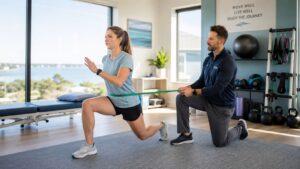
You finish a walk near the Plymouth waterfront and feel that familiar ache again. Maybe it grabs in the groin when you step up a curb. Maybe it burns on the outside of the hip when you get out of the car. Maybe it's not dramatic at all. It just keeps showing up and keeps changing how you move.
That's usually the part people hate most. Not just the pain itself, but the way it starts shrinking your day. You walk less. You avoid stairs. You skip the workout, the long shift, the weekend game, the beach walk, the errands you'd normally handle without a second thought.
Hip pain is a common reason people seek physical therapy in communities like Plymouth, and it sits inside a much larger musculoskeletal burden worldwide. In 2020, an estimated 1.71 billion people globally were living with musculoskeletal conditions, and a 2023 systematic review and meta-analysis found that hip osteoarthritis affects roughly 7.2% of people age 45 and older, with prevalence rising with age, as noted by Peak's Plymouth clinic page. The practical takeaway is simple. If your hip is limiting how you live, it's worth getting it checked.
Table of Contents
- Is It Your Hip? Common Pain Signals We See in Plymouth
- How Physical Therapy Resolves Hip Pain for Good
- Your Personalized Treatment Plan at Peak Physical Therapy Plymouth
- Simple Home Exercises to Get You Started Safely
- Your First Visit What to Expect at Our Plymouth Clinic
- Insurance Telehealth and Booking Your Appointment
- Frequently Asked Questions About Hip Pain PT
Is It Your Hip? Common Pain Signals We See in Plymouth
A lot of people walk into the clinic saying, “My hip hurts,” but they aren't always sure what that means. That's understandable. Pain near the hip can show up in the groin, the side of the leg, the buttock, or even farther down. It can feel sharp one day and dull the next.
For Plymouth neighbors, that often means trouble with ordinary local routines. Walking the waterfront. Getting through a shift on your feet. Carrying groceries. Bending into the garden. Keeping up with kids or grandkids without thinking about every step.

Pain patterns that often point people to PT
Here are a few of the patterns we commonly hear about in Plymouth:
- Groin discomfort with walking or stairs can feel deep, pinchy, or catching.
- Pain on the outside of the hip often shows up when lying on that side, climbing stairs, or getting out of a car.
- A dull ache after sitting may flare when you first stand up, then slowly loosen.
- Pain after activity can linger after yard work, sports, or long days on your feet.
- Clicking or snapping may or may not be painful, but it's worth evaluating if it changes how you move.
Practical rule: Pain location matters, but movement matters more. The same spot can hurt for different reasons.
Sometimes it isn't the hip joint
Self-diagnosis can be tricky. A major challenge for patients is telling true hip-joint pain from referred pain. Pain in the groin, clicking, or pain that changes with spine movement can suggest a non-hip source, which is why a thorough PT evaluation matters, as noted by Maritime Physical Therapy.
That means your “hip pain” could be tied to the low back or SI region. If your symptoms travel below the knee, shift a lot with bending or twisting your spine, or feel more electric than sore, we start asking different questions. If that sounds familiar, our article on sciatica treatment and physical therapy in Plymouth may help you sort out the difference.
A few people also notice their symptoms first thing in the morning and assume the joint is the only issue. Sleep position, mattress support, and nighttime pressure can play a role too. If your hips hurt most after sleeping, this plain-English guide from Golden Dreams Mattress is a helpful starting point.
What usually doesn't work
People often try to stretch harder, rest longer, or just “walk it off.” Sometimes that helps briefly. Often it doesn't.
What usually fails is treating every hip pain problem like the same problem. If the underlying issue is weakness, endless stretching won't fix it. If the pain is coming from your back, hammering the side of the hip with massage tools won't solve much. The right plan starts with figuring out what's causing the pain.
How Physical Therapy Resolves Hip Pain for Good
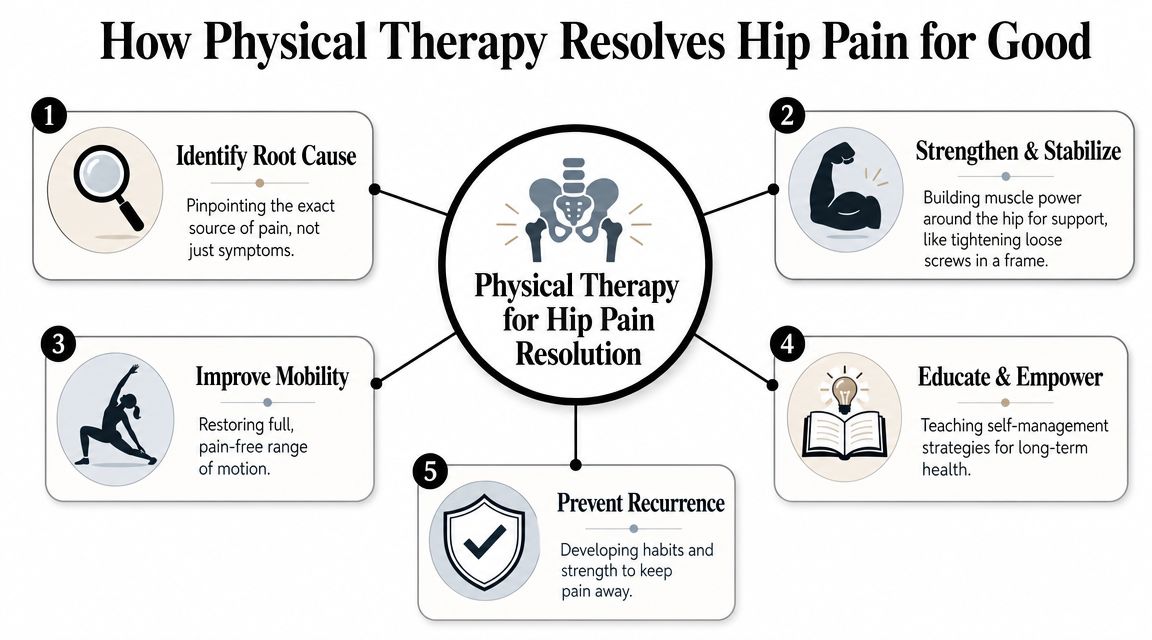
The hip works like a load-transfer point. When the muscles around it do their job, force moves smoothly through the pelvis and leg. When they don't, the joint and nearby tissues take more of the hit.
That's why random exercise often falls short. The issue usually isn't that you need “more movement.” You need the right movement, in the right amount, with the right progression.
Think of the hip like a supported frame
A simple way to understand it is this. Your hip joint is the frame. Your glutes and surrounding muscles are the support cables. If the cables aren't pulling well, the frame takes extra strain.
That's not just a theory. When the muscles around the hip are weak, the joint itself absorbs more stress during daily activities like walking. Physical therapy programs use targeted strengthening to restore muscular support, improve movement efficiency, and reduce painful loading, according to Cape Cod Preferred Therapy.
What helps and what usually wastes time
A good plan usually includes these pieces:
| Approach | What it does | Where it falls short |
|---|---|---|
| Rest alone | Can calm an irritated area briefly | Doesn't rebuild support or improve how you move |
| General stretching | May reduce stiffness for some people | Won't solve a strength or control problem by itself |
| Pain-only treatment | Can make symptoms more manageable | Often misses why the pain keeps returning |
| Targeted rehab | Builds strength, mobility, and control together | Works best when it's tailored to the person |
Weak support around the hip changes how you load every step. That's why rehab has to change the system, not just the soreness.
What lasting relief usually looks like
Long-term improvement typically follows a pattern:
- Calm down the irritated tissue so daily movement feels less guarded.
- Restore motion where stiffness is forcing compensation.
- Build strength in the glutes and surrounding muscles.
- Retrain everyday tasks like walking, stairs, and squatting.
- Progress back to your lifestyle instead of stopping at “it hurts less.”
That's the difference between temporary relief and actual recovery. The goal of hip pain physical therapy in Plymouth, MA isn't just to get you through this week. It's to make your hip more dependable next month and next season.
For a deeper educational breakdown of hip anatomy, biomechanics, and recovery concepts, visit Highbar Health.
Your Personalized Treatment Plan at Peak Physical Therapy Plymouth
Hip pain rarely shows up the same way twice. One Plymouth neighbor feels a sharp pinch getting out of the car after work. Another notices a deep ache halfway through a walk by the waterfront. A student athlete may only feel it during cuts and sprinting. A retired adult may mostly notice it at night or after time on their feet. The plan needs to match those differences.
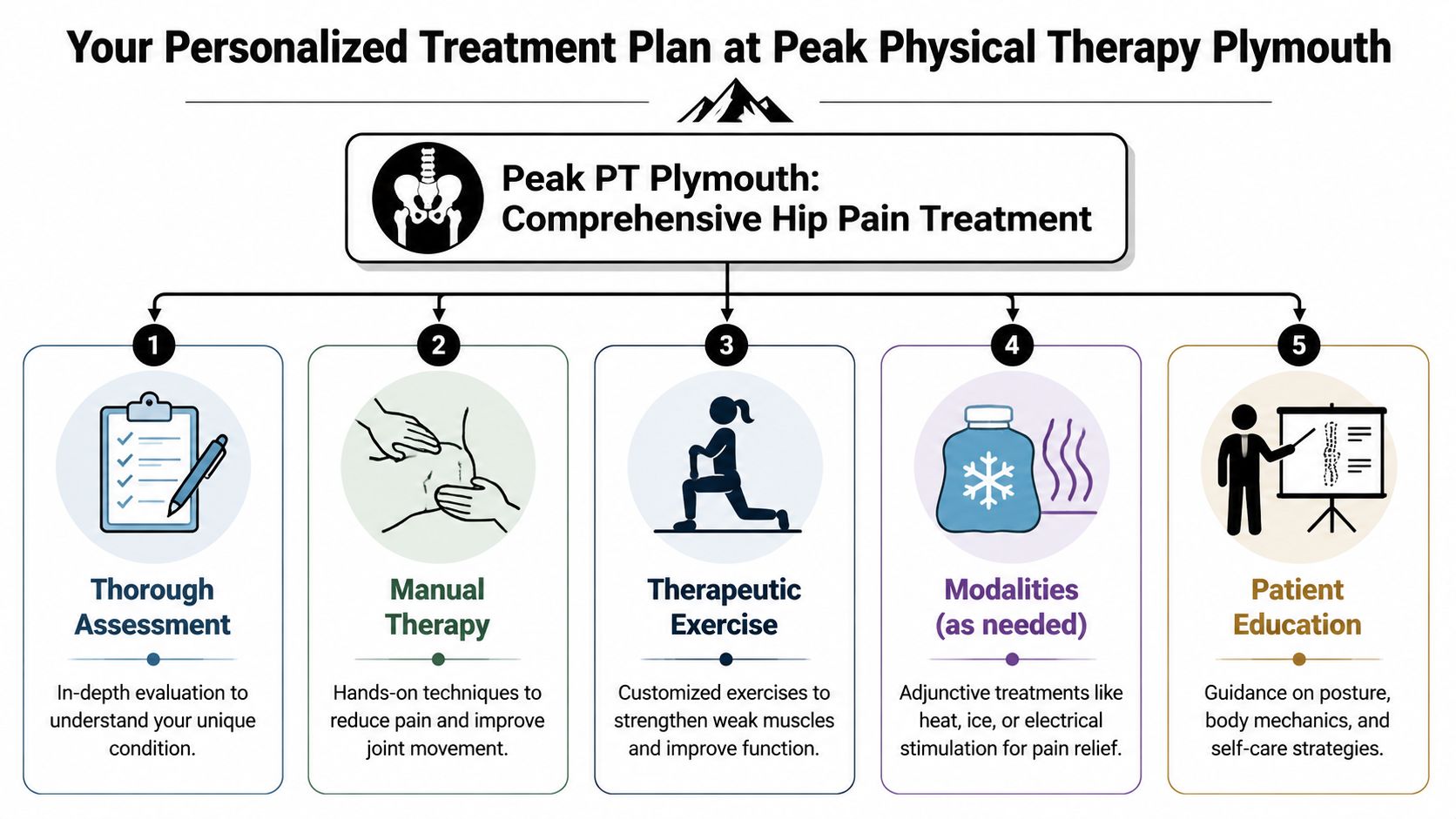
At Peak Physical Therapy Plymouth, treatment starts with a close look at how your pain behaves in real life. We look at what brings it on, what eases it, how you move, where you are stiff, and what your hip has to handle during a normal week on the South Shore. That gives us a clear starting point and helps us avoid guessing.
Three pieces that work together
Hands-on care can help when the hip is stiff, irritated, or guarded. That may include joint mobilization, soft tissue treatment, or guided movement to make it easier to walk, bend, and change positions without bracing.
Strength work gives the hip better support. Early exercises are usually simple and well-controlled. As symptoms calm down, we build toward the demands that matter to you, whether that is stairs, lifting groceries, gym workouts, pickleball, or longer walks around Plymouth.
Movement retraining connects clinic progress to daily life. We watch how you squat, climb steps, pivot, get in and out of the car, or carry weight. Then we clean up the patterns that keep loading the sore area. If you want extra examples of hip pain relief exercises that fit different stages of recovery, that guide is a good next step.
How that changes from person to person
A good plan is specific to your routine, not just your diagnosis.
- Busy parents often need better control with floor transfers, carrying kids, and repeated bending.
- Active adults usually need loading progressions that prepare them for running, hiking, recreational sports, or strength training.
- Older adults often focus on steadier walking, more confidence on stairs, and less hesitation during everyday movement.
- Student athletes need a return-to-sport plan that matches practice, games, and club schedules.
The trade-off is simple. If we push too hard too soon, the hip gets irritated. If we stay too easy for too long, the hip never gets strong enough for real life. Good physical therapy sits in the middle and adjusts as your hip responds.
For general exercise ideas that focus on the outer hip, Zing Coach's hip pain guide can be a useful reference between visits.
Why local care matters
In Plymouth, hip pain usually interrupts ordinary things people care about. Walking the waterfront. Yard work. Weekend games. Beach days. Getting through a shift without limping. Treatment works better when those goals are built into the plan from the start.
Peak Physical Therapy and Sports Performance provides one-on-one physical therapy for Plymouth and the South Shore. If your hip pain is changing how you move, the next step is to book an appointment and get a plan built around what you want to get back to.
Simple Home Exercises to Get You Started Safely
Home exercises can help. They can also irritate the wrong problem if you guess. That's why these examples are best used as a gentle starting point, not a replacement for an evaluation.
If you feel sharp pain, increasing pain, numbness, or symptoms that seem to travel, stop and get guidance. Form matters more than pushing through.
Glute bridge
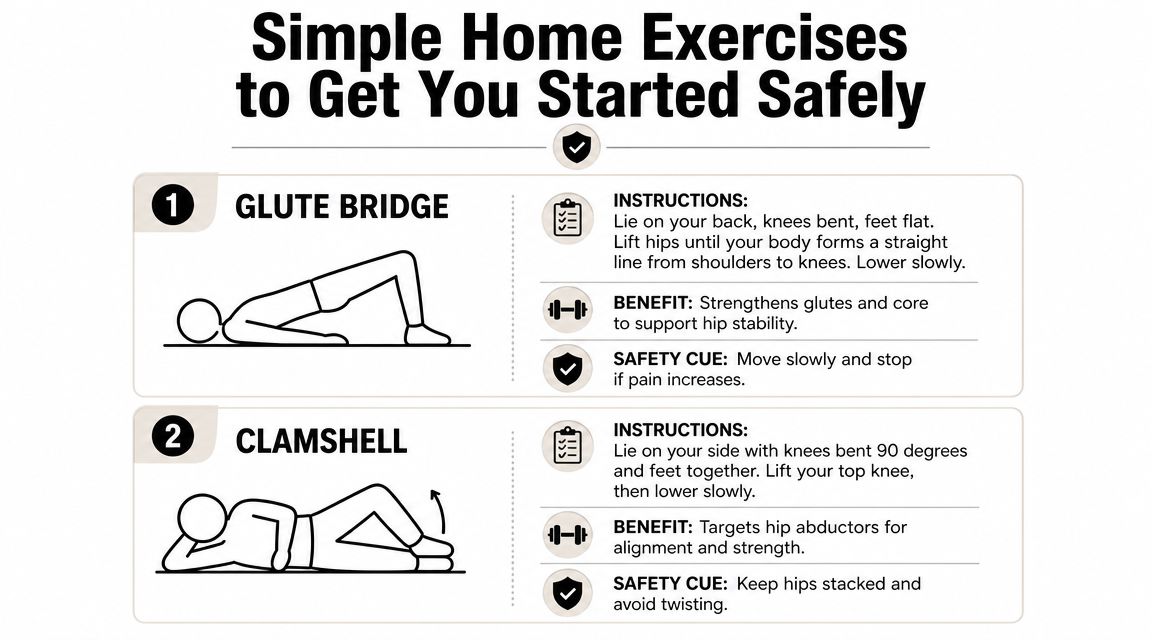
Lie on your back with both knees bent and feet flat. Tighten your stomach gently, squeeze your glutes, and lift your hips until your body forms a straight line from shoulders to knees. Lower slowly.
Why it helps: This exercise starts building hip extension strength without asking the hip to do too much too soon.
Clamshell
Lie on your side with knees bent and feet stacked. Keep your feet together while lifting the top knee. Don't roll your trunk backward to cheat the motion. Lower with control.
Why it helps: This targets the outer hip muscles that help control pelvic and leg position during walking and single-leg tasks.
Sit-to-stand with control
Sit near the front edge of a chair with feet under you. Lean slightly forward, press through both feet, and stand without using your hands if possible. Sit back down slowly.
Why it helps: This makes strength practical. You're training a movement you use all the time.
Safety notes worth following
- Move within tolerance. Mild effort is fine. Sharp pain isn't.
- Slow beats sloppy. Controlled reps usually help more than fast ones.
- Symmetry matters. If one side is doing all the work, back up and reset.
- Stop if symptoms spread. Pain that shoots, tingles, or changes with your back position needs a closer look.
Good exercise should leave you feeling worked, not worse.
If you want a few more exercise ideas before your appointment, our guide to hip pain relief exercises is a helpful next read. For another general fitness perspective on lateral hip strength, Zing Coach's hip pain guide offers additional examples.
Your First Visit What to Expect at Our Plymouth Clinic
You should leave your first visit with answers, not more guesswork.
A lot of people come in after trying to push through the pain for weeks. By that point, the hip may be affecting simple parts of life around Plymouth. Getting out of the car, walking the waterfront, climbing stairs at home, sleeping on one side, or getting back to golf, tennis, or gym workouts all start to feel less predictable. The first visit is where we sort out what is going on and what to do next.
We start with your story. I want to hear where you feel the pain, what brings it on, what you have already tried, and what you want to get back to doing. That goal matters. The plan looks different for someone who wants to return to running than it does for someone who just wants to walk downtown without limping halfway through the afternoon.
The conversation matters
Your history often gives the first big clue. We ask whether the pain feels sharp, achy, pinching, stiff, or unstable. We also ask when it shows up, whether it eases with rest, and whether symptoms travel into the thigh, groin, or low back.
That helps us separate common patterns. Some hips are irritated by compression. Some are limited by stiffness. Some are more about weakness and poor control under load. Some pain that feels like a hip problem is partly coming from the back. Those details change the treatment plan right away.
Hip pain is something we treat regularly at Peak Physical Therapy and Sports Performance. If you want a broader look at physical therapy care in Plymouth, MA, that page gives more context on how we approach orthopedic problems locally.
The movement exam is straightforward
Then we look at how you move. That usually includes walking, hip motion, strength testing, and a few functional tasks that match your day-to-day life. If stairs are the problem, we look at stairs. If getting up from a chair or rolling in bed is the problem, we test that.
The goal is not to make you do a long list of random movements. The goal is to find the motions and loads that match your symptoms so we can make a good plan.
A first visit often answers questions like these:
- Is the pain mainly coming from the hip, the low back, or a mix of both?
- Is the bigger limiter stiffness, strength, irritation, or movement control?
- Which activities are okay to keep doing right now?
- What should change first to calm things down and start progress?
You leave with a plan
Before you leave, you should know what we think is driving the pain, what the next few weeks should focus on, and what to watch for. That plan may include a small number of exercises, changes to walking or training volume, and hands-on treatment if it fits what the exam shows.
We also talk openly about trade-offs. Some people need to scale back activity for a short stretch so the hip can settle. Others do better staying active with a few smart modifications. Good PT is not about shutting life down. It is about choosing the fastest safe path back to it.
If your hip pain is already changing how you move through the day in Plymouth, book an appointment. The sooner we examine it, the sooner you can stop guessing and start working on the right problem.
Insurance Telehealth and Booking Your Appointment
Pain already creates enough friction. Scheduling care shouldn't add more. The practical questions matter just as much as the clinical ones for many people in Plymouth.
Insurance and payment
Peak works with many major insurance plans, and the easiest move is to verify benefits directly when you schedule. If you're not using insurance, ask about self-pay options. That usually makes the next step much clearer.
Bring your insurance card, photo ID, and any referral paperwork if you have it. If you don't know whether you need a referral, ask before your appointment and the front desk can help you sort it out.
Telehealth when in-person isn't easy
Some people can get to the clinic easily. Others are juggling work, caregiving, transportation, or a flare-up that makes travel tough. In those cases, telehealth can be a useful option for guided exercise progressions, movement review, education, and home-program updates.
Telehealth isn't right for every hip presentation. If the main need is hands-on assessment or the diagnosis is unclear, in-person care is usually the better starting point. But for follow-ups or certain phases of rehab, virtual visits can keep momentum going.
Ready to book
If your hip is changing how you walk, sit, sleep, train, or get through the day, it's time to stop guessing.
A few easy next steps:
- Book online if you want the fastest path to an appointment.
- Call the clinic if you'd rather talk through insurance, timing, or symptoms first.
- Use the contact form if you want someone to reach back out with options.
The main thing is to get the evaluation on the calendar. Hip pain rarely improves just because you've gotten good at working around it.
Frequently Asked Questions About Hip Pain PT
How long does it take to feel better
Recovery depends on what is irritating the hip, how long the problem has been present, and how often your daily routine keeps provoking it. A recent flare-up from overtraining usually moves differently than pain tied to months of stiffness, weakness, limping, or surgery.
Early progress often shows up in function first. You sleep with less interruption, get out of the car more easily, or finish a walk along the waterfront without paying for it later.
Do I need a doctor's referral
Some patients come to PT with a referral. Others book directly.
The right answer depends on your insurance plan and your medical history, so confirm that when you schedule. If the pain changed quickly, came on after a fall, or seems tied to something beyond the joint itself, a physician may still need to be part of the process. Good care is not about choosing PT or medical care. It is about getting the right help in the right order.
What makes modern PT different from old-school rest advice
Rest can calm an angry hip for a short window, but it does not rebuild strength, improve mobility, or fix the movement pattern that keeps bringing the pain back. Physical therapy works best when treatment matches the problem.
At Peak Physical Therapy and Sports Performance in Plymouth, that usually means we look at how the hip handles load, how you walk, what positions trigger symptoms, and what your body has stopped doing well. Then we build the plan around your actual goals, whether that is returning to the gym, getting through work without limping, or feeling confident on uneven ground around the South Shore.
Hands-on care can help in the right case. Exercise is usually what creates lasting change.
Is PT only for severe hip pain or after surgery
No. In many cases, earlier treatment is more useful because it gives you a clear direction before you start cutting out walks, workouts, stairs, or sleep positions just to get by.
PT also helps after injections and after surgery, when the job shifts to restoring motion, strength, balance, and trust in the joint. The trade-off is timing. Wait too long, and people often build compensations that make rehab take longer. Come in earlier, and we can usually identify the true source of the pain before those workarounds get stuck in place.
What if I'm not sure the pain is really coming from my hip
That is common.
Pain in the side of the hip, groin, buttock, or upper thigh does not always mean the hip joint is the only issue. The low back, pelvis, tendons, and surrounding muscles can all refer pain into a similar area. That is one reason an evaluation matters. We sort out what structure is most involved and what that means for treatment, instead of asking you to guess based on where it hurts.
What should I do before my first appointment
Try not to test it all week.
Make a short note of what movements aggravate the pain, what eases it, and whether it affects walking, sleeping, stairs, sports, or sitting. Wear clothes you can move in comfortably. If you have imaging, an operative report, or a referral, bring it. If you do not, that is fine. The exam usually tells us far more than people expect.