
You finally feel decent enough to test a run. The ankle isn't barking on stairs. The knee seems quiet on walks. You're looking at your usual route by the Weymouth waterfront, maybe thinking about an easy loop in Hingham, a few flat miles near the Plymouth waterfront, or a soft start before building back toward a local 5K.
That moment is where a lot of runners get into trouble.
Return to running after injury usually goes wrong for one simple reason: people treat it like a fitness decision when it's really a load-management decision. You might feel better, but that doesn't mean your body is ready for repeated impact yet. On the South Shore, I see this all the time. Someone rests, feels impatient, jogs too soon, then ends up right back where they started.
A smarter comeback is boring in the best way. It uses clear readiness tests, a gradual walk-run build, and enough strength work to support the miles you want to get back to.
Table of Contents
- Getting Back on the Pavement on the South Shore
- The South Shore Runner's Readiness Checklist
- Your Progressive Walk-to-Run Plan
- Building a Bulletproof Runner's Body
- Navigating Setbacks and When to Call a Pro
- Your Next Steps to Running Strong on the South Shore
Getting Back on the Pavement on the South Shore
A South Shore runner told me recently that the hardest part of being injured wasn't the pain. It was driving past Duxbury Beach on a good-weather morning and knowing she still wasn't ready. That feeling is real. If your normal week includes early miles before work, weekend loops through Wompatuck State Park, or training with friends for a hometown road race, sitting out gets old fast.
What usually doesn't work is the “test it and see” plan.
If you've been limping through the grocery store, avoiding hills, or feeling a sharp twinge every time life gets a little busier, your body is giving you useful information. The answer usually isn't to force a continuous run and hope confidence catches up. The answer is to rebuild capacity in a way your tissues can tolerate.

What a smart comeback looks like
A good return starts with three questions:
- Can you handle basic daily load? If walking, stairs, and errands still stir things up, running is usually too aggressive.
- Can the injured side do simple single-leg tasks well? Running is a long series of controlled single-leg landings.
- Do you have rules for what to do if symptoms flare? Most runners don't need more motivation. They need better guardrails.
That's why a measured return to running after injury tends to work better than a dramatic restart. It gives you a way to build confidence without gambling every run.
Practical rule: Your first run back should feel almost too easy. That's usually a sign you started at the right place.
If you're also trying to rebuild overall routine after time off, this guide on how BodyBuddy helps you get fit has a useful mindset angle on restarting training habits without trying to do everything at once.
For a local look at how runners get assessed and progressed in this area, Peak also has a helpful article on running physical therapy on the South Shore.
The local factor matters
South Shore runners aren't all returning to the same environment. Sand at Duxbury Beach, cambered roads in older neighborhoods, and rolling terrain around Cohasset or Scituate can all change the load on a recovering foot, ankle, knee, or hip. Early on, surface selection matters. So does keeping your ego out of pace and mileage decisions.
The runners who do best are rarely the toughest. They're the ones who stick to the plan when they feel good enough to skip steps.
The South Shore Runner's Readiness Checklist
Before you jog a step, run through a few simple tests. These aren't fancy clinic tricks. They're practical filters that help you decide whether your body is ready to begin a run-walk progression or whether you still need more prep work.
A practical readiness screen often includes brisk walking for 30 minutes, 30 seconds of single-leg balance, 15 to 20 controlled single-knee dips, 20 to 30 slow single-leg calf raises, and hop tests with at least 90% limb symmetry, according to this return-to-running assessment guide.
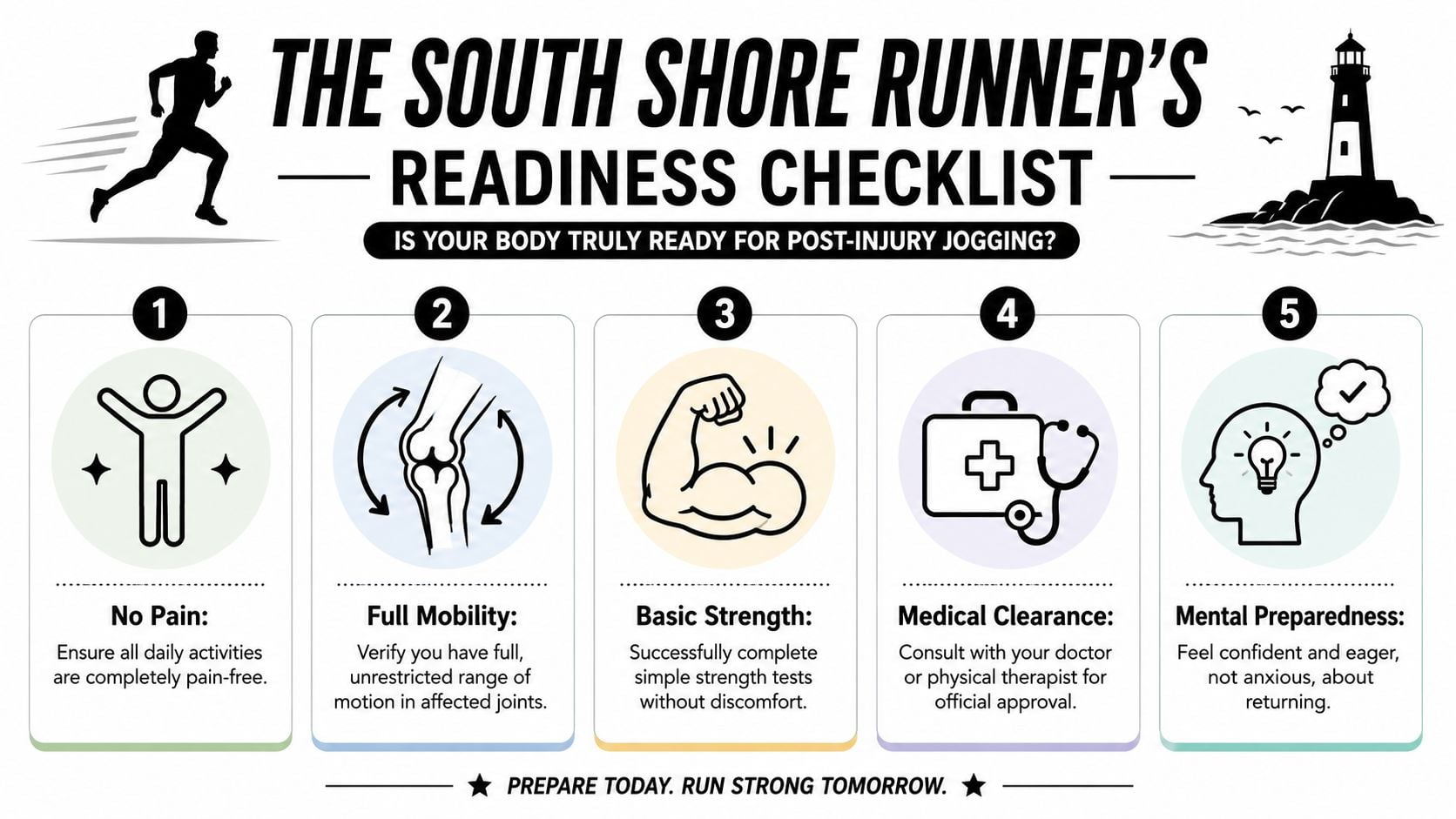
The home screen I'd use first
Think of this as your front-door test. If one item is shaky, don't panic. It just means the next best step is preparation, not proving something on a run.
Brisk walking for 30 minutes
This tells you whether your body tolerates repeated loading before impact enters the picture. If a brisk walk leaves you sore during the walk or later that day, jogging usually isn't the next move.Single-leg balance for 30 seconds
Running asks each leg to stabilize your pelvis and trunk over and over. If you wobble hard, grip the floor with your toes, or feel pain standing on the injured side, you need more control work first.15 to 20 controlled single-knee dips
This checks whether your hip, knee, and ankle can coordinate together. I'm looking for smooth control, not speed. If the knee collapses inward or pain climbs as you go, that matters.20 to 30 slow single-leg calf raises
Your calf complex takes a beating in running. If you can't do these with control, you may not be ready for push-off and landing demands.
What the hop test tells you
The hop test is where many runners realize they're not as close as they thought.
You don't need to turn it into a max effort competition. You do need to notice whether the injured side feels hesitant, heavy, or painful compared with the other side. The goal is confidence and symmetry, not bravado.
If hopping feels sketchy in your living room, it usually won't feel better halfway through a jog on the pavement.
A few quiet green lights
I also want to see a few basics that don't show up neatly on a checklist:
- Daily life is calm
Normal walking, standing, and stairs shouldn't keep poking the same spot. - Mobility is close to normal
You don't need circus flexibility, but you do need the joint to move without obvious restriction. - You trust the leg again
Apprehension changes mechanics. Hesitation is useful information.
If you've had time off and you're worried about overall deconditioning, this article on how long it takes to lose muscle can help put that concern in perspective. Many runners feel weaker after a layoff, but that doesn't mean they've lost the ability to rebuild quickly with the right plan.
If you fail this checklist, don't force a run. Clean up the basics first. That's usually faster than pushing ahead and getting set back.
Your Progressive Walk-to-Run Plan
The best return to running after injury is usually not a straight jump back to continuous mileage. It starts with exposure your body can absorb, then builds only when symptoms stay settled.
Many modern programs use the 10% weekly load progression rule, and some hospital-based guidance advises increasing total weekly running by no more than 10% while making sure you can walk pain-free at about 4.2 to 5.2 miles per hour before starting the plyometric and walk-jog phase, as outlined by Brigham and Women's Hospital.
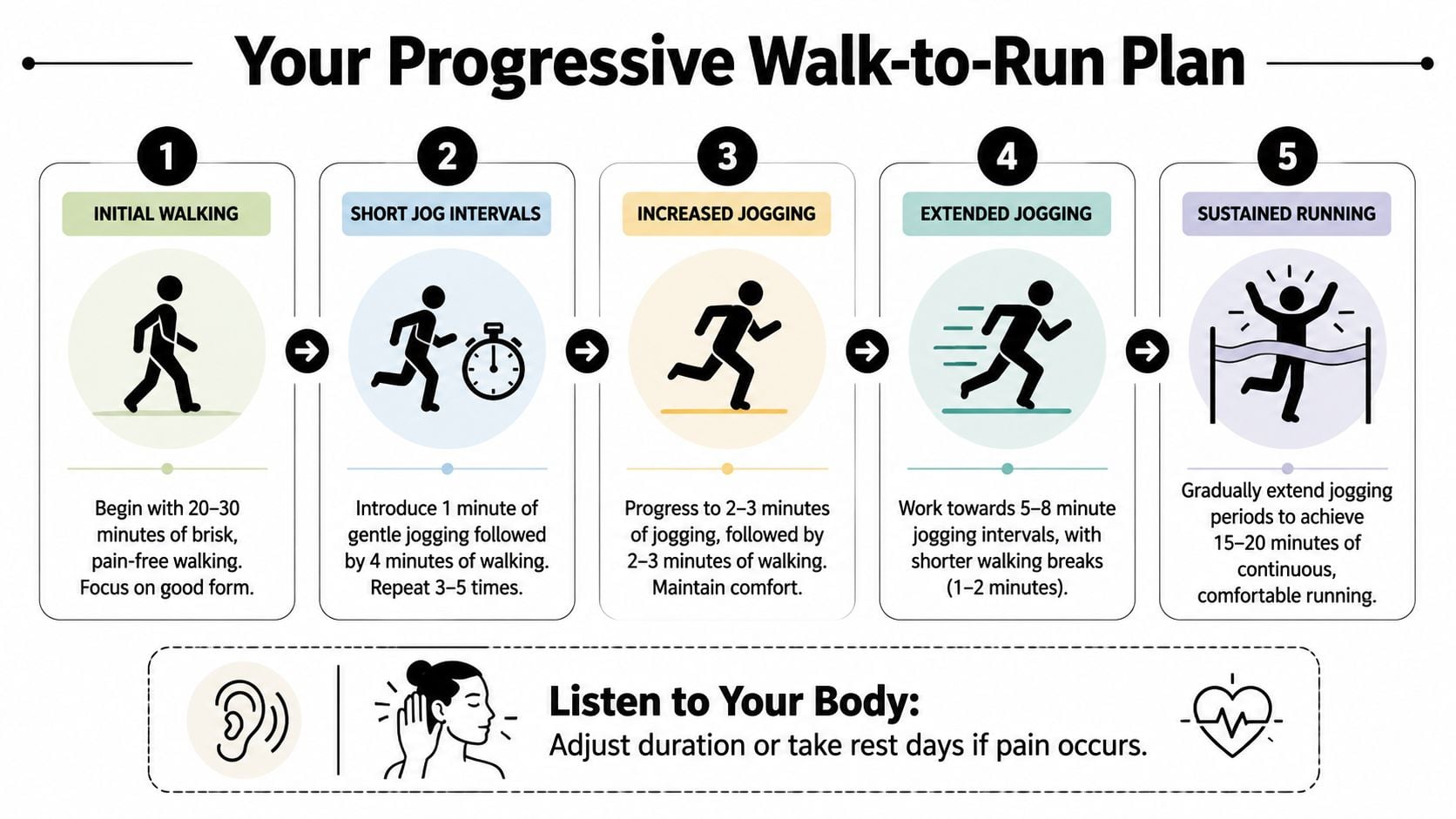
Start flatter and easier than you want to
For early runs, choose forgiving, predictable ground. Flat stretches near the Plymouth waterfront or a smooth neighborhood loop are better than uneven trails, beach sand, or hilly roads. This isn't forever. It's just smart staging.
A simple progression might look like this:
| Week feel | Session idea | What to watch |
|---|---|---|
| First step back | Short jog intervals mixed with longer walks | Pain during the session and later that day |
| Early build | Slightly longer jogs with shorter walk breaks | Whether form stays relaxed |
| Mid build | More total jogging time, still easy pace | Next-day response |
| Later build | Fewer walk breaks, longer continuous easy running | Whether symptoms stay stable across the week |
You don't need a heroic first week. You need repeatable sessions.
A practical sample progression
Use this as a model, not a rigid prescription:
Session 1
Walk, then jog briefly, then walk again. Keep the jogging segments short enough that you finish feeling like you had more in the tank.Session 2
Repeat the same session if the first one was clean. Don't progress just because you were excited.Session 3
Add a little more total jogging time, either by one extra interval or slightly longer jogging segments.Next week
Build gradually. Keep the pace conversational and the route flat.
Peak Physical Therapy and Sports Performance uses this kind of gradual return-to-run structure in clinical care, along with gait monitoring and symptom response checks, for runners working back from lower-limb injuries.
For many runners, the true skill isn't following the plan on a good day. It's knowing what to do when something feels off.
Use a traffic-light rule for pain
This is the part other guides often skip.
Green light
You feel fine during the run, or you notice mild awareness that doesn't build. Later that day is quiet. The next day feels normal. You can usually continue and make only small progressions.Yellow light
You feel a twinge, mild soreness, or stiffness that stays manageable and settles quickly. Don't leap forward. Repeat the same level again, shorten the next run, or add more walking.Red light
Pain sharpens, changes your stride, makes you guard the leg, or lingers into the next day in a meaningful way. Stop guessing. Back off to the last well-tolerated level.
Mild symptoms aren't always the problem. Escalating symptoms are.
If your stride changed during the injury, or you suspect you're still compensating, this article on how to improve gait is worth a read. Better mechanics won't replace good load management, but they can support it.
Building a Bulletproof Runner's Body
If you want a durable comeback, strength work is not optional. It's part of the return, not an extra you add later when life calms down.
A criteria-based return-to-running progression often begins only after the athlete has regained at least 70% quadriceps and hamstring strength on the injured side relative to the uninvolved side, according to this clinical review in PMC. That benchmark doesn't mean every runner needs formal testing before every jog. It does mean strength matters more than most runners want to admit.
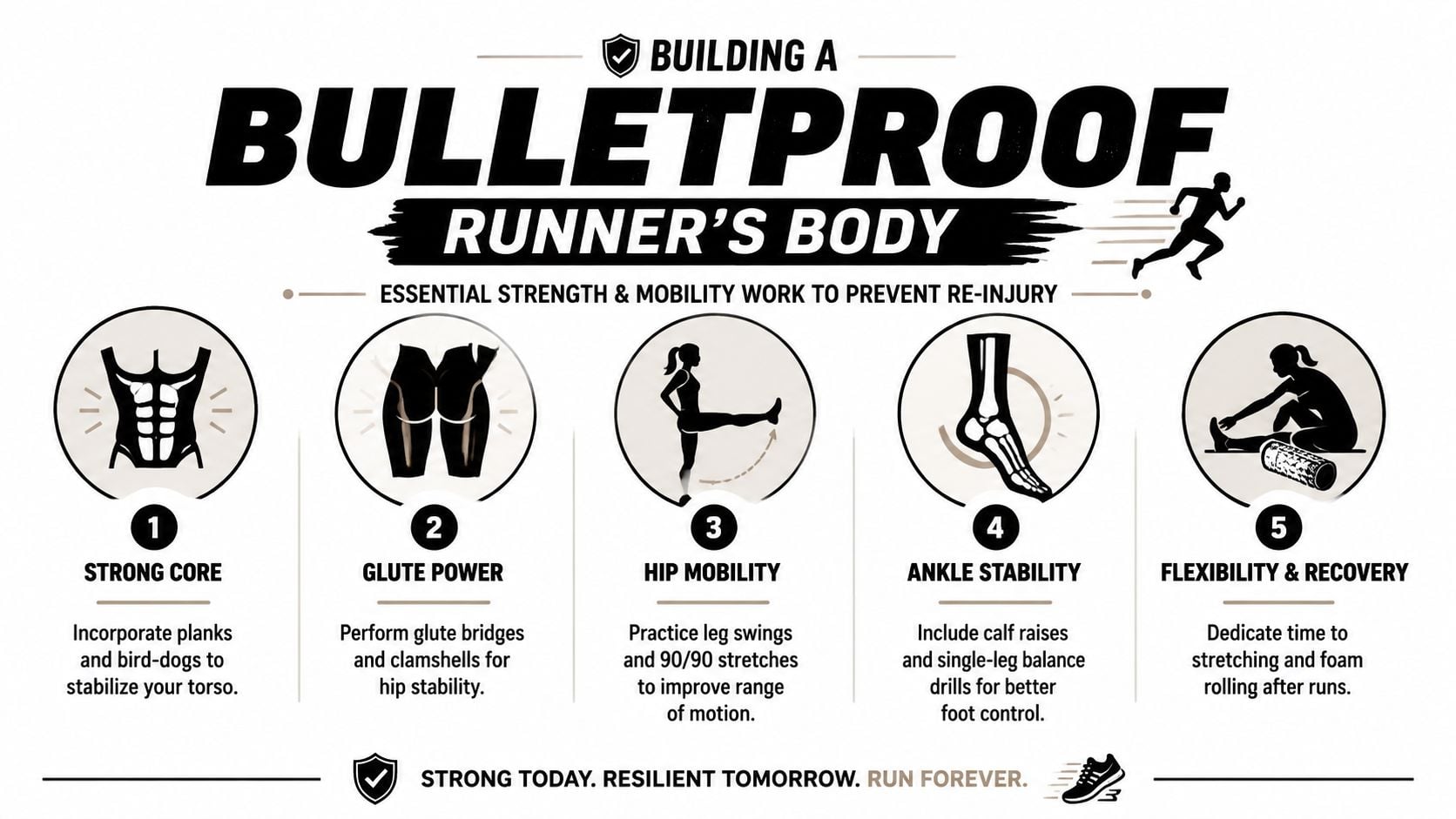
Think chassis, not just engine
A lot of runners focus on lungs and legs in the narrow sense. Can I breathe well enough? Can I survive the mileage? But your body also needs a stable frame. If your hips drop, your calf can't control landing, or your trunk wobbles over one side, the recovering area often gets asked to do too much.
The strongest return plans usually include a few staples done consistently:
Glute bridge
Useful for hip extension strength and pelvic control. Keep the ribs down and avoid arching through your low back.Single-leg calf raise
One of the simplest and most important runner exercises. Move slowly. Own the top and bottom of each rep.Split squat or step-up
Great for rebuilding leg strength with control. Keep your knee tracking smoothly and your torso steady.Plank or bird-dog
These help you resist motion you don't want during running. Stability matters as much as force production.
What I want to see from these exercises
I'd rather see clean, controlled reps than sloppy volume.
Here's the trade-off runners need to accept: if you skip strength work to save energy for running, your running progression often becomes less stable. Then every increase in distance feels risky. When the support system improves, the run-walk plan usually settles down too.
Strong runners don't just tolerate mileage better. They usually make better decisions because their body gives them clearer feedback.
Keep mobility practical
Mobility work helps, but don't turn it into a side quest.
Focus on the areas that influence your stride and your symptoms. For many runners, that means ankle mobility, hip mobility, and enough thoracic rotation to let the body move smoothly. A few focused drills done well beat a long routine you won't keep up with.
If you want a deeper educational breakdown of running mechanics, injury recovery concepts, and anatomy, that content belongs on Highbar's hub. Visit Highbar Health for broader educational resources, then bring the local, practical questions back to your South Shore rehab plan.
Navigating Setbacks and When to Call a Pro
Most runners expect recovery to be linear. Real life usually doesn't cooperate.
You might feel great for two runs, then notice a twinge after a longer workday, poor sleep, or a route with more hills than you realized. That doesn't automatically mean you've re-injured yourself. It does mean you need to respond well instead of emotionally.
Expert rehabilitation guidance notes that progress is not linear and that runners often need to reduce load or return to run-walk intervals when symptoms recur. It also notes that a small amount of soreness is not a failure if it resolves within 24 hours, as explained in this return-after-injury guidance.
What to do when symptoms flare
Use simple decision-making:
If soreness shows up during warm-up and then settles
Stay cautious. Keep the run easy and shorter than planned, or shift to a walk-run format.If soreness builds as you continue
End the run. Building pain usually means the load is too high for that day.If you feel fine during the run but worse later or the next morning
Don't progress. Repeat the prior level or take an extra recovery day.If your stride changes
That's a stop sign. Limping, guarding, or landing differently creates new problems fast.
Cross-training can keep you sane
A lot of South Shore runners get frustrated because they think the only choices are “run” or “lose fitness.” That's not the case.
Cycling, pool work, elliptical training, or other low-impact conditioning can help you stay active while the irritated area settles. The point isn't to win your cross-training session. The point is to keep your routine, protect your mood, and avoid stacking impact on a tissue that isn't ready yet.
When it's time to stop guessing
Here are the situations where I'd stop self-managing and get evaluated:
- Pain keeps returning at the same stage even after you back off and rebuild.
- You can't pass the simple readiness tasks on one side.
- You don't trust the leg even when pain isn't dramatic.
- You keep changing your gait to get through runs.
- You're stuck in a loop of good day, flare-up, rest, repeat.
A lot of runners wonder if they need imaging first. Sometimes imaging matters, but not every comeback problem starts with a scan. A hands-on PT evaluation often clarifies whether the issue is load tolerance, strength, mobility, movement strategy, or a diagnosis that needs further medical follow-up.
Your Next Steps to Running Strong on the South Shore
The fastest way back usually isn't the most aggressive plan. It's the one you can tolerate, repeat, and build.
That means checking readiness before you run, starting with walk-run intervals instead of ego miles, and keeping strength work in the mix even when you're impatient to do more. It also means respecting the small twinge instead of ignoring it until it becomes a real setback.
That caution isn't overkill. Reinjury risk is high. Some reviews report that 20% to 70% of injured runners may be injured again, which is why a controlled comeback beats “rest and resume” every time, as noted in this running injury return review.
If you're trying to get back to morning runs in Quincy, beachside miles in Duxbury, neighborhood loops in Braintree, Hanover, or Norwell, or you're building toward a race in Plymouth, Scituate, Weymouth, Cohasset, Kingston, Milton, Pembroke, or East Bridgewater, don't leave your comeback to guesswork. The local terrain, your injury history, your gait, and your strength deficits all shape what the right plan looks like.
A durable return to running after injury should feel steady. Not rushed. Not random. Steady.
If you're tired of second-guessing every twinge, book an appointment with Peak Physical Therapy and Sports Performance. With clinics across the South Shore in Braintree, Quincy, Weymouth, Cohasset, Duxbury, East Bridgewater, Hanover, Kingston, Milton, Norwell, Pembroke, Plymouth, and Scituate, you can get a personalized plan that matches your injury, your running goals, and the roads and trails you use.