You're probably reading this at home with a sling on, a stack of pillows nearby, and a lot of questions running through your head. How long will this take? When will sleep get easier? When can you drive, work, or get back to the beach, the golf course, or just lifting groceries without thinking about it?
That uncertainty is normal after shoulder surgery. Rotator cuff repair recovery isn't a straight line, and it rarely feels fast in the early weeks. Around the South Shore, we hear the same concerns from people in Quincy, Plymouth, Hanover, and nearby towns. They want a practical plan, not a generic timeline.
This guide is built around real day-to-day recovery. It focuses on what your first months look like, what usually slows people down, and how to move through each phase without rushing the repair. For deeper reading on shoulder conditions and recovery education, Highbar Health has broader resources at highbarhealth.com.
Table of Contents
- Your Rotator Cuff Recovery Journey on the South Shore
- Immediately After Surgery What to Expect
- Phase 1 The Protection and Passive Motion Phase Weeks 0-6
- Phase 2 Active Motion and Early Strengthening Weeks 6-12
- Phase 3 Building Strength and Function Months 3-6
- Phase 4 Returning to Your South Shore Life 6+ Months
- Start Your Recovery with Peak Physical Therapy Today
Your Rotator Cuff Recovery Journey on the South Shore
A lot of people start here the same way. They've had surgery, the nerve block has worn off, and the first trip from the couch to the kitchen feels like a project. Sleeping is awkward. Getting dressed takes patience. Reaching for anything with the surgical arm is off the table.

On the South Shore, recovery goals are personal. For one person in Plymouth, it's getting back to carrying beach chairs without hesitation. For someone in Hanover, it's picking up a grandchild safely. For someone commuting from Quincy, it's returning to desk work without the shoulder flaring up by lunchtime.
What recovery really means
Rotator cuff repair surgery often does well, but outcomes depend heavily on the size of the tear. For small tears, success exceeds 95%, while a longitudinal review cited by Hospital for Special Surgery reported a pooled healing rate of 71% in one analysis, which is a good reminder that the surgery alone isn't the whole story and that a structured rehab plan matters a lot in practice. You can read that in HSS's overview of torn rotator cuff surgery outcomes.
That's why the recovery journey has to be approached in phases. The early phase protects the repair. The middle phases restore motion and then strength. The later phase helps you return to the activities that matter where you live and work.
Practical rule: The shoulder can feel better before the repair is ready for harder use. Pain relief and healing don't always move at the same speed.
If you like comparing rehab perspectives from different clinicians, this overview of comprehensive care for shoulder injuries is a useful companion read. Then bring your questions back to your local PT team, because your tear, surgery, job, and goals all change the plan.
Immediately After Surgery What to Expect
You get home from surgery, settle into the recliner, and then the practical questions start. How do you sleep. How do you get dressed. What do you do with the sling when your neck gets sore. Those first few days are less about progress you can see and more about protecting the repair while your body settles down from the procedure.
Early on, the shoulder usually feels sore, heavy, and awkward. Fatigue can catch people off guard too, especially after anesthesia, disrupted sleep, and pain medication. Around Quincy, Plymouth, and Hanover, I hear the same concerns all the time. Patients want to know if what they're feeling is normal and how to get through the day without irritating the shoulder.
Your primary job is to protect the repair and manage symptoms without creating setbacks at home.
The first priorities at home
Keep the day simple. A good setup makes a big difference.
- Wear the sling as directed: Even small unplanned movements can strain the repair site.
- Use your pain plan on schedule: It is easier to control discomfort early than to chase it once it builds.
- Support the arm well: If the elbow hangs or the sling sits poorly, the shoulder and neck usually complain fast.
- Set up your space: Keep medications, water, chargers, pillows, and snacks within easy reach so you are not repeatedly getting up and reaching.
- Plan for one-handed tasks: Button-up shirts, pump soap, and slip-on shoes are usually easier than trying to manage clothing with both arms.
Incision care needs to match your surgeon's instructions. If the dressing, drainage, or skin looks different than expected, call the surgical office and ask.
Why the early restrictions matter
The repair is at its most vulnerable right now. Reaching out to the side, lifting a coffee mug with the surgical arm, pushing up from bed, or catching yourself during a slip can all place more force on the shoulder than people realize.
This is also the point where pain can be misleading. The shoulder may calm down before the tendon has healed enough to tolerate much use. That gap matters. It is one reason the first week can feel slow, even when you are doing everything right.
Quiet, uneventful days are often a good sign after rotator cuff surgery.
Sleeping is usually the hardest daily-life problem in this window. Many South Shore patients do better slightly reclined with pillows supporting the arm, rather than lying flat right away. Dressing, showering, and getting in and out of bed also take some planning. Peak has a practical local guide on shoulder surgery recovery tips after an operation that covers those day-to-day details.
Food, hydration, and energy
The basics matter here. Drink enough water. Eat regularly, even if appetite is off for a day or two. Expect your energy to dip by afternoon.
Protein intake can be part of that plan once your stomach is settled and you are back to more normal meals. If you want ideas, this in-depth guide to post-workout nutrition is a useful general reference.
If something feels off, reach out early. A quick call to your surgeon or your PT team in Quincy, Plymouth, or Hanover can prevent a small problem from turning into a rough first week.
Phase 1 The Protection and Passive Motion Phase Weeks 0-6
The first six weeks are often the most inconvenient part of rotator cuff repair recovery. They're also one of the most important. This is the stretch where patience protects your long-term result.
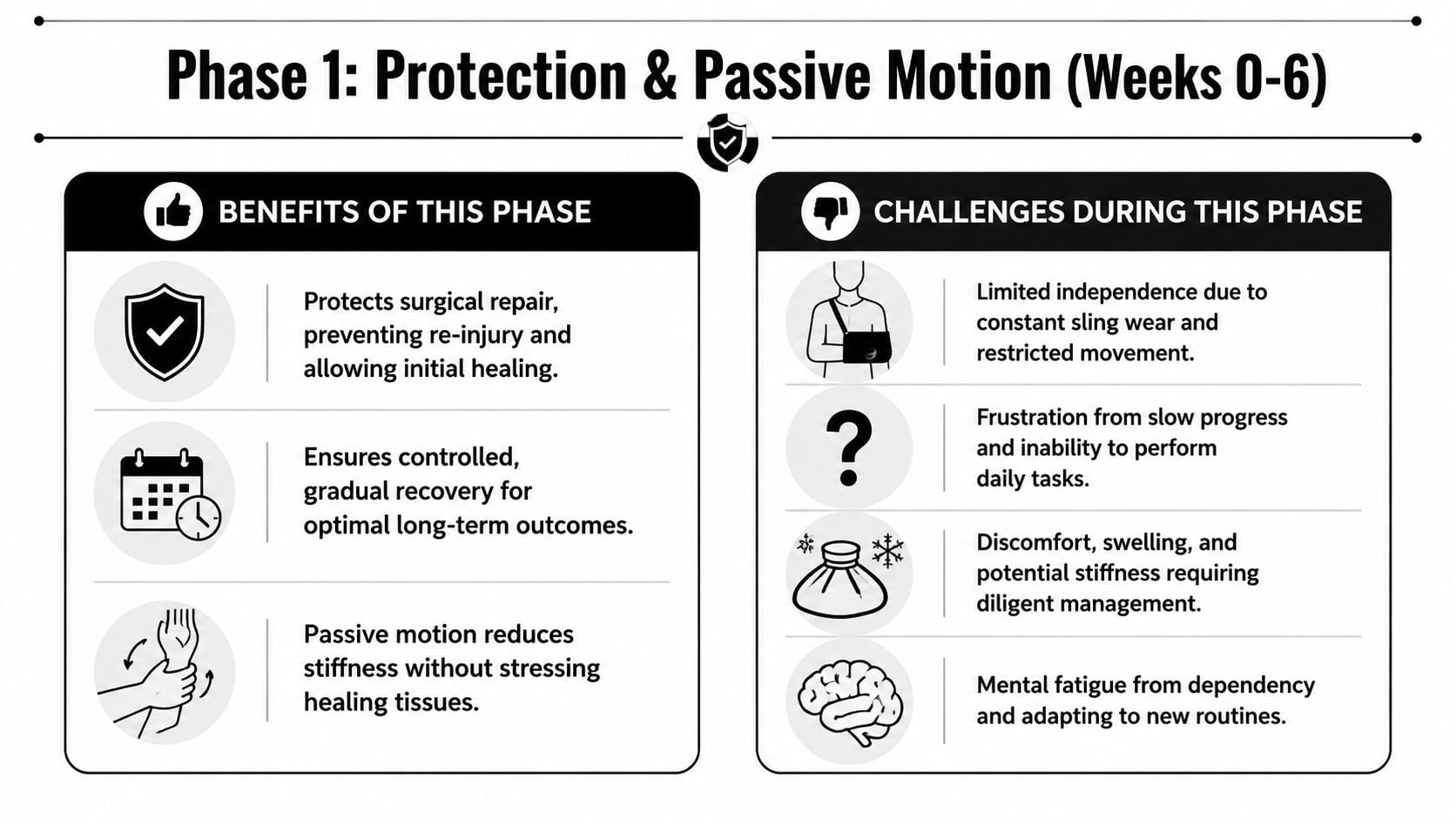
Authoritative rehab protocols describe the first 6 weeks as a high-risk biologic protection window and emphasize sling use while delaying strengthening until at least 12 weeks, with some larger or poorer-quality tears waiting longer, because the tendon-to-bone healing site can't safely tolerate active resisted load too soon. That guidance is laid out in the Durham Hand to Shoulder Centre post-op rotator cuff repair protocol.
What passive motion actually means
Passive motion means the shoulder is moved without the repaired muscles doing the work. Sometimes your therapist moves it. Sometimes you use the other arm, your body position, or gravity to create small controlled movement.
The purpose isn't to get aggressive with stretching. The purpose is to reduce stiffness while still respecting the repair.
A few examples you may see in this phase include:
- Pendulum-style movement: Gentle body-driven motion, not active lifting from the shoulder.
- Supported table or wand work: Motion assisted by the other arm.
- Scapular and posture drills: Light work around the shoulder blade and upper back to keep the area moving well.
The daily life problems nobody tells you enough about
Many people experience frustration. The exercises may only take a short part of the day, but the logistics of one-handed living take up the rest.
Sleeping is usually easier in a reclined position than flat in bed. Pillows can help keep you from rolling onto the surgical side. Dressing often works best when you put the surgical arm into the shirt first and take it out last. Loose shirts, elastic-waist pants, and slip-on shoes can save a lot of aggravation.
Daily living advice: If a task makes you twist, reach suddenly, or catch your balance with the surgical arm, change the setup instead of trying to be tougher than the restriction.
A few practical adjustments help more than people expect:
- For sleep: Use a wedge, recliner, or stacked pillows to stay slightly upright.
- For bathing: Keep items at waist level and avoid slippery setups that could force a quick grab.
- For kitchen tasks: Slide items across the counter instead of lifting and carrying them one-handed.
- For errands: Ask for help with bags, doors, and anything bulky. This isn't the phase for pride.
Hospital-based patient guidance also highlights these everyday issues, especially reclined sleeping, pillow positioning, and step-by-step dressing methods, because self-care is often the main bottleneck while active shoulder use is limited early on.
What doesn't work in this phase
Trying to “get ahead” usually slows people down. So does comparing your week-two shoulder to someone else's week-two shoulder. Tear size, tissue quality, surgical technique, and surgeon preference all affect what your plan should look like.
The goal right now is simple. Protect the repair. Keep the shoulder from getting unnecessarily stiff. Get through normal daily tasks safely.
Phase 2 Active Motion and Early Strengthening Weeks 6-12
This phase usually feels like a turning point. The sling may be reduced or discontinued based on your surgeon's guidance, and the shoulder starts doing more of the work. That sounds exciting, and it is, but it's also where people can get sloppy if they mistake “moving more” for “ready for everything.”
The shift from assisted movement to controlled movement
Active-assisted motion comes first for many people. That means the shoulder begins to participate, but still with help from the other arm, a tool, or body position. Active motion comes next, where you move the arm under its own power without external support.
At this stage, your therapist is usually watching for quality as much as quantity. If your shoulder hikes up, your neck tightens, or you swing the trunk to compensate, the motion may look bigger without actually being better.
You may work on:
- Supported elevation drills: Rebuilding the pattern of lifting the arm without shrugging.
- Gentle rotation work: Restoring the movements that matter for dressing, reaching, and grooming.
- Scapular control: Helping the shoulder blade move well so the joint doesn't do all the work alone.
If you'd like examples of shoulder movement patterns often used in rehab, Peak has a related resource on rotator cuff exercise progressions.
Recovery phases at a glance
According to the AAOS, rotator cuff repair recovery is a structured, multi-phase process. Most patients reach functional motion and strength between 4 to 6 months, full recovery can take up to a year, desk or sedentary work may resume in 6 to 8 weeks, and manual labor may require 4 to 6 months before full return. That timeline is outlined in AAOS guidance on surgical treatment options for rotator cuff tears.
| Phase | Typical Timeline | Primary Goal | Example Activities |
|---|---|---|---|
| Phase 1 | Weeks 0-6 | Protect the repair and begin safe passive motion | Sling use, supported positioning, passive mobility work |
| Phase 2 | Weeks 6-12 | Restore controlled active motion and begin early strength progression when appropriate | Active-assisted movement, active range of motion, light guided exercise |
| Phase 3 | Months 3-6 | Build usable strength and function | Bands, light resistance, reaching and carrying progressions |
| Phase 4 | 6+ months | Return to higher-level work, sport, and recreation | Advanced strengthening, job-specific drills, sport-specific preparation |
What helps and what slows you down
This is the point where consistency matters more than heroics. Small, clean repetitions beat forcing end range and spending the next two days sore and guarded.
For people who enjoy mobility work and want a broader perspective on how movement quality supports pain-free motion, this article on pain-free movement through flexibility adds useful context.
Common setbacks in this phase usually come from three things:
- Doing too much on a good day: A shoulder that feels looser in the morning can still get irritated by evening.
- Skipping the boring basics: Posture, scapular control, and simple assisted work often set up the bigger gains later.
- Rushing resistance: Early strength is earned after movement quality improves, not before.
Phase 3 Building Strength and Function Months 3-6
At this point, many patients start to feel more like themselves. The shoulder often moves better, the sling is behind you, and day-to-day life gets easier. But durable recovery is built during this phase, not just felt.
Motion without strength isn't enough
A shoulder can look good in the clinic and still struggle in real life. Reaching a shelf once is different from putting dishes away for ten minutes. Swinging a light jacket into the back seat is different from lifting a cooler, carrying beach gear, or controlling a golf swing.
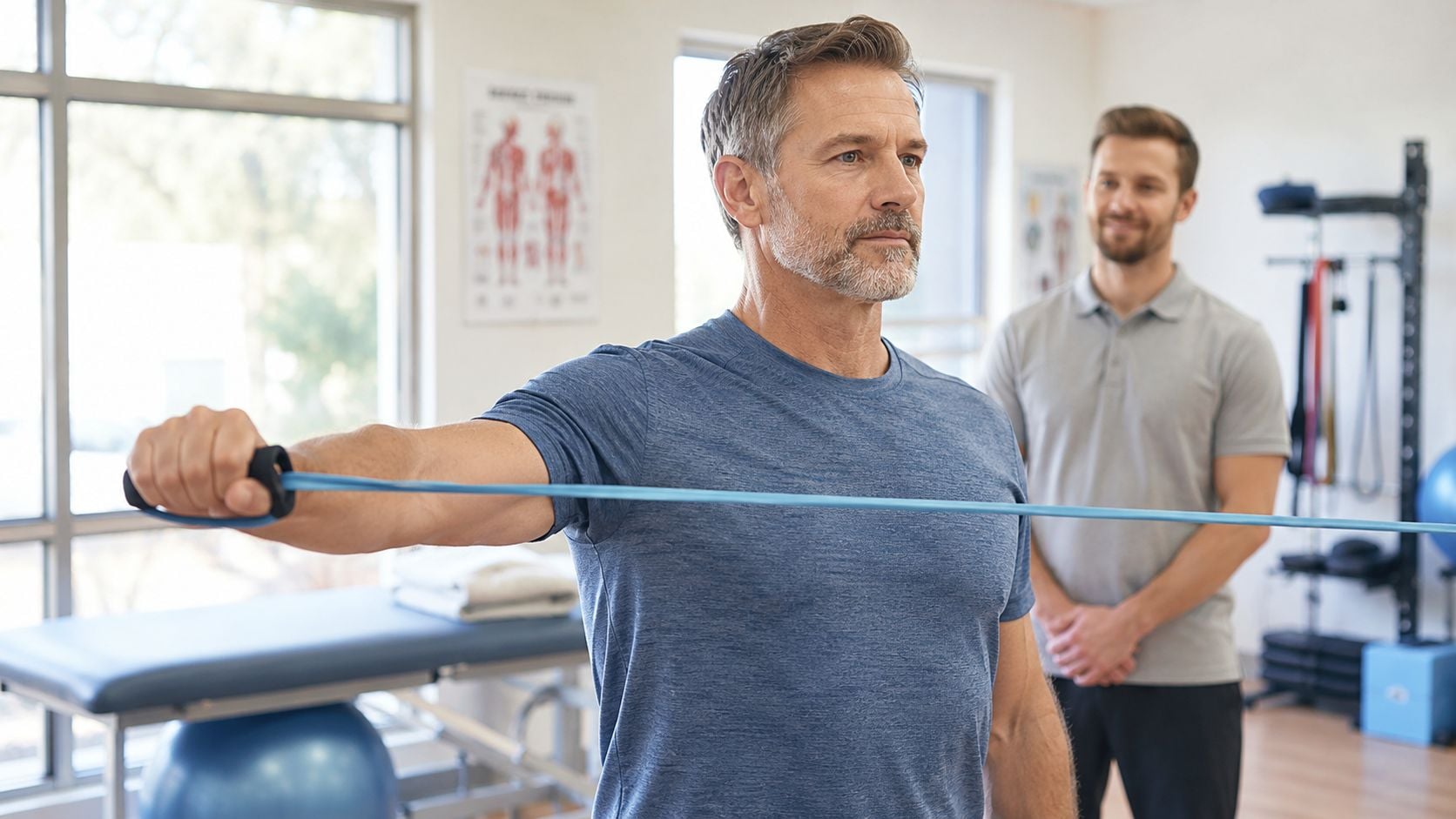
That's why this part of rotator cuff repair recovery needs progression, not guesswork. Resistance bands, light weights, supported closed-chain drills, and endurance work all have a role when they're introduced at the right pace.
You don't return to activity because the calendar says you should. You return because the shoulder can handle the job you're asking it to do.
What strength training looks like in real life
Strength work here usually isn't bodybuilding. It's more targeted and more technical than that. Your therapist is looking at rotator cuff strength, scapular mechanics, trunk control, and whether your body shifts load away from the recovering shoulder.
A well-run program might include:
- Rotational band work: Building control for reaching, lifting, and overhead mechanics.
- Rowing and scapular drills: Improving the support system around the shoulder.
- Progressive carry patterns: Preparing for groceries, work tools, bags, and home tasks.
- Task-specific movement: Practicing the angles and loads that matter for your life.
For someone on the South Shore, that might mean building enough strength to load a kayak for a North River outing, carry supplies across a job site, or get through a full round of golf without the shoulder fatiguing halfway through.
Why objective benchmarks matter
This is also where time-based thinking starts to break down. Yes, months matter, but they don't tell the whole story. Major orthopedic protocols often delay maximal muscle testing until 10 to 12 months after surgery and target about 85% to 90% strength compared to the opposite shoulder before advanced return-to-sport or return-to-work decisions. That benchmark is described in Mass General's rehabilitation protocol for large to massive rotator cuff tears.
That's a key point for anyone eager to get back to overhead sport or heavy work. Better range of motion at a few months doesn't automatically mean the shoulder can generate or tolerate enough force yet.
The argument for guided progression
This is one area where a structured rehab setting can make a real difference. A clinic such as Peak Physical Therapy and Sports Performance can progress load, watch form, and match exercises to local goals like construction work, boating, lifting kids, or returning to recreational sports around Quincy, Hanover, or Plymouth.
What doesn't work well in this phase is random online exercise selection, jumping too quickly to overhead loading, or assuming soreness always means productive work. Good strengthening feels purposeful. It shouldn't leave the repair angry for days.
Phase 4 Returning to Your South Shore Life 6+ Months
Six months after surgery, the question usually changes. Patients stop asking, "Can I move it?" and start asking, "Can I trust it?" That matters on the South Shore, where getting back to normal might mean carrying a beach chair in Duxbury, swinging a golf club in Plymouth, throwing a line off the boat, or finishing a full workday without the shoulder barking that night.
Your return should fit your real life
This phase is about matching your shoulder to your routine.
A computer-based job in Quincy asks for different shoulder capacity than framing, painting, or warehouse work. A relaxed day at the beach is different from repeated overhead serving, swimming, or lifting gear in and out of the car. The shoulder has to handle your actual demands with good control, repeat effort, and no lingering flare that carries into the next day.
That is why late recovery is still individualized. Time since surgery matters, but function matters more. We look at how you reach, lift, carry, sleep, and tolerate longer days, then build the last part of rehab around those patterns.
At Peak PT in Quincy, Plymouth, and Hanover, this stage often includes more task-specific work. For one patient, that means building enough endurance for a long commute and desk day. For another, it means practicing overhead lifting, raking, kayaking, or a return to golf with better mechanics and less compensation.
Durable recovery matters more than rushing the timeline
By this point, people are understandably eager to be done. That is also when poor decisions can set things back. The shoulder may feel much better, but better does not always mean ready for repeated overhead load, heavy pulling, or a full weekend of activity.
The trade-off is straightforward. If you increase volume too quickly, the shoulder often responds with night pain, soreness that hangs around for days, or a return of shrugging and guarded movement. A steady build tends to hold up better in real life.
A shoulder that comes back a little more gradually, then tolerates work, chores, sleep, and recreation consistently, is a much better result than one that looks good for a week and then gets irritated.
If your recovery has been complicated, or if you are trying to return after more than just shoulder surgery, our South Shore post-surgical rehab guide explains how we adjust plans for the person in front of us rather than forcing everyone into the same template.
What to watch for long term
Late rehab should challenge the shoulder. It should not make it feel unstable or progressively worse.
Check in with your surgeon or physical therapist if you notice:
- a sudden drop in strength or function
- sharp pain that is new or clearly worsening
- loss of motion that does not settle after a day or two
- growing compensation, such as hiking the shoulder, leaning your trunk, or using your neck to finish the movement
A few long-term habits make a real difference:
- Keep some shoulder strengthening in your weekly routine. Even a short maintenance program helps.
- Build overhead activity gradually. Weekend projects and sports are common trouble spots.
- Warm up before golf, swimming, yard work, or heavier lifting. A few focused minutes can improve comfort and control.
- Pay attention to sleep, dressing, and reaching behind your back. Those daily tasks often show early signs of overload before bigger symptoms appear.
The goal in this phase is simple. Return to your South Shore life with a shoulder you can rely on.
Start Your Recovery with Peak Physical Therapy Today
The first week after rotator cuff surgery often feels smaller than people expect. Getting comfortable in bed, pulling on a shirt, and figuring out how to protect the shoulder while still getting through the day can take more effort than the operation itself seemed to suggest. That is where a local plan helps.
At Peak Physical Therapy and Sports Performance, care is built around the details that shape recovery on the South Shore. A person trying to get back to computer work in Quincy, childcare in Hanover, or physical work in Plymouth does not need the same weekly plan. The shoulder heals on a general timeline, but the day-to-day strategy should match your home setup, your commute, your job demands, and the activities you want back, whether that is golf, the gym, or a more comfortable summer at the beach.
Peak offers local access across the South Shore, including Braintree, Quincy, Weymouth, Cohasset, Duxbury, East Bridgewater, Hanover, Kingston, Milton, Norwell, Pembroke, Plymouth, and Scituate. If you want a broader look at how therapy is adjusted after orthopedic procedures, our guide to post-surgical rehab on the South Shore explains how we build plans around the person in front of us.
Bring your surgical instructions to the first visit. We will look at your precautions, current pain and motion, and the practical goals that matter to you right now. Sometimes the early priority is sleeping with less irritation. Sometimes it is getting dressed with fewer awkward compensations. Sometimes it is building a realistic path back to work without overloading the repair too soon.
If you are ready for a practical, local plan for rotator cuff repair recovery, schedule an appointment with Peak Physical Therapy and Sports Performance. Care close to home makes it easier to stay consistent, and consistency is what helps this shoulder recover well.